

★★★★★ 4.7/5 — The most complete map available for naming and healing complex childhood trauma.
Best for: Adult survivors of chronic childhood neglect, abuse, or emotionally immature parenting who want a clinical framework plus concrete daily tools.
Reading time: ~35 min summary (~7 hrs for the full book)
Difficulty to apply: Moderate — the tools are simple, but the emotional work underneath them is deep.
Complex PTSD in one minute
Chronic childhood trauma does not leave one wound — it builds a whole survival personality around four automatic responses. In Complex PTSD: From Surviving to Thriving, psychotherapist Pete Walker argues that children raised in ongoing neglect, abuse, or emotional invalidation develop a mix of fight, flight, freeze, and fawn responses that protected them then but quietly run their adult lives now: the reflexive people-pleasing, the sudden shame spirals, the inability to rest, the fear of conflict. Walker calls the disorienting emotional floods that follow “emotional flashbacks” — moments when old childhood feelings hijack the present with no visual memory attached, just raw fear or hopelessness. His central claim is hopeful rather than clinical: these patterns were adaptations, not defects, and they can be unwound through grieving what was lost and reparenting yourself in the ways your caregivers could not.
Key takeaways
- Complex PTSD is different from single-incident PTSD: it comes from chronic, repeated childhood threat rather than one traumatic event, and it shapes personality, not just memory.
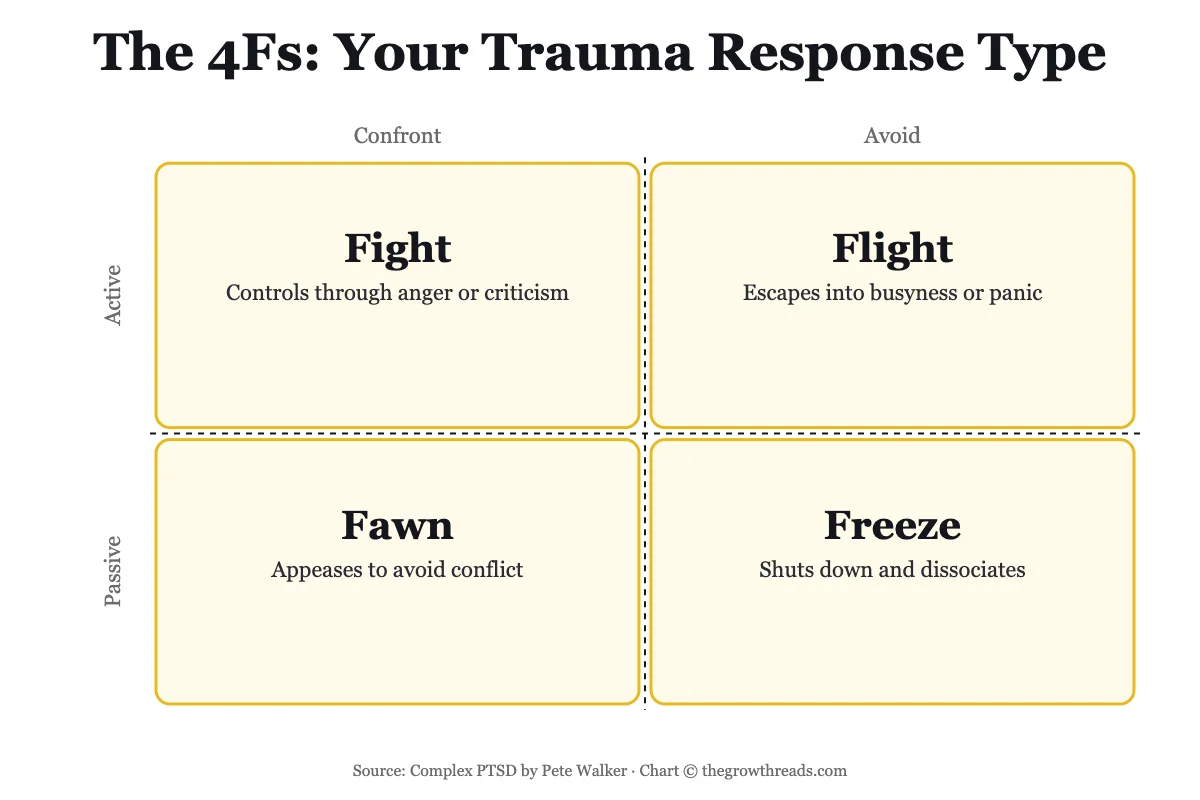
- The 4Fs are survival roles, not character flaws: fight (control through anger), flight (escape into busyness), freeze (dissociation and shutdown), and fawn (appeasement) each kept a child safe in an unsafe home.
- Most people are a blend, with one dominant F: recognizing your primary pattern explains recurring conflicts in relationships and at work.
- Emotional flashbacks are the core symptom: sudden, disproportionate floods of fear, shame, or abandonment that come from childhood, not the present moment.
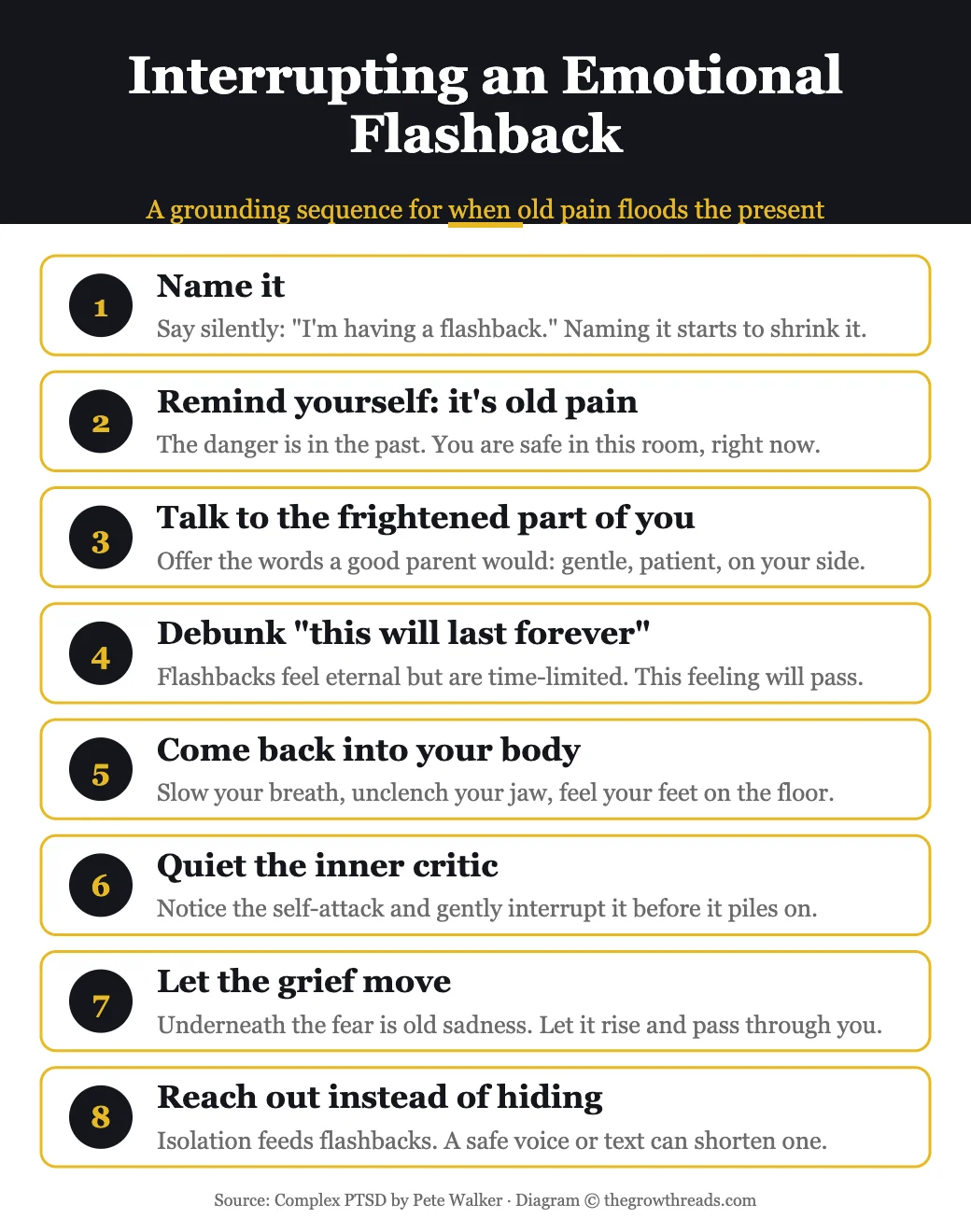
- Flashbacks can be interrupted: naming the flashback, grounding in the body, and talking to yourself with compassion shorten their grip.
- The inner critic is an internalized parent: the harsh, perfectionistic voice in your head is often a direct echo of critical or abusive caregivers.
- The outer critic protects the inner one: judging and distancing from other people can be a defense against ever feeling that criticism again.
- Grieving is the engine of recovery: mourning the childhood and parenting you needed but never received unlocks feelings that were frozen for survival.
- Reparenting means becoming your own good parent: practicing self-compassion, self-protection, and self-nurturance daily, not just in a crisis.
- Recovery is non-linear and lifelong: Walker frames healing as an ongoing practice of self-relationship, not a problem that gets permanently solved.
What is Complex PTSD about?
Complex PTSD: From Surviving to Thriving explains how chronic childhood abuse or neglect creates four survival responses — fight, flight, freeze, and fawn — and produces “emotional flashbacks” that flood adults with old childhood feelings. Pete Walker offers a recovery path built on grieving what was lost and reparenting yourself with the compassion you didn’t receive.
About the author
Pete Walker is a licensed Marriage and Family Therapist who has spent more than three decades helping adult survivors of childhood trauma in his private practice in Lafayette, California. He is himself a survivor of chronic childhood abuse, and that lived experience shapes his refusal to pathologize trauma responses as character flaws. Explore all Pete Walker book summaries →
Walker is best known for naming the emotional flashback and mapping the four trauma-adaptive personality types — fight, flight, freeze, and fawn — a framework now widely used across trauma-informed therapy. His earlier book, The Tao of Fully Feeling, laid the groundwork for the fuller synthesis in Complex PTSD.
Key concepts at a glance
| Concept | What it means | Use it when |
|---|---|---|
| Complex PTSD | Trauma from chronic, repeated childhood abuse or neglect, distinct from single-incident PTSD | You have long-standing relational or emotional struggles with no single traumatic event to point to |
| Emotional flashback | Being flooded by childhood feelings with no visual memory attached | Sudden, overwhelming fear, shame, or hopelessness that feels disproportionate to the moment |
| The 4Fs | Fight, flight, freeze, fawn — four survival adaptations to chronic threat | Identifying your default coping pattern under conflict or stress |
| Inner critic | The internalized voice of critical or abusive parents | Persistent self-attack, perfectionism, or shame spirals |
| Outer critic | Projecting the inner critic’s harshness onto other people | Chronic irritability, distrust, or black-and-white judgments of others |
| Reparenting | Consciously giving yourself what your parents didn’t | Building daily habits of self-compassion and self-protection |
| Grieving childhood loss | Mourning the parenting and safety you needed but didn’t get | Feeling stuck, numb, or angry about the past without knowing why |
Part 1: Naming the Wound
Walker opens by drawing a firm line between Complex PTSD and the PTSD most people picture — a soldier, an accident survivor, someone with a single defining traumatic event. Complex PTSD comes from chronic exposure: years of neglect, criticism, unpredictability, or abuse during childhood, when a developing nervous system has no exit and no adult ally to make sense of what is happening. The threat is not a single event to remember — it is the entire atmosphere of childhood, which is why survivors often cannot point to “the moment it happened.”
This chronic exposure reorganizes personality rather than simply leaving a memory. A child who cannot fight back, flee, or safely freeze may learn to fawn — scanning the room for a caregiver’s mood and pre-emptively appeasing it. Repeated over years, that scanning becomes identity. Walker is also candid about a widespread diagnostic problem: many Complex PTSD survivors, especially those with a strong fawn or freeze response, have been misdiagnosed with Borderline Personality Disorder. The symptoms can look similar — emotional intensity, fear of abandonment, unstable self-image — but the treatment implications are different, and Walker argues a trauma lens, not a personality-disorder lens, changes recovery for the better.
Part 2: The 4Fs and the Emotional Flashback
The heart of the book is Walker’s four-part typology of trauma response. Fight types learned that control and intimidation kept them safe, and carry that into adulthood as a short fuse, a need to win arguments, or a critical edge with people close to them. Flight types learned to escape into busyness, achievement, or anxious over-preparation — perpetual motion so there is no time to feel. Freeze types learned to disappear: dissociating, numbing out, or withdrawing into solitary hobbies and screens rather than risking contact. Fawn types learned that their safety depended on someone else’s mood, so they became expert at reading and pleasing others, often losing track of their own preferences entirely.
Almost nobody is a pure type — most people carry a dominant F with a secondary backup, and Walker devotes real attention to the least-discussed pairing, fawn-freeze, which tends to look like quiet, compliant, chronically self-erasing people who rarely raise their voice or their needs.
Layered on top of the 4Fs is Walker’s most cited contribution: the emotional flashback. Unlike a classic PTSD flashback, there is no vivid scene replaying — just a sudden flood of childhood-sized fear, shame, worthlessness, or panic, triggered by something as small as a tone of voice or a delay in a text reply. Because there is no visual cue attached, the adult mind assumes the feeling belongs entirely to the present, which makes the flashback feel both enormous and inexplicable. Learning to recognize a flashback as a flashback — rather than as accurate information about the current situation — is, for Walker, the single most practical skill in the entire recovery process.
Part 3: The Inner Critic and the Grief Underneath
Walker devotes substantial space to what he calls the inner critic — a harsh, perfectionistic internal voice that, in survivors of chronic childhood criticism or abuse, is often a near-verbatim echo of an actual parent. Left unchecked, the inner critic manufactures a steady low-grade sense of failure regardless of real-world performance, and it frequently teams up with an outer critic that projects the same harshness onto other people, making closeness feel risky in both directions.
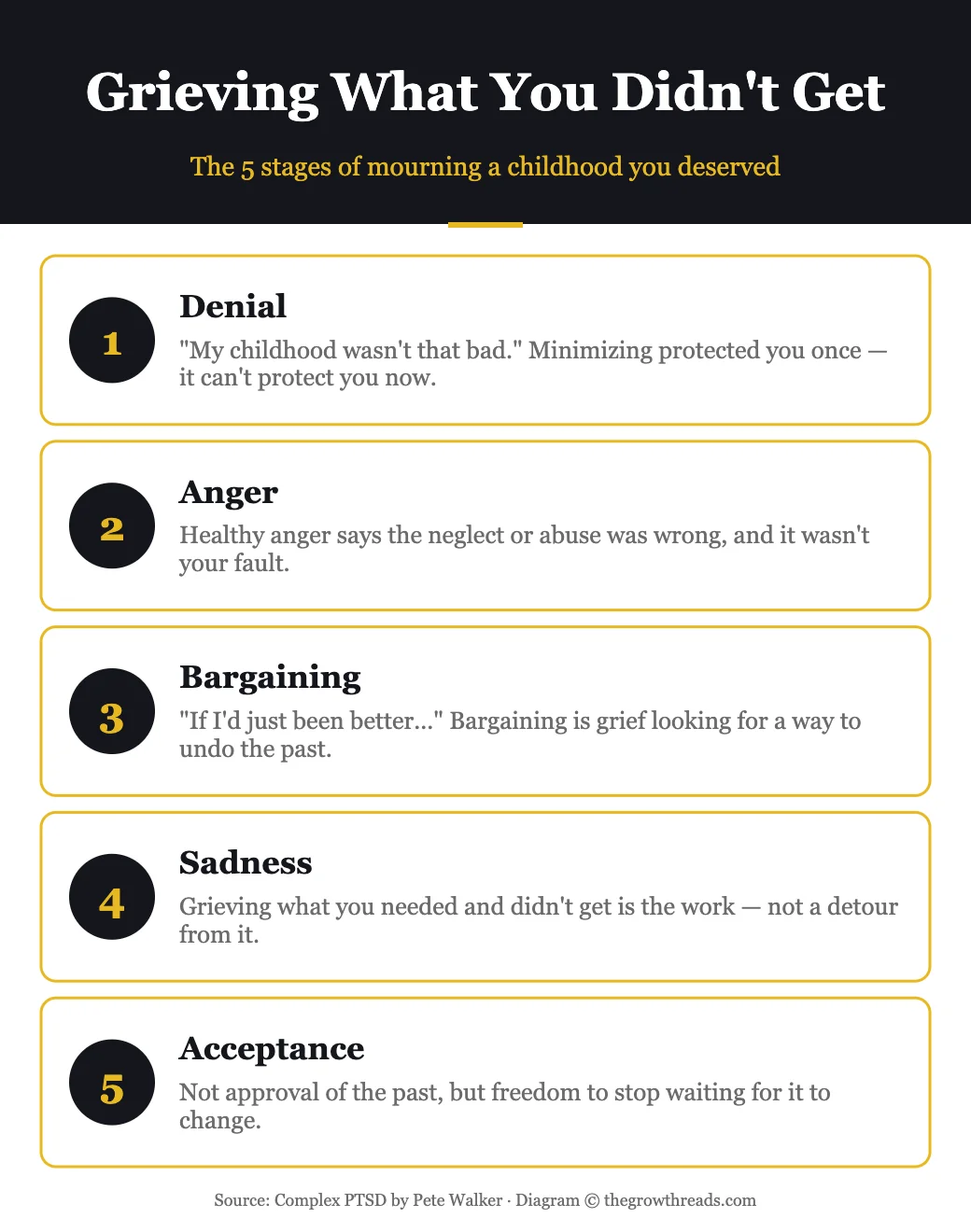
Underneath both critics, Walker locates grief. Adult survivors typically arrive in his office wanting to skip straight to coping skills, but he argues that lasting change requires mourning what was actually lost: a safe childhood, attuned parents, the chance to be a carefree kid. He adapts the classic five stages of grief — denial, anger, bargaining, sadness, and acceptance — specifically for childhood loss, and stresses that this is not a linear staircase but a spiral survivors move through repeatedly, often for years, as new layers of loss become available to feel.
Anger receives particular attention. Many survivors, especially fawn types, were never allowed to be angry at the people who hurt them, and have redirected that anger entirely inward as self-criticism. Walker treats the recovery of healthy, boundaried anger — anger that says “that was wrong” without demanding revenge — as one of the most important and most avoided steps in the entire process.
Part 4: Reparenting: Becoming the Parent You Needed
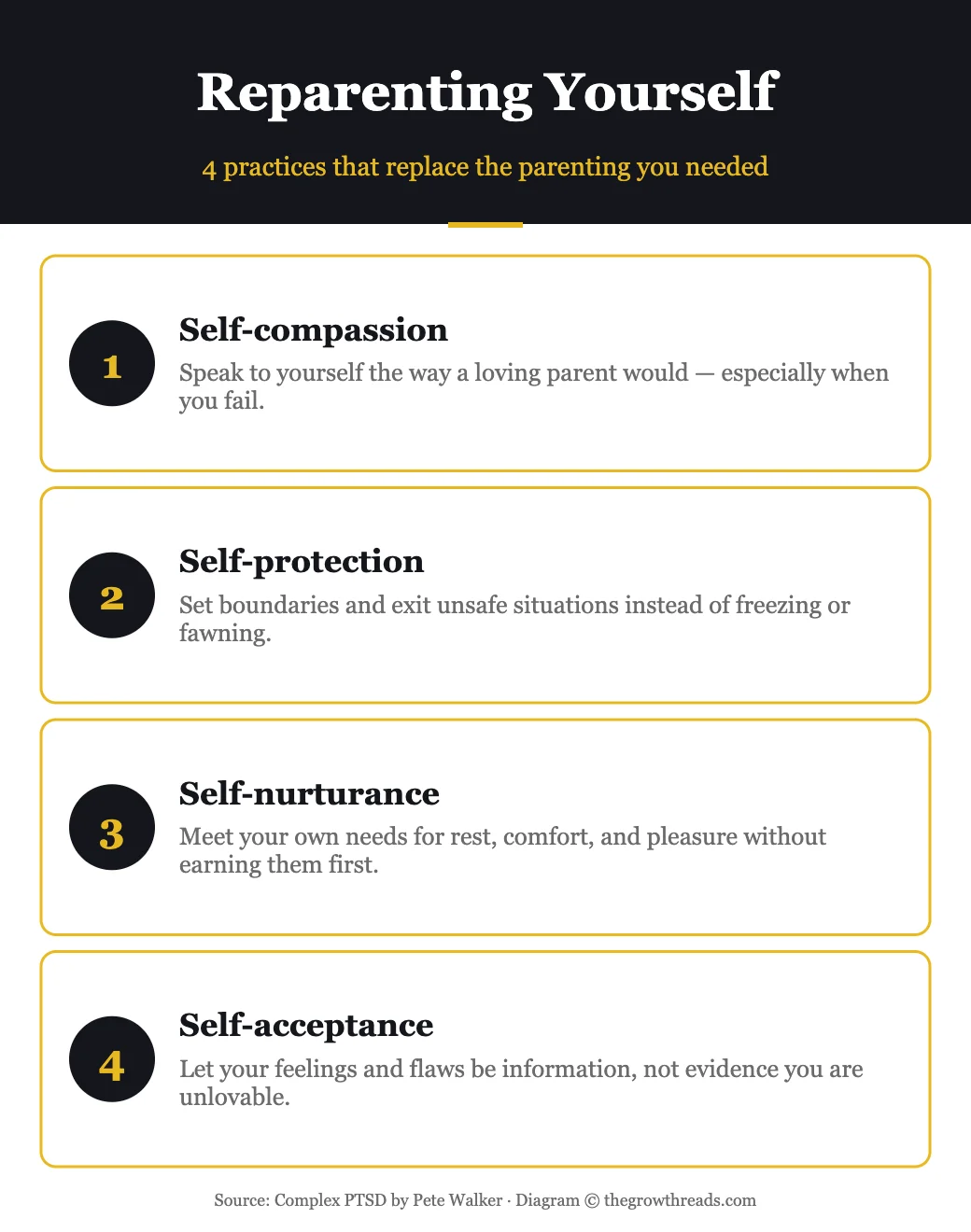
The final movement of the book is practical: if childhood didn’t provide consistent safety, compassion, and structure, adulthood is the chance to provide it yourself. Walker calls this reparenting, and breaks it into habits rather than an abstract goal — self-compassion when you fail, self-protection through boundaries instead of freezing or fawning, self-nurturance that meets your own needs without having to earn them, and self-acceptance that treats difficult feelings as information rather than proof of unworthiness.
Reparenting also includes shrinking the inner critic directly: catching self-attacking thoughts in real time, interrupting them before they cascade, and deliberately substituting the words an attuned parent would actually say. Walker is careful to frame this as a practice, not a performance — the goal is not to silence self-doubt permanently but to stop letting it run unchallenged. Over time, he argues, the nervous system learns that safety and self-compassion can coexist, which is precisely what chronic childhood threat never allowed it to learn.
Who is Complex PTSD best for — and who should read something else first?
This book is best for adults who suspect their struggles trace back to a chronically difficult childhood — not one dramatic event, but years of criticism, unpredictability, neglect, or walking on eggshells — and who want both a clinical framework and concrete daily tools. It is especially useful if you have been told you are “too sensitive” or “overreacting” and suspect there is more structure to your reactions than that.
If your trauma stems from a single identifiable incident rather than chronic childhood conditions, classic PTSD-focused resources may fit your situation more precisely. If you want the body-based half of trauma recovery first, start with The Body Keeps the Score. And if the idea of “trauma” feels too heavy a place to begin, Self-Compassion offers a gentler on-ramp to the same underlying practice.
Questions to reflect on
- Which of the 4Fs — fight, flight, freeze, or fawn — do you recognize as your default under stress, and where do you first remember learning it?
- Can you recall a recent moment that felt like an emotional flashback — a reaction that seemed bigger than the situation in front of you?
- What does your inner critic say on its worst days, and whose voice does it actually sound like?
- What part of your childhood have you never fully allowed yourself to grieve?
- If you reparented yourself for one day, what is the first thing you would do differently?
🔥 Ready to understand your own trauma responses?
Get the full book for Walker’s complete 13-step flashback toolkit and workbook exercises.
How to apply Complex PTSD (7-day plan)
- Day 1: Read through the 4Fs and identify your dominant pattern and likely backup pattern, without judging either.
- Day 2: Track one moment today that might be an emotional flashback. Just notice and name it — “this might be a flashback” — nothing more.
- Day 3: Write down three things your inner critic says most often. Notice whose voice they resemble.
- Day 4: Practice one grounding step from the flashback sequence (naming it, or coming back into your body) the next time you feel flooded.
- Day 5: Write one paragraph about something from childhood you have never let yourself grieve. Do not try to fix or resolve it — just let it be written.
- Day 6: Pick one reparenting practice — self-compassion, self-protection, self-nurturance, or self-acceptance — and do one small, concrete version of it.
- Day 7: Reread your Day 1 notes. Has anything shifted in how you see your own reactions this week?
Frequently asked questions
What is the difference between PTSD and Complex PTSD?
PTSD typically follows a single traumatic event and produces symptoms tied to that specific memory, like intrusive flashbacks of the incident. Complex PTSD develops from chronic, repeated trauma — most often childhood abuse or neglect — and shapes personality and relationship patterns rather than centering on one memory. Complex PTSD is not yet in the DSM-5 as a standalone diagnosis in the U.S., though it is recognized in the ICD-11, which is one reason many survivors go undiagnosed or misdiagnosed for years.
What are the 4Fs in Complex PTSD?
Fight, flight, freeze, and fawn are four survival responses Pete Walker identifies in survivors of chronic childhood trauma. Fight seeks safety through control or anger, flight through escape and busyness, freeze through shutdown and dissociation, and fawn through appeasing others. Most people have a dominant F with a secondary backup pattern, and recognizing your own combination is often the first practical insight the book offers.
What is an emotional flashback?
An emotional flashback is a sudden flood of childhood-era feelings — fear, shame, worthlessness, panic — triggered by a present-day event, without any accompanying visual memory. Because nothing appears to “explain” the intensity, the feelings can seem like accurate information about the current moment rather than an old pattern resurfacing, which is what makes them so disorienting and, once recognized, so useful to name.
Is Complex PTSD often misdiagnosed as Borderline Personality Disorder?
Pete Walker argues this happens frequently, particularly in survivors with strong fawn or freeze responses. The overlapping symptoms — emotional intensity, fear of abandonment, unstable self-image — can look similar on the surface, but Walker believes a trauma-informed lens leads to a more accurate and less stigmatizing path forward. This is his clinical opinion based on decades of practice; a formal diagnosis should always come from a licensed professional familiar with your full history.
Does this book replace therapy?
No — and Walker says so directly. The book is designed as a map and a toolkit, not a substitute for working with a trauma-informed therapist, especially for readers with significant abuse histories or active symptoms. This summary is for educational purposes; if you’re navigating trauma symptoms or a mental health crisis, please connect with a licensed clinician who can work with your specific history.
What is reparenting and how do you actually do it?
Reparenting means consciously giving yourself the compassion, protection, structure, and encouragement a good-enough parent would have provided. In practice, Walker breaks it into daily habits: catching and countering the inner critic, setting boundaries instead of fawning or freezing, meeting your own needs without “earning” them first, and treating difficult emotions as useful information rather than evidence of failure.
How long does it take to heal from Complex PTSD?
Walker is explicit that recovery is non-linear and ongoing rather than a problem with a fixed end date. Many survivors see meaningful relief in the ability to recognize and shorten emotional flashbacks within months of consistent practice, while the deeper grief work and personality-level change tend to unfold over years. He frames this less as a deficiency and more as an honest description of what healing chronic, developmental trauma actually requires.
Related summaries
- The Body Keeps the Score Summary & Review — the somatic half of trauma recovery.
- When the Body Says No Summary & Review — how suppressed emotion becomes physical illness.
- Self-Compassion Summary & Review — a gentler daily practice that overlaps with reparenting.
- Lost Connections Summary & Review — on depression, disconnection, and what actually helps.
- Best Psychology Books — the full reading list.
How we analyze books: our team reads the full text, cross-references the author’s other published work and interviews, and builds original diagrams to make each framework easier to apply — we never reproduce chapters or copy an author’s exercises verbatim. Read our full methodology.