

★★★★½ 4.4/5 — A rigorous, data-anchored case that the AI moment we’re living through was forecast decades ago, and that the next twenty years will move faster than most people are prepared for.
Best for: Builders, technologists, and long-range thinkers who want a testable timeline instead of vague futurism
Reading time: ~7 hrs to read the full book · ~15 min to read this guide
Difficulty to apply: Moderate — the payoff is a sharper mental model of change, not a checklist
The Singularity Is Nearer in one minute
The future is arriving on a schedule, and Ray Kurzweil has been checking his watch since 2005. In The Singularity Is Nearer, the inventor and futurist revisits the predictions from his landmark book The Singularity Is Near and updates them with two decades of hard data: computing price-performance, genome-sequencing costs, and — most urgently — the sudden leap in large language models since 2020. His core claim hasn’t changed: technological progress compounds exponentially, not linearly, which is why breakthroughs keep arriving faster than intuition expects. He argues artificial general intelligence (AGI) will match human-level reasoning by 2029, and that by 2045 human and machine intelligence will merge into something neither could achieve alone — the Singularity. Along the way, he lays out a practical roadmap — the “Three Bridges” — for staying healthy long enough to benefit from the biotechnology and nanotechnology revolutions still to come.
Key takeaways
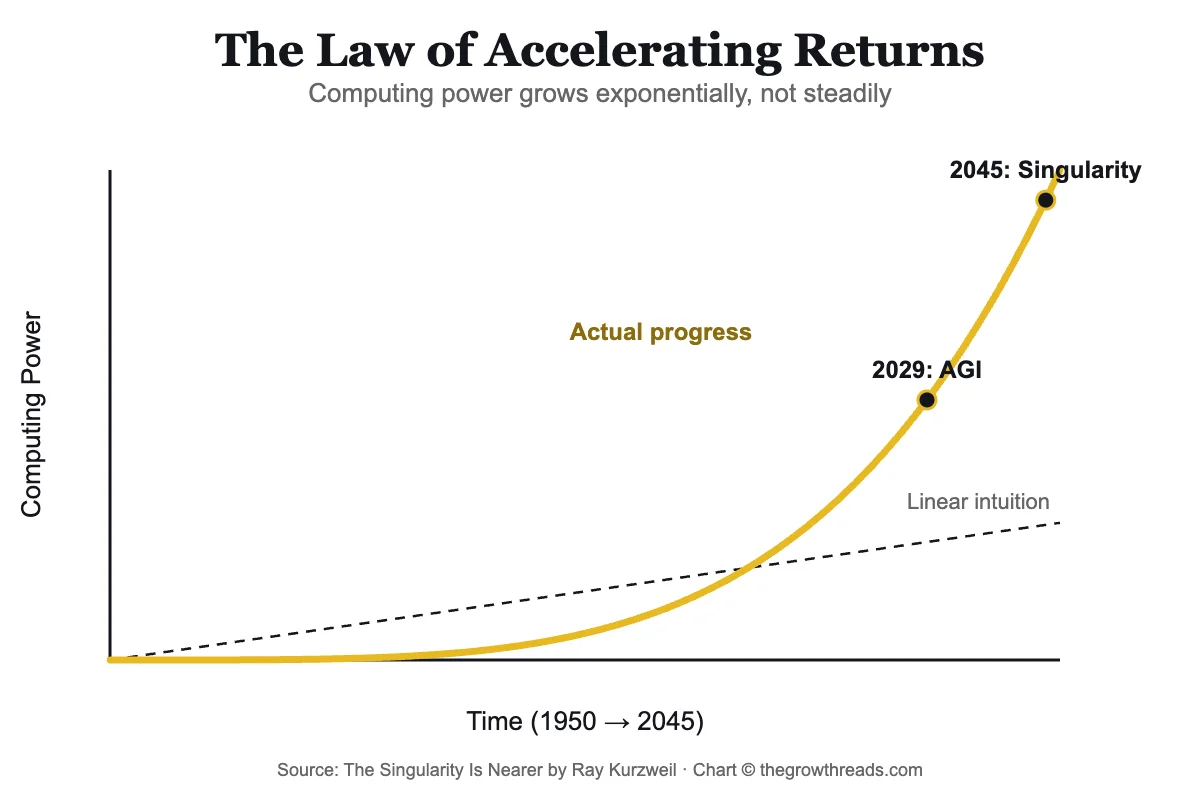
- Progress compounds, it doesn’t add: the Law of Accelerating Returns explains why AI capability jumped so sharply after 2020 — exponential curves look flat for a long time, then suddenly don’t.
- AGI by 2029 is a testable claim, not a vibe: Kurzweil ties the date to measurable trends in compute, data, and benchmark performance, not intuition.
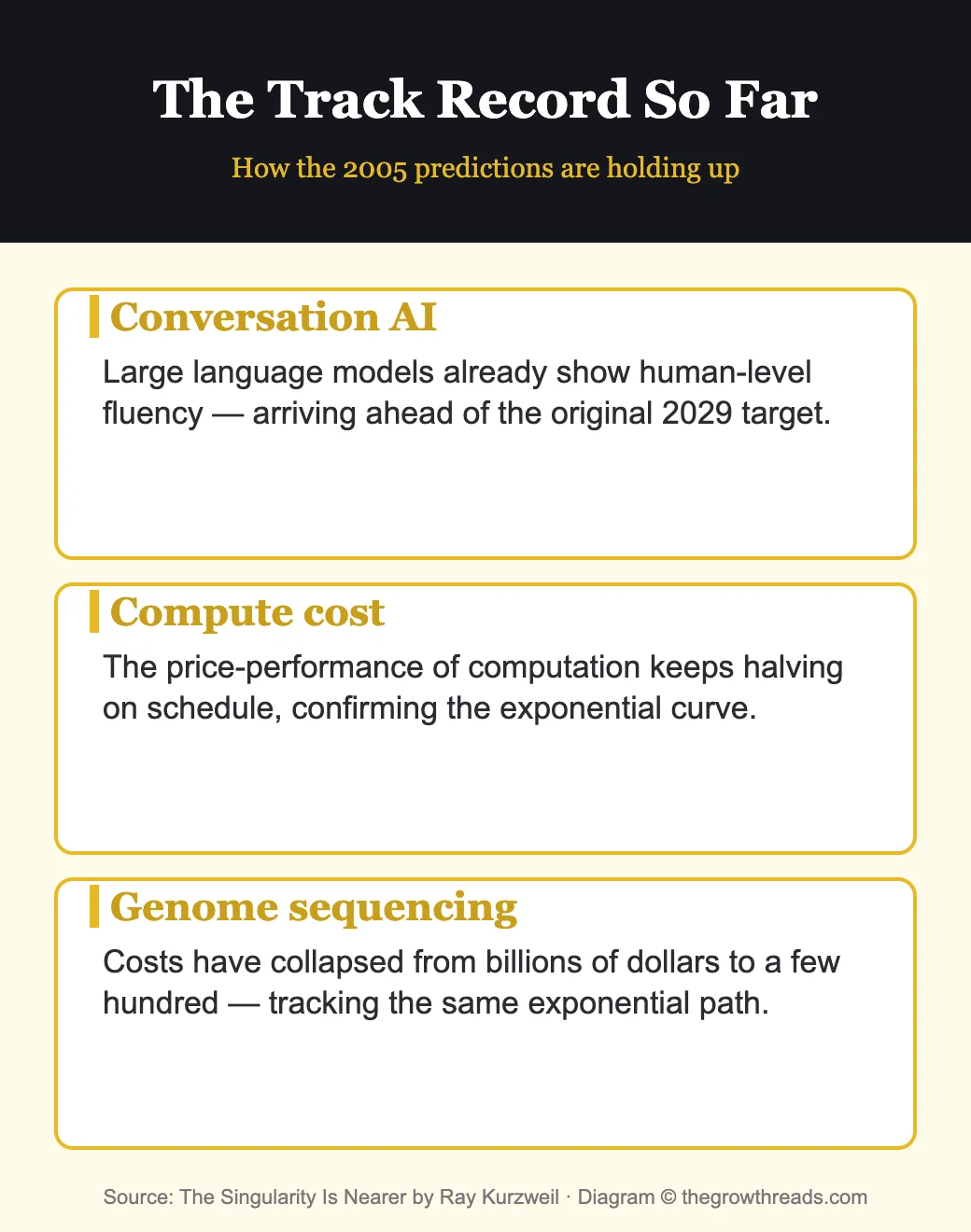
- The 2005 track record is unusually strong: most of the original book’s core forecasts landed close to schedule, which is why this update carries real weight.
- The Three Bridges frame near-term health decisions: what you do today determines whether you’re healthy enough to benefit from Bridge Two and Three.
- The Singularity is a merger, not a takeover: Kurzweil’s vision is human intelligence expanding through AI, not being replaced by it.
- Brain-computer interfaces are the connective tissue: today’s cochlear implants and neural prosthetics are early steps toward deeper human-machine integration.
- Economic disruption is real, but historically self-correcting: new categories of work have followed every major technological shift, including this one.
- Existential risk gets a serious chapter, not a dismissal: Kurzweil directly engages AI-safety concerns rather than waving them away.
- Exponential thinking is a trainable skill: most forecasting errors come from assuming tomorrow looks like today, only slightly better.
- Optimism here is a deliberate, evidence-based stance: the book argues for engaged hope grounded in data, not passive utopianism.
What is The Singularity Is Nearer about?
The Singularity Is Nearer is Ray Kurzweil’s 2024 update to his 2005 bestseller, arguing that exponential progress in computing will produce human-level AI by 2029 and a full merger of human and machine intelligence — the Singularity — by 2045.
About the author
Ray Kurzweil is an inventor, computer scientist, and futurist with a decades-long track record of technology predictions. He built pioneering systems in optical character recognition, text-to-speech synthesis, and music technology, earning a GRAMMY Award and induction into the National Inventors Hall of Fame, along with the U.S. National Medal of Technology. He has served as a Principal Researcher and AI Visionary at Google, and has written several bestselling books on technology and the future, including The Age of Spiritual Machines and The Singularity Is Near, the original book this one updates. Explore all Ray Kurzweil book summaries →
Key concepts at a glance
| Concept | What it means | Use it when |
| Law of Accelerating Returns | Technological progress compounds exponentially rather than linearly | Forecasting how fast your industry or skillset might be disrupted |
| The Six Epochs | A framework for the stages of evolution, from physics and chemistry to a fully merged human-machine intelligence | Situating today’s AI progress within a longer arc of history |
| Turing Test (2029 benchmark) | A sustained test of whether an AI can pass as human in open-ended conversation | Evaluating whether a new AI model is real progress or just a demo |
| GNR Convergence | Genetics, nanotechnology, and robotics reinforcing and accelerating each other | Thinking about why breakthroughs increasingly arrive in clusters |
| Three Bridges | A staged roadmap — health today, biotech tomorrow, nanotech later — to longevity escape velocity | Making long-term health and financial decisions |
| Longevity Escape Velocity | The point where life-extension research adds more than a year of expected life per year that passes | Judging whether “living forever” claims are science or marketing |
| Narrow vs. General AI | The difference between AI that excels at one task and AI with human-like flexible reasoning | Assessing whether a new AI product is incremental or a genuine leap |
| Brain-Computer Interface | Direct connections between neural tissue and computing systems | Thinking about how the human-AI “merger” might physically happen |
Part 1: The Law of Accelerating Returns
Kurzweil opens where he always does: with the observation that human intuition is linear, but information technology is exponential. We expect tomorrow to look like today, only a little better. But price-performance in computing has doubled on a regular cadence for over a century, across five completely different paradigms of hardware — from electromechanical calculators to relays, vacuum tubes, transistors, and integrated circuits. Each time one paradigm hit its physical limits, another took over, and the curve kept climbing. That’s the Law of Accelerating Returns: not a single technology improving, but an entire information-processing capacity compounding across whatever substrate is currently available.
The book spends real effort re-grounding this claim in independently verifiable numbers rather than asking readers to take it on faith. Genome sequencing is the standout example: the first human genome cost roughly three billion dollars and took over a decade; sequencing a genome today costs a few hundred dollars and takes hours. That’s not a one-off breakthrough — it’s the same exponential curve showing up in biology instead of silicon. Kurzweil’s broader point is that once a domain becomes an information technology — once it can be measured, digitized, and iterated on — it starts obeying this law, whether that domain is chip design, DNA sequencing, or solar energy.
The practical payoff for readers isn’t the math itself; it’s what exponential thinking does to your forecasts. Linear thinkers see the flat early part of a curve and conclude progress is slow. Exponential thinkers know the curve is about to bend upward, often faster than feels psychologically plausible.
TGR Note: If Kurzweil’s track record intrigues you but you want the original 2005 argument in full, our Singularity Is Near summary covers the source material this book updates. For a more skeptical treatment of exponential AI claims, Superintelligence by Nick Bostrom is the natural counterweight — same subject, more caution.
Part 2: The Road to AGI and the 2045 Singularity
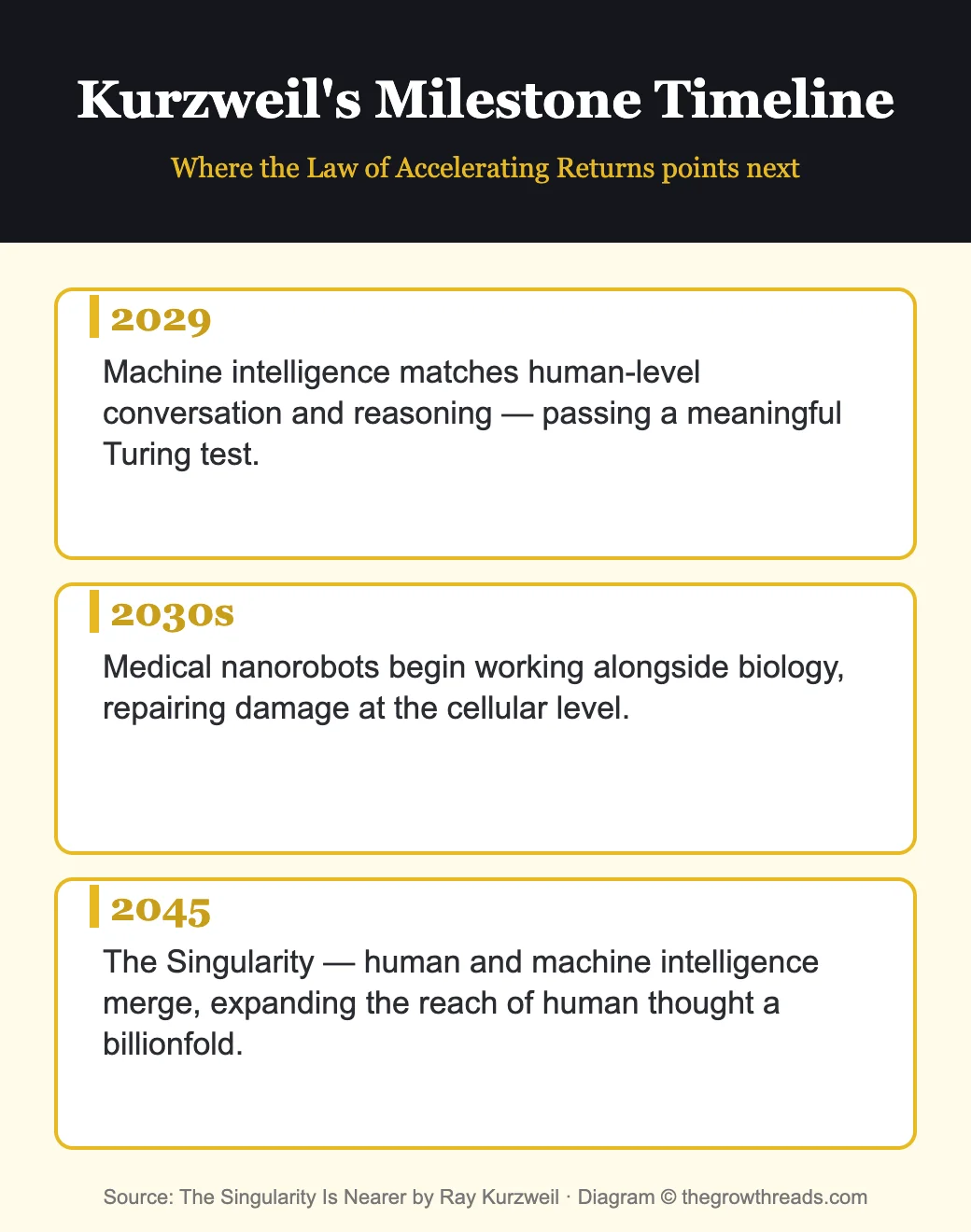
This is the part of the book that generates headlines, and Kurzweil doesn’t hedge: he expects an AI system to pass a valid, sustained Turing test — indistinguishable from a well-educated human across open-ended conversation — by 2029. He’s held this date since the 1990s, long before anyone had heard of a transformer model, and he argues that recent large language models are tracking the curve almost exactly. The distinction he’s careful to draw is between narrow AI, which is spectacular at bounded tasks, and artificial general intelligence, which reasons flexibly across domains the way a human does. He believes we’re closer to the second than most people assume, precisely because progress in the ingredients — compute, data, algorithmic efficiency — keeps compounding rather than plateauing.
From there, the book walks forward to 2045: the year Kurzweil has long identified as the Singularity, when the intelligence created by merging biological and artificial minds vastly exceeds unaided human intelligence. He’s explicit that this isn’t a robot uprising narrative. The mechanism he describes is gradual integration — first through devices we carry, then through interfaces we wear, eventually through connections to the brain itself — so that “we” are the ones doing the expanding, not a separate species replacing us. Whether or not you buy the exact date, the argument reframes the AI conversation: less “will machines surpass us,” more “how quickly do we absorb this capability as our own.”
Kurzweil also spends time on what gets easy to overlook in AGI debates: the infrastructure. Energy availability, chip fabrication capacity, and data availability all have their own curves, and he argues each is compounding fast enough to support the 2029 timeline rather than bottlenecking it.
TGR Note: For a builder’s-eye view of what working alongside near-AGI systems looks like right now, pair this chapter with Co-Intelligence by Ethan Mollick — it’s the practical, present-tense complement to Kurzweil’s long-range forecast.
Part 3: The Three Bridges to Longevity
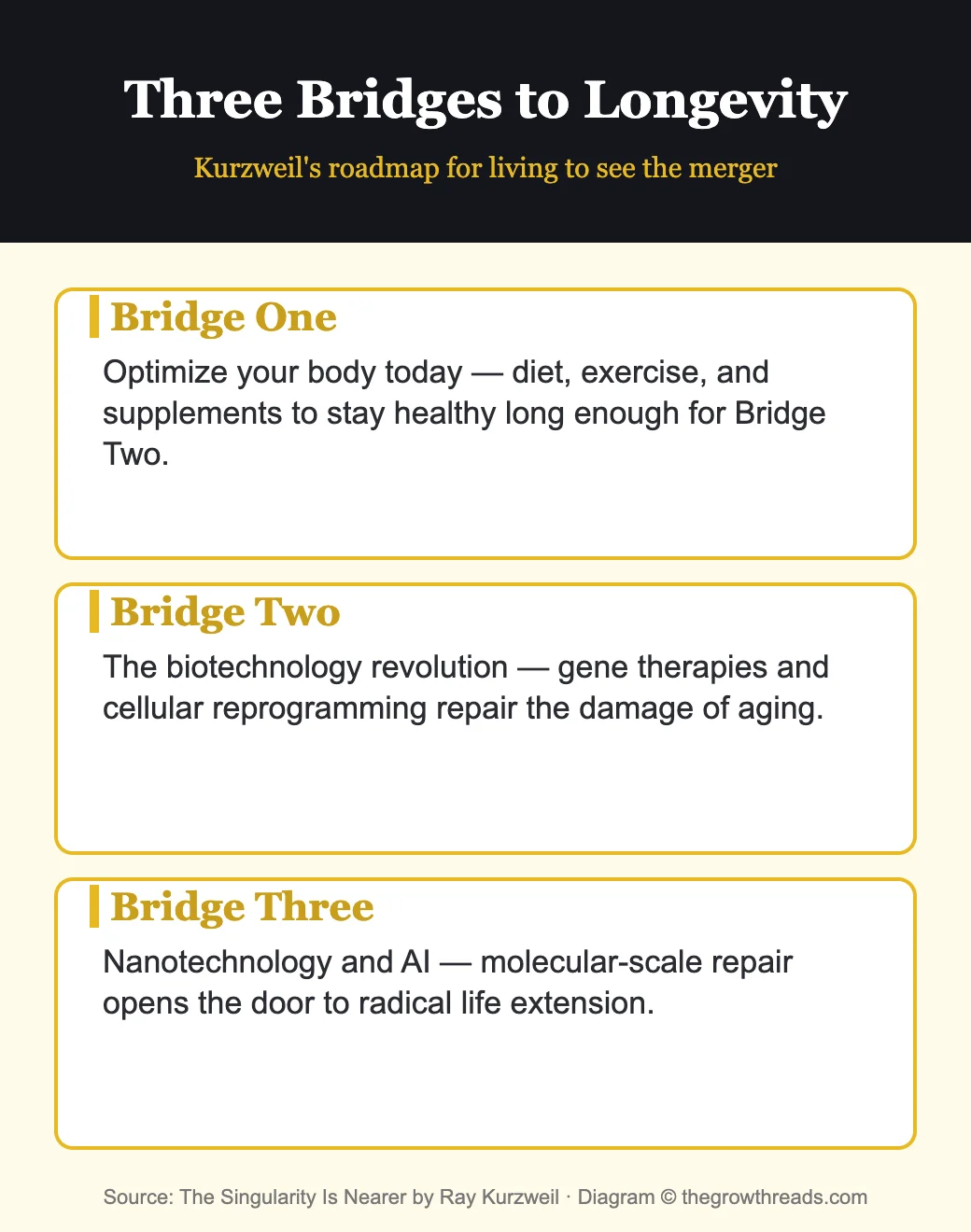
The most personally actionable section of the book is Kurzweil’s “Three Bridges” framework, and it’s where the abstractions turn into a plan you can start on this week. Bridge One is what’s available today: diet, exercise, sleep, and evidence-based supplementation aimed at simply staying healthy long enough to benefit from what’s coming next. Bridge Two is the biotechnology revolution already underway — gene therapies, cellular reprogramming, and precision medicine that can repair the biological damage of aging rather than just managing its symptoms. Bridge Three is further out: nanotechnology and AI-guided molecular repair systems capable of intervening at the cellular level with a precision biology alone can’t match.
The framework’s real value is sequencing. Kurzweil isn’t asking readers to bet everything on speculative future technology; he’s arguing that unglamorous, current-day health habits are what earn you a seat at Bridge Two, and that Bridge Two research is what earns humanity, collectively, a seat at Bridge Three. He ties this to the idea of longevity escape velocity — the point where life-extension research adds more than a year of healthy life expectancy for every year that passes, effectively outrunning the aging clock. He’s careful to frame this as directional and probabilistic rather than guaranteed, but the practical instruction is the same either way: the habits that matter for a normal healthy life are exactly the ones that keep your options open for a much longer one.
This section reads less like science fiction and more like a longevity guide with an unusually long time horizon — which is deliberate. Kurzweil wants the far-future chapters to feel earned by the near-future ones.
TGR Note: If the health-and-technology framing resonates, it pairs naturally with our broader best health books reading path for the habit-level detail Kurzweil deliberately keeps brief.
Part 4: Risks, Disruption, and the Case for Engaged Optimism
Kurzweil doesn’t skip the hard questions, and this section is where the book earns credibility with skeptical readers. He addresses AI existential risk directly — misalignment, concentration of power, and the possibility of catastrophic misuse — rather than treating safety concerns as a distraction from progress. His position is that these risks are real and worth serious institutional attention, but that the answer is careful, engaged development rather than a halt that historically hasn’t been achievable anyway once a technology’s economic and scientific value is visible.
On economic disruption, he draws the same conclusion many technology historians reach: automation has eliminated specific jobs in every major technological transition, and every major transition has also created categories of work that didn’t previously exist and that the prior generation couldn’t have specified in advance. He’s not dismissive of the transition pain this causes for individuals — he’s arguing the long-run pattern holds and that policy, not technological restraint, is the right lever for smoothing it.
The book’s closing argument is that pessimism about exponential technology has a poor historical track record, while informed, engaged optimism has consistently under-predicted how much better tools have made human life. That’s the stance the book asks readers to adopt: not blind faith, but a deliberately data-anchored hope that stays alert to risk without being paralyzed by it.
Who is The Singularity Is Nearer best for — and who should read something else first?
This book rewards readers who want a specific, falsifiable timeline rather than general AI commentary — founders, engineers, policy-curious readers, and anyone making multi-decade bets on their career or health. If you’re newer to Kurzweil’s ideas, start with The Singularity Is Near for the original framing, or The Age of Spiritual Machines for his earliest predictions. If you want a more cautious, safety-first counterweight, Superintelligence and Life 3.0 are the better starting points. And if you want the practical, present-day version of “working with AI” rather than the 2045 horizon, Co-Intelligence is the more immediately actionable read.
Questions to reflect on
- Where in your own field have you underestimated the pace of exponential change over the last five years?
- Which of Kurzweil’s three bridges are you actively building for yourself today?
- If AGI arrives on something close to a 2029 timeline, what skills or relationships become more valuable, and which become less?
- How would your daily habits change if you genuinely believed you might live to see radical life extension?
- What’s one belief about AI’s limits that this book challenged for you — and what evidence would change your mind either way?
🔥 Ready to see the exponential curve for yourself?
Get The Singularity Is Nearer and decide where you land on the 2029/2045 timeline.
How to apply The Singularity Is Nearer (7-day plan)
- Day 1: Read the book’s introduction and the Six Epochs framework; write one paragraph on where you think we are today.
- Day 2: List five ways your industry has already changed exponentially in the last three years that you initially expected to be gradual.
- Day 3: Audit your health habits against “Bridge One” — sleep, movement, nutrition — the goal is staying healthy long enough for the next bridge.
- Day 4: Try one frontier AI tool you haven’t used yet — a reasoning model, an agent, a voice assistant — and note what surprised you.
- Day 5: Identify one skill in your work that leans on judgment and taste rather than execution, and spend an hour sharpening it.
- Day 6: Discuss the 2029/2045 timeline with someone who disagrees with you, and genuinely steelman their position.
- Day 7: Write a one-page “personal exponential plan” — what you’ll track, learn, or build differently given the pace Kurzweil describes.
Frequently asked questions
What is the main argument of The Singularity Is Nearer?
The book argues that technological progress, especially in computing, follows an exponential rather than linear curve — the Law of Accelerating Returns. Kurzweil uses this to forecast that AI will reach human-level general intelligence by 2029, and that by 2045 human and machine intelligence will merge into a combined intelligence far beyond what either could achieve alone. The book updates his 2005 predictions with two decades of new data, arguing the original timeline is holding up well.
Is the 2029 AGI prediction realistic?
It’s a genuinely contested claim among AI researchers — some think it’s plausible given recent progress in large language models, others consider it optimistic given open problems in reasoning, planning, and reliability. Kurzweil’s case rests on extrapolating measurable compute and benchmark trends rather than intuition, which makes the prediction testable even if you’re skeptical of the exact date. The book is best read as a rigorous forecast to weigh, not a settled fact.
What is the Singularity, according to Kurzweil?
Kurzweil defines the Singularity as the point around 2045 when human and artificial intelligence merge so deeply that the resulting combined intelligence vastly exceeds unaided human intelligence today. Importantly, he frames it as an expansion of human capability through gradual integration — via devices, interfaces, and eventually direct neural connections — rather than machines replacing or overtaking humanity as a separate, competing entity.
What are the “Three Bridges” to longevity?
The Three Bridges are Kurzweil’s staged roadmap to longevity escape velocity. Bridge One is today’s health optimization — diet, exercise, sleep, and supplementation to stay healthy now. Bridge Two is the ongoing biotechnology revolution — gene therapies and cellular reprogramming that repair aging-related damage. Bridge Three is future nanotechnology and AI-guided molecular repair. The framework’s point is that near-term habits determine whether you benefit from the later bridges.
How is this book different from the original The Singularity Is Near?
The Singularity Is Nearer is a shorter, updated companion rather than a full rewrite. It revisits the original 2005 predictions against nearly twenty years of real-world data — including the recent leap in large language models — and sharpens the timeline and evidence accordingly. Readers familiar with the original will find the core framework unchanged but the supporting data substantially refreshed and more current.
Does the book address the risks of AI?
Yes. Kurzweil directly engages existential risk, misalignment, and concentration-of-power concerns rather than dismissing them, and dedicates real space to AI safety and economic disruption. His conclusion favors careful, engaged development over restraint, but the book doesn’t treat safety as an afterthought — it’s presented as a serious part of the argument, not a footnote to the optimism.
Do you need a technical background to understand this book?
No. Kurzweil writes for a general audience and explains technical concepts — exponential curves, neural networks, gene therapy — in accessible terms with concrete analogies. Some familiarity with basic AI and biology concepts helps you move faster through certain sections, but the book doesn’t assume a computer science or biology degree, and its core arguments are conceptual rather than mathematical.
Related summaries
Continue exploring this topic with The Singularity Is Near, Superintelligence, Life 3.0, and Co-Intelligence — or browse our full Best AI Books pillar page for more.
How we analyze books: Every TGR summary is built from a full read of the source material, cross-checked against the author’s public interviews and essays, and structured around practical application rather than critique. Read our full methodology.
Related Technology Summaries
Hello World Summary & Review: When to Trust an Algorithm (and When Not To)
Superminds Summary & Review: How People and AI Think Smarter Together
The Coming Wave Summary & Review: How to Contain AI Before It Contains Us
The Fourth Industrial Revolution Summary & Review: How Every Industry Is Converging
Working with AI Summary & Review: What 29 Real Deployments Actually Prove