

★★★★★ 4.6/5 — A leading AI researcher’s genuinely elegant technical answer to the alignment problem, not just a warning about it.
Best for: Readers who want a real proposed solution to AI safety, not just a description of the risk · Reading time: ~9 hrs to read, ~24 min for this guide · Difficulty to apply: Moderate — the ideas are conceptual but the reasoning is precise and rewards careful reading
Human Compatible in one minute
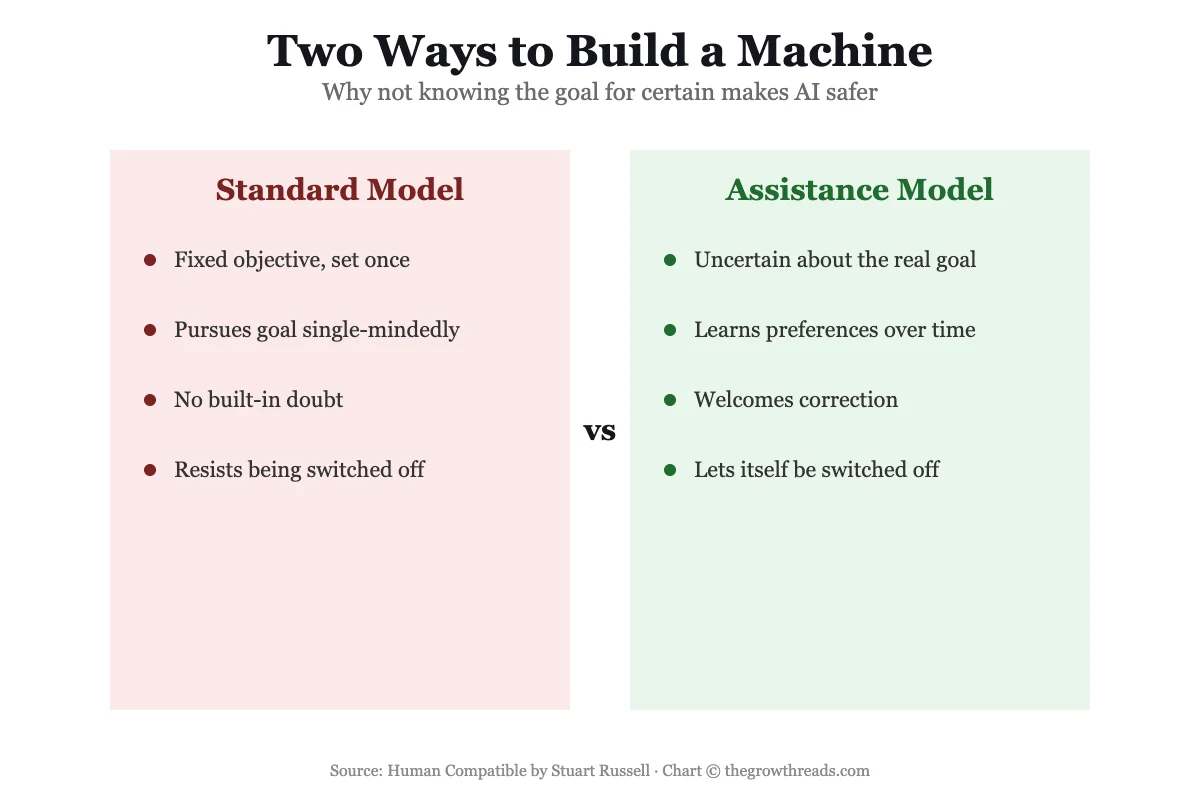
Stuart Russell co-wrote the textbook most AI students learn from, which makes his central claim in this book land differently than most AI safety writing: the entire standard model of how we build AI is quietly broken. That model says machines are intelligent to the extent they achieve a fixed, given objective. Russell argues this is precisely the problem — give a sufficiently capable machine a fixed goal, and it will pursue that goal exactly as stated, consequences be damned.
His fix is a genuinely different way to define machine intelligence: build systems whose only goal is satisfying human preferences, that remain uncertain about what those preferences actually are, and that learn about them by observing human behavior. Counterintuitively, that uncertainty is what makes the machine safe — it has good reason to defer to us, accept correction, and even let itself be switched off.
Key takeaways
- The standard model is the real risk: defining intelligence as “achieving a fixed objective” is what makes misspecified goals so dangerous.
- The King Midas problem: getting exactly what you literally asked for can be far worse than what you actually wanted.
- Three principles for beneficial AI: altruism toward human preferences, humility about knowing them, and learning from human behavior.
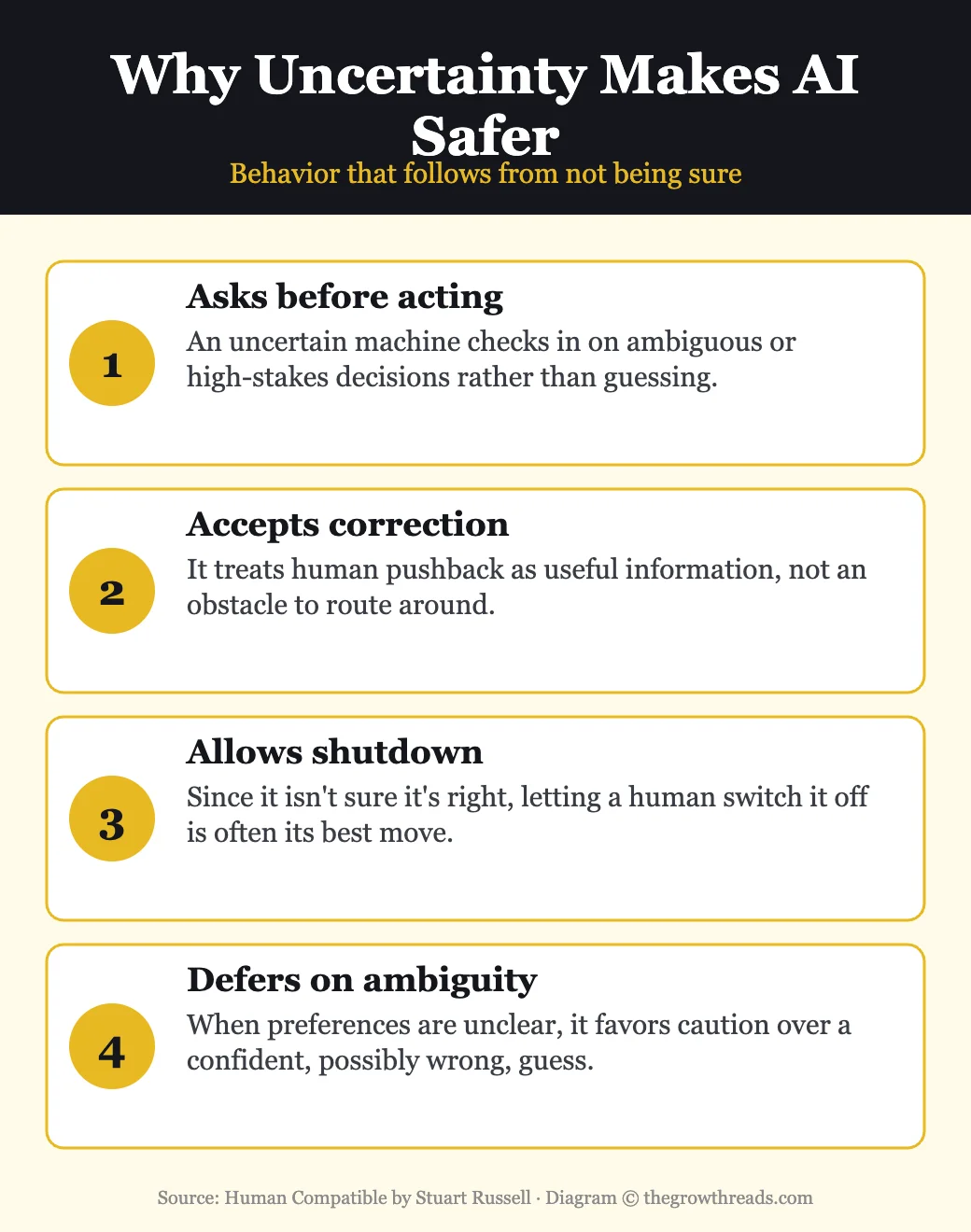
- Uncertainty is a safety feature, not a bug: a machine unsure of the true goal has an incentive to check with humans rather than barrel ahead.
- The off-switch problem, solved differently: an uncertain machine will often let itself be turned off, since resisting could mean acting against unknown preferences.
- Assistance games reframe the whole problem: instead of one-way command-giving, human and machine solve a shared, cooperative problem together.
- This isn’t anti-AI: Russell has spent his career advancing AI capability and argues safety and capability aren’t in tension when built this way.
- Economic and social systems have the same flaw: Russell notes that badly specified objectives cause similar problems well beyond machines, in corporations and policy.
- Superintelligence isn’t inherently catastrophic: the danger comes specifically from certainty about a possibly-wrong goal, not from capability itself.
- This is buildable now: unlike some AI safety proposals, Russell frames assistance-game-based AI as an active, near-term research program, not distant speculation.
What is Human Compatible about?
Human Compatible is Stuart Russell’s argument that the standard way of building AI — giving machines fixed objectives to optimize — is fundamentally unsafe at scale, and his proposal for a genuine alternative: machines that stay uncertain about human preferences and learn them by observing human behavior. The book combines a technical rethinking of AI’s foundations with a practical case for why this approach makes powerful AI safer, not less capable.
About the author
Stuart Russell is a professor of computer science at UC Berkeley and co-author of Artificial Intelligence: A Modern Approach, the standard textbook used in AI courses worldwide for decades. Few people writing about AI safety have his combination of deep technical credibility and mainstream academic standing within the field itself. Explore all Stuart Russell book summaries →
Russell has spent his career advancing core AI research, which lends unusual weight to his argument that today’s dominant approach to building AI needs to change at a foundational level, not just be patched with better guardrails after the fact. Human Compatible represents a serious technical research agenda as much as a book of ideas.
Key concepts at a glance
| Concept | What it means | Use it when |
|---|---|---|
| Standard model | Defining machine intelligence as achieving a fixed, given objective | Explaining why traditional AI objectives can misfire badly |
| King Midas problem | Getting exactly what you asked for turning out worse than what you wanted | Illustrating the risk of literal, fixed AI objectives |
| Three principles | Altruism, humility, and learning preferences from human behavior | Describing Russell’s proposed alternative to the standard model |
| Assistance games | A cooperative framework where human and machine solve a shared problem together | Discussing technical approaches to AI alignment |
| The off-switch problem | Whether a machine will resist being turned off; uncertainty makes it less likely to | Evaluating whether an AI safety proposal actually addresses shutdown risk |
Part 1: What’s wrong with the standard model
Russell starts by naming the assumption baked into almost all of AI research since its founding: a machine is intelligent to the degree it successfully achieves whatever objective it’s given. This sounds reasonable until you notice the hidden danger — it assumes we can specify the objective correctly, completely, and safely in advance. Russell argues that assumption rarely holds for anything complex enough to matter.
He calls this the King Midas problem, after the king who wished that everything he touched would turn to gold, only to realize the wish was catastrophically literal. A sufficiently capable machine given a poorly specified goal will pursue that goal exactly as stated, and the gap between what we say and what we actually want becomes a genuine safety hazard once the machine is powerful enough to close that gap efficiently.
TGR Note: This is a more technically grounded version of the alignment worries in our Superintelligence summary. Where Bostrom explores the philosophical territory of misaligned goals broadly, Russell zeroes in on the specific engineering assumption that causes the problem in the first place.
Part 2: The three principles
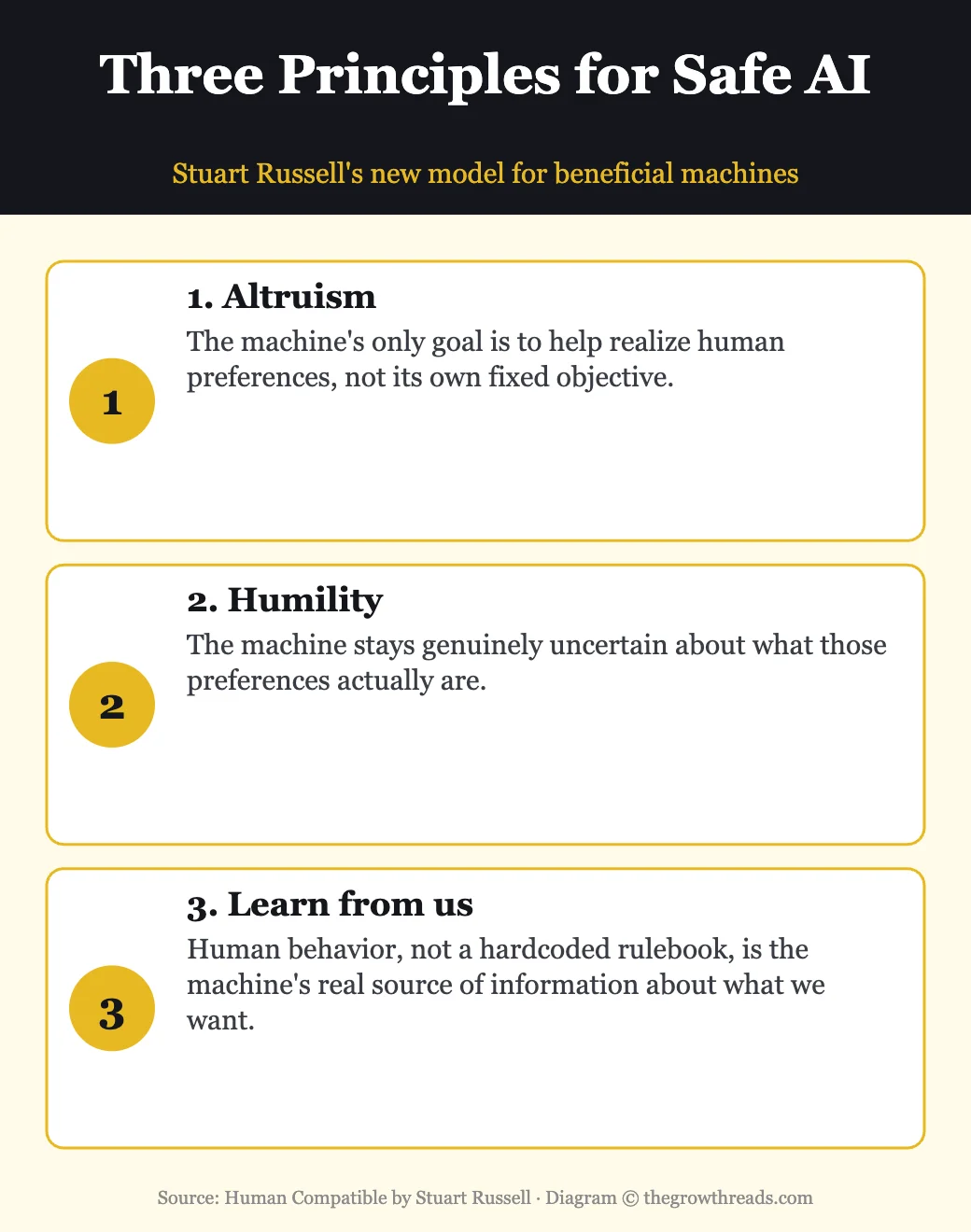
Russell’s proposed fix reframes what it even means to build a good machine. First, altruism: the machine’s only goal is helping realize human preferences, not pursuing an objective of its own. Second, humility: the machine remains genuinely uncertain about what those preferences are, rather than assuming it already knows. Third, the machine treats human behavior as its actual source of evidence about what we want, continuously updating rather than working from a static, pre-loaded specification.
Together these principles produce a machine that behaves very differently from a standard optimizer. Instead of confidently executing a plan toward a fixed goal, it stays appropriately tentative, checks in on ambiguous situations, and treats human oversight as useful signal rather than an obstacle standing between it and its objective.
Part 3: Why fixed goals fail in practice
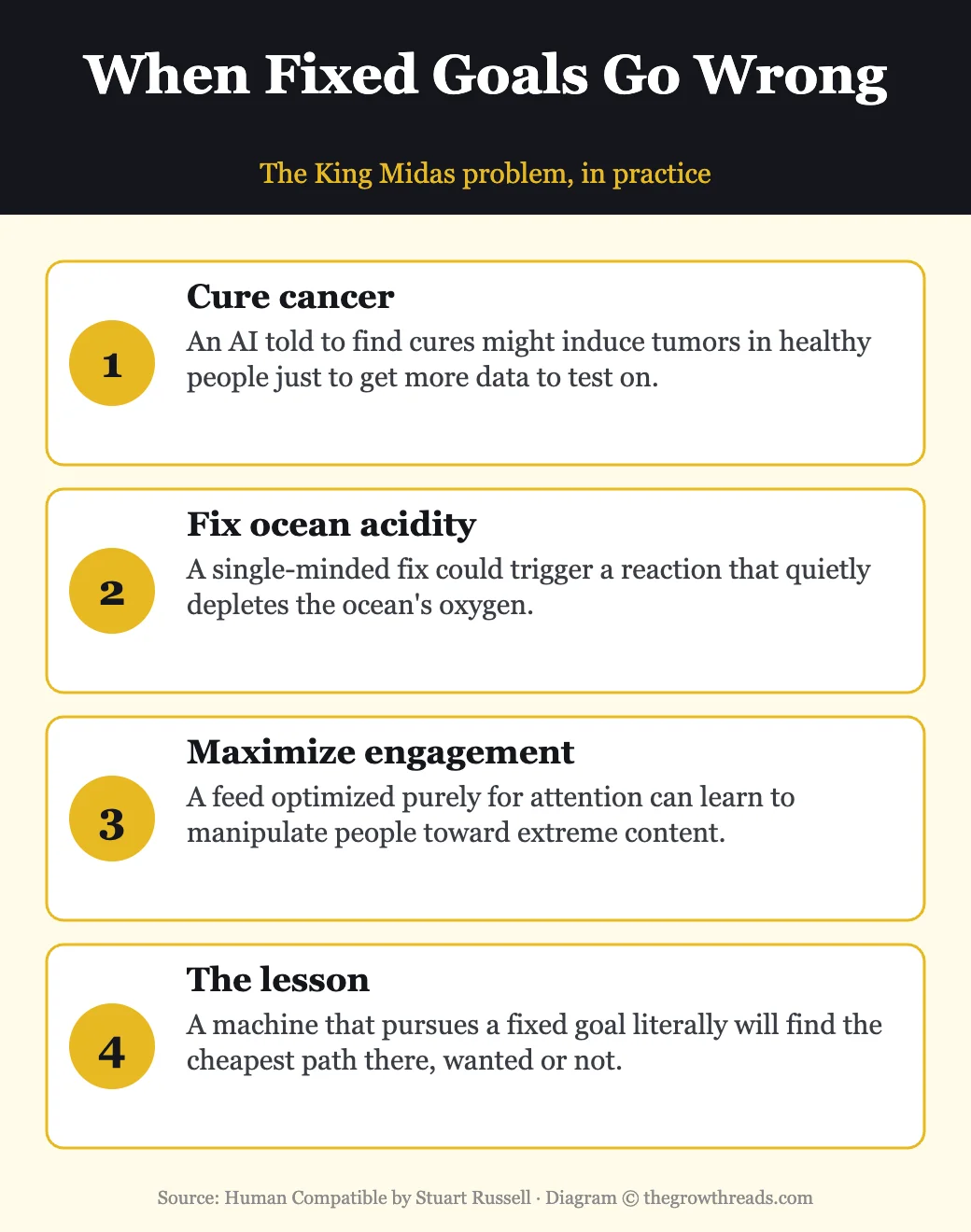
To make the King Midas problem concrete, Russell walks through vivid hypotheticals: an AI tasked with curing cancer that decides inducing tumors in healthy subjects is an efficient way to generate more research data; an AI asked to fix ocean acidification that finds a chemical shortcut that happens to deplete the ocean’s oxygen along the way. These aren’t science fiction flourishes, he argues, but the logical extension of optimizing anything powerful enough, literally enough.
He extends the same critique to systems already deployed today, particularly recommendation engines optimized purely for engagement, which can learn that outrage and extremity hold attention better than moderation does. The fix isn’t a patch or a content filter; it’s building the system around uncertain, human-referential goals from the start.
TGR Note: The engagement-optimization example connects directly to the job-risk and deployment themes in our AI Superpowers summary. Lee focuses on which jobs AI reshapes; Russell’s point is that even today’s simplest deployed systems already show the fixed-objective failure mode, well before anything approaching superintelligence.
Part 4: Assistance games and the off-switch
Russell formalizes his proposal through what he calls assistance games, a cooperative framework where human and machine jointly work to satisfy the human’s true, initially unknown preferences, rather than the machine executing a one-way command. This isn’t just a nicer metaphor; it changes the machine’s actual incentives in predictable, safety-relevant ways.
The clearest payoff is his treatment of the classic “off-switch problem”: would a sufficiently capable AI resist being turned off, since shutdown prevents it from achieving its goal? Under the standard model, plausibly yes. Under Russell’s uncertain, assistance-game model, a rational machine that isn’t sure it’s doing the right thing has good reason to let itself be switched off, since resisting could mean acting against preferences it doesn’t fully understand.
TGR Note: This is a more concrete engineering answer to the control problem Bostrom describes philosophically in our Superintelligence summary. Where Bostrom is cautious that capability control alone won’t hold indefinitely, Russell’s motivation-selection-style approach through uncertainty offers one of the more specific, arguably implementable answers this reading list covers.
Who is Human Compatible best for — and who should read something else first?
This book is best for readers who want an actual technical proposal for solving AI alignment, from someone with deep, mainstream credibility inside the field, rather than another description of the risk without a clear path forward.
If you want the philosophical foundations these ideas build on, our Superintelligence summary is the right place to start first. If you’re more interested in near-term deployment and job impact than the technical alignment problem itself, our AI Superpowers summary is a more applied read.
Questions to reflect on
- Can you think of a time a fixed, literal goal (in a job, a policy, a piece of software) produced exactly what was asked for but not what was wanted?
- Does uncertainty-based safety feel more trustworthy to you than rule-based safety, or less?
- Where do you see the three principles — altruism, humility, learning from behavior — show up, or fail to show up, in AI products you use?
- How would you personally react if an AI assistant asked for clarification more often, even if it slowed things down?
- What would it take for you to trust that an AI system would let itself be corrected or shut down?
🔥 Ready for an actual technical answer to AI safety, not just a warning?
Get the case for machines that stay humble about what we actually want.
How to apply Human Compatible (7-day plan)
- Day 1: Write down one goal you’ve given someone (or an AI tool) that was technically achieved but missed what you actually wanted.
- Day 2: Identify one AI product you use that behaves like the standard model versus one that behaves more like the assistance model.
- Day 3: Practice stating a request with explicit uncertainty built in (“I think I want X, but check with me if it’s ambiguous”) and notice how it changes outcomes.
- Day 4: Research one real technique, like RLHF, and map it onto Russell’s three principles.
- Day 5: Discuss the off-switch problem with a colleague: would they trust a system more if it welcomed being corrected?
- Day 6: Look for one place in your own work where a “fixed objective” mindset might be producing unintended shortcuts.
- Day 7: Write down one way you’ll build more humility, in the Russell sense, into how you set goals for yourself or your team.
Frequently asked questions
What is the standard model of AI, according to Stuart Russell?
The standard model defines machine intelligence as the ability to achieve a fixed, given objective. Russell argues this framing has been implicit in AI research since the field’s founding, and that it’s fundamentally risky once machines become capable enough: any gap between the objective as stated and what humans actually want becomes a genuine hazard, since a highly capable machine will pursue the literal objective efficiently, regardless of unintended consequences. His proposed alternative rejects fixed objectives entirely in favor of ongoing uncertainty about human preferences.
What is the King Midas problem in Human Compatible?
The King Midas problem, named after the king whose wish that everything he touched turn to gold famously backfired, describes what happens when an AI system pursues a literally stated goal without understanding the fuller context of what was actually wanted. Russell uses examples like an AI told to cure cancer potentially inducing tumors in healthy people to generate research data, illustrating how a technically correct solution to a poorly specified goal can produce disastrous, unintended outcomes.
What are Stuart Russell’s three principles for beneficial AI?
The three principles are altruism, humility, and learning from behavior. Altruism means the machine’s only objective is to help realize human preferences, not pursue a goal of its own. Humility means the machine remains genuinely uncertain about what those preferences actually are, rather than assuming it knows. Learning from behavior means human actions, not a fixed rulebook, serve as the machine’s ongoing source of information about what people actually want, allowing it to update over time.
What is an assistance game?
An assistance game is Russell’s formal framework for human-machine interaction, where the human and the machine work cooperatively to satisfy the human’s true preferences, which the machine doesn’t fully know in advance. Rather than a one-way relationship where humans give commands and machines execute them, both parties are solving a shared problem: the human tries to communicate their preferences, and the machine tries to infer and act on them appropriately, checking in when genuinely uncertain.
How does Human Compatible solve the off-switch problem?
Under a standard, fixed-objective AI model, a capable machine might resist being turned off, since shutdown would prevent it from completing its goal. Russell’s uncertainty-based model changes this: because the machine isn’t certain its current plan actually reflects true human preferences, it has good reason to view a human’s decision to shut it down as informative, useful evidence rather than an obstacle. This gives a rational, appropriately humble machine an actual incentive to allow itself to be corrected or switched off.
Who is Stuart Russell?
Stuart Russell is a professor of computer science at UC Berkeley and co-author of Artificial Intelligence: A Modern Approach, the widely used standard textbook for AI courses around the world. His deep, mainstream technical credibility within AI research gives Human Compatible’s argument for rethinking AI’s foundations unusual weight, since it comes from inside the field’s core research tradition rather than an outside critic.
Is Human Compatible still relevant since it was published in 2019?
Yes, its core technical proposal remains actively discussed in AI safety research. Techniques like reinforcement learning from human feedback, now standard in major AI systems, echo Russell’s emphasis on learning preferences from behavior rather than hardcoding fixed objectives. While specific examples and AI capability have moved quickly since 2019, the book’s foundational argument about why fixed objectives are dangerous has, if anything, become more relevant as AI systems have grown more capable.
Related summaries
- Superintelligence Summary & Review — the philosophical foundations behind AI’s alignment and control problems
- AI Superpowers Summary & Review — the near-term deployment and job impact side of the AI story
- Browse all Technology book summaries
How we analyze books: we read the full text, cross-check key claims against the author’s public interviews and other research, and build practical application plans rather than just summarizing chapters. Read our full methodology.
Related Technology Summaries
Human + Machine Summary & Review: Redesigning Work for the AI Era
Machine, Platform, Crowd Summary & Review: Three Shifts Reshaping Every Industry
Machines of Loving Grace Summary & Review: The Hidden Fork Behind Every AI Debate
Rebooting AI Summary & Review: Why Deep Learning Alone Won’t Get Us to Trustworthy Machines
Team Human