

★★★★☆ 4.2/5 — A research-backed case that the best decision-makers aren’t the fastest reactors — they’re the best at managing delay.
Best for: Anyone who makes high-stakes decisions under time pressure and reacts on instinct by default.
Reading time: ~5 hrs (guide: 75 min)
Difficulty to apply: Medium — requires deliberately resisting an instinct, not just adding a habit.
Wait in one minute
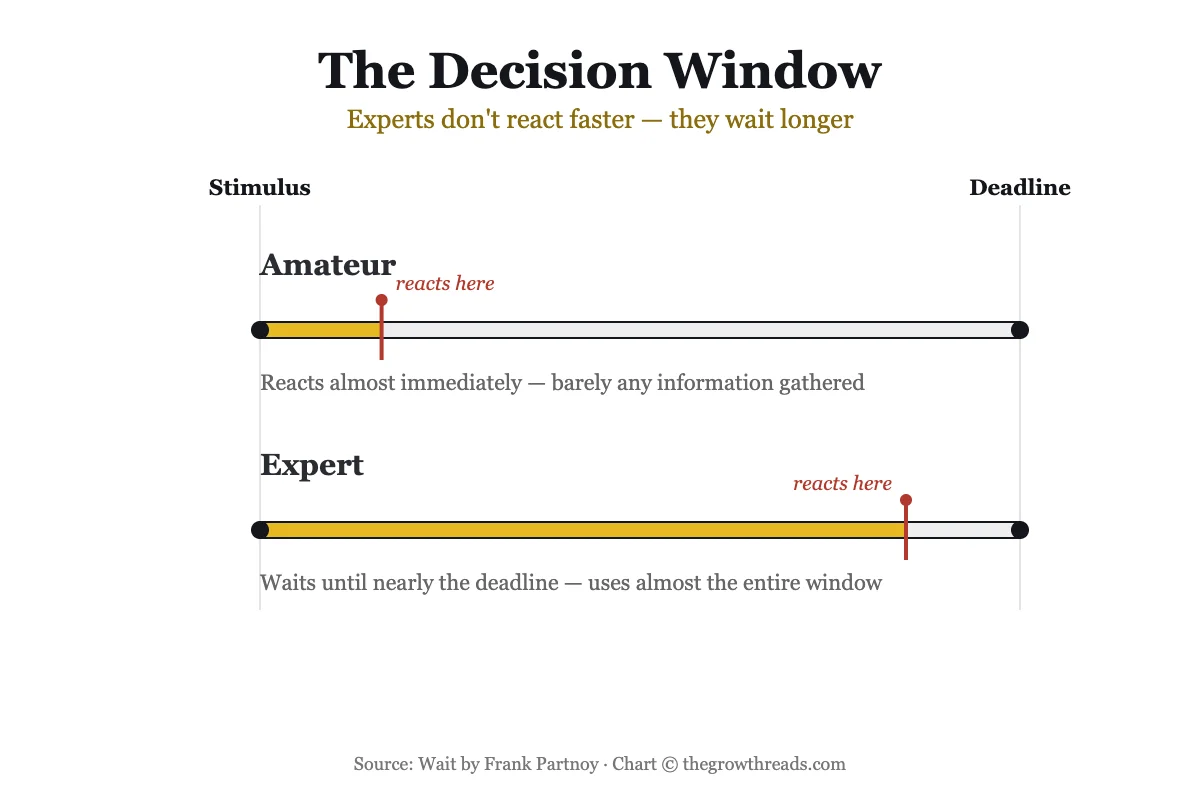
The instinct to react instantly is usually wrong — the best decision-makers deliberately use more of the time they actually have. Frank Partnoy, a former derivatives trader turned law and finance professor, wrote Wait after noticing a pattern across wildly different fields: elite athletes, top comedians, skilled negotiators, and the best traders all share one trait. They don’t react faster than everyone else — they react later, having used more of their available decision window to gather information before committing. Wait lays out the science behind that pattern and a practical two-part process — assessing how much time you actually have, then deciding deliberately how much of it to use — for building the same edge into your own decisions.
Key takeaways
- Speed isn’t the advantage: across sports, comedy, and trading, elite performers react later than amateurs, not sooner.
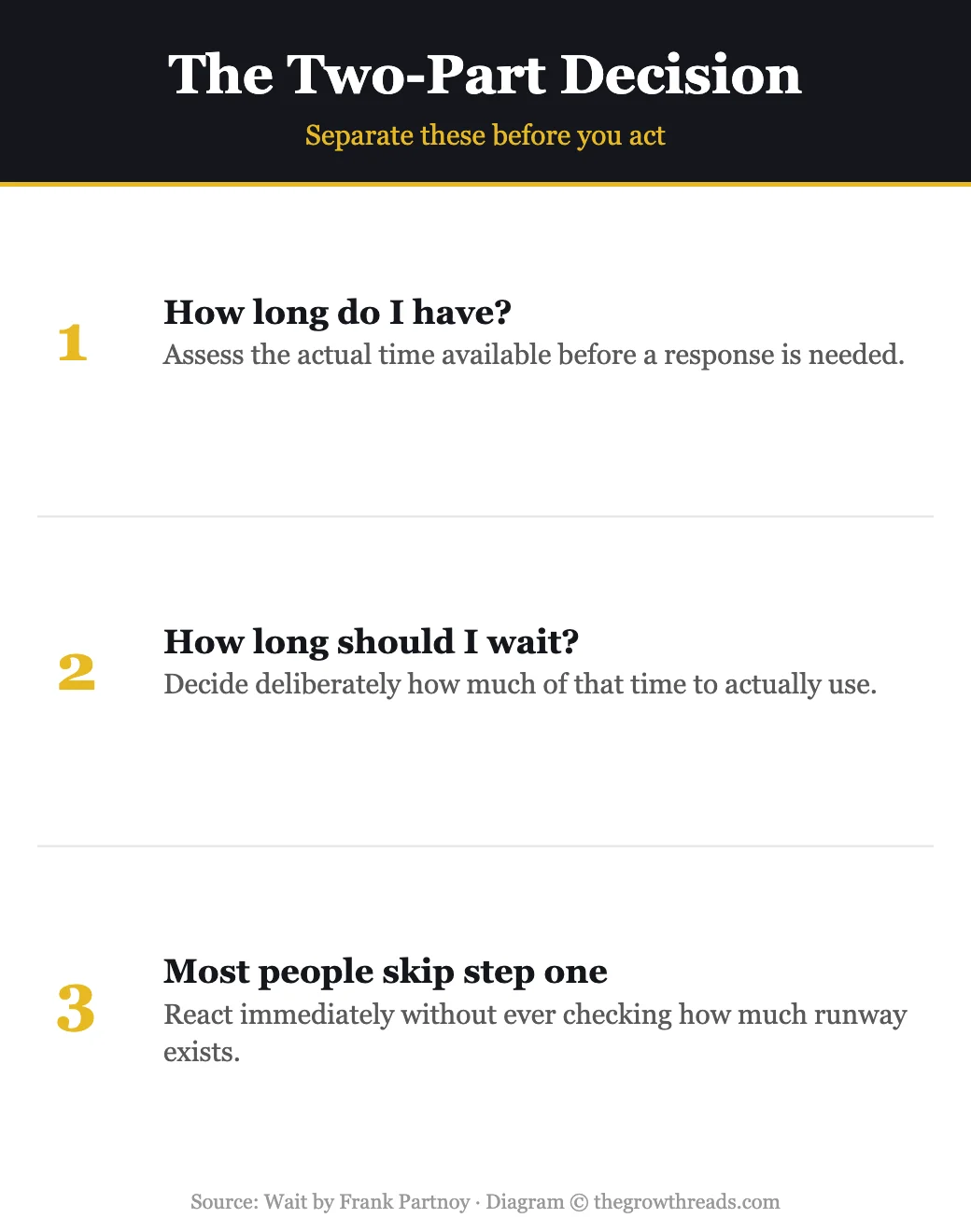
- Every decision has two separate questions: how much time is actually available, and how much of it you should use.
- Most people skip the first question: they react to urgency instead of first checking how much runway genuinely exists.
- Reaction time and decision quality trade off: the fastest response is rarely the best-informed one.
- Delay is a trainable skill: deliberate practice in low-stakes moments builds the capacity to wait under real pressure.
- Silence is a negotiation tool: pausing before responding draws out better offers than filling the gap immediately.
- Technology has shortened perceived decision windows: notifications and real-time feeds pressure faster reactions than situations actually require.
- Managed delay beats procrastination: deliberately using available time differs from avoiding a decision altogether.
- Naming the real deadline reduces false urgency: most “now” pressure is anxiety, not an actual constraint.
- Reviewing past decisions reveals the pattern: your best calls likely involved more waiting than your instinct wanted at the time.
What is Wait about?
Wait is Frank Partnoy’s case that elite decision-makers across sports, comedy, negotiation, and trading share one trait: they deliberately use more of their available reaction time before responding, rather than reacting instantly. It offers a two-part process — assessing how much time you actually have, then choosing how much to use — for building that same edge into everyday decisions.
About the author
Frank Partnoy spent several years as a derivatives trader on Wall Street before moving into academia, where he became a professor of law and finance known for writing about financial markets, corporate governance, and decision-making under uncertainty. His earlier books, including F.I.A.S.C.O. and Infectious Greed, examined risk-taking inside the financial system. Wait, published in 2012, grew out of his own trading experience combined with research across psychology, neuroscience, and sports science, examining why the instinct to react quickly so often produces worse outcomes than a deliberately managed pause. Explore all Frank Partnoy book summaries →
Key concepts at a glance
| Concept | What it means | Use it when |
|---|---|---|
| The decision window | The actual span of time available between a stimulus and a required response | You feel pressure to respond and haven’t checked how much time genuinely exists |
| Two-part decision | Separating “how long do I have” from “how long should I wait” | You’re about to react to something important |
| Elite delay | The pattern of top performers reacting later than amateurs across many fields | You assume speed itself is the advantage in a high-stakes moment |
| Managed delay vs. procrastination | Deliberately using available time versus avoiding a decision altogether | You’re unsure whether waiting is helping or just stalling |
| Pause triggers | Fixed personal rules, like sleeping on high-stakes replies | You want delay to be automatic rather than willpower-dependent |
| False urgency | Perceived time pressure that doesn’t match the actual deadline | A notification or feed makes something feel more urgent than it is |
Part 1: Why the fastest reaction usually isn’t the best one
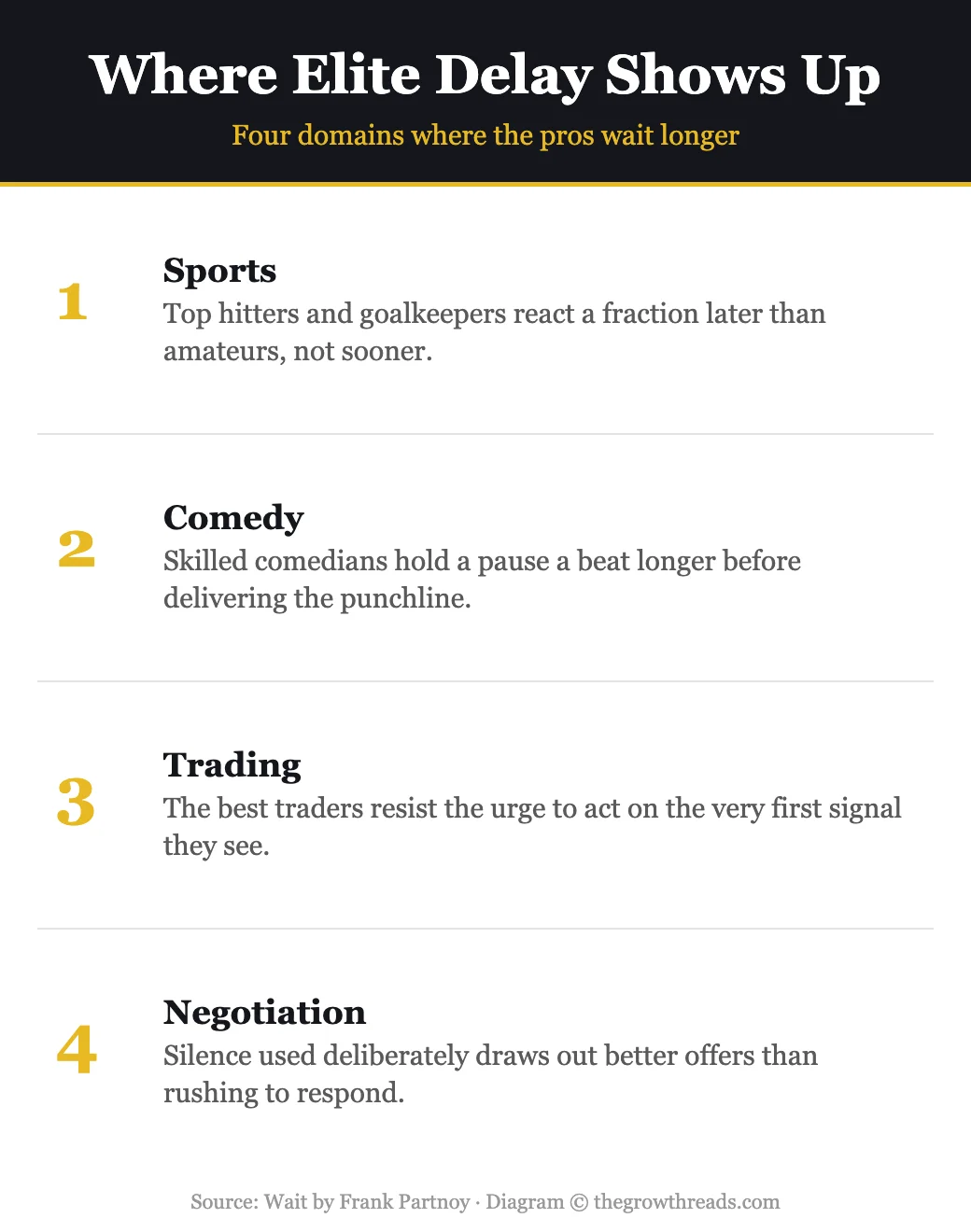
Partnoy opens with examples that cut against instinct. Elite baseball hitters don’t start their swing earlier than amateurs — they actually wait longer, extracting a few extra milliseconds of information about the pitch before committing. Top goalkeepers facing a penalty kick who wait rather than diving early save more shots, even though diving early feels like the more decisive choice. The pattern repeats in comedy, where skilled performers hold a pause a beat longer before the punchline, and in trading, where the best performers resist acting on the very first signal they see.
The common thread across all these fields is that a decision window exists — a real, if often short, span of time between when information starts arriving and when a response is actually required. Reacting at the very start of that window means deciding with the least possible information; reacting nearer the end means deciding with far more. Partnoy’s claim isn’t that slower is always better in the abstract — it’s that most people react much earlier than they need to, discarding information that was genuinely available.
Part 2: Where elite delay shows up across fields
Partnoy spends much of the book cataloguing this pattern across domains that don’t obviously connect. In sports, the advantage shows up in fractions of a second — reaction time that looks identical to amateurs from the outside but is deployed later in the available window. In comedy, it shows up as comic timing, where a slightly longer pause before the punchline raises the laugh rather than losing the audience. In trading, the best performers are distinguished less by faster information access and more by a willingness to sit with a signal before acting on it. In negotiation, deliberate silence after an offer routinely produces a better counteroffer than an immediate response would.
What ties these together, in Partnoy’s account, is that in each field the amateur assumption is the same: that responding first or fastest signals competence. The evidence points the other way — competence more often looks like tolerating the discomfort of not yet having responded.
TGR Note: The negotiation-silence finding pairs well with the decision-fatigue research in our The Time Paradox summary — both point to time pressure distorting judgment in predictable ways.
Part 3: Technology, false urgency, and why we react too soon
Partnoy argues that modern technology has systematically shortened people’s perceived decision windows without actually shortening the real ones. A notification, an incoming message, or a live feed creates a felt sense of “now” that rarely matches the actual deadline attached to a decision. Most of what feels urgent, he argues, is anxiety about an unanswered stimulus rather than a genuine time constraint — and that anxiety, left unexamined, quietly trains people to skip the first half of the two-part decision process entirely, reacting to the alert instead of assessing how much time the underlying decision actually allows.
Distinguishing managed delay from ordinary procrastination matters here. Procrastination avoids a decision without any plan to return to it; managed delay deliberately extends the information-gathering period with the intention of deciding well within a real deadline. The two can look similar from the outside — both involve not responding immediately — but only one of them actually improves the eventual decision.
TGR Note: If false urgency from notifications is the bigger issue for you day to day, our Can’t Even summary covers the broader always-on culture driving that constant reactive pressure.
Part 4: Building the practice of deliberate delay
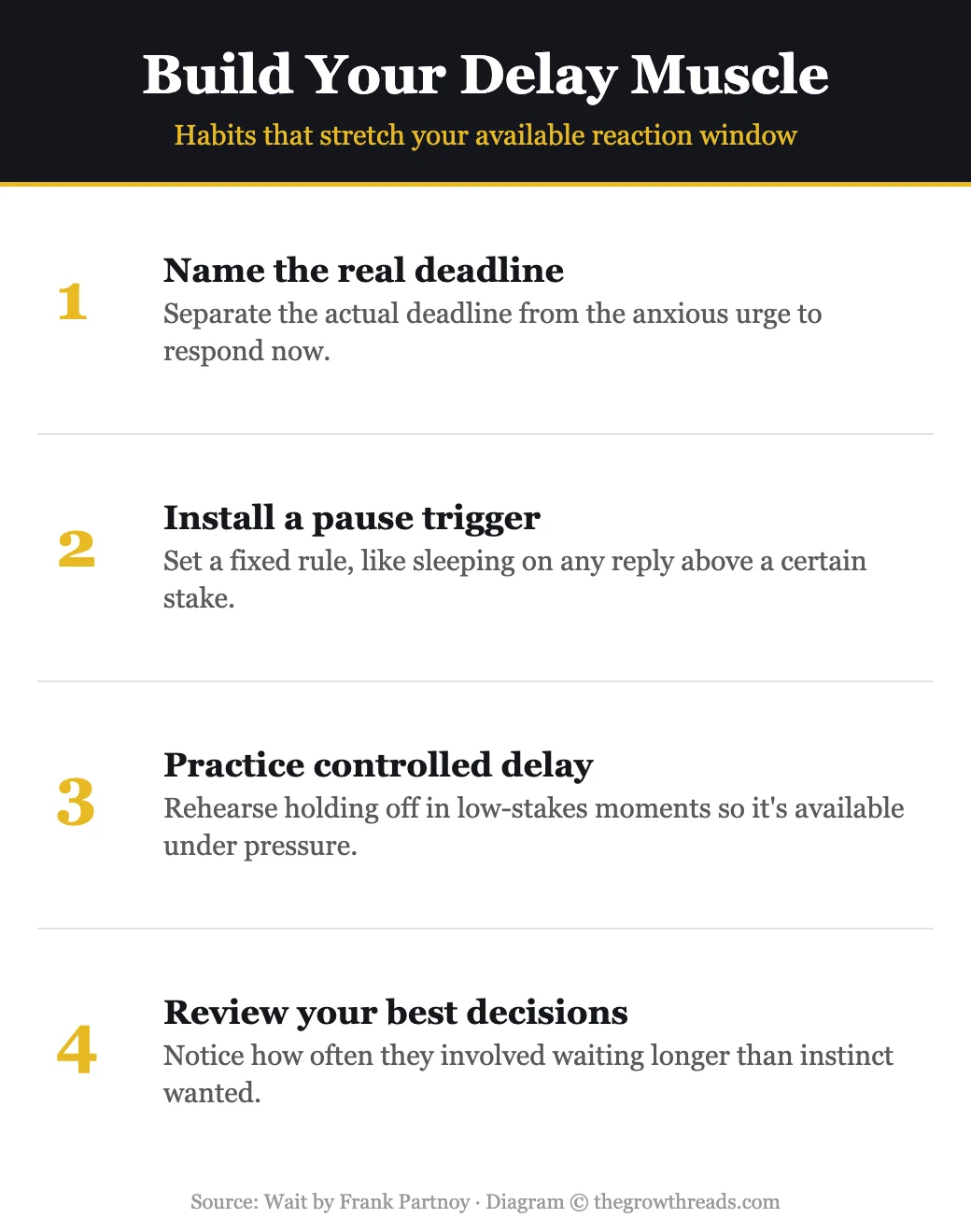
The book closes with practical mechanisms for building elite-style delay into ordinary decisions. Partnoy recommends installing fixed pause triggers — personal rules like sleeping on any reply above a certain stake, or waiting a set period before responding to anything that provokes a strong emotional reaction. He also emphasizes practicing controlled delay in low-stakes situations specifically so the skill is available when the stakes are genuinely high; waiting is much harder to do for the first time under real pressure.
The last recommendation is a review habit: looking back at your best past decisions and noticing, honestly, how often they involved waiting longer than instinct wanted at the time. For most readers, Partnoy argues, that review reveals the two-part process was already happening informally in their best moments — the goal of the book is simply to make it deliberate and repeatable rather than accidental.
TGR Note: Pairing a pause trigger with a fixed daily review routine works well alongside the lightweight system in our Zen to Done summary.
Who is Wait best for — and who should read something else first?
Wait is best for people who regularly make consequential decisions under real or perceived time pressure — managers, traders, negotiators, and anyone whose default is to answer immediately rather than assess how much time they actually have. Its research-driven, cross-domain structure rewards readers who enjoy the evidence behind a claim, not just the takeaway.
If constant reactive pressure from notifications and always-on culture is the deeper issue, Can’t Even addresses that root cause more directly. If your challenge is starting rather than pacing a decision, Do the Work is more targeted. And if you want a broader framework for how time pressure distorts judgment generally, The Time Paradox is a useful companion.
Questions to reflect on
- Think of a recent decision you rushed — how much actual time did you have that you didn’t use?
- What’s one pause trigger you could install for high-stakes replies or decisions?
- Where does false urgency from notifications most often override your judgment?
- Can you recall a past decision where waiting longer than felt comfortable led to a better outcome?
- What’s the difference, in your own work, between managed delay and simple procrastination?
🔥 Ready to make better decisions under pressure?
Get Wait and start using the two-part decision process this week.
How to apply Wait (7-day plan)
- Day 1: Pick one recurring decision and ask how much time you actually have before a response is truly required.
- Day 2: Install one pause trigger — a fixed rule for delaying a specific type of reply or reaction.
- Day 3: Practice controlled delay in a low-stakes moment to build the habit before you need it under pressure.
- Day 4: Notice one instance of false urgency today and name the actual deadline behind it.
- Day 5: In a negotiation or disagreement, deliberately pause before responding and observe what changes.
- Day 6: Review a recent good decision and identify how much you waited before committing.
- Day 7: Apply the full two-part process — assess your window, then decide deliberately how much of it to use — on one real decision.
Frequently asked questions
What is the main argument of Wait?
That elite performers across many fields — sports, comedy, negotiation, trading — succeed not by reacting faster than everyone else, but by deliberately using more of their available decision-making time before responding. Partnoy calls this managed delay and argues it can be trained.
What is the “two-part decision” process?
It’s separating two distinct questions: how much time do I actually have before a response is required, and how much of that time should I use. Partnoy argues most people skip the first question and react to felt urgency instead of the real deadline.
Is this book only relevant to traders and negotiators?
No. While Partnoy draws heavily on his trading background, the book’s examples span sports, comedy, and everyday communication, and the core process applies to any decision made under real or perceived time pressure, from replying to a difficult email to a major life choice.
How is managed delay different from procrastination?
Managed delay deliberately extends an information-gathering period with the intention of deciding well within a genuine deadline. Procrastination avoids a decision with no real plan to return to it. The two can look similar from outside, but only managed delay improves the eventual decision.
Does technology make this worse?
Partnoy argues yes — notifications and real-time feeds create a felt sense of urgency that often doesn’t match the actual deadline attached to a decision, training people to react to the alert rather than to the real time constraint underneath it.
How long does it take to read?
Wait runs around 275 pages and most readers finish it in about five hours. Its cross-domain structure — sports, comedy, trading, negotiation — makes individual chapters easy to read somewhat independently of each other.
What’s the single most useful idea to take from this book?
That reacting quickly is not the same as reacting well, and that checking how much time you actually have — before deciding how much of it to use — is a skill most people skip entirely under pressure.
Related summaries
Continue exploring decision-making and time pressure with these summaries: The Time Paradox, Can’t Even, Do the Work, Zen to Done, or browse our full best productivity books pillar guide.
How we analyze books: we read primary sources and the author’s own essays and interviews, cross-reference key claims, and focus on practical application over academic critique. Read our full methodology.
Related Time Management Summaries
Can’t Even Summary & Review: Why Millennial Burnout Isn’t Your Fault
Hell Yeah or No Summary & Review: Say No to Almost Everything
Stillness Is the Key Summary & Review: The Discipline Behind Clear Thinking
The Time Bandit Solution Summary & Review: Recovering Stolen Time You Never Knew You Had
Time Rich Summary & Review: Reclaim Your Hours by Managing Energy, Not Just the Clock