

★★★★☆ 4.3/5 — A practical system for making creative brilliance reliable instead of accidental, built for anyone whose job depends on ideas.
Best for: People who do creative or knowledge work under deadline pressure and can’t wait for inspiration to show up.
Reading time: ~4 hrs (guide: 60 min)
Difficulty to apply: Medium — a genuine system with several moving parts, not a single habit.
The Accidental Creative in one minute
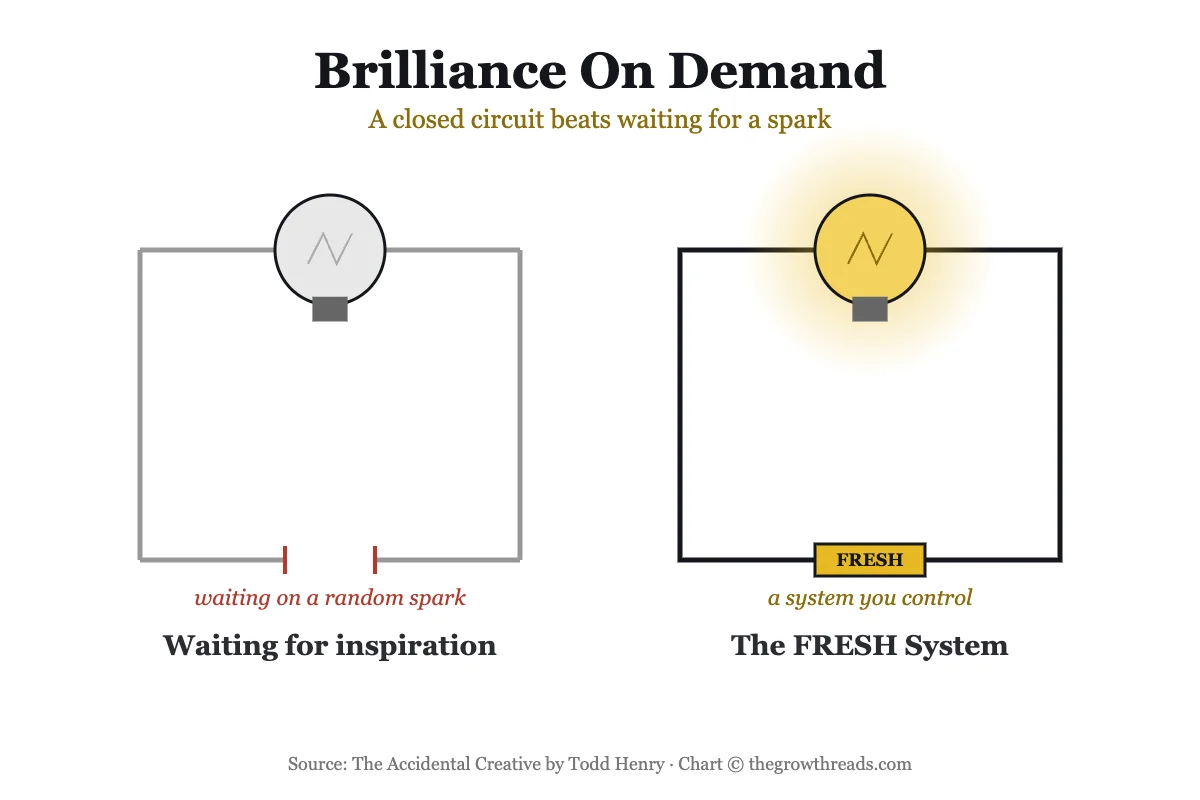
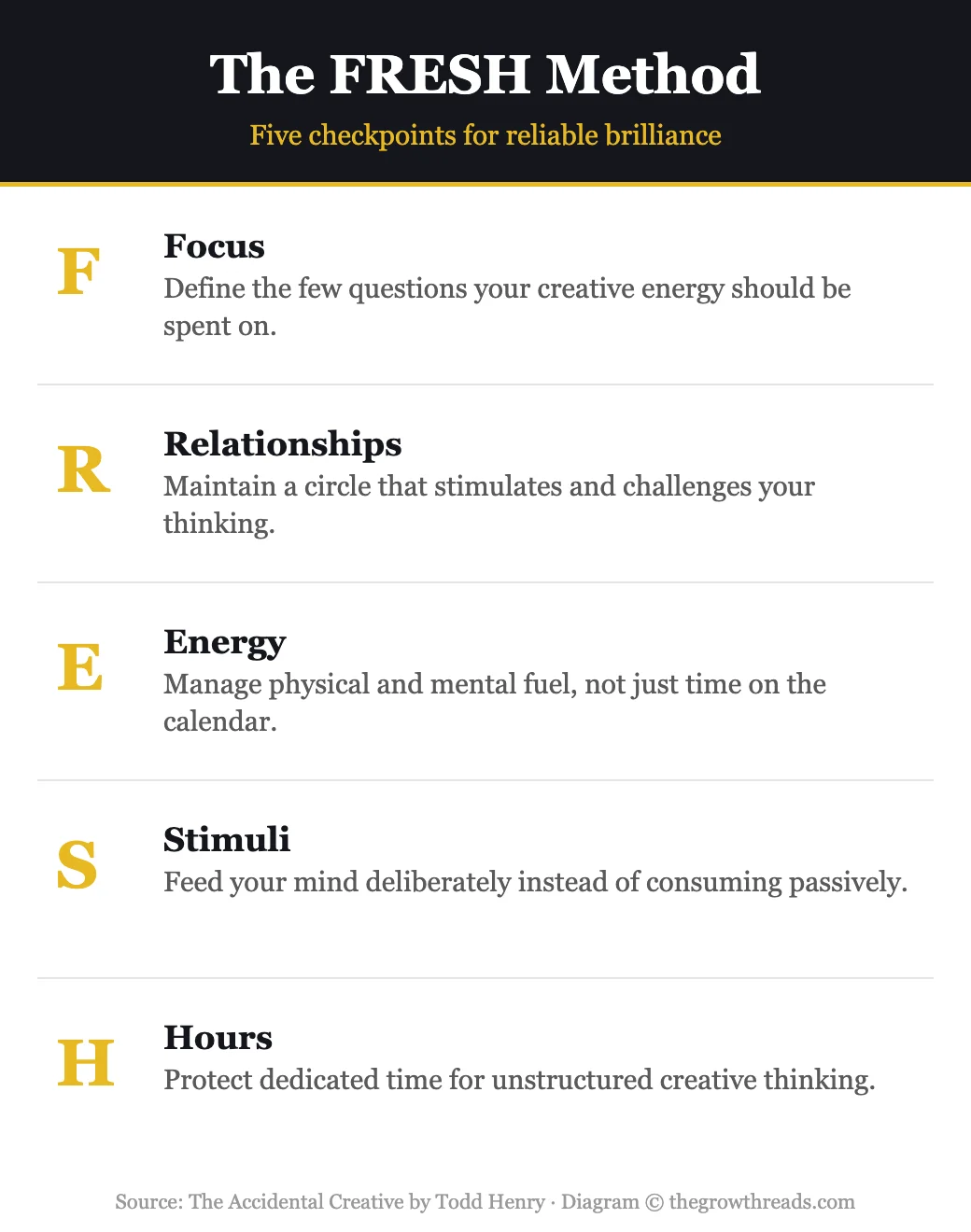
You can’t schedule inspiration, but you can build a system that makes brilliance show up reliably anyway. Todd Henry wrote The Accidental Creative for people who never signed up to be “creatives” in the traditional sense — managers, consultants, marketers, engineers — but whose jobs quietly depend on producing good ideas on demand, often with no warning and a hard deadline. His answer is the FRESH method: five checkpoints (Focus, Relationships, Energy, Stimuli, Hours) that turn creative output from something you wait for into something you manage, plus a weekly rhythm of check-ins and debriefs that keeps the whole system honest over time.
Key takeaways
- Brilliance on demand is a system problem: waiting for inspiration is a strategy that only sometimes works under deadline pressure.
- Focus means narrowing, not expanding: define the few questions your creative energy should actually be spent answering.
- Relationships shape your idea quality: the people who challenge and stimulate your thinking matter as much as raw effort.
- Energy is a resource to manage, not a given: physical and mental fuel run out well before the workday’s official hours do.
- Stimuli should be deliberate: passively consuming the same handful of sources is a fast route to creative stagnation.
- Hours need protecting: unstructured thinking time has to be defended against the default pull of reactive work.
- Short, bounded sprints beat open-ended mulling: a hard time box focuses creative problem-solving instead of letting it drift.
- Externalize open loops: unfinished ideas kept only in your head quietly drain the attention available for new ones.
- Debrief every project: asking what worked and what didn’t turns experience into an improving system rather than a repeating one.
- Unhealthy drift is gradual and reversible: interruption-driven days, stale input, and chronic depletion are warning signs, not verdicts.
What is The Accidental Creative about?
The Accidental Creative is Todd Henry’s system for producing reliable creative output under real-world deadline pressure. It’s built around the FRESH method — Focus, Relationships, Energy, Stimuli, and Hours — five checkpoints that turn brilliant ideas from something you passively wait for into something a deliberate weekly practice can consistently produce.
About the author
Todd Henry is a speaker and writer who built his career helping creative professionals and teams produce their best work reliably rather than sporadically. The Accidental Creative, published in 2011, was his first book and grew out of a podcast and consulting practice of the same name, where he interviewed working artists, designers, and business leaders about how they actually sustain creative output under pressure. He later expanded the underlying ideas about avoidance and unspent potential in his follow-up book, Die Empty. Henry’s background blends corporate consulting experience with a personal investment in the arts, which shows in the book’s practical, workplace-tested framing. Explore all Todd Henry book summaries →
Key concepts at a glance
| Concept | What it means | Use it when |
|---|---|---|
| The FRESH method | Five checkpoints — Focus, Relationships, Energy, Stimuli, Hours — for reliable creative output | You need a repeatable system rather than sporadic bursts of inspiration |
| Focus | Narrowing your creative energy to a few defined questions instead of everything at once | You feel scattered across too many half-formed ideas |
| Relationships | Deliberately maintaining a circle that stimulates and challenges your thinking | Your ideas have started to feel predictable or insular |
| Energy | Managing physical and mental fuel as a resource, not assuming it’s constant | You’re producing lower-quality work later in the day or week |
| Stimuli | Deliberately feeding your mind fresh input instead of consuming passively | Your ideas feel stale or derivative of the same few sources |
| Hours | Protecting dedicated time for unstructured creative thinking | Your calendar has become fully reactive with no room to think |
| Weekly debrief | A regular honest review of what worked and what didn’t on recent projects | You want to turn experience into an improving system, not a repeating one |
Part 1: Why waiting for inspiration is a losing strategy
Henry opens with a plain observation: most people whose jobs depend on ideas never chose to be “creative professionals,” yet they’re expected to produce brilliant work on a schedule set by clients, deadlines, and quarterly plans, not by inspiration. Waiting for a spontaneous spark works occasionally, but it’s an unreliable strategy for anyone who needs good ideas on demand rather than when the mood strikes. The book’s core reframe is that creative output isn’t fundamentally different from any other kind of reliable output — it can be systematized, managed, and improved, provided you’re honest about what actually feeds it.
That system is the FRESH method: five checkpoints that, taken together, function like a dashboard for creative capacity. None of the five is exotic on its own — focus, relationships, energy, stimuli, and hours are all common productivity vocabulary — but Henry’s contribution is treating them as a connected system to check regularly, rather than five separate concerns addressed in isolation whenever a problem shows up.
Part 2: Building a rhythm that produces brilliance reliably
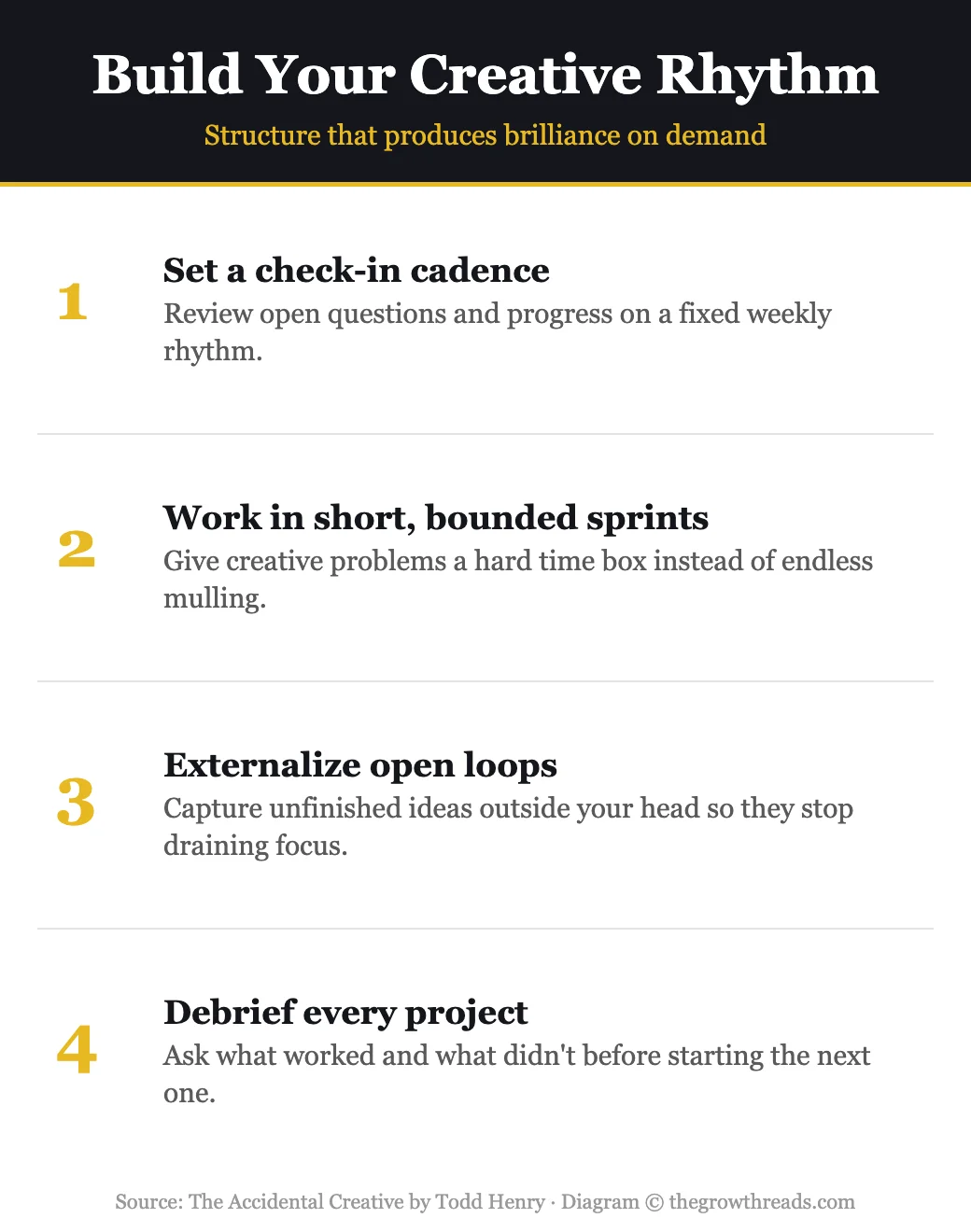
Knowing the five checkpoints matters only if a routine actually maintains them, so Henry pairs FRESH with a practical operating rhythm. He recommends a fixed weekly check-in to review open questions and progress rather than letting creative problems drift indefinitely, and working in short, bounded sprints instead of open-ended mulling — a hard time box, he argues, focuses creative problem-solving in a way that unlimited time rarely does.
Two habits close the loop. First, externalizing open loops: capturing unfinished ideas and half-formed thoughts outside your own head, whether in notes, a project tracker, or a simple list, so they stop quietly consuming attention that’s needed for the next idea. Second, debriefing every project honestly — asking specifically what worked and what didn’t before starting the next one, which is what turns a career of individual projects into a genuinely improving system rather than the same mistakes repeating under new names.
TGR Note: The weekly-review habit pairs well with the lightweight system in our Zen to Done summary — Henry’s debrief step slots naturally into a broader weekly review routine.
Part 3: Guarding against unhealthy drift
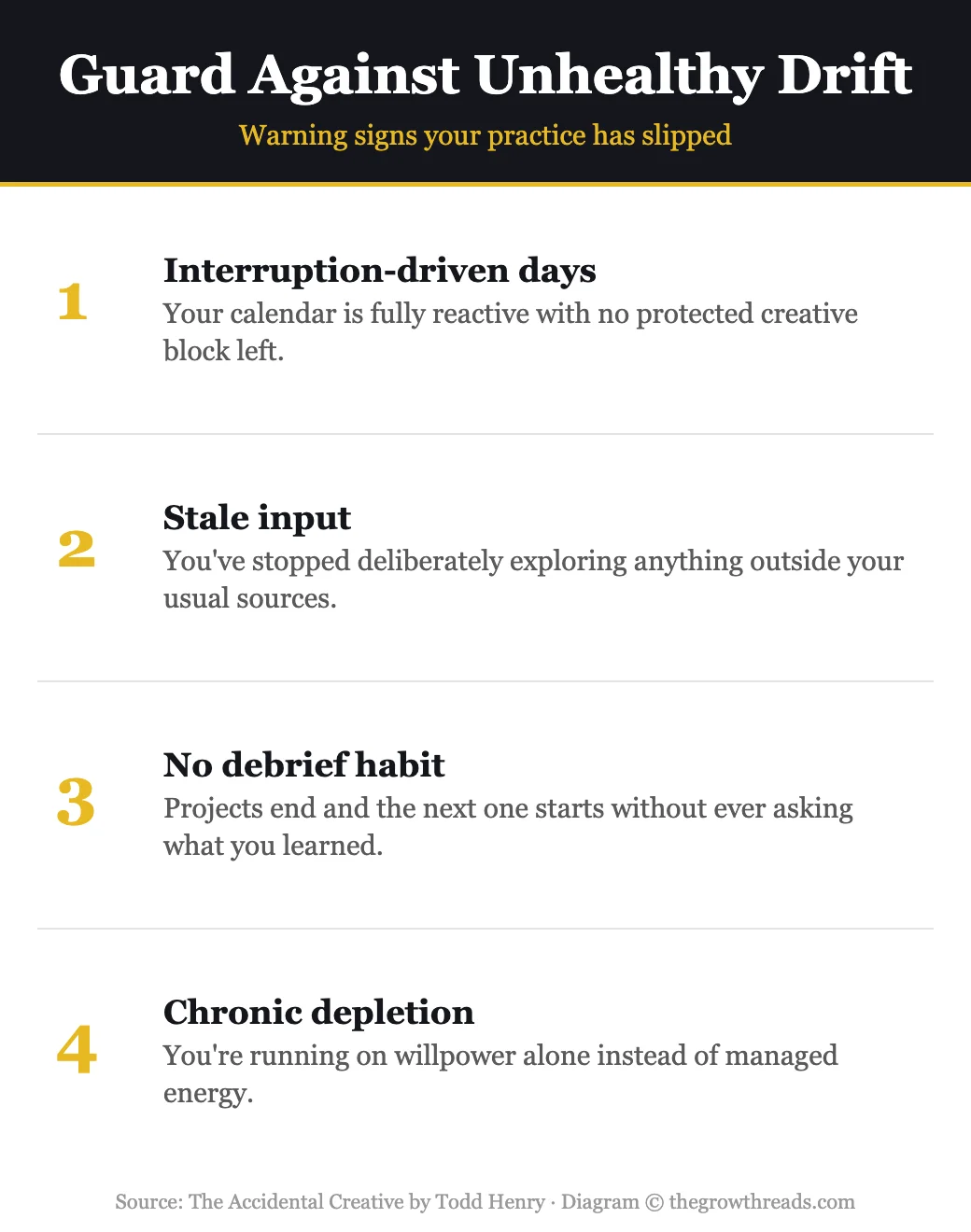
Systems decay quietly, and Henry spends real attention on the specific ways a creative practice slips before it collapses outright. Interruption-driven days are the most visible sign: a calendar that’s become fully reactive, with no protected block left for the unstructured thinking the Hours checkpoint requires. Stale input is subtler — it’s easy to keep working while quietly consuming the same handful of familiar sources, which slowly narrows the raw material available for new ideas without ever feeling like a crisis.
The other two warning signs are behavioral rather than circumstantial: skipping the debrief habit so projects end and the next one starts without any real reflection, and running on willpower alone instead of managed energy, which produces short bursts of output followed by longer stretches of depletion. None of these four signs individually means the system has failed — Henry frames them as early indicators worth checking against the FRESH dashboard regularly, before they compound.
TGR Note: If chronic depletion specifically is the pattern you recognize, our Eat Sleep Work Repeat summary goes deeper into rebuilding sustainable energy at work.
Part 4: Making it a career-long practice
Henry closes by widening the frame from a single project to an entire career of creative work. The FRESH checkpoints and weekly rhythm aren’t meant as a one-time fix for a rough patch — they’re meant to become the default operating system underneath everything else, revisited often enough that drift gets caught within weeks rather than years. He’s explicit that the goal isn’t constant peak output; energy and stimuli naturally fluctuate, and the system’s job is to catch and correct dips quickly rather than pretend they don’t happen.
The book’s later chapters extend this thinking to leading creative teams, since managers who understand the FRESH checkpoints in themselves are far better equipped to notice the same warning signs in the people they manage before those signs turn into burnout or turnover.
TGR Note: Henry’s own follow-up, Die Empty, picks up where this book leaves off — widening the question from “how do I produce reliably” to “am I spending my potential on the right things at all.”
Who is The Accidental Creative best for — and who should read something else first?
The Accidental Creative is best for anyone whose job requires producing good ideas on a schedule they don’t control — marketers, consultants, designers, product managers, and similar roles where “creative” was never in the job title but is quietly part of the job. It’s especially useful for people managing creative teams, not just individual output.
If your problem is specifically finishing a stalled project rather than sustaining ongoing output, Do the Work is more targeted. If you’re further along and sense you’ve settled into safe, repeatable work rather than your best work, Die Empty addresses that broader pattern directly. And if daily systems generally, not just creative ones, are what you’re missing, Zen to Done is the better starting point.
Questions to reflect on
- Which of the five FRESH checkpoints — Focus, Relationships, Energy, Stimuli, Hours — is weakest in your current routine?
- When did you last deliberately seek out stimuli outside your usual sources?
- Do you have a real weekly check-in, or does creative work just happen whenever there’s time left over?
- What open loops are you still carrying in your head instead of externalizing?
- When you finished your last project, did you actually debrief it — or move straight to the next one?
🔥 Ready to make brilliance reliable?
Get The Accidental Creative and start running the FRESH checkpoints this week.
How to apply The Accidental Creative (7-day plan)
- Day 1: Rate yourself honestly on all five FRESH checkpoints and identify the weakest one.
- Day 2: Write down the few specific questions your creative energy should be focused on right now.
- Day 3: Deliberately consume one piece of input completely outside your usual field.
- Day 4: Externalize every open loop currently living only in your head into a single list.
- Day 5: Block a protected, uninterrupted hour for unstructured creative thinking.
- Day 6: Work your current problem in one short, hard-bounded sprint instead of open-ended mulling.
- Day 7: Debrief the week — what worked, what didn’t, and what changes for next week’s FRESH check-in.
Frequently asked questions
What does FRESH stand for?
Focus, Relationships, Energy, Stimuli, and Hours — the five checkpoints Todd Henry uses to diagnose and maintain reliable creative output. The book treats these as a connected system to review regularly, not five separate concerns to address only when something goes wrong.
Is this the same as Die Empty?
No, though both are by Todd Henry and connect naturally. The Accidental Creative focuses on producing reliable creative output week to week; Die Empty widens the question to a career-length concern about whether your best work ever gets attempted at all.
Do I need to be an artist or designer for this book to apply?
No. Henry explicitly writes for “accidental” creatives — managers, marketers, consultants, and others whose jobs require good ideas on demand without the word “creative” ever appearing in their job title. The FRESH system applies to any role where output quality depends on original thinking.
How is this different from typical productivity advice?
Most productivity systems focus on managing tasks and time. The Accidental Creative focuses specifically on managing the conditions that make creative thinking reliable — energy, input, relationships — which standard task-management systems don’t usually address directly.
What’s the weekly practice the book recommends?
A fixed check-in to review open creative questions and progress, short bounded work sprints instead of open-ended thinking time, externalizing unfinished ideas outside your head, and an honest debrief of each project once it’s complete.
How long does it take to read?
The Accidental Creative runs a little over 200 pages, and most readers finish it in around four hours across a few sittings. Its chapters are structured around the FRESH framework, making it easy to revisit individual sections later.
What’s the single most useful idea to take from this book?
That creative brilliance can be managed as a system rather than waited for as an event. Readers most often cite treating the five FRESH checkpoints as a regular dashboard, rather than a one-time read, as the habit that actually changes their output.
Related summaries
Continue exploring creative systems and sustained output with these summaries: Die Empty, Do the Work, Eat Sleep Work Repeat, Zen to Done, or browse our full best productivity books pillar guide.
How we analyze books: we read primary sources and the author’s own essays and interviews, cross-reference key claims, and focus on practical application over academic critique. Read our full methodology.
Related Time Management Summaries
How to Do Nothing Summary & Review: Resisting the Attention Economy
How to Manage Your Home Without Losing Your Mind Summary & Review: Small Habits for “Naturally Messy” People
Sidetracked Home Executives Summary & Review: The Card System That Turns Chaos Into Small, Finished Tasks
Solving the Procrastination Puzzle Summary & Review: Why Delay Is an Emotion Problem
Two Awesome Hours Summary & Review: Protect Your Peak Time Each Day