

★★★★☆ 4.4/5 — A fast, ruthless field manual for shipping the work you keep avoiding: read it in one sitting, then start.
Best for: Anyone with a stalled project circling in their head that they can’t seem to start or finish.
Reading time: ~1.5 hrs (guide: 90 min)
Difficulty to apply: Low — a handful of blunt habits, not a complex system.
Do the Work in one minute
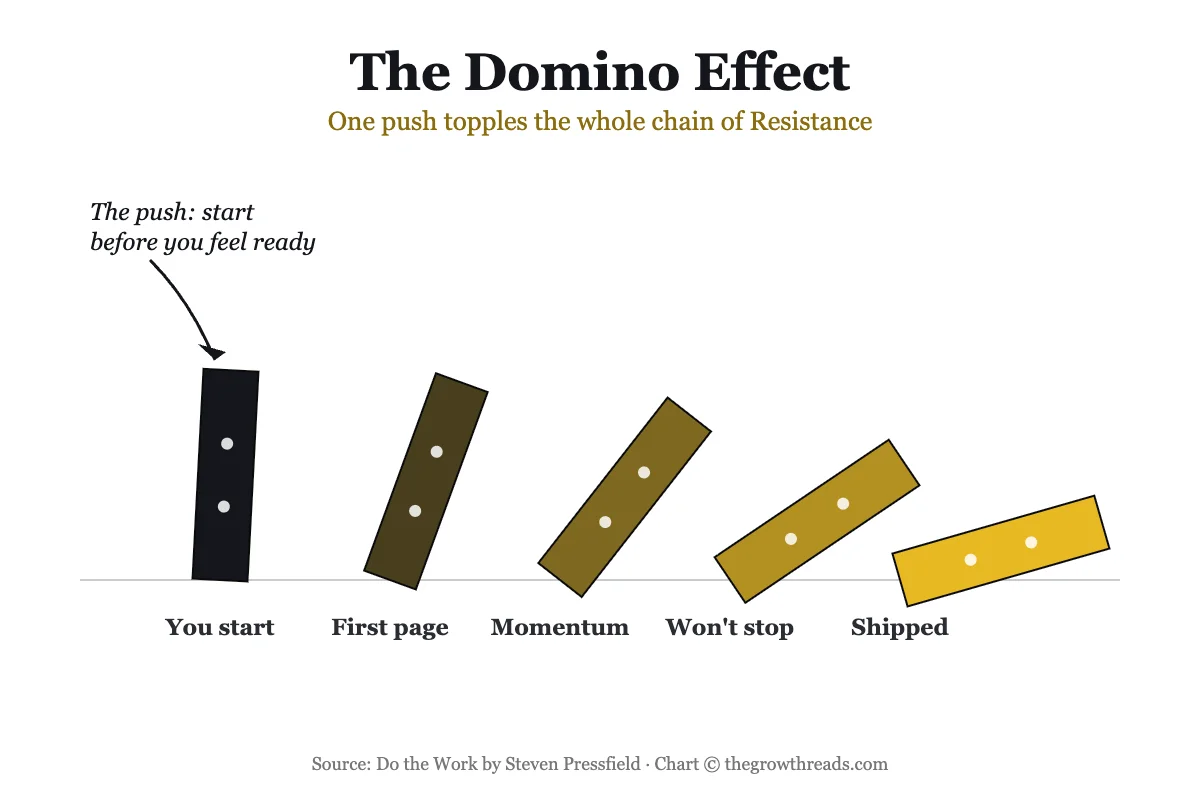
Resistance gets loudest right before you win, so the plan is simple: start before you’re ready, and ship before you’re finished polishing. Do the Work is Steven Pressfield’s short, direct companion to The War of Art — less about naming the enemy of creative work and more about a blunt sequence of moves for beating it in real time. Pressfield argues that the hardest moment on any project isn’t the beginning; it’s the stretch right before the breakthrough, when everything seems to fall apart at once. His answer isn’t a system of habits or a productivity framework — it’s a handful of mental reflexes: start anyway, assign your project a villain, sort your allies from your enemies, borrow a simple three-act shape, and treat “shipped” as the only finish line that counts.
Key takeaways
- Resistance escalates near the finish line: the hardest moment on a project is usually the one right before it would have succeeded.
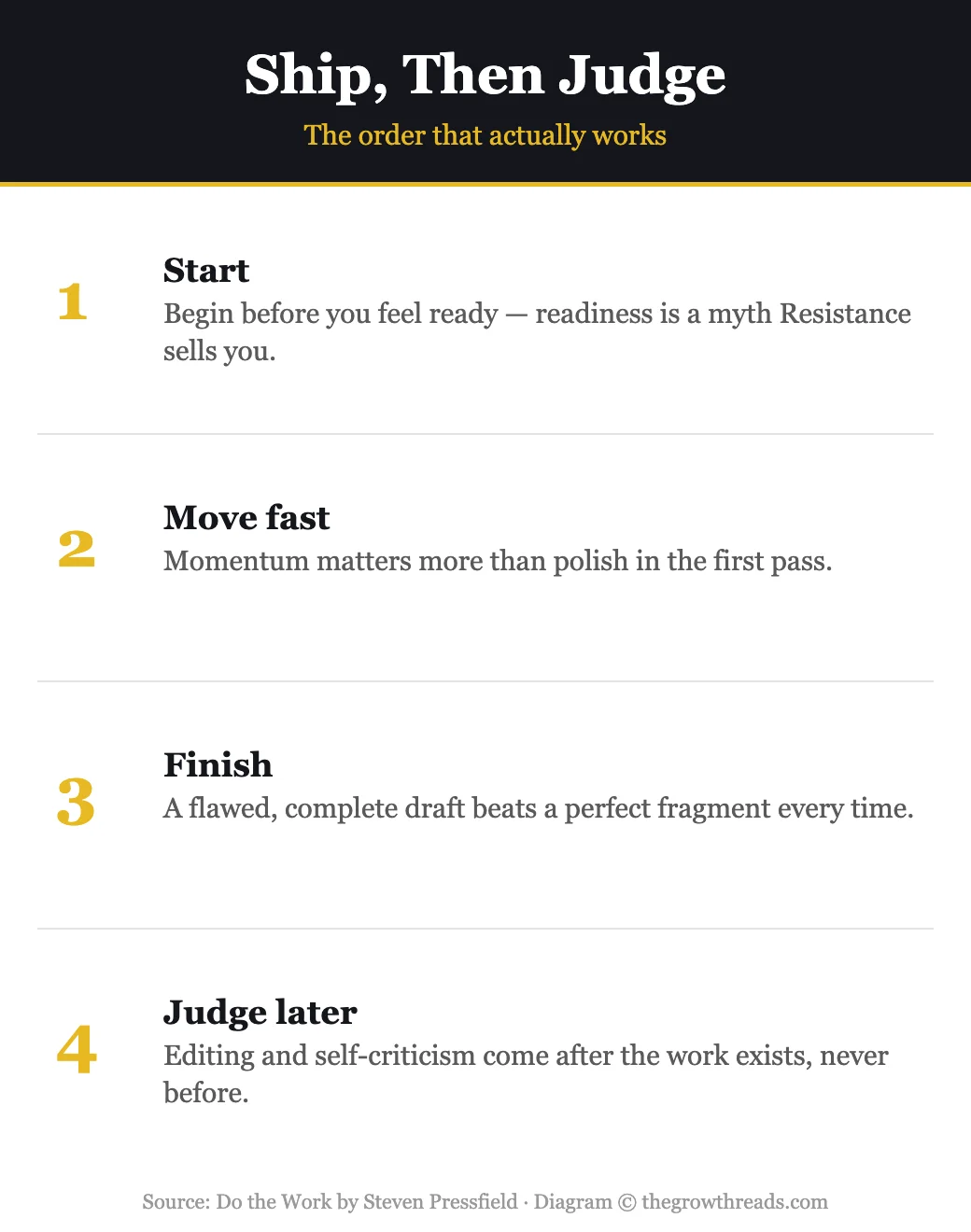
- Start before you feel ready: waiting for confidence is a stalling tactic dressed up as prudence.
- Momentum beats motivation: the second step gets easier the moment the first one exists.
- A rough, finished draft beats a polished fragment: judgment and editing come after the work exists, never before.
- Ideas hide in three places: what scares you, what you keep avoiding, and what quietly obsesses you.
- Every project needs a villain: a concrete obstacle or rival sharpens vague motivation into real drive.
- Choose your allies on purpose: not everyone around you actually wants to see you finish.
- The “rational voice” is Resistance in a lawyer’s suit: reasonable-sounding excuses that always point back to the same delay.
- Stubbornness beats intelligence: cleverness often just produces more sophisticated reasons to quit.
- Ship it: an imperfect thing in the world beats a perfect thing that only exists in your head.
What is Do the Work about?
Do the Work is Steven Pressfield’s short, blunt field manual for finishing what you start. Building on The War of Art, it names the exact moment Resistance strikes hardest — right before you succeed — and offers direct tactics for pushing through: start anyway, build momentum, and ship before perfectionism kills the project.
About the author
Steven Pressfield worked as an advertising copywriter, truck driver, and Hollywood screenwriter for two decades before his 1995 novel The Legend of Bagger Vance found wide success. He’s best known for The War of Art (2002), the book that gave “Resistance” its name as the universal force behind procrastination and self-sabotage, along with historical novels like Gates of Fire and its 2012 companion Turning Pro. Do the Work was published in 2011 through The Domino Project, an Amazon-backed imprint founded by Seth Godin, who also wrote the book’s foreword. Pressfield has spent much of his later career writing directly to other creators about the mechanics of finishing, rather than just starting, their work. Explore all Steven Pressfield book summaries →
Key concepts at a glance
| Concept | What it means | Use it when |
|---|---|---|
| Resistance | The universal force that opposes any act of creation or growth | You feel a sudden urge to quit, over-research, or “improve” instead of finish |
| The Belly of the Beast | The point of maximum difficulty right before a project’s breakthrough | Everything seems to fall apart close to a deadline |
| The rational voice | Reasonable-sounding arguments that talk you out of starting or finishing | Your reasons to delay sound smart but always point to the same excuse |
| Assign a villain | Naming a concrete obstacle or antagonist for your project | A project feels vague or you can’t locate your motivation |
| Allies vs. enemies | Sorting the people around you by whether they help or quietly hinder your finishing | You’re deciding who to share an early draft or plan with |
| Stupidity & stubbornness | Valuing persistence over cleverness when intelligence just produces more reasons to quit | You’re tempted to overthink instead of act |
| Structure (three acts) | Borrowing story structure — setup, confrontation, resolution — for any project | A project feels shapeless and you don’t know where to start |
| Ship it | Treating “done and out the door” as the only real finish line | Perfectionism is the last thing standing between you and completion |
Part 1: Why Resistance gets loudest right before you win
Pressfield’s central claim in Do the Work is almost the opposite of common sense: the moment a project feels most likely to fail is usually the moment right before it would have succeeded. He calls this the Belly of the Beast — the stretch where deadlines collide, doubt spikes, and the “rational voice” suddenly produces its most convincing argument yet for stopping. The mistake, he argues, is treating that spike in difficulty as evidence the project is wrong. It’s usually evidence the project is close.
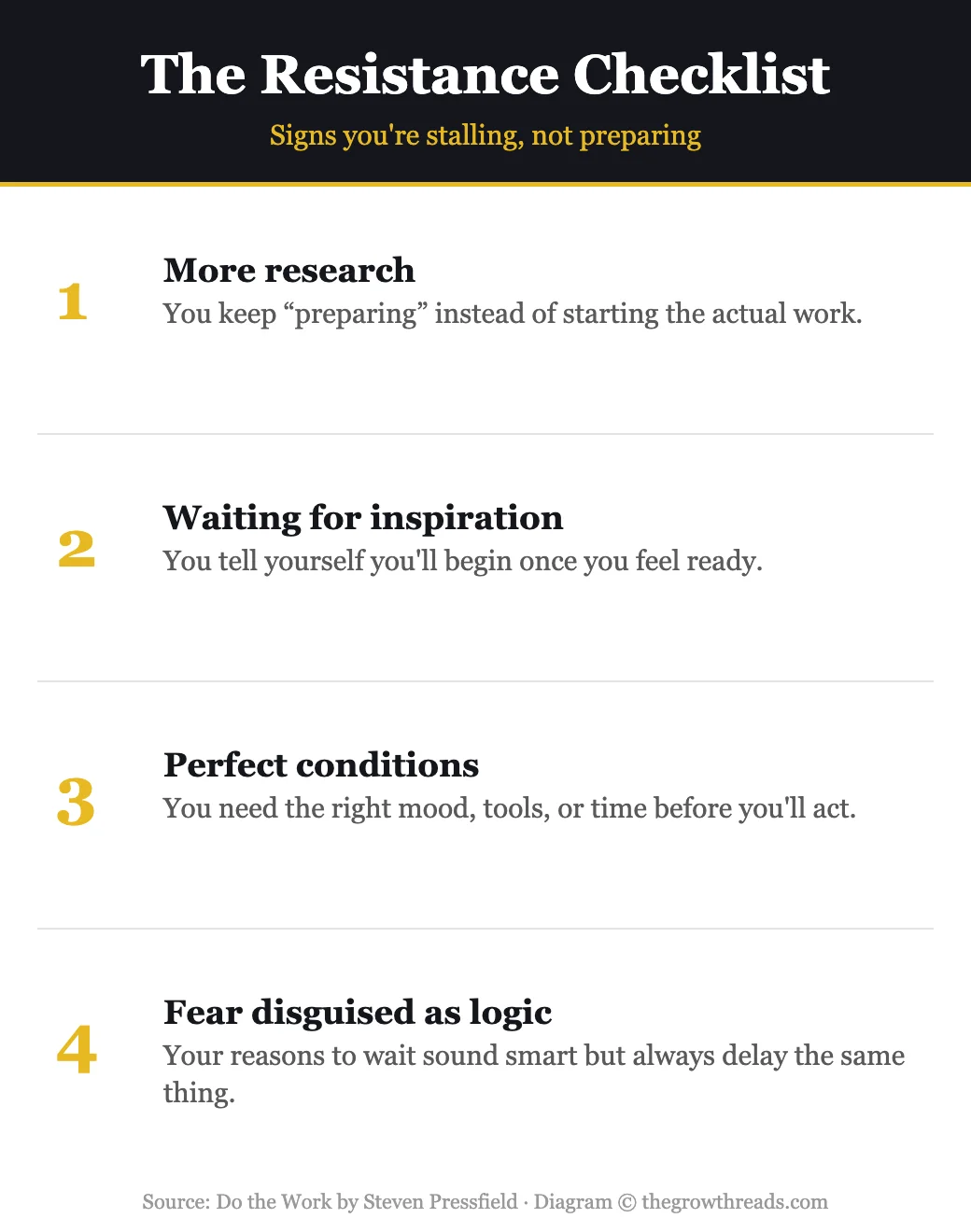
The rational voice is the book’s sharpest reframe of Resistance. It doesn’t show up as laziness or open refusal — it shows up as a smart-sounding reason to pause: “I should research this more,” “the timing isn’t right,” “I need to think this through properly.” Pressfield’s test is simple: if the same category of excuse keeps reappearing at every stage of the project, it isn’t reasoning. It’s Resistance wearing a suit. Recognizing the pattern doesn’t make the fear disappear, but it strips the excuse of its authority — you stop treating it as new information and start treating it as a familiar signal that you’re close to the work that matters.
Part 2: Find the real idea — villains, allies, and where the work is hiding
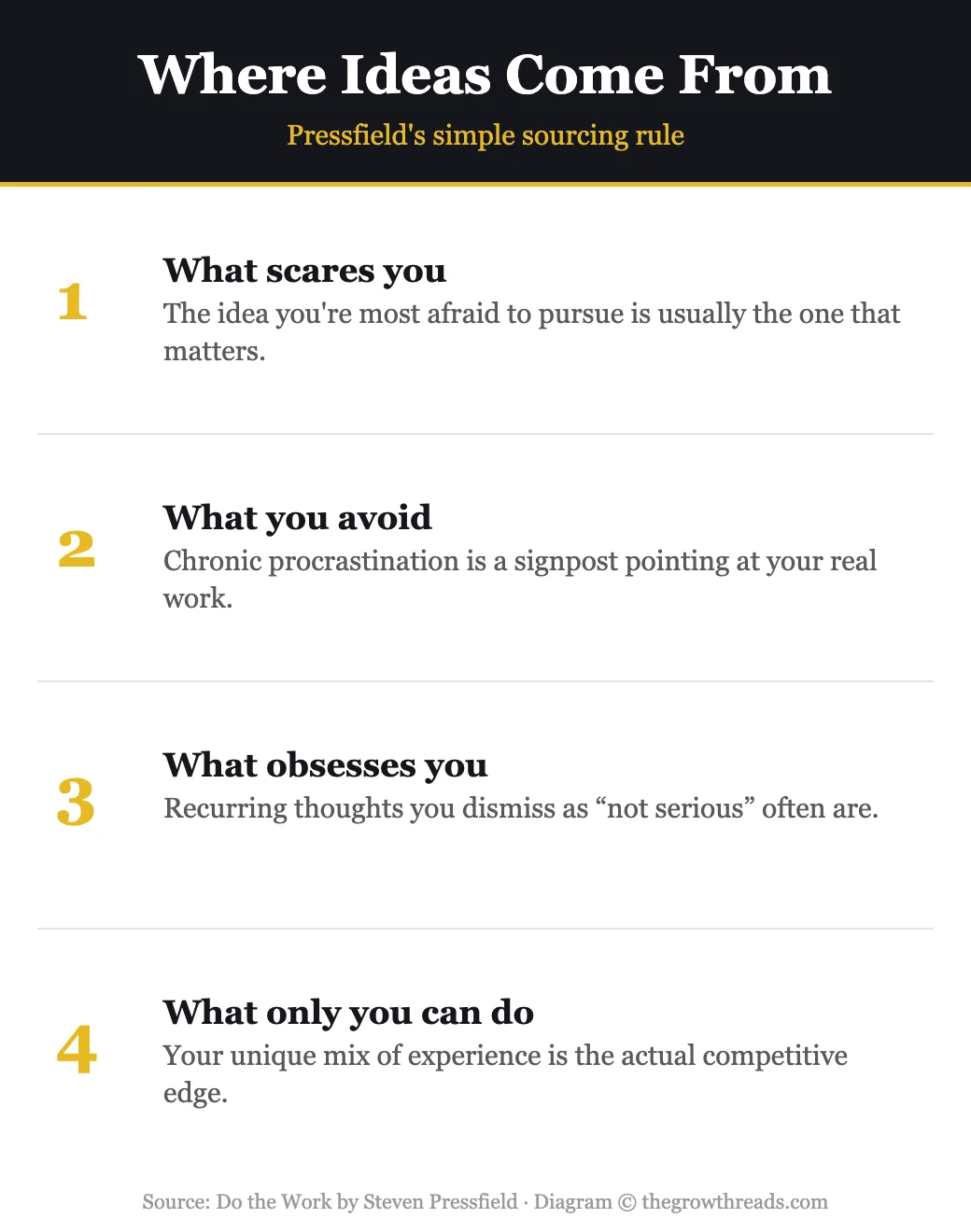
Before tactics, Pressfield insists on a source. He argues the ideas worth pursuing are hiding in three predictable places: what scares you, what you keep avoiding, and what quietly obsesses you even when you dismiss it as “not serious.” Chronic procrastination isn’t just a productivity problem in his framing — it’s a signpost. The project you keep circling without starting is usually the one that actually matters, precisely because it’s the one Resistance has flagged as dangerous to your comfort.
Once the idea is named, Pressfield borrows a storyteller’s trick: give the project a villain. Not a person necessarily — a deadline, a competitor, a version of yourself that gave up last time. A vague goal produces vague motivation; a concrete antagonist produces concrete drive. Alongside the villain comes a second sorting exercise — allies versus enemies. Some people in your life will protect your unfinished work by asking good questions and leaving you alone to do it; others, often without meaning to, will hand you a fresh excuse to stop every time you talk to them. Pressfield’s advice is unsentimental: share your early, fragile drafts only with the first group.
TGR Note: Pressfield’s own follow-up, Turning Pro, goes deeper into why we avoid the work in the first place — read it next if this chapter hit close to home and you want the identity-level explanation, not just the tactics.
Part 3: Borrow the shape — structure and momentum
A shapeless project is a stalled project, so Pressfield reaches for the oldest structural trick available: the three-act shape borrowed from storytelling — setup, confrontation, resolution — and applies it to work that has nothing to do with fiction. A business plan, a fitness goal, a home renovation, a career pivot: each has a beginning that establishes stakes, a middle where the real difficulty lives, and an end where the pieces resolve. Naming which act you’re currently in does more practical work than it sounds like it should — it turns an overwhelming, undifferentiated slog into a known stage with a known job to do.
He pairs structure with a blunt observation about intelligence: cleverness is often the enemy of finishing, because a clever mind can generate an endless supply of sophisticated reasons to stop, revise, or start over. Pressfield openly prizes a kind of productive stubbornness — even stupidity — over the endless second-guessing that intelligence enables. The goal isn’t to think less; it’s to stop letting more thinking substitute for the next concrete step.
TGR Note: If borrowed structure appeals to you but you want a fuller system for organizing daily and weekly work, our Zen to Done summary covers a lightweight habit-based framework that pairs well with this book’s momentum.
Part 4: Ship it — the discipline of finishing
The book’s last movement is the shortest and the most repeated: ship. Pressfield treats “done and out in the world” as the only finish line that counts, and he’s explicit that this means shipping something rougher than you’d like. A flawed, complete project can be improved, sold, learned from, or built on. A polished fragment sitting in a drawer can’t do any of those things — it can only keep generating the quiet anxiety of unfinished business. Momentum, in his account, is less a feeling to wait for and more a byproduct of already having started; the second work session is reliably easier than the first, which is itself the strongest argument for never waiting to feel ready.
Pressfield closes by returning to the Belly of the Beast: expect the hardest part to arrive right before the end, expect the rational voice to make its best case exactly then, and treat that as confirmation you’re close rather than a signal to stop.
TGR Note: For a longer treatment of “small and shipped beats big and perfect” as a business philosophy rather than a personal habit, see our Company of One summary.
Who is Do the Work best for — and who should read something else first?
Do the Work is best for anyone with a specific stalled project — a manuscript, a business idea, a portfolio, a fitness goal — who already knows what they want to do but can’t get moving on it. Its short length and blunt tone make it a good same-day read when you need a push rather than a curriculum.
If you want to understand the deeper identity shift behind chronic avoidance rather than tactics for a single project, read Turning Pro first. If your blocker is a lack of daily systems rather than a lack of nerve, Zen to Done is the better starting point. And if what’s stopping you is closer to exhaustion than fear, Eat Sleep Work Repeat addresses the burnout side of the equation that this book doesn’t.
Questions to reflect on
- What project have you been “researching” for months without actually starting?
- Where does your rational voice show up — what’s the excuse you always reach for first?
- If you assigned a villain to your current project, what or who would it be?
- Who in your life is an ally to your finishing, and who — even with good intentions — quietly isn’t?
- What would “shipped, not perfect” look like for the thing you’re avoiding today?
🔥 Ready to stop circling and start shipping?
Get Do the Work and read it in one sitting — it’s built to be finished, not studied.
How to apply Do the Work (7-day plan)
- Day 1: Name the one project you’ve been avoiding and write down exactly what “shipped” means for it.
- Day 2: Identify your rational voice’s go-to excuse — write it down word for word so you recognize it next time.
- Day 3: Assign a villain to the project: a concrete obstacle, deadline, or rival to push against.
- Day 4: Work for 25 minutes without editing anything — let the output be rough on purpose.
- Day 5: Sort the people around this project into allies and enemies; tell one ally what you’re working on.
- Day 6: Push through the hardest, most resistant part head-on — expect it to feel worse right before it clicks.
- Day 7: Ship the smallest complete version you can, publicly if possible.
Frequently asked questions
What does “Do the Work” mean in this book?
It means treating “shipped” as the only finish line that counts, rather than “planned,” “researched,” or “almost ready.” Pressfield uses the phrase to cut through every stage of preparation that quietly substitutes for actually starting and finishing a specific piece of work.
Is this a sequel to The War of Art?
It’s a companion rather than a direct sequel. The War of Art names Resistance as the force behind self-sabotage; Do the Work assumes you already recognize that force and gives shorter, more tactical advice for pushing a specific project through to completion, especially in its hardest final stretch.
What is the “Belly of the Beast”?
It’s Pressfield’s term for the point of maximum difficulty right before a project’s breakthrough — when deadlines, doubt, and setbacks seem to collide at once. He argues this isn’t a sign the project is failing; it’s usually a sign you’re close, and Resistance is making its strongest final push.
How is Do the Work different from Turning Pro?
Do the Work is tactical and project-specific — how to start, structure, and ship one piece of work. Turning Pro is broader and more identity-focused, about the underlying decision to stop living as an amateur across your whole creative life. Many readers use Do the Work for an active project and Turning Pro for the deeper mindset shift.
Do I need to read The War of Art first?
No, but it helps. The War of Art defines Resistance in depth; Do the Work assumes a working familiarity with the concept and moves quickly into tactics. Readers new to Pressfield can start with either, though The War of Art gives more context for why the tactics here work.
How long does it take to read?
Do the Work is one of Pressfield’s shortest books, well under 100 pages, and most readers finish it in a single sitting of 60 to 90 minutes. It’s intentionally written to be read in one pass rather than studied chapter by chapter.
What’s the single most useful idea to take from this book?
That the hardest moment on a project is usually a sign you’re close, not a sign you’re wrong. Reframing a spike in difficulty as confirmation rather than a stop signal is the idea readers most often say changed how they finish work.
Related summaries
Continue exploring resistance, structure, and finishing with these summaries: Turning Pro, Company of One, Eat Sleep Work Repeat, Zen to Done, or browse our full best productivity books pillar guide.
How we analyze books: we read primary sources and the author’s own essays and interviews, cross-reference key claims, and focus on practical application over academic critique. Read our full methodology.
Related Time Management Summaries
Dopamine Detox Summary & Review: Reset Your Brain to Do Hard Things
Eat Sleep Work Repeat Summary & Review: Rebuilding Joy at Work
It Doesn’t Have to Be Crazy at Work Summary & Review: Build the Calm Company
The CHAOS Cure Summary & Review: Clean Your House in 15 Minutes a Day
The Time Trap Summary & Review: The Classic Guide to Self-Generated vs. Environmental Time Wasters