

★★★★★ 4.5/5 — A short, blunt, galvanizing sequel to The War of Art about the decision that ends self-sabotage.
Best for: Anyone who keeps starting creative or ambitious projects and never quite finishing them.
Reading time: ~3 hrs to read the book, 11 min for this guide.
Difficulty to apply: Simple to understand, hard to sustain — it asks for a permanent shift in identity, not a technique.
Turning Pro in one minute
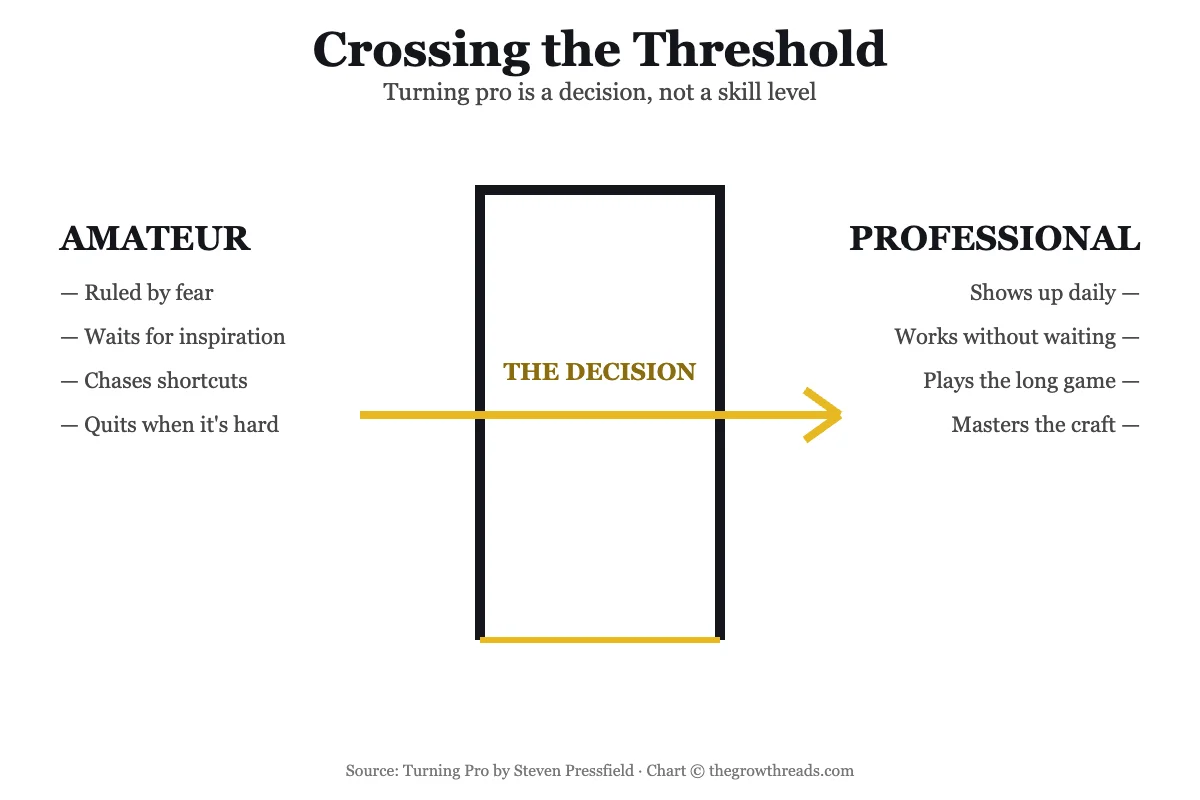
You don’t turn pro by getting good enough — you turn pro the moment you decide to stop being an amateur, and the skill catches up later. Steven Pressfield, continuing the argument he started in The War of Art, argues that most people who feel stuck on their creative or meaningful work aren’t stuck because they lack talent or opportunity. They’re stuck because they’re still operating as amateurs: waiting for inspiration, chasing shortcuts, quitting at the first sign of difficulty, and quietly settling into a “shadow career” that resembles their real calling just enough to numb the guilt of avoiding it. Turning pro, in his telling, isn’t about quitting your job or achieving some level of mastery — it’s an internal decision to treat your work with the discipline, patience, and seriousness a professional brings, starting today, regardless of skill level. The book is short and blunt by design, meant to be read in one sitting as a kind of wake-up call rather than a step-by-step manual.
Key takeaways
- Turning pro is a decision, not a skill level: professionals aren’t defined by talent, but by how seriously they treat the work.
- The amateur is ruled by fear: waiting for confidence or inspiration before starting is amateur behavior, however talented the person.
- The shadow career is a trap: a safer, lesser version of your real calling that quiets guilt without ever satisfying you.
- Professionals show up on schedule: discipline and routine matter more than motivation on any given day.
- The long haul is the whole game: professionals measure progress in years, not days or weeks.
- Failure is data, not identity: a professional treats a bad day’s work as information, not a verdict on their worth.
- Turning pro often means grief first: letting go of the amateur identity can feel like losing something, even though it isn’t.
- Resistance escalates as you turn pro: the internal force opposing creative work gets louder, not quieter, once you commit.
- Mastery requires humility: professionals study fundamentals instead of assuming natural talent is enough.
- The decision can be made today: you don’t need permission, credentials, or perfect conditions to turn pro right now.
What is Turning Pro about?
Turning Pro is Steven Pressfield’s argument that the difference between an amateur and a professional isn’t talent or skill, but a decision to treat your work seriously, starting now. The book identifies the “shadow career” — a safer substitute for your real calling — and lays out the discipline, patience, and humility that mark a genuine professional mindset.
About the author
Steven Pressfield is a novelist and nonfiction writer best known for The War of Art, a widely read book on creative resistance, and for historical novels including Gates of Fire. Before becoming a full-time writer, he spent years working odd jobs — advertising copywriter, truck driver, schoolteacher — while struggling for over a decade to sell his first novel, an experience that directly informs his writing about Resistance and the amateur-to-professional transition. Turning Pro continues the argument he began in The War of Art, drawing on his own long, difficult path to becoming a working writer as evidence that the professional mindset can be adopted before external success ever arrives. Explore all Steven Pressfield book summaries →
Key concepts at a glance
| Concept | What it means | Use it when |
|---|---|---|
| Turning pro | The internal decision to treat your work with professional seriousness, regardless of skill level | You keep waiting to feel “ready” before committing to your work |
| Resistance | The internal force that opposes meaningful creative or ambitious work | Recognizing why a project keeps stalling despite good intentions |
| Shadow career | A safer, lesser substitute for your real calling | Noticing a nagging dissatisfaction with work that otherwise looks fine |
| The amateur | Someone ruled by fear, waiting for inspiration or ideal conditions | Diagnosing self-sabotage or chronic starting-and-stopping |
| The professional | Someone who shows up on schedule and treats the work as non-negotiable | Building a sustainable daily practice around meaningful work |
| The long haul | Measuring progress in years rather than days | Staying committed when early results feel discouragingly small |
Part 1: The amateur’s hidden logic
Pressfield opens by describing amateur behavior not as laziness, but as a coherent, if self-defeating, logic: waiting for inspiration protects you from the risk of trying and failing while fully committed. As long as you haven’t really tried, you can’t really fail. The amateur mindset isn’t about lacking ambition — it’s a strategy, usually unconscious, for staying safe from the vulnerability that real effort requires.
He’s careful to note this isn’t a moral failing. Everyone operates as an amateur in some area of life. The point isn’t shame — it’s recognition, because you can’t make the decision to turn pro until you can see clearly that you’ve been avoiding it.
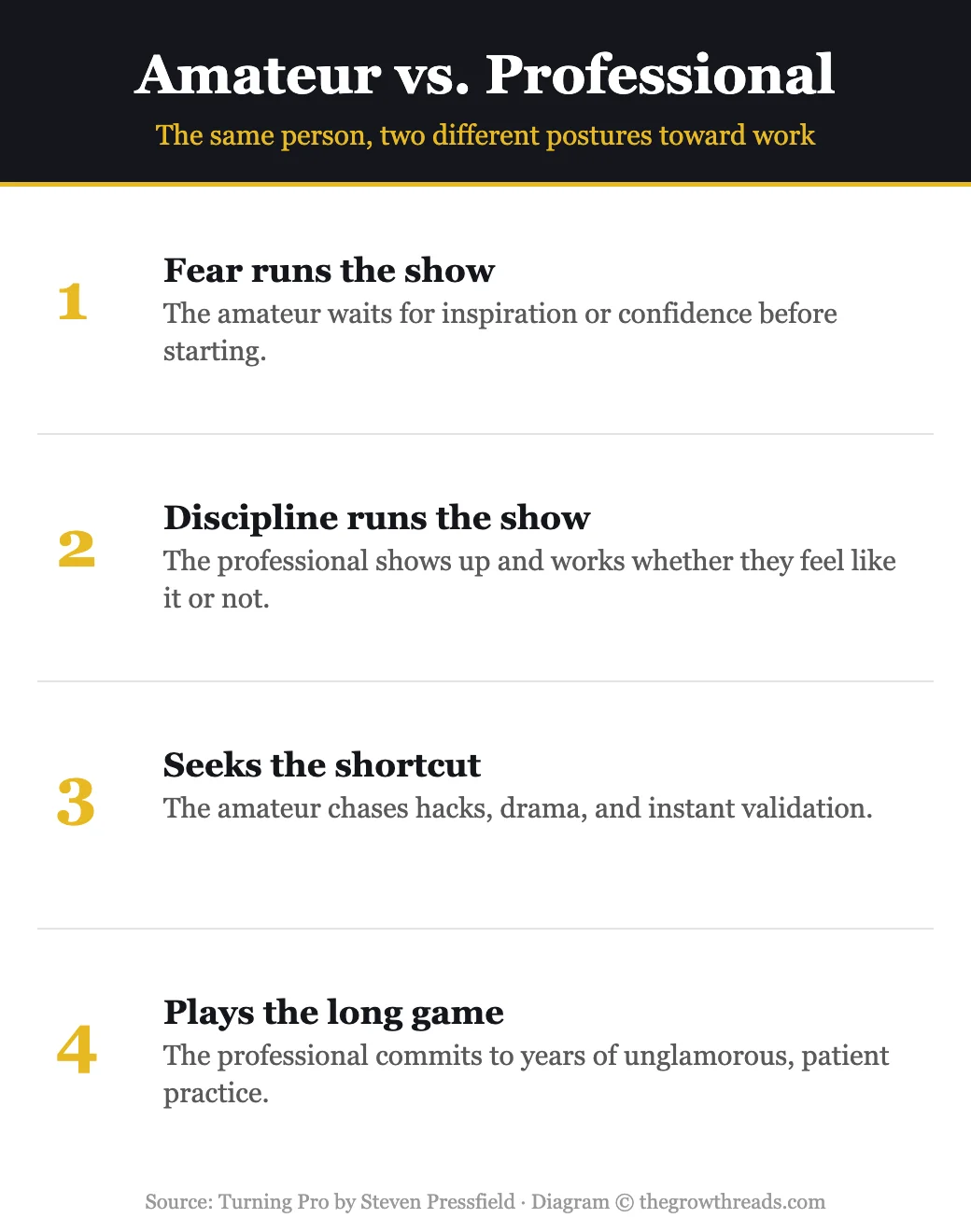
Pressfield is careful to note that this “hidden logic” rarely looks like laziness from the outside. Amateurs are often busy, even exhausted — chasing a dozen half-finished side projects, redesigning a logo instead of writing the book, or drowning in “research” that never turns into a draft. The activity feels productive, which is exactly what makes it such an effective disguise for Resistance. Turning pro doesn’t mean doing more; it means being honest about which of those activities are the work and which are elaborate ways of avoiding it.
Part 2: Finding your shadow career
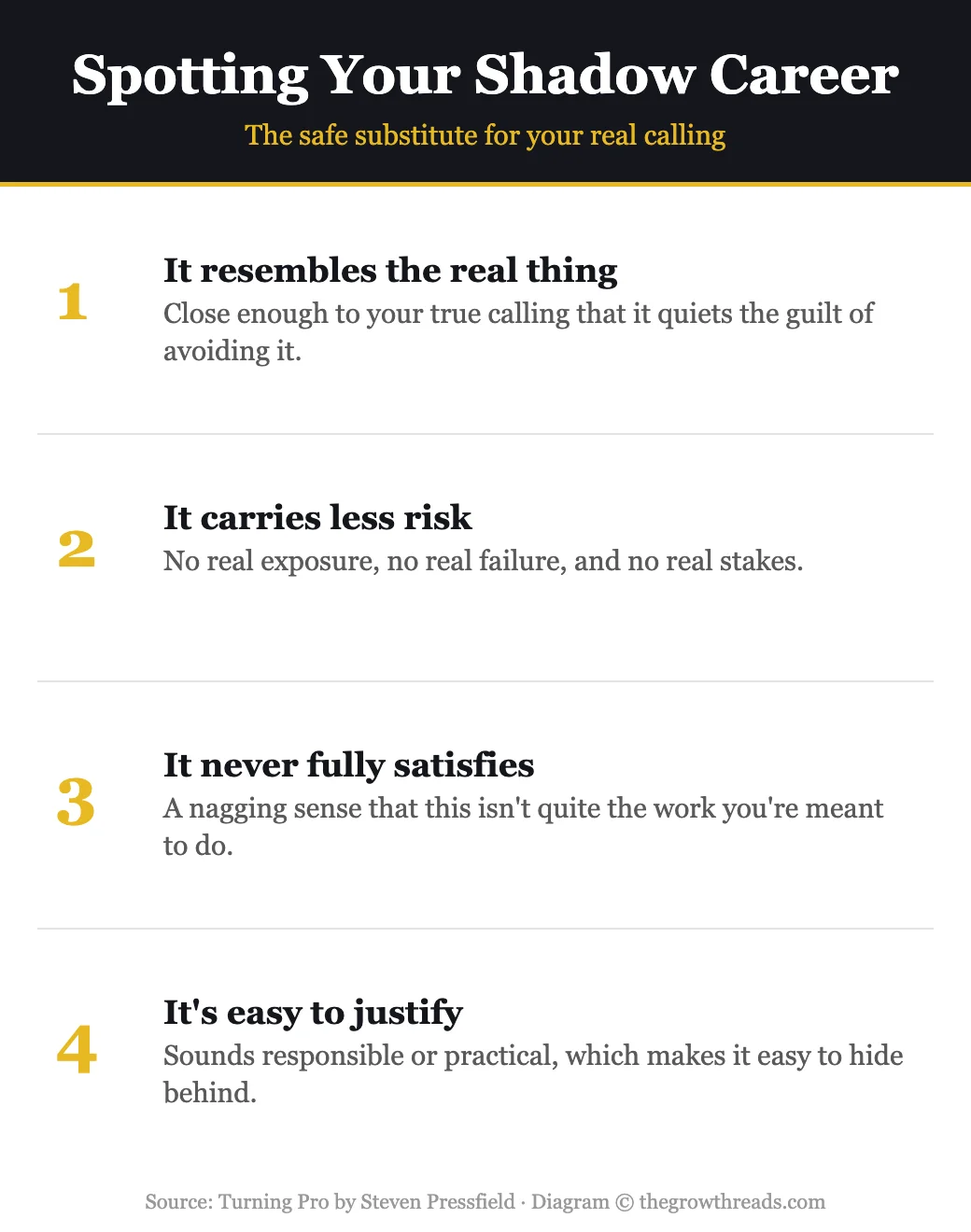
The book’s most useful diagnostic tool is the concept of the shadow career — work that resembles your true calling closely enough to quiet the guilt of avoiding it, without ever actually being it. A writer who spends years “someday” writing a novel while working exclusively in marketing copy may be in a shadow career. A person who dreams of starting a business but only ever reads books about entrepreneurship may be too.
Spotting a shadow career requires honesty most people avoid, because the shadow career often looks responsible, even admirable, from the outside. Pressfield’s point is that comfort and safety are exactly what make it so easy to stay there indefinitely.
Part 3: What professionals actually do
Once the decision to turn pro is made, Pressfield gets concrete about what that looks like day to day. Professionals show up on a fixed schedule regardless of mood, because waiting to feel like working is itself amateur thinking. They study their craft’s fundamentals with humility instead of assuming raw talent is sufficient, and they measure progress across years rather than expecting fast validation.
Crucially, professionals don’t take a bad day’s output personally. A weak draft or a failed attempt is treated as information about the work, not a verdict on the person’s worth — a distinction Pressfield argues is what allows professionals to keep going where amateurs quit.
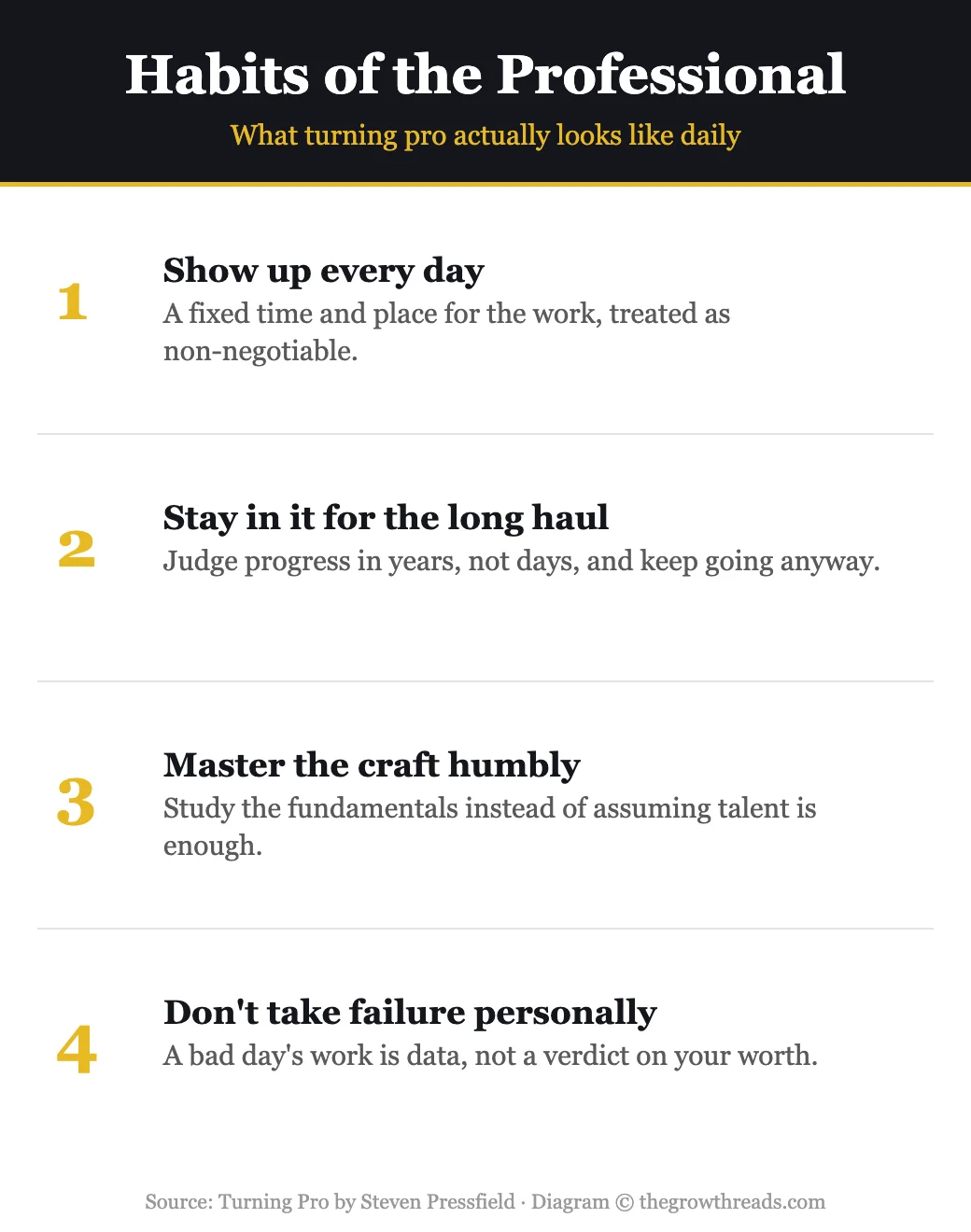
What separates this from sheer willpower is that professionals don’t wait to feel confident before they act — they’ve simply stopped treating fear and self-doubt as a stop sign. Pressfield describes this as acting “in the face of fear,” not after it passes. A professional novelist still feels the blank page’s pull toward distraction every morning; the difference is a pre-decided structure — a set start time, a minimum page count, a closed-door policy — that makes the decision to work automatic rather than something willpower has to re-win daily.
Part 4: The grief of leaving amateur life
Perhaps the book’s most unexpected argument is that turning pro often comes with real grief. Leaving the amateur identity means giving up its comforts: the excuse of not really trying, the safety of the shadow career, the identity of someone with unrealized potential rather than tested, visible results. Pressfield treats this loss as genuine and worth acknowledging rather than something to simply push through.
He also warns that Resistance — the internal force opposing meaningful work — tends to escalate once someone actually turns pro, rather than fading away. The stakes feel higher because they are; this isn’t a sign turning pro was the wrong call, but a predictable part of the process worth expecting in advance.
Who is Turning Pro best for — and who should read something else first?
Turning Pro is best for anyone who keeps starting creative, entrepreneurial, or ambitious work and never quite following through, especially readers already familiar with The War of Art. It’s a short, intense read meant to prompt a decision, not a gradual behavior-change program.
If you want practical daily systems rather than a mindset shift, start with Zen to Done instead. If your stall is about burnout rather than avoidance, Can’t Even is the more targeted read. And if you’re specifically building a business rather than a creative practice, Company of One is a useful companion.
Questions to reflect on
- Is there a shadow career in your life quietly substituting for the work you actually want to do?
- What specific fear is behind your own amateur behavior around this work?
- What would showing up on a fixed schedule, regardless of mood, actually look like for you?
- Where have you taken a bad day’s output personally instead of treating it as information?
- What would you have to grieve or give up in order to fully turn pro?
🔥 Ready to make the decision?
Get Turning Pro and stop waiting to feel ready.
How to apply Turning Pro (7-day plan)
- Day 1: Identify one area where you suspect you’re living in a shadow career.
- Day 2: Name the specific fear behind your amateur avoidance of that work.
- Day 3: Set a fixed daily time and place for the real work, treated as non-negotiable.
- Day 4: Show up at that time even if you don’t feel ready or inspired.
- Day 5: Study one fundamental of your craft you’ve been skipping past.
- Day 6: Treat today’s output, good or bad, as information rather than a verdict.
- Day 7: Write down what turning pro would cost you to give up, and decide anyway.
Frequently asked questions
What does “turning pro” mean in this book?
It means making an internal decision to treat your work with the discipline, patience, and seriousness of a professional, regardless of your current skill level or external success — Pressfield argues the decision comes first, and competence follows.
Is this book a sequel to The War of Art?
Yes — it continues Pressfield’s argument about Resistance, the internal force opposing meaningful work, and focuses specifically on the shift from amateur to professional mindset as the practical next step after recognizing Resistance.
What is a “shadow career”?
A shadow career is a safer, lesser version of your true calling — close enough to quiet the guilt of avoiding the real thing, but never fully satisfying, since it isn’t actually the work you’re meant to do.
Do you need talent to turn pro?
No — Pressfield is explicit that turning pro is a decision about how you treat your work, not a statement about your current skill level. He argues the professional mindset can, and should, be adopted before mastery arrives.
Is the book practical, or mostly motivational?
It leans motivational and philosophical rather than tactical — there’s no detailed daily system. It’s best read as a mindset reset, ideally paired with a more concrete productivity book for implementation.
How long is Turning Pro?
It’s short, well under 200 pages, and deliberately written in brief, punchy sections meant to be read quickly, often in a single sitting, to maximize its impact as a call to action rather than a slow-burn study.
What’s the single most useful idea to take from this book?
That you don’t need to wait for confidence, talent, or ideal conditions to turn pro — the decision to treat your work seriously can be made today, and it’s the decision itself, not external validation, that actually changes things.
Related summaries
- Can’t Even by Anne Helen Petersen
- Company of One by Paul Jarvis
- Eat Sleep Work Repeat by Bruce Daisley
- Zen to Done by Leo Babauta
- Best Productivity Books
How we analyze books: our team reads each title in full, cross-references the author’s other published work and interviews, and builds original diagrams and application plans rather than summarizing chapter by chapter. Read our full methodology.
Related Time Management Summaries
Finish What You Start Summary & Review: Follow Through Without Relying on Motivation
I Know How She Does It Summary & Review: What 1,001 Time Logs Reveal About “Having It All”
Margin Summary & Review: Restoring the Reserves Overload Has Stolen
Off the Clock Summary & Review: Why Equally Busy People Feel Different About Time
Organize Tomorrow Today Summary & Review: Plan Tonight, Win Tomorrow