

★★★★☆ 4.3/5 — A rigorous, research-backed map of how your sense of past, present, and future quietly runs your life.
Best for: Anyone who procrastinates, over-plans, or can’t figure out why some choices feel automatic.
Reading time: ~8 hrs to read the book, 13 min for this guide.
Difficulty to apply: Moderate — the framework is simple, but shifting a lifelong perspective takes deliberate practice.
The Time Paradox in one minute
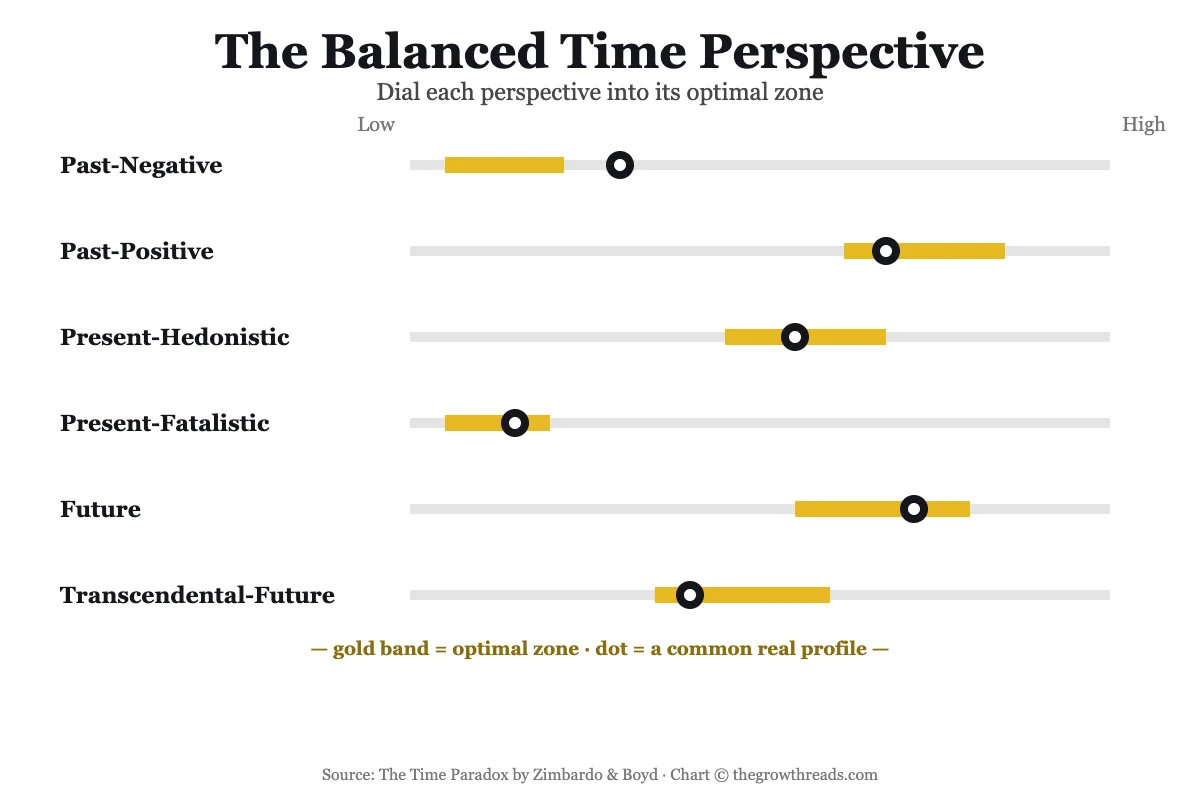
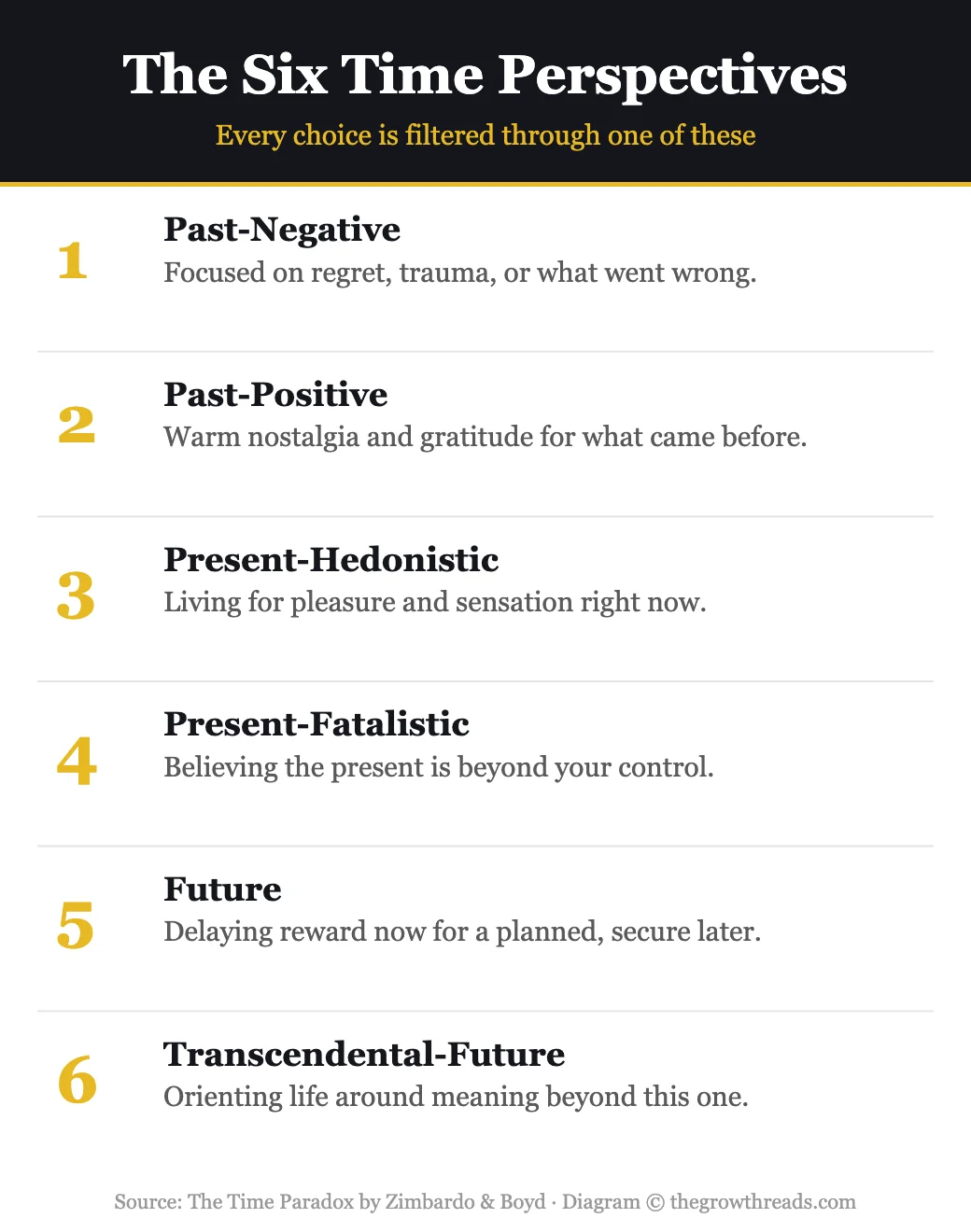
You don’t just have a personality — you have a time perspective, and it’s making your decisions before you notice you’re making them. Stanford psychologist Philip Zimbardo, famous for the Stanford Prison Experiment, teamed up with John Boyd to show that everyone unconsciously leans on one of six ways of relating to time: dwelling on regret (Past-Negative), cherishing memory (Past-Positive), chasing sensation (Present-Hedonistic), feeling powerless (Present-Fatalistic), delaying gratification (Future), or orienting around meaning beyond this life (Transcendental-Future). None of these perspectives is inherently good or bad — the trouble starts when one dominates so completely that it crowds out the others. The Time Paradox lays out decades of research showing that a specific, balanced mix — high Past-Positive, moderate-high Future, moderate Present-Hedonistic, and low levels of Past-Negative and Present-Fatalistic — predicts better health, relationships, and life satisfaction than any single-minded extreme. The book’s real power is diagnostic: once you can name your own default time perspective, you can finally see why certain decisions have always felt automatic, and start deliberately dialing in a healthier mix.
Key takeaways
- Time perspective is mostly unconscious: it operates as a background filter on nearly every choice, from what you eat to how you plan your career.
- There are six core perspectives: Past-Negative, Past-Positive, Present-Hedonistic, Present-Fatalistic, Future, and Transcendental-Future.
- No single perspective is “correct”: each one is adaptive in the right context and harmful in excess.
- A balanced profile predicts well-being: high Past-Positive, moderate-high Future, and moderate Present-Hedonistic outperform any extreme.
- Past-Negative and Present-Fatalistic are the riskiest defaults: both correlate strongly with anxiety, depression, and poor health outcomes.
- Your perspective was shaped early: family stability, culture, and even climate quietly nudge people toward certain defaults.
- Perspective mismatches strain relationships: a Future-dominant partner and a Present-Hedonistic partner often clash over money and planning without realizing why.
- Workplaces have dominant time cultures: some reward long-term planning, others reward present-focused hustle, and friction follows a mismatch.
- You can shift your perspective deliberately: small, repeated practices can raise or lower each dimension over time.
- Awareness alone changes behavior: simply naming your default perspective makes its influence easier to notice and interrupt.
What is The Time Paradox about?
The Time Paradox is Philip Zimbardo and John Boyd’s research-based framework showing that everyone defaults to one of six unconscious time perspectives — rooted in past, present, or future — which silently shapes decisions, relationships, and well-being. The book explains how to identify your own default and deliberately shift toward a healthier, more balanced mix.
About the author
Philip Zimbardo is a professor emeritus of psychology at Stanford University, best known for the controversial 1971 Stanford Prison Experiment and for his later work as president of the American Psychological Association. Over a decades-long career, his research increasingly turned toward understanding everyday psychology rather than crisis behavior, which led him to time perspective theory. John Boyd holds a PhD in social psychology and worked alongside Zimbardo developing and validating the Zimbardo Time Perspective Inventory, the assessment tool that underlies much of this book’s framework. Together they bring both rigorous research credentials and decades of applied testing to a theory that has since been used in clinical, educational, and organizational settings worldwide. Explore all Philip Zimbardo & John Boyd book summaries →
Key concepts at a glance
| Concept | What it means | Use it when |
|---|---|---|
| Time perspective | An unconscious default lens — past, present, or future — through which you filter decisions | Trying to understand a recurring, seemingly irrational choice pattern |
| Balanced time perspective | A healthy mix: high Past-Positive, moderate-high Future, moderate Present-Hedonistic, low negative extremes | Setting a target profile to work toward |
| Past-Negative | A default lens of regret, trauma, or “what went wrong” | Recognizing rumination that keeps replaying old mistakes |
| Present-Fatalistic | Believing outcomes are outside your control | Explaining chronic passivity or “why bother” thinking |
| Perspective mismatch | Two people or a person and their environment default to conflicting time lenses | Diagnosing recurring friction in a relationship or team |
| Temporal reframing | Deliberately practicing a different time lens to shift your default | Trying to lower Past-Negative or raise Past-Positive on purpose |
Part 1: The six lenses you didn’t know you were wearing
Zimbardo and Boyd open by making the invisible visible: everyone has a dominant time perspective, and almost no one has consciously chosen it. It was shaped by family stability, culture, religion, even the pace of the environment you grew up in. A perspective isn’t a personality trait exactly — it’s more like a habitual camera angle your mind uses by default when weighing any decision, from whether to save for retirement to whether to eat the cookie.
The book’s contribution is turning this into something measurable. The Zimbardo Time Perspective Inventory, validated across large populations, scores people on all six dimensions rather than forcing a single label. That matters because most people aren’t purely one type — they carry a blend, and it’s the shape of that blend, not any single dominant trait, that predicts how well someone tends to function.
Part 2: Why extremes go wrong
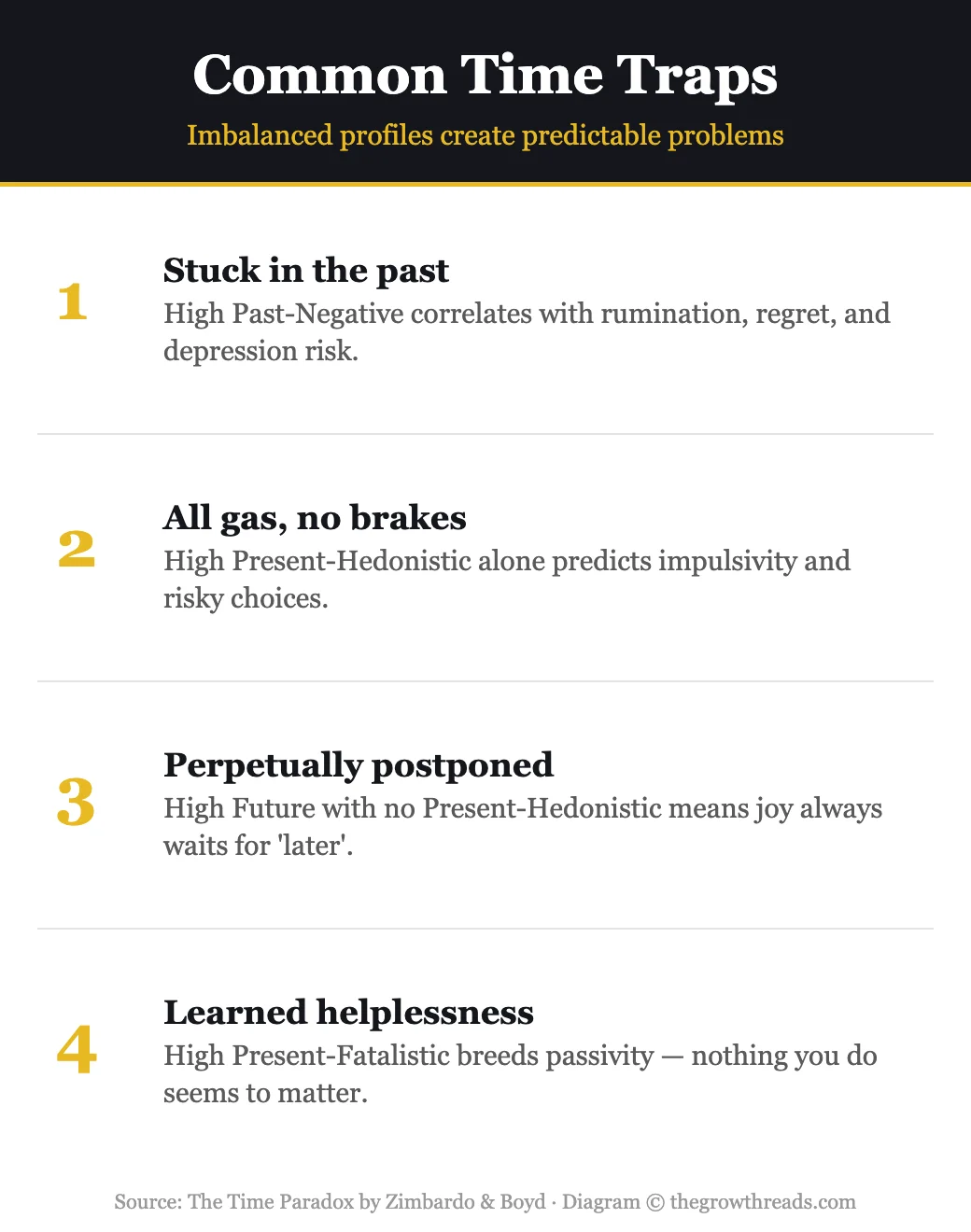
No single perspective is condemned outright in this book — each has a legitimate use. Present-Hedonistic thinking makes vacations enjoyable; Future thinking makes retirement accounts exist. The danger is monoculture: when one lens crowds out the rest so completely that a person can’t access the others when the situation calls for it.
The two riskiest defaults, the data shows, are Past-Negative and Present-Fatalistic. High Past-Negative correlates strongly with depression and anxiety, since every new situation gets filtered through old regret. High Present-Fatalistic correlates with passivity and poor health choices, since effort feels pointless if outcomes seem predetermined. Interestingly, a Future orientation taken to its own extreme isn’t harmless either — an unbroken focus on later can mean a life that never actually arrives at “now,” which is its own quiet form of unhappiness.
Part 3: When perspectives collide
Because most people never consciously identify their own time perspective, mismatches quietly poison relationships and workplaces without anyone naming the real cause. A Future-dominant partner who wants to save aggressively can read a Present-Hedonistic partner’s spending as irresponsible, when it’s really just a different, equally valid default lens. The same friction plays out at work: a manager who rewards long-range planning can unintentionally punish present-focused employees who are actually excellent at handling what’s urgent right now.
Zimbardo and Boyd’s point isn’t that couples or teams need to match perspectives exactly — that’s rarely realistic and not even desirable, since a mixed team often covers more ground. The point is that naming the mismatch turns an unexplained conflict into a solvable one. Once both sides can see “we’re just running different clocks,” blame gives way to negotiation.
Part 4: Changing your default on purpose
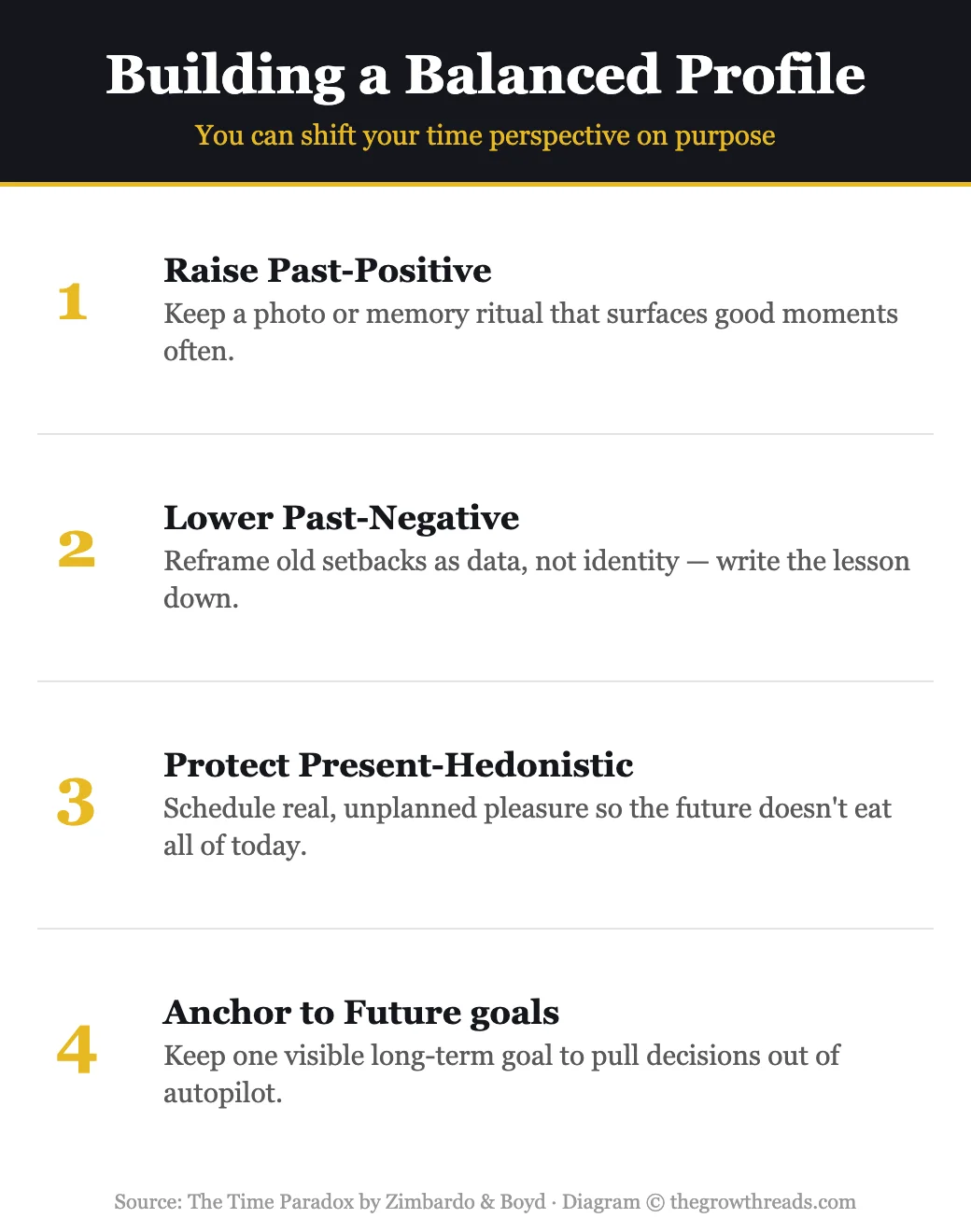
The book’s most practical claim is also its most hopeful: time perspective isn’t fixed. It was learned, which means at least part of it can be relearned through deliberate, repeated practice. Lowering Past-Negative might mean reframing an old failure as useful data instead of a verdict on your character. Raising Past-Positive might mean a simple ritual — a photo, a journal entry — that keeps good memories accessible instead of buried under the negative ones people tend to remember more vividly by default.
Protecting Present-Hedonistic means scheduling real, unplanned pleasure instead of letting a Future orientation consume every open hour. And strengthening a healthy Future orientation, for someone who’s Present-dominant, can be as simple as keeping one long-term goal visibly posted somewhere it gets seen daily. None of these shifts happen from insight alone — they happen from small, repeated actions that retrain which lens the mind reaches for first.
Who is The Time Paradox best for — and who should read something else first?
The Time Paradox is best for chronic planners, chronic procrastinators, and anyone who has ever wondered why the same decision feels effortless for a friend and impossible for them. It’s especially useful for couples and managers trying to understand recurring, unexplained friction.
If you want a more direct, day-to-day productivity system rather than a psychological framework, start with Zen to Done instead. If your main struggle is a critical inner voice rather than a time orientation, Chatter is the more targeted read. And if you’re specifically working through burnout rather than general time psychology, Can’t Even is the better starting point.
Questions to reflect on
- Which of the six time perspectives do you lean on most heavily when making everyday decisions?
- Where has a Past-Negative or Present-Fatalistic lens quietly shaped a choice you assumed was purely rational?
- Is there a relationship in your life where a time-perspective mismatch, not a values mismatch, might explain the recurring friction?
- What would raising your Past-Positive perspective by just 10% look like in a normal week?
- Where in your life is an unbalanced Future orientation quietly crowding out real, unplanned enjoyment?
🔥 Ready to find your time perspective?
Get The Time Paradox and see which lens has been running your decisions.
How to apply The Time Paradox (7-day plan)
- Day 1: Take stock informally — for each decision today, notice which time lens seemed to drive it.
- Day 2: Write down one old regret and reframe it as a lesson learned, not a verdict on your character.
- Day 3: Start a Past-Positive ritual — jot down one good memory or take one photo worth keeping.
- Day 4: Schedule one hour of real, unplanned Present-Hedonistic enjoyment with no productive goal.
- Day 5: Post one long-term goal somewhere visible to strengthen a healthy Future orientation.
- Day 6: Notice a recurring conflict with a partner, friend, or coworker and ask whether a time-perspective mismatch explains it.
- Day 7: Choose the one perspective shift from this week worth keeping, and build a small habit around it.
Frequently asked questions
What is time perspective theory, in simple terms?
It’s the idea that everyone unconsciously defaults to one of six ways of relating to time — regretful, nostalgic, pleasure-seeking, fatalistic, future-focused, or transcendent — and that this default silently shapes everyday decisions until you learn to notice and adjust it.
What is the ideal or “balanced” time perspective?
Research summarized in the book points to high Past-Positive, moderate-high Future, moderate Present-Hedonistic, and low Past-Negative and Present-Fatalistic as the profile most consistently linked to well-being, healthy relationships, and life satisfaction.
Can you actually change your time perspective?
Yes — the authors present it as learned rather than fixed, and describe deliberate practices, like gratitude rituals to raise Past-Positive or scheduled unplanned enjoyment to protect Present-Hedonistic, that can shift a person’s default profile over time with consistent effort.
How is this different from a general personality test?
Personality tests describe broad, relatively stable traits. Time perspective is narrower and more actionable — it’s specifically about how you relate to past, present, and future, and unlike many personality traits, the authors argue it can be deliberately reshaped with practice.
Is Present-Hedonistic thinking always bad?
No — the book is clear that no single perspective is inherently bad. Present-Hedonistic thinking, in moderation alongside the other perspectives, supports enjoyment and spontaneity. Problems arise only when it dominates so completely that planning and follow-through disappear.
Some of Zimbardo’s broader work, like the Stanford Prison Experiment, has been criticized — does that affect this book?
That’s a fair point worth knowing about the author’s history, though it concerns a separate, earlier study. The time perspective research in this book rests on its own large-scale validated inventory and a substantial, independently replicated body of evidence.
What’s the single most useful idea to take from this book?
That the “irrational” choices you or people around you make are often perfectly rational within a different, unconscious time perspective — naming that lens turns confusing friction into something you can actually work with.
Related summaries
- Chatter by Ethan Kross
- Can’t Even by Anne Helen Petersen
- Zen to Done by Leo Babauta
- Peak Performance by Brad Stulberg & Steve Magness
- Best Productivity Books
How we analyze books: our team reads each title in full, cross-references the author’s other published work and interviews, and builds original diagrams and application plans rather than summarizing chapter by chapter. Read our full methodology.
Related Time Management Summaries
Die Empty Summary & Review: Spend Your Potential Before It’s Gone
Gentle Summary & Review: A Sustainable Alternative to Hustle Culture
Off the Clock Summary & Review: Why Equally Busy People Feel Different About Time
Scrum Summary & Review: Doing Twice the Work in Half the Time
Your Brain at Work Summary & Review: Work With Your Brain, Not Against It