

★★★★★ (4.7/5) — Stillness is not passivity. It’s the discipline that makes clear thinking, right action, and lasting peace possible.
Best for: Anyone whose days feel reactive and scattered and wants a practical, historically grounded case for slowing the mind, spirit, and body down together.
Reading time: ~6 hrs to read (288 pages) · ~20 min to skim this guide
Difficulty to apply: Easy — most of the practices are single daily habits, not full systems.
Stillness Is the Key in one minute
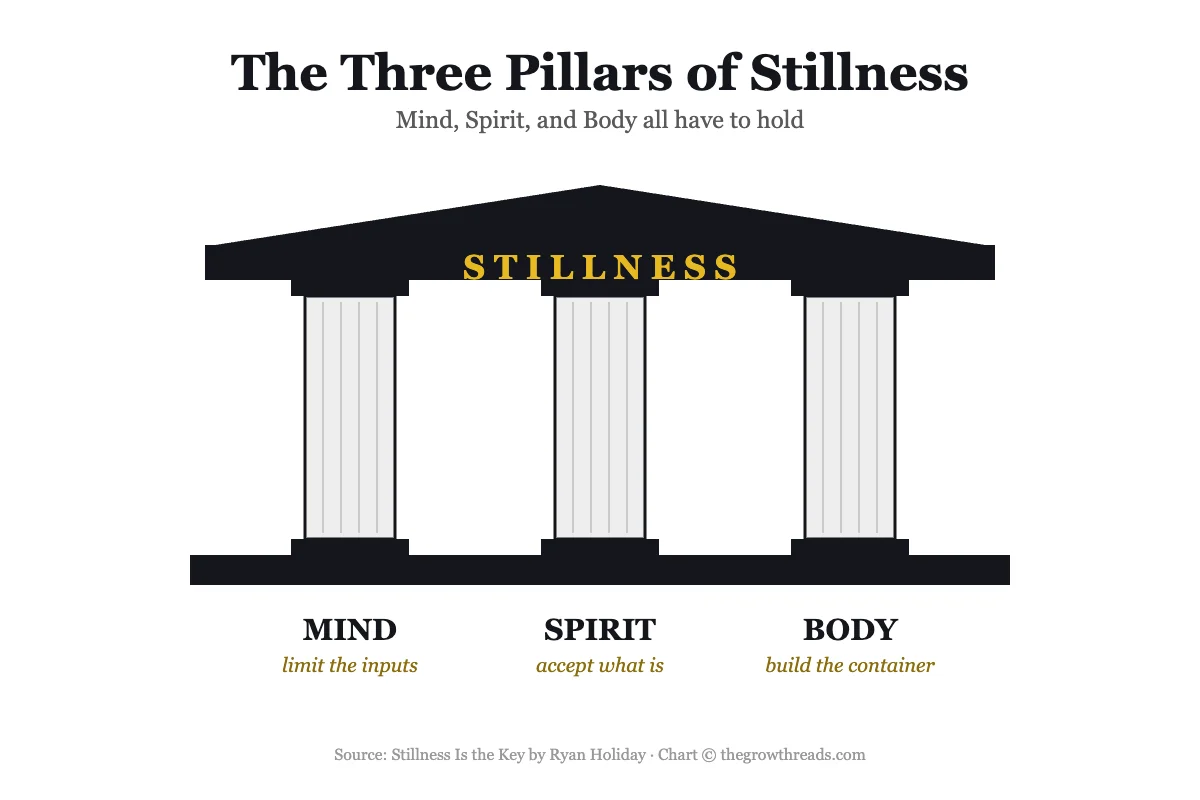
History’s most consequential decisions were rarely made in moments of frantic activity — they were made in moments of stillness. Ryan Holiday, a bestselling author steeped in Stoic philosophy, argues that stillness — mental clarity amid chaos — is the through-line connecting history’s clearest leaders, thinkers, and athletes: John F. Kennedy pausing before responding to the Cuban Missile Crisis, Marcus Aurelius writing in his tent between military campaigns, Tiger Woods rebuilding his game around presence rather than mechanics. Drawing on Stoic, Buddhist, and Christian traditions, Holiday organizes his case around three domains that all have to work together: the mind (what you let in and dwell on), the spirit (what you accept and value), and the body (the physical conditions that make calm possible). None of the three works in isolation — a still mind in a chaotic environment, or a disciplined body serving an ego-driven spirit, both eventually collapse.
Key takeaways
- Stillness is a skill, not a personality trait: anyone can build it deliberately, regardless of temperament.
- Mind, spirit, and body all have to hold together: progress in only one domain rarely sticks on its own.
- Presence beats perfect information: most bad decisions come from reacting too fast, not from lacking data.
- Say no more than you say yes: protecting attention is a daily, active choice, not a passive default.
- Journaling externalizes looping thoughts: writing them down gets them out of your head, where they stop consuming bandwidth.
- Gratitude quiets the chase: naming what already works reduces the restless pull toward what’s still missing.
- A personal code removes relitigating: deciding your values in advance means fewer exhausting decisions in the moment.
- Sleep and unhurried walking are infrastructure: not indulgences, but the physical conditions stillness depends on.
- Silence and solitude let the mind process: even a few unplugged minutes shift you from reacting to thinking.
- History’s clearest decision-makers made room for stillness under real pressure: not just in ideal, low-stakes conditions.
What is Stillness Is the Key about?
Stillness Is the Key, by Ryan Holiday, argues that mental clarity amid chaos — not frantic activity — is what separates history’s clearest thinkers and most effective leaders from everyone else. Drawing on Stoic, Buddhist, and Christian traditions, Holiday shows how stillness of mind, spirit, and body together enables better decisions, deeper work, and lasting peace.
About the author
Ryan Holiday worked as director of marketing at American Apparel and as a media strategist before becoming a full-time writer, and he’s credited with helping popularize Stoic philosophy for a modern audience through a string of bestsellers including The Obstacle Is the Way and Ego Is the Enemy. He also owns and runs the Painted Porch, an independent bookstore in Bastrop, Texas, and edits the widely read Daily Stoic newsletter. Stillness Is the Key (2019) is the third book in his loose trilogy on Stoic virtue, following courage (The Obstacle Is the Way) and humility (Ego Is the Enemy) with a book on temperance and clarity. Holiday’s method throughout is consistent: pairing ancient philosophy with modern research and vivid historical case studies, translating centuries-old ideas into daily, practical habits. Explore all Ryan Holiday book summaries →
Key concepts at a glance
| Concept | What it means | Use it when |
|---|---|---|
| The three domains | Mind, spirit, and body all have to hold together for real stillness | Diagnosing why a change in only one area of life isn’t sticking |
| Limiting inputs | Protecting attention by saying no to most minor opportunities | Your days feel reactive and scattered |
| Accepting what is | Releasing the endless chase for more before peace can arrive | Achievement keeps arriving without satisfaction following it |
| A personal code | A set of values decided in advance, not relitigated daily | Facing a decision that keeps causing the same stress each time |
| Unhurried walking | Low-effort movement with no destination or goal | You need to think, but pushing harder isn’t producing clarity |
| Building routine | A fixed structure for small decisions that frees up willpower | Decision fatigue is eating into focus on what actually matters |
| Historical stillness | Great decisions in history were made in moments of calm, not chaos | Facing high pressure and needing a model for how to respond |
Part 1: The mind — clarity over noise
Holiday opens with John F. Kennedy during the Cuban Missile Crisis, arguably the closest the modern world has come to nuclear war. With advisors pushing for an immediate strike, Kennedy insisted on slowing the process down — reading, gathering perspectives, refusing to let the pressure of the moment dictate an irreversible decision. That pause, Holiday argues, likely saved millions of lives. The lesson generalizes far below world-historical stakes: most bad decisions come not from a lack of information but from reacting before there’s room to think clearly.
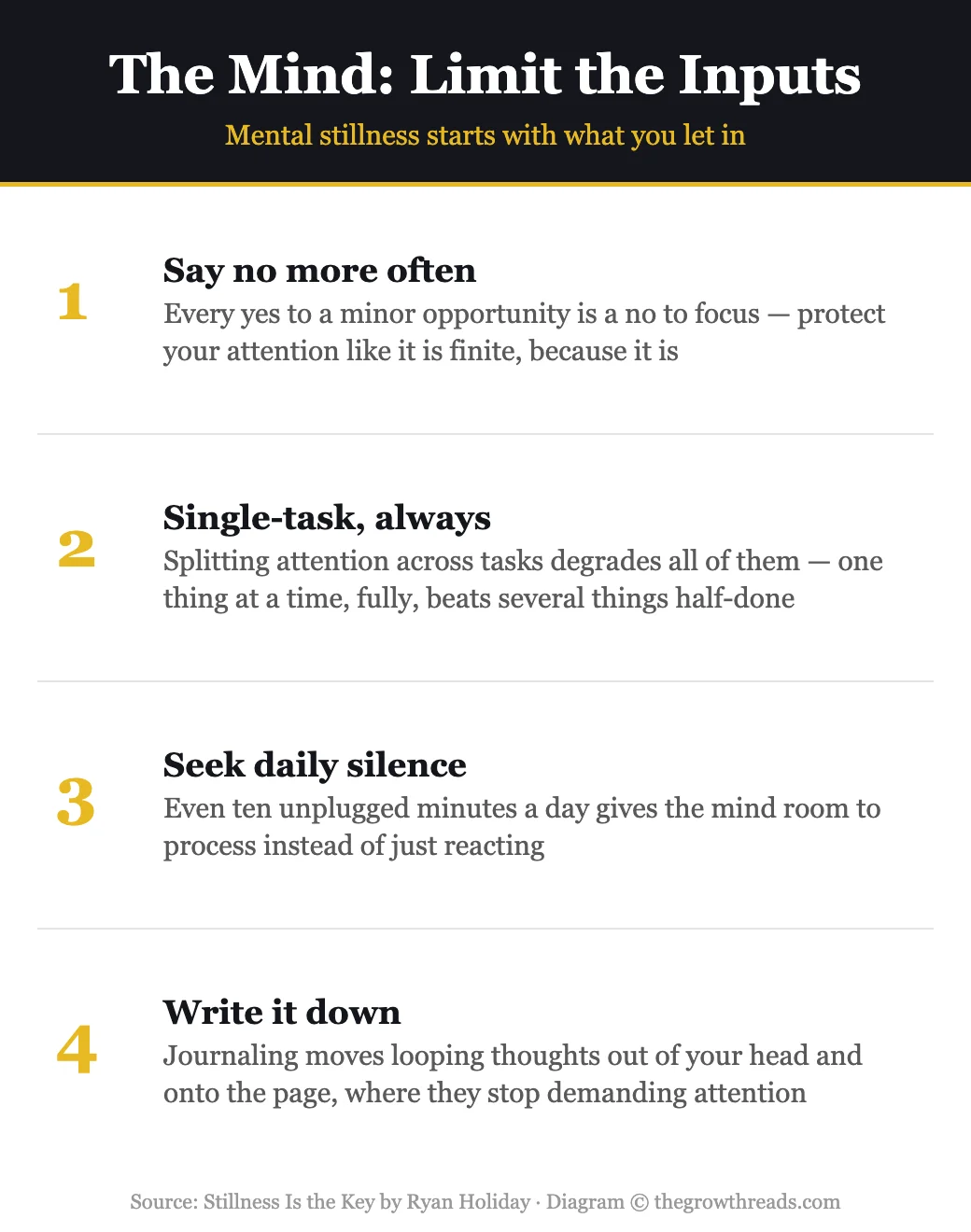
Building that room, in Holiday’s framework, starts with limiting what gets into the mind in the first place. Every yes to a minor opportunity, notification, or distraction is a quiet no to focus. He’s direct about the cost of multitasking — splitting attention across tasks degrades performance on all of them — and makes the case for single-tasking and daily journaling as ways to externalize looping thoughts before they consume the bandwidth needed for real thinking.
TGR Note: The single-tasking argument here echoes what we found in Time Rich — protecting a narrow window of undivided attention consistently beats spreading focus thin across more hours.
Part 2: The spirit — peace over chasing
The second domain is harder to pin down because it isn’t about doing anything — it’s about what you accept and what you’re still chasing. Holiday draws on the Stoics’ emphasis on contentment, contrasting it with the trap of achievement that never satisfies: milestone after milestone arrives, and the restlessness doesn’t lift because the goalpost keeps moving with it. Tiger Woods’ public collapse and quieter rebuilding serves as one of the book’s more pointed case studies — a career built on relentless external validation eventually buckling under its own weight, and a slower, more internally grounded version of success emerging only once the chase itself was questioned.
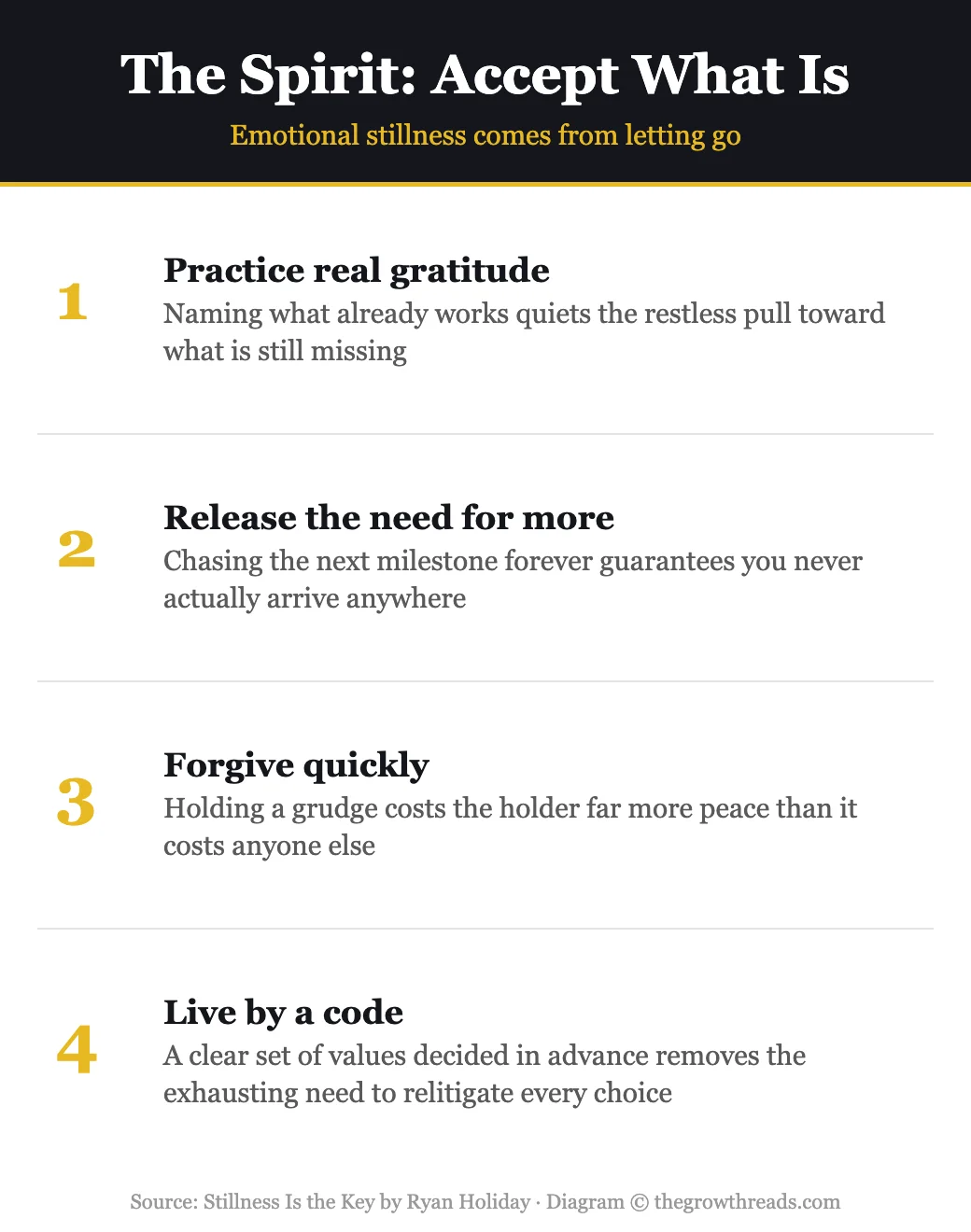
Practically, Holiday points to gratitude as one of the more reliable levers here: consciously naming what already works quiets the pull toward what’s still missing, at least temporarily. He also argues for deciding on a personal code of values in advance, so that recurring decisions — the kind that generate the same stress every time they resurface — get settled once instead of relitigated endlessly.
TGR Note: This “chasing versus contentment” tension shows up again, from a different angle, in Peak Performance — where unrelenting external stress without recovery produces the same eventual collapse Woods experienced.
Part 3: The body — the container for calm
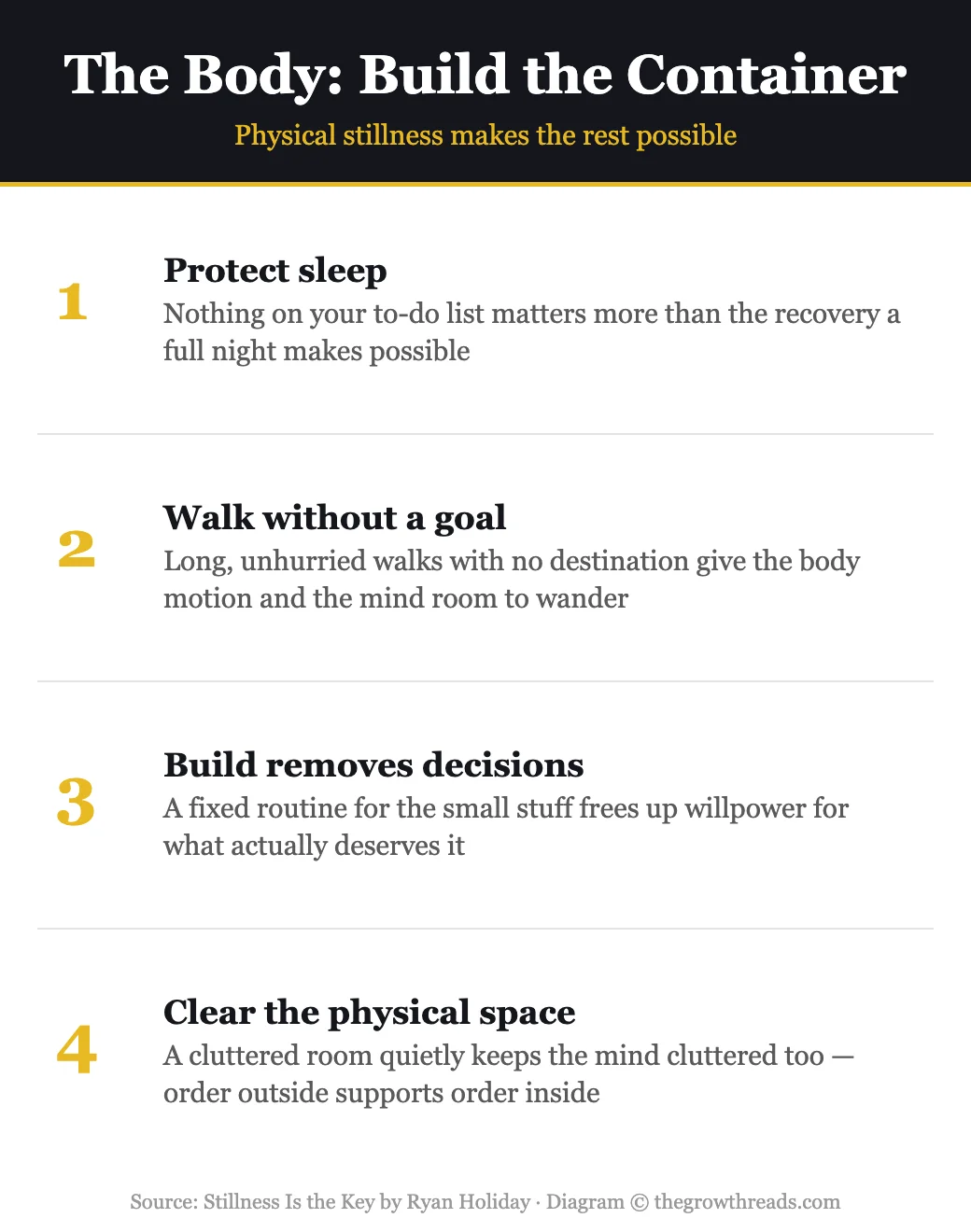
The third domain grounds the other two in something physical. Holiday points to sleep as non-negotiable — not a nice-to-have but the baseline condition that everything else in the book assumes is already in place. He also makes a case for unhurried walking specifically, distinct from exercise-for-fitness: movement with no destination, which gives the body something to do while freeing the mind to actually wander, a practice several of the book’s historical figures relied on for working through hard problems.
Routine gets similar treatment. A fixed structure for small, recurring decisions — what to wear, when to eat, how the morning starts — removes the accumulated friction of deciding those things fresh every day, leaving more willpower available for decisions that actually deserve it. And Holiday extends the same logic to physical space: a cluttered environment, he argues, quietly keeps the mind cluttered along with it, which is why so many of the figures profiled in the book kept notably spare, uncomplicated physical surroundings.
TGR Note: Sleep as a non-negotiable baseline is a theme we keep running into across this whole collection, including in Peak Performance — it’s rarely the exciting takeaway, but it’s consistently the one everything else depends on.
Part 4: Stillness under real pressure
The book’s final throughline is that stillness matters most exactly when it’s hardest to access — under genuine pressure, not in ideal, low-stakes conditions. Holiday returns repeatedly to figures who found calm inside genuinely difficult circumstances: Anne Frank cultivating an inner richness of thought while confined in hiding, Marcus Aurelius writing reflections on virtue between military campaigns rather than after retiring from public life, Fred Rogers maintaining a deliberately unhurried, calm on-camera presence through decades of a rapidly changing and often turbulent media landscape. None of them waited for circumstances to become calm before practicing stillness. They built the capacity for it precisely because circumstances weren’t going to cooperate.
That’s the book’s most useful reframe: stillness isn’t a reward you get once conditions improve. It’s a practice that has to be built during the conditions you actually have, because those are the only conditions that ever reliably show up.
TGR Note: If the underlying issue is less about external chaos and more about internal avoidance, Solving the Procrastination Puzzle tackles that emotional dimension directly.
Who is Stillness Is the Key best for — and who should read something else first?
Stillness Is the Key is best suited to readers whose days feel reactive and scattered and who want a practical, historically grounded case for slowing down across mind, spirit, and body together — not just one productivity hack. If you want a concrete system for finding and protecting time itself first, Time Rich is the more tactical starting point. If your challenge is specifically about sustaining hard effort without burning out, Peak Performance covers that stress-and-recovery cycle in more depth. And if the real obstacle is emotional avoidance rather than external noise, Solving the Procrastination Puzzle addresses that directly.
Questions to reflect on
- When was the last time you made a big decision from a place of genuine calm, rather than under time pressure?
- What’s one minor opportunity or input you could say no to this week, purely to protect your attention?
- Is there a goalpost in your life that keeps moving the moment you reach it — and what would it take to actually feel arrived?
- What recurring decision keeps causing you the same stress, and what would a fixed personal rule settle once and for all?
- What does your physical space say about the state of your mind right now?
🔥 Ready to build real stillness into your life?
Grab a copy of Stillness Is the Key and start with the mind, spirit, or body — wherever you need it most.
How to apply Stillness Is the Key (7-day plan)
- Day 1: Notice one moment today when you reacted instantly instead of pausing — what would ten seconds of stillness have changed?
- Day 2: Say no to one minor opportunity or request purely to protect your attention.
- Day 3: Spend ten minutes journaling whatever thoughts have been looping in your head, with no goal beyond getting them onto the page.
- Day 4: Take a walk with no destination and no podcast — just movement and an unstructured mind.
- Day 5: Write down three things that already work in your life, before reaching for the next thing you think you need.
- Day 6: Pick one recurring decision that stresses you out and decide, once, what your rule for it will be from now on.
- Day 7: Clear one physical space — a desk, a drawer, a room — and notice whether your mind feels different afterward.
Frequently asked questions
What is the main idea of Stillness Is the Key?
The book argues that stillness — mental clarity amid chaos, rather than frantic activity — is what separates history’s clearest thinkers and most effective leaders from everyone else. Ryan Holiday organizes this around three domains that all have to work together: the mind (limiting inputs and staying present), the spirit (accepting what is and releasing the chase for more), and the body (the physical conditions, like sleep and routine, that make calm possible). None of the three works well in isolation from the other two.
Is Stillness Is the Key based on Stoic philosophy specifically?
Stoicism is the dominant lens, consistent with Holiday’s other books, but he draws just as heavily on Buddhist and Christian traditions and on secular historical case studies — scientists, athletes, artists, and political leaders. The book is less a Stoicism primer than a synthesis: whichever tradition or case study best illustrates a given point about stillness is the one Holiday reaches for.
What are the three pillars of stillness in the book?
Mind, spirit, and body. The mind covers limiting inputs, single-tasking, and journaling. The spirit covers accepting what is, practicing gratitude, and living by a settled personal code of values. The body covers sleep, unhurried walking, routine, and a decluttered physical environment. Holiday’s central claim is that progress in only one of these three areas tends not to stick — real stillness requires all three holding together.
Is this book only for people in high-stress leadership roles?
No. While many of the case studies involve leaders and public figures under extreme pressure — Kennedy during the Cuban Missile Crisis, Marcus Aurelius during military campaigns — the practical advice is aimed at ordinary daily life: limiting notifications, taking unhurried walks, journaling, and building small routines. The historical examples illustrate the stakes; the actual habits scale down to any schedule.
How is Stillness Is the Key different from Holiday’s other books?
It’s the third in a loose trilogy built around Stoic virtues: The Obstacle Is the Way focuses on courage and turning adversity into advantage, Ego Is the Enemy focuses on humility and managing ambition, and Stillness Is the Key focuses on temperance and clarity. The three share a method — ancient philosophy paired with modern research and historical case studies — but each addresses a distinct virtue and a distinct set of practical habits.
What are some quick, practical takeaways from Stillness Is the Key?
Three are especially easy to start today: say no to one minor input or opportunity to protect your attention; take a walk with no destination and no phone, purely to let your mind wander; and write down a settled rule for one recurring decision that currently causes you the same stress every time it comes up.
How does Stillness Is the Key compare to Peak Performance or Rest-focused books?
Peak Performance and similar books focus specifically on the stress-and-recovery cycle behind sustainable achievement. Stillness Is the Key operates at a broader level — it’s less about optimizing a performance cycle and more about a general disposition of calm and clarity across every part of life, including moments that have nothing to do with achievement or output at all. The two frameworks complement each other well: one for how to recover from stress, the other for how to think clearly regardless of how much stress you’re under.
Related summaries
- Time Rich by Steve Glaveski
- Peak Performance by Brad Stulberg & Steve Magness
- Solving the Procrastination Puzzle by Timothy A. Pychyl
- Best Productivity Books
How we analyze books: our summaries are researched from the author’s published work, interviews, and reputable secondary sources, then structured around practical application rather than critique. Read our full methodology.
Related Time Management Summaries
How to Do Nothing Summary & Review: Resisting the Attention Economy
Off the Clock Summary & Review: Why Equally Busy People Feel Different About Time
Two Awesome Hours Summary & Review: Protect Your Peak Time Each Day
Work Clean Summary & Review: Borrow a Chef’s Discipline
Zen to Done Summary & Review: The Simple Productivity System That Actually Sticks