

⭐⭐⭐⭐⭐ 4.6/5 — A therapist-poet turns “what makes love work” into five concrete needs and five nameable saboteurs, replacing vague relationship advice with language you can actually use.
Best for: Anyone who keeps hitting the same wall in different relationships and wants to know why.
Reading time: ~4.5 hrs to read the book (guide: 9 min)
Difficulty to apply: Moderate — the ideas are simple, but naming your own patterns takes honest self-reflection.
How to Be an Adult in Relationships in one minute
Most relationship advice tells you what to do differently. David Richo tells you what you are actually looking for. In How to Be an Adult in Relationships, the psychotherapist and Jungian-influenced teacher argues that healthy love delivers exactly five things — Attention, Acceptance, Appreciation, Affection, and Allowing (the “Five A’s”) — and that most relationship struggles trace back to one of these going missing, either in childhood or in the relationship you’re in now. The book maps how unmet childhood needs quietly steer who you fall for and how you fight, names five habits (fear, neediness, control, entitlement, judgment) that sabotage intimacy no matter how much you love someone, and reframes mindfulness as the actual mechanism of loving well: paying attention without judging, accepting without resisting, and letting go without controlling. First published in 2002 and still recommended by therapists more than two decades later, it is less a dating manual than a diagnostic tool — a way to name, precisely, what is missing.
Key takeaways
- The Five A’s are what love actually provides: Attention, Acceptance, Appreciation, Affection, and Allowing — first offered, or withheld, by our parents, then sought again in every adult relationship.
- Adult love is conditional — and that’s healthy: unlike a parent’s one-way devotion to a child, grown-up love is a two-way exchange; expecting a partner to provide unconditional love sets the relationship up to disappoint.
- You’re drawn to the familiar, not just the good: we unconsciously seek partners who recreate the emotional climate of childhood, even a painful one, because it “feels like home.”
- Five habits sabotage intimacy: fear, neediness, control, entitlement, and judgment — Richo argues love only becomes “adult” once you can catch yourself doing these in real time.
- Mindfulness is the mechanism, not a wellness add-on: Richo defines love in practice as attention without judgment and acceptance without resistance.
- Grief is part of loving well: committing to someone means accepting you may one day lose them, and practicing small forms of letting go builds that capacity.
- Boundaries create closeness, they don’t block it: saying what you need and don’t need is what makes vulnerability safe enough to offer.
- You may be loving your partner’s shadow, not your partner: projection — assigning a partner qualities that actually belong to an unresolved parent — is one of the book’s central diagnostic tools.
- Self-love is the floor, not the ceiling: you can’t receive the Five A’s from someone else if you’re not offering them to yourself first.
- “Allowing” is the hardest A, and the most important: real love lets a partner become who they actually are, not who you need them to be.
What is How to Be an Adult in Relationships about?
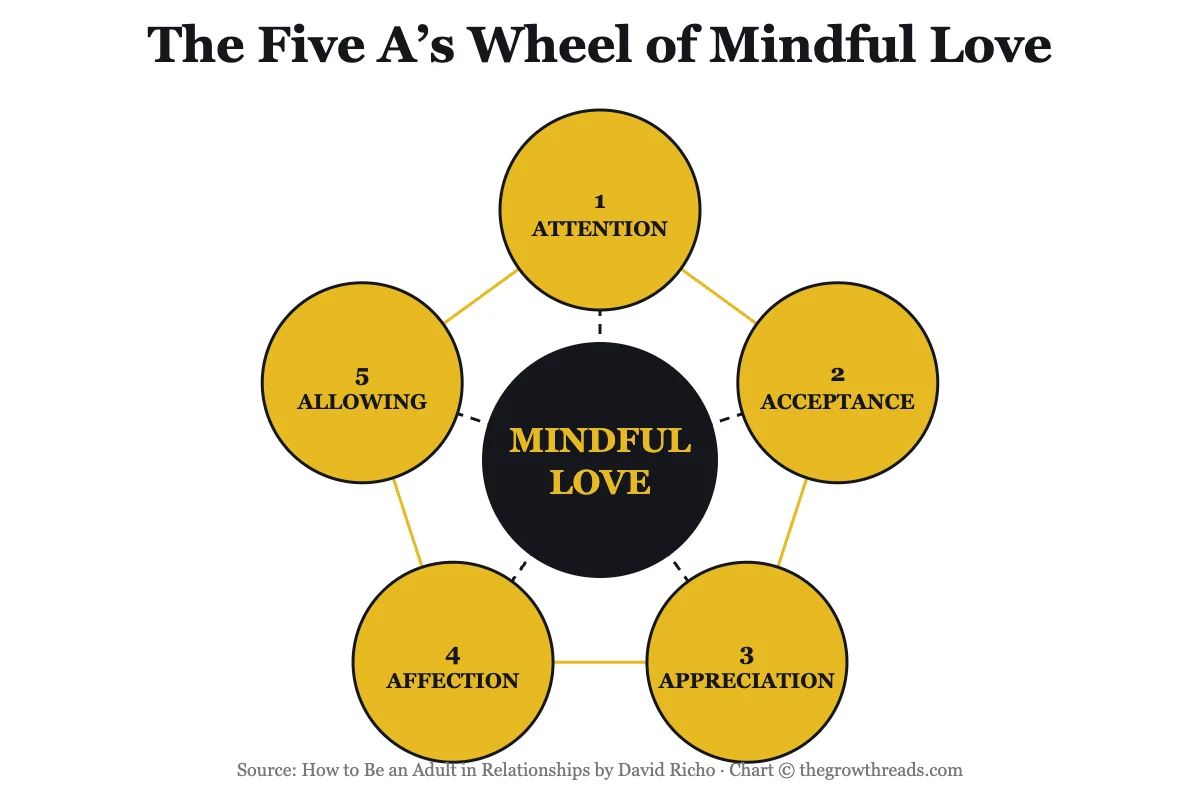
How to Be an Adult in Relationships is a 2002 relationship psychology book by therapist David Richo that argues real intimacy depends on five needs — Attention, Acceptance, Appreciation, Affection, and Allowing — first learned in childhood and re-sought in every adult partnership; it teaches readers to recognize unmet needs, name the habits that block closeness, and practice love mindfully rather than reactively.
About the author
David Richo is a psychotherapist, teacher, and writer with practices in Santa Barbara and San Francisco, where he leads workshops blending Jungian psychology, attachment theory, and Buddhist mindfulness practice. He holds a PhD in clinical psychology and has been a licensed marriage, family, and child counselor in California since 1976, teaching at institutions including UC Berkeley, Esalen Institute, and Santa Barbara City College. How to Be an Adult in Relationships, first published in 2002, became his best-known work and remains a staple therapist recommendation more than two decades later; a 20th-anniversary edition followed in the 2020s. Richo has written more than a dozen related books, including How to Be an Adult in Love and Daring to Trust, all developing the same throughline: that mindfulness, not willpower, is what makes love durable. Explore all David Richo book summaries →
Key concepts at a glance
| Concept | What it means | Use it when |
|---|---|---|
| The Five A’s | Attention, Acceptance, Appreciation, Affection, Allowing — what healthy love provides | Naming what feels missing in a relationship |
| Adult vs. parental love | Grown-up love is reciprocal and conditional, not one-directional devotion | Letting go of “unconditional love” as a standard for partners |
| Five saboteurs | Fear, neediness, control, entitlement, and judgment — habits that block intimacy | Catching yourself mid-pattern during conflict |
| Mindful loving | Attention without judgment, acceptance without resistance | Building a daily practice, not just a mood |
| Projection | Unconsciously assigning a partner your unresolved parent’s traits | Understanding why a small thing triggers a big reaction |
| Grief and letting go | Loving fully means accepting the risk of eventual loss | Processing a breakup, or the fear of one |
| Boundaries | Clear limits that make vulnerability safe | Feeling resentful, overextended, or unheard |
| Self-love as foundation | Offering yourself the Five A’s before expecting them from others | Repeatedly picking partners who can’t meet your needs |
Part 1: The Five A’s — What Love Actually Requires
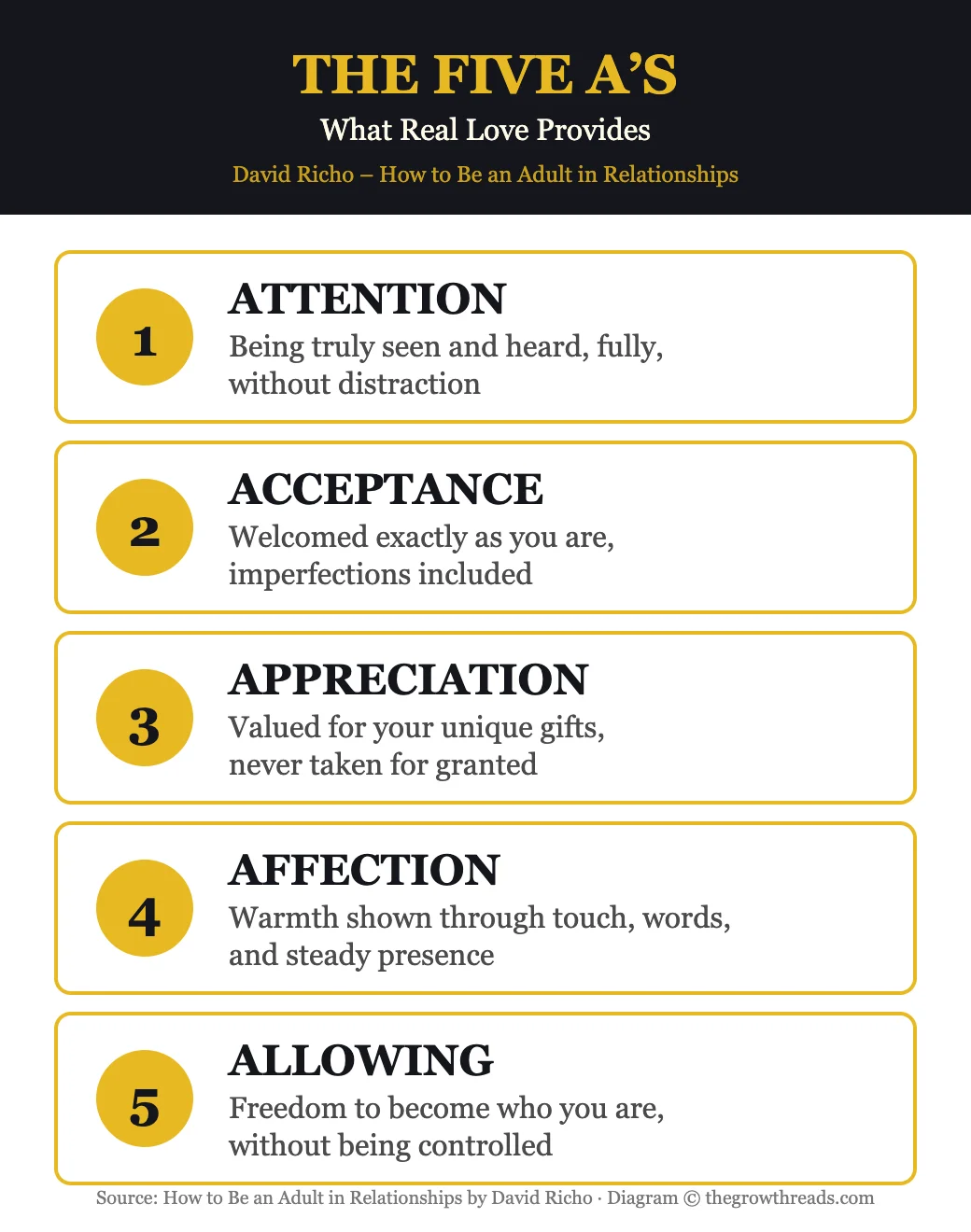
Richo opens with a simple but disarming question: what, exactly, does healthy love provide? His answer distills decades of clinical work into five words — Attention, Acceptance, Appreciation, Affection, and Allowing. He calls these the “Five A’s,” and argues they are not romantic extras but the actual substance of love. Ideally, a child receives all five from a parent: full attention when it matters, acceptance of who they are rather than who a parent wishes they were, appreciation for their particular gifts, physical and verbal affection, and the freedom — allowing — to grow into their own person rather than an extension of someone else’s plans.
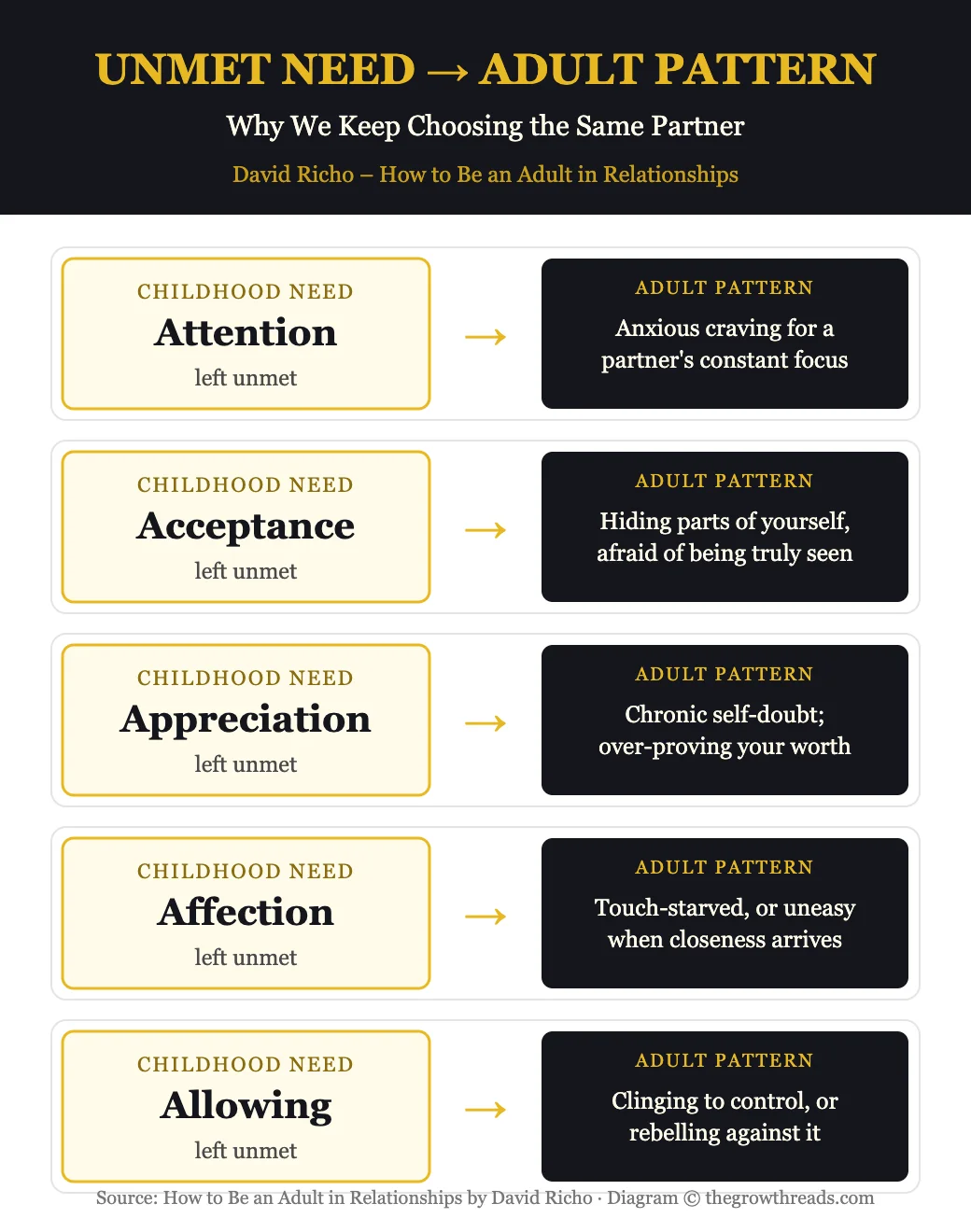
Most people, Richo notes, got some of the Five A’s and not others. A child might have been showered with affection but never truly seen (attention); praised for achievements but never accepted for ordinary, unremarkable moments; given plenty of freedom but little warmth. Whatever went missing doesn’t disappear — it becomes, in Richo’s phrase, unfinished business that adult relationships are unconsciously recruited to complete. This is the book’s central move: it reframes attraction itself as need-driven. You are not simply drawn to people you find compatible; you are drawn to people who can plausibly deliver the specific A you didn’t get enough of.
The complication is that adult love cannot simply repeat childhood. A parent’s love is, ideally, unconditional and one-directional; a partner’s love is a two-way exchange between equals, and expecting a partner to provide unconditional devotion the way a parent should sets the relationship up to fail. Richo’s distinction between parental love and adult love is one of the book’s more clarifying ideas: it explains why some people feel chronically shortchanged in otherwise decent relationships. They are measuring adult, reciprocal love against a childhood standard it was never designed to meet.
TGR Note: The Five A’s overlap with, but aren’t identical to, attachment theory’s account of secure bonding. If you want the research-heavier version of “what unmet childhood needs do to adult relationships,” pair this with our Attached summary, which maps similar territory through anxious, avoidant, and secure attachment styles.
Part 2: Why We Keep Choosing the Same Partner
If unmet needs create a template, Richo asks: how does that template affect who we’re drawn to? His answer leans on a Jungian idea of projection: we don’t just notice compatible partners, we project our unfinished business onto them, then respond to the projection as if it were the whole person. Someone who grew up starved for attention may find themselves electrically drawn to partners who are exciting but inconsistent, because the inconsistency recreates the anxious hope of finally, this time, being fully seen. Someone who grew up conditionally accepted — loved for achievement, not for simply existing — may repeatedly choose partners who are subtly critical, mistaking familiar tension for chemistry.
This is why breakups so often repeat their own pattern, Richo argues — not because people have bad luck, but because the unconscious selection criteria never changed. The antidote isn’t finding a “better” type of partner; it’s making the pattern conscious enough to choose differently. Richo’s exercises ask readers to trace, honestly, which of the Five A’s felt scarce growing up, and then notice how that scarcity shows up in who they’re attracted to and how they interpret a partner’s ordinary behavior.
The same lens explains a common relationship complaint: “I don’t know why this small thing set me off so badly.” Richo’s answer is usually projection — the small thing wasn’t small, because it was standing in for the parent’s original absence, not just the partner’s present-day behavior. Separating the two, he argues, is most of the work of growing up in love.
TGR Note: This “recreate childhood to resolve it” mechanism is also the engine behind Imago Relationship Therapy. Our Getting the Love You Want summary covers the same idea with a more structured couples exercise attached.
Part 3: The Five Saboteurs — Fear, Need, Control, Entitlement, Judgment
The second half of Richo’s framework flips from what love needs to what actively destroys it. He names five specific habits — fear, neediness, control, entitlement, and judgment — and argues that none of them are about love failing to arrive; they’re about how a person unconsciously defends against love once it does arrive.
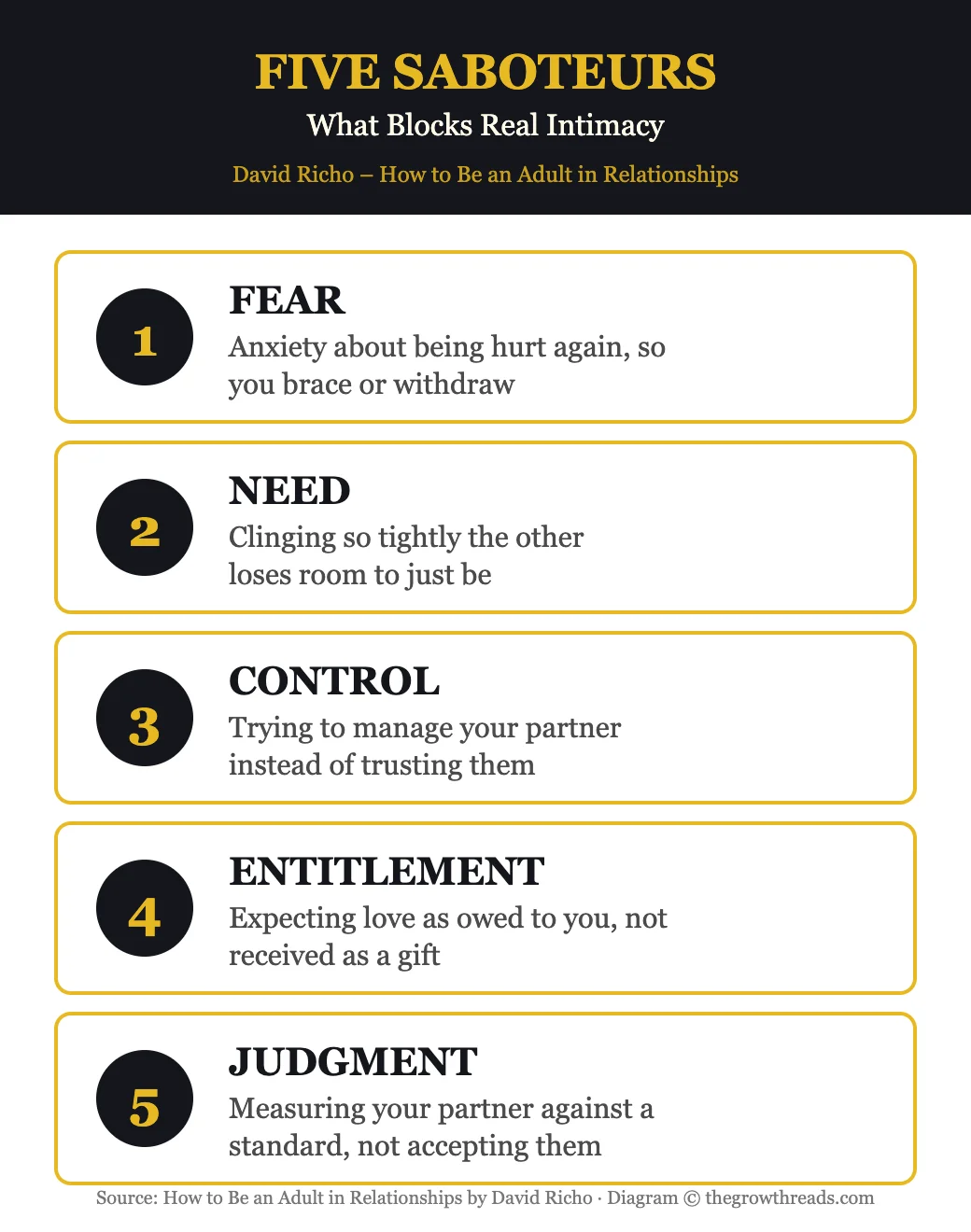
Fear shows up as bracing for loss before it happens — pulling back, testing, or picking fights preemptively so the eventual hurt feels self-inflicted rather than surprising. Neediness is love collapsed into requirement: wanting a partner so badly that their freedom to be a separate person starts to feel threatening. Control is the attempt to manage a partner’s feelings, choices, or growth instead of trusting them to handle their own life. Entitlement treats love as something owed, a transaction completed by effort, rather than something freely given that can also be freely withdrawn. Judgment measures a partner against a mental checklist instead of meeting the actual, imperfect person in front of you.
Richo’s point isn’t that these five habits make someone a bad partner. They’re close to universal, and most people cycle through several under stress. The useful move, he argues, is naming the habit in the moment it’s happening, because naming interrupts the automatic reaction long enough to choose something else. This is where the book’s mindfulness roots show most clearly: the skill isn’t eliminating fear or need, it’s noticing them without being run by them.
TGR Note: Naming a saboteur in real time only works if you also have language for the conversation that follows. Our Nonviolent Communication summary and Difficult Conversations summary both pair well here as practical scripts for what to say next.
Part 4: Mindful Loving — Grief, Letting Go, and Growing Up in Love
Richo’s final movement ties the Five A’s and the five saboteurs together with a single practice: mindful loving, which he defines simply as attention without judgment and acceptance without resistance. This isn’t meditation in the seated, eyes-closed sense. It’s a moment-to-moment discipline applied to a relationship: noticing a partner’s behavior without immediately labeling it good or bad, and accepting what’s actually happening instead of resisting it or trying to force it into a different shape.
A less comfortable piece of this practice is grief. Richo argues that fully loving someone means accepting, from the start, that you might lose them — to death, to a breakup, or simply to the ways people change over decades together. Rather than treating this as morbid, he frames grief tolerance as what makes real intimacy possible: people who can’t tolerate the idea of loss often love cautiously, holding part of themselves back as insurance. Practicing small forms of letting go, releasing a grudge, tolerating a partner’s autonomy, allowing a plan to change, builds the same muscle needed for the bigger losses love eventually asks of everyone.
Boundaries get a similar reframe. Rather than a wall that keeps a partner out, Richo treats a clear boundary as what makes real closeness safe: you can only be truly vulnerable with someone once you trust your limits will be respected. And underneath all of it sits self-love. Richo is explicit that a partner cannot permanently supply Five A’s you refuse to offer yourself. The book’s final ask isn’t for a better partner. It’s for a more honest relationship with your own unmet needs, so love, when it arrives, has somewhere real to land.
TGR Note: Richo’s “acceptance without resistance” is close kin to the mindfulness practice at the center of our Radical Acceptance summary. And if self-love and boundaries feel like the harder half of this chapter, Codependent No More summary goes deeper on rebuilding a self separate from a relationship.
Who is How to Be an Adult in Relationships best for — and who should read something else first?
This book is best for people who notice a repeating pattern across relationships and want language for what’s actually happening, rather than another list of communication tips. It rewards readers willing to do honest self-inventory instead of looking for a partner-focused fix.
If you want a research-backed framework for attachment patterns specifically, start with our Attached summary. If you’re in an active conflict cycle with a partner and need concrete de-escalation tools right now, Hold Me Tight summary will be more immediately useful. If losing yourself in relationships is the core issue rather than choosing the wrong partner, Codependent No More summary goes deeper on that specific pattern.
Questions to reflect on
- Which of the Five A’s, Attention, Acceptance, Appreciation, Affection, Allowing, felt most scarce in your childhood home?
- Which of the five saboteurs (fear, neediness, control, entitlement, judgment) do you reach for first under stress in a relationship?
- Think of a recent overreaction to something small a partner or friend did. What might it have actually been standing in for?
- Where in your life could you practice “allowing,” letting someone be who they are instead of who you need them to be?
- What would change if you offered yourself the Five A’s before waiting for someone else to?
🔥 Ready to understand what your relationships are really asking for?
Get the full book for Richo’s complete framework, exercises, and grief chapters this summary can only outline.
How to apply How to Be an Adult in Relationships (7-day plan)
- Day 1 — Name your scarce A. Journal for 10 minutes: growing up, which of the Five A’s (Attention, Acceptance, Appreciation, Affection, Allowing) felt most missing?
- Day 2 — Catch a saboteur. Notice one moment today where fear, neediness, control, entitlement, or judgment shaped how you responded to someone close to you.
- Day 3 — Practice full attention. Give one person 15 minutes of undistracted attention, phone away, no multitasking, and notice what it feels like on both ends.
- Day 4 — Set one boundary. Identify one limit you’ve been avoiding stating, and say it plainly, once, without over-explaining.
- Day 5 — Practice letting go. Choose one small thing, a grudge, a plan, an expectation, and consciously release it.
- Day 6 — Offer yourself an A. Take the need you named on Day 1 and give it to yourself deliberately: rest if you’re touch-starved for downtime, self-praise if appreciation was scarce.
- Day 7 — Audit one relationship. Write a short Five A’s inventory for your closest relationship: which A’s are present, which are missing, and one honest ask you could make.
Frequently asked questions
What are the “Five A’s” in How to Be an Adult in Relationships?
David Richo’s Five A’s are Attention, Acceptance, Appreciation, Affection, and Allowing, the five things he argues healthy love provides. Attention means being truly seen and heard; acceptance means being welcomed as you are; appreciation means being valued for your specific gifts; affection is warmth expressed through touch, words, and presence; and allowing is the freedom to become who you actually are, without a partner trying to control or reshape you. Richo argues these five needs are first met, or not, by parents, then unconsciously sought again in every adult relationship.
Is How to Be an Adult in Relationships about romantic love only?
No. Richo applies the Five A’s framework broadly, to romantic partnerships, but also to friendships, family relationships, and one’s relationship with oneself. The core argument, that healthy connection requires attention, acceptance, appreciation, affection, and allowing, is presented as a general theory of intimacy rather than a dating-specific playbook, which is part of why therapists recommend it beyond couples work.
What’s the difference between adult love and childhood love, according to Richo?
Richo distinguishes parental love, which is ideally unconditional and flows in one direction from parent to child, from adult love, which is a two-way, reciprocal exchange between equals. He argues much relationship disappointment comes from expecting a partner to provide the unconditional devotion of a parent, an expectation adult love was never designed to meet, since it depends on both people continuing to choose each other.
How does the book explain why people are drawn to certain partners?
Richo leans on a Jungian idea of projection: people unconsciously seek partners who can plausibly recreate the emotional pattern of childhood, including its gaps. Someone who lacked consistent attention growing up may feel strong chemistry with exciting-but-inconsistent partners, because the uncertainty echoes a familiar, unresolved hope of finally being fully seen. The attraction feels like fate, Richo argues, but it’s often familiarity in disguise.
What are Richo’s “five saboteurs” of intimacy?
The five saboteurs are fear, neediness, control, entitlement, and judgment, habits Richo says unconsciously defend against closeness even when a person consciously wants love. Fear shows up as bracing for loss before it happens; neediness turns love into a requirement; control tries to manage a partner instead of trusting them; entitlement treats love as owed rather than given; and judgment measures a partner against a checklist instead of meeting them as they are.
Is How to Be an Adult in Relationships backed by clinical research?
The book sits in the humanistic and Jungian therapy tradition rather than presenting itself as a research review. Richo draws on decades of clinical practice, Buddhist mindfulness teaching, and depth psychology rather than citing controlled studies. Some of its concepts, like projection, are harder to test empirically than newer, research-heavy frameworks such as attachment theory. That said, its core practical advice, naming needs, setting boundaries, practicing non-judgmental attention, is uncontroversial and widely echoed across more clinically validated approaches.
Who should read How to Be an Adult in Relationships?
It’s best for people who notice a repeating pattern across relationships, the same type of conflict, the same type of partner, the same disappointment, and want a framework for understanding why, rather than a list of communication scripts. Readers in the middle of an active, high-conflict relationship crisis may get more immediate value from a more tactical book first, then return to Richo’s framework for the deeper “why.”
Related summaries
If How to Be an Adult in Relationships resonated, these TGR summaries dig into adjacent territory:
- Attached summary — the attachment-theory account of anxious, avoidant, and secure patterns.
- Hold Me Tight summary — seven conversations for breaking a couple’s conflict cycle.
- Codependent No More summary — for readers whose core pattern is losing themselves in relationships.
- Getting the Love You Want summary — Imago therapy’s take on why we choose partners who recreate childhood wounds.
For the full ranked list, see our Best Relationship Books pillar page.
How we analyze books: every TGR summary is built from a full read of the source material, cross-checked against the author’s other published work and interviews, and structured around a consistent framework so you can compare books quickly. We favor practical application over academic completeness. Read our full methodology.
Related Relationships Summaries
Daring Greatly Summary & Review: Why Vulnerability Is the Ultimate Courage
Getting the Love You Want Summary & Review: Why You Chose Your Partner
It’s Not You Summary & Review: How to Heal from a Narcissistic Relationship
No More Mr Nice Guy Summary & Review: Why People-Pleasing Backfires
Wired for Love Summary & Review: The Neuroscience of Lasting Relationships