

⭐⭐⭐⭐ 4.0/5 — A practical, refreshing guide to applying the KonMari method at work — best when paired with the original.
Best for: Knowledge workers drowning in digital clutter, overflowing inboxes, and back-to-back meetings who want a joy-centered framework to reclaim focus.
Reading time: ~3.5 hours (232 pages) | Difficulty to apply: Easy — most changes take minutes, not weeks.
Joy at Work in one minute
Your cluttered desk, overflowing inbox, and soul-crushing meetings are silently draining your energy and creativity. Marie Kondo and organizational psychologist Scott Sonenshein team up to extend the famous KonMari method beyond your closet and into your professional life. The core question shifts from “Does this spark joy?” to “Does this spark joy or serve a clear purpose?” By systematically tidying your physical workspace, digital files, emails, tasks, meetings, and professional network, you create the mental clarity needed to do meaningful work. The book alternates between Kondo’s hands-on tidying strategies and Sonenshein’s research-backed organizational psychology — giving you both the method and the science behind why it works.
Key takeaways
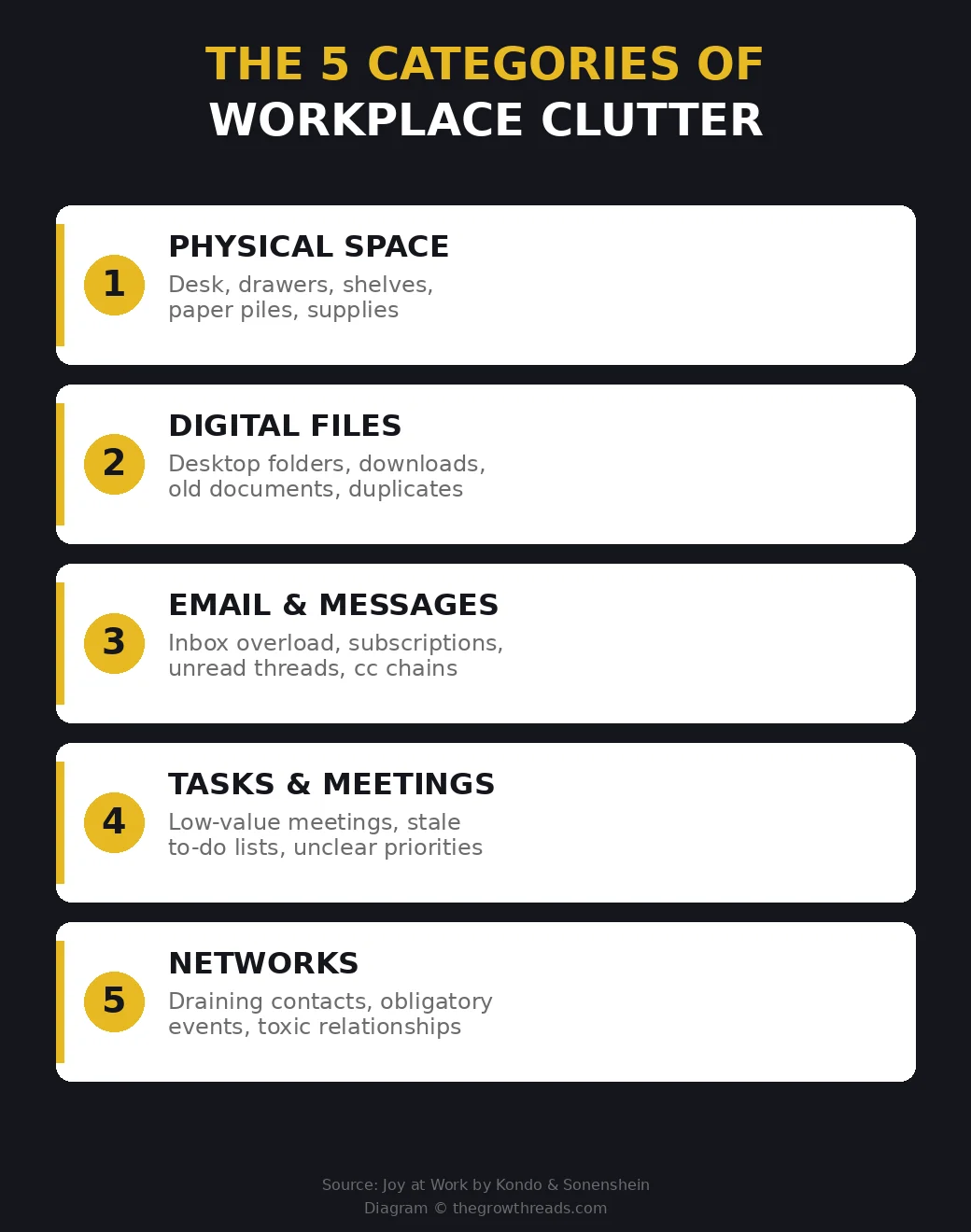
- Clutter is not just physical: Workplace clutter spans five categories — your physical space, digital files, email, tasks and meetings, and professional network. Each drains cognitive energy even when you are not actively looking at it.
- Joy is a valid professional metric: The question “Does this spark joy?” is not fluffy — it is a rapid filter for identifying what energizes you versus what you keep out of obligation or habit.
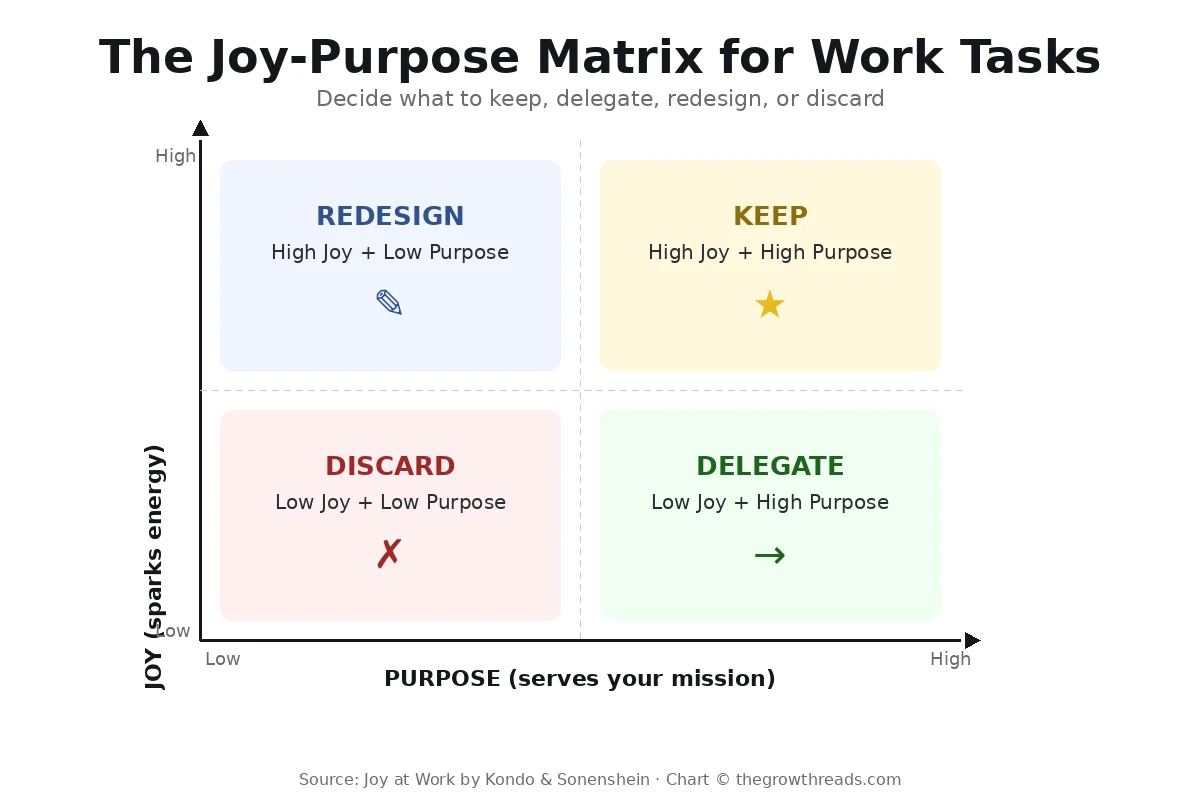
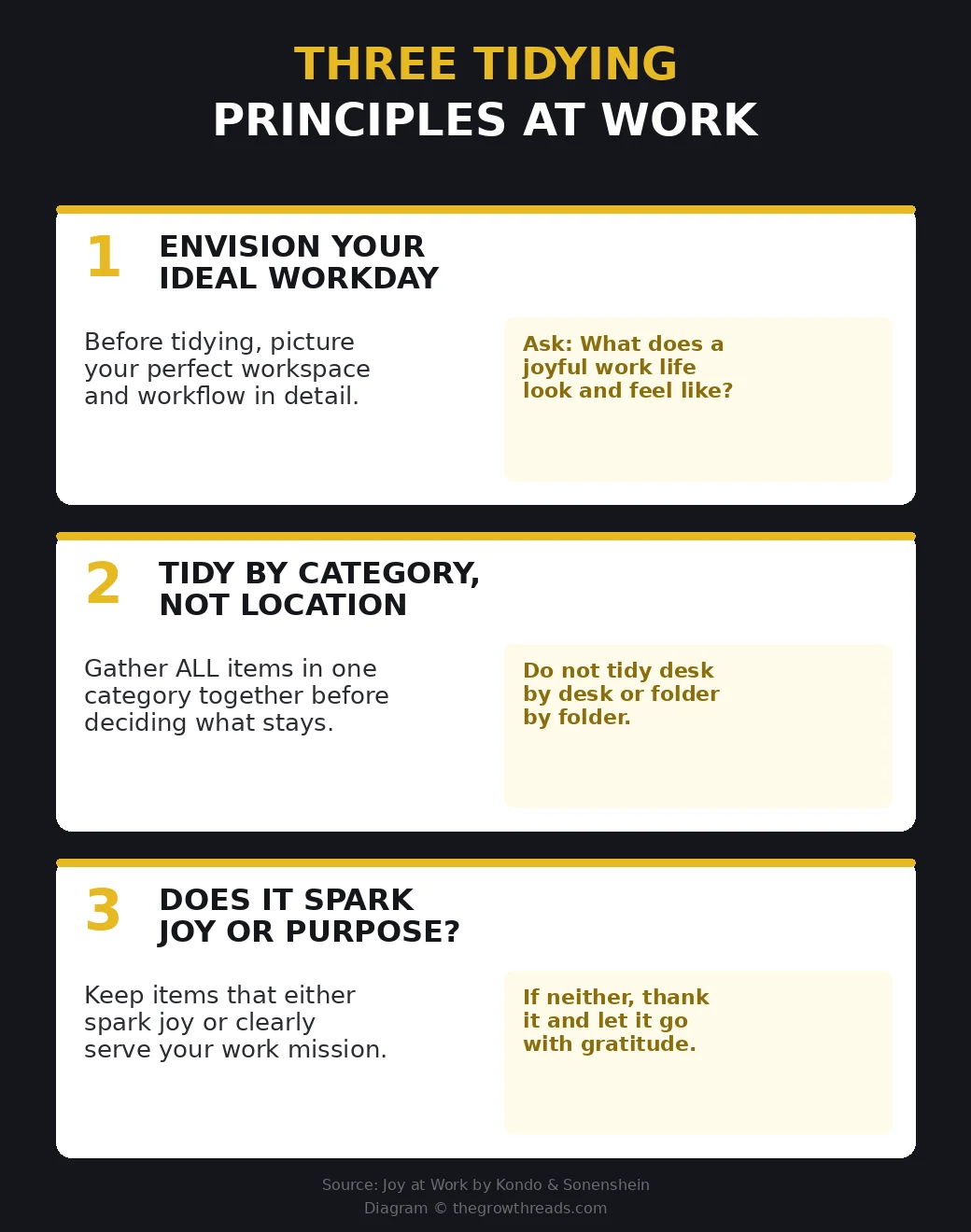
- Add a purpose filter for work: Unlike home tidying, work items sometimes lack joy but serve an essential function. Keep anything that sparks joy or clearly serves your professional mission.
- Tidy by category, not location: Do not organize drawer by drawer. Gather all items from one category (e.g., all papers everywhere) so you can see the true volume and make better decisions.
- Your inbox is not a to-do list: Treat email as a flow to process, not a storage system. Unsubscribe aggressively, archive after acting, and batch email time into specific windows.
- Meetings are the biggest time clutter: Most professionals lose 15+ hours per week to meetings. Audit every recurring meeting and ask whether it still serves a clear purpose.
- Decision clutter is invisible but costly: Reduce low-stakes decisions by building routines, defaults, and simple rules — saving your mental energy for choices that actually matter.
- Your network needs tidying too: Not all professional relationships energize you. Invest more in connections that spark joy and gently reduce time with those that drain you.
- Gratitude is part of letting go: Thank each item, file, or commitment before discarding it. This small ritual reduces guilt and makes decluttering feel complete rather than wasteful.
- Tidying is a skill, not a personality trait: Research shows that organizational ability is learned, not innate. Even self-described messy people can transform their work environment with the right method.
What is Joy at Work about?
Joy at Work adapts Marie Kondo’s KonMari tidying method for professional life. Co-written with organizational psychologist Scott Sonenshein, the book provides a step-by-step system for decluttering your physical workspace, digital files, email inbox, calendar, task list, and professional network — keeping only what sparks joy or clearly serves your work mission.
About the authors
Marie Kondo is a Japanese organizing consultant and author of the global bestseller The Life-Changing Magic of Tidying Up, which has sold over 13 million copies worldwide. Her KonMari Method™ sparked a worldwide decluttering movement and a hit Netflix series. She was named one of TIME’s 100 Most Influential People in 2015.
Scott Sonenshein is a professor of organizational behavior at Rice University’s Jones Graduate School of Business. His research on resourcefulness, creativity, and meaningful work has been published in top academic journals and featured in the New York Times, Wall Street Journal, and Harvard Business Review. He is also the author of Stretch: Unlock the Power of Less — and Achieve More Than You Ever Imagined.
Key concepts at a glance
| Concept | What it means | Use it when |
|---|---|---|
| Joy + Purpose Filter | Keep items that spark joy OR clearly serve your work mission | Deciding what to keep in any work category |
| Tidy by Category | Gather all items from one type before sorting, not location by location | Starting any tidying session |
| Envision Your Ideal | Picture your perfect workday before you start decluttering | Setting your tidying intention |
| The Clutter Cascade | Physical clutter triggers digital clutter, which triggers mental clutter | Understanding why one messy area affects everything |
| Three-Folder Email | Inbox → Action Required, Awaiting Reply, Archive | Rebuilding your email workflow |
| Meeting Audit | Review every recurring meeting for purpose, energy, and necessity | Reclaiming 5–10 hours per week |
| Decision Defaults | Pre-decide recurring low-stakes choices with simple rules | Reducing daily decision fatigue |
| Network Tidying | Evaluate relationships by energy and alignment, not just usefulness | Feeling drained by obligatory professional events |
Part 1: Tidying your physical workspace
Kondo opens by acknowledging that most people spend more waking hours at work than at home — yet rarely apply the same intentionality to their workspace. She argues that a cluttered desk does not just look messy; it creates a constant low-level cognitive drain. Research from the Princeton Neuroscience Institute confirms this: multiple visual stimuli in your field of vision compete for attention, reducing your ability to focus.
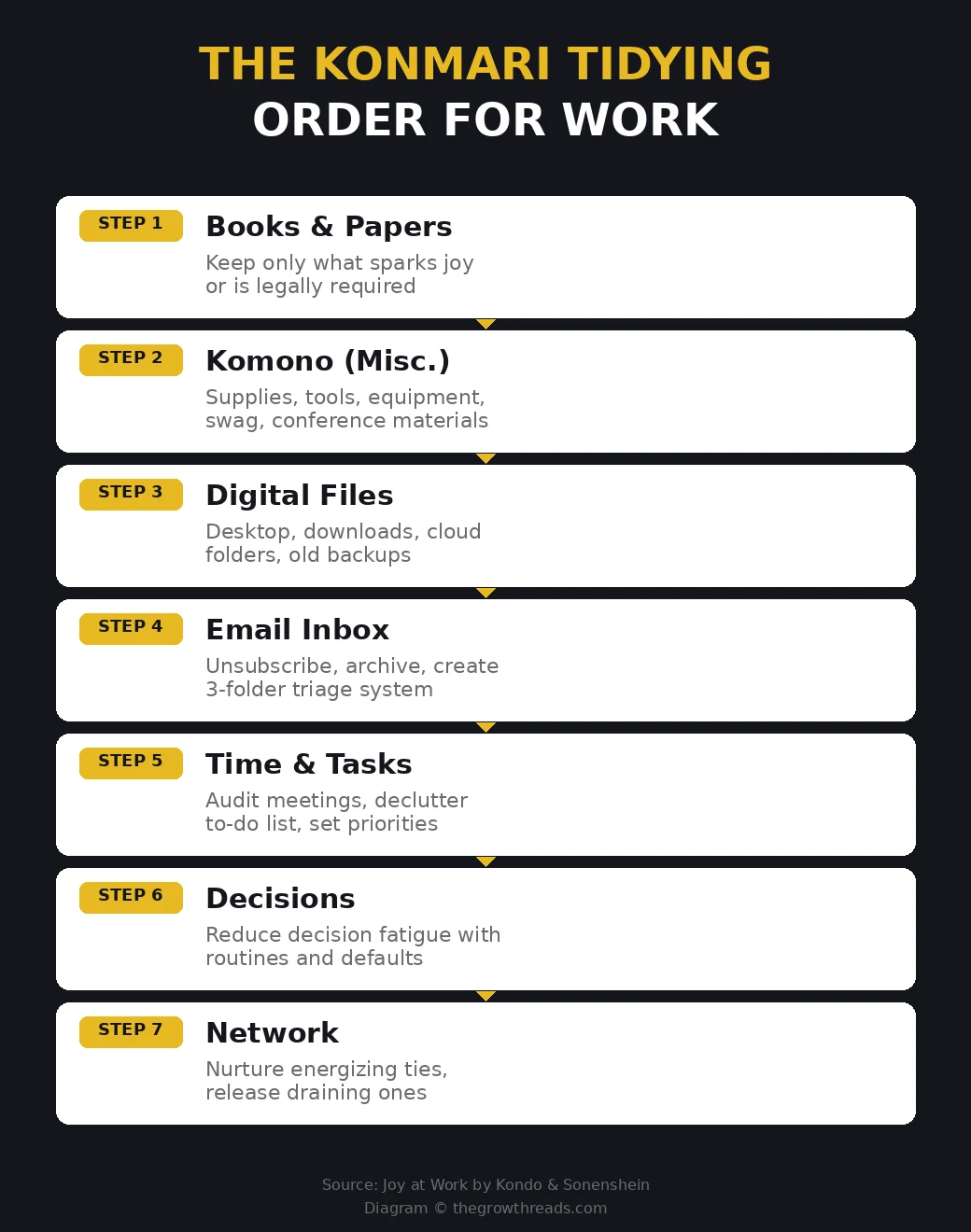
The KonMari order for work starts with books and papers — the easiest category because the emotional attachment is lowest. Kondo recommends gathering every book, binder, printout, and loose paper from your entire office into one pile. Seeing the true volume is often the catalyst for change. Keep only papers that are legally required, actively in use, or spark genuine joy (like a meaningful note from a colleague). Everything else gets shredded, recycled, or digitized.
Next comes komono — the miscellaneous items that accumulate invisibly: spare chargers, conference swag, dried-out pens, old business cards, redundant office supplies. Kondo’s advice is characteristically simple: hold each item and ask whether it serves you now. Not whether it might be useful someday, but whether it serves you right now.
The final physical step is your desk surface itself. Kondo recommends clearing it completely at the end of each day — a reset ritual that signals to your brain that the workday is done. She connects this to the broader KonMari principle of treating your belongings with respect, which she explored at length in The Life-Changing Magic of Tidying Up.
Part 2: Tidying your digital life
Sonenshein takes the lead here with a research-backed case against digital clutter. The average knowledge worker spends 2.5 hours per day on email and has over 200 files on their desktop alone. Digital clutter is particularly insidious because storage is cheap and unlimited — there is no physical constraint forcing you to purge.
For digital files, the authors recommend the same category-first approach: gather all documents (desktop, downloads, cloud drives, USB sticks) and sort by type. Delete duplicates, outdated versions, and anything you have not opened in over a year. Create a simple folder hierarchy with no more than three levels of nesting. The goal is to find any file in under 30 seconds.
The email chapter introduces a three-folder system: Action Required (needs your response), Awaiting Reply (ball is in someone else’s court), and Archive (everything else). Combined with aggressive unsubscribing — Sonenshein suggests removing yourself from at least half of your mailing lists — this can reduce daily email volume by 40–60 percent.
Sonenshein cites Gloria Mark’s research showing that it takes an average of 23 minutes to fully refocus after an interruption. Every unnecessary email, notification, or Slack ping is not just a few seconds of reading — it is a potential 23-minute derailment. Batch processing email at two to three set times per day, rather than responding in real time, is one of the highest-leverage changes in the book.
Part 3: Tidying your time and decisions
This is where Joy at Work becomes most original. Sonenshein argues that time clutter — overpacked calendars, pointless meetings, and sprawling to-do lists — is the most damaging form of professional clutter because it directly steals the resource you cannot buy back.
The meeting audit is the centerpiece of this section. Sonenshein recommends listing every recurring meeting you attend and evaluating each on three criteria: Does it have a clear purpose? Does it need you specifically? Could it be replaced by an email or async update? In his research, most professionals find that 30–40 percent of their meetings fail at least one of these tests. Declining or restructuring even a few reclaims 5–10 hours per week.
For task management, the authors discourage complex productivity systems in favor of a simple daily question: What three things, if completed today, would make this a successful day? This borrows from the essentialism school of thought — constraint breeds clarity. Long to-do lists create the illusion of productivity while scattering your attention across too many priorities.
Decision clutter is the subtlest category. Every day you make roughly 35,000 decisions, most of them trivial. Sonenshein’s solution: create decision defaults. Pre-decide what you wear to the office, where you eat lunch, which email template you use for common replies, and how you structure your morning routine. By automating the small decisions, you preserve willpower for the ones that actually shape your career.
Part 4: Tidying your network and finding joy
The final section tackles the most sensitive category: people. Kondo and Sonenshein are careful to distinguish between ditching colleagues (which they are not advocating) and intentionally managing the energy you invest in professional relationships.
Sonenshein introduces the concept of network auditing. List the people you interact with professionally each week and note how each interaction makes you feel. Some connections leave you energized and inspired — those are your “spark joy” relationships. Others consistently drain you through negativity, gossip, or one-sided emotional labor. The goal is not to ghost anyone, but to deliberately invest more time in energizing relationships and create polite boundaries around draining ones.
Kondo adds a characteristically elegant reframe: just as you thank a shirt before donating it, you can mentally thank a relationship for what it taught you before reducing its presence in your life. This gratitude practice removes guilt from what is ultimately a healthy boundary-setting exercise.
The book closes with a vision of what the authors call a “tidied work life” — not a perfectly organized desk, but a professional existence where you spend the majority of your time on activities that spark genuine joy or serve a clear purpose. Sonenshein’s research shows that people who feel alignment between their daily tasks and their values report 64 percent higher job satisfaction and are significantly less likely to experience burnout.
Who is Joy at Work best for — and who should read something else first?
Joy at Work is ideal for knowledge workers, remote professionals, and anyone who feels overwhelmed by digital clutter, inbox overload, or meeting-heavy schedules. If you loved The Life-Changing Magic of Tidying Up and want to bring the same philosophy to your 9-to-5, this is the natural next step.
If your primary struggle is deep focus and distraction rather than organizational clutter, start with Cal Newport’s Deep Work. If you want a broader framework for cutting non-essential commitments from your entire life (not just work), try Greg McKeown’s Essentialism. And if you have not yet read Kondo’s original book, we’d recommend starting with The Life-Changing Magic of Tidying Up first — Joy at Work assumes familiarity with the KonMari philosophy.
Questions to reflect on
- If you cleared your desk completely right now, which three items would you put back first — and what does that reveal about what you truly value at work?
- How many of your recurring meetings would survive a genuine “Does this need me?” test?
- When was the last time you felt genuine joy during a work task — and what were you doing?
- Which professional relationship consistently energizes you, and are you investing enough time in it?
- If you could only check email twice per day, what systems would you need to put in place to make that work?
🔥 Ready to tidy your work life and find your focus?
Get the full framework for decluttering your workspace, inbox, calendar, and network.
How to apply Joy at Work (7-day plan)
- Day 1 — Envision your ideal workday. Spend 15 minutes writing a detailed picture of what your perfect work environment and daily flow looks and feels like. Be specific about your desk, your schedule, and the type of work you’re doing.
- Day 2 — Tidy your physical workspace. Gather all books, papers, and office supplies from your desk, drawers, and shelves. Hold each item and keep only what sparks joy or is actively needed. Clear your desk surface completely.
- Day 3 — Declutter your digital files. Spend 30 minutes purging your desktop, downloads folder, and one cloud drive. Delete duplicates, outdated files, and anything untouched for over a year. Create a three-level folder structure.
- Day 4 — Tidy your inbox. Unsubscribe from at least 10 mailing lists. Set up the three-folder system (Action Required, Awaiting Reply, Archive). Process your inbox to zero using these folders.
- Day 5 — Audit your meetings. List every recurring meeting you attend. For each one, ask: Does it have a clear purpose? Does it need me? Could it be an email? Decline or restructure at least two.
- Day 6 — Create decision defaults. Identify three recurring low-stakes decisions you make daily (lunch, email responses, morning routine) and pre-decide them with simple rules or templates.
- Day 7 — Tidy your network. List the 10 people you interact with most at work. Note which interactions energize you and which drain you. Schedule one coffee with an energizing contact this week.
Frequently asked questions
Is Joy at Work worth reading if I have already read The Life-Changing Magic of Tidying Up?
Yes, but with a caveat. Part 1 (physical tidying) covers familiar ground and may feel repetitive if you know the KonMari method well. The real value is in Parts 2–4, where Scott Sonenshein introduces research-backed strategies for tidying digital files, email, meetings, decisions, and your professional network. These chapters go well beyond the original book’s scope. If you skip Part 1, you will still get substantial new material from the rest.
Does the “spark joy” test actually work for professional tasks?
The authors adapt it for work by adding a purpose filter. Many work tasks do not spark joy but are essential — filing taxes, compliance reviews, difficult conversations. The modified question becomes: “Does this spark joy or clearly serve my professional mission?” If a task fails both tests, it is a candidate for elimination, delegation, or redesign. This dual filter is more practical than pure joy-testing in a work context.
How long does it take to fully tidy your work life using this method?
The authors suggest the process can take anywhere from one weekend (for a focused physical-space blitz) to several weeks (if you work through all categories methodically). The 7-day plan in the book is a good starting framework, but network tidying and meeting restructuring are ongoing practices rather than one-time events. Most readers report noticeable improvements within the first week of implementing even two or three changes.
Can I apply this method if I share an office or work in an open-plan environment?
Absolutely. The method focuses on your personal workspace and digital environment, not the entire office. You can tidy your desk, your drawers, your digital files, and your calendar regardless of your office layout. For shared spaces, the authors recommend focusing on what you can control — your belongings, your email habits, and your meeting schedule — rather than trying to reorganize communal areas without buy-in.
What is the most impactful single change from Joy at Work?
Based on the research Sonenshein cites, auditing your recurring meetings delivers the highest return on time. Most knowledge workers spend 15 or more hours per week in meetings, and studies consistently show that 30–40 percent of those meetings are unnecessary. Declining or shortening just a few reclaims 5–10 hours per week — more than any amount of inbox tidying or desk organizing can achieve.
How is Joy at Work different from other productivity books like Getting Things Done or Atomic Habits?
GTD (David Allen) is a comprehensive task-management system focused on capturing and processing everything. Atomic Habits (James Clear) is about building small behavioral changes through habit loops. Joy at Work is about subtracting — removing clutter, commitments, and draining relationships so that what remains sparks joy or serves purpose. The three approaches complement each other: tidy first (Joy at Work), build systems (GTD), then layer in habits (Atomic Habits).
Does Marie Kondo practice what she preaches at her own company?
According to the book and interviews, Kondo applies the KonMari method at KonMari Media, Inc. — her team uses minimal-clutter workspaces, digital filing systems, and structured meeting schedules. Sonenshein also applies the principles in his university research lab at Rice. That said, Kondo has publicly noted that maintaining a perfectly tidy workspace with small children at home requires ongoing effort rather than a single transformation.
Related summaries
- The Life-Changing Magic of Tidying Up Summary — Kondo’s original KonMari method for your home, the foundation for everything in Joy at Work.
- Atomic Habits Summary — Build small productivity habits after you have decluttered the noise.
- Finish What You Start Summary — If clutter is not your problem but follow-through is, start here.
- Best Productivity Books — Our ranked guide to the most impactful books on getting more done with less stress.
Related Productivity Summaries
Hyperfocus Summary & Review: Master Both Focus and Creative Mind-Wandering
The 10X Rule Summary & Review: Why Massive Action Beats Average Effort
The 5 Second Rule Summary & Review: Stop Overthinking, Start Moving
The 80/20 Principle Summary & Review: Find Your Vital Few
The Talent Code Summary & Review: Greatness Is Grown, Not Born