

★★★★☆ 4.3 / 5
One-liner: A radical, category-by-category system that resets your relationship with stuff — tidy once, completely, and never backslide.
Best for: Anyone drowning in clutter who has tried (and failed) with gradual room-by-room approaches.
Reading time: ~4 hours (224 pages)
Difficulty to apply: Moderate — the method is simple, but confronting every possession takes emotional energy.
The Life-Changing Magic of Tidying Up in one minute
Most people tidy the wrong way — and then blame themselves when clutter bounces back. Marie Kondo argues the problem is not laziness or a lack of storage products, but a flawed strategy. Instead of cleaning room by room, a little at a time, she prescribes a single, intensive tidying “festival” where you sort belongings by category — clothes, books, papers, miscellaneous, then sentimental items — keeping only what sparks genuine joy. The KonMari method replaces guilt-based purging with a positive question (“Does this spark joy?”) and pairs it with a folding-and-storage system that makes everything visible. Kondo claims — and thousands of readers confirm — that people who complete this process once never revert to clutter.
Key takeaways
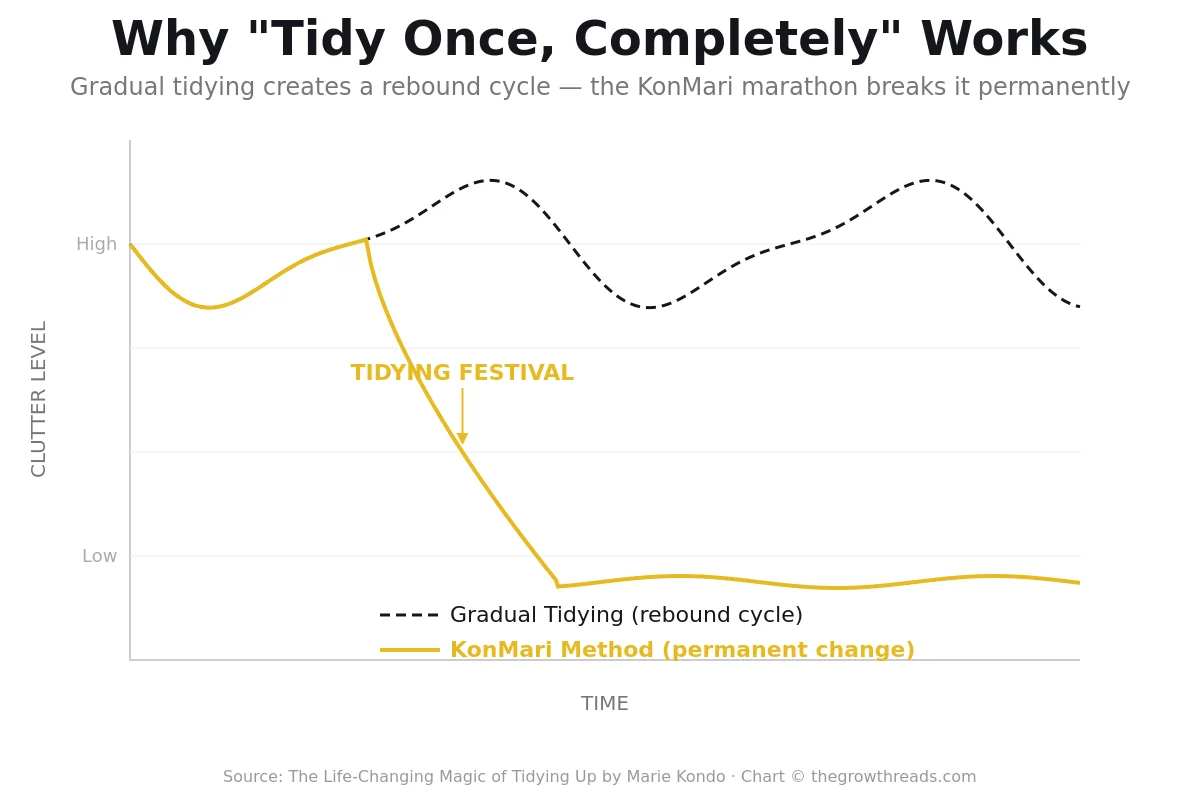
- Tidy in one marathon, not in small daily bites: A single concentrated effort creates a dramatic “before and after” that rewires your relationship with possessions permanently.
- Sort by category, not by room: Gathering all items from one category (e.g., every piece of clothing from every closet) forces you to see the true volume you own.
- Ask “Does it spark joy?” — not “Should I throw this away?”: Choosing what to keep is emotionally easier and more accurate than choosing what to discard.
- Follow the five-category order: Clothes, books, papers, komono (miscellaneous), then sentimental items — sequenced from easiest to hardest joy-judgment.
- Thank items before letting go: Expressing gratitude removes guilt and creates emotional closure, making it easier to part with things.
- Every item needs a designated home: Clutter returns when objects have no fixed address. Assign a specific spot for every single thing.
- Fold, do not hang — and store vertically: KonMari folding turns clothes into compact rectangles filed upright in drawers, so you can see everything at a glance.
- Simplify your storage solutions: Shoeboxes beat expensive organizers. The goal is fewer possessions, not more clever containers.
- Discard before you organize: No storage system works until you reduce volume first. Organizing clutter just hides it.
- Tidying is a life event, not a daily chore: Once you complete the full process, daily maintenance takes minutes because everything already has a home.

What is The Life-Changing Magic of Tidying Up about?
The Life-Changing Magic of Tidying Up is a practical guide to permanently decluttering your home using the KonMari method. Marie Kondo teaches readers to sort belongings by category rather than room, keep only items that “spark joy,” and give every possession a designated home — transforming not just living spaces but daily habits and emotional wellbeing.
About the author
Marie Kondo is a Japanese organizing consultant who began her tidying obsession at age five, reorganizing her family’s bookshelves and kitchen drawers while her classmates played outside. She launched her consulting business as a university student in Tokyo, building a six-month waiting list before she had even graduated. Her first book, published in Japan in 2011, sold over four million copies domestically and became an international phenomenon when the English translation arrived in 2014. Kondo was named one of Time magazine’s 100 Most Influential People in 2015, and her Netflix series Tidying Up with Marie Kondo introduced the KonMari method to millions more. She has since founded KonMari Media, Inc. and trained certified consultants worldwide. Explore all Marie Kondo book summaries →
Key concepts at a glance
| Concept | What it means | Use it when |
|---|---|---|
| Spark joy | Keep only items that produce a genuine physical thrill when you hold them | Making any keep-or-discard decision |
| Tidying festival | A concentrated, one-time marathon of sorting every possession | Starting the full KonMari process |
| Category order | Clothes → Books → Papers → Komono → Sentimental | Deciding what to tackle next |
| Vertical storage | Filing items upright so everything is visible at a glance | Organizing drawers, shelves, and bags |
| Thanking items | Expressing gratitude to possessions before letting them go | Overcoming guilt about discarding |
| Rebound effect | Clutter returning after room-by-room or gradual tidying | Understanding why past attempts failed |
| Designating a home | Every item gets one fixed spot it always returns to | Preventing clutter from accumulating again |
| Komono | The catch-all miscellaneous category (kitchen tools, toiletries, hobby gear) | Sorting non-clothing, non-book, non-paper items |
Part 1: Why we fail at tidying
Kondo opens with a counterintuitive claim: the reason most people can never keep their homes tidy is not laziness or personality — it is strategy. Conventional advice tells you to tidy a little each day, tackle one room at a time, and invest in better storage products. Kondo argues all three approaches guarantee failure.
Daily tidying in small doses never produces the dramatic contrast needed to shift your mindset. You organize a drawer today, but the living room stays chaotic, so the emotional baseline never changes. Room-by-room sorting is equally flawed because possessions of the same type live in multiple rooms. You might organize the bedroom closet beautifully, only to discover three more bags of clothes in the hallway, the laundry room, and the guest bedroom.
Storage products — the bins, dividers, and closet systems — are the most seductive trap of all. They create the illusion of order without reducing volume. Kondo likens this to rearranging deck chairs on a sinking ship: no amount of reorganizing solves the fundamental problem of owning too much.
Her solution is radical: stop tidying incrementally and treat decluttering as a one-time life event. Gather everything you own in a single category into one pile, confront the full volume, and make a joy-based decision on every single item. Do this once, completely, and the rebound effect vanishes.
Part 2: The KonMari method — discard first, by category
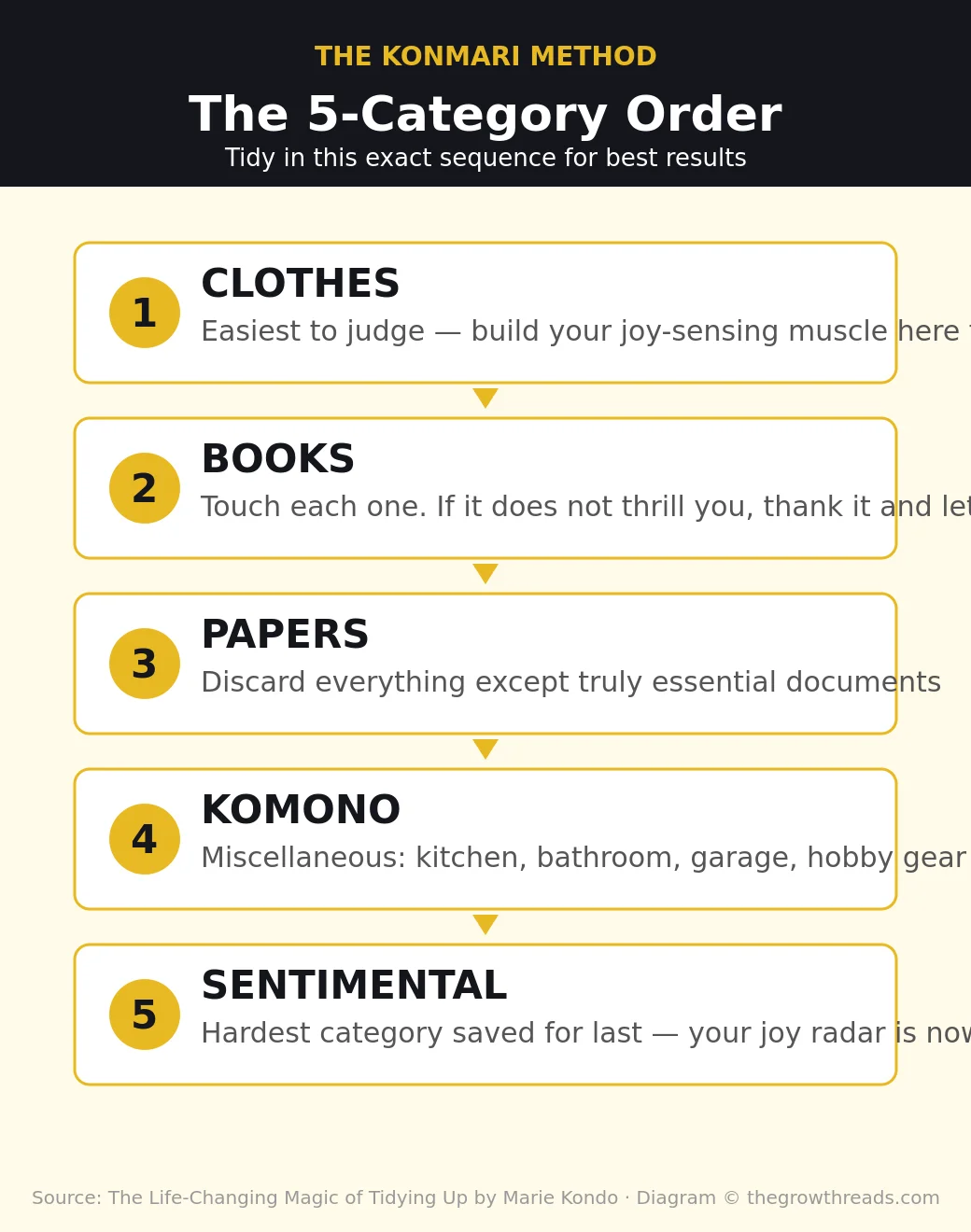
The core of the KonMari method rests on two principles: discard before you organize, and sort by category rather than location. Kondo prescribes a strict five-category sequence — clothes, books, papers, komono (miscellaneous), sentimental items — specifically ordered from easiest to hardest emotional attachment.
You begin with clothes because the joy judgment is relatively straightforward: hold a shirt against your body and notice whether it produces a physical sensation of pleasure. Kondo calls this “spark joy” and insists the feeling is unmistakable once you learn to notice it. Early wins with clothes train your sensitivity for harder categories later.
Books come next. Kondo controversially advises taking every book off the shelf and placing them in a pile on the floor. The visual shock of the total volume is intentional — it forces an honest reckoning. For books you “intend to read someday,” Kondo is blunt: if you have not read it by now, the moment has passed. Let it go.
Papers have the simplest rule: discard everything. The only exceptions are papers currently in use, papers needed for a limited time, and papers that must be kept indefinitely (contracts, certificates). Everything else — including instruction manuals, old bank statements, and seminar handouts — goes.
Komono, the miscellaneous category, covers everything from kitchen tools to bathroom supplies to hobby equipment to electronics. Kondo recommends subdividing it into smaller groups and working through each systematically.
Sentimental items — photographs, letters, childhood mementos — come last. By this point, your joy-sensing ability is fully calibrated, making these hardest decisions more manageable.
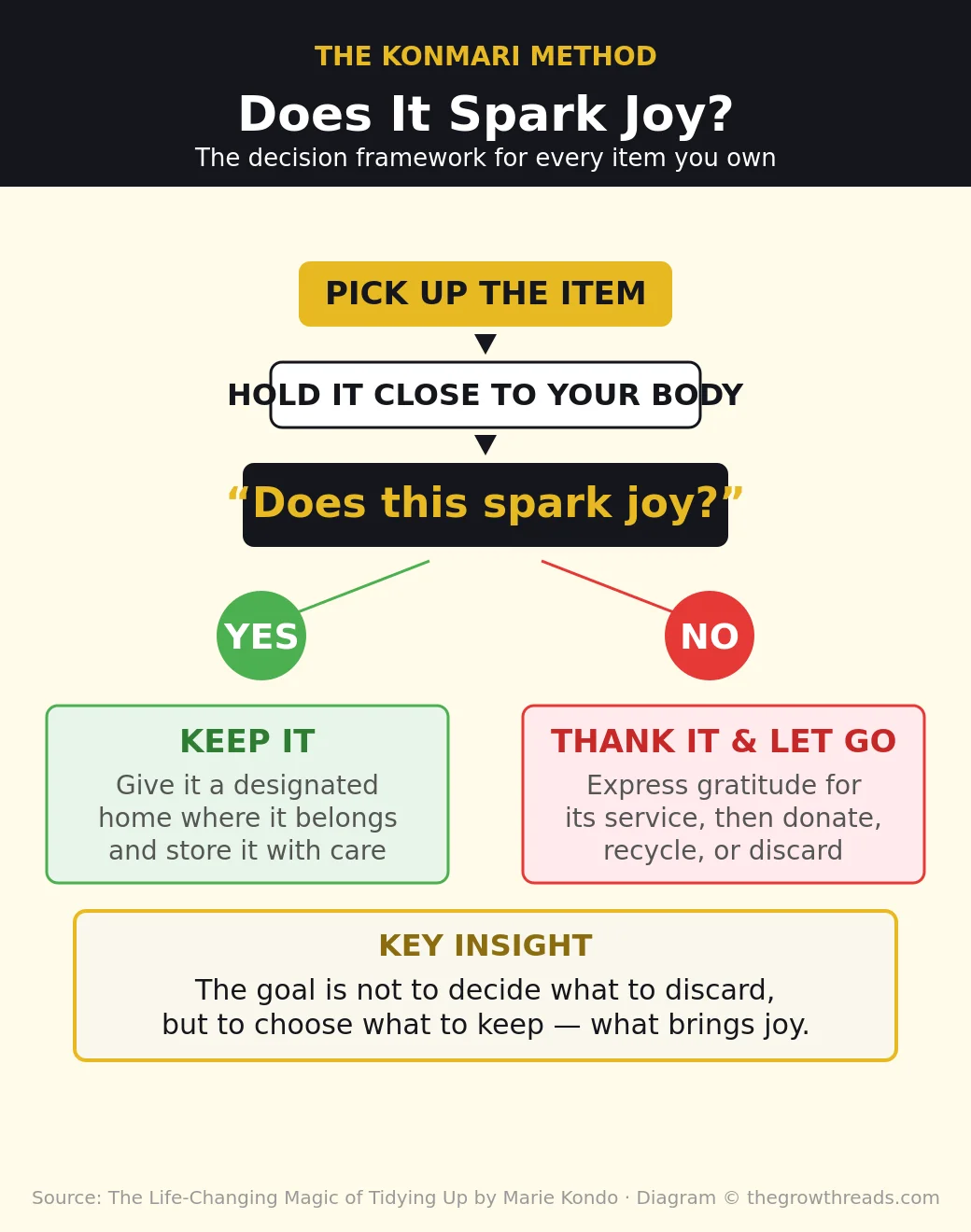
Throughout this process, every discarded item receives a moment of gratitude. Kondo asks you to literally thank the item — for keeping you warm, for the information it provided, for the joy it once brought. This ritual, which skeptics often dismiss as quirky, serves a concrete psychological function: it removes guilt from the act of letting go. You are not “throwing something away.” You are acknowledging its service and releasing it.
Part 3: The art of storage
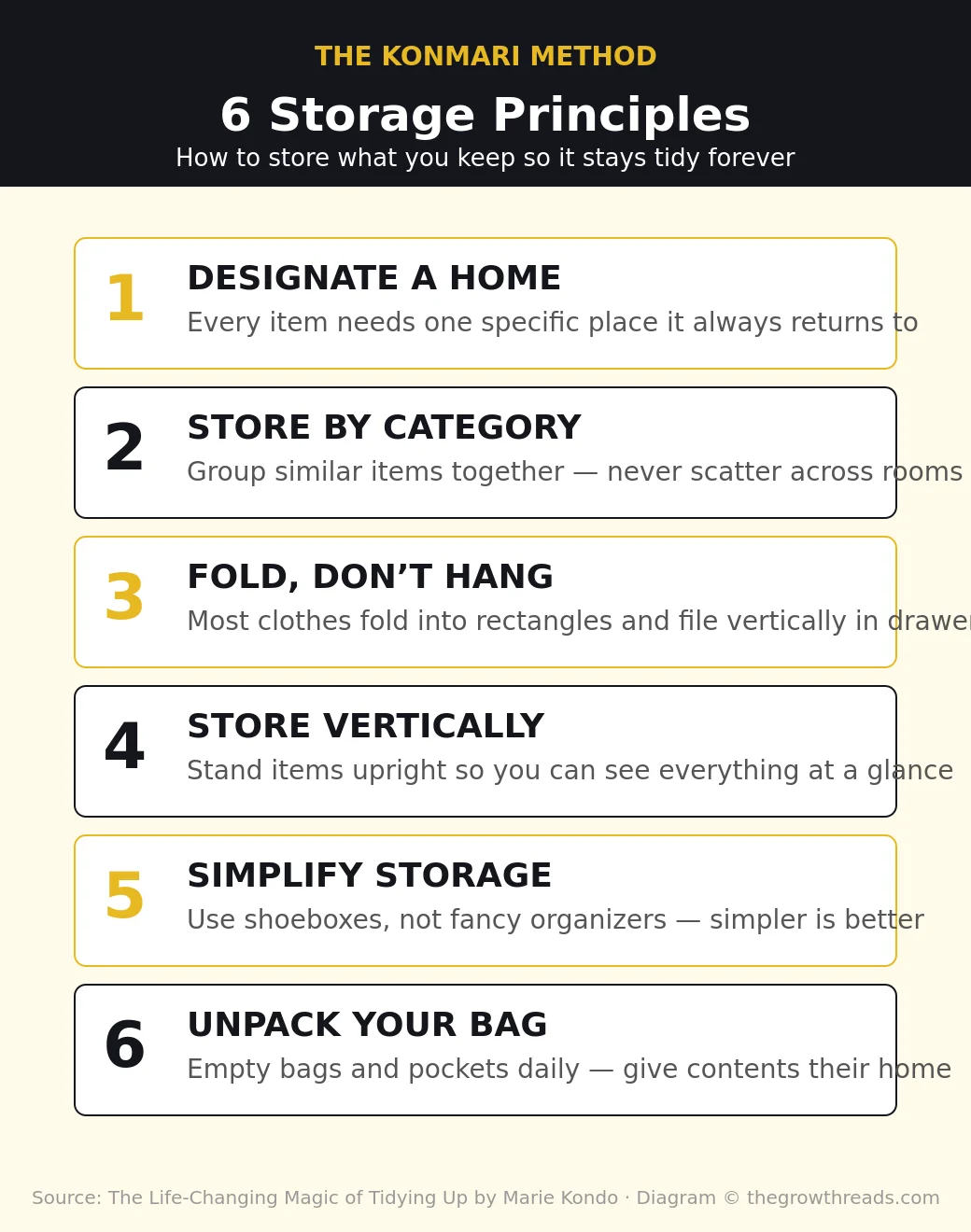
Once discarding is complete, Kondo turns to storage — and her approach is equally unconventional. The central rule is that every item must have a designated home: a single, specific location it always returns to after use. Clutter, in Kondo’s framework, is simply the accumulation of items that have no address.
Her most famous storage technique is vertical folding. Instead of stacking clothes in piles (where you can only see the top item), Kondo teaches you to fold each garment into a compact rectangle and file it upright in a drawer — like books on a shelf. This way, every item is visible when you open the drawer, nothing gets crushed or forgotten at the bottom, and you can immediately see how much you own.
Kondo advocates storing items by category, not by person or room. All cleaning supplies go in one place, all medicines together, all stationery in one spot. This eliminates the common frustration of buying duplicates because you forgot where you stored the original.
For storage solutions, Kondo recommends simplicity over sophistication. Shoeboxes work perfectly as drawer dividers. You do not need expensive organizer systems — and buying more storage products often feeds the cycle of accumulation rather than breaking it.
She also insists on emptying bags and pockets daily. Your handbag, briefcase, and coat pockets should be completely emptied every evening, with each item returned to its designated home. This small habit prevents the “bag-within-a-bag” phenomenon that turns purses and backpacks into mobile junk drawers.
Part 4: The life-changing effects
The final chapters move beyond closets and drawers into something more personal. Kondo argues that tidying is not really about stuff — it is about choosing the life you want. Every keep-or-discard decision is a small act of self-definition. When you surround yourself exclusively with things that spark joy, your environment starts to reflect your values rather than your defaults.
Kondo reports that clients who complete the full KonMari process frequently experience ripple effects they did not expect: career changes, relationship improvements, weight loss, and a newfound clarity about personal goals. She attributes this not to magic but to the decision-making practice itself. Sorting through thousands of possessions trains you to ask “What do I really want?” — a skill that transfers naturally to bigger life choices.
There is also a practical liberation. When everything has a home and clutter is gone, daily maintenance takes minutes rather than hours. The mental burden of “I should really clean” evaporates. Weekends are no longer consumed by reorganizing. The time and energy previously spent managing excess possessions becomes available for activities that actually matter.
Kondo ends with a quiet but powerful point: the things you choose to keep are a portrait of who you are becoming, not who you were. The whole process is less about tidying and more about designing a life that sparks joy on every level.
Who is The Life-Changing Magic of Tidying Up best for — and who should read something else first?
This book is ideal for chronic re-organizers who have tried multiple systems and always reverted to clutter. It works best for people willing to commit a full weekend (or a few concentrated days) to the process rather than chipping away at it. It is also particularly valuable for anyone going through a life transition — a move, a breakup, a career shift — when re-evaluating possessions can accelerate the mental reset.
If you prefer a more relaxed, one-room-at-a-time approach without the marathon commitment, try Decluttering at the Speed of Life by Dana K. White. If your challenge is less about physical clutter and more about digital overload and time chaos, How to Have a Good Day may be a better starting point. For parents struggling with household management beyond just tidying, How to Manage Your Home Without Losing Your Mind offers a family-friendly system.
Questions to reflect on
- When you walk through your home, which rooms or spaces drain your energy — and what specific categories of items are causing that feeling?
- How many of your possessions are kept out of obligation or guilt rather than genuine enjoyment?
- If you could only keep the things that truly spark joy, what would your home look like by next month?
- What are you avoiding confronting — and could sorting through a physical category help you process it?
- How much time do you currently spend each week looking for misplaced items, and what would you do with that time if it were freed?
🔥 Ready to spark joy and reclaim your space?
Get Marie Kondo’s bestselling guide to the only tidying method you will ever need.
How to apply The Life-Changing Magic of Tidying Up (7-day plan)
- Day 1 — Commit and visualize: Set a completion date for your tidying festival. Write down exactly what your ideal home looks and feels like. Clear your calendar for the next few days.
- Day 2 — Clothes: Gather every piece of clothing you own into one pile on the floor. Pick up each item, hold it close, and ask “Does this spark joy?” Keep only the yeses. Thank and bag the rest.
- Day 3 — Books and papers: Pull every book off every shelf. Apply the joy test. Then gather all papers and apply the three-pile rule: currently in use, needed temporarily, or keep indefinitely. Discard everything else.
- Day 4 — Komono (miscellaneous), round one: Start with kitchen items, then bathroom products, then cleaning supplies. Sort each sub-category completely before moving to the next.
- Day 5 — Komono, round two: Tackle hobby gear, electronics, office supplies, and any remaining miscellaneous items. Be rigorous — duplicates and “just in case” items rarely spark joy.
- Day 6 — Sentimental items: Photographs, letters, childhood keepsakes. This is the hardest day. Trust the joy radar you have built over the past four days. Thank items deeply before letting go.
- Day 7 — Designate homes and store: For everything you kept, assign a specific home. Fold clothes vertically into drawers. Arrange items by category. Step back, take a photo, and notice how your space — and your mind — feel different.
Frequently asked questions
Is The Life-Changing Magic of Tidying Up worth reading?
Yes — especially if you have tried tidying before and failed. The book offers a complete, step-by-step system rather than scattered tips, and the “spark joy” framework gives you a consistent decision-making tool for every possession you own. It has sold over 13 million copies worldwide for a reason: the method works, and the results tend to stick. Even if you adapt the system rather than follow it rigidly, the core principles (discard before organizing, sort by category, give everything a home) will transform how you think about your space.
How long does the KonMari method take?
Kondo recommends completing the entire process in about one to six months, depending on the volume of your possessions and how much time you can dedicate. Most people can finish the initial discard phase in a focused weekend or a series of concentrated sessions over two to three weeks. The storage phase takes less time once volume is reduced. The key is to complete each category fully before moving to the next, rather than spreading the work thinly over many months.
What does “spark joy” actually mean?
Kondo describes “spark joy” as a physical sensation — a slight thrill, a feeling of warmth, or a sense of rightness when you hold an item close to your body. It is not purely intellectual (“I might need this someday”) but visceral. She compares it to the feeling of picking up a puppy or touching fabric you love. The test works best when you hold items one at a time and pay attention to your immediate, gut-level response before your rational mind starts generating justifications for keeping it.
Does the KonMari method work for families with kids?
It can, but it requires adaptation. Kondo advises starting with your own belongings first — never tidying someone else’s possessions without permission. For children, the spark-joy principle still applies, but younger kids may need simpler language like “Do you love this toy?” The method works best when each family member goes through their own categories independently. For a more family-oriented household management system that builds on similar principles, see our summary of How to Manage Your Home Without Losing Your Mind.
What is the difference between KonMari and minimalism?
Minimalism typically prescribes owning less as a goal in itself — sometimes aiming for specific numbers (100 items, a capsule wardrobe). KonMari does not set quantity targets. Instead, it uses joy as the only filter: if 200 books spark joy, you keep 200 books. The method is compatible with maximalist aesthetics, collections, and hobbies, as long as every item passes the joy test. The result is often fewer possessions, but the reduction is a side effect of choosing joy, not the primary objective.
How do you fold clothes the KonMari way?
The KonMari fold turns each garment into a smooth, compact rectangle that can stand upright on its own. For a T-shirt: fold both sides toward the center to form a long rectangle, then fold the bottom up to the neckline (or in thirds for longer shirts), creating a small packet. File these packets vertically in a drawer so you can see every item when you open it — like records in a crate. The technique works for socks (folded, never balled), underwear, pants, and even towels. The key test: can it stand up on its own edge?
What should I read after The Life-Changing Magic of Tidying Up?
If you want to go deeper on KonMari, read Kondo’s follow-up Spark Joy, which provides illustrated folding guides and room-by-room storage tips. For a less intensive decluttering approach, try Decluttering at the Speed of Life. To extend the tidy-environment principle to your workspace, Work Clean applies mise en place thinking from professional kitchens. And for applying the “less but better” philosophy to productivity more broadly, see our summary of The 80/20 Principle.
Related summaries
- Decluttering at the Speed of Life Summary & Review — Dana K. White’s practical approach for people who hate organizing
- Work Clean Summary & Review — apply the “everything in its place” philosophy to your workstation
- The 80/20 Principle Summary & Review — focus on the vital few possessions, tasks, and habits that matter most
- Best Productivity Books — our ranked guide to the most actionable productivity reads
Related Productivity Summaries
Hyperfocus Summary & Review: Master Both Focus and Creative Mind-Wandering
Sprint Summary & Review: Solve Big Problems and Test Ideas in Five Days
The 12 Week Year Summary & Review: Get More Done in Less Time
The Pomodoro Technique Summary & Review: 25 Minutes to Real Focus
The Talent Code Summary & Review: Greatness Is Grown, Not Born