

★★★★☆ 3.6/5 — A practical reset for anyone whose calendar runs them instead of the other way around.
Best for: Overloaded managers, founders, and freelancers who feel constantly busy but rarely productive.
Reading time: ~5 hrs to read (about 240 minutes)
Difficulty to apply: Easy to moderate — most of the ideas are a single habit change away, not a full life overhaul.
Time Rich in one minute
Time is worth more than money, because you can always make more money but you can never make more time. That trade-off sits at the center of Steve Glaveski’s Time Rich, which argues most of us manage our calendars like we manage nothing else that matters: reactively, by whoever shouts loudest, with almost no regard for what our best hours are actually worth. Glaveski’s fix isn’t another to-do list app. It’s a shift in how you decide what deserves your time at all — prioritizing the few things that move the needle, automating or delegating the rest, and protecting the energy that makes any of it possible in the first place.
Key takeaways
- Time, not money, is the scarce resource: money can be earned back; hours spent are gone for good, so decisions should be filtered through a time cost, not just a dollar cost.
- Busy is not the same as productive: a full calendar can still be a calendar full of the wrong things.
- Prioritize before you optimize: figure out what actually matters before you try to do more of everything faster.
- Automate what doesn’t need judgment: repeatable, low-decision tasks belong to tools and systems, not to you.
- Delegate what doesn’t need you specifically: if someone else can do it nearly as well, it’s a candidate to hand off.
- Energy is a schedule input, not an afterthought: when you work matters almost as much as how long you work.
- Flow is protected, not stumbled into: deep, focused stretches need to be defended on the calendar in advance.
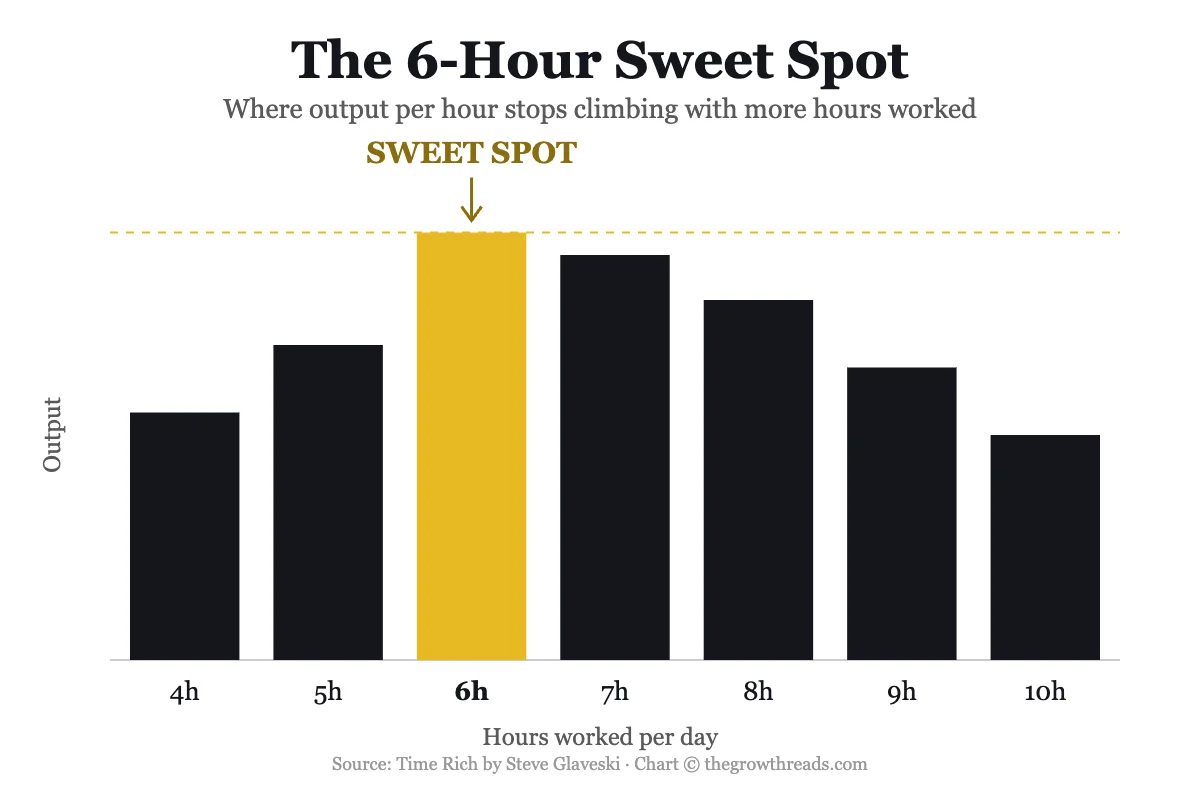
- Shorter, more focused workdays can outperform longer ones: output tends to plateau — and eventually decline — well before the traditional workday ends.
- Recovery is part of the system: real rest, not just less screen time, is what lets peak performance repeat day after day.
- Small weekly reviews compound: a short, regular check-in on where your time actually went beats an annual overhaul.
What is Time Rich about?
Time Rich is a practical guide to reclaiming hours from an overloaded schedule by treating time, not money, as the resource worth protecting. Steve Glaveski walks through how to prioritize what actually matters, automate or delegate the rest, and manage energy and focus so the hours you do keep are used well — not just filled.
About the author
Steve Glaveski is an Australian entrepreneur, author, and podcaster known for writing and speaking on productivity, entrepreneurship, and the future of work. He co-founded Collective Campus, an innovation and venture-building consultancy, and hosts the Future Squared podcast, where he has interviewed founders, scientists, and productivity researchers on how people and organizations work best. Time Rich draws on that mix of firsthand entrepreneurial experience and years of conversations with people who study how time, attention, and energy actually work — distilled into a practical playbook rather than an academic one. Explore all Steve Glaveski book summaries →
Key concepts at a glance
| Concept | What it means | Use it when |
|---|---|---|
| Money-time trade-off | Time is the truly scarce resource; money can be regenerated, hours cannot. | You’re weighing whether a task, meeting, or purchase is really worth your time. |
| Prioritize, Automate, Delegate | Sort tasks by impact, hand repeatable work to tools, and pass off what others can do. | Your task list is longer than your available hours. |
| Energy management | Matching demanding work to your naturally higher-energy hours. | You’re deciding when in the day to schedule deep work versus admin. |
| Flow protection | Blocking uninterrupted stretches on the calendar before the day fills up. | You need extended focus for a single hard problem. |
| TYRE (“spare tyres”) | Glaveski has described building in buffer time and backup plans so one delay doesn’t derail the day — a concept he likens to carrying a spare tyre. | Your schedule has zero slack and one late meeting cascades into the rest of the day. |
| C.R.A.P. filter | Glaveski has described a filter for cutting Clutter, Redundancy, and other low-value work that doesn’t earn its place on the calendar. | You’re deciding what to cut from a task list, not just what to add. |
| Shorter, focused workdays | Output per hour tends to flatten and then fall well before a traditional 8-hour day ends. | You’re questioning whether a longer day is actually a more productive one. |
Part 1: Time is worth more than money
Glaveski opens with a reframe that sounds obvious once stated but rarely governs how people actually behave: money is a renewable resource and time is not. You can lose money and earn it back. You cannot lose an afternoon and earn it back. Yet most of us budget our money carefully and our time carelessly — saying yes to meetings, favors, and obligations without ever running the equivalent of a cost check.
The book’s opening chapters build the case that decisions — what to buy, what to commit to, what to say yes to — should be filtered through a time cost as seriously as a dollar cost. A cheap purchase that costs you three hours of research and comparison-shopping wasn’t actually cheap. A “quick favor” that costs an afternoon wasn’t quick. Once you start pricing decisions in hours instead of dollars, a lot of low-value activity becomes much easier to say no to.
TGR Note: This lines up closely with the money-versus-time argument in Hell Yeah or No, where Derek Sivers makes essentially the same case for ruthless selectivity — if it isn’t a “hell yeah,” it’s a no. Reading the two together makes the underlying principle harder to ignore.
Part 2: Prioritize, automate, delegate
With the mindset shift established, Time Rich moves into its most actionable section: a simple three-step filter for deciding what to actually do with your hours. First, prioritize — sort tasks by real impact rather than urgency, and protect time for the handful that matter most. Second, automate — anything repeatable and low-judgment (scheduling, recurring reports, routine follow-ups) should be handed to a tool or a system, not redone by hand every time. Third, delegate — anything someone else can do nearly as well as you should be passed to them, freeing your hours for the work that specifically requires you.
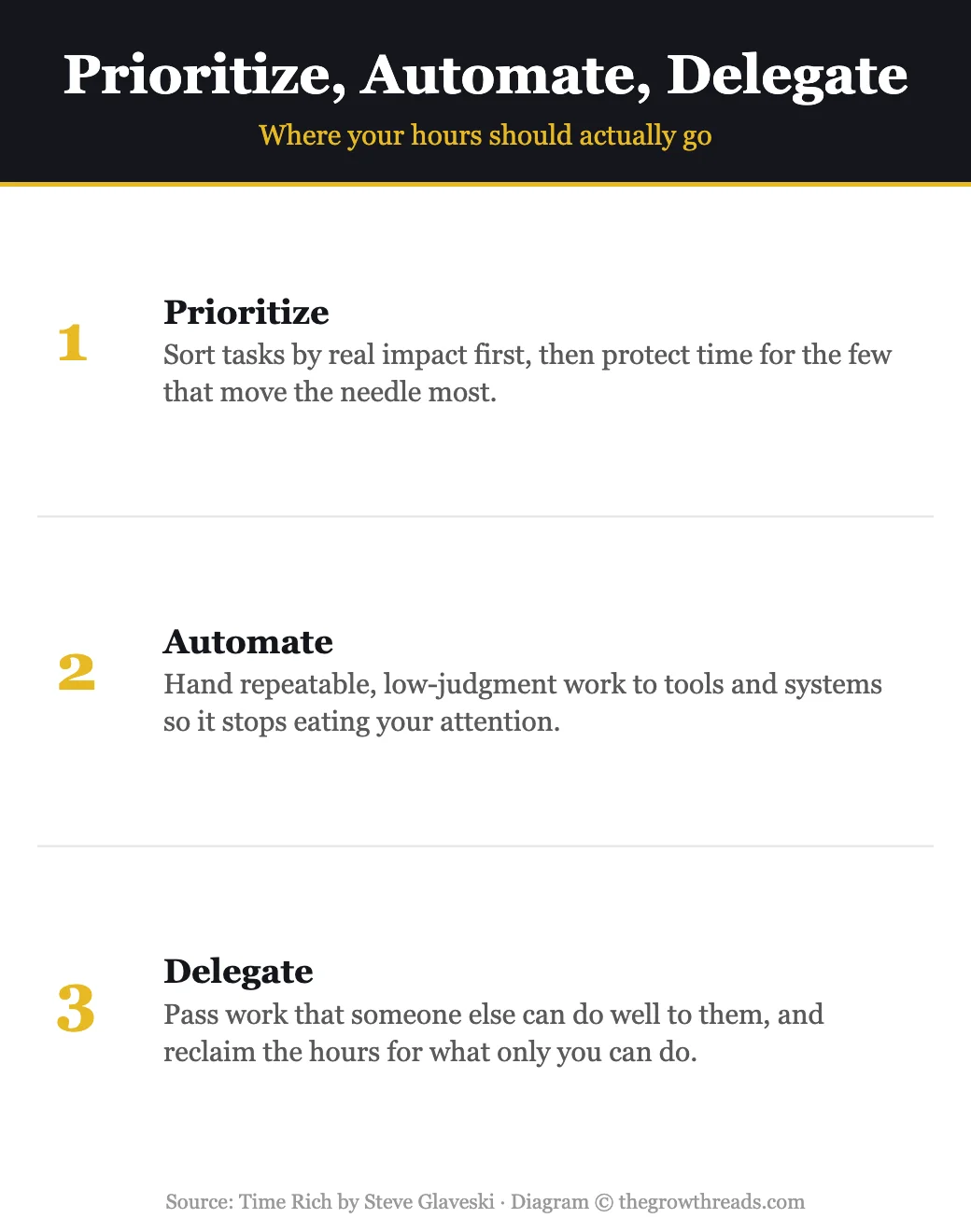
The order matters. Automating or delegating before you’ve prioritized just means doing the wrong things faster or handing the wrong things to someone else. Glaveski is emphatic that the filter has to run in sequence — decide what matters first, then figure out how to stop personally doing everything else.
Part 3: Where your time actually goes missing
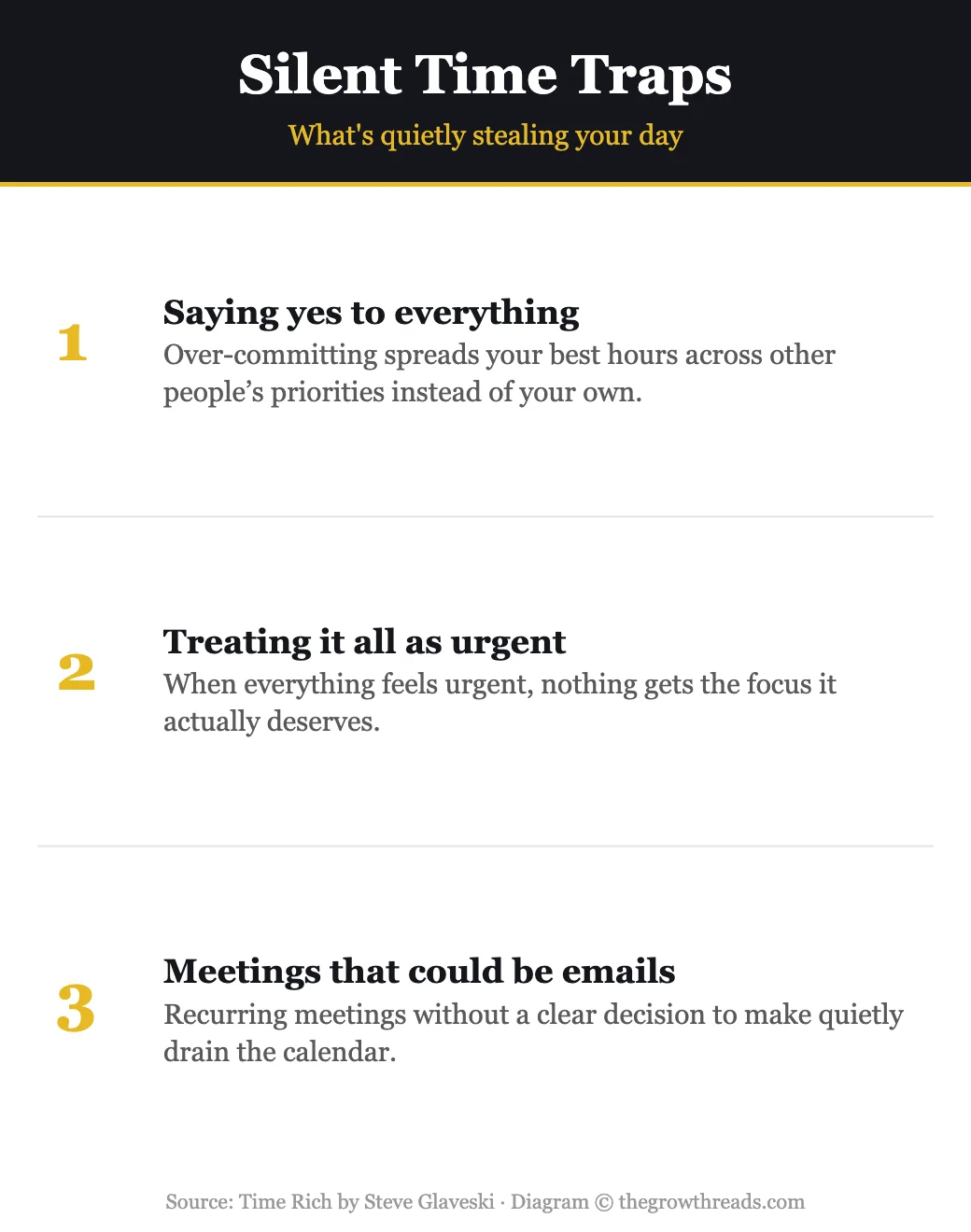
The middle of the book turns from what to do to what to stop doing, cataloguing the everyday habits that quietly drain a calendar without ever feeling like a single big decision. Saying yes by default. Treating every request as equally urgent. Sitting through recurring meetings that no longer have a clear decision attached to them. None of these feel dramatic in the moment — that’s exactly why they survive so long unexamined.
Glaveski has also described using a simple filter — he calls it C.R.A.P. — for spotting Clutter, Redundancy, and other low-value activity that has drifted onto a calendar without ever earning its place there. He’s also talked about building in “spare tyres” (TYRE): deliberate buffer time and backup plans, so that one delayed meeting or one dropped ball doesn’t cascade into a wrecked afternoon. Treat both as useful mental checklists rather than rigid formulas — the underlying habit, regularly auditing what’s actually on your calendar and why, is the part worth adopting either way.
TGR Note: The meetings-that-could-be-emails problem also shows up in The Perfect Day Formula, which argues that a well-structured day needs far fewer meetings than most calendars actually contain. Both books land on the same fix: default to no, and make the requester justify the meeting rather than the other way around.
Part 4: Manage energy, not just the clock
The book’s final major argument is that when you work matters nearly as much as how long you work. Everyone has a window — usually a few hours — where focus and decision-making are naturally sharper. Glaveski’s advice is to identify that window and defend it fiercely for the work that actually needs it, pushing shallow, low-stakes tasks like email and routine admin into the lower-energy parts of the day instead.
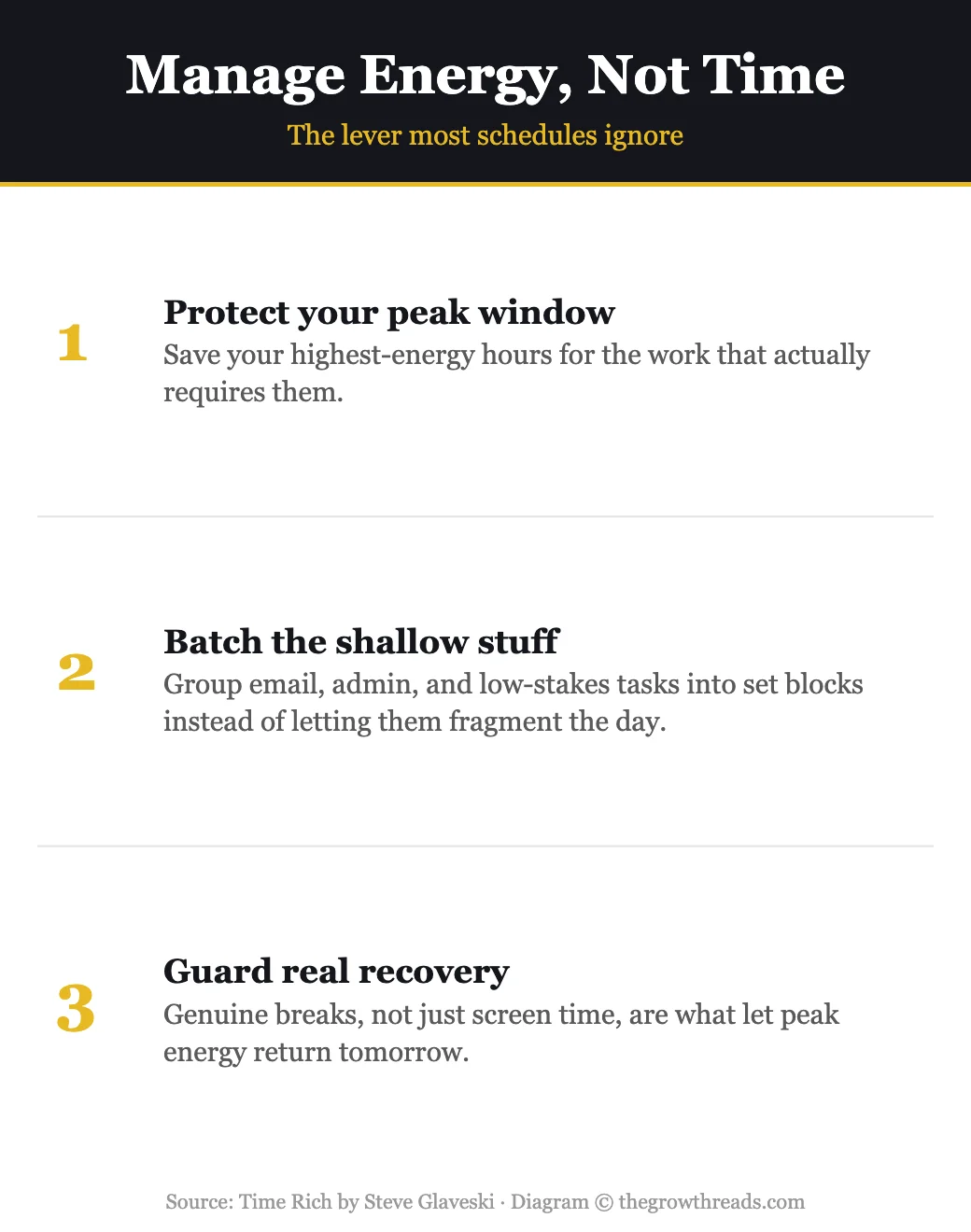
This section also connects to a broader lineage of research, going back to reporting popularized by Harvard Business Review, suggesting that output per hour tends to flatten — and can even decline — well before a traditional eight-hour workday is over. Glaveski uses this as an argument for shorter, more deliberately structured workdays rather than simply longer ones, paired with genuine recovery time rather than passive screen time, so peak energy is available to repeat the next day instead of slowly eroding across the week.
TGR Note: This is close to the argument in Two Awesome Hours, which zeroes in on protecting just one or two peak windows a day rather than trying to optimize every hour equally. If you want a deeper dive on this specific idea, that book is a natural next read.
Who is Time Rich best for — and who should read something else first?
Time Rich is best for people whose calendars are already full but whose output doesn’t match the hours going in — managers, founders, freelancers, and anyone juggling more inbound requests than they can reasonably say yes to. If your core problem is closer to procrastination or getting started at all rather than an overloaded calendar, The Miracle Equation may be a better starting point. If you want a deeper system for organizing tasks across life domains rather than a philosophy of time itself, Master Your Time, Master Your Life is a more structured complement.
Questions to reflect on
- Which recurring commitment on your calendar would you cut first if you priced it in hours instead of dollars?
- What’s one task you’re still doing by hand that a tool or a system could take off your plate?
- Is there something on your plate that someone else could do nearly as well as you — and what’s stopping you from handing it off?
- When during the day is your focus genuinely sharpest, and does your calendar actually protect that window?
- What would a “spare tyre” — a small buffer or backup plan — look like for your most fragile day of the week?
🔥 Ready to get your time back?
Grab a copy of Time Rich and start reclaiming hours this week.
How to apply Time Rich (7-day plan)
- Day 1: Track where your hours actually go for one full day, without changing anything yet.
- Day 2: List every recurring commitment on your calendar and price each one in hours per month, not dollars.
- Day 3: Pick one repeatable, low-judgment task and set up a tool or template to automate it.
- Day 4: Identify one task you can delegate this week, and hand it off.
- Day 5: Notice your natural peak-energy window and block it for one piece of focused work only.
- Day 6: Cancel or shorten one recurring meeting that no longer has a clear decision attached to it.
- Day 7: Do a 15-minute weekly review: what worked, what still drained your time, and one change for next week.
Frequently asked questions
What is the main idea of Time Rich by Steve Glaveski?
The main idea is that time, not money, is the resource worth protecting most carefully, because money can be earned back while spent hours cannot. Glaveski builds a practical system around that idea: prioritize what matters, automate or delegate the rest, and manage your energy so the hours you keep are used well rather than just filled with activity.
Who should read Time Rich?
It’s aimed at people whose schedules are already full but whose results don’t match the hours going in — managers, founders, freelancers, and anyone fielding more requests than they can reasonably handle. If you struggle more with getting started than with an overloaded calendar, a book focused on motivation and momentum may be a better first read.
What is the prioritize, automate, delegate framework?
It’s a three-step filter Glaveski recommends running in order: first sort tasks by genuine impact rather than urgency, then hand repeatable, low-judgment work to tools and systems, and finally delegate anything someone else could do nearly as well. Running the steps out of order tends to mean doing the wrong things faster or offloading the wrong things to someone else.
Does Time Rich say working shorter hours makes you more productive?
Glaveski argues that output per hour tends to flatten and can even decline well before a traditional eight-hour workday ends, drawing on research popularized by outlets like Harvard Business Review. He uses this as a case for shorter, more deliberately structured workdays paired with real recovery time, rather than a blanket claim that fewer hours always beats more for every job or every person.
What are TYRE and C.R.A.P. in Time Rich?
These are two mental checklists Glaveski has described in his writing and interviews. TYRE (“spare tyres”) is about deliberately building in buffer time and backup plans so one delay doesn’t cascade into a wrecked day. C.R.A.P. is a filter for spotting Clutter, Redundancy, and other low-value activity that has drifted onto a calendar without earning its place there. Both are best used as habits of regular auditing rather than rigid formulas.
Is Time Rich based on scientific research?
The book draws on a mix of Glaveski’s own entrepreneurial experience, interviews from his Future Squared podcast, and cited research on productivity, energy, and workday length. Some of the statistics and framing have been debated by other researchers, but the core practical advice — prioritize deliberately, protect peak energy, and build in buffer time — is broadly uncontroversial and echoed across the productivity literature.
How is Time Rich different from other time management books?
Rather than offering another scheduling app or to-do list method, Time Rich starts from a mindset shift — time as the scarcer resource — and builds a filter for decisions before it gets into tactics. Its emphasis on energy management and shorter, more focused workdays also sets it apart from books that focus purely on squeezing more tasks into the same number of hours.
Related summaries
- Do Less: Work With Your Energy, Not the Clock
- Two Awesome Hours: Protect Your Peak Time Each Day
- Master Your Time, Master Your Life
- See all the best productivity books
How we analyze books: Every TGR summary is built from a close read of the book’s core arguments, cross-checked against the author’s other published work and interviews, and organized around what you can actually do differently this week. Read our full methodology.
Related Time Management Summaries
Company of One Summary & Review: Why Bigger Isn’t Always Better
No B.S. Time Management for Entrepreneurs Summary & Review: Price Your Own Hour
Organize Tomorrow Today Summary & Review: Plan Tonight, Win Tomorrow
Scrum Summary & Review: Doing Twice the Work in Half the Time
The Time Paradox Summary & Review: The Hidden Clock Running Your Decisions