

★★★★☆ 3.6/5 — A gracious, negotiation-based fix for interruption overload, built around one simple habit: blocking your calendar and defending it out loud.
Best for: Anyone whose calendar keeps getting hijacked by other people’s urgency
Reading time: ~3 hrs (a compact, practical guide)
Difficulty to apply: Low — the core habit takes one calendar block to start
The Time Bandit Solution in one minute
Most of what steals your day isn’t a mystery — it’s a meeting that ran long, a colleague who “just needs five minutes,” or your own inbox pulling you away from the thing you sat down to do. Edward G. Brown’s The Time Bandit Solution: Recovering Stolen Time You Never Knew You Had argues that the fix isn’t a stricter to-do list or a willpower upgrade. It’s a habit called Time Locking: you block real, protected chunks of calendar time for the work that matters, and you defend those blocks the same way you’d defend a client meeting — graciously, but firmly. The twist that makes the book worth reading past the first chapter is its second half: you are, at least sometimes, someone else’s time bandit too. The solution isn’t to build higher walls around your calendar. It’s to negotiate better, on both sides.
Key takeaways
- Interruptions cost more than the interruption itself: every time you get pulled off a task, there’s a refocusing tax afterward — the real loss is the ramp-up time, not just the minutes the interruption took.
- A large share of a typical workday is lost this way: Brown cites research suggesting that somewhere in the range of 40–60% of a workday gets eaten by interruptions and the recovery time that follows them.
- Time Locking is the core habit: block specific, recurring calendar time for your priority work and treat it with the same seriousness as an external appointment.
- A block that isn’t defended isn’t a block: the calendar entry only works if you’re willing to say, out loud, that you’re unavailable during it.
- Defend gracefully, not rigidly: the goal is a negotiation, not a wall — offer the interrupting person a specific alternative time instead of a flat no.
- You are a time bandit too: the same behaviors that frustrate you — the drop-in, the “quick question,” the last-minute ask — are ones you do to other people as well.
- Mutual awareness changes the tone: once you recognize your own interrupting habits, asking someone else to respect your Time Lock stops feeling like a demand and starts feeling like a trade.
- Small, protected blocks beat one big ambition: a single well-defended 90-minute block most days accomplishes more than an entire day vaguely intended for “focus work.”
- Review and adjust weekly: which blocks held, which got negotiated away, and why — the system is meant to flex with your actual week, not fight it.
- This is a workplace-culture fix, not just a personal one: Time Locking works best when the people around you also understand and respect it, which means the habit spreads through modeling, not mandate.
What is The Time Bandit Solution about?
The Time Bandit Solution is a short, practical guide to reclaiming lost workday hours through a habit called Time Locking — blocking and gracefully defending calendar time for priority work — paired with the reminder that everyone, including the reader, interrupts other people too.
About the author
Edward G. Brown co-founded Cohen Brown Management Group, a sales performance and management consulting firm that has worked with large organizations on training and culture change. Before moving into consulting, Brown’s career included time in the entertainment industry, which he has credited with shaping his interest in how people actually behave under pressure rather than how process documents say they should. The Time Bandit Solution grew out of decades spent inside companies watching skilled, well-intentioned people lose their days to interruptions they felt powerless to say no to — and noticing that the same people were, often without realizing it, doing the interrupting themselves. Explore all Edward G. Brown book summaries →
Key concepts at a glance
| Concept | What it means | Use it when |
|---|---|---|
| Time Locking | Blocking recurring calendar time for priority work and defending it like an external commitment | You have work that needs sustained, uninterrupted attention |
| The refocusing tax | The extra time lost after an interruption while you rebuild context, on top of the interruption itself | You’re tallying the real cost of “just a quick question” |
| Gracious negotiation | Responding to an interruption with a specific alternative time instead of a flat refusal | Someone tries to break into a locked block |
| We are all time bandits too | Recognizing that you interrupt others as often as they interrupt you | You’re about to ask a colleague to respect your calendar |
| Weekly review | Checking which Time Locks held, which were negotiated away, and why | Your blocks keep disappearing and you’re not sure why |
| Culture by modeling | Other people start respecting Time Locks once they see you respecting theirs | You want the habit to spread beyond your own calendar |
Part 1: The real cost of interruptions
Brown opens with a number most readers underestimate: somewhere in the range of 40 to 60 percent of a typical workday disappears into interruptions and the recovery time that follows them. That second half of the equation is the part people miss. A two-minute question from a colleague doesn’t just cost two minutes — it costs the two minutes plus however long it takes you to remember where you were, reload the mental context of what you were doing, and get back to the same depth of focus you had before. Brown calls this the refocusing tax, and across a full day of small interruptions, it adds up to something much larger than the interruptions themselves.
The book’s first move is simply to make this visible. Most people can name the meetings that eat their calendar, but they underestimate the drip-drip of smaller interruptions — a Slack message, a “got a sec?”, an email that could have waited. Brown’s term for anyone or anything that pulls you off task, whether it’s a person, a notification, or a habit of your own, is a time bandit. Some are obvious — the coworker who drops by unannounced. Others are quieter — the phone you check between paragraphs, the open tab you didn’t need to open.
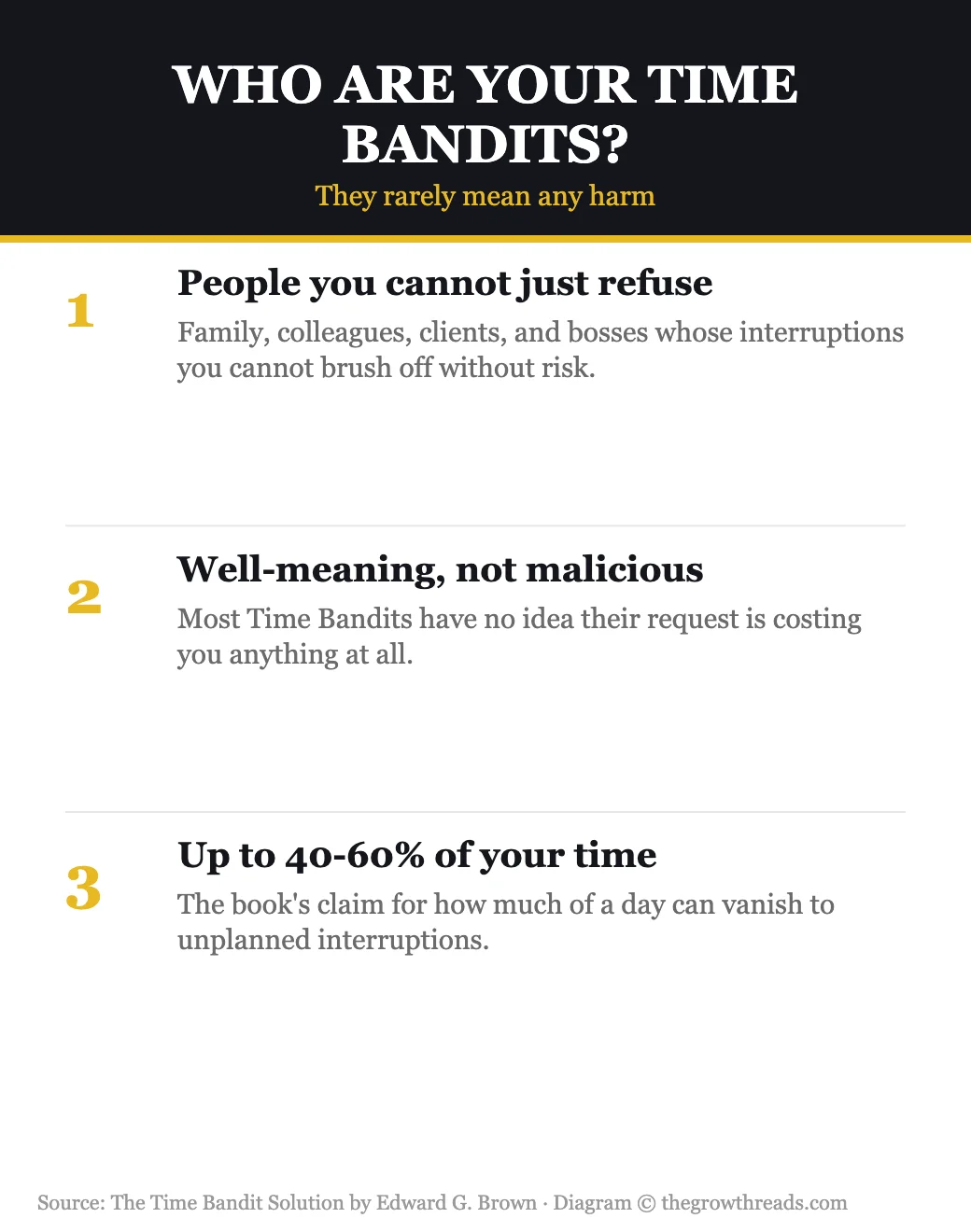
What makes this framing useful rather than just discouraging is that Brown doesn’t stop at naming the problem. The point of tallying the cost of interruptions isn’t to feel bad about a chaotic calendar — it’s to build the case, for yourself and for the people around you, that protecting blocks of time is worth the mild social friction of doing so. If 40 to 60 percent of the day really is at stake, then a few gracious, well-placed “not right now, but how about” conversations are a small price for getting a meaningful chunk of that time back.
Part 2: Time Locking — the core technique
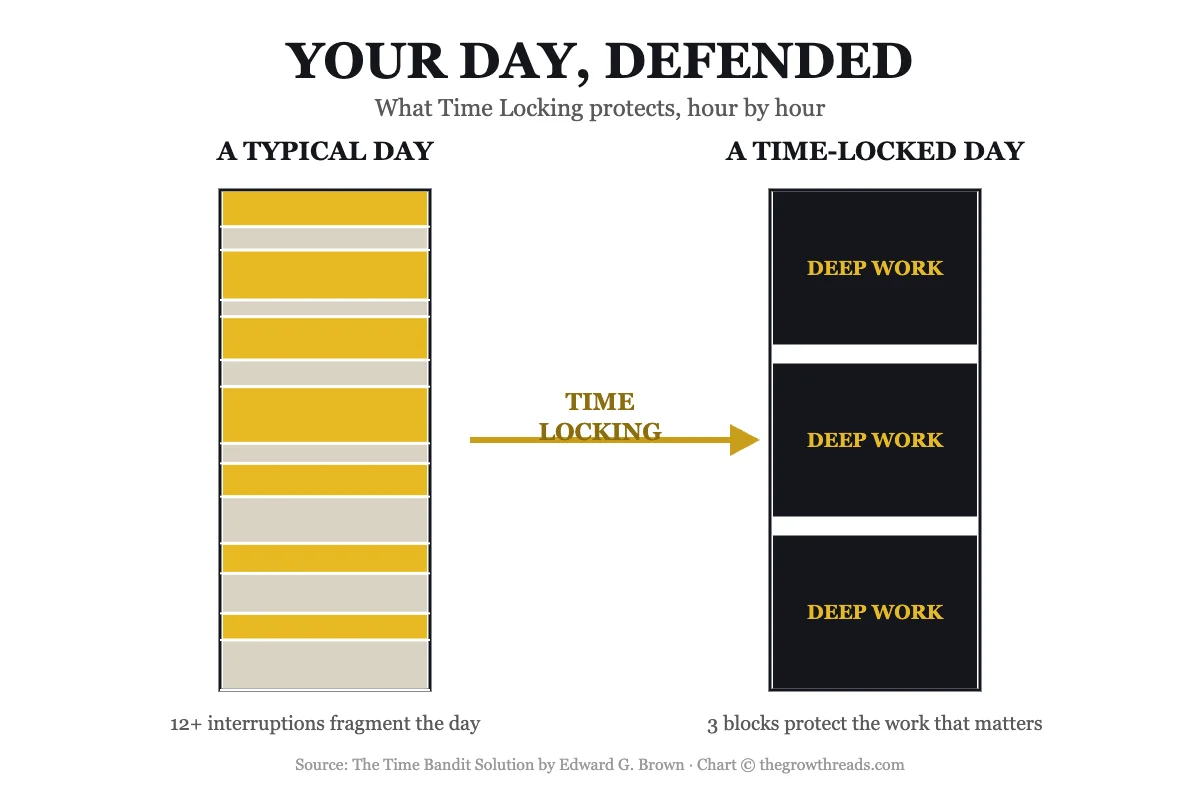
The book’s central habit is straightforward to describe and, Brown is careful to note, harder to sustain than it sounds. You choose a specific, recurring window of time — the same hour or two each day works best — and you put it on your calendar exactly as you would an external commitment. Not “focus time” as a vague aspiration, but a named block with a start and end time that shows up the same way a client call would.
The reason this matters more than it sounds like it should: a vague intention to “get to the important stuff later” loses every negotiation with an urgent-feeling interruption, because later has no defender. A calendar block with a name and a time slot has a fighting chance, because turning it down now has a visible cost — you can see exactly what you’re giving up and when you’d have to reschedule it.
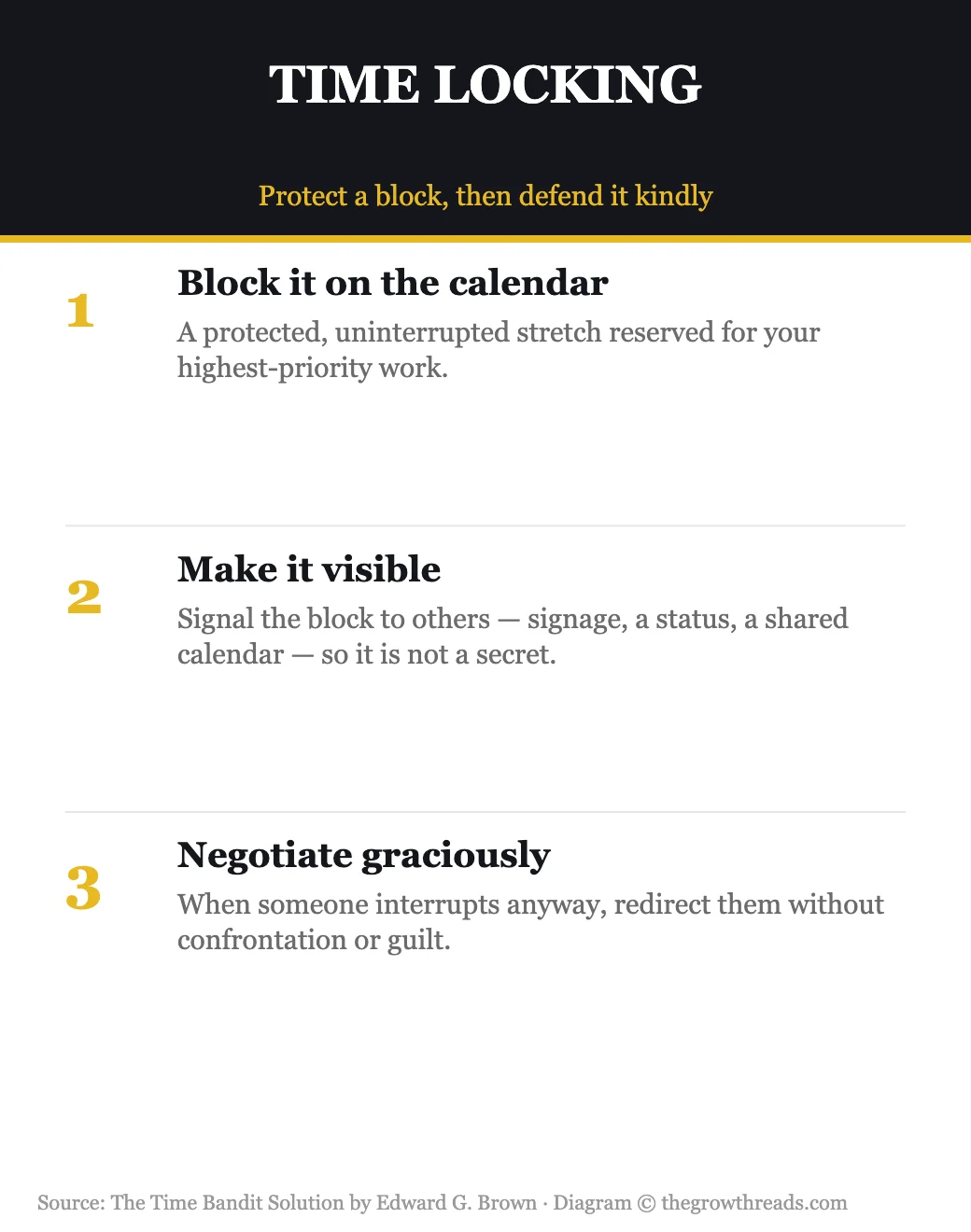
Brown is explicit that Time Locking isn’t about disappearing for eight hours a day. Most of the examples in the book involve blocks of 60 to 90 minutes — long enough to get real traction on something that needs sustained attention, short enough that defending it once or twice a day doesn’t require becoming unreachable. The habit compounds: a single protected block, held consistently, does more for a meaningful project over a month than an entire week nominally set aside for “deep work” that keeps getting reshuffled.
Part 3: Negotiating your calendar gracefully
The word Brown returns to again and again is gracious. A Time Lock that’s defended with a closed door and a flat “I’m busy” creates resentment and, eventually, people who stop respecting it because it feels like a wall rather than a boundary. The alternative the book teaches is a specific kind of negotiation: when someone tries to interrupt a locked block, you don’t just decline — you offer a concrete alternative. “I’m heads-down until 11, but I can call you right after” does the same job as “not now” while leaving the other person with something instead of nothing.
This matters because most interruptions aren’t actually urgent — they just feel urgent to the person doing the interrupting, in the moment. A specific, near-term alternative usually satisfies that feeling of urgency just as well as immediate attention would. Brown’s point is that this isn’t a trick or a soft way of saying no — it’s a genuine trade, and treating it as one is what keeps the relationship intact.
The book also spends time on the harder cases: the repeat interrupter, the boss whose “quick question” isn’t optional, the team culture where everyone’s calendar is treated as open by default. Brown’s answer isn’t a script for every scenario so much as a consistent posture — stay gracious, stay specific about the alternative, and hold the line more often than not. The blocks that survive contact with a busy office are the ones defended calmly and repeatedly, not the ones defended once, loudly.
Part 4: We are all time bandits too
The section that gives the book its sharpest angle comes in the second half, where Brown turns the lens around. It’s easy to read the first chapters as a manual for protecting your time from other people. But Brown is direct about the fact that the reader is, at least sometimes, the interruption in someone else’s day — the drop-in visitor, the sender of the “got a minute?” message, the person who assumes their question is the exception to whatever the other person is doing.
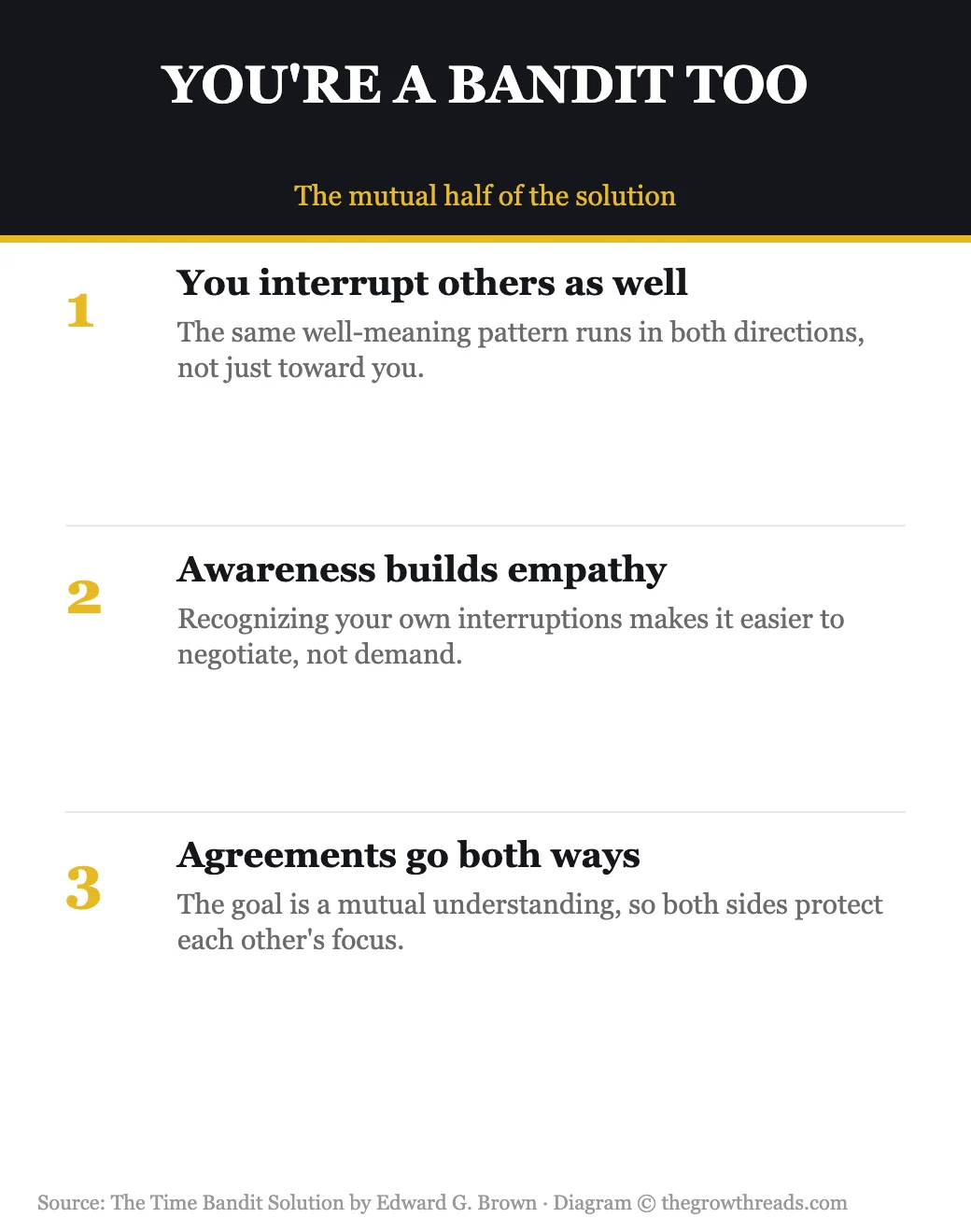
This reframing changes the tone of the whole system. Asking a colleague to respect your Time Lock stops being a one-sided demand once you’ve also committed to respecting theirs. Brown’s case is that Time Locking works best as a mutual practice rather than a personal defense mechanism — a team where everyone understands and honors each other’s protected blocks loses far less to interruptions than a team where one person tries to build a wall around their own calendar while everyone else’s stays wide open.
Who is The Time Bandit Solution best for — and who should read something else first?
This book is best for people whose calendars are being taken over by other people’s urgency — managers, client-facing professionals, and anyone in an open-plan or highly collaborative environment where “got a minute?” is a constant refrain. It’s especially useful if you’ve already tried blocking time and found that the blocks kept getting overridden; Brown’s book is really a guide to defending a block once you’ve made it, more than a guide to making one.
If you haven’t yet built the habit of planning your day around priorities at all, start with Master Your Time, Master Your Life for the underlying prioritization system, or The Perfect Day Formula for a structure to build your day around from scratch. Come back to The Time Bandit Solution once you have blocks worth defending.
Questions to reflect on
- Which single recurring interruption costs you the most time once you factor in the refocusing tax afterward?
- If you tried Time Locking before and it didn’t stick, was it because you never scheduled the block, or because you didn’t defend it once it was on the calendar?
- Who in your work life would benefit from you being more predictable about when you’re interruptible and when you’re not?
- Think of the last time you interrupted someone else. What alternative could you have offered instead of expecting immediate attention?
- What would a gracious, specific alternative sound like the next time someone tries to break into your protected time?
🔥 Ready to stop losing your day to other people’s urgency?
Get The Time Bandit Solution and start defending your first block this week.
How to apply The Time Bandit Solution (7-day plan)
- Day 1: Track every interruption for one day, including how long it takes you to get back to full focus afterward.
- Day 2: Pick one recurring 60–90 minute window and put a named Time Lock on your calendar for the rest of the week.
- Day 3: Tell the two or three people most likely to interrupt that block what it is and when you’re free instead.
- Day 4: The next time someone tries to break into the block, practice the gracious-alternative script instead of a flat no.
- Day 5: Notice one interruption you caused for someone else today, and offer them a specific alternative time.
- Day 6: Review which parts of the block held and which got negotiated away — and why.
- Day 7: Adjust the time or length of your block based on the week, and commit to it as a standing appointment going forward.
Frequently asked questions
What is Time Locking?
Time Locking is the core habit in The Time Bandit Solution: you block a specific, recurring window of calendar time for priority work and treat it with the same seriousness as an external commitment, rather than as a vague intention to focus “when things quiet down.”
How much time does the book claim interruptions actually cost?
Brown cites research suggesting that somewhere between 40 and 60 percent of a typical workday is lost to interruptions and the recovery time that follows them — what the book calls the refocusing tax, which is often larger than the interruption itself.
Is this the same as basic time blocking?
It builds on the same foundation as time blocking, but the book’s focus is specifically on defending a block once it exists — through gracious, specific negotiation rather than a flat refusal — which is the part most time-blocking advice skips over.
What does “we are all time bandits too” mean?
It’s Brown’s reminder that the reader also interrupts other people, often without noticing. The book argues that Time Locking works best as a mutual practice, where you extend the same respect for other people’s protected time that you’re asking them to extend to yours.
Does the book have a large following or many reviews?
It has a smaller review footprint than many productivity bestsellers, with a modest number of ratings on major retailers. That doesn’t reflect on the quality of the ideas — the core habit of Time Locking is a well-established concept with roots in more widely known time-management literature — but readers looking for a book with a large public conversation around it may want to pair it with a better-known title.
Do I need to read this cover to cover to get value from it?
No. The core technique — block, name, and gracefully defend a recurring window of time — can be extracted and applied from the first couple of chapters. The rest of the book is mostly examples and edge cases for defending blocks in harder situations.
Who is Edward G. Brown?
Edward G. Brown is a co-founder of Cohen Brown Management Group, a sales performance and management consulting firm. Before his consulting career, he spent time in the entertainment industry, an experience he has cited as shaping his interest in how people actually behave under pressure.
Related summaries
If you found this useful, you may also like Master Your Time, Master Your Life, The Perfect Day Formula, and Atomic Habits. For more, browse our full best productivity books guide.
Related Time Management Summaries
Decluttering at the Speed of Life Summary & Review: The Container Concept That Actually Works
It Doesn’t Have to Be Crazy at Work Summary & Review: Build the Calm Company
Organize Tomorrow Today Summary & Review: Plan Tonight, Win Tomorrow
Time Rich Summary & Review: Reclaim Your Hours by Managing Energy, Not Just the Clock
Your Best Year Ever Summary & Review: A 5-Step Plan for Your Best Year