

★★★★★ 4.6/5 — A direct, practical case for redesigning your environment instead of trying to out-discipline yourself.
Best for: Anyone who has repeatedly tried and failed to change a habit through sheer determination alone.
Reading time: ~4 hours to read the book, about 20 minutes to read this guide.
Difficulty to apply: Moderate — the ideas are simple, but redesigning your environment takes real upfront effort.
Willpower Doesn’t Work in one minute
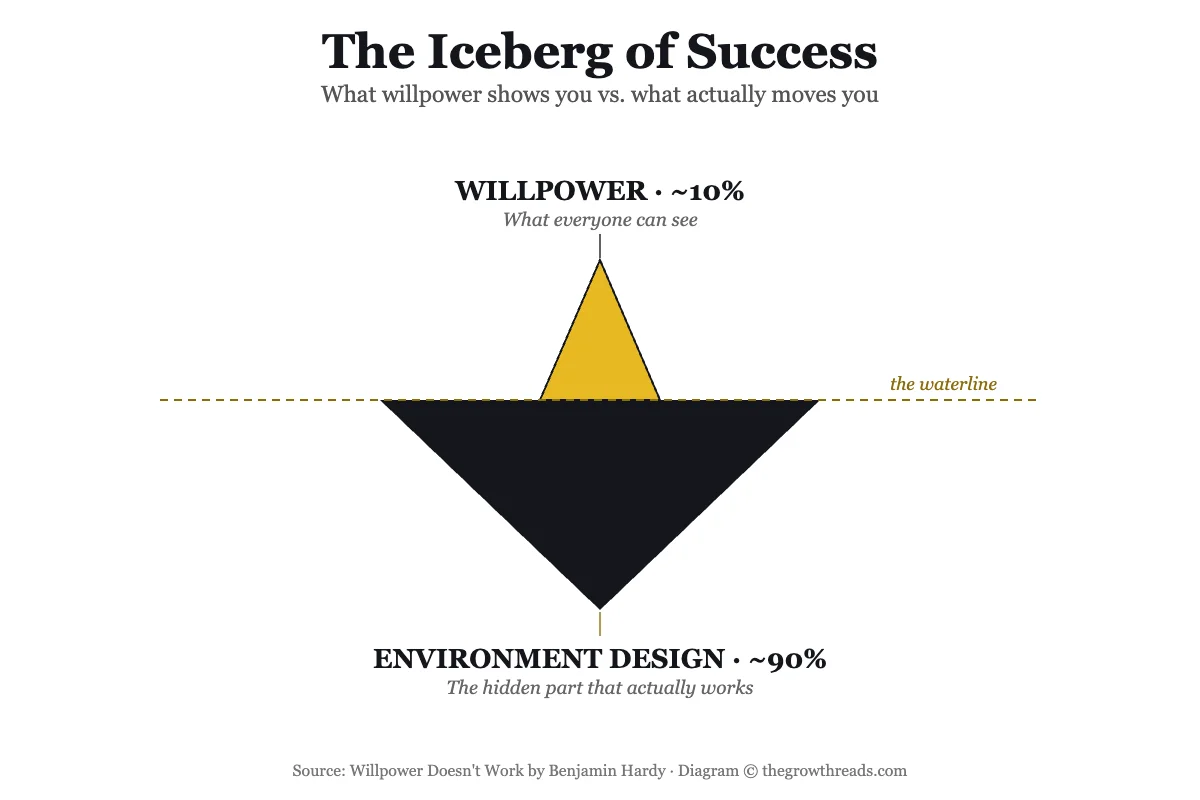
The problem was never a lack of discipline — it was trying to use discipline in the first place. That is the provocative core of Benjamin Hardy’s Willpower Doesn’t Work: relying on willpower to resist temptation or force yourself into good habits is, according to Hardy, a strategy that predictably fails, because willpower is inconsistent, exhausting, and easily overwhelmed. The far more reliable lever, he argues, is your environment — the physical spaces, social relationships, and daily defaults that shape your behavior automatically, without requiring a single act of resistance. Change the environment once, deliberately, and the desired behavior becomes the path of least resistance instead of a constant uphill fight.
Hardy, who holds a PhD in Industrial-Organizational Psychology from Clemson University and was once the top writer on Medium.com, builds the book around practical domains: making major life decisions in the right setting, engineering your daily surroundings intentionally, upgrading the environments and relationships you’re embedded in, and building real proximity to people who already model the behavior you want. The through-line is consistent — success is less about who has the most willpower and more about who has designed their life so willpower barely needs to show up.
Key takeaways
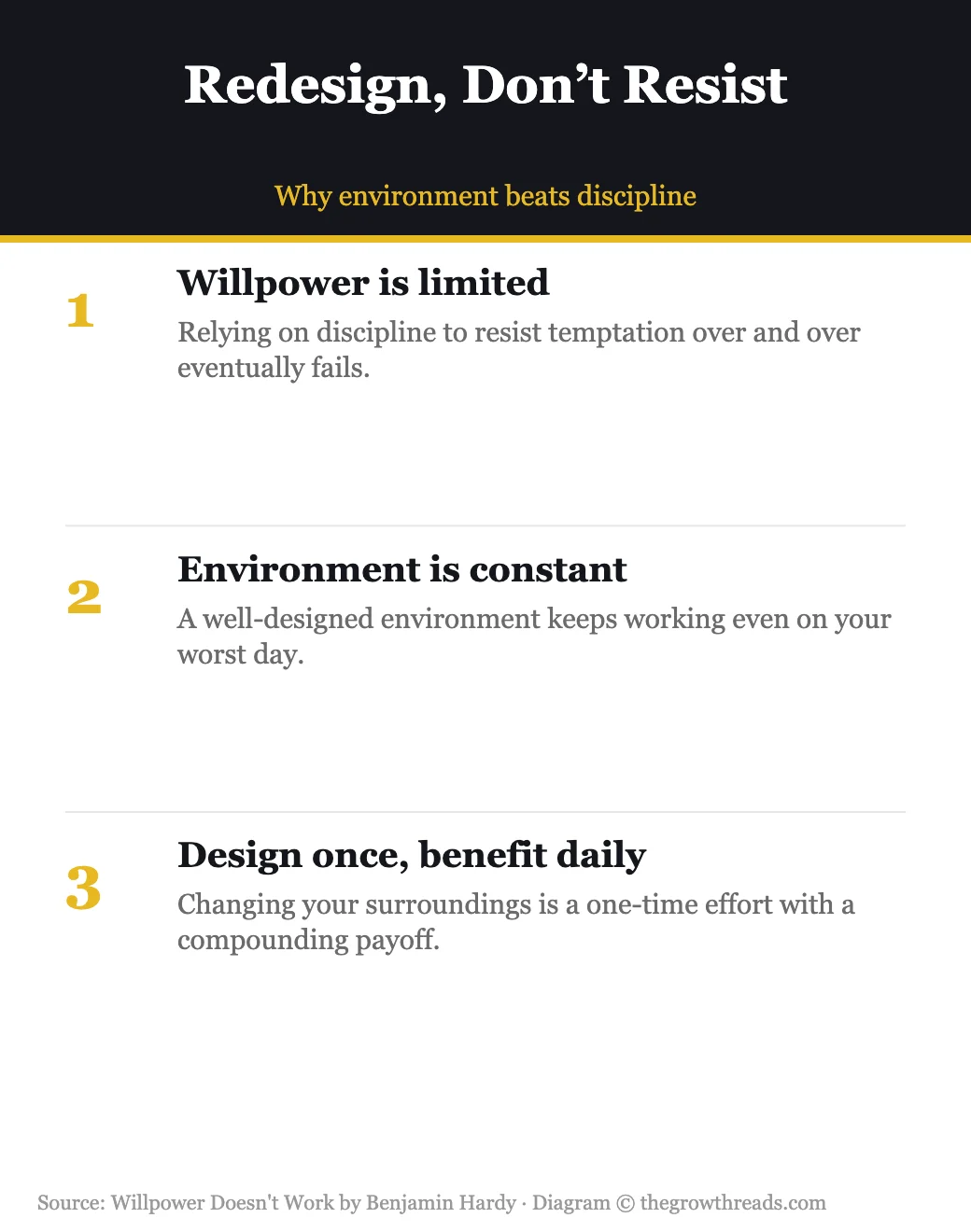
- Willpower is an unreliable strategy: Relying on discipline to resist temptation repeatedly tends to fail eventually, no matter how motivated you start out.
- Environment does the work instead: A well-designed environment produces the desired behavior automatically, even on your least motivated day.
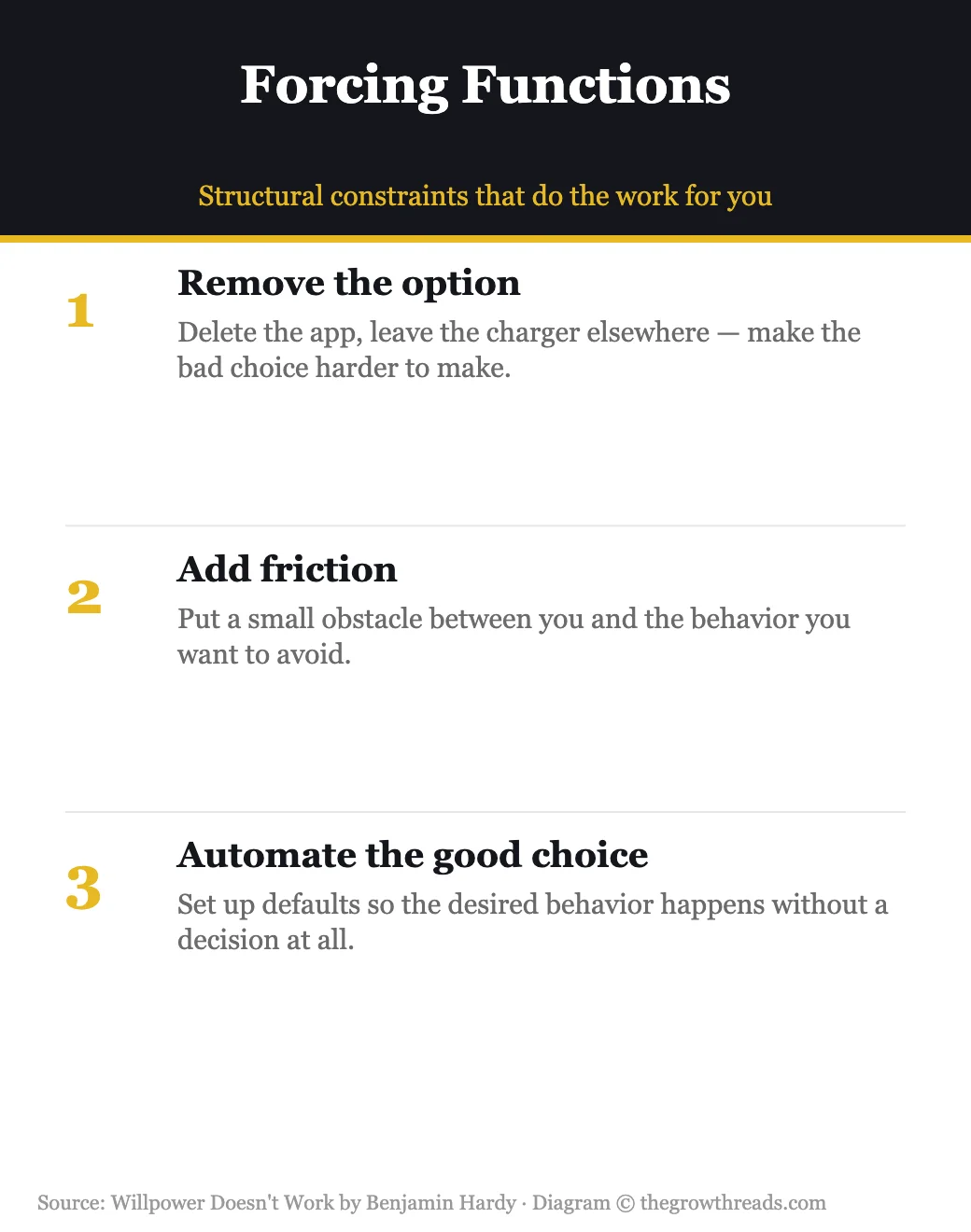
- Use forcing functions: Structural constraints — deleting an app, removing a temptation from reach — make the wrong choice harder without requiring resistance.
- Add friction to bad habits: A small obstacle between you and an unwanted behavior is often enough to break the automatic pattern.
- Automate good defaults: Setting up your environment so the desired choice happens without a decision removes the need for willpower entirely.
- Design once, benefit repeatedly: Redesigning your surroundings is a one-time effort whose payoff compounds every day afterward.
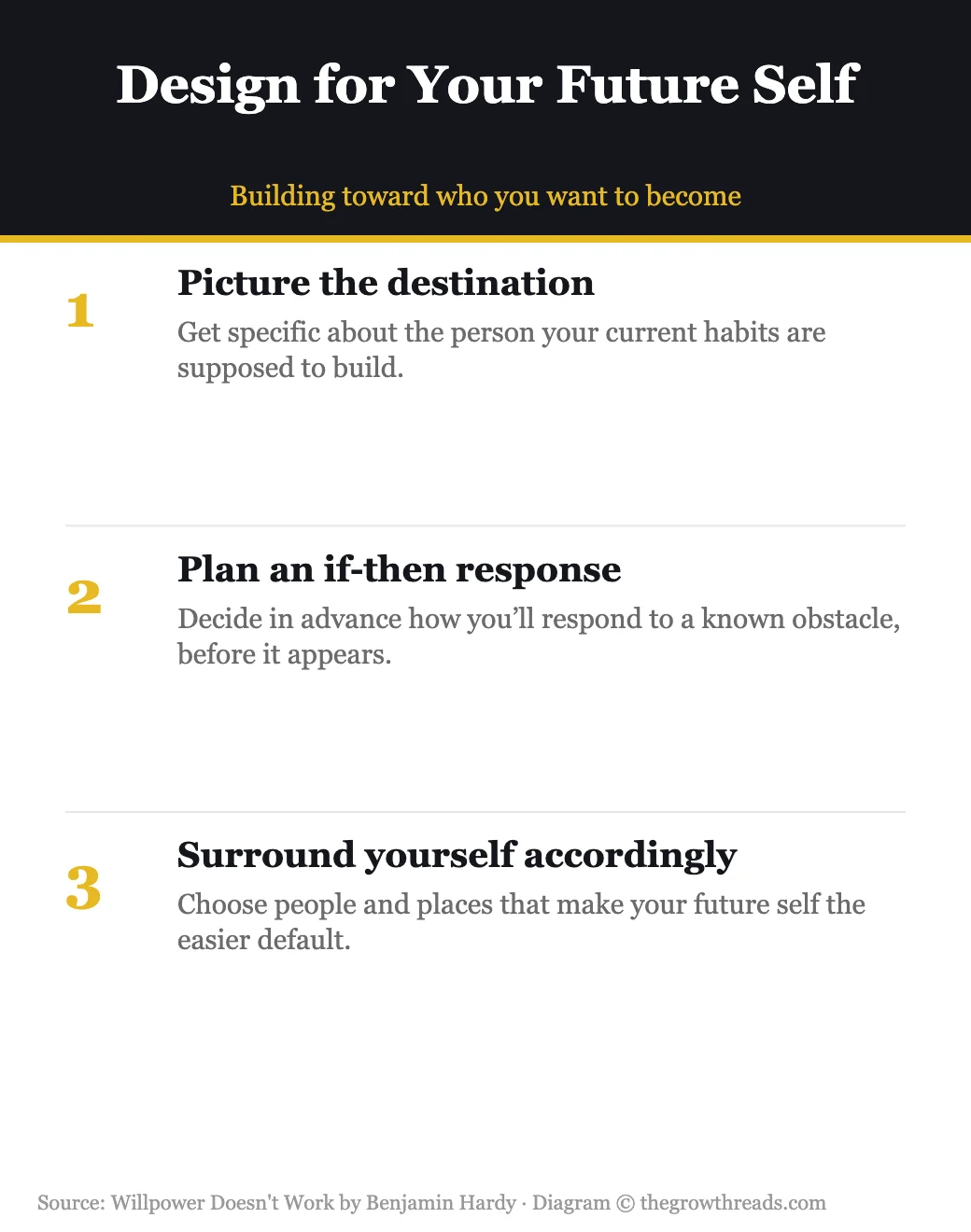
- Plan if-then responses: Deciding in advance how you’ll respond to a known obstacle — “if X happens, I’ll do Y” — removes the need to improvise willpower in the moment.
- Picture your future self specifically: Getting concrete about who your current habits are building makes it easier to choose environments that support that person.
- Proximity shapes behavior: The people and places you’re closest to make certain choices the default — choose that proximity deliberately.
- Nurture beats nature: Hardy’s central claim is that context shapes conduct far more powerfully than raw self-discipline does.
What is Willpower Doesn’t Work about?
Willpower Doesn’t Work is Benjamin Hardy’s case against relying on discipline to change your behavior, and for redesigning your environment instead. The book argues that willpower is an inherently limited and unreliable strategy, while a deliberately engineered environment — your surroundings, defaults, and relationships — produces the behavior you want automatically, without requiring constant effortful resistance.
About the author
Benjamin Hardy holds a PhD in Industrial-Organizational Psychology from Clemson University and was the most-read writer on Medium.com in 2016, with his writing also appearing in Forbes, Psychology Today, and Fortune. Beyond this book, he has authored several other bestsellers, including Personality Isn’t Permanent and Who Not How and 10x Is Easier Than 2x, both co-authored with entrepreneur Dan Sullivan. His academic training in organizational psychology, combined with a prolific blogging career built on distilling research into practical advice, shapes the book’s central move: treating behavior change as a design problem rather than a matter of personal willpower. That background also explains the book’s tone: less inspirational pep talk, more applied psychology translated into concrete, repeatable moves a reader can act on the same day. Explore all Benjamin Hardy book summaries →
Key concepts at a glance
| Concept | What it means | Use it when |
|---|---|---|
| Environment design | Deliberately structuring your surroundings so desired behavior is the default | You keep failing to sustain a habit through discipline alone |
| Forcing function | A structural constraint that compels a specific action or blocks an unwanted one | You want a choice to be automatic instead of effortful |
| Implementation intention | A pre-planned “if-then” response to a known obstacle | You know in advance what’s likely to derail you |
| Future self | A specific, concrete picture of who your habits are building you into | Your current choices feel disconnected from your long-term goals |
| Proximity | The people and places closest to you, which shape your defaults | You want a behavior to feel normal instead of exceptional |
Part 1: Why willpower fails
Hardy opens by dismantling the popular image of self-discipline as a virtue that separates successful people from everyone else. In his telling, willpower behaves less like a character trait and more like a resource that gets spent down — every decision, every moment of resisting temptation, draws on the same limited reserve. Ask it to carry an entire behavior change on its own, repeated daily, indefinitely, and it eventually runs out at exactly the moment you need it most.
This is why, Hardy argues, so many New Year’s resolutions and dramatic personal overhauls fail within weeks: they depend entirely on a resource that was never designed to sustain that kind of continuous demand. The people who do change successfully, in his account, aren’t the ones with more willpower — they’re the ones who stopped relying on it and changed something more durable instead. That reframe matters because it shifts the question people ask when a habit fails. Instead of concluding they simply lack the discipline other people apparently have, Hardy’s framework points them toward a more answerable question: what about the surrounding environment made the old behavior easier than the new one, and what would need to change about that setup for the reverse to be true.
TGR Note: It’s worth noting that the “willpower as a depletable resource” research this argument draws on — often called ego depletion — has faced significant replication challenges in psychology since around 2015. That doesn’t undercut Hardy’s practical conclusion, though: whether or not willpower depletes in a strict experimental sense, the book’s broader point that environment is a more reliable lever than motivation holds up on its own, and pairs well with David Rock’s related argument in Your Brain at Work about the brain’s limited capacity for effortful decisions.
Part 2: Forcing functions and friction
If willpower can’t be trusted to carry a behavior change, Hardy’s alternative is to make the desired behavior require less willpower in the first place. A forcing function is a structural constraint that compels a specific action — leaving your phone charger in another room so you can’t scroll in bed, for instance, or removing a tempting app entirely rather than promising yourself you’ll use it less. The goal isn’t heroic resistance; it’s removing the option so resistance never has to happen.
The same logic works in reverse for good habits: reduce the friction between you and the behavior you want. Laying out gym clothes the night before, keeping a book on your pillow instead of your phone, pre-committing to a specific first task — each small adjustment shifts the path of least resistance toward the outcome you actually want.
TGR Note: This idea of removing a decision rather than trying to make it correctly every time echoes the nightly reset in Jason Selk and Tom Bartow’s Organize Tomorrow Today — both books bet on pre-deciding things the night before so the version of you in the moment has fewer choices left to get wrong.
Part 3: Designing once, benefiting daily
A central argument in the book is that environment design is a far better use of limited willpower than trying to apply that willpower directly to a behavior every single day. Spend a burst of effort once — reorganizing a kitchen, changing a commute, restructuring a morning — and the environment keeps producing the desired behavior automatically afterward, long after the motivation that built it has faded. Redesigning the setup is a one-time cost; the payoff compounds every day the new environment stays in place.
This reframes the whole project of self-improvement: instead of asking “how do I get more disciplined,” Hardy suggests asking “what would need to be true about my surroundings for this behavior to require no discipline at all.” It’s a small shift in framing with large downstream consequences for where people actually invest their effort. Hardy is careful to note that this doesn’t mean environment design is effortless — building the right setup often takes real upfront work, sometimes uncomfortable conversations, sometimes a genuinely inconvenient reorganization of a physical space. The difference is that this effort is spent once, deliberately, at a moment when motivation is available, rather than being demanded daily from a version of you who may or may not have any left.
Part 4: Designing for your future self
The book’s final throughline is that environment design isn’t just about breaking bad habits — it’s about deliberately building toward a specific future self. Hardy encourages getting concrete about the person your daily choices are constructing, rather than leaving that identity vague, because a specific target makes it much easier to judge whether a given environment, relationship, or habit is actually moving you toward it or away from it.
Two practical tools recur throughout: implementation intentions — deciding in advance exactly how you’ll respond to a known obstacle, before it appears — and deliberate proximity, choosing the people and places you spend time around so that the behavior you’re aiming for becomes the normal, unremarkable default rather than an exceptional act of will.
TGR Note: This emphasis on a concrete future self connects naturally to the single “must-do task” from Organize Tomorrow Today — both books argue that clarity about what specifically matters tomorrow is what makes today’s environment and choices easier to get right.
Who is Willpower Doesn’t Work best for — and who should read something else first?
This book speaks most directly to anyone who has tried, more than once, to change a habit through sheer determination and watched it fail after a few weeks. It’s especially useful for people who’ve internalized the idea that failure to stick with a habit reflects a personal character flaw — Hardy’s argument reframes that failure as a design problem instead.
If you want the same environment-first instinct applied specifically to your daily schedule rather than your habits broadly, Organize Tomorrow Today covers similar ground with a nightly-planning focus. If you’re more interested in the underlying brain science of decision fatigue and depleted focus, Your Brain at Work goes deeper into the research. And if your core challenge is chronic overwork rather than habit design, Time Off addresses the rest side of the equation this book doesn’t cover.
Questions to reflect on
- What habit have you tried to build or break through sheer willpower alone, more than once, without lasting success?
- What single environmental change — removing something, adding friction, changing a default — might make that habit require no discipline at all?
- Who are you closest to day to day, and what behaviors does that proximity make feel normal?
- If you pictured your future self specifically, what would that person’s environment look like differently from yours today?
- What obstacle keeps derailing you that you could plan an if-then response for in advance?
🔥 Ready to stop relying on willpower alone?
Get Willpower Doesn’t Work and start redesigning your environment.
How to apply Willpower Doesn’t Work (7-day plan)
- Day 1 — Name one failed habit: Pick one habit you’ve tried to build or break through discipline alone, without lasting success.
- Day 2 — Find the environmental cause: Identify what in your current environment makes the unwanted behavior the path of least resistance.
- Day 3 — Install one forcing function: Remove, relocate, or add friction to make the unwanted choice structurally harder.
- Day 4 — Automate one good default: Set up your environment so one desired behavior happens without requiring a decision.
- Day 5 — Write an if-then plan: Decide in advance exactly how you’ll respond the next time a known obstacle shows up.
- Day 6 — Check your proximity: Notice which people or places currently make the unwanted behavior feel normal, and adjust one.
- Day 7 — Review the redesign: Look back at the week — did the new environment produce the behavior without requiring willpower? Adjust what didn’t work.
Frequently asked questions
What is the main idea of Willpower Doesn’t Work?
The book argues that relying on willpower and self-discipline to change behavior is an unreliable strategy because willpower is limited and easily overwhelmed. Its alternative is to deliberately redesign your physical, social, and psychological environment so the desired behavior becomes the default, removing the need for constant effortful resistance.
Who is Benjamin Hardy?
Benjamin Hardy holds a PhD in Industrial-Organizational Psychology from Clemson University and was the top writer on Medium.com in 2016. He has authored several other bestselling books, including Personality Isn’t Permanent and Who Not How and 10x Is Easier Than 2x, the latter two co-authored with entrepreneur Dan Sullivan.
What is a “forcing function”?
A forcing function is a structural constraint that compels a specific action or blocks an unwanted one — for example, removing a tempting app rather than promising to use it less. The idea is to make the wrong choice harder to make, rather than relying on resisting it in the moment.
Is the science behind “willpower depletes” still considered solid?
The specific research often called ego depletion, which suggested willpower is a literal limited resource that drains with use, has faced significant replication challenges in psychology since around 2015. That doesn’t undermine the book’s practical conclusion, though — regardless of the precise mechanism, redesigning your environment is a more reliable lever for behavior change than relying on motivation alone.
What is an “implementation intention”?
An implementation intention is a pre-planned “if-then” response to a known obstacle — deciding in advance, for example, that if you crave something unhealthy, you’ll reach for a specific alternative instead. Deciding the response ahead of time removes the need to improvise willpower in the moment.
How is this different from other habit-change books?
Many habit books focus on repetition and consistency as the mechanism for change. This book instead treats behavior change primarily as a design problem — the emphasis is on restructuring your surroundings once so the desired behavior becomes automatic, rather than on building the discipline to repeat a behavior indefinitely.
Does this mean willpower is completely useless?
Not entirely — the book’s title is deliberately provocative. The more precise claim is that willpower alone is an unreliable long-term strategy compared to environment design. A small amount of willpower is still useful for making the initial changes to your environment; the point is not to depend on it to carry the behavior every day afterward.
Related summaries
- Organize Tomorrow Today — planning tomorrow’s priorities the night before.
- Your Brain at Work — the science behind why focus and decision-making deplete over the day.
- Time Off — building a sustainable rest ethic alongside a productive one.
- Scrum — redesigning a team’s process instead of relying on individual heroics.
For more, browse our full guide to the best productivity books.
How we analyze books: We read the original text, cross-check factual claims where possible, and focus on practical application rather than critique. Read our full methodology.
Related Time Management Summaries
Extreme Productivity Summary & Review: Judge Output, Not Hours
It Doesn’t Have to Be Crazy at Work Summary & Review: Build the Calm Company
Master Your Time, Master Your Life Summary & Review: Ten Categories, One Focused System
The 5 Choices Summary & Review: The Path to Extraordinary Productivity
Wait Summary & Review: The Art and Science of Delay