

★★★★★ 4.5/5 — A short, focused case for treating the first hour of the day as your most valuable, most controllable one.
Best for: Anyone whose mornings currently disappear into email before they’ve chosen what actually matters.
Reading time: ~2 hours to read the book, about 15 minutes to read this guide.
Difficulty to apply: Easy — the core habit is choosing what to do with one hour you already have.
What the Most Successful People Do Before Breakfast in one minute
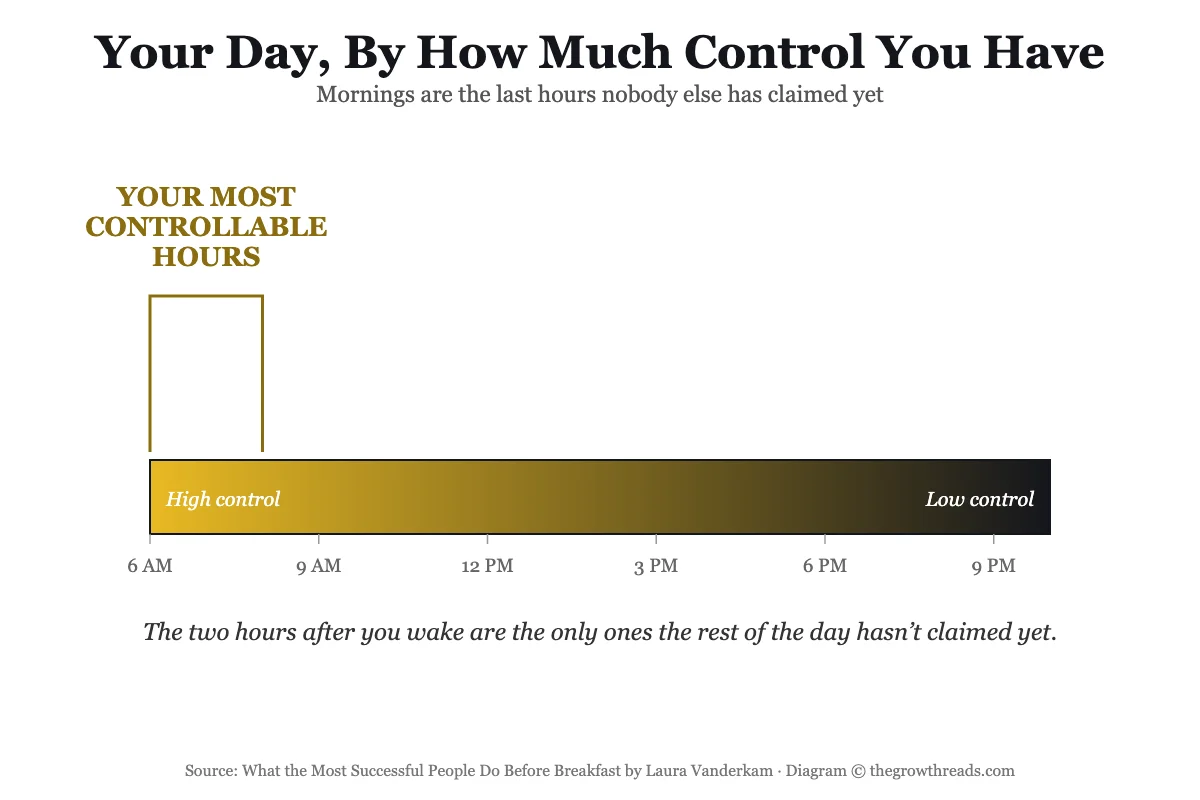
By the time most people check email, the day has already started making decisions for them. That is the premise behind Laura Vanderkam’s What the Most Successful People Do Before Breakfast: mornings are the one stretch of the day nobody else has claimed yet, and how you spend that stretch says more about your real priorities than almost anything else you do. As the day goes on, obligations to other people — meetings, requests, other people’s emergencies — accumulate and crowd out discretionary time. Mornings, by contrast, start clear. Vanderkam’s argument is that people who feel most fulfilled and productive tend to use those early hours deliberately, for something that matters to their career, health, or relationships, rather than defaulting to whatever lands first in their inbox.
The book also leans on a well-documented idea from psychology: willpower behaves like a limited resource that tends to be freshest earlier in the day and gets used up by the accumulated decisions and self-control demands that follow. Vanderkam’s practical conclusion is straightforward — if a task requires real discipline or focus, doing it in the morning, before that resource is depleted, gives it the best chance of actually happening. The book is short and direct: less a comprehensive productivity system than a focused argument for reclaiming one specific part of the day.
Key takeaways
- Mornings are uniquely controllable: Obligations to other people accumulate as the day goes on — the early hours are the closest thing to genuinely free time most people have.
- Willpower is freshest early: Self-control behaves like a depletable resource, so tasks requiring real discipline are more likely to happen in the morning than the evening.
- Track before you change anything: Logging how you actually spend your current mornings reveals the gap between how you think you spend them and reality.
- Envision the ideal morning: Picture what a morning built around your real priorities would look like before trying to build it.
- Start small and adjust: Build the new habit gradually and expect to revise it as life changes, rather than overhauling everything at once.
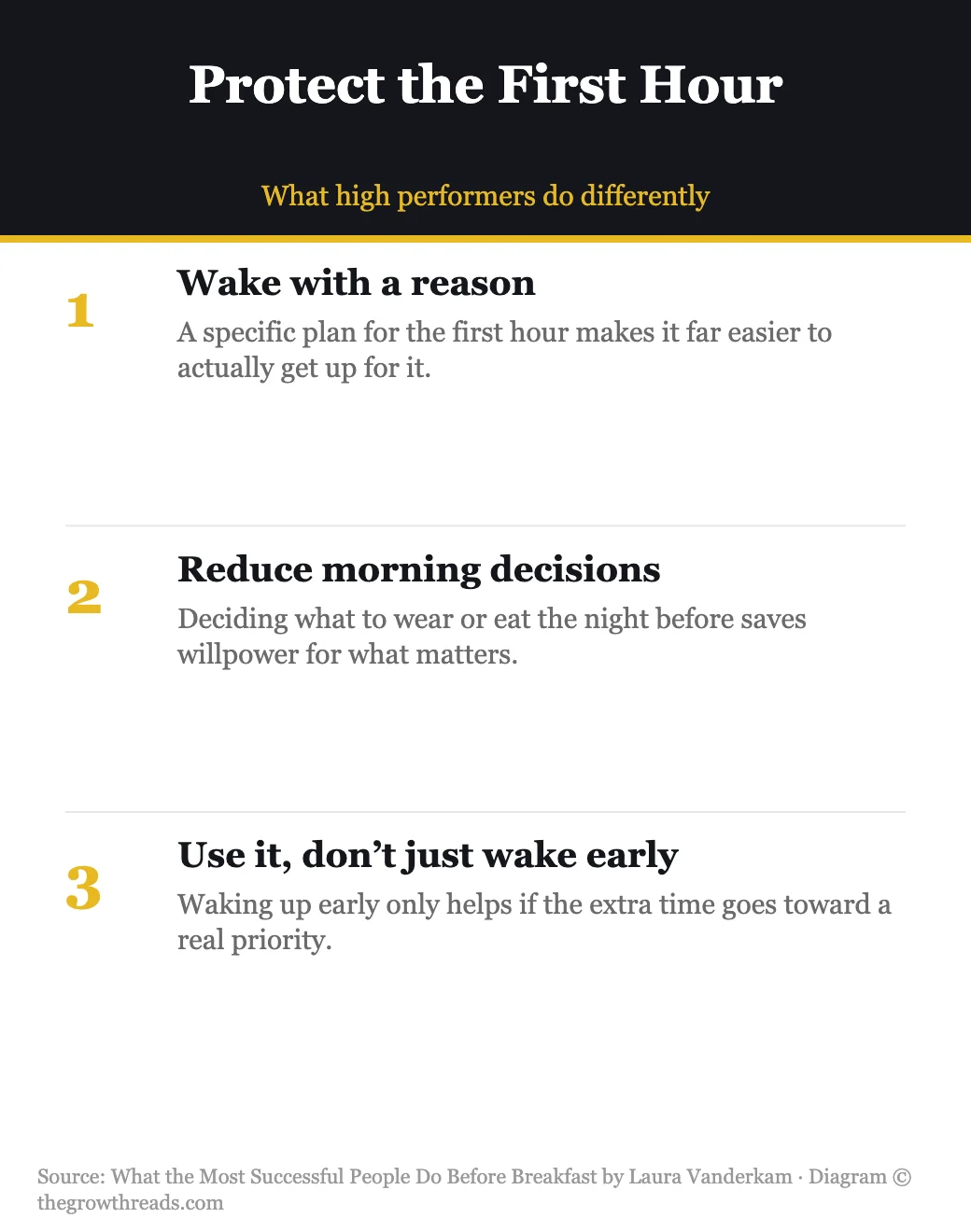
- Reduce morning decisions: Deciding what to wear or eat the night before frees up willpower for what actually matters.
- Wake with a specific reason: A concrete plan for the first hour makes it far easier to actually get up for it than a vague intention to “be more productive.”
- Extra time only helps if it’s used: Waking up earlier is worthless on its own — the benefit comes entirely from what you do with the reclaimed time.
- High performers protect mornings deliberately: Vanderkam cites executives and other high performers who treat early hours as sacred, structured time rather than a buffer for whatever comes up.
- Small, consistent mornings compound: A modest habit repeated daily outperforms an occasional, ambitious morning that doesn’t survive a bad night’s sleep.
What is What the Most Successful People Do Before Breakfast about?
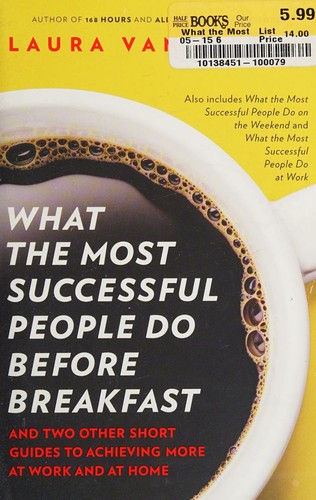
What the Most Successful People Do Before Breakfast is Laura Vanderkam’s short, focused argument that the first hour of the day is the most controllable — and most undervalued — block of time most people have. The book lays out a practical, five-step process for redesigning your mornings around what actually matters to you, rather than letting email and other people’s requests decide your priorities by default.
About the author
Laura Vanderkam is a time-management writer and speaker whose work regularly appears in the New York Times, Wall Street Journal, and Fortune. She hosts the daily podcast “Before Breakfast” and co-hosts “Best of Both Worlds,” and her TED talk on time management has been viewed by millions. Her broader body of work — including 168 Hours, I Know How She Does It, Off the Clock, and Tranquility by Tuesday — is built on a consistent method: collecting real professionals’ logged time-use data and mining it for patterns, rather than relying on anecdote alone. That research-driven approach, applied specifically to mornings, is what distinguishes this book from a general motivational take on early rising. It also means the book’s claims tend to be more grounded than the typical productivity title: rather than asserting that successful people simply have more discipline, Vanderkam’s broader work treats time use as something that can be observed, logged, and redesigned like any other habit, which is why this short guide reads more like a practical field manual than a pep talk. Explore all Laura Vanderkam book summaries →
Key concepts at a glance
| Concept | What it means | Use it when |
|---|---|---|
| The controllable hour | The early morning window before other people’s obligations start accumulating | You want time that is genuinely yours to direct |
| Willpower depletion | Self-control is a limited resource that tends to be freshest earlier in the day | You keep failing to do a demanding task later in the day |
| Track, envision, plan | The book’s process: log current mornings, picture the ideal one, then plan the logistics | You want to redesign a habit instead of guessing at it |
| Decision reduction | Deciding low-stakes choices (clothes, breakfast) the night before to save willpower | Your mornings feel effortful before the real work even starts |
| Protected first hour | Treating the first hour as reserved, structured time rather than a buffer | You want one part of the day that’s reliably yours |
Part 1: Why the morning is different
Vanderkam opens with a simple structural observation: time isn’t equally available throughout the day. As hours pass, other people’s needs, meetings, and unplanned requests accumulate, narrowing what’s genuinely discretionary. By evening, whatever energy and willpower remain often go toward recovering from the day rather than pursuing anything deliberate. Mornings, before that accumulation begins, are structurally different — closer to genuinely free time than any other stretch of the day.
This is also, she argues, why so many good intentions fail specifically in the evening: a plan to exercise, write, or have a real conversation after work competes with a depleted, already-claimed version of the day. Move the same intention to the morning, before anything else has staked a claim on your attention, and its odds improve substantially — not because mornings are magic, but because they are comparatively empty.
TGR Note: This idea that willpower depletes over the course of a demanding day connects directly to David Rock’s argument in Your Brain at Work that the brain’s capacity for effortful thinking is a limited resource — protecting your morning is, in effect, scheduling your hardest choices for when that resource is fullest.
Part 2: The five-step process
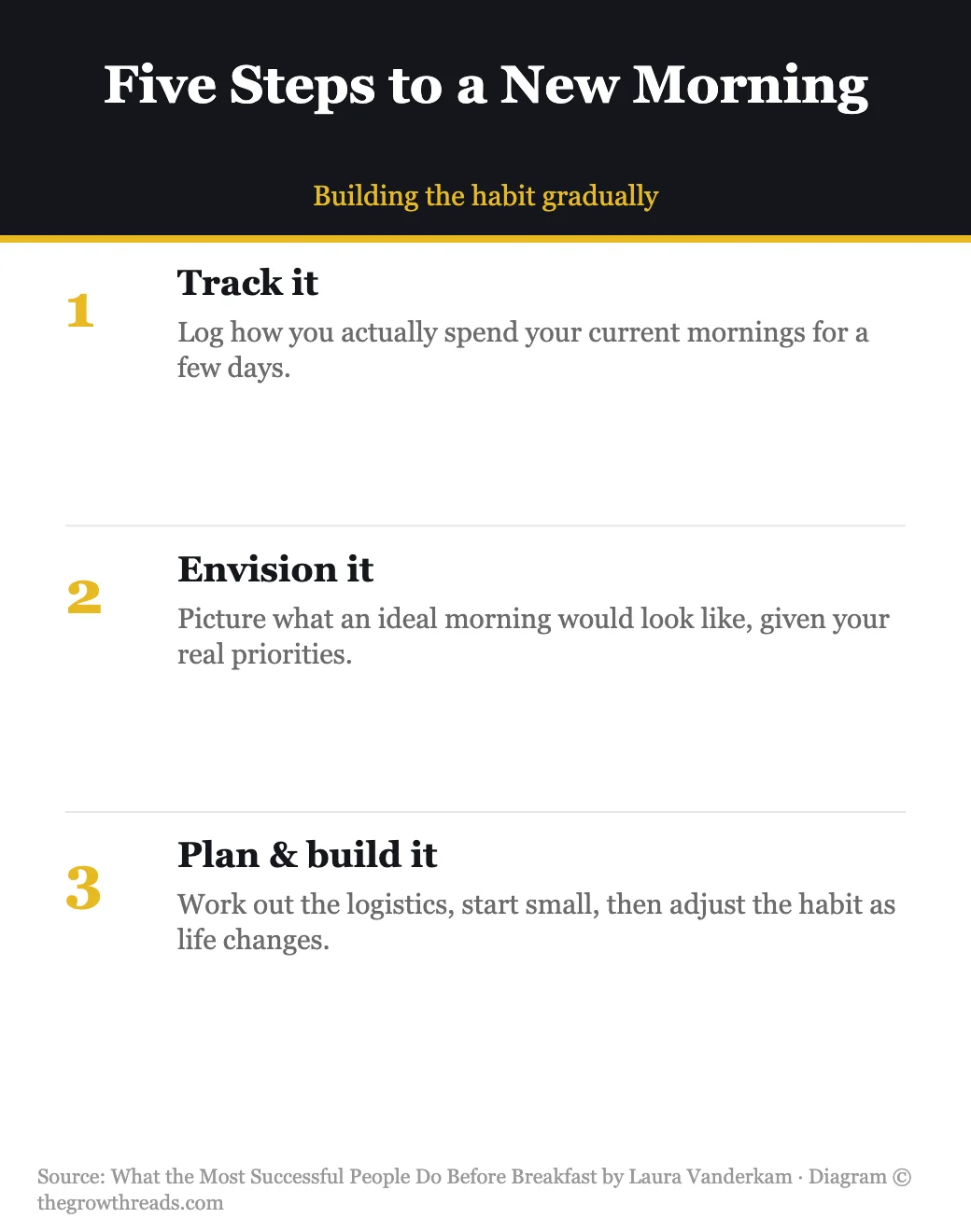
Vanderkam’s method for actually changing a morning is deliberately unglamorous: track your current mornings for a few days to see how the time really goes, envision what an ideal morning would look like given your actual priorities, and then plan the logistics — what needs to happen the night before, what time you’d need to wake, what the first task would be. From there, the new routine gets built gradually, in small pieces rather than a single dramatic overhaul, and adjusted as circumstances change rather than treated as fixed forever.
The tracking step matters more than it sounds. Most people, Vanderkam notes, have only a vague sense of how their mornings actually unfold — a few days of honest logging is often the first moment the gap between the intended morning and the real one becomes visible.
TGR Note: This track-then-redesign approach mirrors the nightly review habit in Jason Selk and Tom Bartow’s Organize Tomorrow Today — both books treat a small daily habit of reflection as the mechanism that makes a bigger change stick.
Part 3: Why mornings work, mechanically
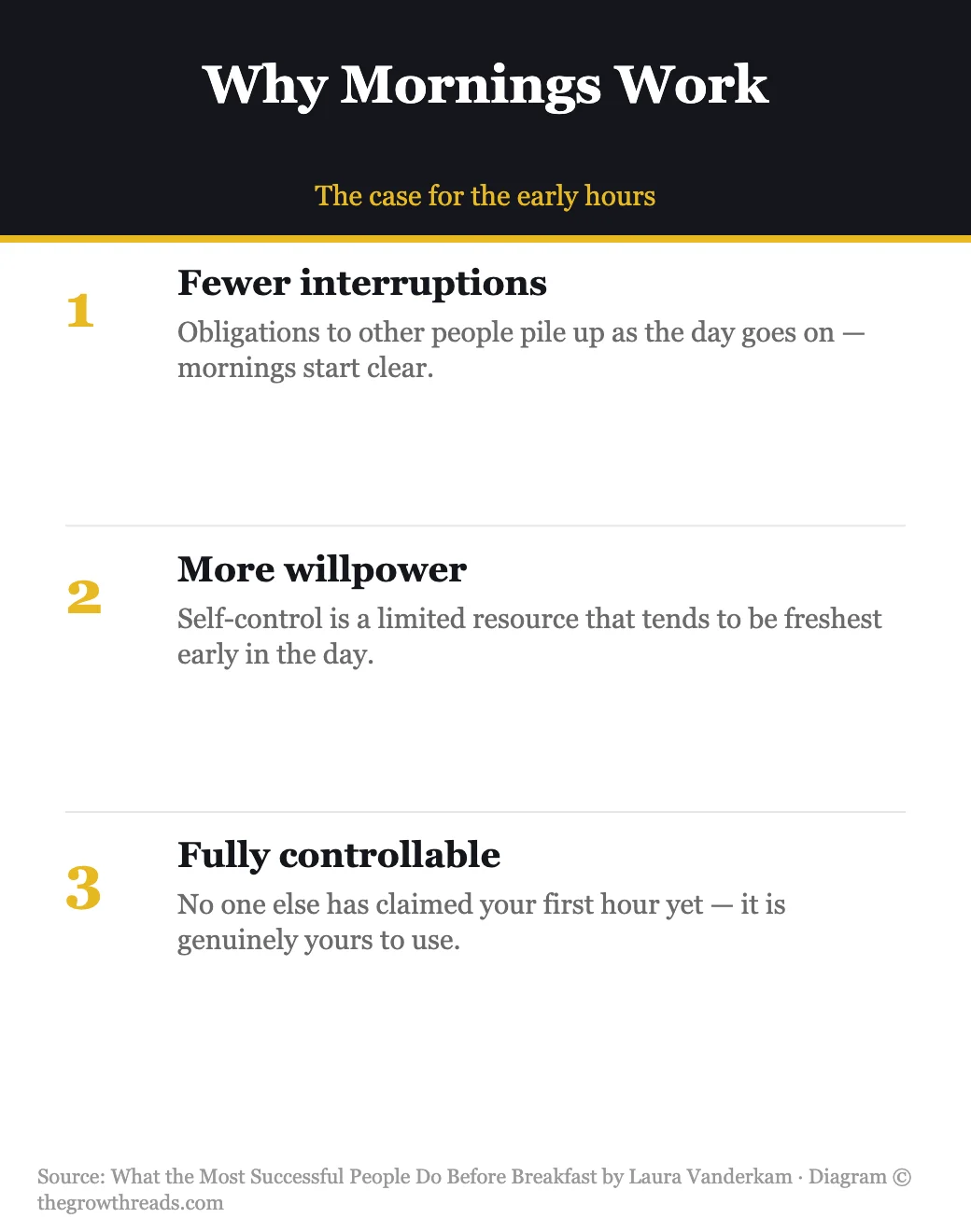
Beyond the willpower argument, Vanderkam points to the sheer structural quiet of early hours: fewer emails have arrived, fewer people are awake to make requests, and the day’s inevitable surprises haven’t yet had the chance to happen. This isn’t about romanticizing 5 a.m. specifically — for people with unconventional schedules, “morning” simply means the first block of time after waking, whenever that falls. The core mechanism is the same regardless of the clock: use the quietest, least-claimed part of your day for what actually matters, before it gets claimed by something else.
She backs this with research on high performers who wake notably early, citing interviews with executives finding that a striking majority of a small sample of leaders were up well before most of their teams. The specific figures should be read as illustrative of a broader pattern rather than a universal rule — the point isn’t the exact wake time, but the deliberate use of the quiet hour that follows it.
Part 4: Protecting the first hour
The book’s most concrete advice centers on removing friction between waking up and doing the thing that matters. Deciding what to wear, what to eat, and what task to start with — all the night before — means the morning self doesn’t have to make any of those decisions while still groggy and low on willpower. Vanderkam is blunt that waking up early accomplishes nothing on its own; the entire benefit comes from what fills the reclaimed time. An earlier alarm without a specific plan just produces a longer, emptier morning.
She’s equally clear that this isn’t about becoming a different kind of person overnight. The habits she describes are small and mechanical — a plan, a reduced set of decisions, a specific first task — deliberately unglamorous so they can survive a bad night’s sleep or a disrupted week, rather than depending on motivation that may or may not show up.
TGR Note: This preference for small, sustainable habits over dramatic overhauls is the same discipline behind the single “must-do task” in Organize Tomorrow Today — both books bet on modest, repeatable routines over ambitious ones that don’t survive contact with a hard week.
Who is What the Most Successful People Do Before Breakfast best for — and who should read something else first?
This book is a natural fit for anyone whose mornings currently vanish into email before they’ve consciously chosen what to do with them — it’s short, direct, and easy to start applying the same day you finish it. It’s especially useful for people who have tried and failed at vague “wake up earlier” resolutions and want a more structural reason why that alone doesn’t work.
If you want the same night-before-planning instinct applied to your whole day, not just the morning, Organize Tomorrow Today covers that ground directly. If your challenge is less about mornings specifically and more about willpower and decision fatigue generally, Your Brain at Work digs deeper into the underlying brain science. And if the bigger issue is chronic overwork rather than morning structure, Time Off addresses the rest side of the equation this book doesn’t cover.
Questions to reflect on
- What currently claims your first hour after waking — a plan, or whichever request arrives first?
- If you tracked your mornings honestly for three days, what gap would you find between the morning you intend and the one you actually have?
- What task keeps failing to happen in the evening that might succeed if you moved it to the morning instead?
- What decisions could you make the night before to free up willpower for tomorrow morning?
- What would need to be true for you to actually get up for your first hour — not just set an earlier alarm?
🔥 Ready to reclaim your mornings?
Get What the Most Successful People Do Before Breakfast and redesign tomorrow’s first hour.
How to apply What the Most Successful People Do Before Breakfast (7-day plan)
- Day 1 — Track your morning: Log exactly how you spend the first hour after waking, without changing anything yet.
- Day 2 — Track again: Repeat the log — a single day isn’t enough to see the real pattern.
- Day 3 — Envision the ideal morning: Write down what a morning built around your real priorities would actually look like.
- Day 4 — Remove one decision: Choose tomorrow’s clothes or breakfast tonight, so morning-you has one less choice to make.
- Day 5 — Name the first task: Decide the specific thing you’ll do first tomorrow, before checking email.
- Day 6 — Protect the hour: Do that first task before anything else gets a chance to claim your attention.
- Day 7 — Review and adjust: Look back at the week — what worked, what didn’t, and what small change would make tomorrow’s morning easier to protect?
Frequently asked questions
What is the main idea of this book?
The book argues that mornings are the most controllable part of the day — before other people’s requests and obligations accumulate — and that deliberately using that time for what matters most, rather than defaulting to email, is a meaningful lever for both productivity and fulfillment.
Who is Laura Vanderkam?
Laura Vanderkam is a time-management writer and speaker known for research-driven books built on real professionals’ logged time-use data, including 168 Hours, I Know How She Does It, and Off the Clock. She hosts the podcast “Before Breakfast” and has given a widely viewed TED talk on time management.
Do I have to wake up at 5 a.m. to benefit from this book?
No — the book’s argument is about protecting the first hour after you wake, whatever time that is, not about a specific clock time. The mechanism is using the quietest, least-claimed part of your schedule deliberately, which applies regardless of whether your day starts at 5 a.m. or 9 a.m.
What is the five-step process the book describes?
Vanderkam recommends tracking your current mornings to see how time actually goes, envisioning an ideal morning based on your real priorities, planning the logistics needed to make it happen, building the new habit gradually, and adjusting it as circumstances change rather than treating it as fixed.
Why does the book emphasize reducing decisions in the morning?
The book draws on the idea that willpower and self-control behave like limited resources that deplete with use. Deciding low-stakes choices — what to wear, what to eat — the night before conserves that resource for the morning’s more important task rather than spending it on trivial decisions.
Is waking up earlier enough on its own?
No — Vanderkam is explicit that an earlier alarm accomplishes nothing by itself. The benefit comes entirely from what fills the reclaimed time; without a specific plan, a longer morning is just a longer stretch of the same reactive habits.
How is this different from a general “wake up early” book?
Rather than treating early rising as a virtue on its own, the book grounds its advice in the structural reality that obligations accumulate throughout the day and in research on willpower depletion — making the case less about discipline for its own sake and more about working with, rather than against, how attention and self-control actually behave.
Related summaries
- Organize Tomorrow Today — planning tomorrow’s priorities the night before.
- Your Brain at Work — the science behind why willpower and focus deplete over the day.
- Time Off — building a sustainable rest ethic alongside a productive one.
- The 5 Choices — a framework for ranking priorities at the individual level.
For more, browse our full guide to the best productivity books.
How we analyze books: We read the original text, cross-check factual claims where possible, and focus on practical application rather than critique. Read our full methodology.
Related Time Management Summaries
Hell Yeah or No Summary & Review: Say No to Almost Everything
Master Your Time, Master Your Life Summary & Review: Ten Categories, One Focused System
No B.S. Time Management for Entrepreneurs Summary & Review: Price Your Own Hour
Off the Clock Summary & Review: Why Equally Busy People Feel Different About Time
Two Awesome Hours Summary & Review: Protect Your Peak Time Each Day