

★★★★★ 4.6/5 — A practical, story-driven guide to the neuroscience of focus, decision-making, and staying calm under pressure at work.
Best for: Anyone whose job demands constant decisions, multitasking, and difficult conversations.
Reading time: ~7 hrs to read, 25-30 min for this guide.
Difficulty to apply: Easy — the book’s techniques are simple, concrete, and designed to slot into a normal workday.
Your Brain at Work in one minute
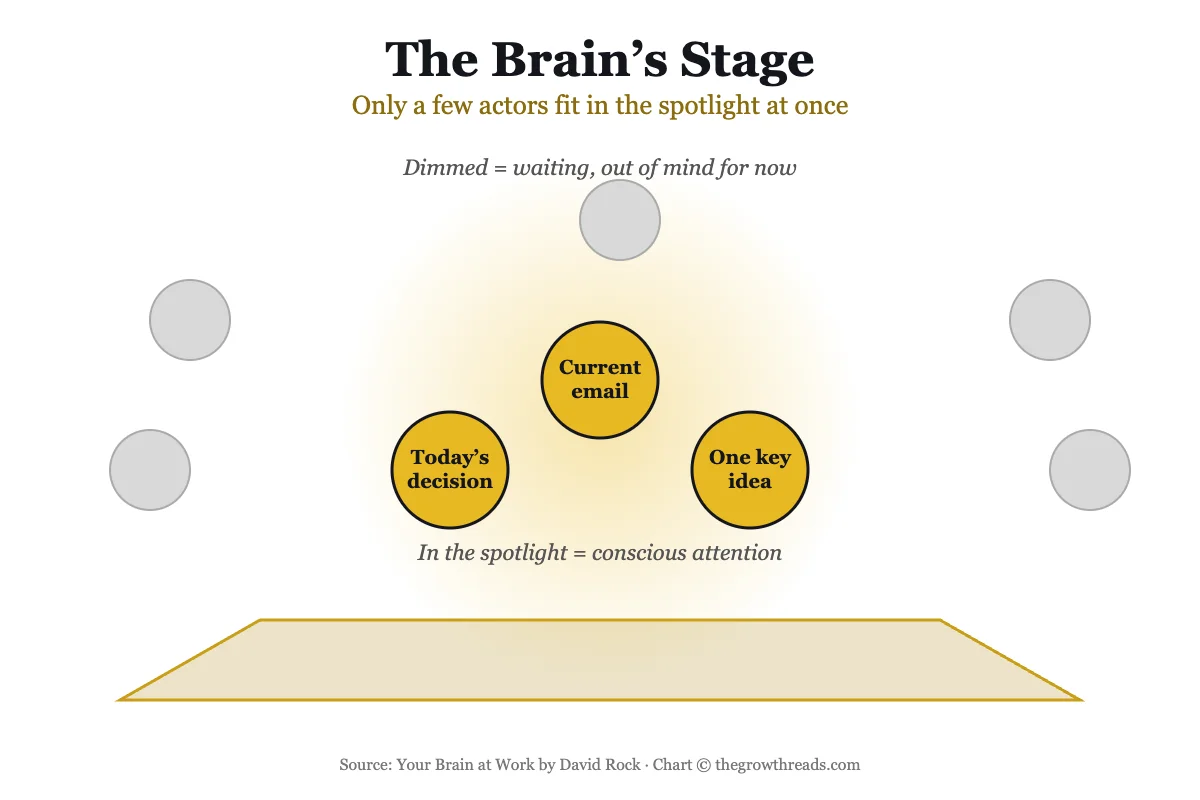
Your brain has a small stage, and only a few ideas can stand in the spotlight at once. David Rock, founder of the NeuroLeadership Institute, follows a fictional couple — Emily, newly promoted and juggling a big conference, and Paul, an IT consultant pitching a major project — through a single workday to show how basic brain mechanics shape everyday performance. The prefrontal cortex, the part of the brain responsible for conscious thought, decision-making, and self-control, is treated as a limited resource: it fatigues fast, holds only a handful of items at once, and is easily hijacked by social threats. The book’s promise is that once you understand these mechanics, you can work with your brain instead of against it — deciding earlier, single-tasking more, and staying calmer under the kind of pressure that used to derail a whole day.
Key takeaways
- Conscious thought is a limited resource: your prefrontal cortex fatigues throughout the day, so the order you tackle tasks in matters.
- The “stage and actors” metaphor: only a few ideas can occupy conscious attention at once — adding more doesn’t help, it just crowds the stage.
- Working memory is small: most people can hold only a handful of items in mind simultaneously, which is why writing things down frees up real mental capacity.
- Hardwired vs. conscious processing: habits run on cheap, automatic “hardwired” circuits; new or complex thinking runs on expensive conscious processing.
- The SCARF model: Status, Certainty, Autonomy, Relatedness, and Fairness are five social dimensions the brain treats like physical threats or rewards.
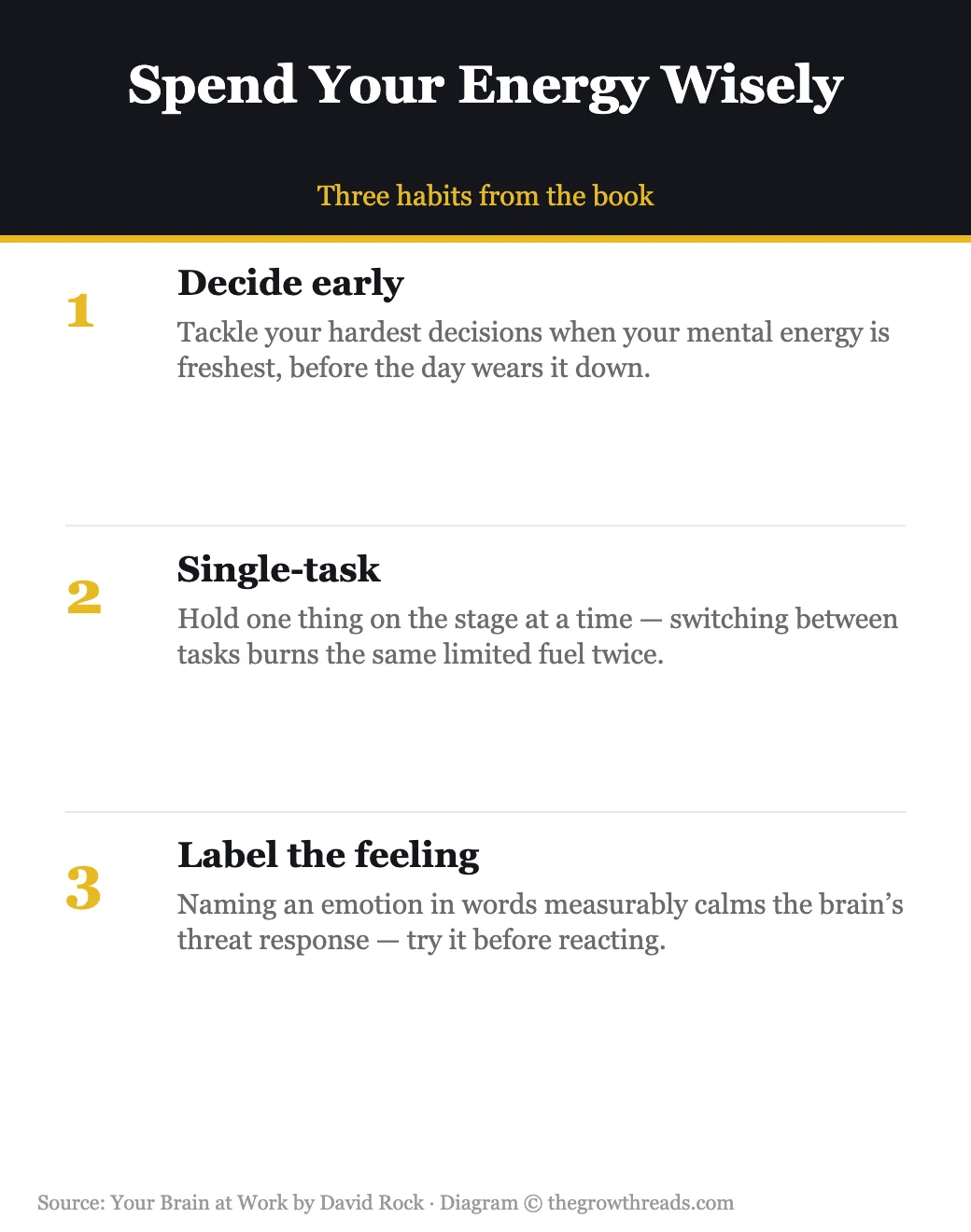
- Decide before you deplete: your hardest decisions deserve your freshest mental energy, typically earlier in the day.
- Single-tasking beats multitasking: switching between tasks costs the same limited fuel as holding two things in mind at once.
- Naming emotions calms them: putting a feeling into words appears to reduce its grip, making it easier to think clearly under pressure.
- Facilitate insight, don’t just give advice: in the book’s SCARF-based approach to change, helping someone reach their own insight avoids triggering a status threat.
What is Your Brain at Work about?
Your Brain at Work uses basic neuroscience to explain why focus, decision-making, and difficult conversations are so mentally taxing — and offers concrete techniques, illustrated through a fictional workday, for managing limited mental energy, working memory, and social threat responses more skillfully.
About the author
David Rock is the founder and CEO of the NeuroLeadership Institute, an organization that applies brain science to management and leadership practice. He is credited with coining the term “neuroleadership” and developed the widely used SCARF model, first published in the NeuroLeadership Journal in 2008. Rock has spent his career translating cognitive and social neuroscience research into practical frameworks for executives, coaches, and organizations, and Your Brain at Work remains his best-known book for a general business audience — praised by leadership figures including Warren Bennis and Stephen Covey for making brain science genuinely usable at work. Explore all David Rock book summaries →
The book is structured in four parts that follow Emily and Paul through the same workday twice — once showing the problem play out, then again showing the same scene improved once they apply the book’s techniques — a device that makes abstract neuroscience concepts easy to picture in a reader’s own job rather than staying purely theoretical.
Key concepts at a glance
| Concept | What it means | Use it when |
|---|---|---|
| The stage & actors | A metaphor for conscious attention — only a few “actors” (ideas) fit on the small “stage” (prefrontal cortex) at once. | You’re deciding whether to add one more thing to an already full plate. |
| Hardwired processing | Automatic, low-energy mental routines — habits, familiar tasks, well-practiced skills. | You want to reduce mental load on routine work. |
| Conscious processing | Effortful, high-energy thinking — new problems, decisions, self-control. | You’re scheduling your hardest thinking for the day. |
| SCARF model | Status, Certainty, Autonomy, Relatedness, Fairness — social triggers the brain treats like threats or rewards. | You’re giving feedback or navigating a tense conversation. |
| Working memory limit | The small number of items you can hold actively in mind before something gets pushed out. | You’re deciding what to write down versus try to remember. |
| Affect labeling | Naming an emotion in words, which appears to reduce its intensity in the brain. | You feel a strong reaction rising before a big conversation. |
Part 1: The stage and the actors
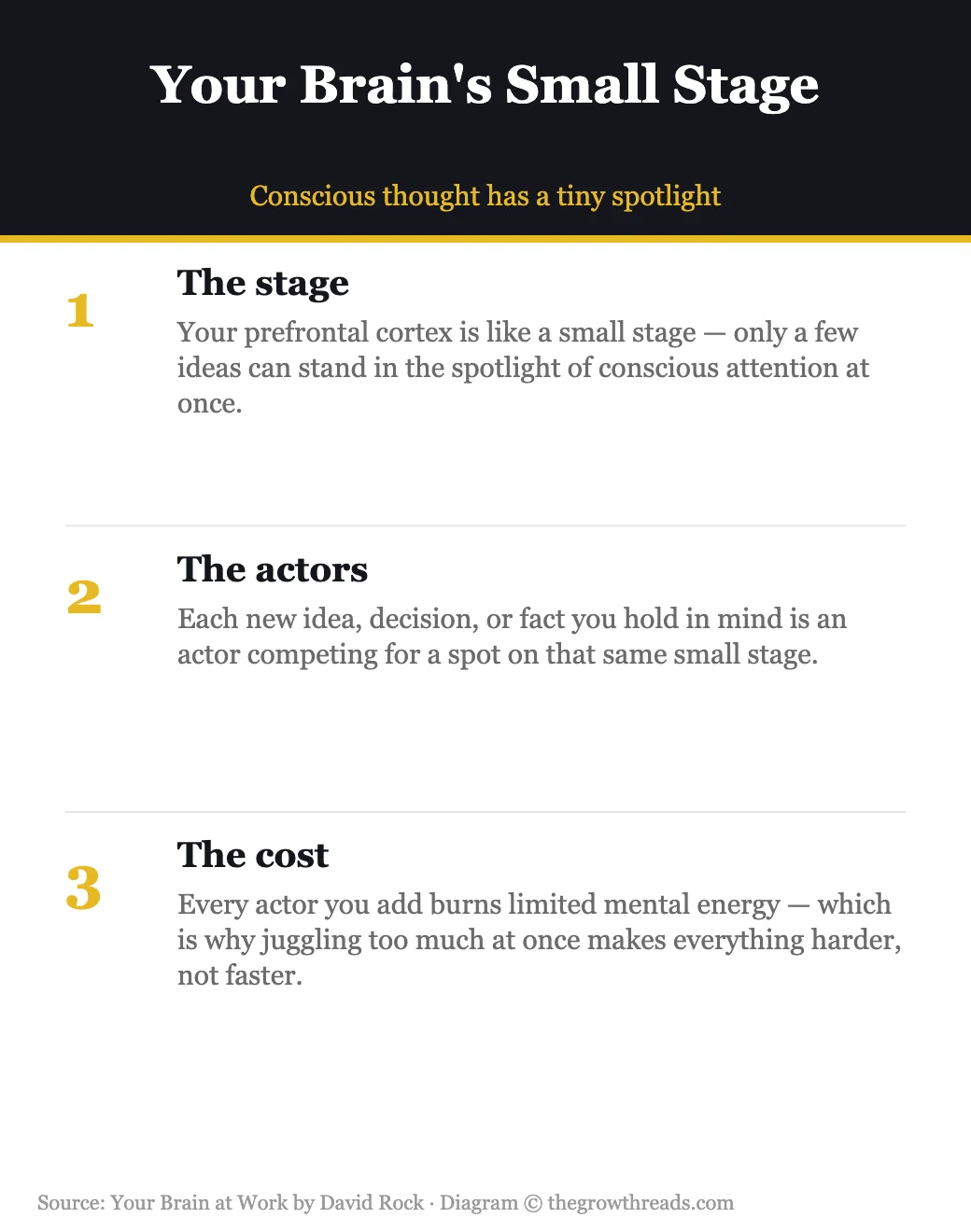
Rock’s central metaphor is a small theater stage inside your head. Conscious attention — your prefrontal cortex — can only hold a handful of “actors,” or pieces of information, in the spotlight at any moment. Everything else waits in the wings, out of conscious awareness. This isn’t a metaphor for effect only; it maps onto a real, well-established limit on working memory capacity, refined by psychologist Nelson Cowan’s research to roughly four active items — a tighter estimate than the older, more famous “seven plus or minus two” rule most people have heard.
The practical implication is blunt: every new email, decision, or worry you try to hold “in mind” competes for the same small stage. Writing things down, closing open tabs, or finishing one task before starting another isn’t just tidiness — it’s freeing up literal cognitive capacity for whatever you’re trying to do next.
Rock illustrates this through Emily’s morning: she arrives already holding a half-dozen loose threads in mind — an unresolved staffing question, a nagging worry about the conference budget, three unanswered messages — and finds herself unable to focus cleanly on any single one. The fix in the book isn’t more willpower; it’s externalizing the load, capturing each open thread somewhere outside her own head so the stage has room for whatever she’s actually working on right now.
TGR Note: The stage-and-spotlight idea pairs naturally with the working-memory limits covered in our The Distracted Mind summary, which digs further into why interruptions are so costly to a brain with so little spare capacity.
Part 2: Hardwired habits vs. costly conscious thought
The book draws a sharp line between two modes of mental processing. “Hardwired” processing runs on the basal ganglia — cheap, fast, automatic, the circuitry behind habits and well-practiced skills. Conscious processing runs on the prefrontal cortex — slow, effortful, and expensive in terms of glucose and mental energy, reserved for anything genuinely new or complex. The book’s advice follows directly from this split: automate what you can turn into habit, and protect your limited conscious-processing budget for the decisions and problems that actually need it.
This is also where the book leans on the idea that willpower itself draws from a limited, depletable resource — a framing popular in psychology when the book was first written. It’s worth flagging directly: the broader “ego depletion” research this idea is associated with has faced serious replication challenges since then, including a large multi-lab study that found the effect close to zero, though the original researchers have disputed those results and the science remains genuinely unsettled rather than fully resolved either way. The more conservative, still well-supported takeaway is simply that effortful conscious thinking is tiring and finite in practice — regardless of the exact biological mechanism, most readers will recognize that hard thinking gets harder as the day wears on.
The book also touches on why habits feel so much easier than new tasks: once a behavior is practiced enough to become “hardwired,” it moves off the expensive conscious stage entirely and runs on cheaper automatic circuitry, freeing up capacity for whatever’s genuinely new. This is part of why an experienced driver can hold a conversation while driving a familiar route, but a first-time driver in an unfamiliar car in heavy traffic often can’t focus on much else — the same action, at wildly different mental cost depending on how automatic it’s become.
TGR Note: If the SCARF model resonates, it shares DNA with the social-threat research covered in our Peak Mind summary — both books treat social and emotional reactions as genuine cognitive events worth managing deliberately, not just “soft skills.”
Part 3: The SCARF model — why feedback backfires
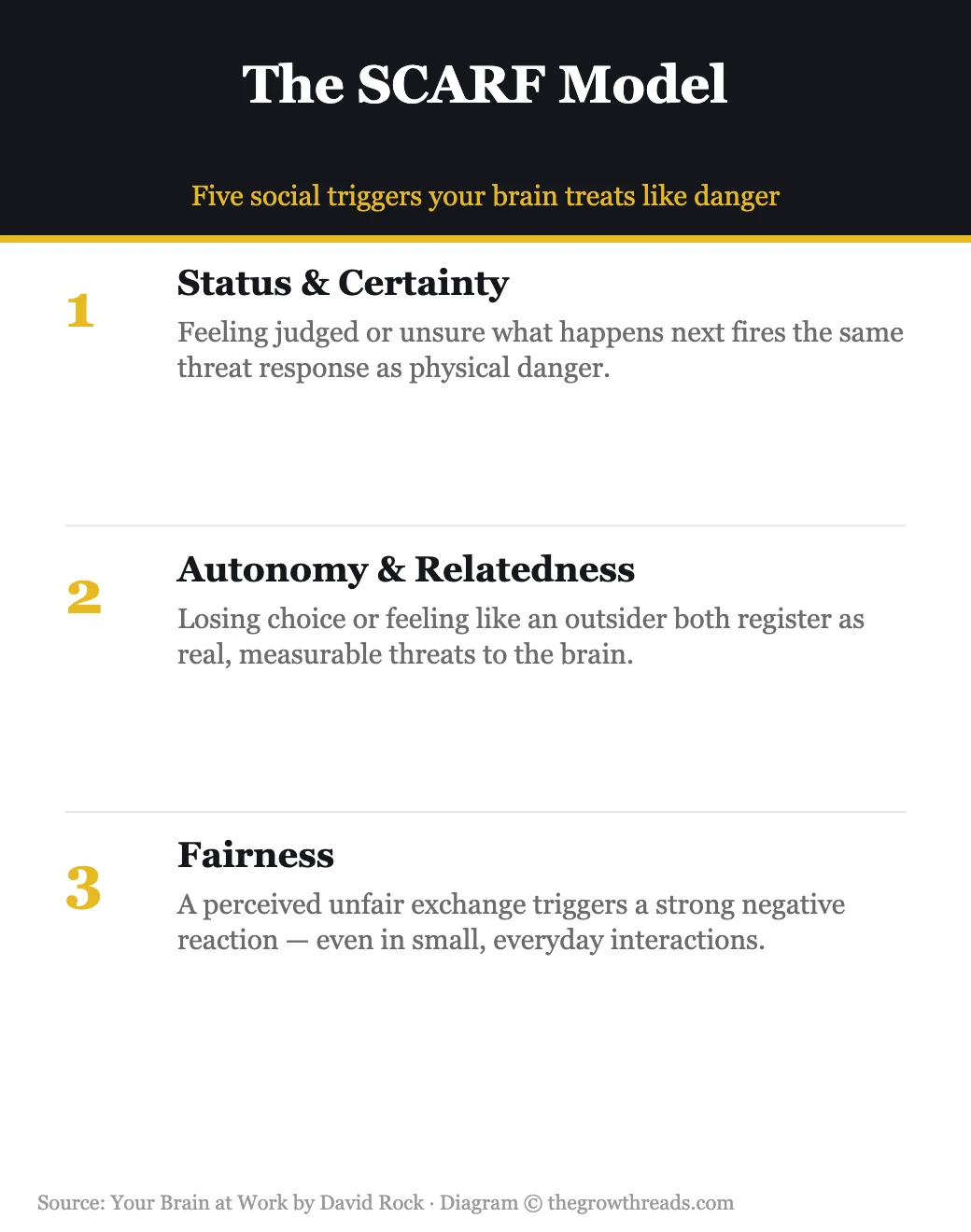
Rock’s SCARF model names five social dimensions the brain monitors constantly: Status (how you rank relative to others), Certainty (whether you can predict what’s coming), Autonomy (how much control you have over your situation), Relatedness (whether you feel like part of the group), and Fairness (whether an exchange feels equitable). The book’s argument, drawing on social neuroscience research into exclusion and reward, is that threats along any of these dimensions activate brain circuitry similar to a physical threat response — which is why a poorly delivered piece of feedback can trigger a genuinely defensive reaction, not just hurt feelings.
This reframes a lot of workplace friction. A manager who gives direct, unsolicited advice may unintentionally trigger an autonomy threat; a comment made in front of the team can trigger a status threat even if the content is mild. The book’s alternative approach is to help people reach their own insight through good questions rather than direct instruction — a technique that respects autonomy and status simultaneously, and tends to produce more durable behavior change than being told what to do.
The book walks through Paul’s project pitch as a case study: when a senior colleague responds with a list of unsolicited fixes rather than questions, Paul’s engagement visibly drops, even though the advice itself is reasonable. Rock frames this as a predictable SCARF reaction — the advice, however well-intentioned, registers as a status and autonomy threat before it registers as useful information, which is why the delivery of feedback often matters as much as its content.
TGR Note: The insight-over-instruction approach echoes ideas in our How to Have a Good Day summary, which covers Caroline Webb’s parallel research on framing conversations to work with the brain’s social wiring rather than against it.
Part 4: Staying calm and facilitating change
The book’s later sections tackle emotional regulation and leading others through change — both framed as extensions of the same limited-resource brain model. For emotional regulation, Rock highlights “affect labeling”: research associated with UCLA neuroscientist Matthew Lieberman suggesting that simply naming an emotion (“I’m frustrated”) reduces activity in the brain’s threat-detection circuitry, making it easier to think clearly rather than react. The book offers a short menu of reappraisal techniques — reinterpreting a situation, normalizing a reaction, reordering what matters, or repositioning yourself relative to the problem — as ways to regulate emotion without suppressing it outright.
For leading change, the book applies the same SCARF lens: announcing a reorganization without warning threatens certainty; removing someone’s input threatens autonomy. The practical guidance is to proactively address as many SCARF dimensions as possible when introducing change — give people information early, offer real choices where possible, and involve them in the process rather than simply informing them of the outcome.
Rock is careful to note this doesn’t mean over-explaining every decision or seeking consensus on everything — it means being deliberate about which SCARF dimensions a given change will threaten, and addressing the highest-risk ones first. A reorganization that removes someone’s authority over their own schedule, for instance, might be softened by offering a genuine choice elsewhere, even a small one, since restoring some autonomy can offset the loss felt in another area.
Compared to more tactics-first productivity books, Your Brain at Work spends unusually much of its page count explaining the “why” behind each technique, using its narrative device consistently throughout. That makes the advice easier to trust and adapt, though the fictional-scenario format means some readers may want to skim past the story beats to get to the underlying techniques faster.
TGR Note: For more on labeling and regulating difficult emotions specifically, our Laziness Does Not Exist summary covers a complementary, more self-compassion-focused angle on the same underlying problem.
Who is Your Brain at Work best for — and who should read something else first?
This book is best for managers, consultants, and anyone whose day is full of decisions, difficult conversations, and competing priorities — the fictional workday format makes the concepts easy to picture in your own job. If you want a deeper dive specifically into the neuroscience of distraction rather than the broader workday picture, start with our The Distracted Mind summary instead. If you’re mainly looking for conversation and feedback techniques rather than the full neuroscience framework, our How to Have a Good Day summary is a more conversational entry point.
Questions to reflect on
- What’s the one decision today that deserves your freshest mental energy — and are you scheduling it early enough?
- How many “actors” are currently competing for space on your mental stage right now?
- Which SCARF dimension (Status, Certainty, Autonomy, Relatedness, Fairness) tends to get threatened most often in your work relationships?
- Next time you feel a strong reaction rising, could you pause and simply name the emotion out loud?
- Where could you replace giving advice with asking a good question instead?
🔥 Ready to work with your brain instead of against it?
Get the full framework, the complete SCARF model, and every technique from the book.
How to apply Your Brain at Work (7-day plan)
- Day 1 — Map your stage: notice how many things you’re mentally juggling at once today, and write them down instead of holding them in mind.
- Day 2 — Front-load one hard decision: pick your toughest decision and make it first thing, before the day drains your mental energy.
- Day 3 — Try one single-task block: protect one 60-90 minute window for exactly one task, no switching.
- Day 4 — Spot a SCARF trigger: notice one moment today where status, certainty, autonomy, relatedness, or fairness felt threatened — yours or someone else’s.
- Day 5 — Ask instead of tell: in one conversation, replace advice-giving with a good question that helps the other person reach their own insight.
- Day 6 — Label an emotion: next time you feel a strong reaction, name it in one word before responding.
- Day 7 — Review and rebuild: pick the one technique — early decisions, single-tasking, SCARF awareness, or labeling — that made the biggest difference, and keep it going next week.
Frequently asked questions
What is the main idea of Your Brain at Work?
The book argues that conscious thought — the prefrontal cortex’s work of deciding, focusing, and self-regulating — is a limited, energy-hungry resource, unlike automatic “hardwired” habits. Understanding this limit, plus the brain’s sensitivity to social threats and rewards (the SCARF model), helps readers make better decisions, stay calmer under pressure, and communicate more effectively at work.
What is the SCARF model?
SCARF stands for Status, Certainty, Autonomy, Relatedness, and Fairness — five social dimensions the brain monitors and reacts to with a threat-or-reward response similar to physical safety. David Rock developed the model in 2008, and it recurs throughout the book as a lens for understanding feedback, conflict, and change management at work.
Is the “willpower as a limited resource” idea in this book still considered accurate?
It’s genuinely debated. The book draws on “ego depletion” research popular when it was first written, but a large multi-lab replication study later found the effect much weaker than originally reported, and the original researchers have disputed that replication’s methods — so the underlying mechanism remains unsettled. The more defensible, still-supported takeaway is simply that sustained effortful thinking is tiring in practice, regardless of the precise biology behind it.
Who is David Rock and why should I trust his framework?
David Rock is the founder of the NeuroLeadership Institute and is credited with coining the term “neuroleadership.” He has spent his career applying cognitive and social neuroscience to management and coaching, and his SCARF model is widely referenced in leadership and organizational psychology circles beyond this one book.
Does the book require a science background to understand?
No — the book is written for a general business audience and uses a fictional narrative (following two characters through a workday) specifically to make the neuroscience concepts concrete and easy to follow without technical jargon.
How is this different from other workplace productivity books?
Most productivity books offer tactics without much explanation of why they work. Your Brain at Work leans more heavily on the underlying brain mechanics — limited conscious-processing capacity, social threat responses, working memory limits — which gives readers a mental model they can apply to new situations, not just a fixed checklist.
What’s the single most useful technique from the book?
Many readers point to scheduling the hardest decisions early, before mental energy is depleted, as the easiest change to make immediately. The SCARF model tends to be the most useful long-term framework, since it applies to nearly every workplace interaction, not just a single type of task.
Readers coming from a pure productivity-hacks background sometimes find the SCARF model useful well beyond the workplace — in family conversations, friendships, or any relationship where a comment can unexpectedly land as a threat rather than the neutral information it was meant to be.
Related summaries
If this topic resonated, continue with our The Distracted Mind summary, How to Have a Good Day summary, Peak Mind summary, and Laziness Does Not Exist summary — or browse the full best productivity books collection.
How we analyze books: we read the full text, cross-check key claims and studies against primary sources, and build original diagrams and application plans rather than reproducing the book’s content. Read our full methodology.
Related Time Management Summaries
Hell Yeah or No Summary & Review: Say No to Almost Everything
I Know How She Does It Summary & Review: What 1,001 Time Logs Reveal About “Having It All”
Organize Tomorrow Today Summary & Review: Plan Tonight, Win Tomorrow
Stillness Is the Key Summary & Review: The Discipline Behind Clear Thinking
The Time Paradox Summary & Review: The Hidden Clock Running Your Decisions