

★★★★★ 4.6/5 — A blunt, no-apologies case for treating your own hour as the most expensive thing you own.
Best for: Entrepreneurs, consultants, and small business owners who are too busy being polite to protect their calendar.
Reading time: ~5 hrs to read the full book · 8 min to read this guide
Difficulty to apply: Easy to start, requires ongoing nerve to sustain — the ideas are simple, saying no is the hard part.
No B.S. Time Management for Entrepreneurs in one minute
Time is the one asset you can never get back, and Dan Kennedy wants you to stop treating it like it’s free. Written in his trademark blunt, contrarian style and updated with Ben Glass for the current edition, No B.S. Time Management for Entrepreneurs argues that most business owners are broke on time not because there isn’t enough of it, but because they hand it away — to meetings, to interruptions, to people who’ve never had to ask permission because no one ever said no. Kennedy’s fix isn’t a new app or a color-coded planner. It’s a mindset: calculate what your hour is actually worth, compare everything you do against that number, and stop apologizing for protecting it.
Readers already familiar with softer productivity books will notice the difference in tone immediately — this one isn’t interested in permission slips or gentle nudges, it’s interested in results, and it treats a reader’s discomfort with directness as a problem to work through rather than something the book should accommodate.
Key takeaways
- Time is your only non-renewable asset: money lost can be remade; an hour spent is gone permanently — treat it accordingly.
- Calculate your real hourly value: divide your income goal by the hours you actually have to earn it, and use that number as a filter.
- Anything below your number gets delegated: paying someone else a fraction of your rate to do a task is a profit, not an expense.
- Watch for time vampires: people and activities that drain hours without proportional value, meetings chief among them.
- Meetings multiply cost: a one-hour meeting with five people isn’t one hour — it’s five hours of collective time spent.
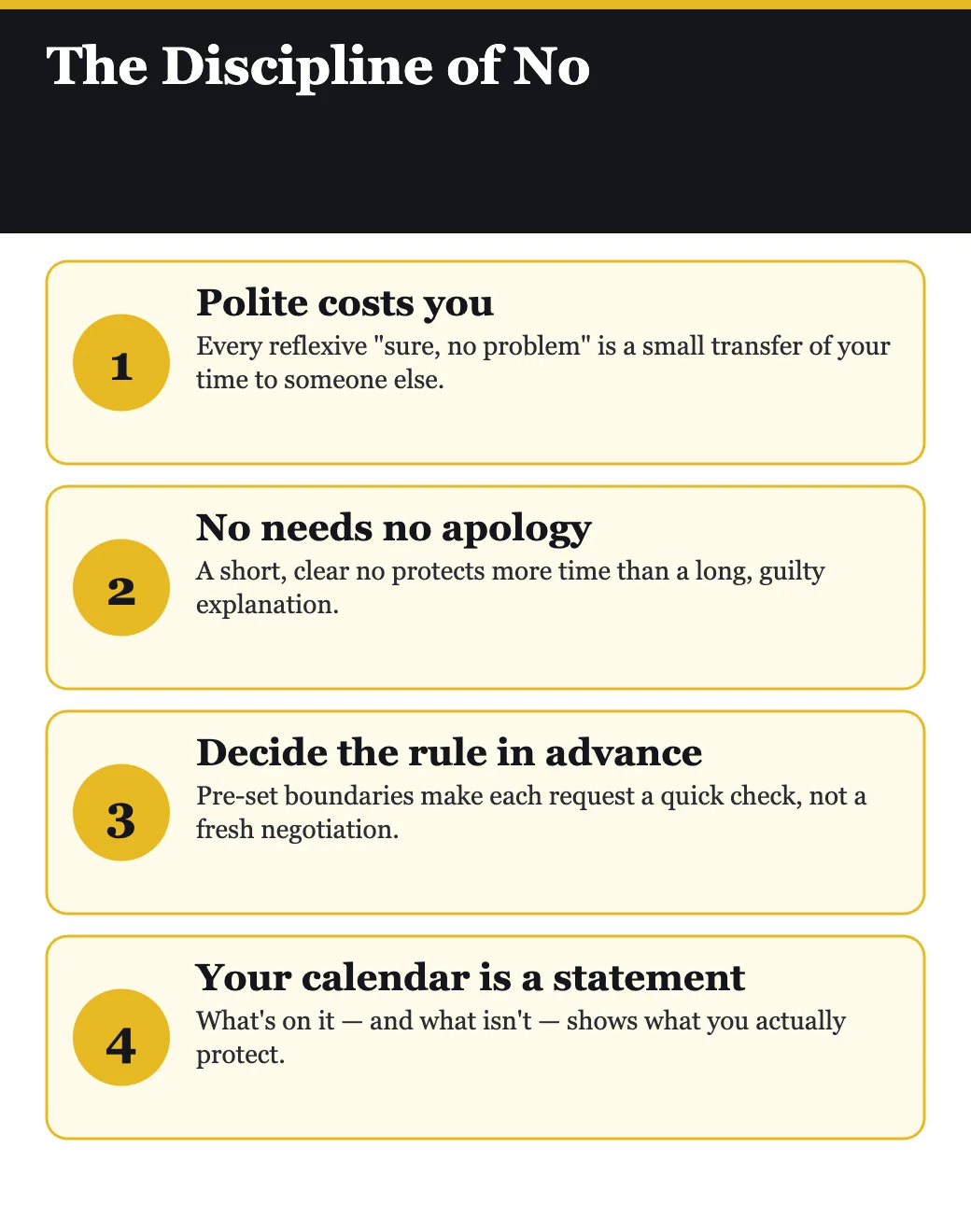
- Politeness is expensive: a reflexive “sure, no problem” is a small transfer of your time to whoever asked.
- No needs no justification: a short, clear no protects more time than a long, guilty explanation ever does.
- Decide boundaries in advance: pre-set rules turn each new request into a quick check instead of a fresh negotiation.
- Your calendar is a statement of values: what’s protected on it — and what isn’t — shows what you actually prioritize.
- Discipline beats systems: the best planner in the world doesn’t help if you don’t have the nerve to say no.
What is No B.S. Time Management for Entrepreneurs about?
No B.S. Time Management for Entrepreneurs is Dan Kennedy’s blunt, contrarian argument that time — not money — is a business owner’s only truly finite resource, and that most entrepreneurs waste it through politeness, poor boundaries, and tolerance of “time vampires.” It’s part of Kennedy’s larger No B.S. series and pushes readers to calculate their real hourly value and defend it without apology.
About the author
Dan S. Kennedy built his reputation as a direct-response marketing consultant and copywriter, working with entrepreneurs across industries from small local businesses to companies valued in the hundreds of millions. That direct-response background shows up throughout his No B.S. series — a shelf of blunt, deliberately combative business books on marketing, sales, ruthless management, and, in this volume, time itself. Kennedy’s stated position, carried across the series, is that most conventional business advice is too soft to actually change behavior, and that entrepreneurs respond better to plain, sometimes uncomfortable, directness than to gentle encouragement. The current edition adds Ben Glass, an attorney and podcast host, as co-author, updating the book’s examples and advice for today’s business owners while keeping Kennedy’s original voice and framework intact. Explore all Ben Glass book summaries →
That combination — a founding voice built on decades of direct-response marketing experience, paired with an updater bringing more current examples — is part of why the book reads as neither dated nor watered down. The core argument hasn’t changed because it doesn’t need to: the math behind an hourly rate and the discomfort of saying no are the same whether the request arrives by phone, email, or a messaging app. What’s been refreshed is the surface layer of examples, keeping the book’s central case as relevant to a current reader as it was to one in 2004.
Key concepts at a glance
| Concept | What it means | Use it when |
|---|---|---|
| Time vampires | People, meetings, or habits that drain time without proportional value | Auditing where your week actually goes |
| Hourly value | Your income goal divided by the hours available to earn it | Deciding whether a task is worth doing yourself |
| The delegation math | Paying someone a fraction of your rate to do sub-threshold work | Handing off tasks below your number |
| Meeting cost multiplier | One hour × every attendee, not just one hour | Deciding whether a meeting is worth calling |
| The discipline of no | Refusing requests without over-explaining or apologizing | Protecting your calendar from other people’s priorities |
| Pre-set boundaries | Rules decided in advance rather than negotiated case by case | Handling recurring requests for your time |
Part 1: Time as your only truly finite asset
Kennedy opens from a position most productivity books only gesture at: money is renewable, time is not. You can lose a client, a deal, even a business, and rebuild it — but an hour spent is permanently spent, with no possibility of a do-over. That asymmetry, he argues, should change how entrepreneurs treat their calendar entirely. Most business owners guard their bank account far more carefully than their schedule, even though the schedule is protecting the more scarce resource of the two.
The book’s tone here is deliberately uncomfortable. Kennedy isn’t interested in softening the message with a gentler productivity framework — his stance is that entrepreneurs waste time precisely because no one has ever told them, bluntly, that it’s their own fault. Interruptions succeed because they’re allowed to. Meetings run long because no one ends them. Low-value work fills the day because higher-value work was never explicitly protected from it. The fix starts with accepting that the leak is self-inflicted before any tactic can close it.
What separates Kennedy’s version of this argument from a generic productivity pep talk is his refusal to let the reader off the hook with sympathy. Plenty of books acknowledge that entrepreneurs are busy and overwhelmed and then offer gentle tactics for coping with it. Kennedy’s position is closer to: the overwhelm is a choice, made repeatedly, one unexamined yes at a time, and no external system fixes a problem that’s fundamentally about permission. That’s an uncomfortable frame for readers who’d rather blame a chaotic market or an unreasonable client base, but it’s also, on its own terms, an empowering one — if the leak is self-inflicted, it’s also fully within the reader’s power to close.
Part 2: Pricing your own hour
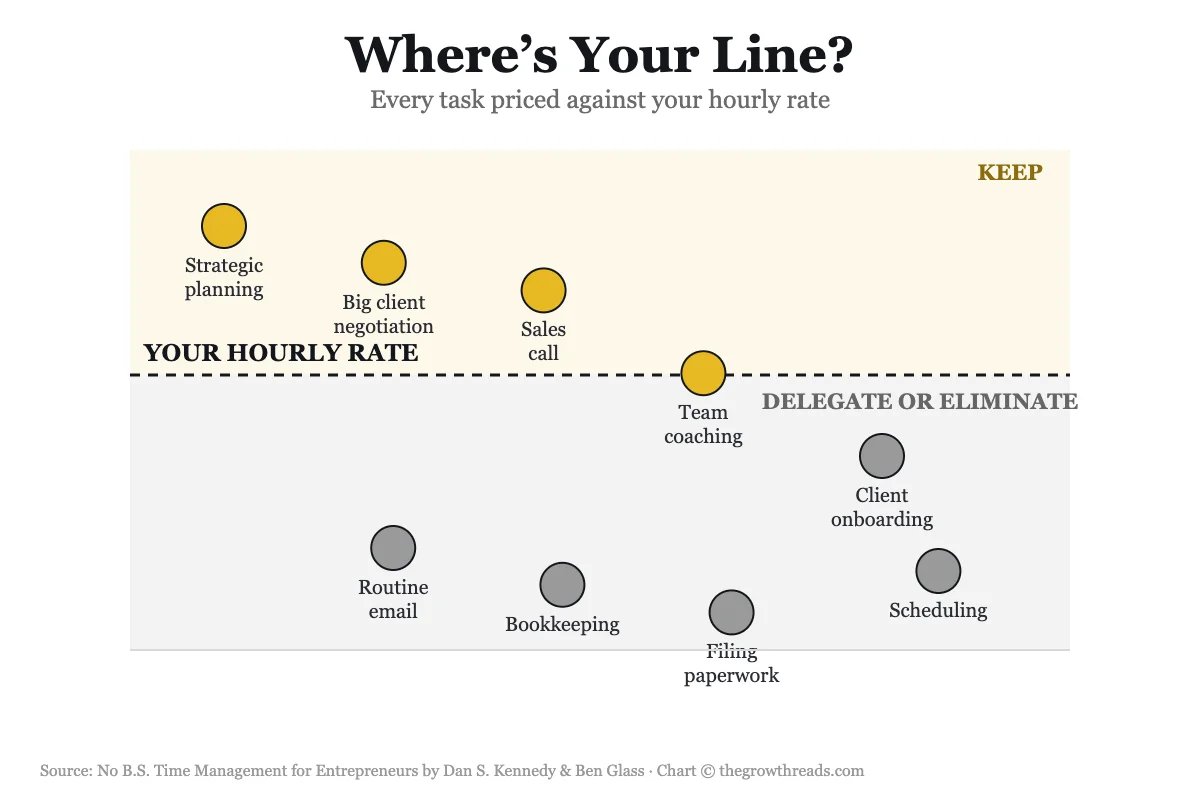
The book’s most concrete tool is also its simplest: calculate your real hourly value by dividing your income goal by the number of hours you actually have available to earn it, then use that number as a filter for every task that crosses your desk. A task worth less than your number — filing, routine scheduling, low-stakes admin — doesn’t belong in your hands, regardless of how quick or easy it feels in the moment. A task worth more — strategic decisions, high-value client relationships, work only you can do — deserves fierce protection.
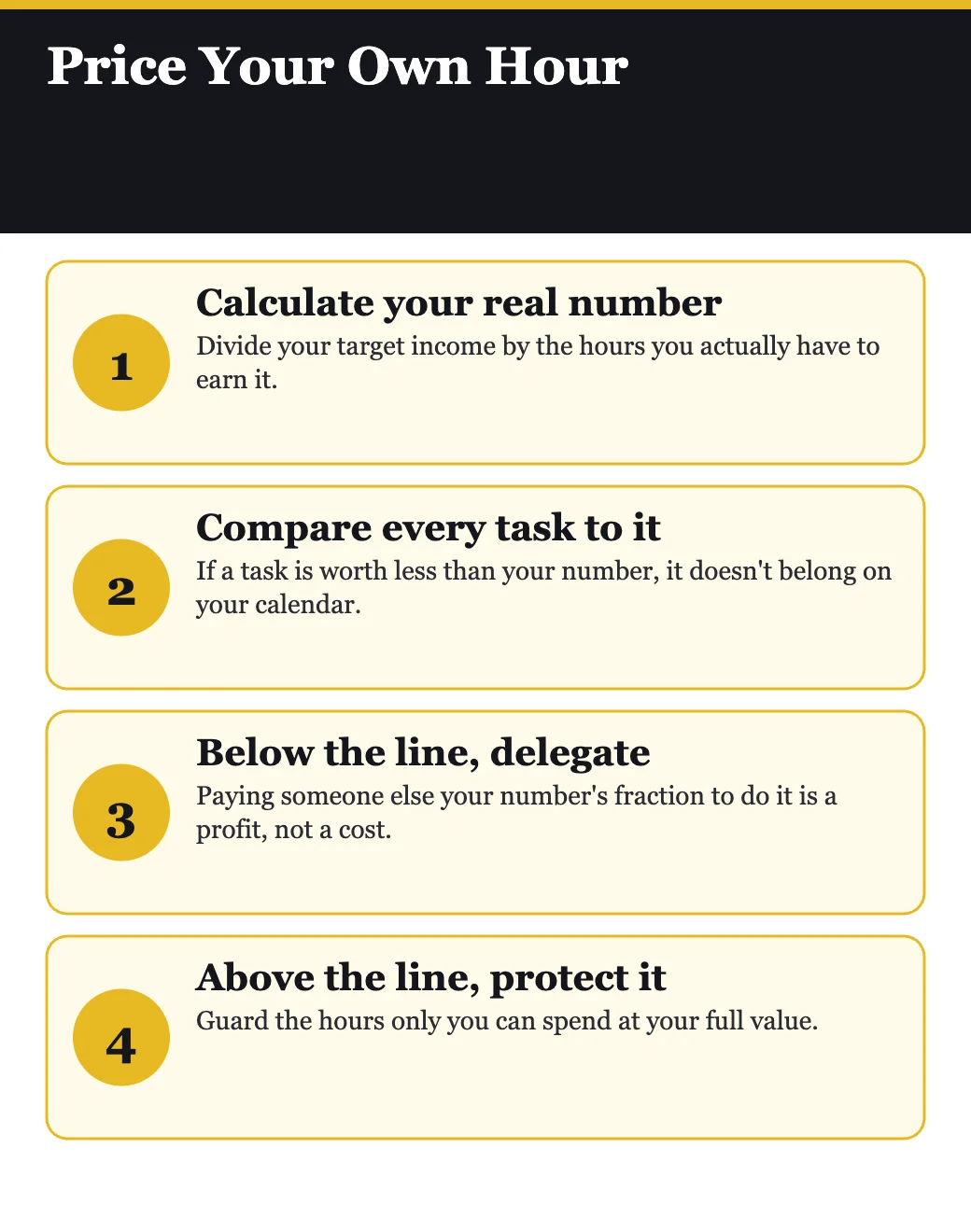
The delegation math that follows is where the argument turns from mindset into action. If your hour is worth a meaningful sum and you can pay someone a fraction of that to handle a sub-threshold task, the arrangement isn’t a cost — it’s a straightforward profit, freeing your highest-value hours to be spent at their actual worth. Kennedy is unsentimental about tasks many owners feel obligated to keep doing themselves out of thrift or habit; the math, run honestly, usually says otherwise.
Kennedy is careful to note that this math isn’t a license for false economy in the other direction either — hiring cheaply for the wrong reasons, or delegating a task to someone unqualified simply because it’s technically below your hourly number, tends to create rework that costs more than doing it right the first time would have. The point of the calculation isn’t to delegate reflexively; it’s to make the tradeoff visible so it can be made deliberately. A task worth delegating done well, to the right person, at the right price, is what actually returns the freed hour to its highest use — not delegation for its own sake.
Part 3: Time vampires and the true cost of meetings
Kennedy’s term for the people, habits, and recurring obligations that drain time without proportional value is “time vampires” — and meetings, in his account, are the most common and most underpriced offender. A one-hour meeting with five people isn’t one hour of cost; it’s five hours of collective time spent, a number almost nobody actually calculates before scheduling one. Framed that way, a habitual weekly status meeting stops looking like a minor scheduling item and starts looking like a recurring five-figure expense over a year.
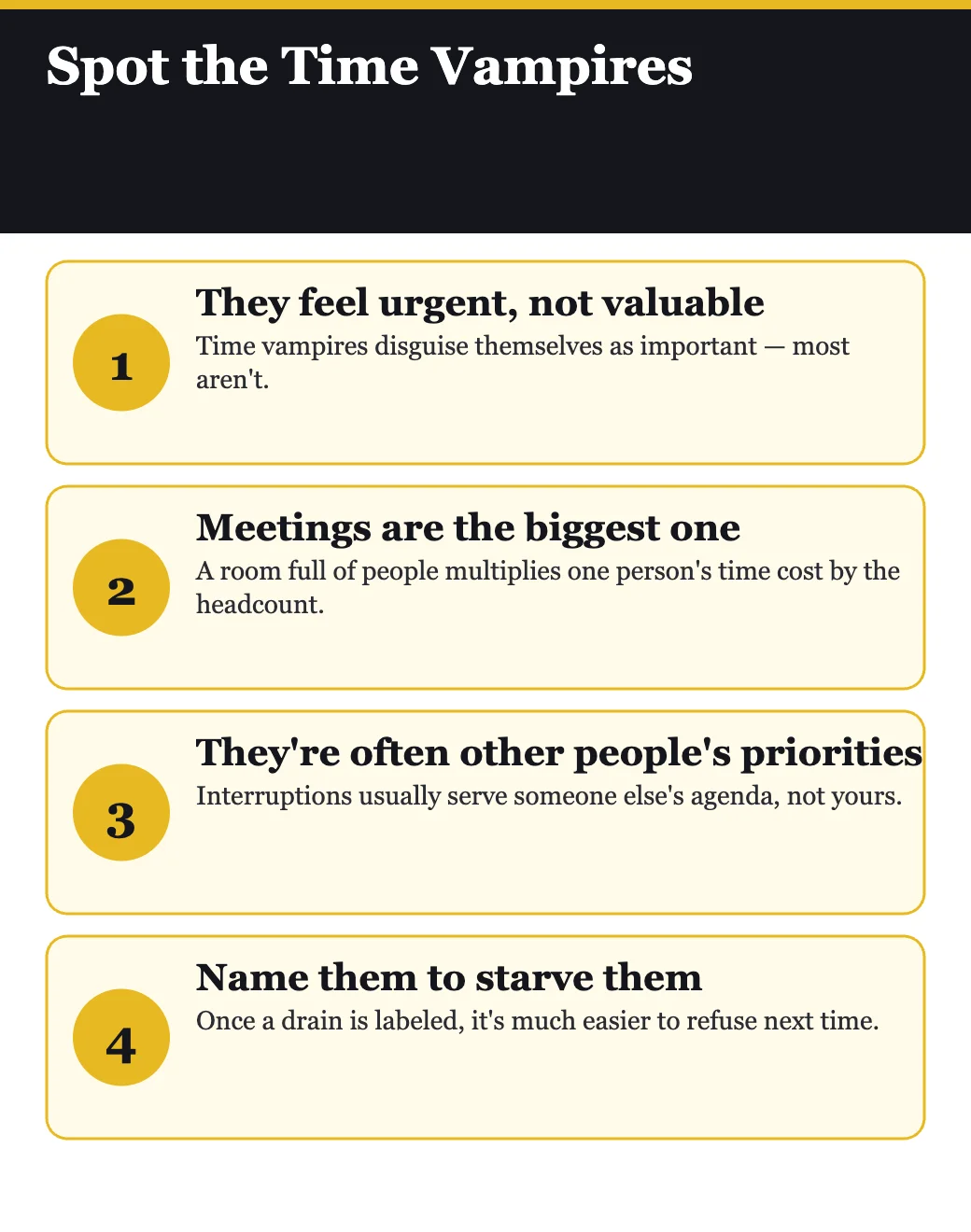
The book’s advice isn’t to eliminate every meeting — some genuinely need every person in the room. It’s to make the true cost visible before the invite goes out, and to apply the same scrutiny to recurring “quick syncs” that most calendars let slide by unquestioned. A meeting that can’t justify its real, multiplied cost doesn’t deserve the slot, no matter how routine or well-intentioned it feels.
The same lens applies to smaller, less obvious drains that never get formally scheduled: the colleague who stops by “for just a second,” the client who calls instead of emailing because it feels more personal, the habit of checking a group chat throughout the day instead of at set intervals. None of these individually looks like much. Priced honestly, at your calculated hourly value, multiplied across a week and then a year, the total is usually startling — which is precisely why Kennedy insists on doing the math rather than trusting a vague sense that “it’s not that bad.” Vague senses are, in his account, exactly how time vampires survive.
Part 4: The discipline of saying no
The hardest part of the book to actually implement, and the part Kennedy spends the most energy defending, is the discipline of saying no without apology. Most entrepreneurs, he argues, over-explain their refusals out of a need to be liked — and the long justification usually costs more time and goodwill than a short, clean no would have. A boundary stated plainly, without a paragraph of caveats, tends to be respected faster than one hedged into vagueness.
The practical suggestion is to decide boundaries in advance rather than negotiating them fresh every time a request arrives. A pre-set rule — no meetings before 10am, no same-day requests without a genuine emergency, no unpaid “quick calls” for strategic advice — turns each new ask into a simple check against a standing policy instead of an exhausting case-by-case negotiation. Over time, Kennedy argues, this is what actually changes how people treat your calendar: not a better excuse, but a visible pattern of boundaries that don’t move.
What makes this section land is Kennedy’s insistence that guilt is the actual obstacle, not logistics. Anyone can build a boundary into a calendar app. Far fewer people can hold that boundary the first time someone pushes back on it — and the book’s bluntness is, in large part, an attempt to give readers permission to hold the line without feeling like they owe an explanation for protecting something that was always rightfully theirs.
There’s a compounding effect the book returns to more than once: the first no in a new relationship or role is the hardest, and every one after it gets easier, because the boundary becomes an established fact rather than a fresh negotiation each time. People and organizations adapt remarkably quickly to a consistently held line — the discomfort is almost always front-loaded into the first few instances. Readers who give up on the discipline usually do so after one uncomfortable pushback, right before the boundary would have started holding on its own. Kennedy’s advice, bluntly, is to expect that early friction and treat it as the cost of admission rather than a sign the approach isn’t working.
Who is No B.S. Time Management for Entrepreneurs best for — and who should read something else first?
This book is built for entrepreneurs, consultants, and small business owners who already sense their time is being taken from them but haven’t yet given themselves permission to stop it — the blunt, combative tone works as a deliberate push past the politeness that Kennedy argues is the real obstacle. Readers who prefer a gentler, more research-driven tone may prefer Off the Clock or Manage Your Day-to-Day, both of which cover overlapping ground on protecting focus with a softer delivery. Readers specifically wrestling with delegation and elimination as a system, rather than a mindset shift, will find a more structured five-step framework in Procrastinate on Purpose.
It’s also worth naming plainly who this book is not for: readers who need a lot of emotional warmth from a business book, or who are looking for research-heavy citations rather than blunt, experience-based conviction, will likely find Kennedy’s delivery grating rather than motivating. That’s a legitimate mismatch, not a flaw unique to this reader — Kennedy’s style is a deliberate choice aimed at a specific kind of reader who responds to directness, and the book makes no attempt to soften itself for anyone outside that audience. For the right reader, though, that same bluntness is often exactly what finally makes the boundary-setting advice stick where gentler books haven’t.
Questions to reflect on
- What is your real hourly value, calculated honestly against your actual income goal and available hours — and does your calendar reflect it?
- Which recurring meeting on your calendar would you cancel first if you had to justify its true, multiplied cost out loud?
- Where have you said “sure, no problem” recently when a clean no would have cost you less?
- What boundary could you decide once, in advance, instead of renegotiating every time a similar request comes in?
- Who or what in your week fits Kennedy’s description of a time vampire — and what would change if you named it out loud?
🔥 Ready to price your own hour?
Get No B.S. Time Management for Entrepreneurs and start defending your calendar without apology.
How to apply No B.S. Time Management for Entrepreneurs (7-day plan)
- Day 1: Calculate your real hourly value — divide your income goal by the hours you actually have available to earn it. Write the number down somewhere visible.
- Day 2: Audit yesterday’s calendar against that number. Circle every task that was worth less than your hour.
- Day 3: Identify one recurring meeting. Calculate its true cost (one hour × every attendee) and decide whether it survives the math.
- Day 4: Say no to one request today without over-explaining. Notice how it actually lands compared to what you expected.
- Day 5: Pick one below-threshold task from Day 2 and delegate it — to a person, a tool, or simply by deciding it doesn’t get done.
- Day 6: Write one pre-set boundary (a rule, not a one-time decision) that will apply to every future request of a certain type.
- Day 7: Review the week. Keep the one change that protected the most time, and let the rest wait until it’s a habit rather than an experiment.
Frequently asked questions
What are “time vampires” in this book?
Time vampires are Kennedy’s term for the people, habits, and recurring obligations — meetings chief among them — that drain time without delivering proportional value. The book argues most entrepreneurs never actually calculate the true cost of these drains, which is why they persist; naming them explicitly and pricing their real cost is the first step toward cutting them.
How do you calculate your hourly value using this book’s method?
Divide your income goal by the number of hours you actually have available to earn it — not a theoretical 40-hour week, but the real hours left after existing commitments. That number becomes a filter: tasks worth less than it are candidates for delegation or elimination, while tasks worth more deserve your direct, protected attention.
Is Dan Kennedy’s tone in this book really as blunt as people say?
Yes — the book is intentionally combative, part of a “No B.S.” series built around plain, sometimes uncomfortable directness rather than gentle encouragement. Kennedy’s stated position is that softer advice hasn’t worked for most readers, so the bluntness is a deliberate choice meant to jolt readers out of habitual politeness rather than a stylistic accident.
Is this book only useful for high earners with expensive time?
No — the calculation works at any income level, and arguably matters more for earlier-stage entrepreneurs, since every hour spent on low-value work is a larger proportional loss to a smaller business. The specific dollar number changes, but the discipline of pricing your time and protecting it above that price applies regardless of current revenue.
Does the book address modern remote work and digital distractions?
The current edition, updated with co-author Ben Glass, brings the original 2004 book’s advice into a more contemporary business context. Some readers of earlier editions have noted references that reflect an older, more analog business environment; the update aims to keep the core time-value framework intact while making the examples more relevant to how entrepreneurs actually work today.
Why does the book put so much emphasis on saying no without explanation?
Kennedy argues that over-explaining a refusal usually costs more time and invites more negotiation than a short, clear no would. A boundary stated plainly and without a paragraph of justification tends to be respected faster, while a heavily caveated one signals room to push back. The emphasis is less about rudeness and more about efficiency — and about not owing an explanation for protecting something that was always yours to protect.
What’s a good first step after reading this book?
Most readers get the clearest early win from simply calculating their real hourly value and writing it down somewhere visible before attempting any of the book’s other advice. Once that number exists, every other suggestion — delegating below-threshold tasks, pricing meetings honestly, holding boundaries — becomes a concrete comparison instead of an abstract discipline to will yourself into.
Related summaries
Continue exploring focus and time management: Procrastinate on Purpose · Manage Your Day-to-Day · Off the Clock · A High-Performing Mind · or browse the full productivity library.
How we analyze books: every summary on The Growth Reads is built from a close reading of the book’s core arguments, cross-checked against the author’s other published work and interviews, then structured around practical application rather than just recap. Read our full methodology.
Related Time Management Summaries
Gentle Summary & Review: A Sustainable Alternative to Hustle Culture
I Know How She Does It Summary & Review: What 1,001 Time Logs Reveal About “Having It All”
Organize Tomorrow Today Summary & Review: Plan Tonight, Win Tomorrow
The Distracted Mind Summary & Review: Why Your Brain Fights Focus
The Time Bandit Solution Summary & Review: Recovering Stolen Time You Never Knew You Had