

⭐⭐⭐⭐⭐ 4.7/5 — A neuroscientist’s research-backed case that attention is trainable, and that 12 minutes a day of practice measurably protects it under stress.
Best for: Readers who want the actual science behind mindfulness and attention, not just a general call to “be more present.”
Reading time: ~6-7 hrs to read the book (guide: 13 min)
Difficulty to apply: Moderate — the exercises are simple, but building a genuine daily practice takes consistency over at least four weeks to see benefits.
Peak Mind in one minute
Attention is the brain’s most valuable resource, and it’s constantly getting hijacked by threat, novelty, and reward — but neuroscientist Amishi Jha’s research shows just 12 minutes of daily attention training measurably protects focus and working memory, even during genuinely high-stress periods. Drawing on more than a decade studying U.S. Marines, elite athletes, and other high-stress populations, Jha breaks attention down into three trainable subsystems — the Flashlight (focused attention), the Floodlight (open monitoring), and the Juggler (working memory) — and shows through her own peer-reviewed research that consistent short practice keeps all three from degrading when it matters most.
Key takeaways
- Attention is trainable, not fixed: like a muscle, it can be strengthened with consistent short practice, and it degrades measurably under chronic stress without it.
- Three subsystems do the work: the Flashlight (narrow focus), the Floodlight (broad open monitoring), and the Juggler (working memory managing your goals).
- Attention gets hijacked automatically: threat, novelty, and reward capture the Flashlight involuntarily — a survival reflex that misfires constantly in modern life.
- The mind wanders close to half of waking hours: well-established research on mind-wandering shows attention drifts off-task far more often than most people realize.
- 12 minutes a day, five days a week, is the empirically derived dose: Jha’s lab found this threshold by analyzing practice logs from high-benefit groups, then confirmed it prospectively with athletes and military cohorts.
- Benefits require at least four weeks of consistent practice: shorter interventions in her studies underperformed — this isn’t a one-off fix.
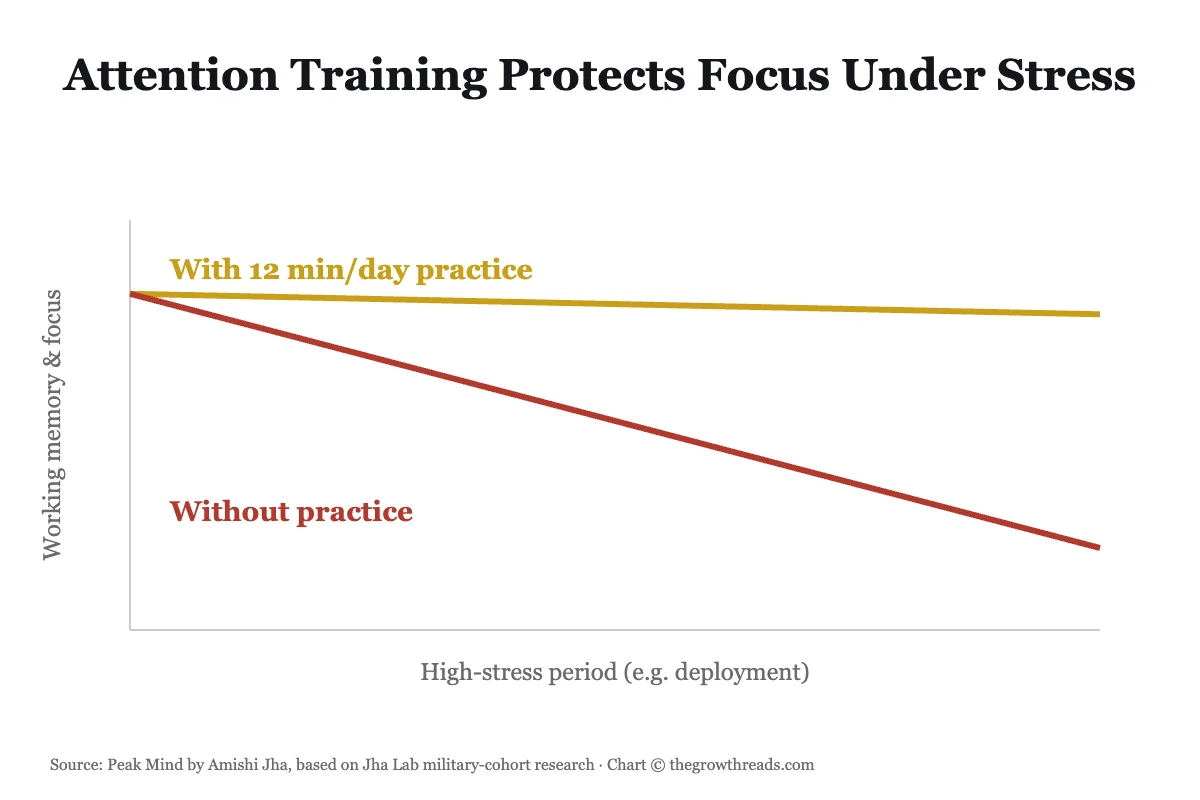
- Marines who sustained practice held steady under deployment stress: those with low practice showed measurable attention and working-memory decline; some who increased practice mid-deployment saw performance rebound.
- Multitasking doesn’t actually work: attention has a hard capacity limit, so it switches rapidly between tasks rather than truly splitting, and quality suffers.
- Fighting a wandering mind tends to backfire: noticing it and gently redirecting works better than trying to suppress it through sheer willpower.
- The training is simple but not effortless: the exercises themselves are short and clear, but building an actual daily habit is the real work of the book.
- The research is Jha’s own: unlike many popular attention books that summarize other people’s studies, the claims here come from research her own lab designed and ran.
What is Peak Mind about?
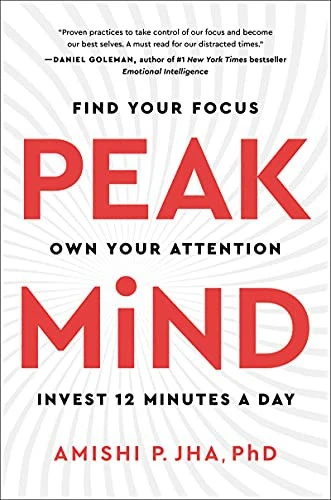
Peak Mind argues that attention is a limited, trainable resource that gets constantly hijacked by threat, novelty, and reward, and that just 12 minutes of daily mindfulness-based attention training — backed by the author’s own research with military and high-stress populations — measurably protects focus and working memory even under pressure.
About the author
Amishi P. Jha, Ph.D., is a professor of psychology and director of contemplative neuroscience at the University of Miami, where her lab has spent more than a decade studying attention in high-stress, high-stakes populations, including U.S. Marines preparing for deployment, elite athletes, and first responders. Her research uses controlled, peer-reviewed methodology — practice logs, cognitive performance testing, and in some studies neural measures — to test whether mindfulness-based attention training actually changes outcomes under real-world stress, not just self-reported wellbeing. Explore all Amishi Jha book summaries →
That research background shapes the entire book: unlike many mindfulness titles built primarily on philosophy or anecdote, Peak Mind (HarperOne, 2021) is structured around what Jha’s lab has actually measured, including the origin of its signature “12 minutes a day” claim, which came from analyzing her own studies’ practice-log data rather than being an arbitrary round number chosen for marketing.
Key concepts at a glance
| Concept | What it means | Use it when |
|---|---|---|
| The Flashlight | Narrow, focused attention aimed at one thing at a time | You need to concentrate on a single task without distraction |
| The Floodlight | Broad, open awareness scanning for the unexpected | You want to notice what’s happening around you, not just in front of you |
| The Juggler | Working memory that holds your goals and manages competing priorities | You’re juggling multiple tasks or objectives at once |
| The Boss | Threat, novelty, and reward hijacking your attention automatically | You keep getting pulled off-task and want to understand why |
| Mind wandering | Attention drifting off-task, which happens close to half of waking hours | You want a realistic baseline for how often focus naturally slips |
| The STOP technique | Stop, Take a breath, Observe, Proceed — a fast in-the-moment reset | You’re in an acute stress moment and need to recenter quickly |
Part 1: What attention is, and how it gets hijacked
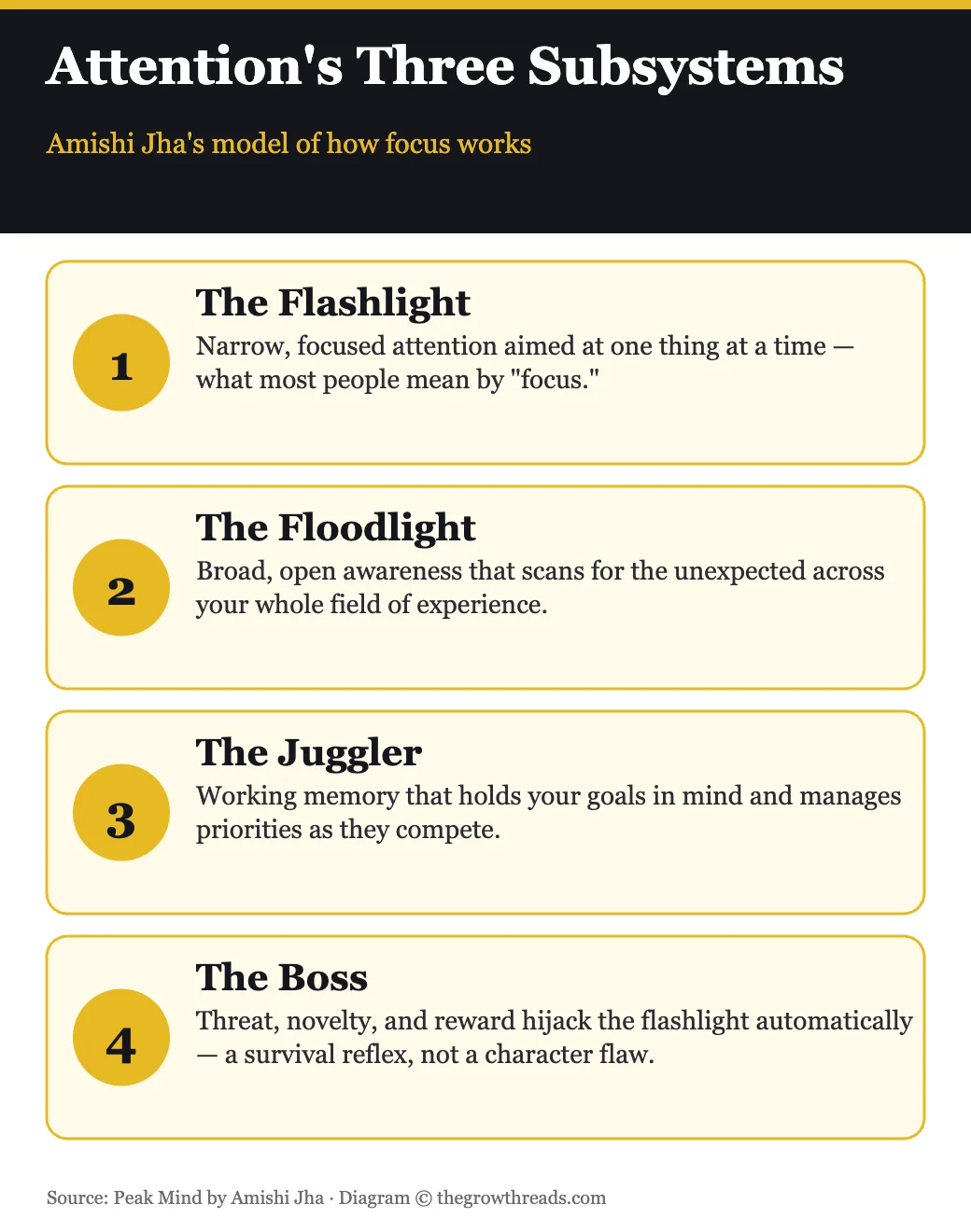
Jha opens by defining attention precisely rather than vaguely — not as a personality trait some people simply have more of, but as a set of three distinct cognitive subsystems: the Flashlight for narrow focus, the Floodlight for open monitoring, and the Juggler for working memory. She then introduces what she calls the Boss: the brain’s automatic tendency to redirect the Flashlight toward threat, novelty, and reward, a survival mechanism inherited from an environment where spotting danger fast mattered more than sustained concentration. In a notification-saturated modern environment, that same reflex means a phone buzz or an unexpected email can hijack attention dozens of times a day, often without the person even registering the redirection as it happens.
Jha frames this hijacking as neither a flaw to eliminate nor a modern invention — it’s an ancient survival circuit doing exactly what it evolved to do, just in an environment saturated with far more false alarms than the one it was built for. A rustle in tall grass warranted an instant reflexive attention shift when the cost of ignoring a real predator was catastrophic; a notification buzz triggers the same circuit today even though the cost of a delayed response is almost always trivial. Understanding the mechanism doesn’t switch it off, but Jha argues it changes the relationship: instead of experiencing each hijack as a personal failure of discipline, it becomes recognizable as a predictable reflex that attention training can learn to work with rather than constantly fight.
TGR Note: This three-subsystem model pairs well with the kinetic attention research in Attention Span — both books treat attention as something with real structure and limits, rather than a single dial you either have turned up or don’t.
Part 2: How attention loss actually shows up in your life
This section grounds the abstract cost of scattered attention in concrete terms: missed moments with people you care about, decisions made on autopilot, and a persistent sense of being present in body but not in mind. Jha cites the well-established finding that the mind wanders off-task close to half of waking hours — a striking baseline that reframes distraction as the norm the brain defaults to, not a personal failing unique to distracted people. She connects this to mood and wellbeing directly: a wandering mind, on average, correlates with lower reported happiness than a mind that’s actually engaged with whatever it’s doing, even when the task itself is mundane.
Jha is careful to distinguish this argument from a blanket case against mind-wandering, a nuance easy to miss in a book largely arguing for more focused, directed attention, noting that some undirected mental drift supports creativity and problem-solving. Her point isn’t that a wandering mind is always bad, but that involuntary, unnoticed wandering — the kind that happens without your awareness or consent — is where the real cost lives, since it’s the difference between choosing to daydream and simply losing track of your own experience without realizing it.
Jha ties this distinction to a broader point about presence: the goal of attention training isn’t to eliminate every stray thought, which isn’t realistic or even desirable, but to restore the ability to notice when attention has left and choose whether to bring it back. That act of noticing is itself the skill being trained — not suppressing distraction through force, but catching the drift earlier and more often, so that more of your waking hours are spent actually experiencing what’s in front of you rather than running on autopilot without registering it.
Part 3: Why the usual fixes don’t work
Before offering her own solution, Jha addresses common attention-management strategies and explains why they tend to underdeliver. Multitasking is the clearest case: because attention has a hard capacity limit, apparent multitasking is really rapid switching between tasks, and each switch carries a real cost, well documented in cognitive science through phenomena like the attentional blink, where the brain misses a second target if it appears too soon after processing a first one. Willpower alone fares little better as a strategy, precisely because willpower is one of the resources that degrades under the chronic stress attention training is meant to protect.
This point deserves unpacking because it inverts a common assumption: many productivity approaches treat willpower as the tool that solves attention problems, but Jha’s research suggests the causal arrow runs the other way — willpower itself depends on the same finite attentional and working-memory resources that get depleted by chronic stress, so trying to power through a depleted state with more willpower is drawing on a well that’s already running low.
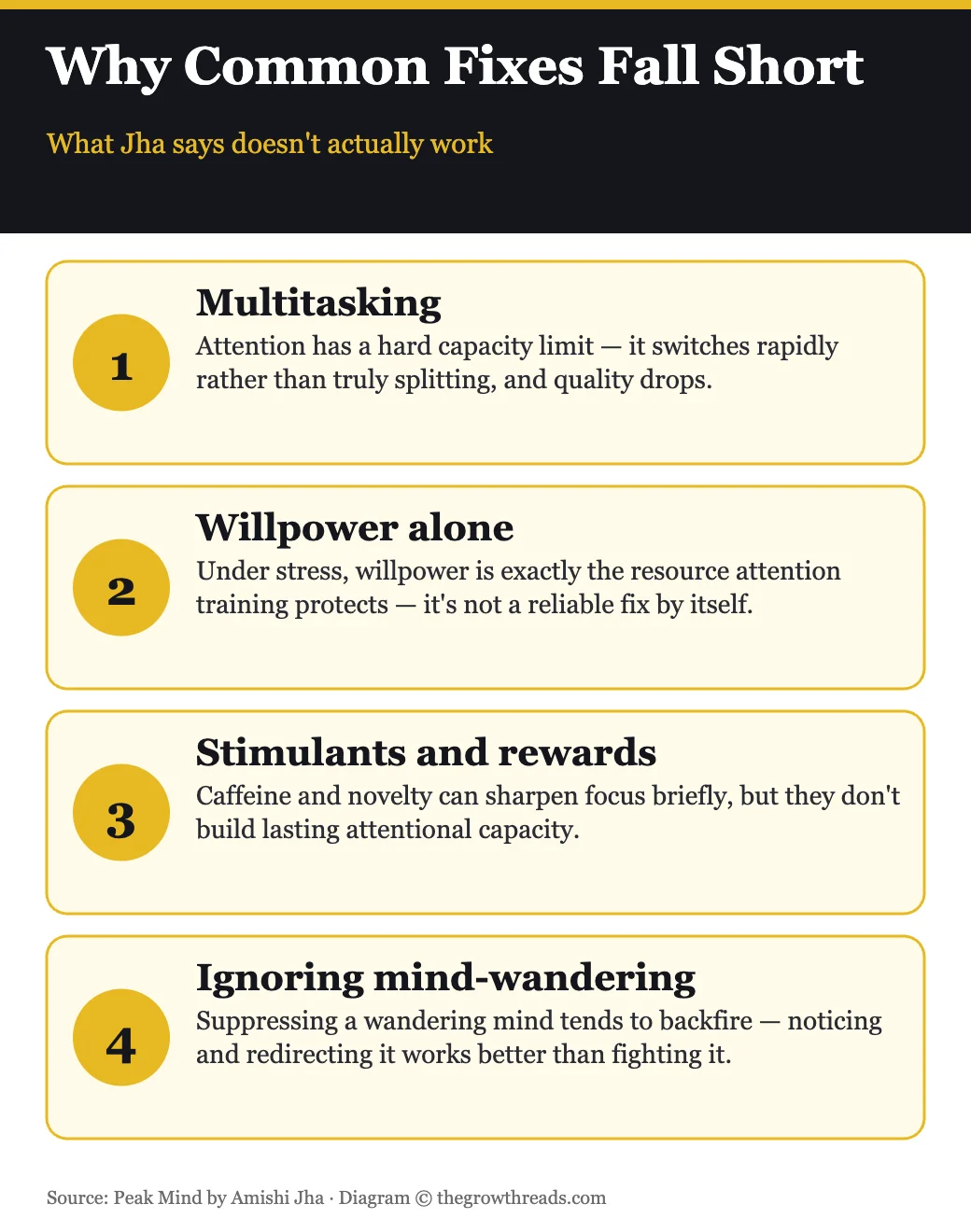
Stimulants and short-term rewards get similar treatment: caffeine or a burst of novelty can sharpen focus temporarily, but neither builds the underlying capacity that makes attention resilient over the following weeks and months. Jha’s alternative isn’t a single hack but a training regimen — consistent, brief, and specific enough to actually change the trajectory rather than just patching over a bad moment.
The attentional blink research Jha cites is worth spelling out because it’s a clean, well-replicated illustration of attention’s hard limits rather than just a rhetorical point: when two targets appear in rapid succession within a stream of information, people reliably miss the second one if it shows up within roughly a quarter to half a second of the first, because attention is still occupied processing the earlier target. What’s notable in Jha’s account is that trained meditators, in some studies, show a reduced attentional blink compared to untrained controls — evidence that this isn’t a fixed hardware limitation but a capacity that shifts with practice, which is the same core claim the book makes about attention broadly.
TGR Note: The critique of willpower-as-strategy echoes a similar point in Finish What You Start — both books argue that relying on willpower under stress is a losing bet, and that building a specific, repeatable system is what actually holds up when motivation or focus naturally dips.
Part 4: The 12-minute practice
The book’s practical core is a short, structured mindfulness practice built from a small set of exercises: a breath-focus “Finding your Flashlight” anchor practice, where attention rests on the breath and gets gently redirected each time it wanders; a body-scan exercise that trains the skill of moving focus deliberately through the body on command; an open-monitoring practice that widens awareness to the whole field of experience rather than a single anchor, training the Floodlight specifically; and the STOP technique (Stop, Take a breath, Observe, Proceed) as a fast, in-the-moment reset for acute stress that doesn’t require a formal seated session.
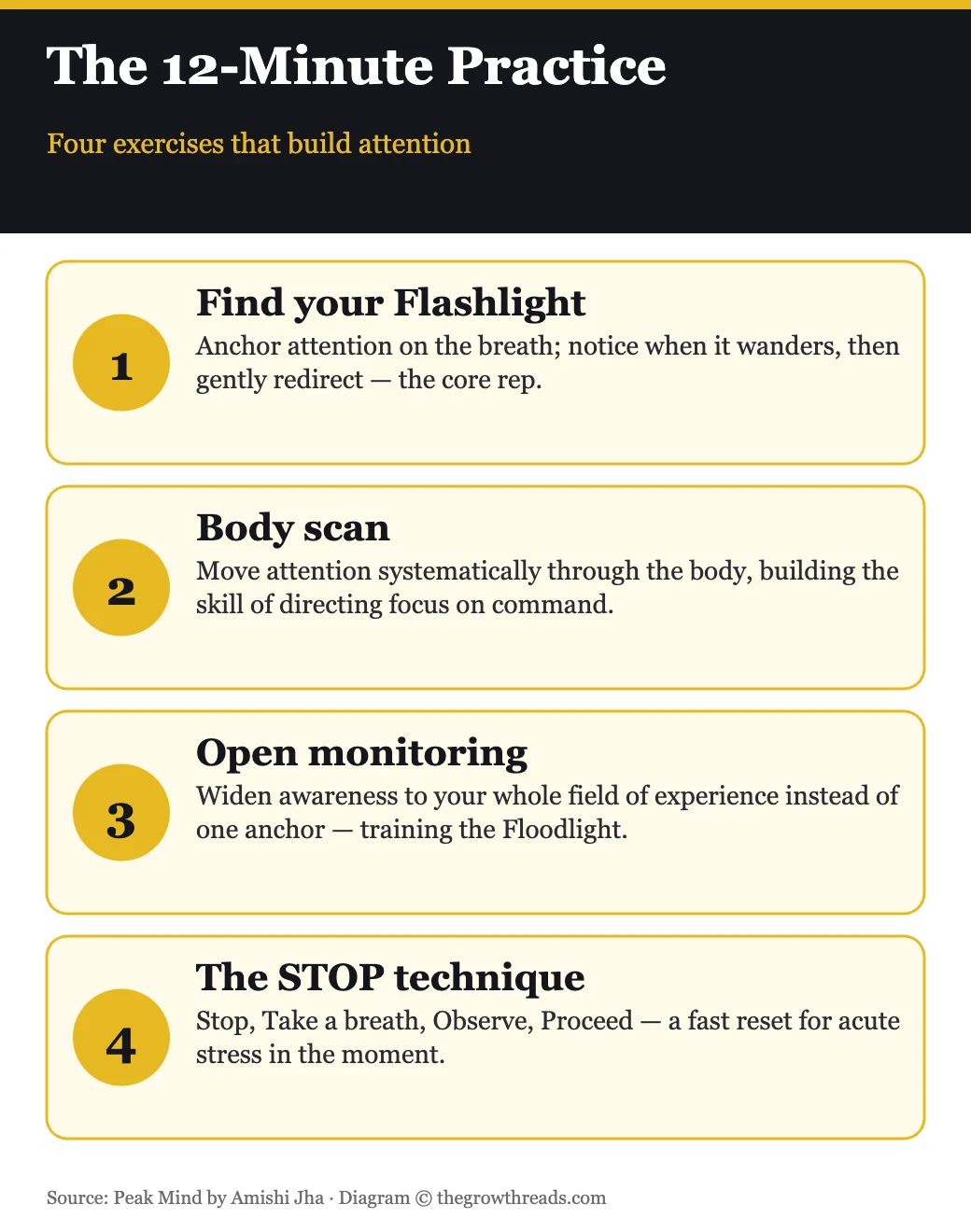
What distinguishes this from a generic mindfulness routine is the specificity of the dosage: Jha’s lab arrived at the 12-minutes-a-day, five-days-a-week figure by analyzing which practice amounts predicted the strongest protective effects in earlier studies, then testing that threshold prospectively in new cohorts, including athletes and special operations forces, rather than proposing it as an intuitive round number. She’s equally specific about the timeline: her research found that benefits generally required at least four weeks of sustained practice, which sets realistic expectations rather than promising an overnight fix.
Jha also addresses a practical objection many readers raise before starting: that 12 minutes sounds achievable in the abstract but still competes with an already full schedule. Her response leans on the deployment research directly — Marines under some of the most demanding time pressure imaginable still found room for the practice when it was framed as training rather than an optional wellness extra, the same way physical conditioning is treated as non-negotiable preparation rather than something to fit in if time allows. The reframe she’s proposing is less about finding extra time than about treating attention training with the same seriousness typically reserved for physical fitness, given that her research shows a comparably measurable, comparably trainable return.
The book also addresses whether the effects generalize beyond a controlled lab or military setting, since real life offers less structure than a research protocol. Jha’s answer leans on the fact that the practices themselves require no special equipment or setting — a few minutes of breath-focus or body-scan practice fits into a commute, a lunch break, or the few minutes before a meeting, which is part of why the studies chose a 12-minute target rather than the 30- to 45-minute sessions common in some meditation traditions. The shorter dose was deliberately tested for feasibility in busy, high-demand lives, not just for its effect size in a lab.
Who is Peak Mind best for — and who should read something else first?
This book is best for readers who want the actual research behind mindfulness and attention claims rather than a general wellness pitch, and who are willing to commit to a short daily practice for at least a month before expecting results. Some of the neuroscience passages are dense enough that casual readers may find themselves skimming toward the exercises — a fair trade for the credibility the research grounding provides, but worth knowing going in if you prefer a lighter read.
It’s also worth being upfront about what this book doesn’t try to do: it isn’t positioned as a spiritual or philosophical text about mindfulness, and readers looking for that framing may find it more clinical than they expected. What it offers instead is unusually well-evidenced for the genre — most popular attention and focus books cite other people’s research secondhand, while Jha is reporting on studies her own lab designed and ran, which gives the claims a level of directness that’s rare in mainstream productivity and wellness writing.
That directness cuts both ways, worth saying plainly: it means the book’s claims are unusually well-supported for the genre, but it also means Jha is careful not to overstate what the research shows, which readers used to more sweeping self-help promises may notice as a more measured, occasionally hedged tone. That restraint is itself informative — a researcher describing her own findings tends to stay closer to what the data actually supports than a popular author summarizing someone else’s work secondhand, and the book reads accordingly.
If you want more on the specific rhythm of attention across a workday rather than a formal training regimen, Attention Span covers related ground with a different research base. If sustained willpower and follow-through are your bigger obstacle than attention itself, Finish What You Start offers more tactical, non-mindfulness-based systems. And if you’re drawn to this book’s underlying case against overwork and constant stimulation, How to Do Nothing makes a related argument from a more philosophical angle.
Questions to reflect on
- How often does your attention get hijacked by threat, novelty, or reward in a typical day — and can you name a specific recent example?
- Which of the three subsystems (Flashlight, Floodlight, Juggler) do you rely on most, and which feels weakest?
- Could you commit to 12 minutes a day of attention practice for four weeks before judging whether it works for you?
- When your mind wanders, do you tend to notice and redirect it, or does it take you somewhere before you catch it?
- What’s one moment this week when the STOP technique (Stop, Take a breath, Observe, Proceed) could have helped you reset?
- If you tracked your own practice for four weeks the way Jha’s research subjects did, what would you expect to see change first — your focus, your stress response, or something else?
🔥 Ready to train your attention like a muscle?
Get Peak Mind and start the 12-minute practice backed by real research.
How to apply Peak Mind (7-day plan)
- Day 1 — Try the breath-focus anchor practice for 5-12 minutes: rest attention on the breath, and gently redirect each time it wanders.
- Day 2 — Notice three moments today when your attention got hijacked by threat, novelty, or reward.
- Day 3 — Practice a body scan, moving attention deliberately through the body from head to feet.
- Day 4 — Try an open-monitoring session: widen awareness to your whole field of experience instead of one anchor.
- Day 5 — Use the STOP technique at least once during a stressful moment: Stop, Take a breath, Observe, Proceed.
- Day 6 — Notice one moment of mind-wandering you catch and redirect, versus one you only notice after the fact.
- Day 7 — Reflect on which of the three subsystems (Flashlight, Floodlight, Juggler) felt strongest this week, and plan to keep practicing daily.
Frequently asked questions
What is the main argument of Peak Mind by Amishi Jha?
Jha argues that attention is a limited but trainable resource, constantly hijacked by threat, novelty, and reward, and that her own peer-reviewed research shows just 12 minutes of daily mindfulness-based attention training measurably protects focus and working memory, even during genuinely high-stress periods like military deployment. The book grounds this in her lab’s studies rather than general mindfulness philosophy.
What are the three subsystems of attention in this book?
Jha describes attention as made up of the Flashlight (narrow, focused attention on one thing), the Floodlight (broad, open awareness scanning for the unexpected), and the Juggler (working memory that holds your goals and manages competing priorities). A fourth force, which she calls the Boss, automatically redirects the Flashlight toward threat, novelty, and reward.
Where does the “12 minutes a day” claim come from?
It’s not an arbitrary number — Jha’s lab arrived at it by analyzing practice-log data from earlier studies to find the amount of daily practice associated with the strongest protective effects, then testing that threshold prospectively with new groups, including athletes and special operations forces. Her research also found that benefits generally require at least four weeks of consistent practice.
What research does the book cite about military populations?
Jha’s lab studied U.S. Marines before and after deployment, finding that those who sustained consistent mindfulness practice held their attention and working-memory performance steady across the high-stress deployment cycle, while those with low practice showed measurable decline. Some Marines who increased practice mid-deployment saw their performance rebound, suggesting a dose-response protective effect.
Is mind-wandering always bad?
No — Jha is explicit that some undirected mental drift supports creativity and problem-solving. The real cost, in her framing, is involuntary, unnoticed wandering that happens without your awareness, which is the difference between choosing to daydream and simply losing track of your own experience without realizing it.
Is this book too science-heavy for casual readers?
Some of the neuroscience explanations are dense enough that casual readers may find themselves skimming toward the practical exercises, which is a fair trade-off some reviewers note for the credibility the research grounding provides. If you want the science explained rigorously, that density is a strength; if you just want the exercises, you can move directly to Part 4.
What should I read after Peak Mind?
For more on the rhythm of attention across a workday, Attention Span covers related ground with a different research base. If follow-through rather than attention itself is your bigger obstacle, Finish What You Start offers more tactical, non-mindfulness-based systems.
Related summaries
Continue training your focus with Attention Span, How to Do Nothing, Finish What You Start, and Laziness Does Not Exist, or browse the full productivity books collection.
How we analyze books: Every summary on The Growth Reads is built from a full read of the source material, cross-checked against the author’s interviews and published research where available, and structured around practical application rather than just recap. We focus on what you can actually do differently after reading. Read our full methodology.
Related Time Management Summaries
How to Manage Your Home Without Losing Your Mind Summary & Review: Small Habits for “Naturally Messy” People
I Know How She Does It Summary & Review: What 1,001 Time Logs Reveal About “Having It All”
Meditations for Mortals Summary & Review: Why Your Limitations Are the Point
The Distracted Mind Summary & Review: Why Your Brain Fights Focus
Time Off Summary & Review: Build Your Rest Ethic