

⭐⭐⭐⭐⭐ 4.5/5 — A social psychologist’s case that “laziness” is almost always a rational response to unmet needs, not a character flaw.
Best for: Readers who feel guilty for resting, chronically burned out, or who’ve internalized that their worth depends on how much they produce.
Reading time: ~6 hrs to read the book (guide: 13 min)
Difficulty to apply: Moderate — the ideas are more mindset shift and permission-giving than a tactical system, so lasting change takes deliberate practice.
Laziness Does Not Exist in one minute
What looks like laziness — procrastination, exhaustion, an inability to keep up — is almost never a character flaw; it’s a rational response to unmet needs, burnout, or unfair systemic conditions. Devon Price, a social psychologist, calls the belief that productivity equals worth “the Laziness Lie” and traces it back to the Puritan work ethic, later weaponized to justify slavery and industrial-era labor discipline, and still shaping how modern workplaces (and people’s inner voices) treat rest as something that has to be earned. The book’s central move is diagnostic: before assuming someone (including yourself) is lazy, look for the invisible barrier — illness, trauma, caregiving, overwork, unmet needs — that a label of “lazy” is covering up.
Key takeaways
- Laziness as a character trait doesn’t exist: what looks like laziness is almost always explained by situational and contextual factors, not personal deficiency.
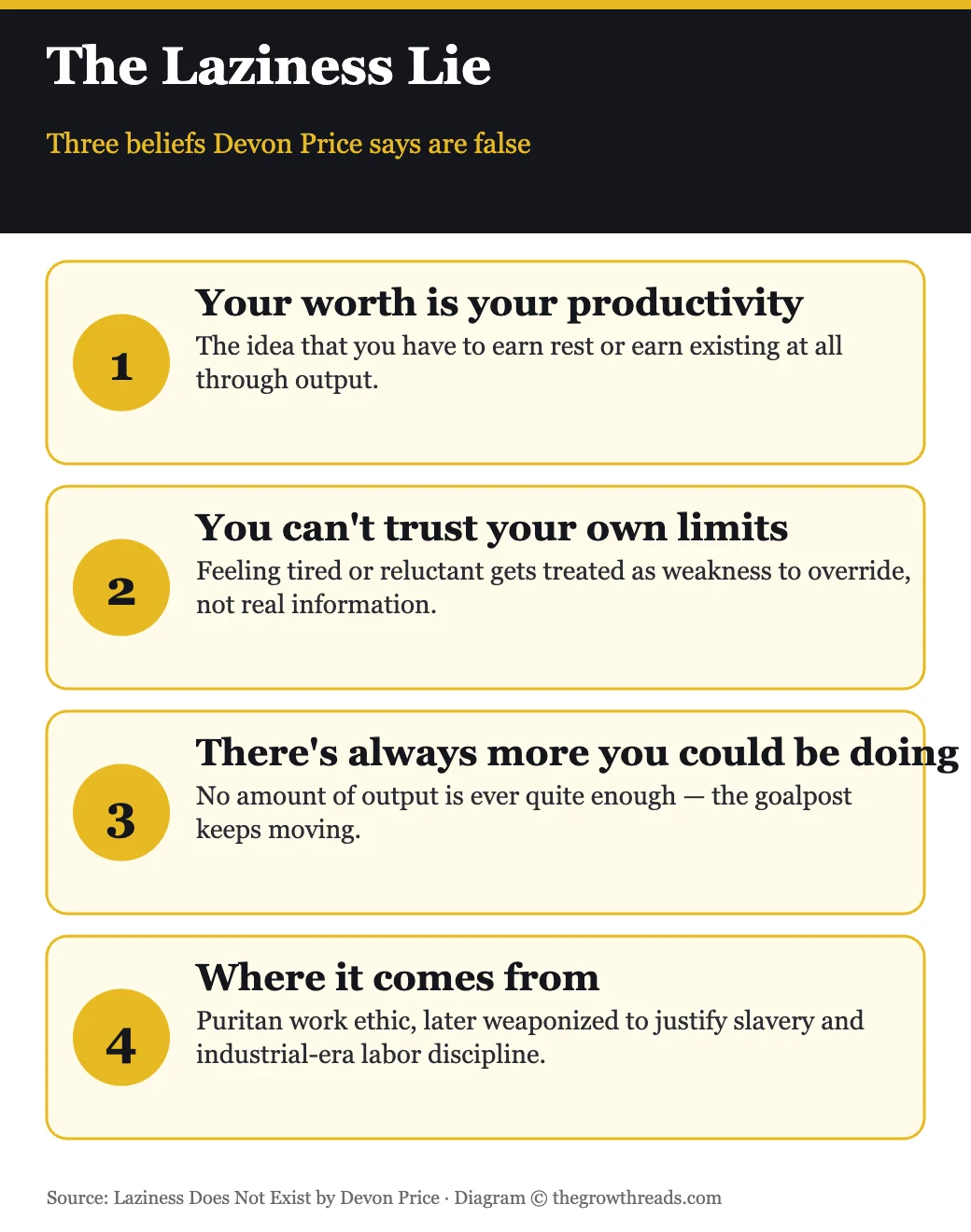
- The Laziness Lie has three tenets: your worth equals your productivity, you can’t trust your own feelings and limits, and there’s always more you could be doing.
- The Lie has a specific history: it traces to the Puritan work ethic, later used to justify slavery and industrial-capitalist labor discipline — it’s not a neutral, timeless truth.
- Feeling “lazy” is a warning signal, not a diagnosis: Price calls it a canary in a coal mine — a sign of misalignment between your values and your life’s demands, worth investigating rather than overriding.
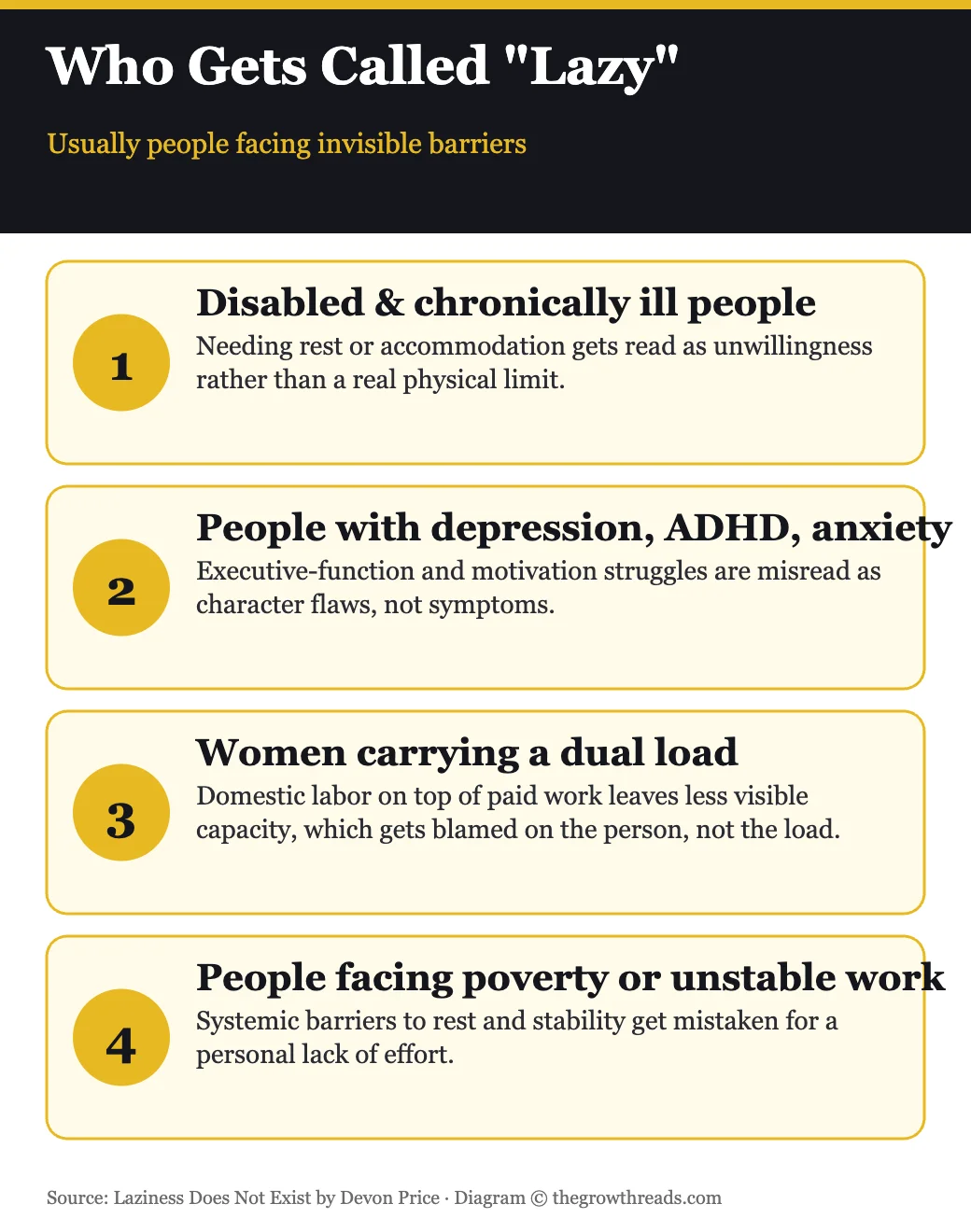
- Marginalized groups are disproportionately labeled lazy: disabled and chronically ill people, people with depression/ADHD/anxiety, women carrying a dual domestic-and-professional load, and people facing poverty all get blamed individually for what are often systemic barriers.
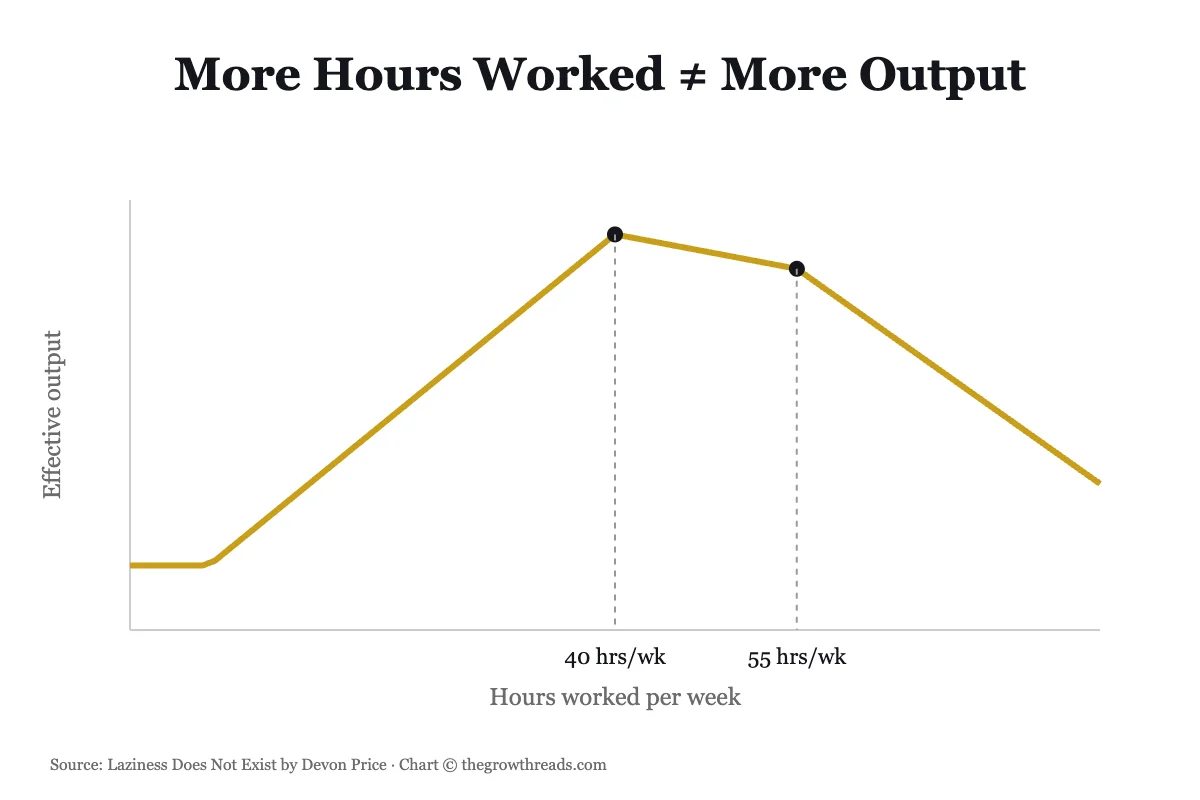
- More hours worked doesn’t mean more output: genuinely focused work tops out around three hours a day, and productivity drops sharply past 40 hours a week and further past 55.
- Overwork culture damages relationships and self-image: the compulsion to always be doing more crowds out rest, family time, and a stable sense of self-worth.
- The fix is usually reducing, not optimizing: when you feel unproductive, the answer is rarely a better system for doing more — it’s often fewer commitments.
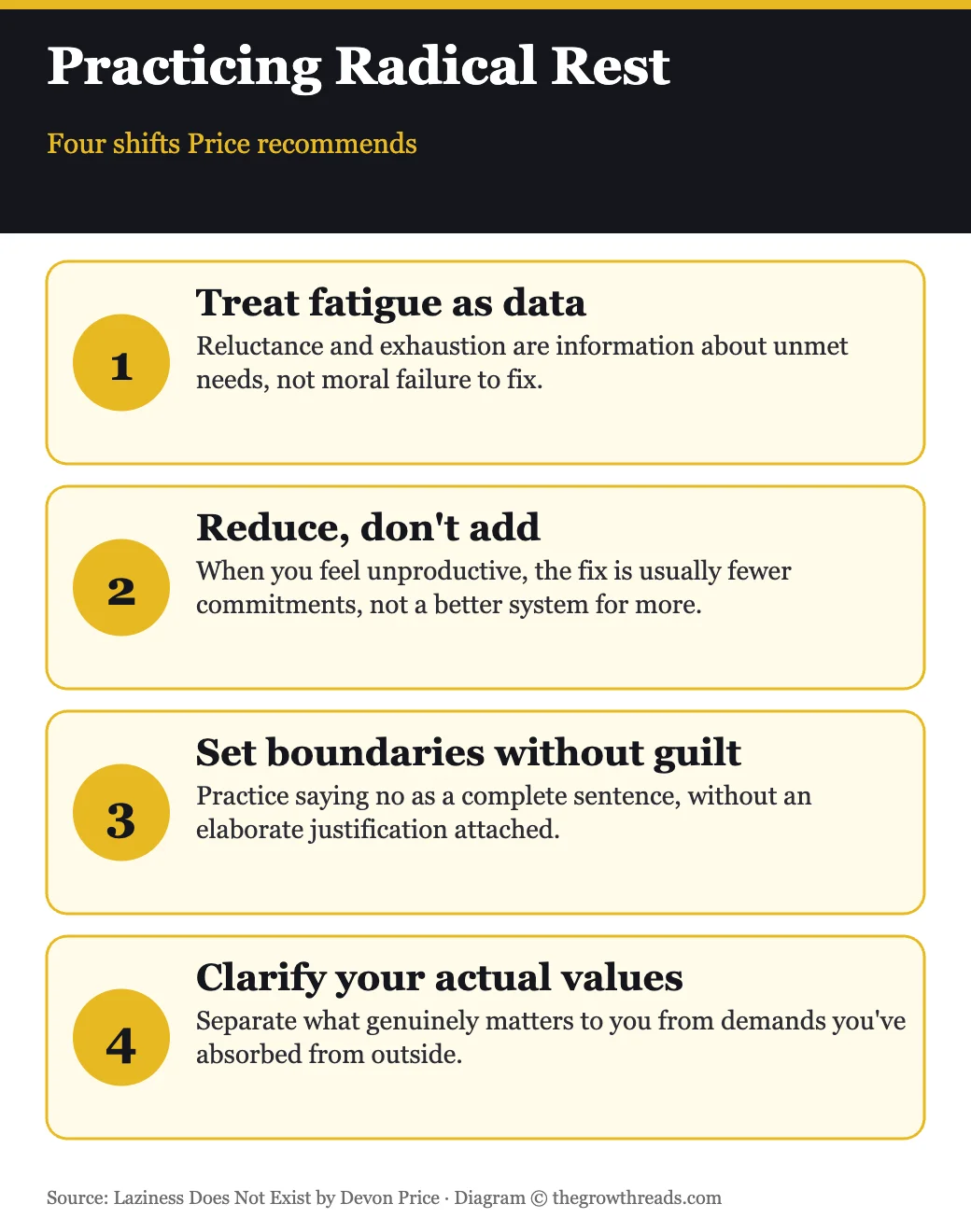
- Radical rest is a practice, not an indulgence: deliberately scheduling rest, setting boundaries without guilt, and treating fatigue as legitimate data are skills that take practice to rebuild.
- The book is a mindset shift more than a tactical system: it’s stronger on reframing and permission-giving than on step-by-step productivity tactics.
- The diagnostic question travels beyond work: “what situational factors are holding this person back” applies just as well to parenting, friendship, and household life as it does to a job.

What is Laziness Does Not Exist about?
Laziness Does Not Exist argues that what looks like laziness is almost always a rational response to burnout, unmet needs, or unfair systemic conditions rather than a character flaw, and offers a path toward treating rest as legitimate rather than something that has to be earned through output.
About the author
Devon Price, Ph.D., is a social psychologist and associate professor at Loyola University Chicago, whose academic and popular writing focuses on how workplace and social norms around productivity, disability, and mental health intersect. Price’s 2018 essay “Laziness Does Not Exist,” published on Human Parts/Medium, went viral and became the seed for this 2021 book (Atria Books), which expands the essay’s central argument with research on burnout, historical context on the origins of the work ethic, and interviews with people across a range of professions and circumstances. Explore all Devon Price book summaries →
The book quickly became a bestseller and a widely discussed touchstone in conversations about burnout, workplace culture, and disability accommodation, well beyond the productivity and self-help audience it was initially aimed at.
Price’s academic background in social psychology shows in the book’s consistent move to locate behavior in context and environment rather than in fixed personal character — the same lens used throughout to argue that a person who seems to be underperforming is usually responding rationally to real constraints, not failing morally. That framing extends to Price’s own experience; the book draws on personal reflection alongside interview subjects and published research rather than presenting itself as a purely academic text.
Key concepts at a glance
| Concept | What it means | Use it when |
|---|---|---|
| The Laziness Lie | The false belief that productivity determines your worth as a person | You feel guilty for resting or not “earning” your downtime |
| Canary in a coal mine | Feeling lazy as a warning signal of misalignment, not a character diagnosis | You keep feeling unmotivated and want to investigate why instead of pushing through |
| Radical rest | Deliberately scheduled rest treated as necessary, not indulgent | You only rest after collapsing from exhaustion, never proactively |
| Overwork/work-life interference | Work encroaching on relationships, family time, and self-image | Your job is consistently crowding out everything else in your life |
| Situational factors | Real, often invisible barriers (illness, caregiving, unmet needs) behind apparent underperformance | You’re tempted to judge someone (including yourself) as lazy |
| Boundary-setting | Saying no without an elaborate justification attached | You habitually over-explain or over-apologize for protecting your own time |
Part 1: The Laziness Lie and where it came from
Price opens by naming the belief system directly: the Laziness Lie rests on three tenets — your worth is your productivity, you can’t trust your own feelings and limits, and there’s always more you could be doing. None of these, Price argues, hold up under scrutiny, but they’re deeply embedded enough that most readers will recognize at least one operating in their own inner voice. The historical chapter that follows traces this belief back further than most readers expect: to the Puritan work ethic, which framed hard labor as a sign of moral virtue and idleness as a sign of spiritual failing, an ideology later put to devastating use justifying slavery and, afterward, shaping the labor discipline of industrial capitalism.
Price traces how this ideology adapted rather than disappeared as economies changed: the same underlying logic that framed idleness as moral failing under Puritan theology resurfaced in industrial-era factory discipline, where clocking in and out, standardized shifts, and productivity quotas turned time itself into something owed to an employer rather than something a person owned. What makes this history useful rather than just academic, Price argues, is that recognizing the Laziness Lie as a specific, traceable ideology — rather than a neutral fact about human nature — makes it easier to question rather than simply absorb as an unquestionable truth about how people should relate to work and rest.
TGR Note: This historical grounding pairs well with the attention economy critique in How to Do Nothing — both books insist that the pressure to always be visibly productive isn’t a natural law, but a specific ideology with a traceable history and interested parties behind it.
Part 2: Who gets called lazy — and who doesn’t
This section is where the book’s diagnostic lens does its most concrete work. Price walks through groups disproportionately labeled lazy: disabled and chronically ill people, whose need for rest or accommodation gets read as unwillingness rather than a genuine physical limit; people with depression, ADHD, or anxiety, whose executive-function and motivation struggles are misread as character flaws rather than symptoms; women carrying a dual domestic-and-professional load, whose reduced visible capacity gets blamed on them individually rather than on the uncompensated labor underneath it; and people facing poverty or unstable work, whose systemic barriers to rest and stability get mistaken for a personal lack of effort.
Price is candid that this treatment stays relatively brief rather than exhaustive — the book gestures toward the intersections of disability, race, and class rather than offering a sustained deep-dive into any one of them, which is a fair limitation to flag for readers hoping for a more thorough intersectional analysis. Readers coming from disability justice, labor organizing, or critical race scholarship may find the treatment here an accessible entry point rather than a deep dive, and may want to follow up with more specialized work in those areas for a fuller picture. What the section does accomplish is reframing the diagnostic question itself: instead of asking “why is this person lazy,” Price consistently asks “what situational factors are holding this person back, and what needs are going unmet.”
This reframing has a practical implication Price returns to throughout: because the barriers behind apparent laziness are often invisible — an undiagnosed illness, an unmanageable caregiving load, a mental health condition someone hasn’t disclosed — judging from the outside is inherently unreliable. Price argues this cuts both ways: it should make readers slower to label others as lazy, but it should also make readers more willing to extend the same benefit of the doubt to themselves, rather than assuming their own struggles must be a personal failing simply because the underlying cause isn’t immediately visible or easy to name.
Part 3: The cost of overwork
Price backs up the case against constant productivity with research on diminishing returns: genuinely focused, high-quality work tops out at around three hours a day for most people, and total output drops sharply once someone works past 40 hours a week, becoming negligible past 55. The chapter draws on burnout scholarship, notably Christina Maslach’s research, to describe how chronic overwork doesn’t just fail to produce proportionally more output — it actively damages the relationships, family time, and stable self-image that make sustained work possible in the first place.
Price connects this to a specific mechanism worth naming: burnout doesn’t arrive as a single dramatic collapse for most people, but as a gradual erosion of capacity that’s easy to misread as declining discipline rather than a predictable physiological response to sustained overload. Someone who used to finish tasks easily and now struggles with the same workload hasn’t necessarily become lazier — a distinction that matters enormously for how that person, or their manager, responds — Maslach’s research on burnout describes exactly this kind of capacity decline as a normal, well-documented response to chronic stress, not a personal failing that shows up out of nowhere.
TGR Note: This diminishing-returns argument echoes the “load vs. power” framing in Margin — both books make the case that reserve capacity, not maximum output, is what actually sustains performance over time.
Price illustrates the point with interview subjects across a range of circumstances — a college student with depression who needed daily naps to function and called himself lazy for it, a person unable to say no to constant parental demands who used work itself as an excuse to avoid emotional dread, and high-achieving novelists, artists, and activists who felt like failures despite major accomplishments. The common thread across all of them is that the feeling of “not doing enough” persisted regardless of actual output, which Price uses to argue that the feeling itself is the real problem to address, not the level of productivity underneath it.
Price is careful to note that this pattern isn’t limited to people who are objectively underperforming by any measure, which is itself a striking finding worth sitting with — several of the interview subjects were, by conventional standards, highly successful, which is part of the point. If external achievement doesn’t reliably resolve the internal sense of not doing enough, then the problem was never a productivity gap to close in the first place; it was the belief system itself, still operating regardless of how much evidence accumulates against it. That distinction matters practically because it redirects the intervention: rather than chasing more accomplishment in hopes the feeling will finally go away, Price argues the actual work is dismantling the belief that accomplishment was ever supposed to earn you the right to rest.
Part 4: Practicing radical rest
The closing chapters turn from diagnosis to practice, framed less as a tactical system than as a set of permissions and habits to rebuild. Price recommends treating fatigue, dread, and reluctance as legitimate data rather than something to override; reducing commitments rather than adding new productivity systems when you feel behind; scheduling deliberate rest as a non-negotiable rather than something you earn after collapsing from exhaustion; and setting boundaries by practicing “no” as a complete sentence, without the lengthy justification many readers habitually attach to it.
Price also recommends a values-clarification exercise — separating what genuinely matters to you from demands you’ve absorbed from family, work culture, or social media — as a way of redirecting freed-up time and energy toward things that actually feel worthwhile, rather than simply replacing one form of busyness with another. This section is more mindset-shift than checklist, and Price is explicit that lasting change here is a practice, not a one-time fix.
Price also addresses a common objection directly: that all this sounds nice in theory but impractical for anyone with real deadlines and real obligations. The response isn’t that boundaries and rest are costless — it’s that the current default, treating overwork as sustainable indefinitely, has its own hidden costs that tend to surface eventually as burnout, health problems, or damaged relationships, just on a longer delay that makes the connection to overwork harder to see. Reframed that way, radical rest isn’t presented as an alternative to taking obligations seriously, but as a more honest accounting of what those obligations actually cost when pursued without any limit.
Who is Laziness Does Not Exist best for — and who should read something else first?
This book is best for readers who feel chronic guilt about resting, who’ve been personally or professionally labeled lazy despite facing real barriers, or who recognize the Laziness Lie’s three tenets operating in their own inner voice. It’s worth naming a fair critique some readers raise: the advice to set boundaries or reduce commitments assumes some baseline flexibility — a salaried job, a manageable financial cushion, a boss open to negotiation — that not every reader has in equal measure, particularly hourly, gig, or blue-collar workers with less control over their schedules.
That said, even readers without much control over their formal schedule can apply the book’s diagnostic reframe internally — separating the external reality of a demanding job from the internal, often harsher story about what that demand says about their worth as a person. Price’s argument is at its most universal on that internal level: the belief that you have to justify rest, or that your value is measured by output, operates on people across very different material circumstances, even if the practical room to act on boundary-setting varies considerably by job and financial situation.
If you want a more historically and philosophically framed critique of productivity culture rather than a psychology-focused one, How to Do Nothing is a strong pairing. If your main challenge is reserve capacity and sustainable pacing more broadly, not specifically the guilt around rest, Margin covers that ground directly. And if you’re looking for more concrete, step-by-step tactics rather than a mindset reframe, this book pairs well as a permission-giving companion to something more systematic like Finish What You Start.
Questions to reflect on
- Which of the Laziness Lie’s three tenets shows up most often in your own inner voice?
- Is there a situation right now where you’ve labeled yourself (or someone else) “lazy” without asking what real barrier might be behind it?
- What would it look like to reduce a commitment this week instead of trying to optimize your way through it?
- Do you rest proactively, or only after you’ve already collapsed from exhaustion?
- What’s one demand in your life that came from outside you, rather than from something you actually value?
- If a close friend described their own week the way you’d describe yours, would you call them lazy — or would you see the real barriers you might be missing in your own case?
🔥 Ready to stop earning your rest?
Get Laziness Does Not Exist and start treating rest as legitimate, not indulgent.
How to apply Laziness Does Not Exist (7-day plan)
- Day 1 — Notice one moment you call yourself (or someone else) “lazy,” and ask what real barrier might be underneath it.
- Day 2 — Identify which of the three tenets of the Laziness Lie you catch yourself believing most.
- Day 3 — Schedule one block of deliberate rest this week, before you’re exhausted, not after.
- Day 4 — Practice saying no to one request without an attached justification.
- Day 5 — Pick one commitment to reduce rather than trying to optimize your way through it.
- Day 6 — Do a short values-clarification exercise: list what actually matters to you versus what you feel obligated to do.
- Day 7 — Reflect on how it felt to treat fatigue as legitimate information this week instead of something to push through.
Frequently asked questions
What does Devon Price mean by “the Laziness Lie”?
The Laziness Lie is Price’s term for the false belief system that your worth equals your productivity, that you can’t trust your own feelings and limits, and that there’s always more you could be doing. Price argues this belief traces back to the Puritan work ethic, later weaponized to justify slavery and industrial-era labor discipline, and still shapes how modern workplaces and people’s inner voices treat rest as something that has to be earned.
Does the book argue that laziness literally never happens?
Price’s argument is that laziness as a fixed character trait doesn’t exist — what looks like laziness is almost always explained by situational factors like illness, unmet needs, burnout, or systemic barriers, not personal deficiency. The book asks readers to look for the invisible barrier behind apparent underperformance rather than assuming a moral failing, in themselves or in others.
What is “radical rest” in this book?
Radical rest is Price’s term for treating rest as a deliberate, scheduled necessity rather than something you earn after collapsing from exhaustion or something indulgent to feel guilty about. It includes practices like treating fatigue as legitimate data, reducing commitments instead of optimizing around them, and setting boundaries without an attached justification.
Does more hours worked actually mean more output?
No — Price cites research showing that genuinely focused, high-quality work tops out around three hours a day for most people, and that total output drops sharply once someone works past 40 hours a week and becomes negligible past 55. The book uses this to argue against overwork culture on its own productivity terms, not just as a wellbeing concern.
Is this book realistic for readers without flexible jobs?
This is a fair limitation reviewers commonly raise — the advice to set boundaries or reduce commitments assumes some baseline flexibility, like a salaried role or financial cushion, that hourly, gig, or blue-collar workers may not have in equal measure. The underlying reframe about situational factors versus character still applies broadly, but the specific practical suggestions translate more easily for readers with more control over their schedules.
Is this book more mindset or more tactical?
More mindset. Price frames the book as a reframing and permission-giving project rather than a step-by-step productivity system, and some readers who wanted more concrete tactics have noted this. Readers looking for a more systematic approach may want to pair it with a more tactics-focused book once the underlying guilt and mindset shift are addressed.
What should I read after Laziness Does Not Exist?
For a more historically and philosophically framed critique of productivity culture, How to Do Nothing is a strong pairing. For sustainable pacing and reserve capacity more broadly, Margin covers related ground with a more systematic framework.
Related summaries
Continue exploring sustainable productivity with How to Do Nothing, Margin, Meditations for Mortals, and Finish What You Start, or browse the full productivity books collection.
How we analyze books: Every summary on The Growth Reads is built from a full read of the source material, cross-checked against the author’s interviews and published research where available, and structured around practical application rather than just recap. We focus on what you can actually do differently after reading. Read our full methodology.
Related Time Management Summaries
Extreme Productivity Summary & Review: Judge Output, Not Hours
It Doesn’t Have to Be Crazy at Work Summary & Review: Build the Calm Company
Margin Summary & Review: Restoring the Reserves Overload Has Stolen
Meditations for Mortals Summary & Review: Why Your Limitations Are the Point
The Miracle Equation Summary & Review: Two Decisions That Make Goals Inevitable