

⭐⭐⭐⭐½ 4.6/5 — A sharp, readable tour through the brain chemistry behind wanting, loving, and chasing “more.”
Best for: Anyone who keeps hitting goals and still feels restless, plus couples curious about why passion changes shape over time.
Reading time: ~4.5 hrs to read · ~35 min to read this guide
Difficulty to apply: Easy — the ideas reframe how you interpret your own cravings and moods almost immediately.
The Molecule of More in one minute
One brain chemical explains why almost nothing feels like “enough” for long. Dopamine isn’t the chemical of pleasure — it’s the chemical of pursuit. It fires when you anticipate a reward, not when you finally have it, which is why new jobs, relationships, and purchases feel thrilling for a while and then quietly stop registering. Psychiatrist Daniel Z. Lieberman and writer Michael E. Long argue that a second family of chemicals — serotonin, oxytocin, endorphins, and the endocannabinoids, which they group together as “H&N” (here-and-now) chemicals — governs the opposite experience: enjoying what’s actually in front of you. Desire and enjoyment run on separate circuitry, which is why getting what you want doesn’t always feel like winning. Understanding the difference explains restlessness, addiction, the fading of romantic passion, the link between creativity and mental instability, and why ambition rarely feels satisfied — and it points toward a workable way to feel more content without giving up drive.
Key takeaways
- Dopamine is about wanting, not liking. It spikes at the possibility of reward and fades once you actually have it — which is why anticipation often outshines the real thing.
- H&N chemicals run the opposite system. Serotonin, oxytocin, endorphins, and endocannabinoids reward you for enjoying what already exists, right now, in your body and surroundings.
- Dopamine only cares about the future. It has no interest in the present moment — it is entirely built around prediction, possibility, and “what’s next.”
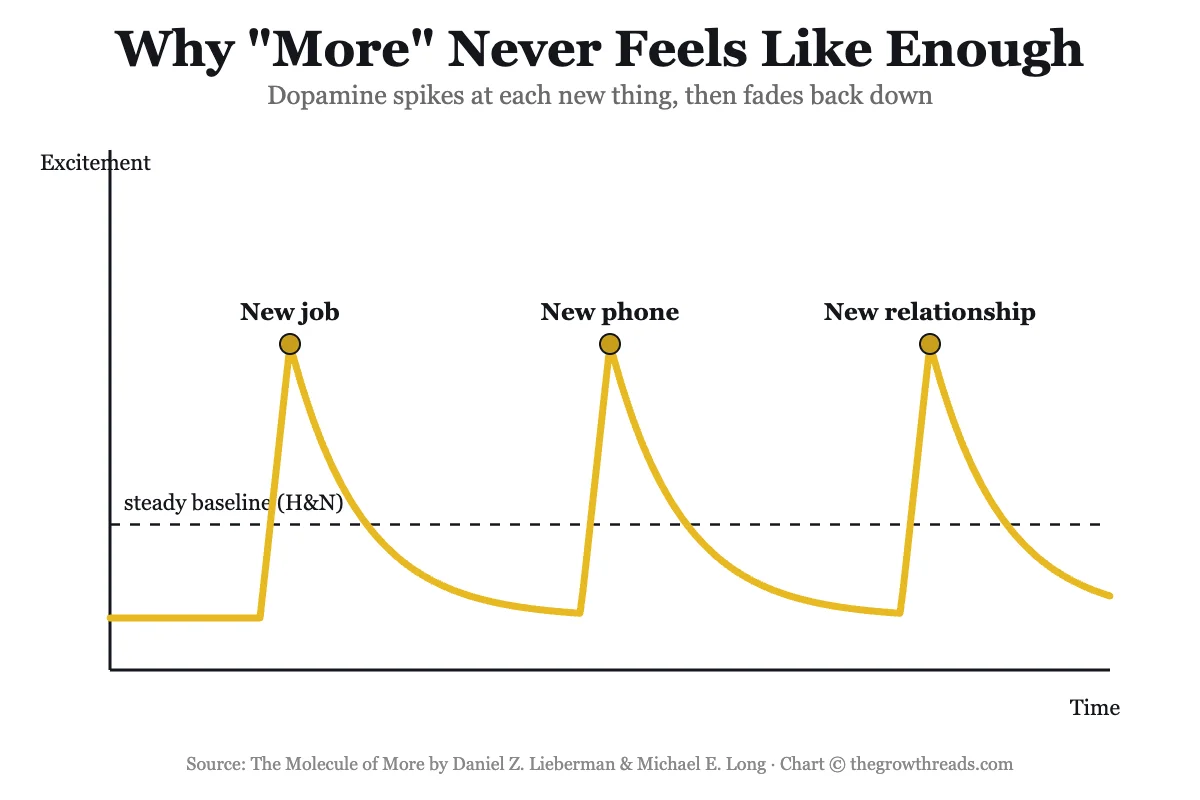
- Tolerance is built in. The same stimulus produces less dopamine every time you experience it, which is why novelty — not accumulation — is what keeps the thrill alive.
- Addiction is dopamine hijacked. Drugs, gambling, and compulsive scrolling all exploit the same circuit that once rewarded finding food or a mate.
- Passionate love runs on dopamine — and it fades. The obsessive, can’t-stop-thinking-about-them phase typically softens within one to three years as the brain habituates.
- Companionate love runs on H&N chemicals. Oxytocin-driven attachment can replace the dopamine rush with something calmer and more durable — if a couple lets it.
- Dopamine also powers abstract thought. A separate “dopaminergic control” pathway rewards ideas, plans, and reasoning — the same circuitry behind self-control and long-term thinking.
- Heightened dopamine sensitivity is linked to both creativity and mental illness. The same trait that fuels unconventional thinking appears more often alongside mood and psychotic disorders.
- Balance, not suppression, is the goal. The aim isn’t to kill ambition — it’s to pair the dopamine drive for more with enough H&N presence to actually enjoy what you build.
What is The Molecule of More about?
The Molecule of More explains how dopamine, the brain’s chemical of desire and anticipation, drives craving, ambition, and addiction — while a separate group of “here-and-now” chemicals governs the enjoyment of what you already have, and understanding both explains why satisfaction is so hard to hold onto.
About the author
Daniel Z. Lieberman, MD, is a clinical professor of psychiatry and behavioral sciences at George Washington University and a Distinguished Fellow of the American Psychiatric Association. He has published more than 50 scientific reports on behavioral science and has advised U.S. federal agencies on psychiatric and drug policy issues, in addition to discussing mental health on CNN, C-SPAN, and PBS. Michael E. Long is an award-winning speechwriter, screenwriter, and playwright who has written for members of Congress, cabinet secretaries, and business leaders, and who teaches writing at Georgetown University. Their pairing of clinical neuroscience with narrative storytelling is what makes a dense topic — neurotransmitter biology — read like a page-turner rather than a textbook. Explore all Daniel Z. Lieberman book summaries →
Key concepts at a glance
| Concept | What it means | Use it when |
|---|---|---|
| Dopamine (“the molecule of more”) | The neurotransmitter of desire, anticipation, and pursuit of future rewards | You want to understand why you crave things you don’t yet have |
| H&N chemicals | Serotonin, oxytocin, endorphins, and endocannabinoids — the chemicals of enjoying the present moment | You want to understand contentment, love, and physical pleasure |
| Wanting vs. liking | Two separate brain circuits — one drives pursuit, the other drives enjoyment of what you have | You’re deciding whether a goal will actually make you happier |
| Tolerance / habituation | Dopamine’s response to the same stimulus shrinks with repeated exposure | You notice an achievement or purchase stopped feeling exciting |
| Dopamine control circuit | A separate dopamine pathway that rewards ideas, planning, and abstract reasoning | You’re trying to build long-term discipline or delay gratification |
| Passionate vs. companionate love | Passionate love runs on dopamine and typically fades in 1–3 years; companionate love runs on H&N chemicals and can last | You’re navigating how a long relationship’s feelings change over time |
| Dopaminergic personality | Higher dopamine sensitivity linked to novelty-seeking, creativity, and elevated risk of mood or psychotic disorders | You’re curious about the “mad genius” connection |
| The progress paradox | Dopamine drives achievement and invention but never lets the achiever feel satisfied for long | You’ve hit a goal and still feel restless afterward |
Part 1: The Chemical of Desire
Lieberman and Long open by separating two experiences that most people treat as one: wanting something and liking something. Brain-imaging and lesion studies going back decades show that these run on different circuits. Dopamine fires hardest not when you receive a reward, but in the gap between expecting it and getting it — the moment of “maybe.” A rat that knows a lever delivers food shows its biggest dopamine spike when a light signals the food is coming, not when the food arrives. Humans show the same pattern with everything from lottery tickets to first dates to a phone notification.
This is why dopamine is described as future-oriented by nature. It has no mechanism for appreciating what is already true — only for calculating what might happen next. The authors walk through how this explains a huge range of ordinary experiences: the thrill of window-shopping outlasting the thrill of the purchase, the joy of planning a trip exceeding the joy of the trip itself for many travelers, and the strange emptiness that can follow even a major accomplishment. None of this is a flaw in your character. It’s the chemical doing exactly what it evolved to do — keep you scanning for the next opportunity instead of settling for what you already have.
The flip side of the system is what the authors label H&N chemicals: serotonin, oxytocin, endorphins, and the endocannabinoids. These reward you for being here, physically, in the present — the taste of food already in your mouth, the warmth of a hand you’re already holding, the relief of a task already finished. Crucially, the two systems can work against each other. A mind flooded with dopamine-driven planning has a harder time registering H&N signals, which is one reason ambitious, future-focused people often struggle to simply enjoy a moment of success once it arrives.
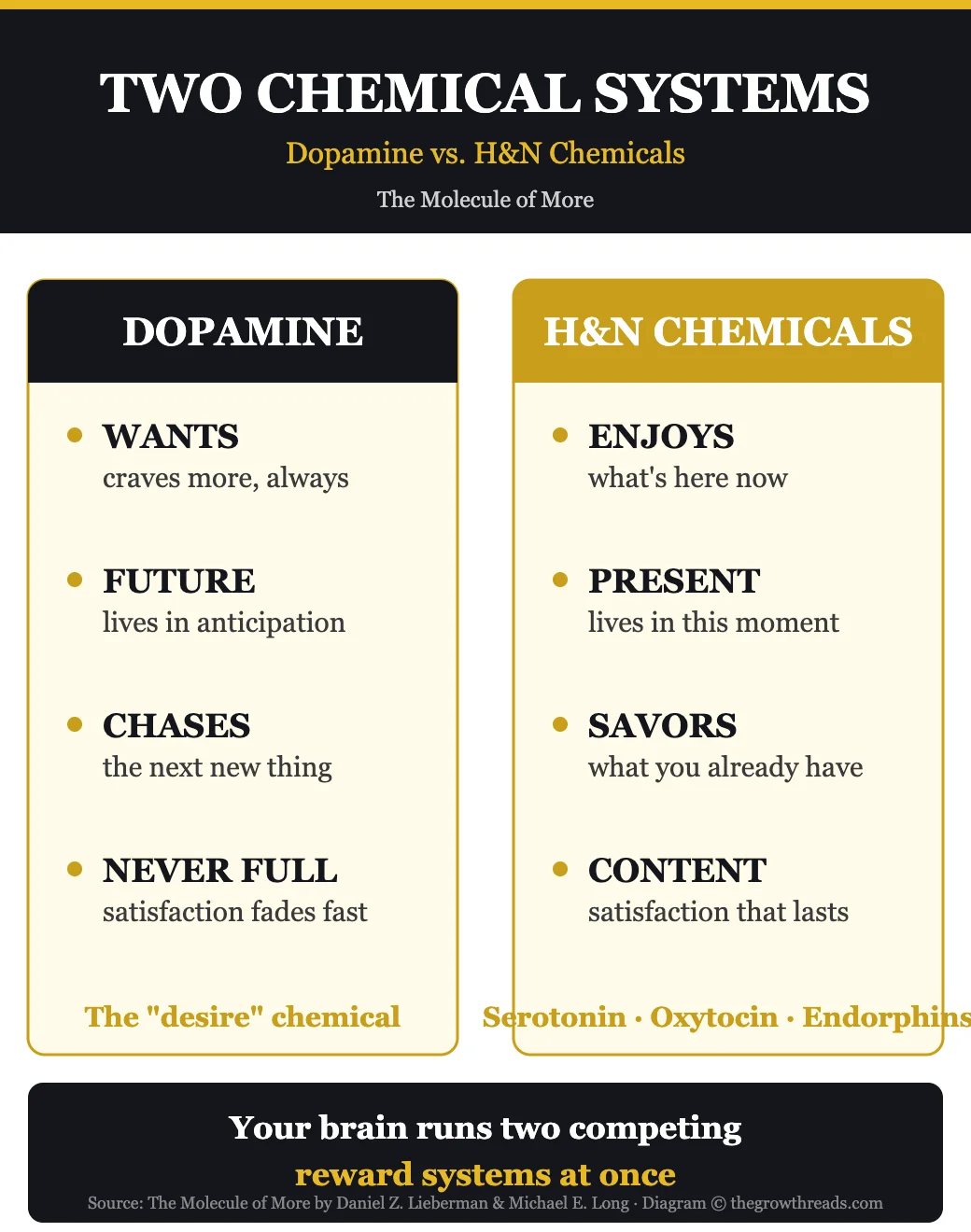
Lieberman and Long spend real time on why evolution would build two competing systems rather than one efficient one. Their answer is that a purely present-focused animal never explores, never stores food for winter, and never takes the risk of approaching a potential mate — while a purely future-focused animal never actually reproduces the biological payoff its behavior was chasing. Survival required both a scout and a settler living in the same brain, and dopamine and H&N chemicals are the biological embodiment of that division of labor.
Part 2: Tolerance, Addiction, and the Treadmill of More
The second part of the book turns to what happens when the desire circuit runs unchecked. Dopamine’s response to any given stimulus shrinks every time you experience it — a process called tolerance. The first bite of your favorite dessert lights up the circuit powerfully; the tenth bite of the same dessert barely registers. The same curve applies to raises, promotions, new relationships, and new possessions. This is not pessimism about human nature; it’s a testable feature of the neurotransmitter. It explains the “hedonic treadmill” that psychologists have documented for decades: people adapt to almost any positive change in circumstances and return, within months, to roughly their prior baseline of contentment.
Addiction, the authors argue, is this exact mechanism hijacked. Drugs of abuse artificially spike dopamine far beyond what any natural reward can produce, which both intensifies craving and accelerates tolerance — requiring more of the substance to produce the same effect, while making ordinary pleasures feel duller by comparison. The same logic extends, in a milder form, to behavioral patterns like compulsive phone checking, gambling, and binge-watching, all of which exploit the unpredictability that makes dopamine fire hardest.
Lieberman and Long are careful to note that dopamine sensitivity varies by individual and is shaped by both genetics and environment, which is part of why some people are more prone to addictive patterns than others. The practical implication for a general reader, though, is less about diagnosis and more about expectation-setting: if a purchase, achievement, or relationship stops feeling exciting after a while, that isn’t proof something is wrong with it. It’s dopamine doing its job.
Part 3: Love, Sex, and the Chemistry of Relationships
One of the book’s most memorable arguments is that romantic love has two distinct chemical phases, and mistaking the second for a failure of the first causes real damage. Passionate love — the phase of obsessive thinking, idealization, and can’t-eat-can’t-sleep infatuation — is driven almost entirely by dopamine. Studies cited in the book show this phase reliably intensifying and then softening over a window of roughly one to three years, regardless of the couple, as the brain habituates to a now-familiar partner the same way it habituates to any repeated stimulus.
What happens next determines a great deal. Some couples interpret the fading of the dopamine high as evidence the relationship has failed and move on to chase a new passionate-love spike with someone else — restarting the cycle rather than progressing through it. Others transition into what the authors call companionate love, built on H&N chemicals, especially oxytocin: a calmer, steadier attachment rooted in shared presence rather than novelty. It is, by the book’s account, less thrilling on a moment-to-moment basis and considerably more stable and satisfying over years.
The authors extend the same framework to sexual attraction and desire more broadly, noting that novelty itself is a dopamine trigger independent of who a partner is — which explains both the excitement of new relationships and why long-term desire benefits from deliberately introducing new shared experiences rather than relying on the relationship itself to stay novel.
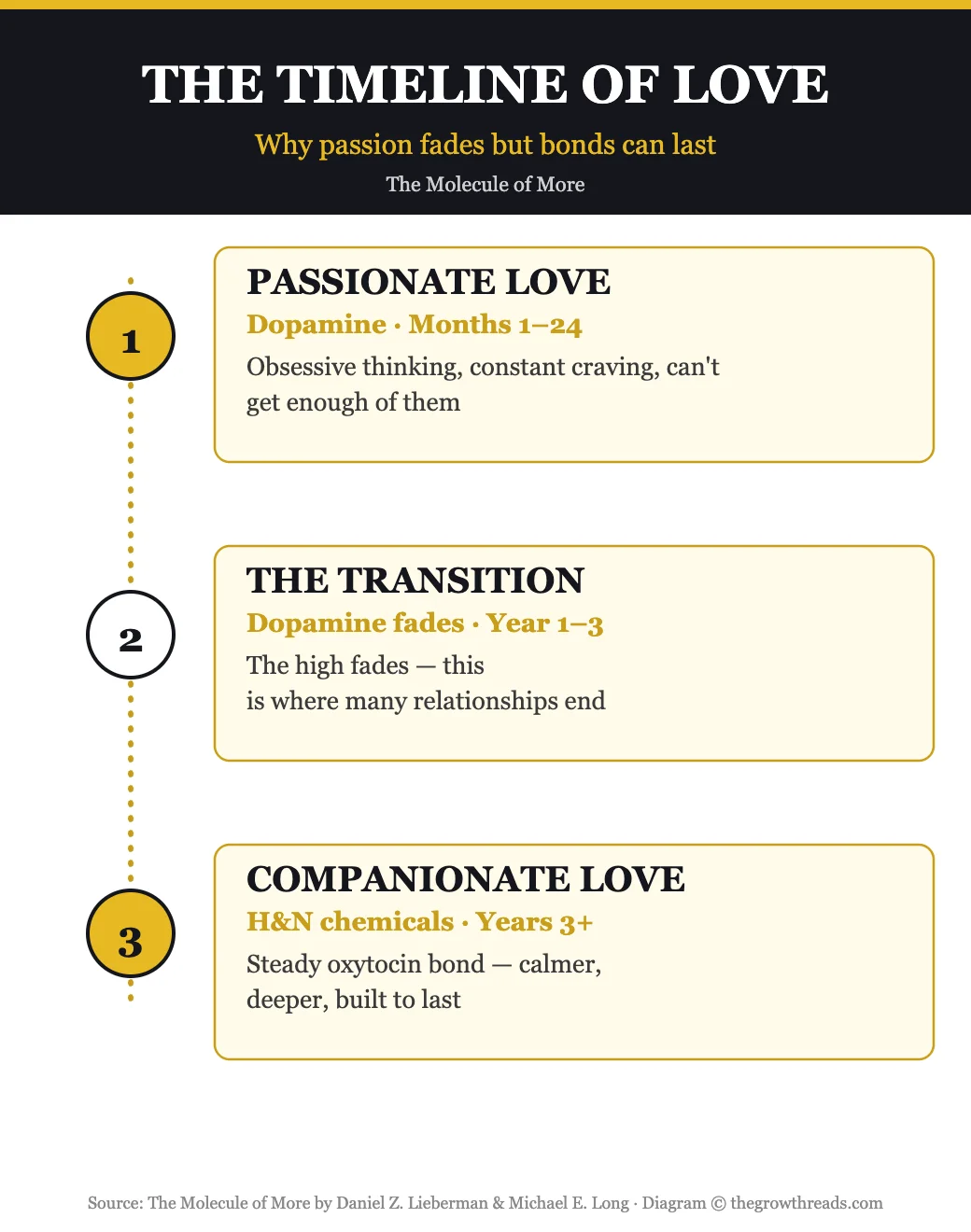
None of this means passionate love is a trick or companionate love is a consolation prize. The book is careful to frame the transition as neither a downgrade nor an inevitability — some relationships never make it past the dopamine phase, and some couples actively work to keep both systems engaged, layering H&N-building rituals like shared meals and physical affection on top of periodic dopamine-boosting novelty like travel or new shared goals. The point isn’t to pick a side; it’s to recognize which chemical is driving a given feeling so you don’t mistake a normal chemical shift for a relationship failing.
Part 4: Creativity, Madness, Politics, and Finding Balance
The final section widens the lens from individual behavior to personality and society. Lieberman and Long describe a “dopaminergic personality” — people whose baseline dopamine activity runs higher, making them more novelty-seeking, more future-oriented, and statistically more likely to show elevated creativity alongside elevated risk for mood disorders and psychosis-spectrum conditions. They walk through research linking dopamine sensitivity to divergent thinking and unconventional idea generation, while being careful to note this is a population-level pattern and correlation, not a guarantee for any individual.
The book’s more speculative chapter applies this same dopamine-versus-H&N framework to political orientation, associating dopamine-driven, future- and novelty-oriented thinking with progressive positions and H&N-driven, present- and tradition-oriented thinking with conservative positions. This is presented as a hypothesis drawn from personality research rather than settled science, and it’s the part of the book reviewers most often flag as provocative and underdetermined — worth reading with curiosity rather than as a verdict on either political tradition.
The authors close on a more actionable note: rather than treating dopamine as a problem to eliminate, they recommend cultivating what they call “dopamine control” — using the same future-oriented circuitry to plan and pursue meaningful long-term goals — while deliberately building H&N-rich habits (gratitude, physical touch, unhurried time with people you love) that let you actually feel the satisfaction your ambition earns.
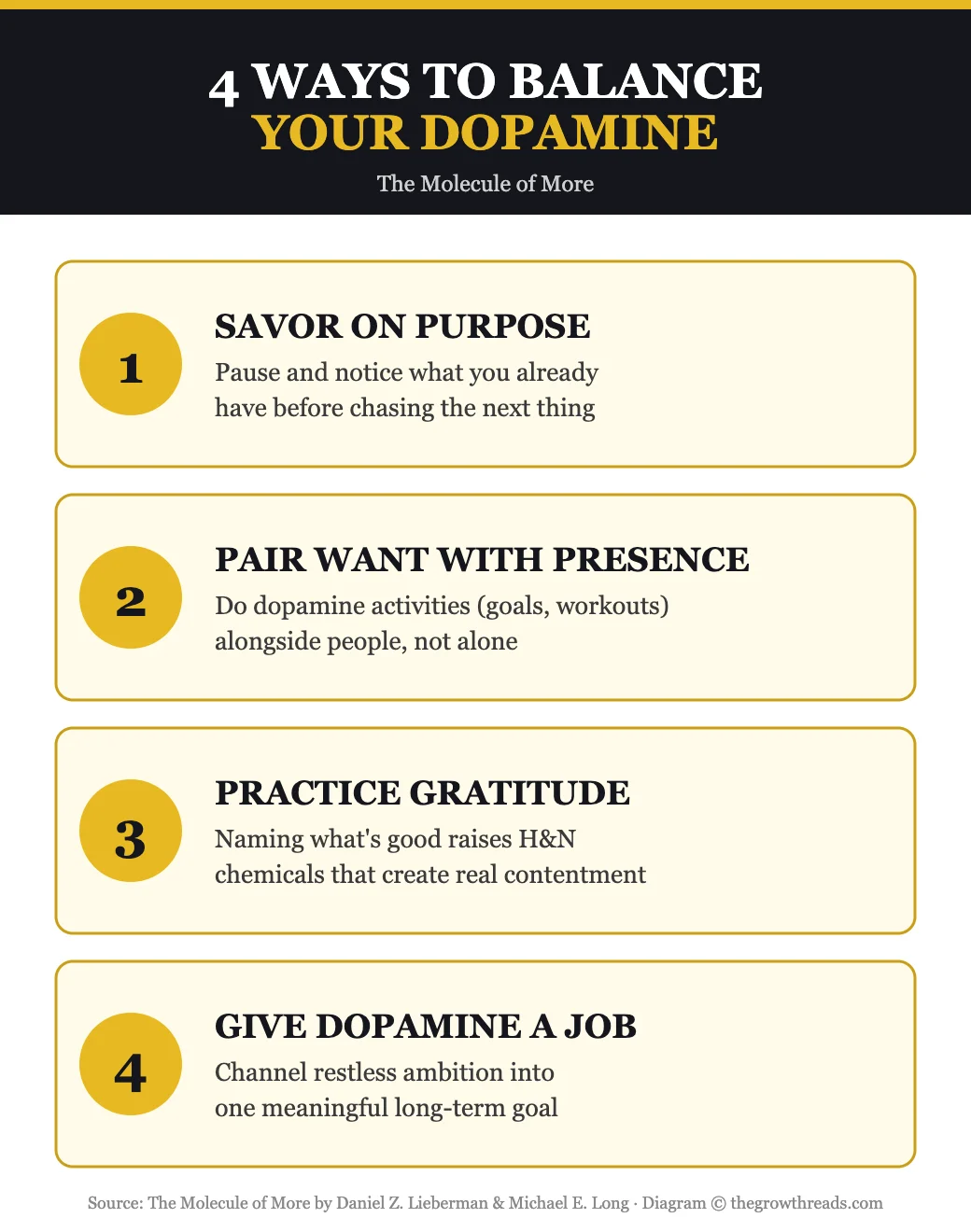
What makes this closing framework more useful than a simple “practice gratitude” platitude is the mechanism behind it: because dopamine and H&N chemicals occupy different circuits, boosting one doesn’t automatically crowd out the other. You can chase a demanding, dopamine-fueled goal and still build daily H&N habits alongside it — the two aren’t in a zero-sum trade-off, they’re a duet that most modern lives have let fall out of balance in dopamine’s favor.
Who is The Molecule of More best for — and who should read something else first?
This book is best for people who keep achieving things and still feel unsatisfied, for couples trying to understand why the early spark of a relationship changes shape, and for anyone who wants a clear, science-grounded explanation for cravings, restlessness, or compulsive habits. It rewards readers who enjoy narrative science writing more than clinical self-help.
If you want concrete, step-by-step techniques for building better habits rather than the underlying “why,” start with Atomic Habits instead. If you’re specifically dealing with compulsive overconsumption — of food, screens, or substances — and want a more clinical, recovery-oriented treatment of the same chemistry, Dopamine Nation is the more targeted read. And if your interest is broader emotional self-awareness rather than neurochemistry specifically, Emotional Intelligence is a better starting point.
Questions to reflect on
- Think of your last major purchase or achievement — how long did the excitement actually last, and what happened to it?
- Where in your life are you chasing the anticipation of something more than you’d actually enjoy having it?
- If you’re in a long relationship, has it shifted from passionate to companionate love — and how do you feel about that shift?
- What’s one H&N-chemical habit (gratitude, touch, unhurried presence) you could build into a day that’s currently all dopamine-driven hustle?
- Is there a goal you’re pursuing purely because “more” feels compelling, rather than because you’ve thought through whether it will make you happier?
🔥 Ready to understand your own cravings?
Grab a copy and see which chapters hit closest to home.
How to apply The Molecule of More (7-day plan)
- Day 1: Notice one moment of anticipation (checking your phone, waiting on a reply) and name it as dopamine, not need.
- Day 2: Pick one recent achievement or purchase and write down honestly how long the excitement lasted.
- Day 3: Practice one H&N habit deliberately — a slow meal, a hug held a few seconds longer, five minutes with no phone.
- Day 4: Identify one goal you’re chasing purely for the “more” feeling and ask whether it will actually make you happier.
- Day 5: If you’re in a long relationship, plan one genuinely new shared experience instead of waiting for spontaneous novelty.
- Day 6: Write down three things you already have that you’ve stopped noticing because tolerance dulled the excitement.
- Day 7: Set one long-term goal and one small daily H&N ritual to go with it — pairing dopamine’s drive with a chemical you can actually feel.
Frequently asked questions
What is the main idea of The Molecule of More?
The main idea is that dopamine is the brain’s chemical of desire and anticipation, not enjoyment — it drives you to pursue future rewards but doesn’t let you savor them once you have them. A separate group of chemicals, which the authors call H&N (here-and-now) chemicals, governs the enjoyment of what’s already present. Understanding both explains why satisfaction is so fleeting and points toward habits that help you feel content without giving up ambition.
Is The Molecule of More based on solid science?
Much of the neuroscience on dopamine’s role in anticipation versus reward is well-supported by decades of research, including classic primate and human studies the authors cite directly. Some of the book’s broader claims — particularly the chapter linking dopamine sensitivity to political orientation — are more speculative and have drawn pushback from readers and scientists as an oversimplification of a genuinely complex, multi-causal topic. The core wanting-versus-liking framework, however, is well established.
What’s the difference between dopamine and “H&N” chemicals?
Dopamine drives wanting — it fires in anticipation of a reward and pushes you toward the future. H&N chemicals (serotonin, oxytocin, endorphins, and endocannabinoids) drive liking — they reward you for being present with something you already have, whether that’s food, touch, or a finished task. The authors argue most emotional confusion comes from treating these as the same system when they’re not.
Why does romantic passion fade, according to this book?
Passionate love is largely dopamine-driven, and dopamine’s response to any repeated stimulus — including a familiar partner — shrinks over time through tolerance. The book cites research showing this intense, obsessive phase typically softens within one to three years. This isn’t necessarily a sign the relationship is failing; it can be a transition into companionate love, an oxytocin-driven attachment that many couples find calmer and more durable.
How does dopamine relate to addiction?
Addictive substances and behaviors artificially spike dopamine well beyond what natural rewards produce, intensifying craving while accelerating tolerance — so more of the substance or behavior is needed over time to produce the same effect. The book frames this as the same reward circuit that once helped early humans seek food and mates, now hijacked by substances and technologies engineered to exploit it.
What is the “dopamine control circuit”?
It’s a separate dopamine pathway, distinct from the desire circuit, that the authors say rewards abstract thought — planning, reasoning, and delaying gratification for a future goal. It’s the same chemical used differently: instead of driving simple wanting, it supports the kind of long-term thinking behind self-control and sustained achievement.
How can I apply this book’s ideas in daily life?
The most practical shift is pairing dopamine-driven goals with deliberate H&N habits — gratitude practices, physical touch, unhurried presence with people you care about — so that achieving something doesn’t just trigger the next craving. Noticing when you’re chasing anticipation rather than genuine value, and consciously savoring what you already have, are the book’s two most repeatable takeaways.
Related summaries
If you found this useful, you might also like our summaries of Dopamine Nation, Predictably Irrational, The Happiness Hypothesis, and Flow — or browse our full list of best psychology books.
How we analyze books: We read the full text, cross-check key claims against cited research and other work in the field, and focus our summaries on practical application rather than critique. Read our full methodology.
Related Psychology Summaries
Stumbling on Happiness Summary & Review: Why Your Brain Lies About the Future
Superforecasting Summary and Review
Talking to Strangers Summary & Review: Why We Misread Everyone
The Art of Thinking Clearly Summary & Review: 99 Biases That Sabotage Your Decisions
The Laws of Human Nature Summary & Review: Decode What Drives People