

★★★★½ 4.3/5 — the definitive case for doing radically less, better.
Best for: anyone whose to-do list keeps growing while their results stay flat · Reading time: ~6–7 hours (this guide: 16 min) · Difficulty to apply: Medium — the thinking is simple, the discipline to act on it is not
The 80/20 Principle in one minute
Most of what you do barely matters — a small slice of it matters enormously. Richard Koch generalizes Vilfredo Pareto’s century-old observation that roughly 80% of outcomes come from roughly 20% of causes into a full operating philosophy for time, work, and life. The goal isn’t to do everything a little better; it’s to find the vital few efforts already producing outsized results and pour more of yourself into them, while deliberately doing less of everything else. Koch calls the fast, intuitive version of this “80/20 Thinking” and the rigorous, data-driven version “80/20 Analysis” — and argues most people never learn to use either.
Key takeaways
- Effort and results are almost never proportionate: a small share of your time, customers, or actions typically accounts for the large majority of what you actually achieve.
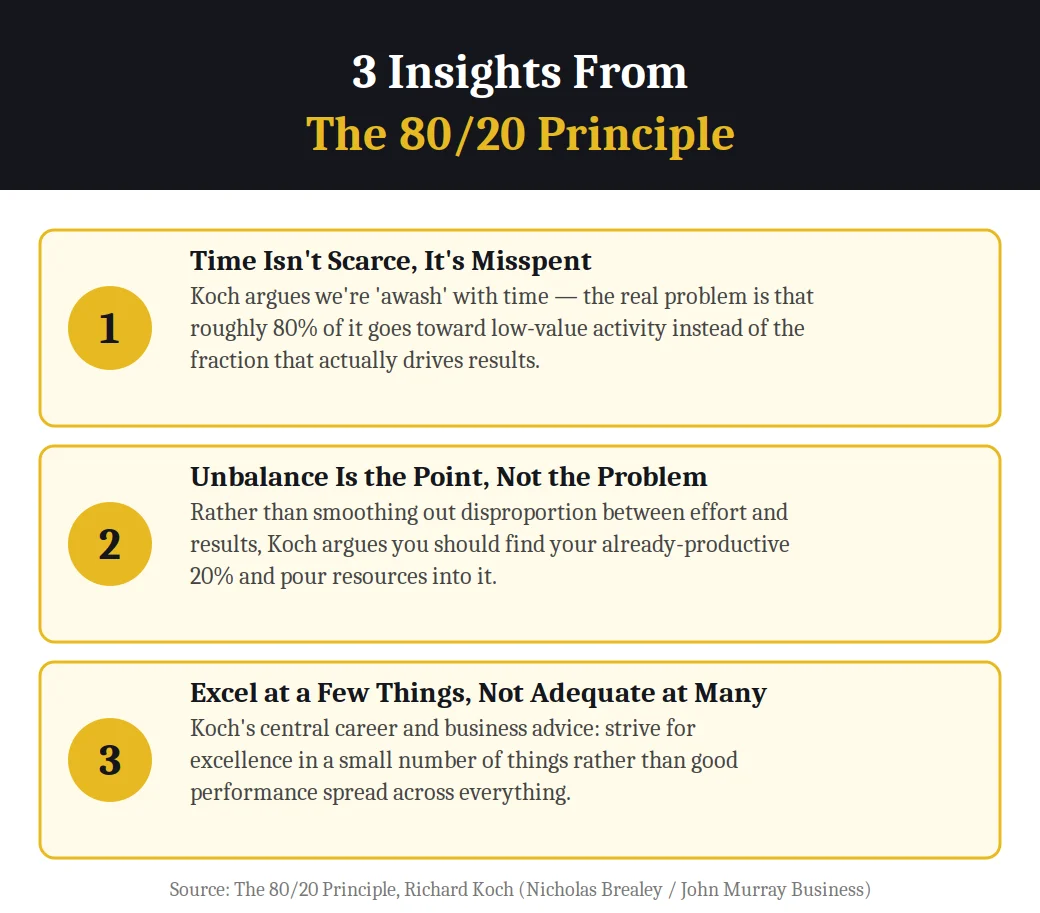
- Time isn’t scarce, it’s misspent: Koch argues we’re “awash” with time — the real problem is that most of it goes toward low-value activity instead of the fraction that drives results.
- 80/20 Analysis is the rigorous version: comparing two data sets (like customers vs. profit) to precisely quantify where value concentrates.
- 80/20 Thinking is the fast version: a working hypothesis about where your vital few probably lies, formed from experience rather than full data collection.
- The “vital few” is Joseph Juran’s term, not Pareto’s — Juran extended Pareto’s economic observation into quality management in the 1940s, and Koch borrows it as shorthand for the small subset of causes worth your attention.
- Unbalance on purpose: rather than smoothing out disproportion between effort and results, deliberately expand whatever is already working.
- Excellence beats adequacy: Koch’s central career advice is to be excellent at a small number of things rather than merely good at everything.
- Find your “islands of achievement”: the specific moments, projects, or relationships where you were unusually effective or fulfilled are your best evidence of where your 20% actually lives.
- The pattern shows up almost everywhere: sales, friendships, happiness, even the words we use most — Koch treats 80/20 less as a fixed ratio than as a reminder that inputs and outputs are rarely equal.
- Multiply, don’t balance: the practical instruction isn’t to work harder across the board, but to re-engineer your time so more of it goes toward what already works.
What is The 80/20 Principle about?
The 80/20 Principle by Richard Koch argues that roughly 80% of results in most areas of life come from just 20% of causes — and that success comes from identifying that vital few and multiplying it, not from working harder on everything evenly. First published in 1997 and repeatedly updated, it turns Vilfredo Pareto’s 19th-century economic observation into a practical system for time management, business strategy, and personal decision-making.
About the author
Richard Koch spent the 1980s inside elite strategy consulting — Boston Consulting Group, Bain & Company, and as a co-founder of L.E.K. Consulting — before turning to investing full time. That consulting background is exactly where he first noticed how consistently the 80/20 pattern showed up in client after client’s sales and profit data, long before he wrote it down as a general principle. He later applied the same selective-focus logic as an investor, taking early stakes in companies including Filofax and the Belgo restaurant group, both of which he has credited to spotting an underexploited “vital few” opportunity rather than broad diversification. Koch has since written more than 20 books on strategy, decision-making, and unconventional success, including Superconnect and The Star Principle, but The 80/20 Principle — first published in 1997 and repeatedly expanded — remains the idea he’s most identified with. Explore all Richard Koch book summaries →
Key concepts at a glance
| Concept | What it means | Use it when |
|---|---|---|
| The Pareto Principle | Vilfredo Pareto’s 1896 observation that ~80% of Italy’s land was owned by ~20% of the population | You want the historical root of the pattern |
| 80/20 Analysis | Rigorous comparison of two data sets to precisely quantify where value concentrates | You have real data available (sales, customers, time logs) |
| 80/20 Thinking | A fast, intuitive hypothesis about where your vital few probably lies | You lack full data and need a quick working theory |
| The Vital Few | Joseph Juran’s term for the small subset of causes that drive most results | Deciding what deserves your limited attention |
| Islands of Achievement | The specific moments or relationships where you were unusually effective | You’re unsure where your productive 20% actually is |
| Unbalance on purpose | Deliberately pouring more resources into what’s already working | Rebalancing a schedule, budget, or team’s focus |
| Excellence over adequacy | Superior effort in a few things beats average effort spread over many | Deciding where to specialize or say no |
| Multiply, don’t balance | Re-engineer your time to expand the productive slice, not smooth out the rest | Planning your next quarter or year |
Part 1: Where the 80/20 pattern comes from
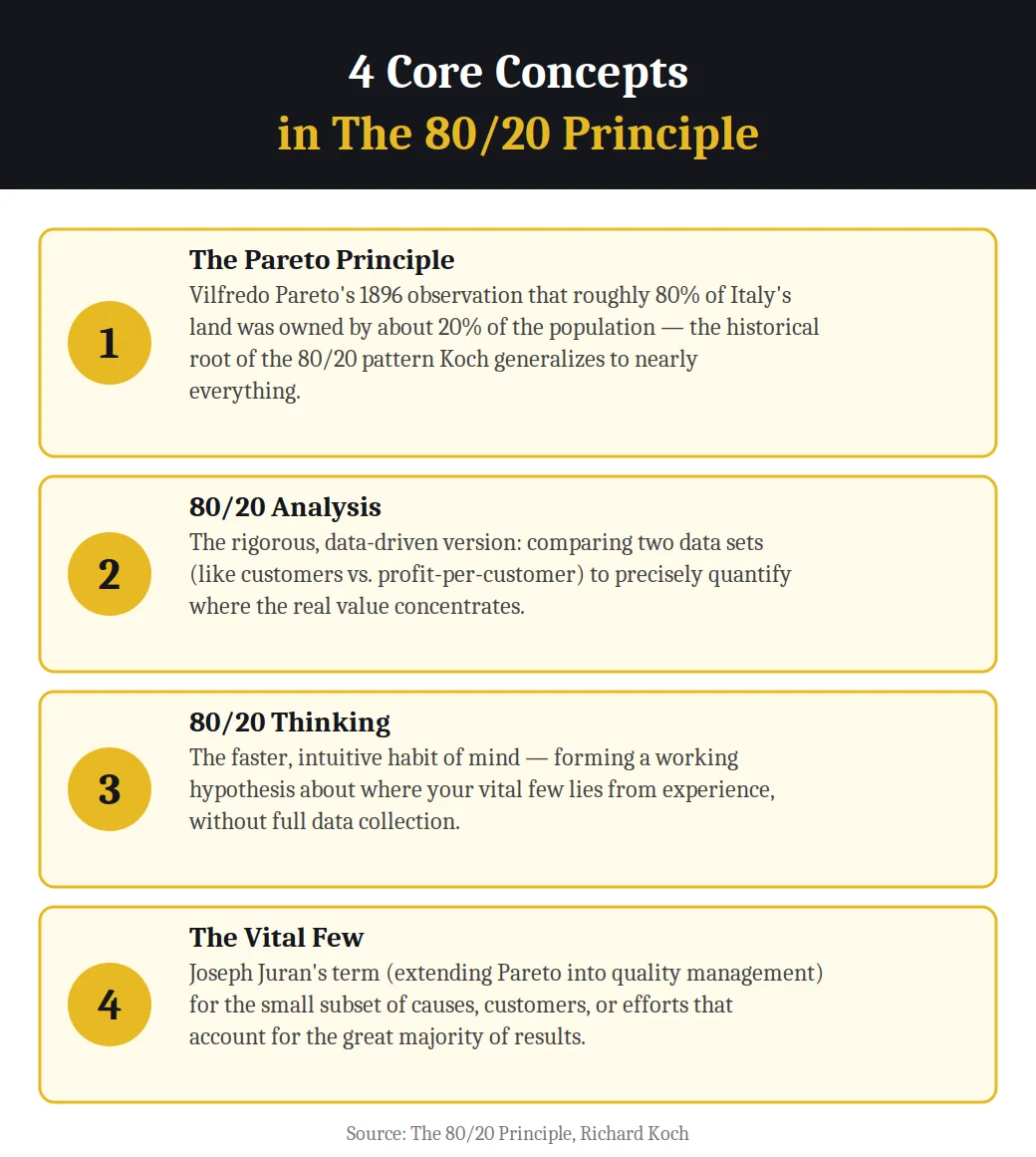
Koch traces the idea to the Italian economist Vilfredo Pareto, who noticed in 1896 that roughly 80% of the land in Italy was owned by about 20% of the population — and that the same lopsided ratio kept appearing in other countries’ income and wealth data he examined. Pareto never generalized this into a life philosophy; that leap came decades later, largely through the quality-management pioneer Joseph Juran, who in the 1940s coined the phrase “the vital few and the trivial many” to describe how a small number of causes typically account for most defects in a manufacturing process. Koch’s contribution is popularizing and extending that logic far beyond economics and manufacturing — to careers, relationships, happiness, and how individuals spend their time — while being careful to note that the ratio itself is illustrative, not a strict law: sometimes it’s 70/30, sometimes 90/10, but the underlying imbalance between effort and result shows up again and again.
TGR Note: This is close in spirit to Greg McKeown’s Essentialism, which argues for “less but better” from a discipline-and-boundaries angle. Koch’s version leans more analytical — find the disproportion in your actual data or experience first, then decide what to cut, rather than starting from a philosophy of subtraction.
Part 2: 80/20 Analysis vs. 80/20 Thinking
Koch draws a sharp and useful line between two ways of applying the idea. 80/20 Analysis is the rigorous, quantitative version: you gather two comparable data sets — say, a list of customers and the profit each one generates — and calculate exactly what share of results comes from what share of causes. It’s slow, it requires real data, but it’s precise, and Koch treats it as the gold standard whenever the data is available (he spends real time in the book walking through how a business might tabulate customer profitability this way). 80/20 Thinking is the shortcut for everyday life, where full data collection usually isn’t practical: it’s the habit of assuming, based on experience and a rough mental model, that a small fraction of what you’re doing is responsible for most of what’s working — and acting on that hypothesis without waiting for a spreadsheet to confirm it. Most of the book’s everyday advice, from career choices to happiness, runs on 80/20 Thinking rather than formal Analysis.
TGR Note: If 80/20 Analysis appeals to you, it pairs naturally with the systems in Getting Things Done — GTD gives you a trustworthy way to capture and categorize the raw material (tasks, projects, commitments) that 80/20 Analysis then ranks by actual value.
Part 3: Radical unbalance — why “well-rounded” is the wrong goal
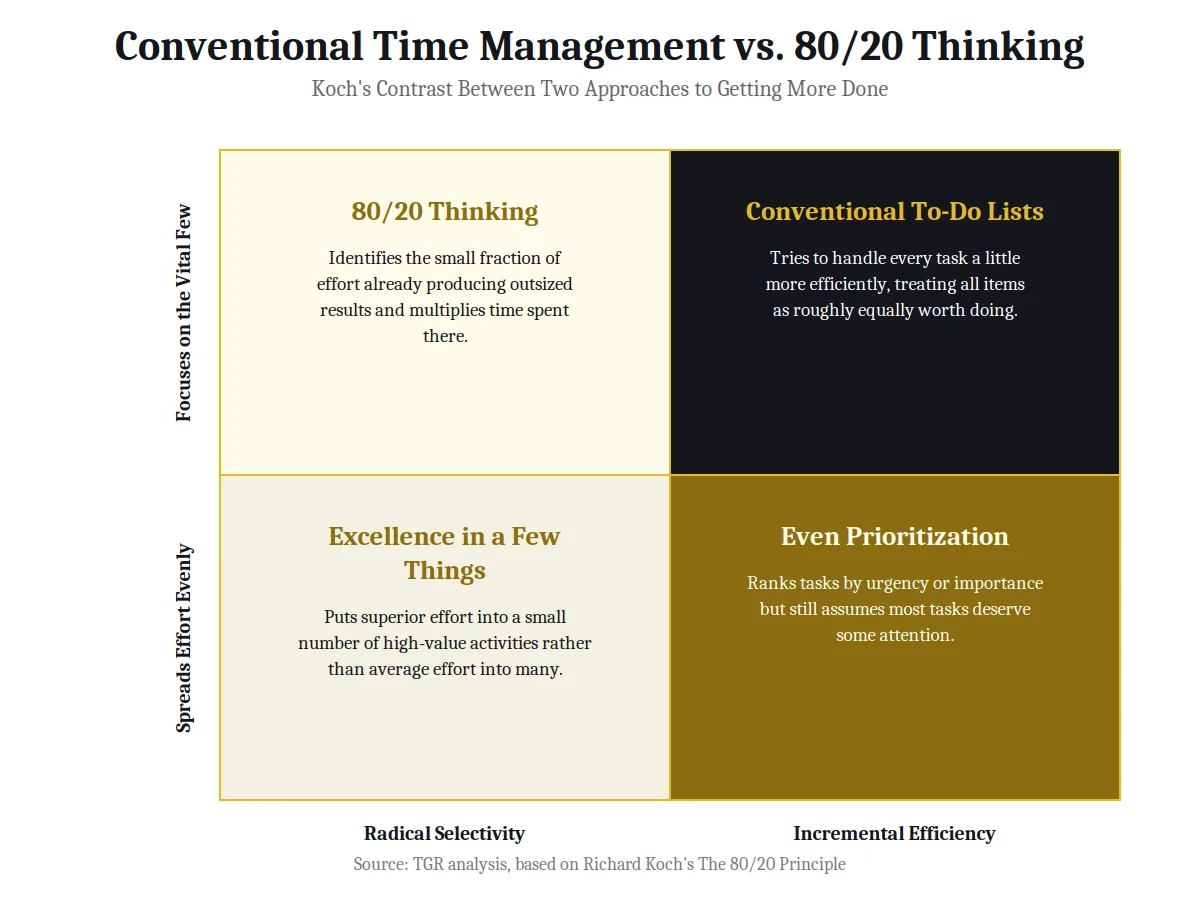
Most advice about work and life pushes toward balance: be well-rounded, improve your weak spots, spread your attention evenly across your responsibilities. Koch argues this is close to backwards. If a small fraction of your effort is producing almost all your results, then time spent shoring up the other 80% is, by definition, low-value time — better spent doubling down on what’s already working. He introduces the idea of “islands of achievement”: specific periods, projects, or relationships in your own history where you were unusually effective, fulfilled, or both. Rather than treating those as flukes, Koch’s advice is to study them for what made them work and then deliberately re-create those conditions elsewhere. The same logic applies to skill-building: he argues for excellence in a small number of areas rather than competence spread across many, on the grounds that the market (and your own sense of satisfaction) rewards being genuinely excellent at a few things far more than being adequate at everything.
TGR Note: Oliver Burkeman’s Four Thousand Weeks arrives at a similar place from the opposite direction — instead of optimizing toward your vital few, Burkeman argues for radical acceptance that you were never going to do it all anyway. Read them together and the same practical instruction falls out twice: stop trying to be equally good at everything.
Part 4: Finding — and multiplying — your vital few
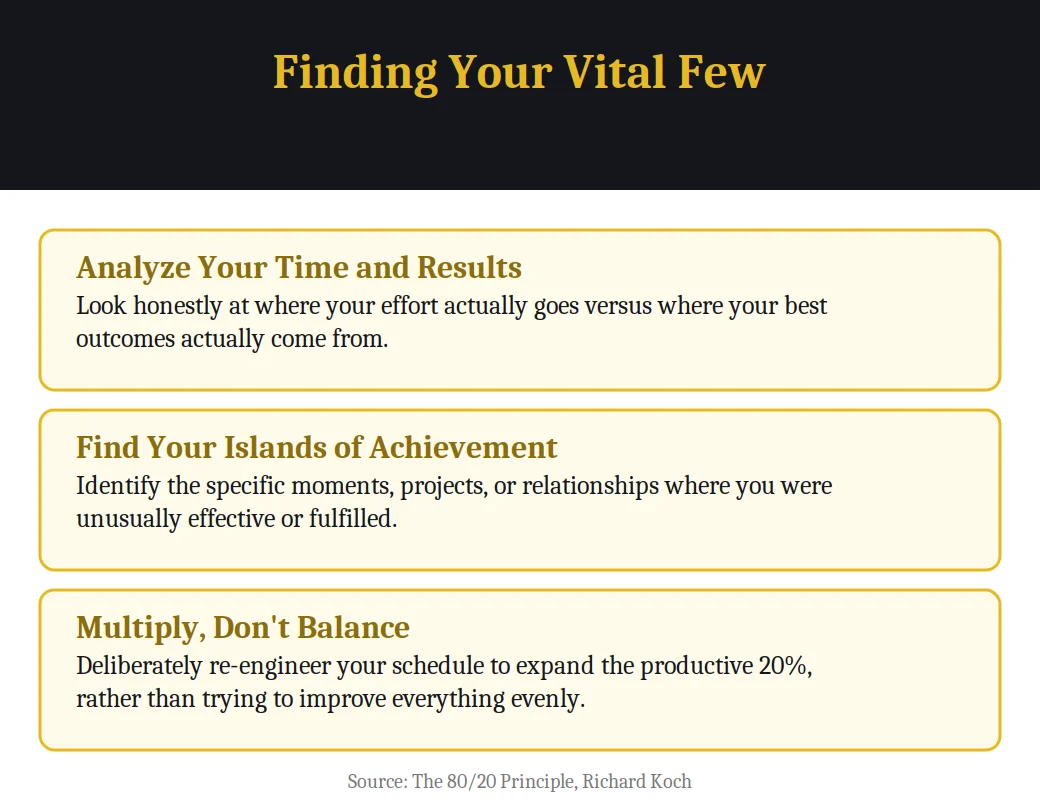
The book’s most actionable section is also its simplest: a short, repeatable process for locating your own 20%. Start by analyzing where your time actually goes versus where your best outcomes actually come from — most people, Koch notes, have never compared the two directly. Then look for your islands of achievement, the specific moments you’d point to if asked “when was I at my best?” Finally, and this is the step people skip, deliberately re-engineer your calendar, your client list, or your responsibilities to expand the productive slice, rather than trying to make marginal improvements everywhere at once. Koch is explicit that this isn’t a one-time exercise — your vital few shifts as your circumstances change, so the analysis is worth repeating periodically rather than treating any single answer as permanent.
Who is The 80/20 Principle best for — and who should read something else first?
Best for: people whose calendars are full but whose results feel flat, business owners who suspect a small slice of customers or products is doing most of the work, and anyone who has tried conventional time-management advice and found it just makes them more efficient at low-value tasks. If you want a gentler, discipline-first version of “do less,” start with Essentialism. If your bottleneck is distraction rather than prioritization, Deep Work is the better first read. And if you want one ruthless daily prioritization question rather than a full analytical framework, The ONE Thing is the faster path in.
Questions to reflect on
- If you compared your actual time log to your actual results, would the two line up — or would you find, like most people, that they don’t?
- What are your two or three “islands of achievement” — the specific projects or relationships where you were unusually effective — and what made them different?
- Where in your life are you currently trying to be well-rounded when you could instead be excellent at a few things?
- What would you stop doing entirely if you were confident it was part of your unproductive 80%?
- What’s one place you could multiply effort this month, rather than merely balance it?
🔥 Ready to find your vital few?
This guide is the map — the book is the full analytical toolkit, with Koch’s own data walkthroughs and career case studies a summary can’t carry.
How to apply The 80/20 Principle (7-day plan)
- Day 1: Log where your time actually went yesterday, in 30-minute blocks, without judging it yet.
- Day 2: Compare that log to your best results from the last month. Circle anything that overlaps.
- Day 3: Write down two or three “islands of achievement” from the past year and what specifically made them work.
- Day 4: Pick one low-value, high-time activity from Day 1 and cut or delegate it.
- Day 5: Pick one high-value activity from Day 2 and double its time allocation this week.
- Day 6: Ask: where am I trying to be well-rounded instead of excellent? Choose one area to stop “balancing.”
- Day 7: Review the week’s numbers. Repeat the log-and-compare exercise monthly, since your vital few will shift.
Frequently asked questions
What is the 80/20 principle in simple terms?
The 80/20 principle, also called the Pareto Principle, is the observation that roughly 80% of outcomes tend to come from roughly 20% of causes — a small share of your customers often generate most of your profit, a small share of your effort often produces most of your results. Richard Koch’s book extends this beyond economics into a personal and business philosophy: instead of trying to improve everything a little, identify the vital few inputs already producing outsized results and deliberately expand them. The exact ratio isn’t fixed at 80/20 — Koch treats it as shorthand for any significant imbalance between effort and outcome, whether the real split is 70/30 or 90/10.
What’s the difference between 80/20 Analysis and 80/20 Thinking?
80/20 Analysis is the rigorous, quantitative version: you compare two real data sets — like a customer list against the profit each customer generates — to calculate precisely where value concentrates. It requires data and time but produces a defensible answer. 80/20 Thinking is the fast, intuitive version for situations where full data collection isn’t practical: a working hypothesis, built from experience, about where your vital few probably is. Koch recommends Analysis when the stakes are high and data exists, such as a major business decision, and Thinking for the constant small decisions of daily life where you can’t run a full analysis every time.
Who invented the 80/20 rule?
The pattern was first documented by the Italian economist Vilfredo Pareto in 1896, who observed that about 80% of Italy’s land was owned by about 20% of the population, and found similar imbalances in other countries’ wealth data. The phrase “the vital few and the trivial many” — closer to how the idea is used today — was coined decades later by quality-management pioneer Joseph Juran in the 1940s, applying Pareto’s observation to manufacturing defects. Richard Koch’s contribution, starting with the first edition of this book in 1997, was generalizing both ideas into a broad personal and business philosophy well beyond economics or manufacturing.
Does the 80/20 rule always add up to exactly 100?
No, and Koch is explicit about this: 80/20 is a memorable label for a pattern of imbalance, not a strict mathematical law that always sums to 100. The real ratio in any given situation might be 70/30, 90/10, or something else entirely — what matters is the underlying claim that causes and results are rarely proportionate, not the specific numbers. Some of the statistics and anecdotes used to illustrate the principle across popular business writing have been debated or loosely sourced over the years; the durable, well-supported idea is the general pattern of disproportion, not any single precise statistic.
How do I find my vital few?
Start by comparing where your time actually goes against where your best results actually come from — most people have never lined the two up directly. Then look for “islands of achievement”: specific projects, clients, or periods where you were unusually effective or fulfilled, and ask what made them different from the rest of your work. Finally, act on what you find by deliberately expanding the productive slice — taking on more of what’s working, cutting or delegating what isn’t — rather than trying to improve everything evenly. Koch recommends repeating this analysis periodically, since your vital few shifts as your role and circumstances change.
Is the 80/20 principle scientifically proven?
The underlying statistical pattern — a minority of causes producing a majority of a given outcome — is well documented in economics, business, and quality management, going back to Pareto’s original wealth-distribution data and Juran’s manufacturing-defect studies. What’s less rigorous is the leap Koch and other popularizers make in applying it broadly to happiness, relationships, and daily time management, where the “80” and “20” are illustrative rather than measured. Treat the specific ratio as a memorable heuristic rather than a precise law, while taking the core insight seriously: effort and results are very rarely proportionate, and it’s usually worth checking where yours actually stand.
How is this different from typical time-management advice?
Most time-management systems, like Getting Things Done or Eat That Frog!, focus on doing your existing list of tasks more efficiently or in a better order. The 80/20 Principle asks a prior question: is this task worth doing at all, given how little of your value likely comes from it? Rather than optimizing execution across the board, Koch’s approach pushes you to shrink the list itself — cutting or delegating the low-value majority so more time goes to the vital few activities already producing most of your results. The two approaches aren’t in conflict; 80/20 thinking decides what belongs on the list, and a system like GTD helps you execute it.
Related summaries
Essentialism · Deep Work · The ONE Thing · Four Thousand Weeks — or browse all the best productivity books.
How we analyze books: We work from the full book — reconstructing its core arguments in our own words, adding commentary that connects it to related research and other books in our library, and pressure-testing the advice in a practical 7-day plan. Ratings weigh usefulness, readability, and evidence quality. Read our full methodology.
Related Productivity Summaries
Indistractable Summary & Review: How to Control Your Attention
Mastery Summary & Review: The Path to Extraordinary Skill
Rework Summary & Review: Build Less, Ship More, Stay Profitable
The Now Habit Summary & Review: A Strategic Program for Overcoming Procrastination
The One Thing Summary & Review: The Surprisingly Simple Truth Behind Extraordinary Results