

★★★★★ 4.6/5 — “The playbook for creating markets instead of fighting over them.”
Best for: Founders, product leaders, and strategists tired of price wars and me-too competition.
Reading time: ~7 hrs for the full book (320 pages) · ~14 min for this guide.
Difficulty to apply: Moderate — the frameworks are simple to sketch, but reshaping a real strategy takes genuine market research and buy-in.
Blue Ocean Strategy in one minute
Stop trying to win the game everyone else is already playing. Blue Ocean Strategy argues that the biggest returns don’t come from beating competitors in existing markets — “red oceans” bloodied by rivalry — but from creating new, uncontested markets, or “blue oceans,” where competition is irrelevant. W. Chan Kim and Renée Mauborgne studied 150 strategic moves spanning more than a century and 30 industries and found a repeatable pattern: companies that broke their industry’s unwritten rules created a leap in value for buyers while simultaneously lowering costs — a combination they call “value innovation.” The book hands you the actual tools to do this yourself: the Strategy Canvas to see how your industry competes, and the Four Actions Framework to redesign what you offer. It’s illustrated throughout with case studies like Cirque du Soleil, Yellow Tail wine, Southwest Airlines, and the Nintendo Wii — all of which grew fast by refusing to compete on the industry’s existing terms.
Key takeaways
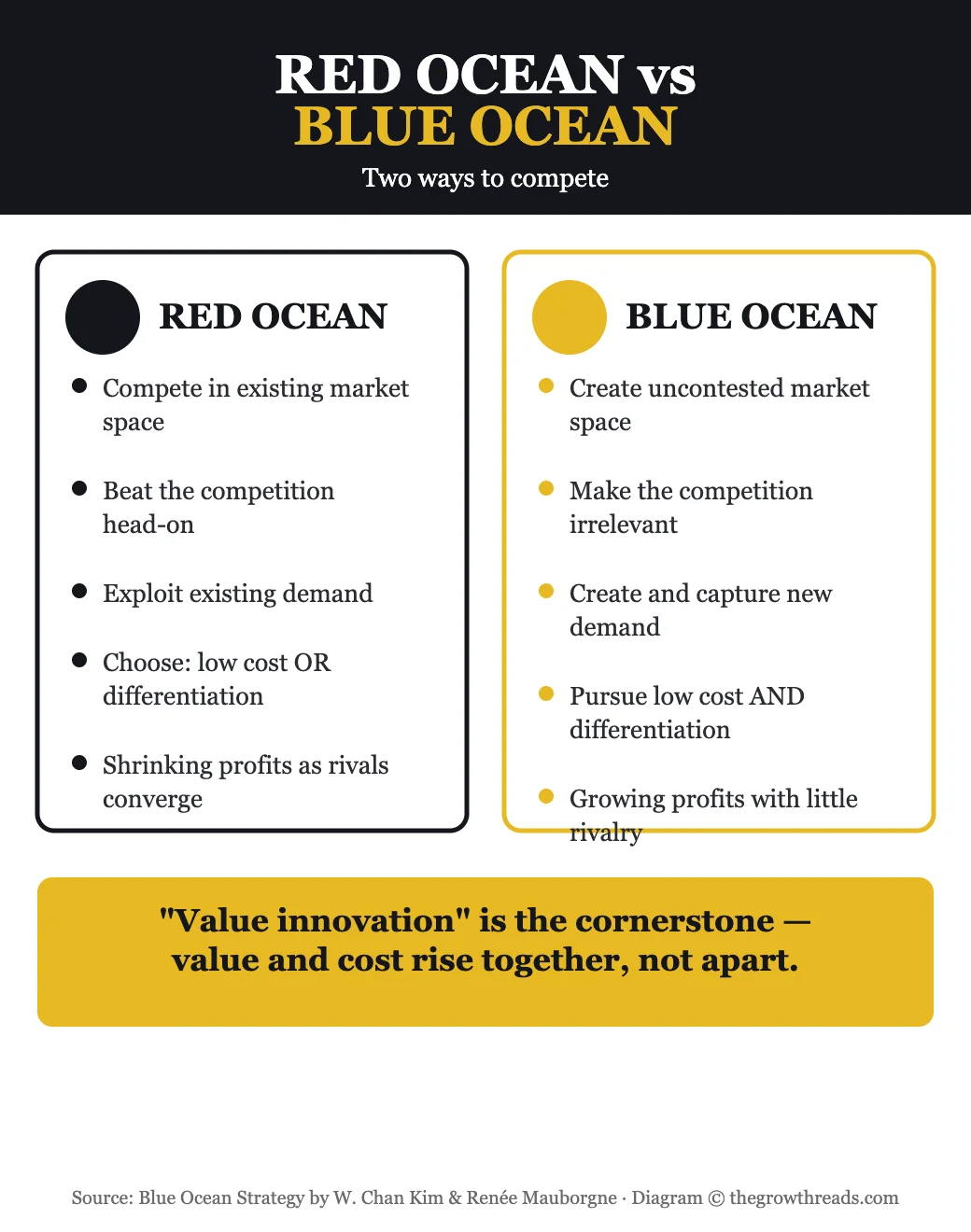
- Red oceans vs. blue oceans: red oceans are known market space where rivals fight over a shrinking, fixed pool of demand; blue oceans are unknown market space where new demand is created rather than captured.
- Value innovation is the cornerstone: instead of trading off differentiation against low cost, blue ocean strategists pursue both at once, breaking the conventional value-cost trade-off.
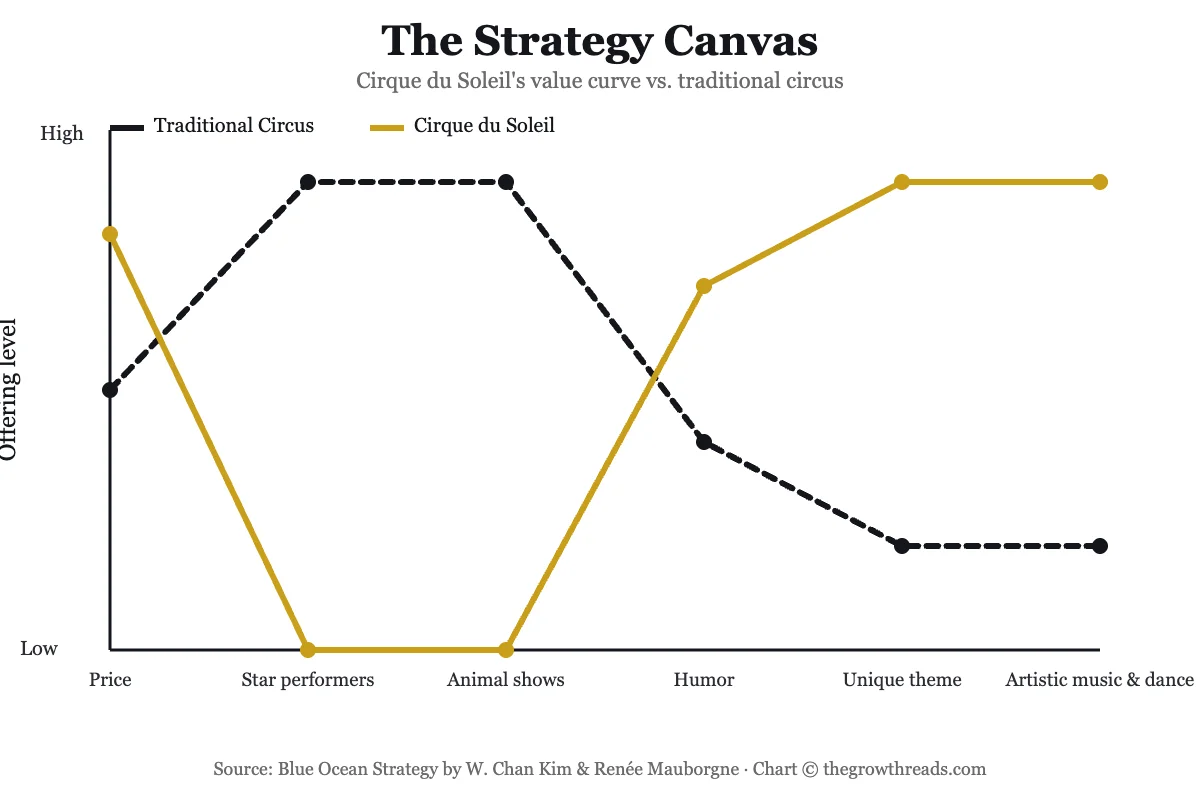
- The Strategy Canvas reveals convergence: plotting how every competitor performs on the same handful of factors almost always shows a nearly identical “value curve” — the strategic sameness hiding in plain sight.
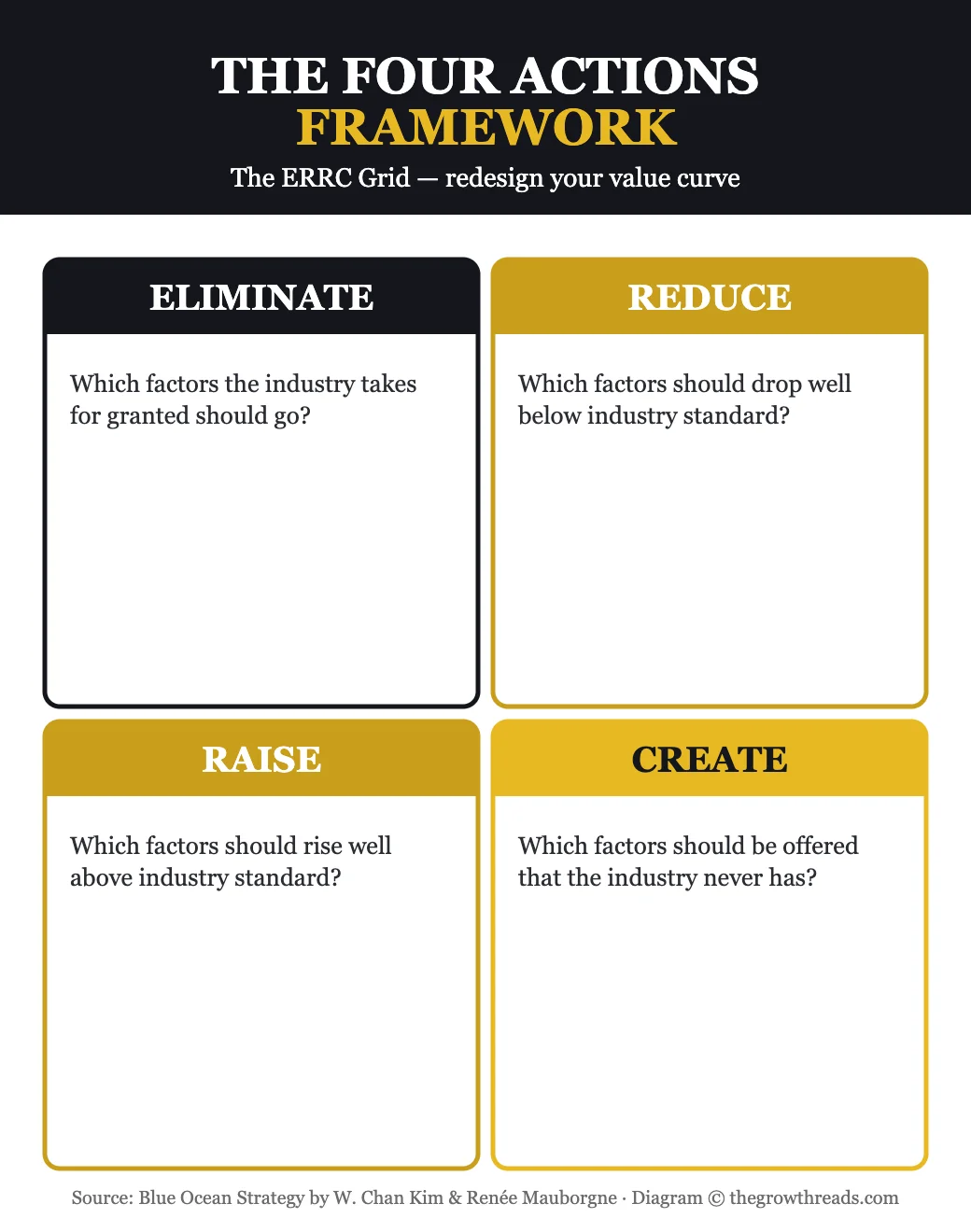
- The Four Actions Framework (ERRC) forces you to ask what to Eliminate, Reduce, Raise, and Create — not just improve on what already exists.
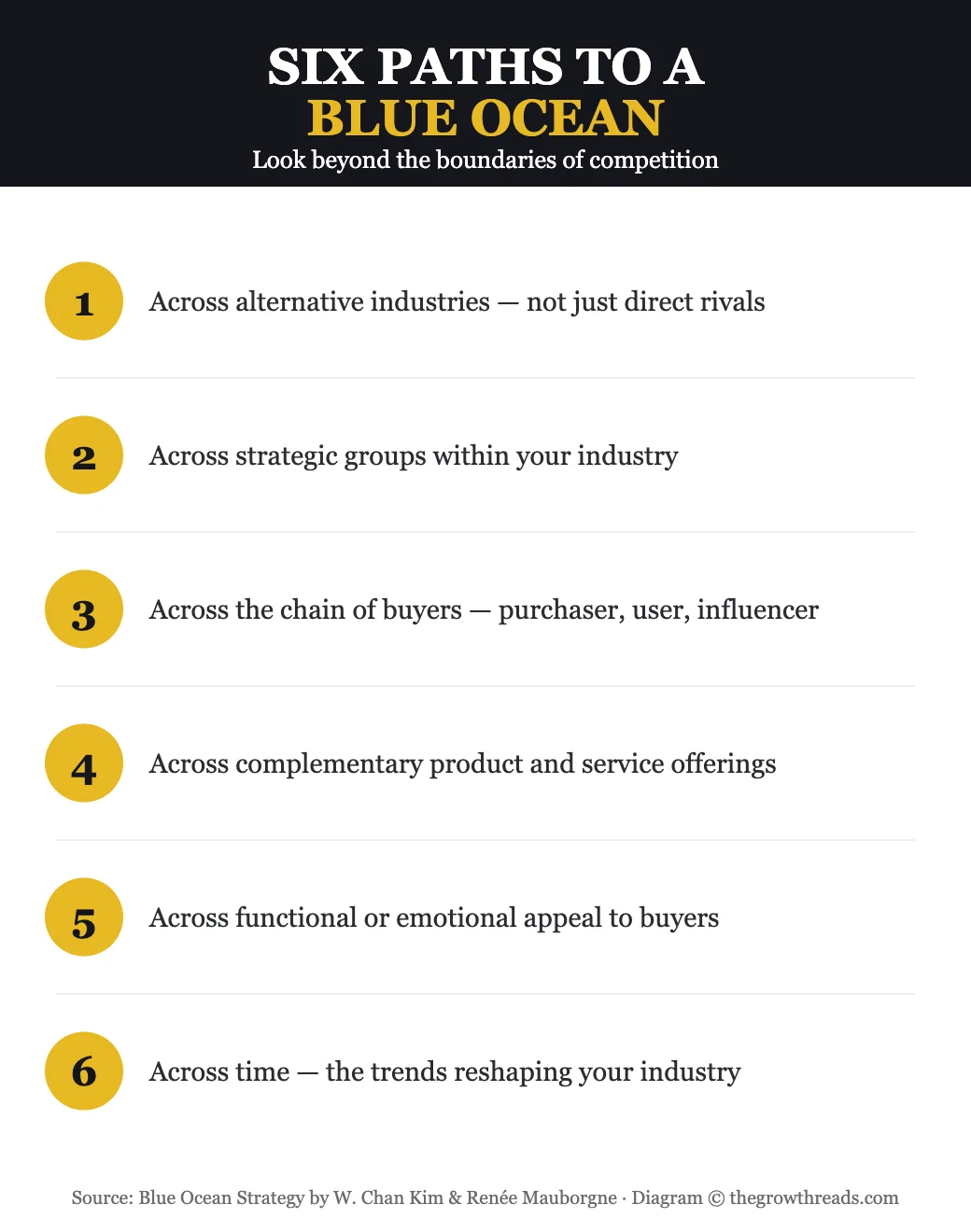
- Six paths lead beyond direct rivals: alternative industries, strategic groups, the buyer chain, complementary offerings, functional-versus-emotional appeal, and time all hide overlooked blue oceans.
- Three tiers of noncustomers — soon-to-be, refusing, and unexplored — usually hold more untapped demand than the customers companies already fight over.
- A good idea must pass the utility-price-cost-adoption sequence; skipping any one step is why plenty of “innovative” ideas fail commercially.
- Tipping point leadership shows how to transform an organization on limited resources by concentrating effort on a few high-leverage hotspots rather than spreading thin.
- Fair process — engagement, explanation, and clear expectations — determines whether people actually execute a new strategy or quietly resist it, regardless of how good the plan is.
- Blue oceans don’t stay blue forever: imitators eventually arrive, so the same tools must be revisited as today’s blue ocean drifts back toward red.
What is Blue Ocean Strategy about?
Blue Ocean Strategy is a business strategy book by W. Chan Kim and Renée Mauborgne that teaches companies how to create new, uncontested markets (“blue oceans”) instead of competing in existing ones (“red oceans”), using tools like the Strategy Canvas and Four Actions Framework to pursue differentiation and low cost at the same time.
About the author
W. Chan Kim and Renée Mauborgne are Professors of Strategy at INSEAD and co-directors of the INSEAD Blue Ocean Strategy Institute in Fontainebleau, France. Their research into 150 strategic moves spanning more than a century and 30 industries produced Blue Ocean Strategy, which has sold more than four million copies in 49 languages and is routinely named one of the most influential business books ever written. In 2019, Thinkers50 named the pair the world’s most influential management thinkers, and in 2023 Harvard Business Review honored them as two of its four most impactful authors on the journal’s 100th anniversary. Kim and Mauborgne went on to write two follow-ups, Blue Ocean Shift and Beyond Disruption, and founded the Blue Ocean Global Network, whose teaching materials have been adopted by more than 3,000 universities worldwide. Explore all Renée Mauborgne book summaries →
Key concepts at a glance
| Concept | What it means | Use it when |
|---|---|---|
| Red Ocean | Existing market space where rivals compete for a fixed, shrinking pool of demand | You feel pricing pressure and copy-cat competition |
| Blue Ocean | New, uncontested market space with new demand | You want growth without fighting head-to-head |
| Value Innovation | Simultaneously raising value and lowering cost | You’re stuck choosing between “cheap” or “premium” |
| Strategy Canvas | A chart plotting how the industry competes across key factors | You want to see your value curve versus rivals |
| Four Actions Framework (ERRC) | Eliminate, Reduce, Raise, Create — questions that redesign an offering | You’re building a new value curve |
| Six Paths Framework | Six places to look for blue oceans beyond direct competitors | You’ve run out of obvious ideas |
| Three Tiers of Noncustomers | Groups who don’t yet buy from your industry at all | You want to expand the size of the market |
| Tipping Point Leadership | Focusing limited resources on high-leverage hotspots | You must execute a big change fast and cheaply |
| Fair Process | Engagement, explanation, and clear expectations during execution | You need real buy-in, not just a signed-off plan |
Part 1: Stop Competing, Start Creating
Kim and Mauborgne open with a blunt observation: most companies spend their strategic energy fighting over red oceans — markets everyone already knows about, where the boundaries and competitive rules are fixed and demand is basically capped. In a red ocean, growth means taking share from a rival, so as more players pile in, products commoditize, differentiation shrinks, and price becomes the main lever. Margins bleed out.
Blue oceans are the alternative: market space that doesn’t exist yet, created rather than fought over. There’s no rulebook to follow because there’s no competition to benchmark against — the company that opens the blue ocean sets the rules. The authors are careful to note this isn’t the same as “disruptive innovation” in the Clayton Christensen sense, and it isn’t only about technology. Cirque du Soleil didn’t invent a new technology; it recombined circus and theater, dropped expensive star performers and animal acts, and created something audiences had never seen, all without competing head-to-head with Ringling Bros. on any of the old rules.
The mechanism behind this is value innovation — the deliberate refusal to accept the standard trade-off between differentiation and low cost. Conventional strategy says you can be the premium option or the cheap option, not both. Value innovation says: eliminate and reduce the cost drivers buyers don’t actually value, then raise and create the factors that generate a genuine leap in value, and you can lower costs while raising value at the same time.
TGR Note: Peter Thiel makes a similar case in our Zero to One summary — that durable profit comes from monopoly-like uniqueness, not from surviving competition. Where Thiel focuses on technology-driven monopolies, Kim and Mauborgne give you a repeatable, non-technical process for finding that same kind of uncontested space in any industry.
Part 2: Reading the Market with the Strategy Canvas
Before you can create a blue ocean, you have to see clearly how your industry currently competes — and the book’s signature tool for that is the Strategy Canvas. On the horizontal axis you list the factors the industry competes on and invests in (price, features, service, brand, and so on); on the vertical axis you plot how much each competitor offers on each factor. Connect the dots for any company and you get a “value curve.” Do this for the whole industry and something uncomfortable usually appears: everyone’s value curve looks roughly the same shape, just shifted up or down. That sameness is the red ocean made visible.
The book’s most famous illustration of breaking that pattern is Cirque du Soleil. Traditional circuses compete hard on star performers, animal shows, and multiple arenas running simultaneously — all expensive to deliver. Cirque du Soleil’s value curve looks nothing like that: it eliminated animal acts and star performers entirely, reduced the fun-and-humor elements to a more sophisticated register, and raised the price well above a standard circus ticket — while creating brand-new factors like a unifying artistic theme, original music and dance, and a more refined viewing environment. The result wasn’t a cheaper or fancier circus; it was a new category that didn’t have to compete with circuses or theater at all.
A well-drawn Strategy Canvas should pass three tests: focus (it shouldn’t spread resources across every factor equally), divergence (your curve should look distinctly different from competitors’), and a compelling tagline that a customer could actually repeat back to a friend. If your canvas fails any of these, Kim and Mauborgne argue you don’t yet have a real strategy — just a set of tactics dressed up as one.
TGR Note: This pairs naturally with the positioning work in Good to Great — Jim Collins asks “what can you be best in the world at,” while the Strategy Canvas gives you a visual method for checking whether “best” even means competing on the same factors as everyone else.
Part 3: The Four Actions Framework and Six Paths to New Markets
Once you can see the industry’s shared value curve, the Four Actions Framework — nicknamed the ERRC grid — gives you a structured way to redraw it. For every factor the industry competes on, you ask four questions: which factors should be eliminated that the industry takes for granted but buyers no longer value; which should be reduced well below the industry standard because companies have over-designed them competing with each other; which should be raised well above the standard; and which factors should be created that the industry has never offered at all. The Eliminate and Create questions are the ones that push companies furthest from the pack — they’re also the ones most executives skip, because it’s uncomfortable to remove something a whole industry assumes is mandatory.
The natural follow-up question is where to look for these ideas in the first place, and that’s what the Six Paths Framework answers: look across alternative industries that solve the same underlying need in a different form; across strategic groups within your own industry (budget vs. premium tiers, for instance); across the chain of buyers, since the purchaser, the user, and the influencer often want different things; across complementary products and services consumed around your own offering; across the functional-versus-emotional appeal of the industry, since switching from one to the other often opens new demand; and across time, by tracking the trends that are reshaping the industry rather than reacting to competitors’ current moves.
Yellow Tail wine used the strategic-group path — the founders looked at what separated cheap jug wine from intimidating, connoisseur-oriented premium wine, and eliminated the complexity (tannins, oak, vintage talk) that scared off casual drinkers, creating an easy, fun wine that outsold nearly every competitor within two years. Southwest Airlines looked across alternative industries, treating cars and buses as its real competition rather than other airlines, which is why it eliminated seat assignments, meals, and hub connections to compete on speed and price instead. Nintendo’s Wii looked at noncustomers of gaming consoles entirely — families and older adults who found existing consoles too complex and expensive — rather than trying to out-spec the PlayStation or Xbox.
TGR Note: Clayton Christensen’s The Innovator’s Dilemma explains why incumbents struggle to respond once a challenger opens a blue ocean below them — they’re organizationally built to serve their existing, more profitable customers, which is exactly the trap the Six Paths Framework is designed to help you exploit as a challenger.
Part 4: Executing Without Letting the Blue Ocean Turn Red
Finding a blue ocean idea is only half the book. Kim and Mauborgne insist a good idea must clear four hurdles in sequence: exceptional utility for the buyer, a strategic price the mass of target customers can readily afford, a cost structure that still hits your profit target at that price, and a realistic plan to overcome adoption hurdles among employees, partners, and the public. Skip any one of these and even a brilliant idea fails commercially — a common trap for “innovative” products that are technically superior but priced or costed unrealistically.
Execution inside a real organization runs into predictable resistance, which the book addresses with tipping point leadership: rather than trying to change an entire organization’s mindset and resources at once, leaders should identify the disproportionately influential people, actions, and activities — the “hotspots” — and concentrate limited time and budget there first, since organizations (like epidemics) can tip quickly once the right pressure points move.
Underneath all of this sits fair process — engagement (involving people in decisions that affect them), explanation (making sure everyone understands the reasoning, even if they disagree), and clarity of expectations (setting the new rules of the game explicitly up front). The authors’ research found that people will support a strategy they disagree with if they believe the process that produced it was fair, and will sabotage a strategy they’d otherwise like if they feel the process was unfair — which is why so many good strategies die in execution rather than in the boardroom.
Finally, the book is honest that blue oceans don’t stay blue: imitators arrive, competitors copy what works, and the same market drifts back toward red over time. The Strategy Canvas and ERRC grid aren’t one-time tools — they’re meant to be revisited periodically, watching for when your own value curve starts converging with everyone else’s again.
TGR Note: Ben Horowitz’s The Hard Thing About Hard Things is a useful companion here — where Blue Ocean Strategy gives you the analytical tools to find the market, Horowitz’s book is a ground-level account of the organizational grind of actually executing a big strategic shift under pressure.
Who is Blue Ocean Strategy best for — and who should read something else first?
This book is best for founders and product leaders shaping a differentiated go-to-market strategy, corporate strategists tired of price wars and feature-matching, and consultants who want a repeatable framework for strategy workshops. It rewards readers willing to actually sketch a Strategy Canvas rather than just read the case studies passively.
If you’re looking for personal productivity tactics rather than market strategy, Atomic Habits is a better starting point. If you want a ground-level account of executing under pressure rather than a market-creation framework, try Extreme Ownership or Good to Great first, then come back to this book once you have a strategic direction to execute against.
Questions to reflect on
- Which factors does your industry compete on that customers might not actually value as much as everyone assumes?
- If you eliminated your single biggest cost driver tomorrow, what would you have to create to keep customers happy anyway?
- Who are the “noncustomers” just outside your market, and what’s actually stopping them from buying?
- Where could you borrow an idea from a completely unrelated industry to reshape what you offer?
- If a competitor copied your current strategy perfectly tomorrow, would you still win — or does your advantage depend on staying ahead of imitation?
🔥 Ready to stop fighting over the same customers?
Get Blue Ocean Strategy and start building a market where competition doesn’t matter.
How to apply Blue Ocean Strategy (7-day plan)
- Day 1: Sketch a rough Strategy Canvas for your own industry — list the 5–7 factors everyone competes on.
- Day 2: Score your company and your top two competitors on each factor (0–10) and plot your current value curves side by side.
- Day 3: Run the Four Actions Framework on your own offering — write two items under each of Eliminate, Reduce, Raise, and Create.
- Day 4: Pick two paths from the Six Paths Framework most relevant to your business and brainstorm three ideas under each.
- Day 5: Identify your three tiers of noncustomers and talk to two or three people from a tier you’ve never targeted before.
- Day 6: Draft one “blue ocean idea” that combines your ERRC changes into a coherent new value curve, and sanity-check it against the utility-price-cost-adoption sequence.
- Day 7: Share the draft with your team using fair process — explain your reasoning, invite challenge, and set clear expectations before deciding next steps.
Frequently asked questions
What is a “blue ocean” in Blue Ocean Strategy?
A blue ocean is a new, uncontested market space created rather than fought over — as opposed to a “red ocean,” which is an existing market where rivals compete for a fixed, shrinking pool of demand. Kim and Mauborgne argue that blue oceans are created through value innovation: simultaneously raising the value delivered to buyers and lowering the cost to deliver it, rather than trading one off against the other. Examples in the book include Cirque du Soleil (versus traditional circuses) and Yellow Tail wine (versus the existing wine market). The goal isn’t to beat competitors at their own game, but to make their game irrelevant to your customers.
Is Blue Ocean Strategy still relevant today given how fast markets change?
Yes, though the pace of imitation has sped up since the book’s original 2005 publication, which is partly why the authors released an Expanded Edition and a follow-up, Blue Ocean Shift, focused on execution. The underlying tools — the Strategy Canvas, Four Actions Framework, and Six Paths Framework — are process-based rather than tied to any specific technology or era, so they apply as well to software and platform businesses today as they did to circuses and airlines in the original case studies. The core warning that blue oceans eventually turn red is, if anything, more true in fast-moving markets, which makes the book’s advice to revisit your strategy periodically more relevant, not less.
What’s the difference between Blue Ocean Strategy and disruptive innovation?
Disruptive innovation, a term from Clayton Christensen, typically describes a cheaper, simpler product that starts by serving overlooked customers at the low end of a market and gradually moves upmarket to displace incumbents. Blue ocean strategy is broader and doesn’t require being cheaper or simpler — it’s about breaking the value-cost trade-off entirely, which can mean charging more (as Cirque du Soleil does relative to a standard circus) rather than less. The two ideas overlap in some cases but aren’t the same framework, and Kim and Mauborgne treat value innovation as the more general concept.
Do I need an entirely new industry to create a blue ocean, or can I do this within my current market?
You don’t need a new industry. Most of the book’s examples, including Yellow Tail wine and Southwest Airlines, created blue oceans within existing industries by redrawing the value curve rather than inventing a new category from scratch. The Six Paths Framework is specifically designed to help you find blue ocean opportunities inside your current market — by looking across strategic groups, buyer chains, or complementary offerings within the industry you already compete in, rather than requiring you to leave it.
What is “value innovation” and how is it different from just innovation?
Value innovation is the simultaneous pursuit of differentiation and low cost, achieved by eliminating and reducing factors buyers don’t value while raising and creating factors that deliver a genuine leap in value. Ordinary innovation often focuses only on technology or novelty without regard to whether it lowers cost or whether buyers will actually pay for it — which is why many technically impressive innovations fail commercially. Value innovation ties innovation explicitly to utility, price, and cost, which is what makes it a strategic tool rather than just a product feature.
Can small businesses or startups actually use this, or is it only for big companies?
The frameworks scale down well — a Strategy Canvas and an ERRC grid can be sketched on a whiteboard by a two-person startup team as easily as by a Fortune 500 strategy department. In some ways small companies have an advantage, since they carry less organizational inertia and fewer sunk-cost commitments to the industry’s existing value curve. The book’s tipping point leadership chapter was written with resource-constrained organizations specifically in mind, addressing how to execute big strategic shifts without the budget of an incumbent.
What happens once other companies copy a successful blue ocean strategy?
Over time, imitators arrive, the market becomes more contested, and what was once a blue ocean gradually turns red again — this is acknowledged directly in the book rather than treated as a failure of the strategy. Kim and Mauborgne’s advice is to periodically re-run the Strategy Canvas and Four Actions Framework on your own business, watching for the moment your value curve starts converging with competitors’, and to treat blue ocean strategy as an ongoing cycle rather than a strategy you set once and leave alone.
Related summaries
- Zero to One — Peter Thiel’s case for building monopoly-like businesses instead of competing.
- The Innovator’s Dilemma — why incumbents struggle to respond to challengers who open new markets below them.
- Good to Great — what separates companies that sustain a real strategic edge from those that don’t.
- The Lean Startup — a complementary process for testing new market ideas quickly and cheaply.
- Best Leadership Books — our full guide to the leadership and strategy silo.
How we analyze books: every TGR summary is built from a full read of the book, cross-checked against the author’s own interviews and published research, and organized around the frameworks and case studies that make the book’s ideas usable in practice — not just a chapter-by-chapter recap. Read our full methodology.
Related Leadership Summaries
Shoe Dog Summary & Review: The Raw Truth Behind Building Nike
Team of Teams Summary & Review: Leading in Complexity
Think Again Summary & Review: Master the Art of Rethinking
Trillion Dollar Coach Summary & Review: The Coaching Playbook Behind Silicon Valley’s Greatest Companies
Zero to One Summary & Review: How to Build Companies That Create the Future