

TGR Verdict: ★★★★☆ 4.5/5
A sharp, practical dissection of why genuine apologies are so rare and so powerful, useful equally for readers who owe one and readers who are still waiting for one.
Why Won’t You Apologize? in one minute
Clinical psychologist Harriet Lerner, best known for The Dance of Anger, turns her attention to the psychology of apology: why a sincere “I’m sorry” is so hard to give, and why it matters so much when it finally comes. She dissects the “non-apology apology” — phrases like “I’m sorry you feel that way” or anything starting with “I’m sorry if” — and names the defensive “but” reflex that turns an apology into an excuse the instant it’s attached. The book is written for two audiences at once: people who need to learn how to apologize well, and people who are owed an apology that may never come. For the second group, Lerner makes her most distinctive argument — that forgiveness is optional, and real peace is still possible without it.
Key takeaways
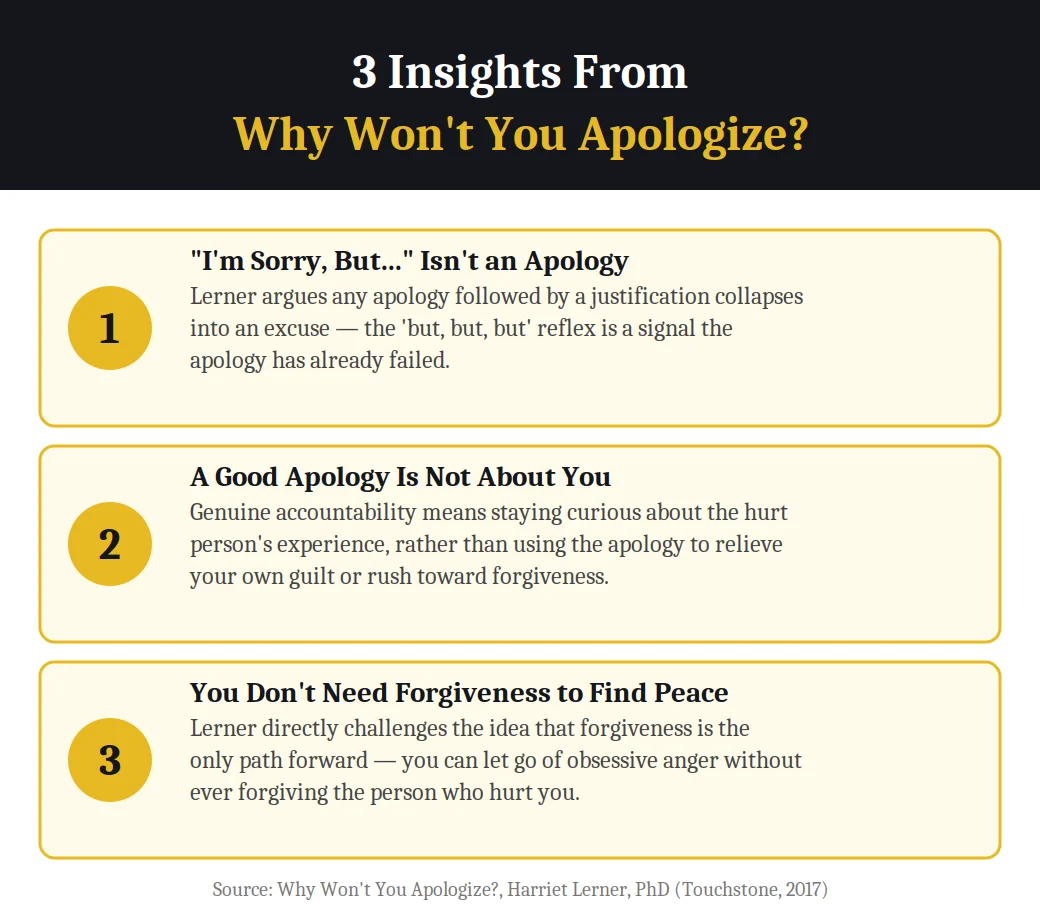
- A genuine apology requires tolerating shame and taking unambiguous responsibility for the impact of your actions, not just explaining your intentions.
- “I’m sorry you feel that way” and any apology starting with “I’m sorry if” are non-apologies that assign no real responsibility.
- Any apology followed by a justifying “but” collapses into an excuse — the “but, but, but” reflex signals the apology has already failed.
- A good apology is not about you: staying curious about the hurt person’s experience matters more than relieving your own guilt.
- Research suggests men statistically under-apologize while women statistically over-apologize, often for things that don’t actually matter.
- Save your apologies for things that matter — reflexive over-apologizing dilutes the ones that count.
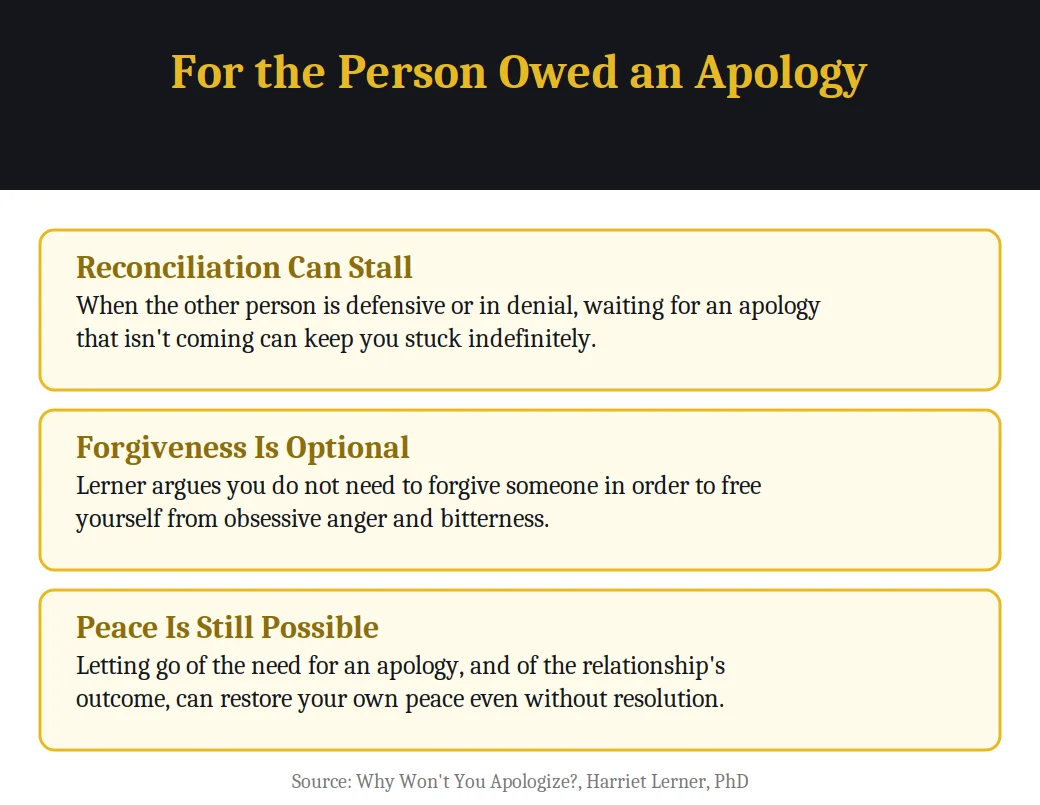
- When the other person is defensive or in denial, waiting indefinitely for an apology that isn’t coming can keep you stuck.
- You do not need to forgive a person who has hurt you in order to free yourself from obsessive anger and bitterness.
- Letting go of the need for an apology, and of a particular outcome, can restore your own peace even without resolution.
What is Why Won’t You Apologize? about?
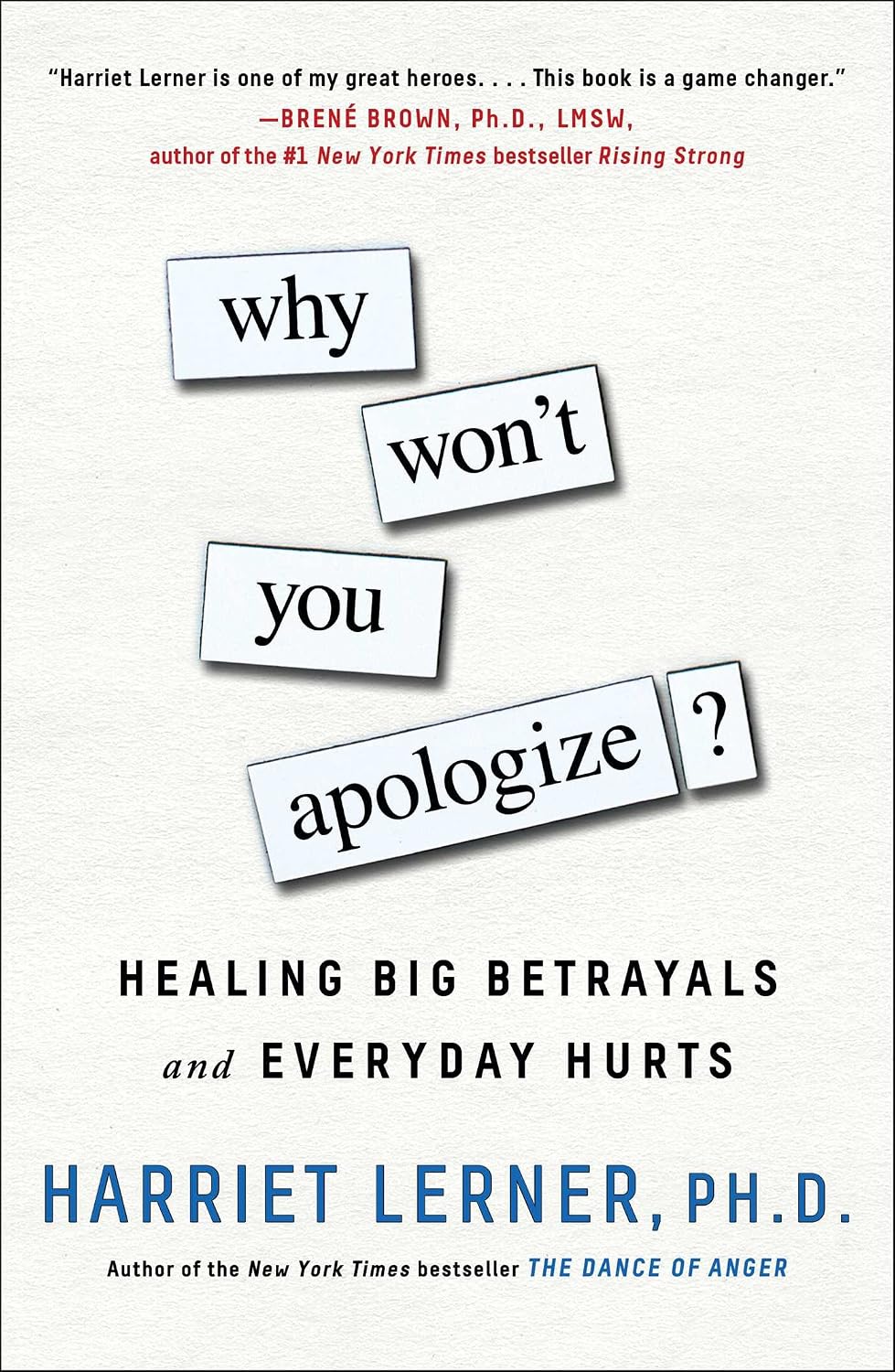
Why Won’t You Apologize? is Harriet Lerner’s deep dive into why genuine apologies are so hard to give and so powerful to receive, covering both “big betrayals” like affairs and estrangement and the everyday hurts that accumulate in any close relationship. Lerner spends the book’s early chapters cataloguing the many ways apologies go wrong — vague non-apologies, defensive “but” statements, apologies that rush toward forgiveness before the hurt person is ready — before turning to the more distinctive second half of the book: what to do when the apology you’re owed never comes. Rather than treating forgiveness as mandatory, she argues that letting go of anger and finding real peace are possible independent of whether the other person ever takes responsibility.
About the author
Harriet Lerner, PhD, is a clinical psychologist who spent nearly three decades on staff at the Menninger Clinic and taught at the Karl Menninger School of Psychiatry. She is best known for The Dance of Anger (1985), a New York Times bestseller that helped popularize the idea that women’s anger deserves to be taken seriously rather than suppressed, and has since written The Dance of Intimacy, The Dance of Deception, Marriage Rules, and Why Won’t You Apologize? (2017). Explore all Harriet Lerner, PhD book summaries →
Key concepts at a glance
| Concept | What it means |
|---|---|
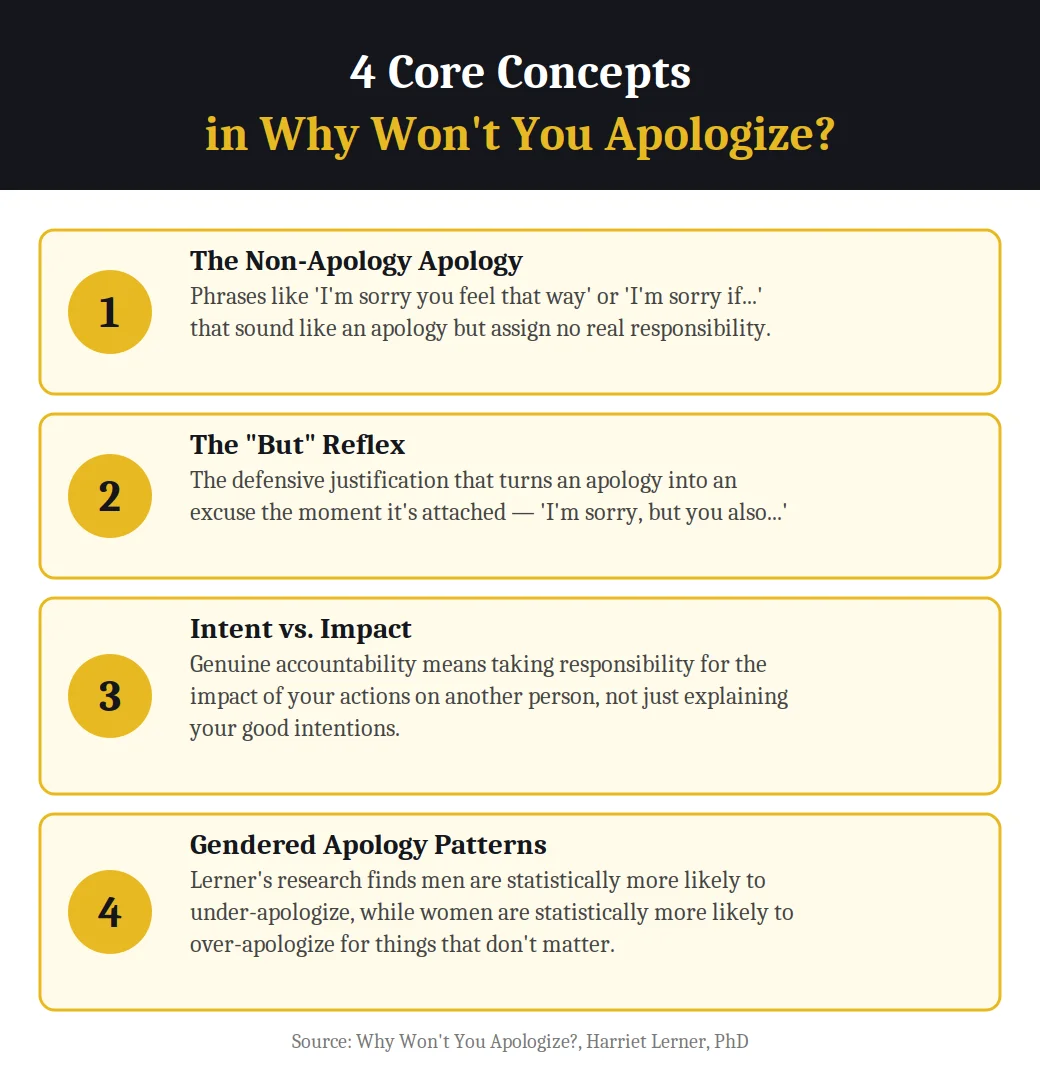
| The Non-Apology Apology | Phrases like “I’m sorry you feel that way” or “I’m sorry if…” that sound like an apology but assign no real responsibility. |
| The “But” Reflex | The defensive justification that turns an apology into an excuse the moment it’s attached. |
| Intent vs. Impact | Genuine accountability means taking responsibility for the impact of your actions on another person, not just explaining your good intentions. |
| Gendered Apology Patterns | Men statistically under-apologize while women statistically over-apologize, often for things that don’t matter. |
| Forgiveness Is Optional | You do not need to forgive a person who has hurt you in order to free yourself from obsessive anger and bitterness. |
Part 1: What ruins an apology
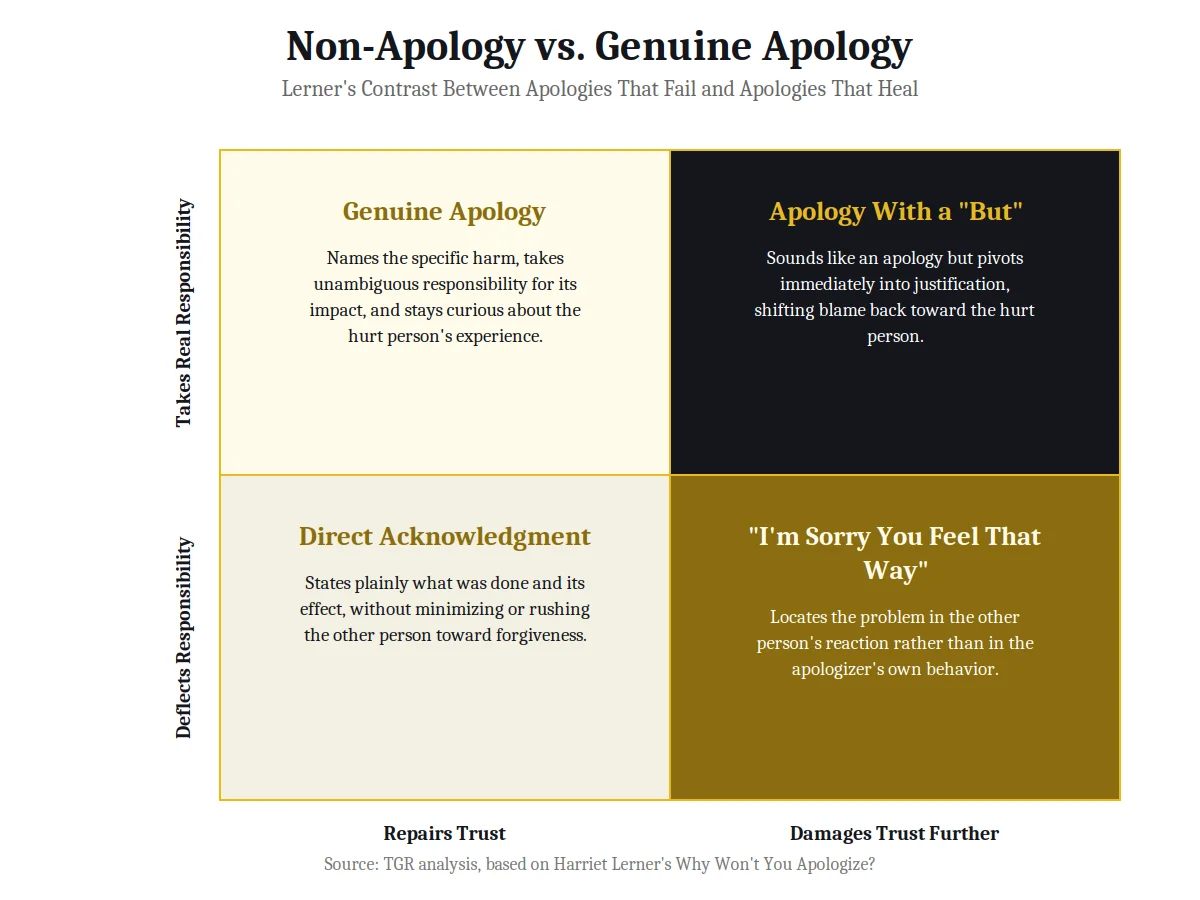
Lerner opens by cataloguing the specific ways apologies fail. “I’m sorry you feel that way” locates the problem in the hurt person’s reaction rather than in the apologizer’s own behavior. Any apology beginning with “I’m sorry if” hedges responsibility with a conditional, as though the harm might not have actually happened. And the defensive “but” reflex — “I’m sorry, but you also…” — turns an apology into a justification the instant it appears. Lerner argues genuine accountability requires taking unambiguous responsibility for the impact of your actions on the other person, distinct from simply explaining your intentions, which is a much easier and much less meaningful move.
TGR Note: This distinction between explaining your intent and acknowledging your impact echoes the “I position” Lerner develops further in her earlier book on anger — read our The Dance of Anger summary for more on stating your own position clearly without blame.
Part 2: Why genuine apologies are so rare
Lerner argues that a real apology asks the apologizer to tolerate shame directly, without deflecting it back onto the other person — which is exactly why so few people do it well. She notes research suggesting men statistically under-apologize while women statistically over-apologize, often for things that don’t actually matter, diluting the apologies that count. A section she titles “A Good Apology Is Not About You” makes the case that genuine accountability means staying deeply curious about the hurt person’s experience, rather than using the apology to relieve your own guilt or rush the other person toward forgiveness before they’re ready.
TGR Note: This idea that gender shapes who over-functions emotionally in a relationship connects directly to the pursuer-distancer and over-functioning/under-functioning patterns Milan and Kay Yerkovich describe in our How We Love summary.
Part 3: When the apology never comes
The book’s most distinctive contribution is its second half, aimed squarely at readers who are owed an apology that isn’t coming. Lerner directly challenges what she calls the popular belief that forgiveness is the only path to peace, arguing instead that a person can achieve real peace without ever forgiving the one who hurt them. When someone is defensive, in denial, or a repeat offender, waiting indefinitely for accountability can keep the hurt person stuck in obsessive anger. Letting go of the specific outcome — the apology, the acknowledgment, the reconciliation — is presented not as giving up, but as its own form of freedom.
Who is Why Won’t You Apologize? best for?
This book is best for anyone navigating a relationship rupture — whether they’re the one who needs to apologize and doesn’t know how to do it well, or the one who’s still waiting for an apology that may never arrive. Its dual framing makes it unusually useful for both sides of a conflict, not just the person at fault.
It pairs well with our The Dance of Anger summary for more on Lerner’s broader framework of taking a clear position without blame, or our How We Love summary for more on the childhood patterns that shape how people handle conflict and accountability.
Questions to reflect on
- Do you tend to give non-apologies — “I’m sorry you feel that way” or “I’m sorry if…” — rather than direct acknowledgment?
- Is there a “but” you routinely attach to your own apologies that undercuts them?
- Are you an over-apologizer, under-apologizer, or somewhere in between?
- Is there someone in your life you’re still waiting on an apology from — and what would it look like to find peace regardless?
- The next time you owe someone an apology, can you stay curious about their experience instead of rushing to relieve your own guilt?
How to apply Why Won’t You Apologize? (7-day plan)
- Day 1: Notice one apology you’ve given recently and check it for hedges like “if” or “but.”
- Day 2: Identify whether you tend to over-apologize or under-apologize in general.
- Day 3: The next time you owe someone an apology, practice naming the specific harm without justifying it.
- Day 4: Practice staying curious about the other person’s experience instead of rushing to explain your intentions.
- Day 5: Reflect on someone you’re still waiting on an apology from, and what’s kept you stuck waiting.
- Day 6: Consider what letting go of that specific outcome might feel like, separate from forgiveness.
- Day 7: Reflect on one relationship where a genuine apology, given or received, changed things for the better.
Frequently asked questions
What is a “non-apology apology” according to Harriet Lerner?
A non-apology apology is a phrase like “I’m sorry you feel that way” or anything beginning with “I’m sorry if,” which sounds like an apology but assigns no real responsibility to the person saying it.
What is the “but” reflex in Why Won’t You Apologize?
It’s Lerner’s term for the defensive justification that turns an apology into an excuse the moment it’s attached, as in “I’m sorry, but you also…”
Does Why Won’t You Apologize argue that men and women apologize differently?
Yes — Lerner cites research suggesting men are statistically more likely to under-apologize, while women are statistically more likely to over-apologize, often for things that don’t actually matter.
Do you have to forgive someone to move on, according to this book?
No — Lerner directly argues that forgiveness is optional, and that a person can free themselves from obsessive anger and bitterness without ever forgiving the one who hurt them.
Is this book only for people who need to apologize?
No — it’s written for two audiences at once: people who owe an apology and don’t know how to give one well, and people who are owed an apology that isn’t coming.
Who is Harriet Lerner?
Harriet Lerner, PhD, is a clinical psychologist who spent nearly three decades at the Menninger Clinic and is best known for The Dance of Anger (1985), a New York Times bestseller.
What does “intent vs. impact” mean in this book?
It’s Lerner’s distinction between explaining your good intentions, which is easy and often deflects blame, and taking unambiguous responsibility for the actual impact of your actions on the other person, which is what a genuine apology requires.
Related summaries
If you found Why Won’t You Apologize? valuable, read our The Dance of Anger summary for more on Harriet Lerner’s work, or explore our full list of best relationship books.
Our methodology: TGR book summaries are researched using the original text, publisher materials, author interviews, and critical reception, then structured to give you the core arguments, practical applications, and an honest verdict on who the book is best for.
Related Relationships Summaries
Daring Greatly Summary & Review: Why Vulnerability Is the Ultimate Courage
Loving Bravely Summary and Review
Nonviolent Communication Summary & Review: Replace Blame With Connection
Thanks for the Feedback Summary & Review: Master the Art of Receiving
The Road Less Traveled Summary & Review: Why Growth Demands Embracing Difficulty