

★★★★☆ 3.9/5 — A wide-ranging, personally grounded case that sleep deprivation is a public health crisis dressed up as a status symbol, though stronger on making that case than on offering deep, novel tactics.
Best for: readers who need convincing that sleep is worth prioritizing, and want cultural and historical context alongside practical basics · Reading time: ~8 hrs (this guide: ~10 min) · Difficulty to apply: Easy — most recommendations are foundational sleep-hygiene habits rather than a complex program
The Sleep Revolution in one minute
Arianna Huffington argues that modern hustle culture has turned sleep deprivation into a bizarre status symbol — a way of signaling ambition and toughness — when it’s actually a public health crisis with measurable costs to health, cognition, relationships, and the economy. The book grew directly out of her own 2007 collapse: running on roughly four hours of sleep a night while building The Huffington Post, she passed out from exhaustion at her desk, hit her head on the way down, and woke up in a pool of blood with a broken cheekbone. That event reoriented her thinking on success, leading first to her book Thrive and its “Third Metric” — success measured by well-being, wisdom, and wonder, not just money and power — and then to this deeper exploration of sleep as the foundation underneath that Third Metric. Published in 2016, the book compares normalized sleep deprivation to how smoking was once glamorized before its health costs were understood, and argues that reclaiming real sleep is one of the highest-leverage things a person can do, whether for personal health, workplace performance, or relationships.
Key takeaways
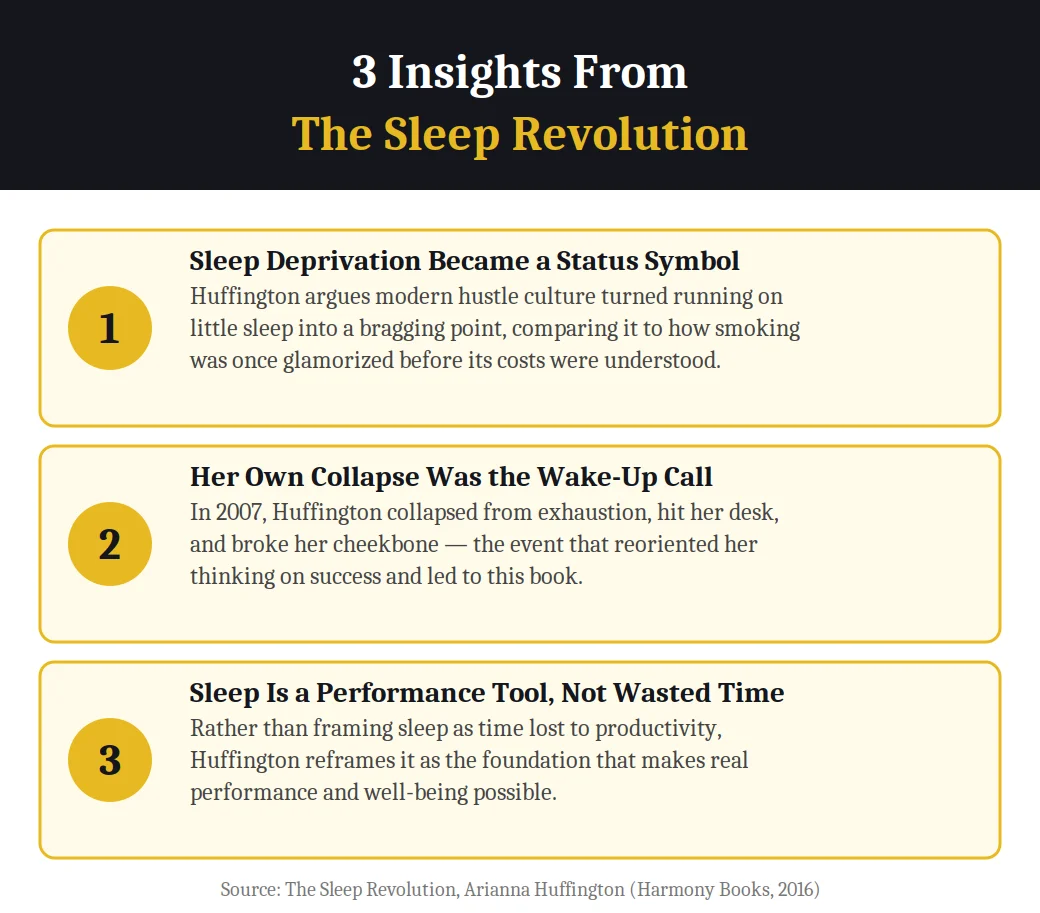
- Sleep deprivation became a status symbol: Huffington argues hustle culture turned running on little sleep into a bragging point, likening it to how smoking was once glamorized before its costs were understood.
- Her own collapse was the catalyst: a 2007 exhaustion-driven collapse that broke her cheekbone reoriented her thinking on success and led directly to this book.
- Sleep is a performance tool, not wasted time: rather than framing sleep as time lost to productivity, Huffington reframes it as the foundation that makes real performance and well-being possible.
- The crisis is culturally normalized, not just individual: she frames chronic under-sleeping as a widespread problem enabled by workplace culture, not simply a personal failing to fix alone.
- Sleep hygiene basics matter more than people assume: removing screens from the bedroom, keeping the room cool and dark, and maintaining consistent bedtimes are presented as foundational, evidence-backed changes.
- Napping is reframed as a performance tool: companies like Google and Zappos are cited as examples of workplaces normalizing napping as legitimate recovery, not laziness.
- Sleep deprivation has real economic costs: Huffington cites lost productivity from inadequate sleep as a substantial, multi-billion-dollar drag on the economy each year.
- Extended wakefulness impairs functioning measurably: she compares cognitive impairment after many hours awake to functioning at a notable level of impairment, affecting decisions and mood.
- Sleep inequality is a real and under-discussed issue: she cites research showing sleep quality tends to decrease as income decreases, complicating any one-size-fits-all prescription for better sleep.
What is The Sleep Revolution about?
The Sleep Revolution is Arianna Huffington’s case that chronic sleep deprivation, far from being a badge of ambition, is a public health crisis with real costs to health, cognition, relationships, and the economy — and that reclaiming sufficient sleep is foundational to the “Third Metric” of success (well-being, wisdom, and wonder) she introduced in her earlier book Thrive. Drawing on her own 2007 collapse from exhaustion as a personal catalyst, Huffington surveys the cultural history of sleep deprivation as a status symbol, cites research on its health and cognitive costs, and offers practical sleep-hygiene guidance across different life stages — students, workers, couples, and athletes. Published in 2016 by Harmony Books, the book pairs cultural and historical commentary with foundational, accessible recommendations for improving sleep quality and quantity.
About the author
Arianna Huffington is the co-founder of The Huffington Post and founder and CEO of Thrive Global, a behavior-change technology company focused on well-being and productivity. In April 2007, she collapsed from exhaustion at her desk, breaking her cheekbone on the way down — an event she has described as her wake-up call away from a culture that treats overwork and sleep deprivation as badges of honor. That collapse shaped her earlier book Thrive: The Third Metric to Redefining Success and Creating a Life of Well-Being, Wisdom, and Wonder, and led directly to The Sleep Revolution, which extends her argument that well-being, not just money and power, has to include sufficient rest. Explore all Arianna Huffington book summaries →
Key concepts at a glance
| Concept | What it means | Use it when |
|---|---|---|
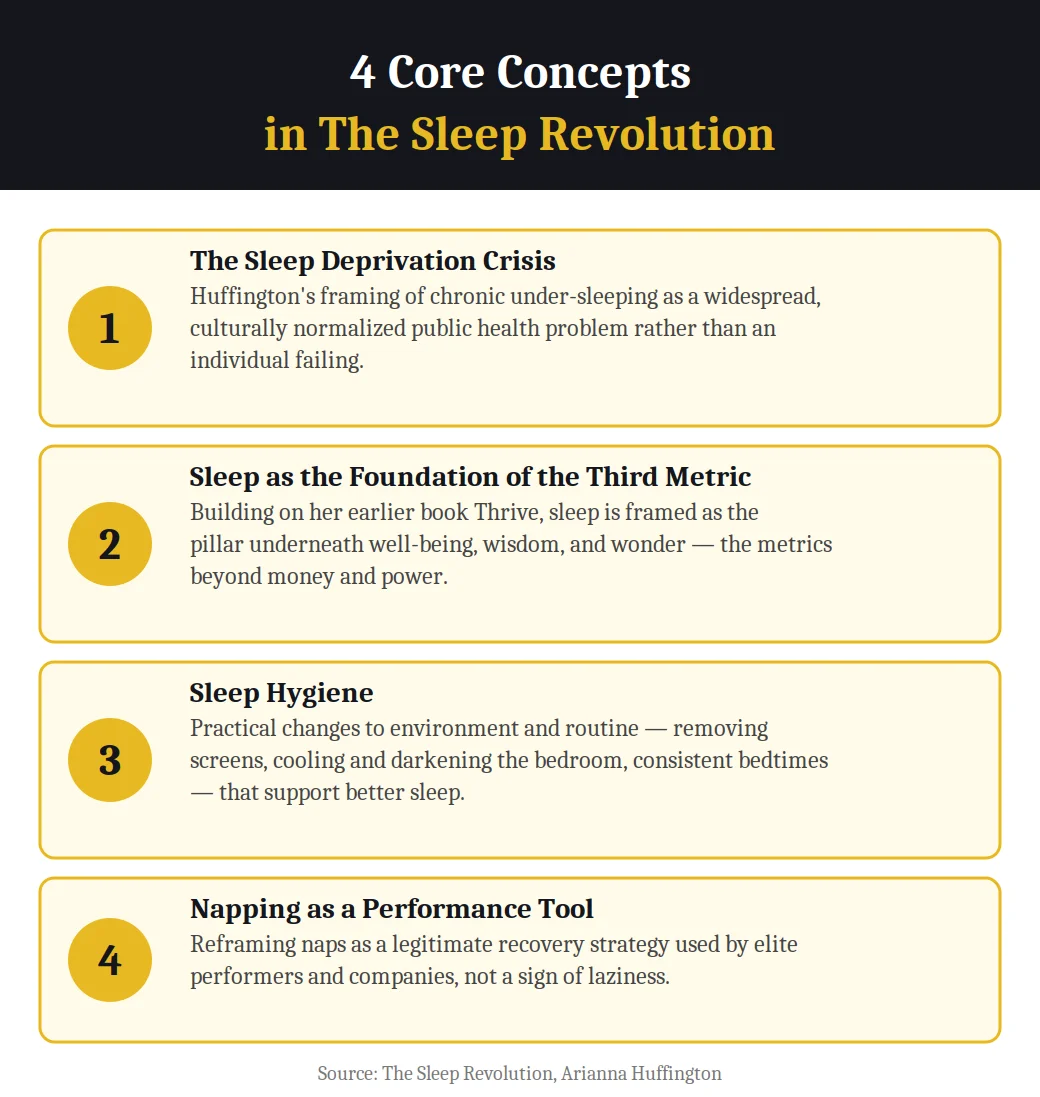
| The Sleep Deprivation Crisis | Chronic under-sleeping framed as a widespread, culturally normalized public health problem | You’re evaluating whether your own sleep habits are actually normal or actually a problem |
| Sleep as the Third Metric’s Foundation | Sleep positioned as the pillar underneath well-being, wisdom, and wonder from Thrive | You’re thinking about success in terms beyond money and career achievement |
| Sleep Hygiene | Practical environment and routine changes — no screens, cool dark room, consistent bedtime | You want concrete, low-effort changes to try first |
| Napping as a Performance Tool | Reframing naps as legitimate recovery, used by elite performers and forward-thinking companies | You’re deciding whether a midday rest is worth protecting on your calendar |
| Sleep Inequality | The pattern that sleep quality tends to decline as income declines | You’re considering how realistic standard sleep advice is for your own circumstances |
Part 1: From personal collapse to public health crisis
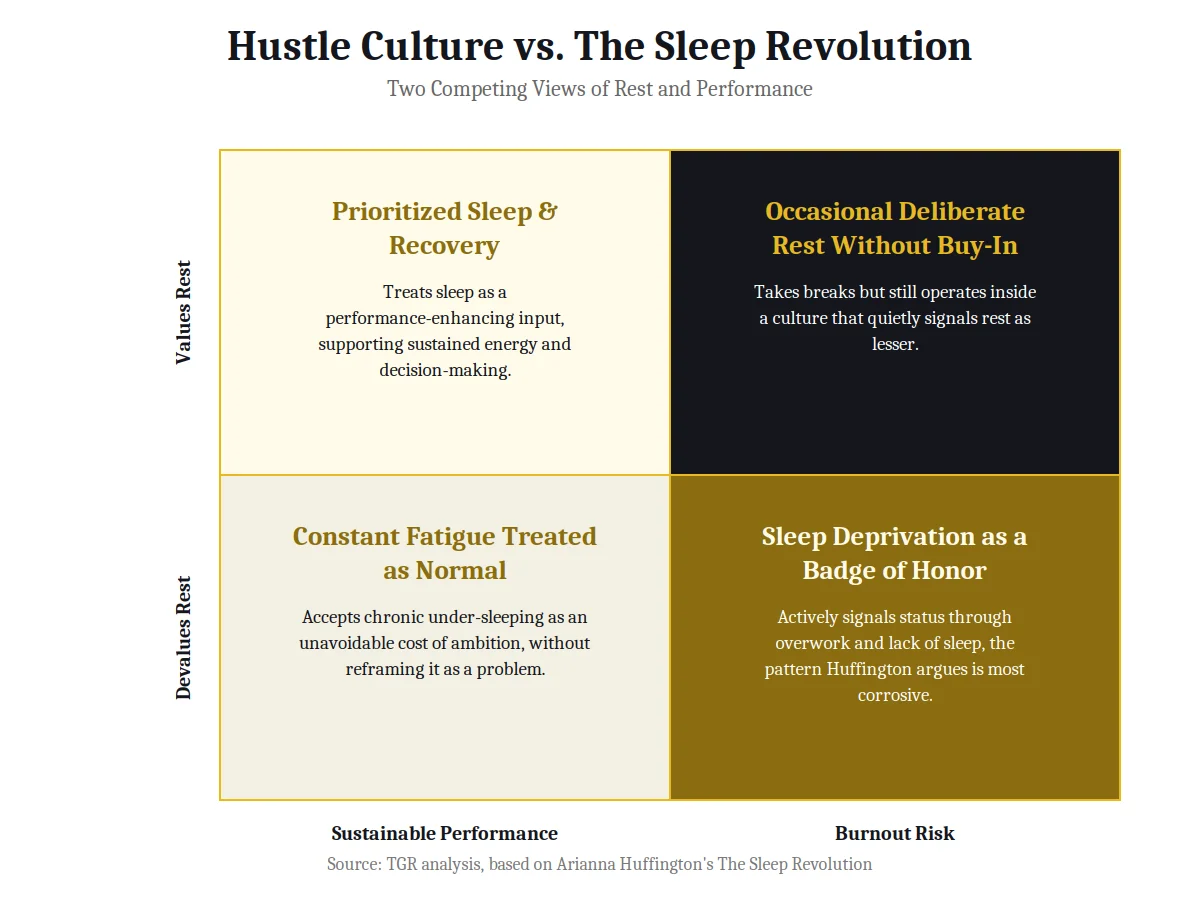
Huffington opens from personal experience: in April 2007, running The Huffington Post on roughly four hours of sleep a night, she collapsed from exhaustion at her desk, hit her head on the way down, and woke up with a broken cheekbone. That event became the catalyst for rethinking her relationship to work and success, first explored in Thrive and its “Third Metric” of well-being, wisdom, and wonder beyond money and power, and then extended here into a deeper argument: that sleep deprivation isn’t an individual quirk but a widespread, culturally reinforced crisis. She points to the way executives and public figures have historically bragged about running on little sleep, arguing this glamorization mirrors how smoking was once treated as sophisticated before its health costs were widely understood.
TGR Note: Huffington’s argument that rest underlies sustainable performance connects to Younger Next Year‘s case that daily recovery habits, not raw effort, determine long-term outcomes.
Part 2: The costs of sleep deprivation and the case for napping
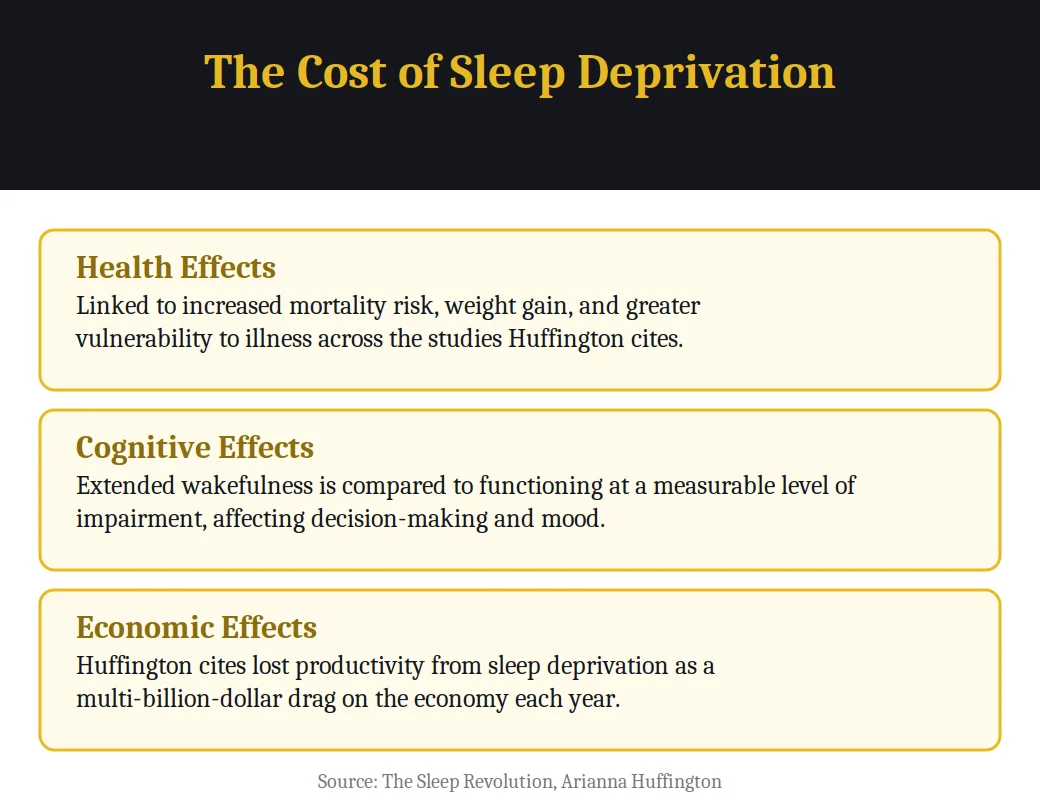
Huffington marshals a wide range of statistics to make the stakes concrete: extended wakefulness compared to measurable cognitive impairment, sleep deprivation linked to increased mortality risk and weight gain, and lost productivity from inadequate sleep estimated as a multi-billion-dollar economic drag each year. She reframes napping specifically as a legitimate performance tool rather than a sign of laziness, pointing to companies like Google, Zappos, and Ben & Jerry’s that have installed nap spaces alongside conference rooms, and predicting that dedicated nap rooms will become as standard in workplaces as meeting rooms already are. This section is where the book leans most heavily on comparison and statistics to build its case for taking sleep seriously as a lever for both health and performance.
Part 3: Practical sleep hygiene and sleep inequality
The book’s practical guidance is intentionally foundational: removing electronics from the bedroom, establishing a screen cutoff before bed, keeping the room cool and dark, building consistent bedtime rituals, and managing caffeine intake. Huffington extends this guidance across different groups — students and school start times, couples and the value of physical touch during sleep, and workers navigating demanding schedules — while also acknowledging an important complication: a University of Chicago study she cites found sleep quality tends to decline as income declines, meaning lower-wage workers, who often hold multiple jobs, face structural barriers to the very recommendations the book offers. This tension between individual sleep-hygiene advice and systemic sleep inequality is acknowledged but not fully resolved in the text.
Who is The Sleep Revolution best for — and who should read something else first?
This book is best for readers who need to be convinced that sleep deserves real priority — those still operating inside a culture that treats rest as optional or weak — and who want cultural and historical context alongside foundational sleep-hygiene guidance. Readers who already accept the importance of sleep and want deeper, more clinical tactics, or anyone dealing with a diagnosed sleep disorder, may find the practical advice here more introductory than they need.
If you want a broader look at daily recovery habits beyond sleep specifically, Younger Next Year offers a complementary case for exercise and connection as the other pillars of sustainable long-term health.
Questions to reflect on
- Do you find yourself, even subtly, treating little sleep as a sign of hard work or dedication?
- What would change in your evenings if you set a firm screen cutoff time before bed?
- How does your workplace culture treat rest — as a legitimate need or as a weakness to hide?
- If napping were normalized at your workplace the way it is at some tech companies, would you use it?
- How realistic do the book’s sleep-hygiene recommendations feel given your actual schedule and circumstances?
🔥 Ready to stop treating sleep deprivation as a badge of honor?
This guide covers the core framework — the book gives you Huffington’s full cultural history of sleep, the complete research, and practical guidance for every life stage.
How to apply The Sleep Revolution (7-day plan)
- Day 1: Track how many hours of sleep you actually get for a baseline, without judgment.
- Day 2: Set a screen cutoff time — put your phone outside the bedroom or in airplane mode an hour before bed.
- Day 3: Adjust your bedroom environment: cooler temperature, blackout curtains or an eye mask if needed.
- Day 4: Build a simple wind-down ritual — a bath, reading, or stretching instead of scrolling.
- Day 5: Cut caffeine after a set time in the early afternoon and notice the effect that night.
- Day 6: If your schedule allows, try a short midday nap and notice its effect on your afternoon energy.
- Day 7: Reflect on which habit from the week felt most sustainable, and commit to keeping it going.
Frequently asked questions
What prompted Arianna Huffington to write this book?
A 2007 collapse from exhaustion, in which she broke her cheekbone, reoriented her thinking on success and sleep.
What is the “Third Metric”?
A measure of success beyond money and power, encompassing well-being, wisdom, and wonder, introduced in Huffington’s book Thrive.
Does the book recommend napping at work?
Yes — it cites companies like Google and Zappos as examples of workplaces treating naps as a legitimate performance tool.
Is this book useful for people with diagnosed sleep disorders?
It’s aimed more at lifestyle-driven sleep deprivation than clinical insomnia or sleep apnea, which warrant professional treatment.
Does the book address sleep inequality?
Yes — it cites research showing sleep quality tends to decline as income declines, though it doesn’t fully resolve the tension this creates.
What are the main sleep hygiene recommendations?
Removing screens from the bedroom, a cool dark room, consistent bedtimes, and managing caffeine intake.
How is this different from Younger Next Year?
Younger Next Year focuses on exercise and connection for healthy aging; this book focuses specifically on sleep as a foundation for performance and well-being.
Related summaries
If The Sleep Revolution resonated, these dig further into related territory: Younger Next Year on daily habits for healthy aging, and other titles in our best health books pillar page.
How we analyze books: We work from the full book — reconstructing its core arguments in our own words, adding commentary that connects it to related research and other books in our library, and pressure-testing the advice in a practical 7-day plan. Ratings weigh usefulness, readability, and evidence quality. Read our full methodology.
Related Health Summaries
How to Change Your Mind Summary & Review: The Science Behind the Psychedelic Renaissance
Ikigai Summary & Review: The Japanese Secret to a Long and Happy Life
Outlive Summary & Review: The Science and Art of Longevity
Spark Summary & Review: The Science of Exercise and the Brain
The Complete Guide to Fasting Summary & Review: Heal Your Body Through Fasting