

★★★★☆ 4.1/5 — A sweeping case that traditional food-preparation wisdom encodes genuine nutritional science, and that industrial food — especially refined vegetable oils — disrupts the cellular signaling genes depend on.
Best for: readers curious about the intersection of traditional cooking, epigenetics, and modern disease, willing to weigh a physician’s argument against mainstream nutrition science · Reading time: ~10 hrs (this guide: ~11 min) · Difficulty to apply: Moderate — the Four Pillars are simple to state but require real changes to how you source and prepare food
Deep Nutrition in one minute
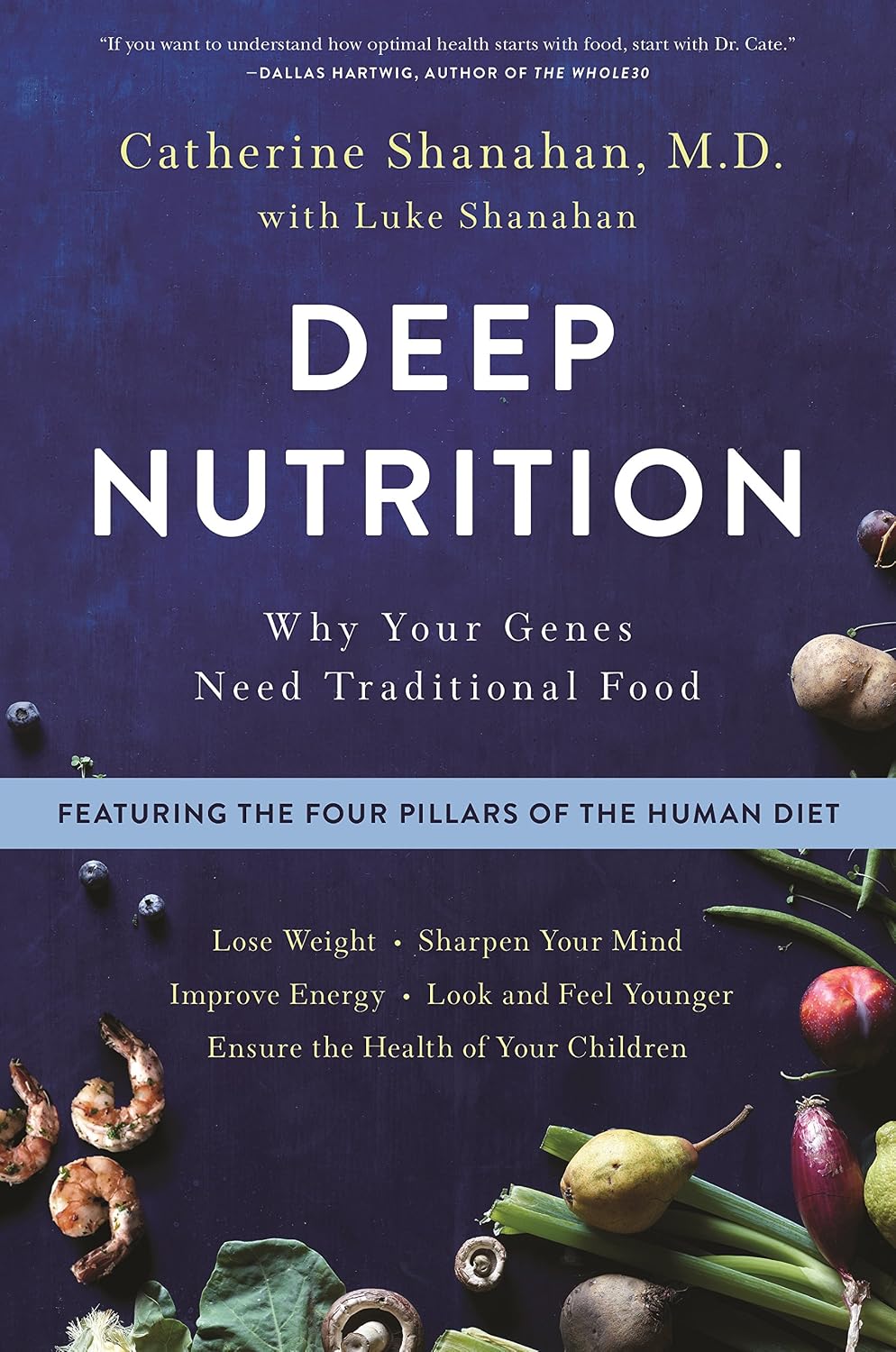
Catherine Shanahan, MD, argues that food isn’t just calories — it’s information that directs gene expression and cellular development, starting in utero and compounding across generations. Drawing on Weston A. Price’s early-20th-century field surveys of traditional societies worldwide, Shanahan identifies four recurring practices she calls the “Four Pillars of the Human Diet”: meat cooked on the bone (bone broth), organ meats, fresh minimally processed food, and fermented or sprouted food. She contrasts these traditional foundations with the modern industrial diet’s reliance on refined sugar, refined flour, and — her central concern — industrial seed and vegetable oils, which she argues are chemically unstable and disruptive to cell membranes and hormone signaling in ways traditional fats like butter and animal fat never were. Originally self-published in 2008 and substantially revised and expanded by Flatiron Books in 2017, the book extends its argument into epigenetics, proposing that a parent’s diet shapes offspring health through gene-expression changes — a concept she frames as “genetic wealth” being either preserved or spent down across generations.
Key takeaways
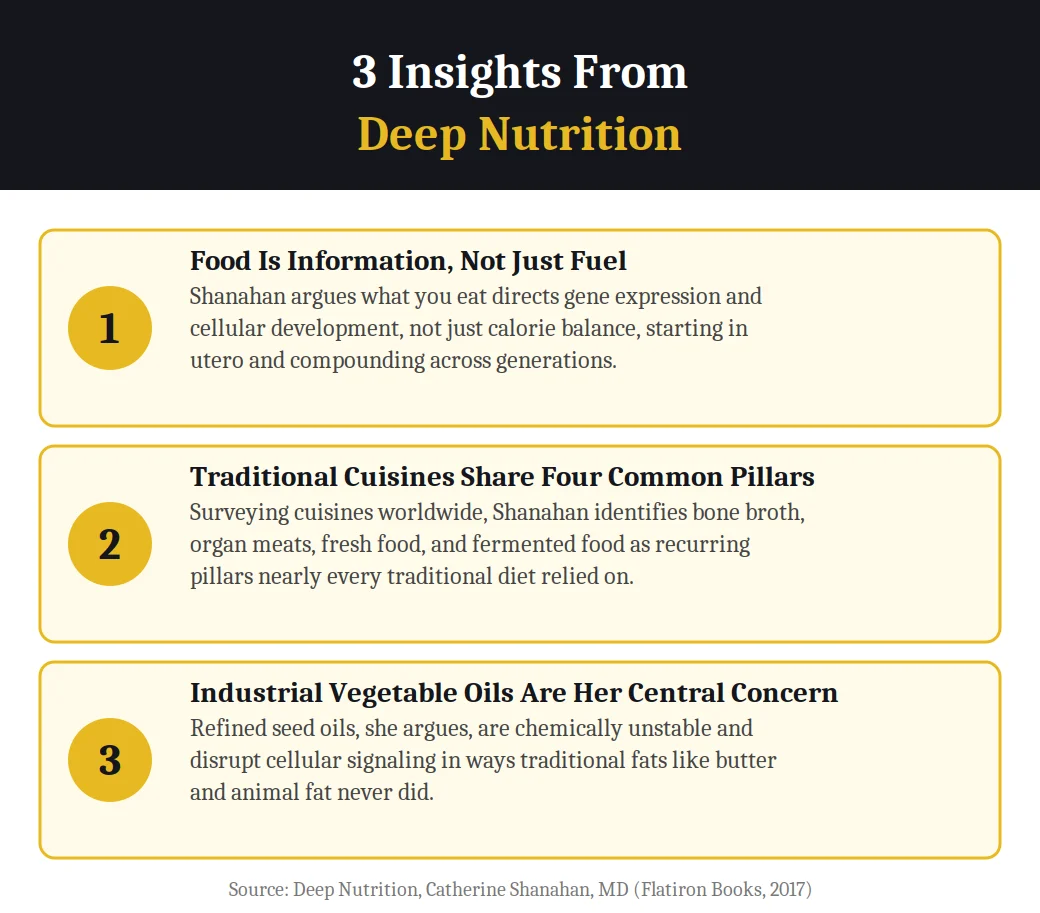
- Food is information, not just fuel: Shanahan argues nutrients direct gene expression and cellular development, not merely supply calories — a distinction she treats as central to understanding modern chronic disease.
- Traditional cuisines share four common pillars: bone broth, organ meats, fresh food, and fermented or sprouted food recur across traditional diets worldwide, according to her survey of world cuisines building on Weston A. Price’s fieldwork.
- Industrial seed oils are her central concern: refined vegetable oils are chemically unstable and oxidize easily, she argues, disrupting cell membranes and hormone signaling in ways traditional fats did not.
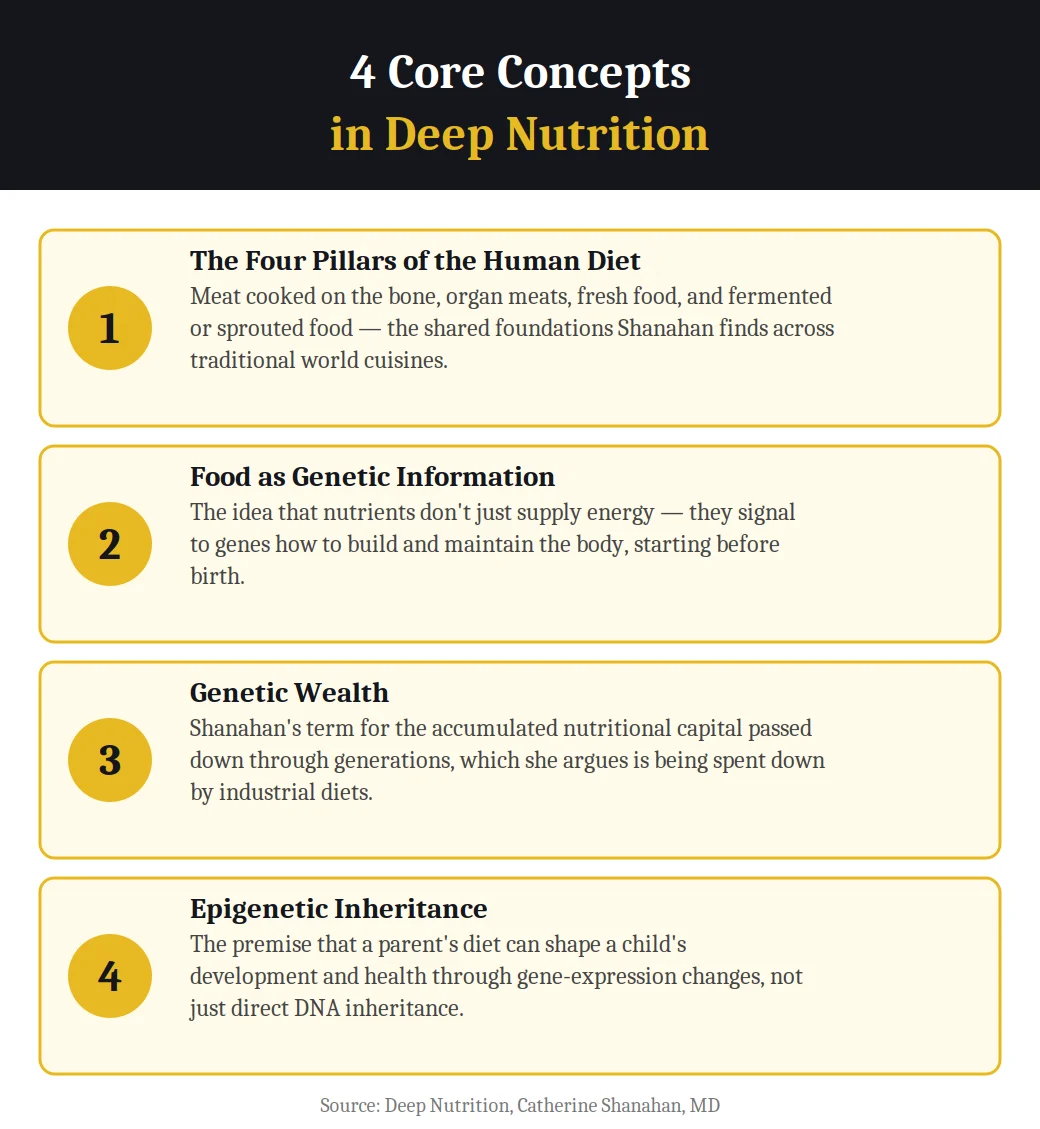
- Epigenetics extends the stakes across generations: Shanahan argues a parent’s diet can shape a child’s development and health through gene-expression changes, not just direct DNA inheritance.
- “Genetic wealth” can be spent down: her term for accumulated nutritional capital passed down through generations, which she argues industrial diets are depleting rather than replenishing.
- Facial and skeletal development are used as visible markers: Shanahan references generational changes in jaw and facial structure as a proxy for deeper developmental effects of diet.
- Bone broth and organ meats are nutrient-dense staples: she argues these traditional foods carry minerals and fat-soluble vitamins that muscle meat and produce alone don’t fully replace.
- Fermentation and sprouting increase bioavailability: traditional preparation methods, she argues, make nutrients more accessible and add beneficial microbes that raw or industrially processed versions lack.
- The book’s core seed-oil claims are contested by mainstream nutrition science: major public-health researchers have found little evidence that seed oils themselves are harmful, tracing much of their bad reputation to their association with ultra-processed food rather than intrinsic chemistry.
What is Deep Nutrition about?
Deep Nutrition is Catherine Shanahan’s case that traditional food-preparation wisdom — distilled into what she calls the “Four Pillars of the Human Diet” — reflects genuine nutritional science that modern industrial eating has abandoned, with consequences for both individual and multi-generational health. Drawing on Weston A. Price’s field surveys of traditional societies and her own background in genetics and biochemistry, Shanahan argues that food functions as information directing gene expression, and that industrial staples — especially refined vegetable oils — disrupt that signaling in ways traditional fats and whole foods do not. Originally self-published in 2008 and substantially revised and expanded by Flatiron Books in 2017, the book combines evolutionary biology, epigenetics, and practical dietary guidance, while extending into more contested territory around facial development, fertility, and the intergenerational transmission of health.
About the author
Catherine Shanahan, MD, is a family physician with a background in biochemistry and genetics, and the former team physician for the Los Angeles Lakers. After completing her medical training and a period of research and practice in Japan and China, she opened a family practice in Kauai, Hawaii, where she began treating chronic disease through a lens combining evolutionary biology, genetics, and traditional nutrition. Drawing on Weston A. Price’s early-20th-century field surveys of traditional diets around the world, Shanahan developed the “Four Pillars” framework at the center of Deep Nutrition, and has continued to expand her critique of industrial food, especially refined vegetable oils, in subsequent books including Dark Calories. Explore all Catherine Shanahan, MD book summaries →
Key concepts at a glance
| Concept | What it means | Use it when |
|---|---|---|
| The Four Pillars of the Human Diet | Bone broth, organ meats, fresh food, and fermented or sprouted food shared across traditional world cuisines | You’re deciding what categories of food to prioritize adding back into your diet |
| Food as Genetic Information | The idea that nutrients signal to genes how to build and maintain the body, not just supply energy | You’re evaluating why two similar-calorie diets might have very different health effects |
| Genetic Wealth | Accumulated nutritional capital passed down through generations, which industrial diets may deplete | You’re thinking about diet choices in the context of future children, not just yourself |
| Epigenetic Inheritance | The premise that a parent’s diet can shape offspring development through gene-expression changes | You’re planning nutrition around pregnancy or early childhood |
| Industrial Seed Oils | Shanahan’s central concern — refined vegetable oils she argues are chemically unstable and disruptive | You’re comparing cooking fats and deciding what to use regularly |
Part 1: The Four Pillars of the human diet
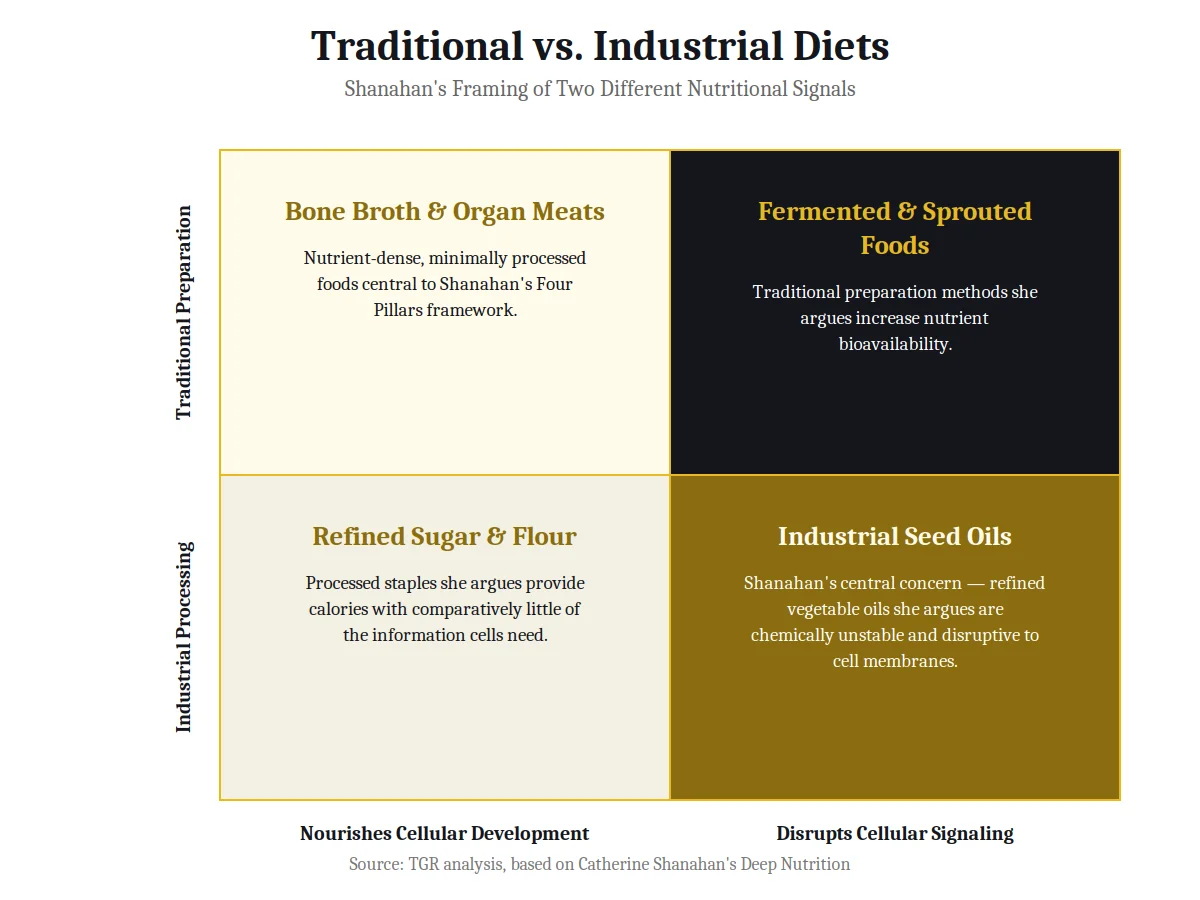
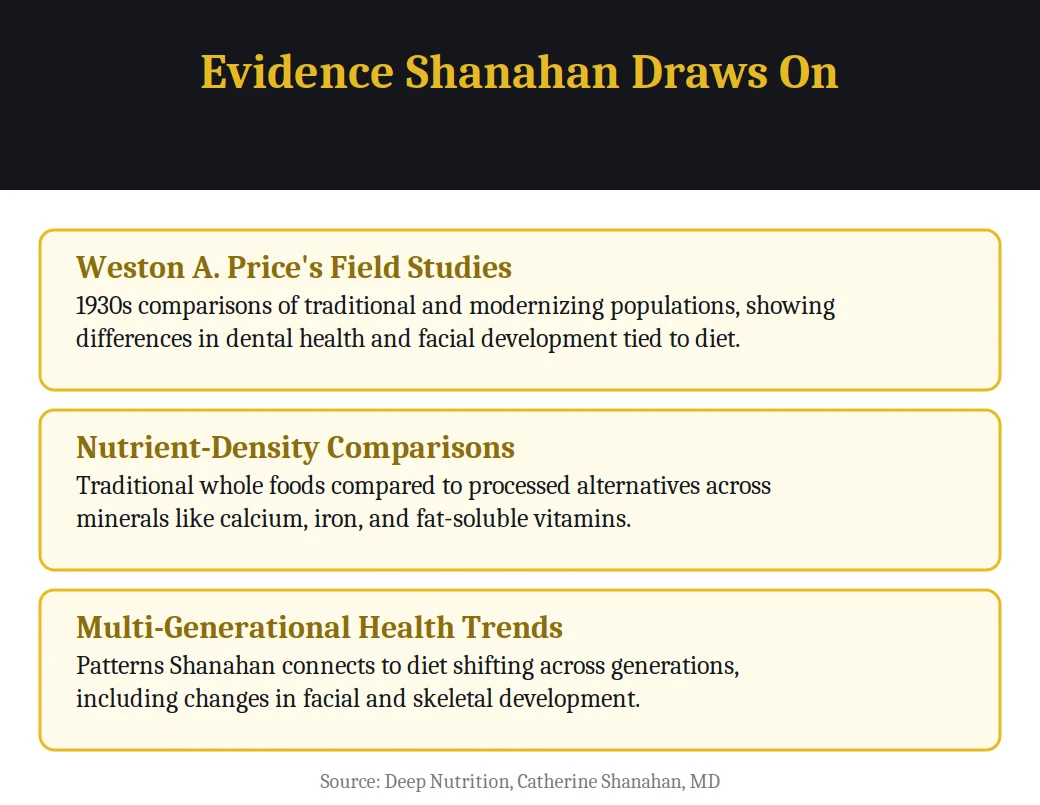
Shanahan’s foundational framework comes from surveying traditional cuisines around the world — building on physician and researcher Weston A. Price’s 1930s fieldwork across roughly a dozen traditional societies — and finding four recurring practices she argues appear almost universally: meat cooked on the bone (bone broth and stock, valued for minerals and collagen), organ meats (prized for nutrient density well beyond muscle meat), fresh, minimally processed food (vegetables, herbs, and spices for antioxidants and enzymes), and fermented or sprouted foods (valued for improved bioavailability and beneficial microbes). She argues these four categories, taken together, supplied the nutritional density that traditional populations relied on, and that their disappearance from the modern plate — replaced by refined staples — is a primary driver of contemporary chronic disease.
TGR Note: Shanahan’s emphasis on whole, minimally processed food echoes How Not to Diet‘s caloric-density argument — both push back against relying on refined, industrially processed staples as the foundation of a diet.
Part 2: Food as information and the epigenetics argument
Central to Shanahan’s thesis is the claim that food functions as information directing gene expression and cellular development, not merely as a source of calories — a claim she extends into epigenetics, arguing a parent’s diet at conception and during pregnancy can shape a child’s long-term health through gene-expression changes rather than only through direct DNA inheritance. She frames this as “genetic wealth”: an accumulated nutritional buffer passed down through generations that can either be preserved through traditional eating or spent down by industrial diets, leaving successive generations progressively less robust. This is the most scientifically ambitious — and most contested — part of the book: while epigenetic mechanisms like DNA methylation responding to maternal nutrition are well established in mainstream science, critics argue Shanahan extends this into broader claims about multi-generational health and facial/skeletal development that run ahead of what current evidence firmly supports.
Part 3: The case against industrial seed oils
Shanahan’s most pointed and, per critics, most contested argument concerns industrial seed and vegetable oils — soybean, corn, canola, and cottonseed oil among them — which she argues are chemically unstable, oxidize readily during both processing and digestion, and integrate into cell membranes in ways that disrupt hormone signaling and mitochondrial function. This is worth reading with real skepticism alongside her case: major public-health researchers, including at Johns Hopkins Bloomberg School of Public Health, have found abundant evidence that seed oils are not harmful and that linoleic acid specifically is associated with lower, not higher, cardiovascular and Type 2 diabetes risk, with much of seed oils’ bad reputation traced to their association with ultra-processed food rather than any intrinsic toxicity. Readers should treat Shanahan’s seed-oil argument as one contested position in an active scientific debate rather than settled consensus.
Who is Deep Nutrition best for — and who should read something else first?
This book is best for readers interested in the intersection of traditional cooking, evolutionary biology, and epigenetics who are willing to weigh Shanahan’s arguments — particularly on seed oils and multi-generational health — against mainstream nutrition science rather than accepting them uncritically. It’s a useful lens for thinking about food quality and preparation, less so as a settled scientific reference on seed-oil toxicity specifically.
If you want a more mainstream-aligned, evidence-dense treatment of nutrition and weight, How Not to Diet offers a heavily cited counterpoint built on caloric density and fiber rather than traditional food preparation.
Questions to reflect on
- Which of the Four Pillars — bone broth, organ meats, fresh food, fermented food — is most absent from your current diet?
- How much of your regular cooking relies on refined vegetable oils, and would you consider substituting traditional fats for some of it?
- If you’re planning a pregnancy or have young children, how does the epigenetics argument change how you think about your own diet’s stakes?
- Where do you land on the seed-oil debate after weighing Shanahan’s case against the mainstream public-health research cited alongside it?
- What would a small, realistic step toward incorporating traditional food preparation look like in your own kitchen this week?
🔥 Ready to see food as information, not just fuel?
This guide covers the core framework — the book gives you Shanahan’s full Four Pillars research, recipes, and the complete epigenetics argument.
How to apply Deep Nutrition (7-day plan)
- Day 1: Check your kitchen for which of the Four Pillars — bone broth, organ meats, fresh food, fermented food — are missing from your regular rotation.
- Day 2: Make or buy a batch of bone broth and use it as a base for one meal.
- Day 3: Try incorporating a small amount of organ meat (like liver) into one dish.
- Day 4: Swap one meal’s cooking oil for a traditional fat like butter, ghee, or olive oil.
- Day 5: Add a fermented food — yogurt, sauerkraut, kimchi — to one meal.
- Day 6: Read up on the seed-oil debate from both Shanahan’s perspective and mainstream public-health sources to form your own view.
- Day 7: Plan one realistic, sustainable change to your weekly cooking routine based on the Four Pillars.
Frequently asked questions
What are the Four Pillars of the Human Diet?
Meat cooked on the bone, organ meats, fresh food, and fermented or sprouted food — practices Shanahan finds across traditional world cuisines.
What does “food is information” mean?
The idea that nutrients direct gene expression and cellular development, not just supply calories.
Are seed oils actually harmful, according to mainstream science?
Major public-health researchers have found little evidence they’re harmful, and some evidence they’re associated with lower cardiovascular risk.
What is “genetic wealth”?
Shanahan’s term for accumulated nutritional capital passed down through generations, which she argues industrial diets deplete.
Is the epigenetics argument scientifically established?
The underlying mechanisms are real, but critics argue Shanahan’s broader multi-generational claims go beyond current consensus.
Which edition of the book should I read?
The 2017 Flatiron Books revised and expanded edition is the version commonly sold today, roughly double the length of the original 2008 self-published edition.
How is this different from How Not to Diet?
How Not to Diet focuses on evidence-dense nutrition science for weight loss; Deep Nutrition focuses on traditional food preparation and epigenetics.
Related summaries
If Deep Nutrition resonated, these dig further into related territory: How Not to Diet on evidence-based nutrition science, and other titles in our best health books pillar page.
How we analyze books: We work from the full book — reconstructing its core arguments in our own words, adding commentary that connects it to related research and other books in our library, and pressure-testing the advice in a practical 7-day plan. Ratings weigh usefulness, readability, and evidence quality. Read our full methodology.
Related Health Summaries
Salt Sugar Fat Summary & Review: How the Food Giants Hooked Us
The Longevity Diet Summary & Review: Valter Longo’s Science-Backed Plan for Living Longer
The Telomere Effect Summary & Review: The Nobel Prize Science of Slowing Biological Aging
The Wim Hof Method Summary & Review: Breathe, Embrace the Cold, Transform Your Health
You Are the Placebo Summary & Review: How Your Mind Rewires Your Body