

★★★★☆ 4.5/5 — A blunt, energizing case that most of what we call aging past 50 is optional biological decay, reversible through daily exercise and real connection.
Best for: readers over 40 who want a science-backed, no-excuses case for why daily exercise matters more than almost anything else · Reading time: ~7 hrs (this guide: ~12 min) · Difficulty to apply: Moderate — the rules are simple, building the daily habit is the real work
Younger Next Year in one minute
Most of what people call “aging” after 50 isn’t aging at all — it’s decay, and Chris Crowley and Dr. Henry Lodge argue decay is a decision you don’t have to make. Written in alternating chapters — Crowley, a retired Wall Street lawyer who transformed his own health in his 70s, provides the motivational voice, while Lodge, an internal medicine physician, explains the underlying biology — the book’s central claim is that roughly 70% of premature aging and physical decline before age 80 is governed by lifestyle, not genetics. The mechanism is cellular signaling: exercise triggers “grow” signals that tell tissue to repair and build itself, while a sedentary life sends the opposite “decay” signal, since the body is still biologically wired for the daily physical activity of a hunter-gatherer past. First published in 2004 and updated in a revised second edition in 2019, the book distills its argument into a blunt set of “Harry’s Rules” — exercise six days a week, quit eating crap, connect and commit to other people — treating fitness, nutrition, and emotional connection as a single, unified prescription for a vital “next third” of life.
Key takeaways
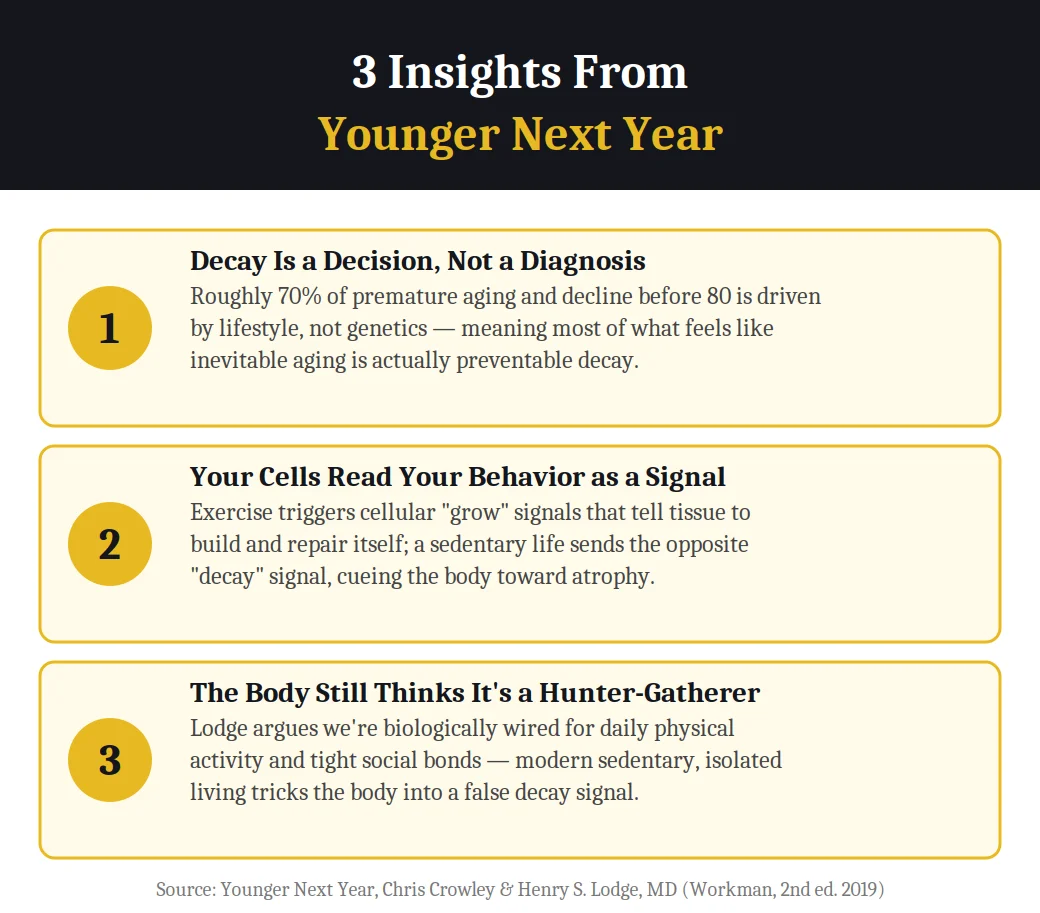
- Decay is a decision, not a diagnosis: roughly 70% of premature aging and decline before age 80 is driven by lifestyle choices, not genetics, meaning most of what feels like inevitable aging is actually preventable.
- Your cells read your daily behavior as a signal: exercise triggers cellular “grow” signals that tell tissue to build and repair itself, while inactivity sends the opposite “decay” signal.
- The body still thinks it’s a hunter-gatherer: humans are biologically wired for daily physical activity and tight social bonds, so modern sedentary, isolated living tricks the body into a false decay signal.
- Exercise six days a week is the foundational rule: the first and most important of “Harry’s Rules,” everything else in the book builds on this baseline commitment.
- Aerobic exercise and strength training serve different purposes: aerobic work maintains cardiovascular and metabolic health, while strength training preserves the muscle mass and bone density that otherwise decline fastest with age.
- Isolation is treated as physiologically damaging as inactivity: connection, caring, and commitment to other people reduce stress hormones and inflammation in ways structurally similar to exercise’s effects.
- Nutrition matters, but simply: the book’s dietary rule is blunt and unfussy — “quit eating crap” — rather than a complicated system of tracking or restriction.
- Retirement needs a plan to build toward, not just escape from: the authors argue a vital “next third” of life requires actively constructing something to retire to, not merely retiring from work.
- You are not too old, and it’s not too late: Crowley’s own transformation in his 70s is used throughout as living proof that the biology described applies at any starting point.
What is Younger Next Year about?
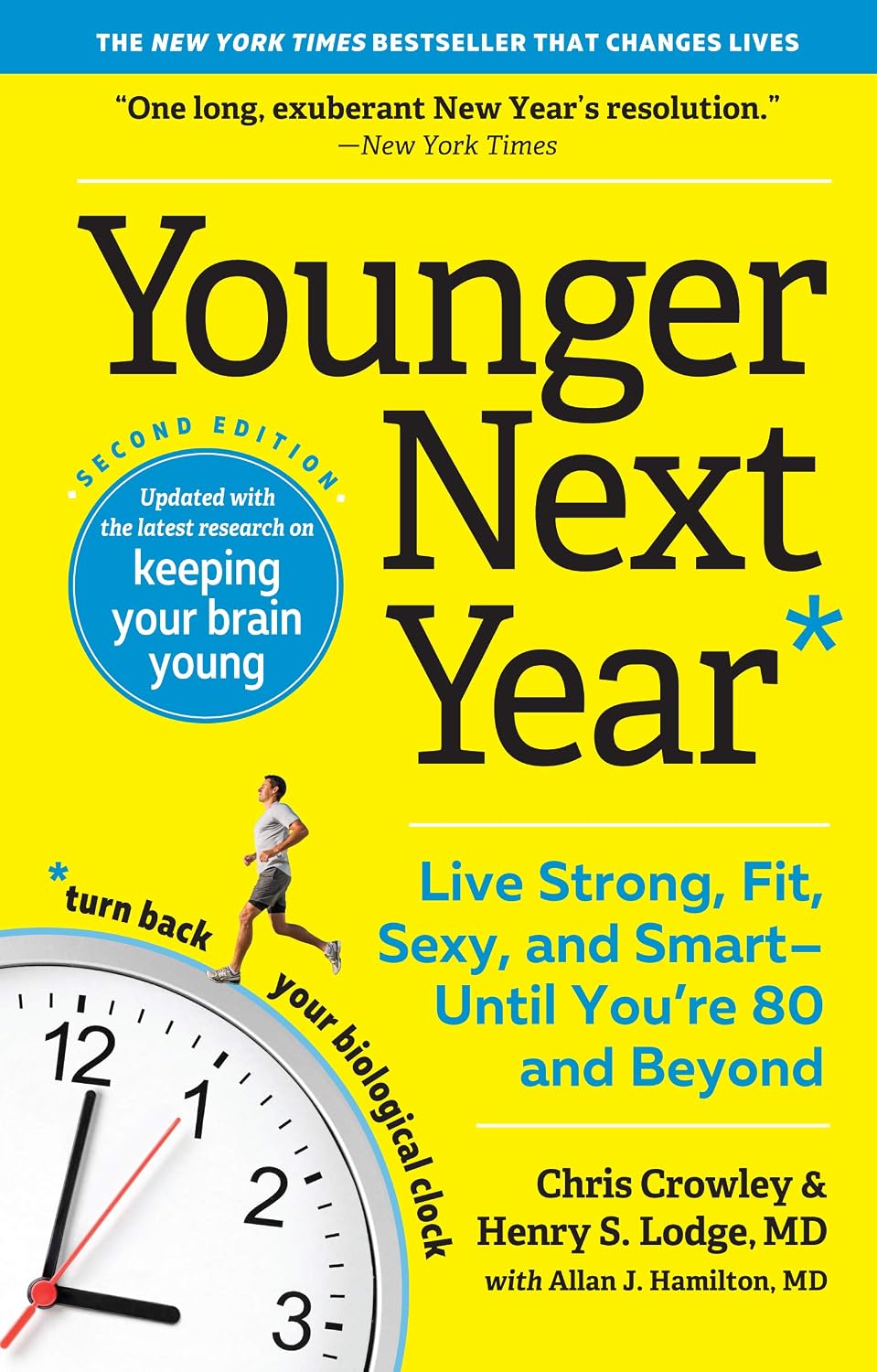
Younger Next Year is Chris Crowley and Dr. Henry Lodge’s argument that most of what gets called “aging” after 50 is actually biological decay caused by inactivity — and that decay, unlike aging itself, is optional and reversible. Written in alternating chapters, with Crowley providing a motivational, first-person voice grounded in his own late-life fitness transformation and Lodge explaining the underlying cellular biology, the book argues that daily exercise sends the body “grow” signals while a sedentary lifestyle sends “decay” signals, rooted in humans’ evolutionary history as physically active hunter-gatherers. First published in 2004 and revised in a 2019 second edition with updated research on brain health, the book distills its case into a blunt, memorable set of rules covering exercise, nutrition, and emotional connection as a single unified prescription for building a vital “next third” of life.
About the author
Chris Crowley is a retired Wall Street litigator who, after decades of a sedentary lifestyle, transformed his own health in his 70s through daily exercise and became the layman voice of Younger Next Year, writing its motivational chapters from personal experience. Henry S. Lodge, MD, was an internal medicine physician and professor at Columbia University College of Physicians and Surgeons who specialized in preventive medicine, and wrote the book’s science chapters explaining the cellular biology of exercise and aging until his death in 2014. Together they built one of the most widely read fitness-and-aging franchises in publishing, including Younger Next Year for Women and companion titles, with the core book continuing in updated editions after Lodge’s death. Explore all Chris Crowley & Henry S. Lodge, MD book summaries →
Key concepts at a glance
| Concept | What it means | Use it when |
|---|---|---|
| Decay Is a Decision | Most premature decline after 50 is lifestyle-driven, not an inevitable biological fate | You’re tempted to write off physical decline as simply “getting old” |
| Grow vs. Decay Signals | Exercise triggers cellular repair signals; inactivity triggers atrophy signals | You’re deciding whether a day off from movement really “doesn’t matter” |
| Harry’s Rules | A blunt set of daily commandments covering exercise, diet, and connection | You want a simple, memorable framework rather than a complicated program |
| The Next Third | The last third of a normal lifespan, reframed as a stage to actively build, not just endure | You’re planning what retirement or life after 50 should actually look like |
| Connection as Medicine | Social bonds and emotional commitment treated as physiologically protective, not just pleasant | You’re evaluating what “healthy aging” really requires beyond diet and exercise |
Part 1: Why decay is optional
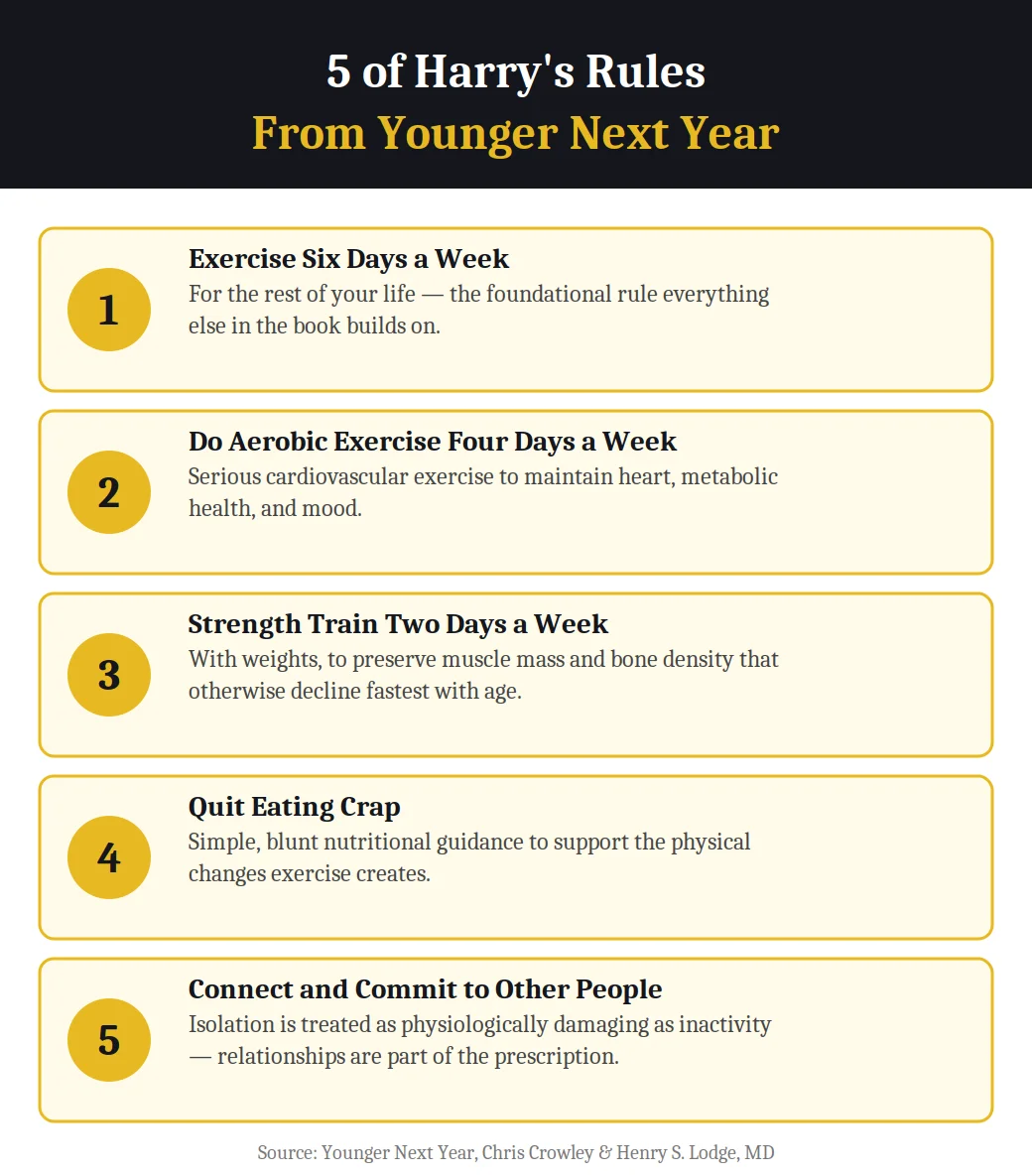
Lodge’s central biological argument is that the body is constantly reading signals from daily behavior and deciding, cell by cell, whether to grow or decay. Exercise — especially aerobic activity that raises the heart rate, combined with strength training — triggers a cascade of cellular messengers that tell tissue to build, repair, and maintain itself. A sedentary life sends the opposite signal, cueing the body toward atrophy and inflammation, because evolutionarily, inactivity signaled that winter — or death — was approaching. Crowley’s own story anchors the science in lived experience: a retired Wall Street lawyer who was sedentary and overweight well into his 60s, he became seriously fit in his 70s, described as skiing and biking better than he had decades earlier, offering living proof that the biology described applies at any starting point.
TGR Note: The book’s “decay is a decision” framing echoes Why Zebras Don’t Get Ulcers‘s case that chronic stress biology, not just isolated events, shapes long-term health outcomes.
Part 2: Harry’s Rules and the daily practice
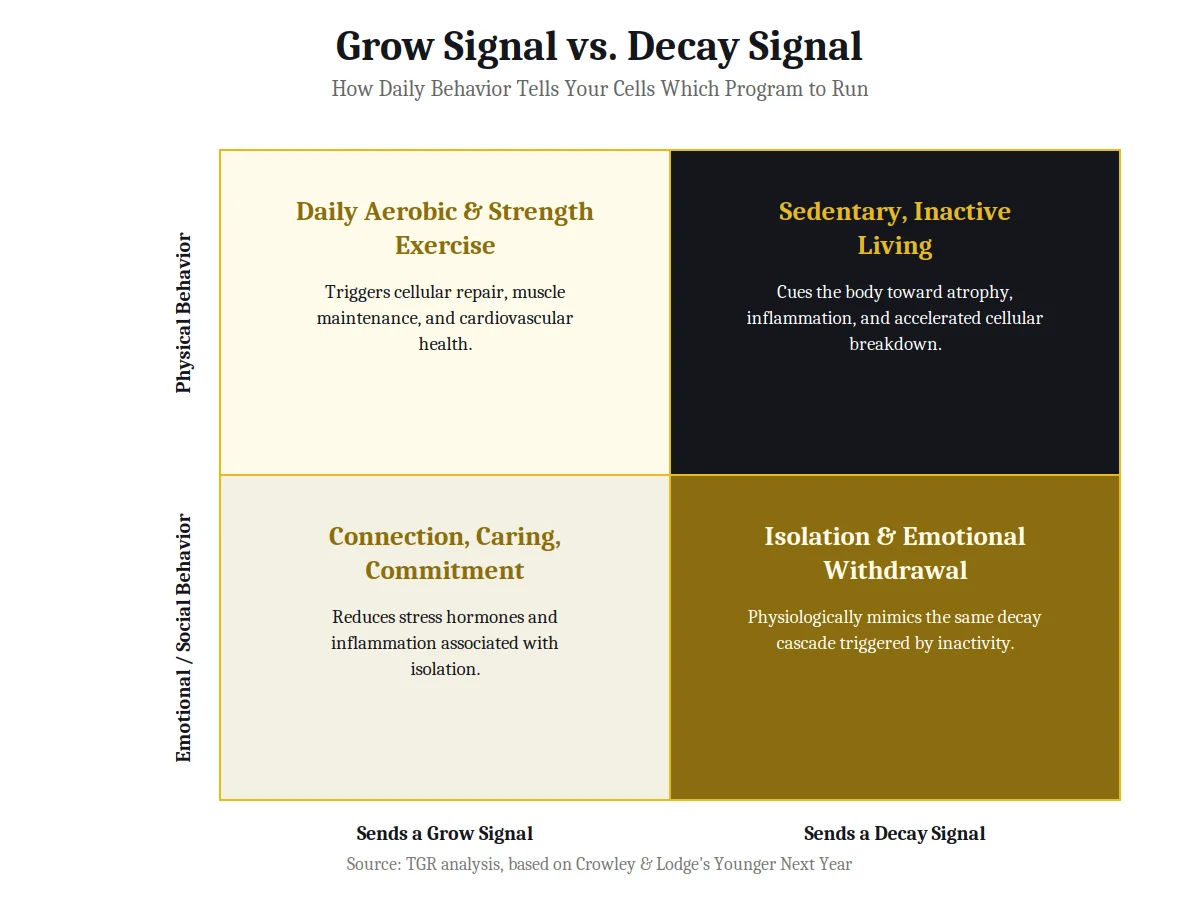
The book translates its biology into a blunt, memorable set of commandments nicknamed “Harry’s Rules”: exercise six days a week for the rest of your life, do serious aerobic exercise four days a week, strength train with weights two days a week, quit eating crap, care, connect and commit to other people, retire to something rather than from something, and don’t let the sun go down on the same argument you started the day with. The rules deliberately blend the physical and the emotional — Lodge argues isolation and emotional withdrawal are nearly as physiologically damaging as inactivity, since both trigger stress hormones and inflammation that mimic the same decay cascade caused by a sedentary lifestyle. The specificity is intentional: rather than vague advice to “stay active,” the rules give an exact, trackable weekly commitment.
Part 3: Building a vital “next third”
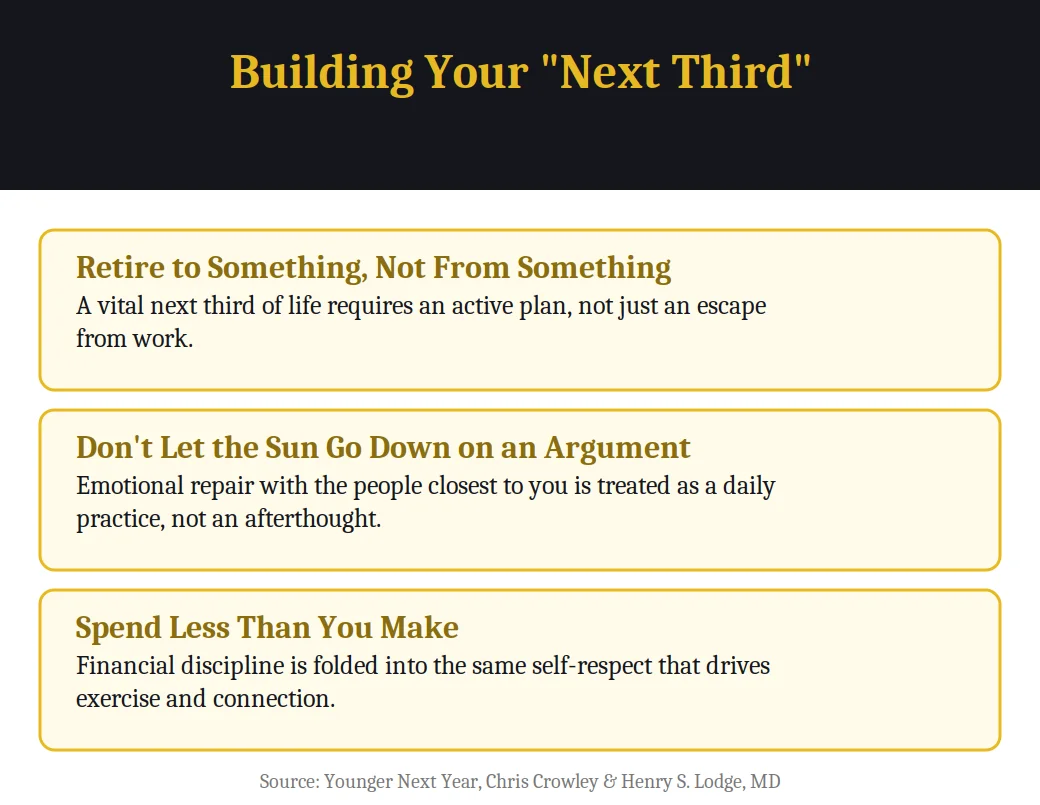
The book’s final movement widens the lens from individual habits to how to build an entire stage of life. Crowley and Lodge frame the years from roughly 50 to 80 and beyond not as an inevitable decline to be endured, but as a distinct “next third” that can be actively constructed — with retirement aimed toward something meaningful rather than simply away from work. Financial discipline, framed simply as spending less than you make, and daily emotional repair with the people closest to you are folded into the same self-respect that drives exercise and connection, treating the whole framework as one integrated approach to aging well rather than a series of separate health tips.
Who is Younger Next Year best for — and who should read something else first?
This book is best for readers over 40 who want a blunt, energizing, science-grounded case for why daily exercise matters more than almost any other health decision — especially those tempted to write off physical decline as simply “getting old.” Its conversational, alternating-voice structure makes it an easier read than a typical medical text, though readers wanting deep clinical detail may want a more technical resource alongside it.
If you want to understand the stress-biology side of this same mind-body connection in more depth, Why Zebras Don’t Get Ulcers offers a complementary, more clinically detailed look at how chronic stress shapes long-term health.
Questions to reflect on
- Which parts of your current physical decline, if any, might actually be decay rather than unavoidable aging?
- Could you commit to the specific weekly structure of Harry’s Rules — six days of exercise, four aerobic, two strength — starting this week?
- Where in your life is isolation or emotional withdrawal quietly acting like a second form of inactivity?
- What would you be “retiring to” rather than “retiring from” if you built your own next third intentionally?
- Is there an unresolved argument with someone close to you that’s lingered longer than a day, and what would it take to close it?
🔥 Ready to stop treating decay as inevitable?
This guide covers the core framework — the book gives you Crowley and Lodge’s full science, personal stories, and week-by-week guidance.
How to apply Younger Next Year (7-day plan)
- Day 1: Schedule your exercise for the next six days, distinguishing aerobic days from strength-training days.
- Day 2: Do a 20-30 minute aerobic session and notice how your energy and mood shift afterward.
- Day 3: Complete a strength-training session, even a short one, focused on major muscle groups.
- Day 4: Identify one piece of “crap” in your regular diet and remove or replace it this week.
- Day 5: Reach out to someone you care about and have one real, connecting conversation, not just a check-in.
- Day 6: Resolve one lingering disagreement with someone close to you before the day ends.
- Day 7: Sketch what you want your own “next third” to look like — what you’re building toward, not just retiring from.
Frequently asked questions
What does “decay is a decision” mean?
That roughly 70% of premature aging and physical decline before 80 is driven by lifestyle choices, not genetics, making much of it preventable.
What are Harry’s Rules?
A blunt set of daily commandments covering exercise frequency, nutrition, emotional connection, and how to approach retirement.
How much exercise does the book recommend?
Exercise six days a week, with four days of aerobic activity and two days of strength training.
What are “grow” and “decay” signals?
Cellular messengers triggered by exercise (grow) or inactivity (decay) that determine whether tissue repairs itself or breaks down.
Why does the book emphasize connection and emotion?
Because isolation and emotional withdrawal are argued to be nearly as physiologically damaging as inactivity itself.
Is this book only for older readers?
It’s aimed primarily at readers over 40-50, though its exercise and connection principles apply at any age.
What is the “next third” of life?
The years from roughly 50 to 80 and beyond, reframed as a distinct life stage to be actively built rather than endured.
Related summaries
If Younger Next Year resonated, these dig further into related territory: Why Zebras Don’t Get Ulcers on stress biology, and other titles in our best health books pillar page.
How we analyze books: We work from the full book — reconstructing its core arguments in our own words, adding commentary that connects it to related research and other books in our library, and pressure-testing the advice in a practical 7-day plan. Ratings weigh usefulness, readability, and evidence quality. Read our full methodology.
Related Health Summaries
Eat to Live Summary & Review: The Nutrient Density Blueprint
How to Change Your Mind Summary & Review: The Science Behind the Psychedelic Renaissance
The Blue Zones Summary & Review: 9 Lessons From the World’s Longest-Lived People
The China Study Summary & Review: The Case for Plant-Based Eating
Why We Get Fat Summary & Review: It’s the Carbs, Not the Calories