

★★★★★ 4.6/5 — A rigorous, deeply humane case that fighting global poverty isn’t one ideological debate but hundreds of testable questions — and randomized trials can show us which answers actually work.
Best for: readers who want an evidence-based, on-the-ground understanding of global poverty beyond “more aid” versus “free markets” · Reading time: ~9 hrs (this guide: ~13 min) · Difficulty to apply: Moderate — the ideas apply directly to how you evaluate any claim about “what works”
Poor Economics in one minute
The big ideological debates about fighting global poverty — does aid work, do free markets work — are largely unanswerable, and Abhijit Banerjee and Esther Duflo argue we should stop asking them. Instead, borrowing randomized controlled trials from medicine, the authors test specific, narrow interventions the same way a drug trial tests a new medicine: comparing a treatment group against a control group to isolate what actually causes a change in outcomes. Their field research across multiple countries reveals that behavior often dismissed as “irrational” — buying a television or spending on a festival instead of more food — usually reflects reasonable trade-offs, limited mental bandwidth, and an understandable desire for pleasure and dignity amid real deprivation. Published in 2011 and grounded in the same research that later earned both authors (with Michael Kremer) the 2019 Nobel Memorial Prize in Economic Sciences, the book’s central practical finding is that the “last mile” — actually getting proven, cheap interventions to reach people — is usually the real bottleneck, not a lack of knowledge or resources.
Key takeaways
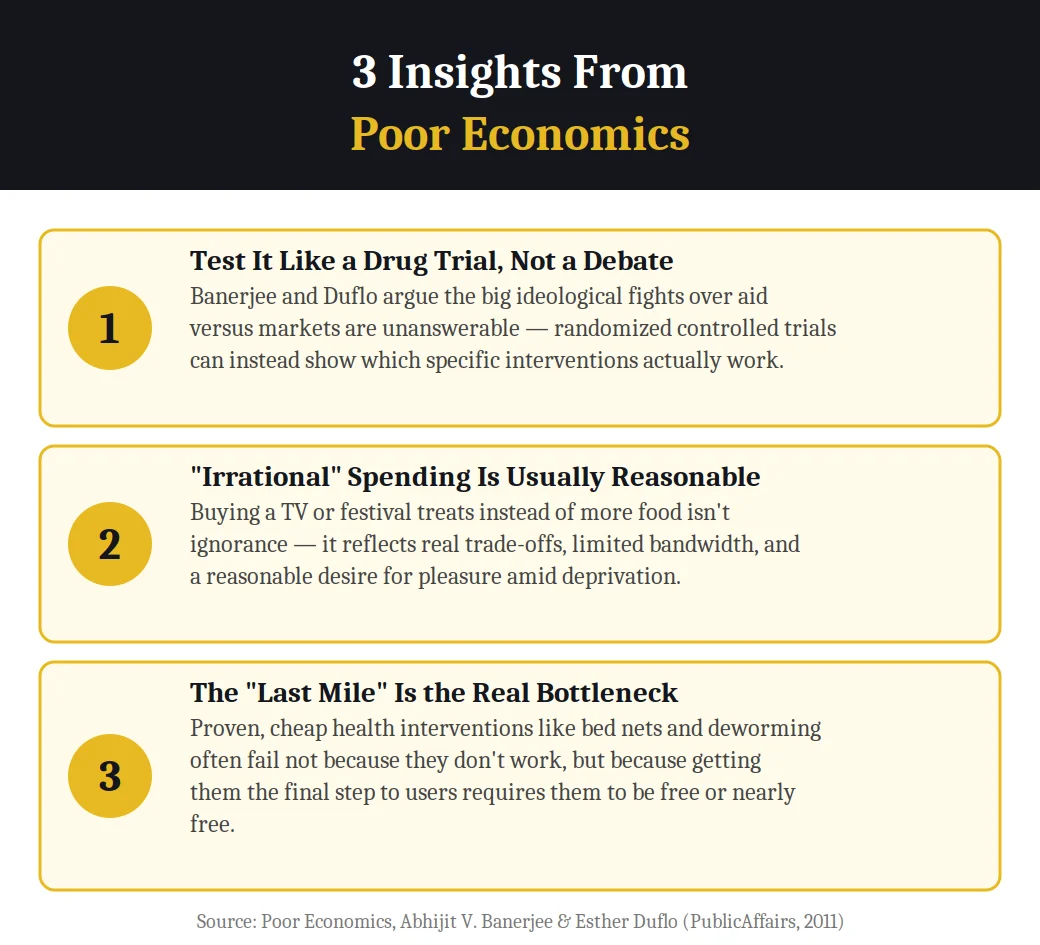
- Test interventions like drug trials, not ideological debates: randomized controlled trials can show which specific anti-poverty interventions actually work, sidestepping unanswerable questions about aid versus markets.
- Poverty traps are real in some domains, not universal: nutrition and health can follow an S-shaped curve where small investments barely help but returns accelerate sharply past a threshold — but many poor households aren’t trapped, just under-resourced.
- “Irrational” spending is usually reasonable: buying a TV or spending on festivals instead of more food reflects real trade-offs and a reasonable desire for pleasure and normalcy, not ignorance.
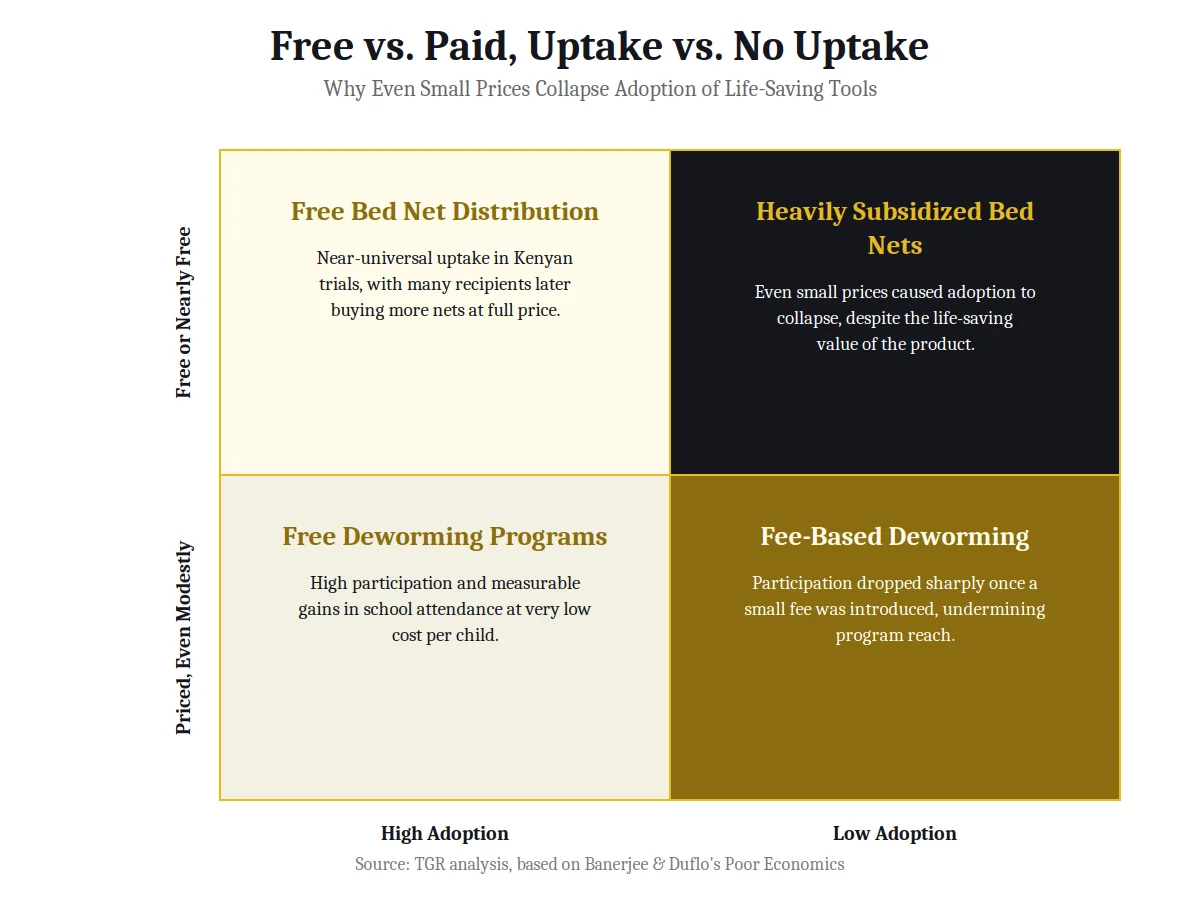
- Even small prices collapse adoption of life-saving tools: Kenyan bed net studies found near-universal uptake when nets were free, but adoption collapsed at even modestly subsidized prices.
- Deworming may be the single most cost-effective education intervention: cheap deworming programs raised school attendance more efficiently than nearly any other tested intervention, but participation dropped sharply once a small fee was added.
- Building schools doesn’t guarantee learning: teacher absenteeism, curricula pitched to elite students, and lack of accountability undermine outcomes more than physical access to a classroom.
- Microfinance’s real impact is modest, not miraculous: rigorous trials showed microloans genuinely help some small businesses but fall well short of the poverty-ending hype that surrounded them in the 2000s.
- The poor face outsized risk with few tools to manage it: weather and health shocks hit hardest exactly where formal insurance is least available, and trust deficits and cost keep many formal products from reaching the people who need them most.
- The “last mile” is usually the real bottleneck: proven, inexpensive interventions frequently fail not because the science is wrong, but because delivery design — not just supply — determines whether they actually reach people.
What is Poor Economics about?
Poor Economics is Abhijit Banerjee and Esther Duflo’s argument that fighting global poverty requires abandoning big ideological debates — aid versus markets — in favor of testing specific, narrow interventions with the same rigor medicine uses to test drugs. Drawing on years of randomized controlled trials conducted across multiple countries through the Abdul Latif Jameel Poverty Action Lab (J-PAL), which they co-founded, the authors examine health, education, savings, credit, and risk through the lens of what actually changes outcomes for people living in poverty, rather than what ideology predicts should work. Published in 2011, the book grounds its claims in field research that later contributed to both authors, together with Michael Kremer, winning the 2019 Nobel Memorial Prize in Economic Sciences for their experimental approach to alleviating global poverty.
About the author
Abhijit V. Banerjee and Esther Duflo are economists at the Massachusetts Institute of Technology and co-founders of the Abdul Latif Jameel Poverty Action Lab (J-PAL), a research center that pioneered the use of randomized controlled trials to test anti-poverty interventions. In 2019, together with Michael Kremer, they were jointly awarded the Nobel Memorial Prize in Economic Sciences for their experimental approach to alleviating global poverty. Their work applies the rigor of medical drug trials to development economics, testing specific interventions — bed nets, deworming, microfinance, education programs — rather than relying on broad ideological debates about aid versus free markets, and Poor Economics distills years of this field research into an accessible account of what actually helps people escape poverty. Explore all Abhijit V. Banerjee & Esther Duflo book summaries →
Key concepts at a glance
| Concept | What it means | Use it when |
|---|---|---|
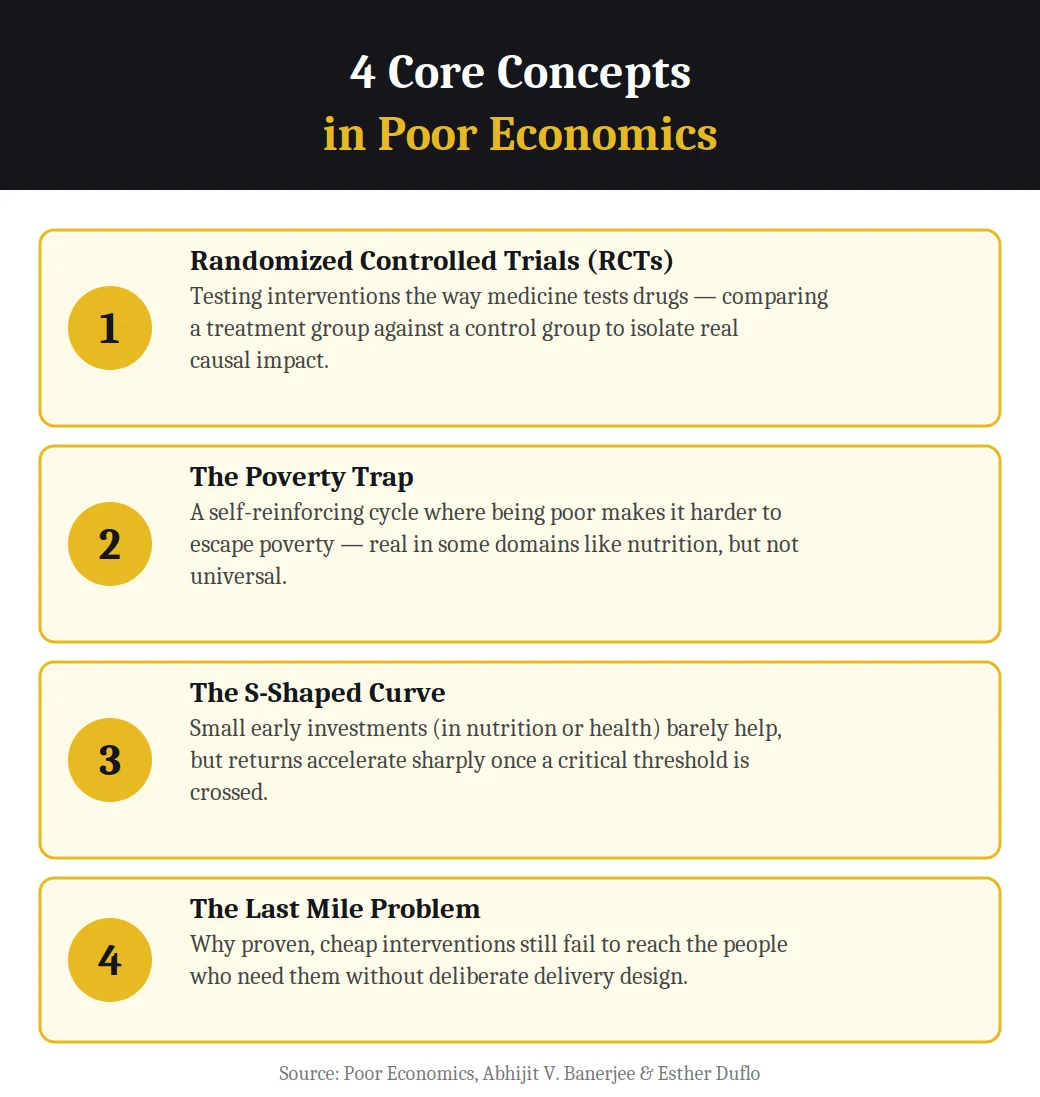
| Randomized Controlled Trials | Testing interventions like drug trials — comparing treatment and control groups to isolate real causal impact | You’re evaluating a claim about “what works” in policy or charitable giving |
| The Poverty Trap | A self-reinforcing cycle where being poor makes escaping poverty harder, real in some domains but not universal | You’re assessing whether a small intervention or a larger structural change is needed |
| The S-Shaped Curve | Small early investments barely help, but returns accelerate once a critical threshold is crossed | You’re designing or evaluating a nutrition or health investment program |
| The Last Mile Problem | Why proven, cheap interventions still fail to reach people without deliberate delivery design | A program with strong evidence behind it isn’t achieving expected real-world impact |
| Limited Bandwidth | Constant trade-off decisions under scarcity deplete the mental resources needed for other good choices | You’re judging a decision that looks “irrational” from the outside |
Part 1: Testing poverty like a drug trial
Banerjee and Duflo open by rejecting the two dominant camps in development economics — those who believe more foreign aid is the answer, and those who believe free markets alone will lift people out of poverty — as both offering unfalsifiable, ideology-driven claims that field evidence can’t resolve at that scale. Instead, they borrow randomized controlled trials from medicine: testing one specific intervention at a time, comparing a group that receives it against a control group that doesn’t, to isolate what actually causes a measurable change. This approach also reframes seemingly “irrational” choices among the poor — buying a television instead of more food, spending on a festival during a lean season — not as ignorance, but as reasonable responses to real trade-offs, limited mental bandwidth for constant decision-making, and an understandable desire for pleasure and dignity amid deprivation.
TGR Note: The “limited bandwidth” explanation for seemingly irrational spending closely parallels Scarcity‘s bandwidth tax and tunneling — both books show that scarcity itself, not poor character, drives decisions that look irrational from a comfortable distance.
Part 2: Why proven interventions still fail to reach people
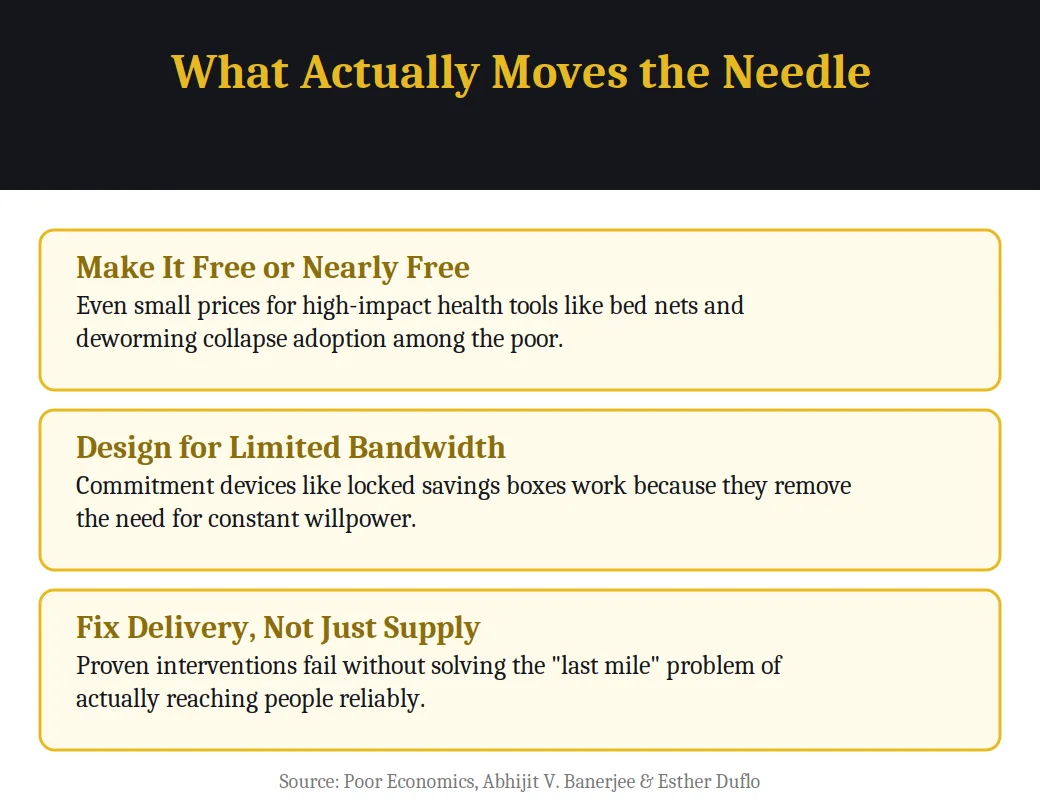
Some of the book’s most striking findings come from health interventions that work brilliantly in trials but struggle in the real world. Kenyan bed net studies found nearly universal uptake when nets were distributed free, with many recipients later purchasing additional nets at full market price — directly undercutting the common assumption that people don’t value what’s given away. Yet even small, heavily subsidized prices caused adoption to collapse, despite the nets’ life-saving value. Deworming programs showed a similar pattern: cheap, free deworming raised school attendance more cost-effectively than almost any other education intervention tested, but participation dropped sharply the moment a small fee was introduced. The lesson Banerjee and Duflo draw is that the “last mile” — the final, practical step of actually getting a proven intervention to the person who needs it — is usually the real bottleneck, not a lack of scientific knowledge or overall resources.
Part 3: Education, microfinance, and risk
The book’s education chapters show that building schools doesn’t guarantee learning — teacher absenteeism, curricula pitched toward elite students, and a lack of real accountability often undermine outcomes more than physical access to a classroom does. Its treatment of microfinance is notably measured: rigorous randomized trials, including Banerjee’s own study in Hyderabad, found microloans genuinely help some existing small businesses but fall well short of the poverty-ending transformation that surrounded the concept’s hype in the 2000s. Finally, the authors examine risk and savings, showing that the poor face outsized exposure to health and weather shocks with few tools to manage them, want to save but lack commitment devices and safe storage, and are often failed by formal insurance products that don’t account for trust deficits and real-world costs.
Who is Poor Economics best for — and who should read something else first?
This book is best for readers who want a rigorous, evidence-based understanding of global poverty that moves past ideological debate — students, policymakers, and anyone involved in philanthropy or international development who wants to know what actually works. Its dense, research-driven chapters reward patient readers more than those looking for a quick, single-argument read.
If you want to see the same bandwidth and scarcity mechanisms applied closer to home, Scarcity makes a closely related psychological argument, and Naked Economics offers a broader, more general introduction to the field this book specializes within.
Questions to reflect on
- Have you ever judged a decision as “irrational” without considering the trade-offs and bandwidth constraints behind it?
- Where in your own giving or policy views have you relied on ideology rather than evidence about what actually works?
- Can you think of a “last mile” problem in your own work — where a good solution exists but doesn’t reliably reach the people who need it?
- What would it look like to test one of your own assumptions the way a randomized controlled trial tests a drug?
- Where have you seen a small price barrier collapse participation in something valuable, even when the underlying value was high?
🔥 Ready to see what actually works in the fight against global poverty?
This guide covers the core framework — the book gives you Banerjee and Duflo’s full field research, country-by-country case studies, and data.
How to apply Poor Economics (7-day plan)
- Day 1: Identify one belief you hold about “what helps people in poverty” that’s based on ideology rather than evidence.
- Day 2: Research whether a charity or cause you support has been evaluated with randomized controlled trials or similar rigorous evidence.
- Day 3: Reconsider a decision — yours or someone else’s — you’ve judged as “irrational,” looking for the real trade-offs behind it.
- Day 4: Identify a “last mile” problem in your own work or community, where a good solution exists but doesn’t reliably reach people.
- Day 5: Look into one specific, well-tested global health intervention (like bed nets or deworming) and its actual measured impact.
- Day 6: Notice a small barrier — a fee, a form, an extra step — that might be collapsing participation in something valuable around you.
- Day 7: Write down one way you could apply “test it, don’t assume it” thinking to a decision in your own life or work.
Frequently asked questions
What is a randomized controlled trial in this context?
Testing an anti-poverty intervention like a drug trial — comparing a treatment group against a control group to isolate its real causal impact.
Do poverty traps really exist?
In some domains like nutrition and health, yes — but the authors argue many poor households aren’t trapped, just genuinely under-resourced.
Why do the poor sometimes buy “unnecessary” things like TVs?
It usually reflects real trade-offs and a reasonable desire for pleasure and normalcy, not ignorance about nutrition.
Why do free bed nets work better than subsidized ones?
Even small prices collapsed adoption in Kenyan trials, while free distribution drove near-universal uptake and later purchases.
Does microfinance end poverty, according to the book?
No — rigorous trials found modest, real benefits for some small businesses, well short of the transformative hype it received.
What is the “last mile problem”?
Why proven, cheap interventions often fail to reach people who need them without deliberate delivery design, even when the science works.
Did this research win a Nobel Prize?
Yes — Banerjee, Duflo, and Michael Kremer won the 2019 Nobel Memorial Prize in Economic Sciences for their experimental approach to poverty.
Related summaries
If Poor Economics resonated, these dig further into related territory: Scarcity on the psychology of limited resources, Naked Economics on broader economic principles, and other titles in our best money and economics books pillar page.
How we analyze books: We work from the full book — reconstructing its core arguments in our own words, adding commentary that connects it to related research and other books in our library, and pressure-testing the advice in a practical 7-day plan. Ratings weigh usefulness, readability, and evidence quality. Read our full methodology.
Related Money Summaries
Just Keep Buying Summary & Review: Data-Driven Wealth Building Made Simple
Millionaire Teacher Summary & Review: Nine Rules of Wealth
The Behavior Gap Summary & Review: Stop Sabotaging Your Returns
The Psychology of Money Summary & Review: Why Your Mindset Matters More Than Your Portfolio
The Snowball Summary & Review: Warren Buffett and the Business of Life