

★★★★★ 4.6/5 — A classic, data-backed case that most investors win not by picking brilliant stocks, but by avoiding costly, unforced mistakes.
Best for: readers who want the intellectual case for low-cost, long-term index investing, made with a memorable analogy and decades of evidence · Reading time: ~6 hrs (this guide: ~11 min) · Difficulty to apply: Low — the core advice is simple, the discipline to follow it through market cycles is the hard part
Winning the Loser’s Game in one minute
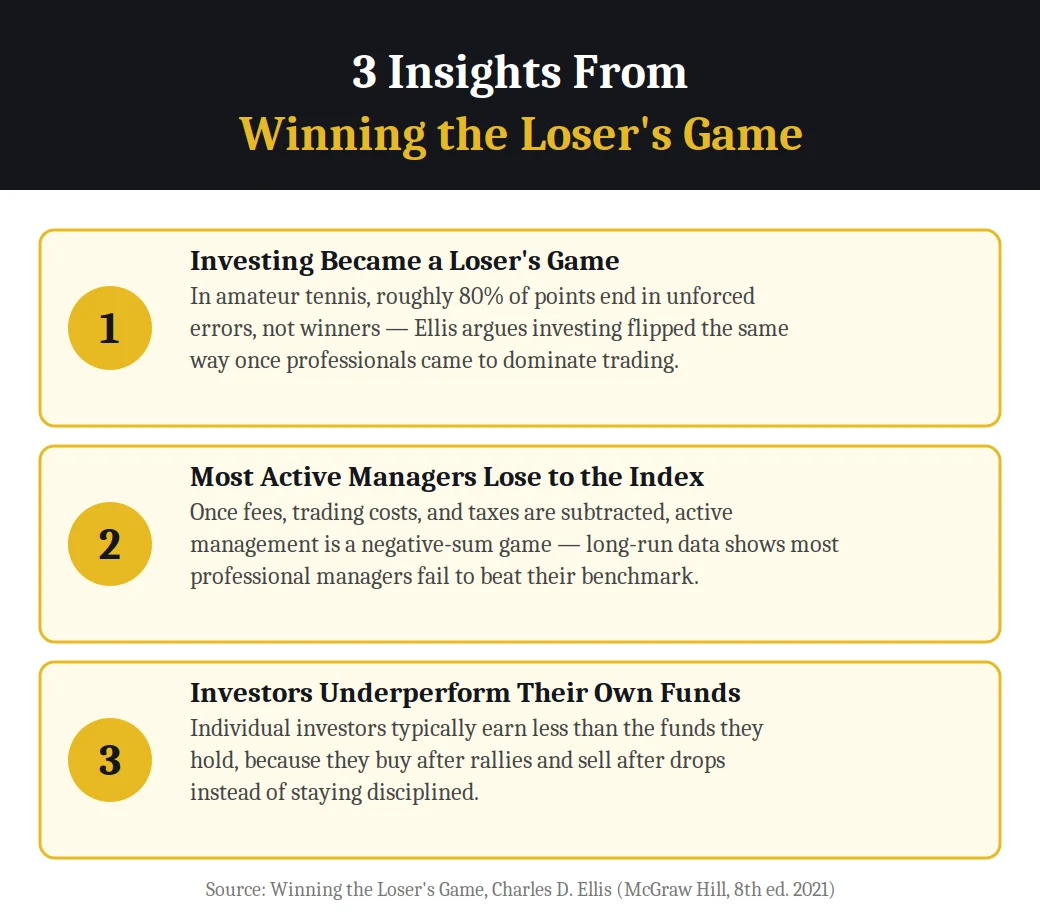
Investing has quietly become a “loser’s game,” and Charles D. Ellis argues most investors will do better by focusing on not losing than by trying to win. Borrowing an analogy from amateur tennis — where roughly 80% of points end in unforced errors rather than winning shots — Ellis shows that as professional investors came to dominate trading over individuals across the 1960s and 70s, active stock-picking stopped being a game you could reliably win through skill and became one decided by who made the fewest costly mistakes. Once fees, trading costs, and taxes are subtracted, active management is a negative-sum game, and long-run data consistently shows most professional fund managers fail to beat their own benchmark index. First published in 1985 and now in its eighth edition, the book makes the case for low-cost indexing, disciplined asset allocation, and staying invested through volatility — the “boring” strategy that, Ellis argues, quietly outperforms most of the alternatives.
Key takeaways
- Investing became a loser’s game once professionals took over: as institutional trading rose from roughly 10% to roughly 90% of NYSE volume, any individual trying to out-trade the market was now competing against other skilled professionals, not amateurs.
- The tennis analogy explains why: amateur tennis matches are decided by unforced errors, not winning shots — Ellis argues modern investing rewards the same avoid-the-mistake mindset.
- Active management is a negative-sum game after costs: trading costs, fees, and taxes turn what’s already a zero-sum contest before costs into a game most active participants are mathematically likely to lose.
- Most active managers underperform their benchmark over time: long-run studies consistently show a large majority of professional fund managers fail to beat a simple low-cost index over 10-20 year periods.
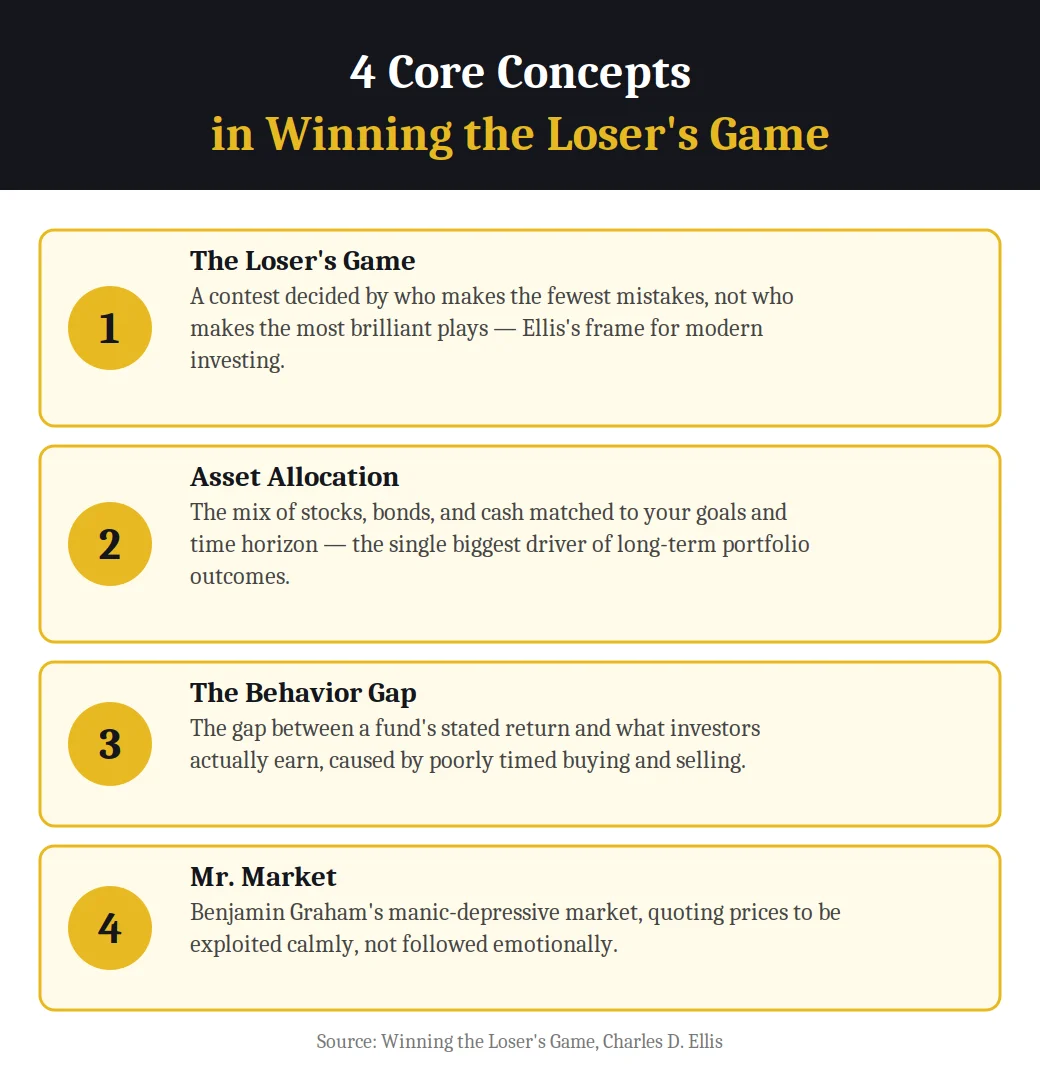
- Asset allocation dominates security selection: your mix of stocks, bonds, and cash — matched to your goals and time horizon — explains far more of your long-term results than which individual securities you own.
- Individual investors underperform even their own funds: the “behavior gap” between a fund’s stated return and what its investors actually earn comes from buying after rallies and selling after drops.
- Mr. Market should be exploited, not followed: Ellis invokes Benjamin Graham’s manic-depressive market metaphor to argue investors should take advantage of its mood swings rather than react emotionally to them.
- Costs, turnover, and taxes are genuinely controllable: unlike future returns, fees and trading frequency are levers an investor can actually manage — and minimizing them is one of the most reliable ways to improve outcomes.
- Time is the investor’s greatest lever: Ellis calls time “Archimedes’ lever in investing” — a long horizon and a written, disciplined policy matter more than any single decision.
What is Winning the Loser’s Game about?
Winning the Loser’s Game is Charles D. Ellis’s argument that modern investing has quietly become a “loser’s game” — a contest won not by making brilliant plays, but by avoiding costly, unforced mistakes. Drawing on a 1975 essay he wrote for the Financial Analysts Journal, Ellis borrows an analogy from amateur tennis, where the majority of points are lost rather than won, to explain why individual stock-picking became a losing proposition once professional investors came to dominate market trading. First published in 1985 and now in its eighth edition, the book builds the intellectual and statistical case for low-cost index investing, disciplined asset allocation, and long-term patience over active trading — a case that has only strengthened with each successive edition’s data.
About the author
Charles D. Ellis is an investment consultant, author, and former managing partner of Greenwich Associates, the institutional investment research firm he founded in 1972. Over a five-decade career he advised many of the world’s largest investment institutions and served on the investment committees of Yale University and other major endowments, working alongside legendary investor David Swensen. His 1975 Financial Analysts Journal paper “The Loser’s Game” became one of the most influential essays in the history of investment management, laying the intellectual groundwork for the shift toward low-cost index investing that followed in the decades after. Ellis has written more than 20 books on investing and institutional management, and Winning the Loser’s Game remains one of the most widely read books on long-term investing, with the current edition updated for post-pandemic markets. Explore all Charles D. Ellis book summaries →
Key concepts at a glance
| Concept | What it means | Use it when |
|---|---|---|
| The Loser’s Game | A contest decided by who makes the fewest mistakes, not who makes the most brilliant plays | You’re deciding whether to actively trade or simply hold a diversified index |
| Asset Allocation | The mix of stocks, bonds, and cash matched to your goals and time horizon | You’re building or rebalancing a long-term portfolio |
| The Behavior Gap | The gap between a fund’s stated return and what investors actually earn, from poor timing | You’re tempted to sell after a drop or chase a fund after a rally |
| Mr. Market | Benjamin Graham’s manic-depressive market, quoting prices to be exploited, not followed emotionally | Market volatility is tempting you into an emotional, reactive decision |
| Cost & Turnover Discipline | Minimizing fees, trading frequency, and taxes — one of the few things an investor fully controls | You’re comparing investment products or evaluating your own trading habits |
Part 1: Why investing became a loser’s game
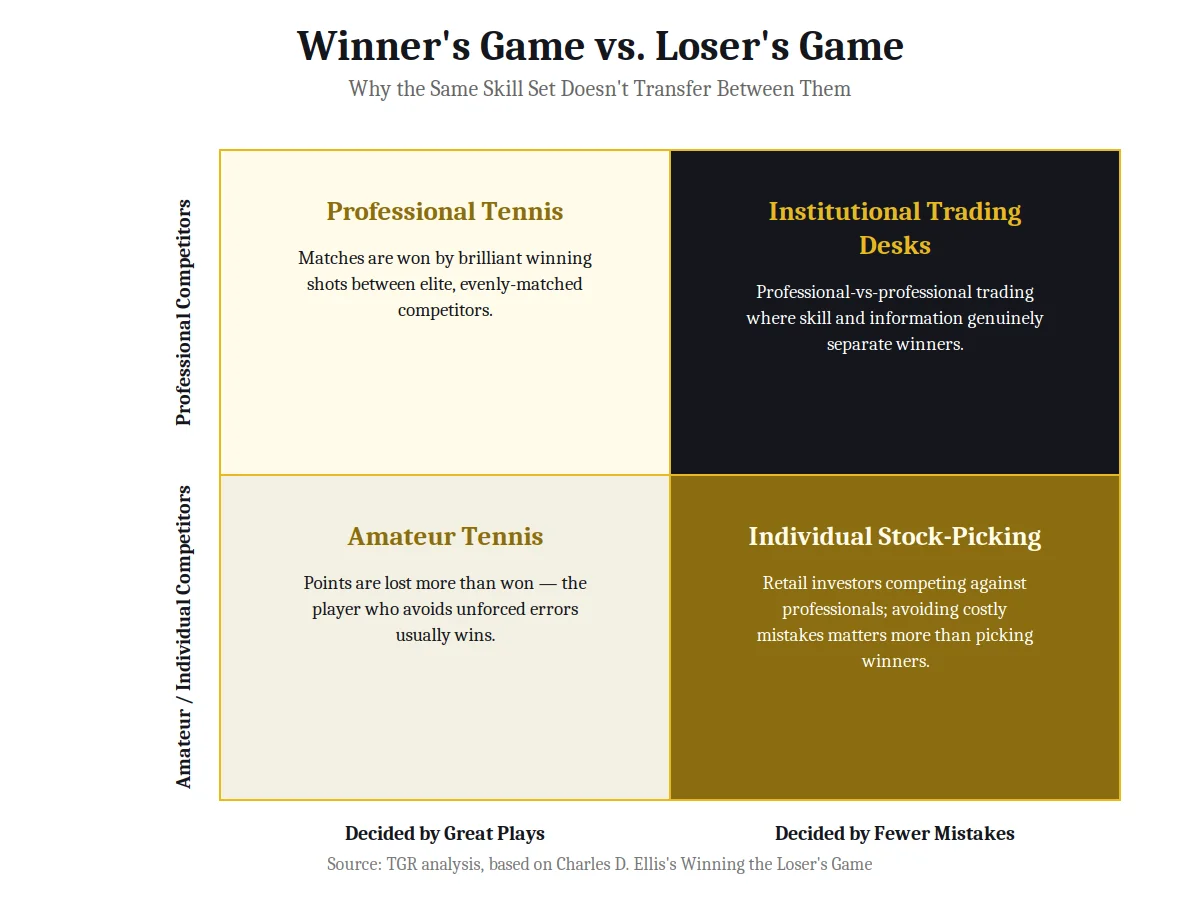
Ellis’s central analogy comes from research on amateur tennis showing that roughly 80% of points end in unforced errors rather than genuine winning shots — professional tennis, by contrast, is a “winner’s game” decided by brilliant plays between closely matched elite competitors. Ellis argues investing underwent the same transformation: in the 1950s and 60s, individual investors drove the large majority of trading on the New York Stock Exchange, but by the 1970s, institutional and professional investors came to dominate volume instead, roughly reversing that balance. The practical consequence is stark — any investor trying to actively out-trade the market is no longer competing against amateurs, but against other well-resourced professionals, which turns stock-picking into a contest where avoiding costly mistakes matters far more than making brilliant calls.
TGR Note: Ellis’s case that most professional forecasters and stock-pickers fail to beat a simple benchmark pairs naturally with The Black Swan‘s broader skepticism of expert prediction — both books argue confidence in forecasting is usually misplaced.
Part 2: Why most active managers lose, and what actually drives returns
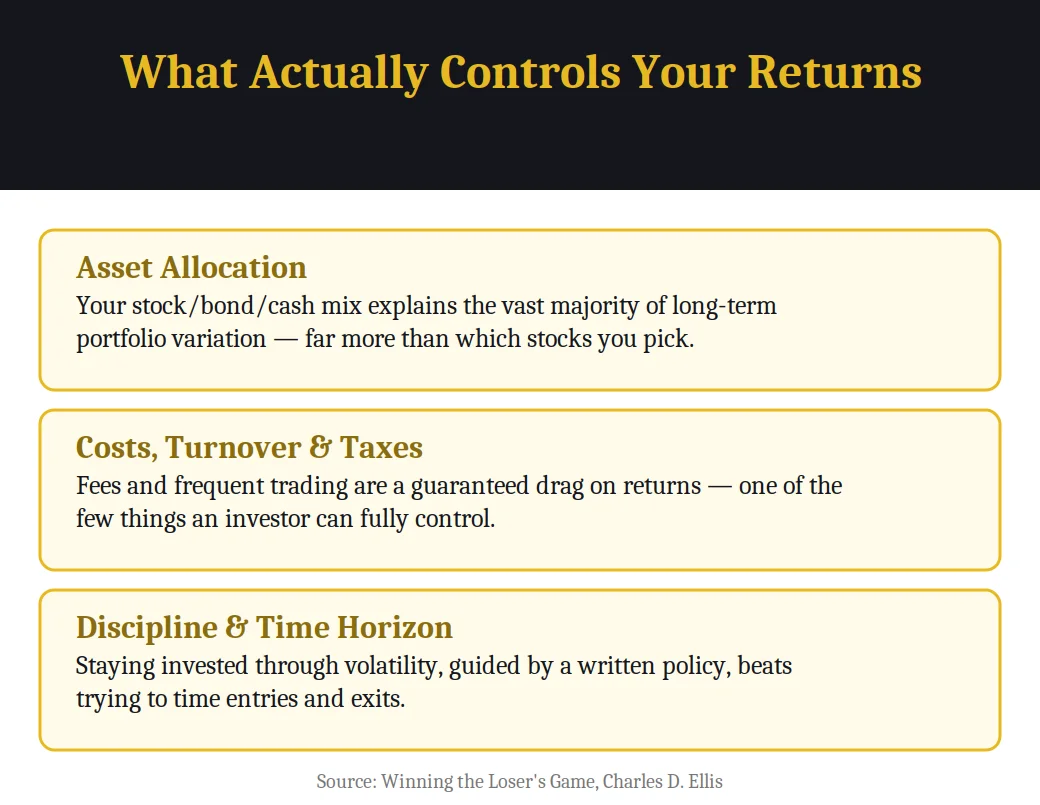
Once trading costs, management fees, and taxes are subtracted from the zero-sum gross returns of active trading, Ellis argues the game becomes explicitly negative-sum — meaning the average actively managed dollar is mathematically likely to underperform a low-cost index over time. Long-run studies he cites consistently confirm this: a large majority of professional fund managers fail to beat their own benchmark over 10- to 20-year periods, evidence that has only accumulated further with each new edition of the book. Ellis then redirects attention to what actually drives long-term portfolio outcomes — not security selection or market timing, but asset allocation: the mix of stocks, bonds, and cash matched to an investor’s goals and time horizon, which explains the great majority of variation in long-term results.
TGR Note: The book’s “behavior gap” evidence — investors underperforming their own funds through bad timing — connects to Scarcity‘s findings on how situational pressure, not poor character, drives seemingly irrational financial decisions.
Part 3: What investors can actually control
Since future returns can’t be controlled or reliably predicted, Ellis focuses on the levers investors genuinely can pull: minimizing costs, turnover, and taxes, all of which are a guaranteed drag on returns whenever they’re incurred unnecessarily. He invokes Benjamin Graham’s metaphor of “Mr. Market” — a manic-depressive business partner who shows up daily offering to buy or sell at wildly different prices — as a reminder that market volatility should be exploited calmly, not followed emotionally. Ellis calls time “Archimedes’ lever in investing,” arguing that a long time horizon combined with a written, disciplined investment policy does more for an investor’s long-term results than any single tactical decision ever could — a “boring” prescription he argues is exactly what makes it work.
Who is Winning the Loser’s Game best for — and who should read something else first?
This book is best for readers who want the clear intellectual and statistical case for low-cost, long-term index investing — new investors building their first portfolio, and experienced ones tempted to actively trade who need a data-backed reminder not to. Its concise, direct style makes it one of the fastest classic investing books to actually finish.
If you want a broader look at how forecasting confidence is usually misplaced across many domains, not just investing, The Black Swan covers related territory in far more philosophical depth.
Questions to reflect on
- Are you currently playing a “winner’s game” mindset — trying to make brilliant picks — in a domain that’s actually a loser’s game?
- What’s your current asset allocation, and does it actually match your real goals and time horizon, or just what feels comfortable today?
- Have you ever bought after a rally or sold after a drop — and can you trace what that timing decision actually cost you?
- What fees, turnover, or tax drag are you currently paying that you could reduce without changing your actual investment goals?
- Do you have a written investment policy you could return to the next time the market tests your discipline?
🔥 Ready to stop trying to win a game that’s rigged against active players?
This guide covers the core framework — the book gives you Ellis’s full data, historical examples, and updated post-pandemic market analysis.
How to apply Winning the Loser’s Game (7-day plan)
- Day 1: Calculate the total fees and expense ratios you’re currently paying across every investment account you hold.
- Day 2: Compare your actively managed funds’ long-term returns against a comparable low-cost index over the same period.
- Day 3: Write down your actual time horizon and goals, and check whether your current asset allocation genuinely matches them.
- Day 4: Review your trading history for the past year and identify any buy or sell driven by emotion rather than a written plan.
- Day 5: Draft a one-page written investment policy statement you can return to during the next period of market volatility.
- Day 6: Identify one unnecessary cost, fee, or tax-inefficient habit you could eliminate this month.
- Day 7: Set a calendar reminder to rebalance your portfolio on a fixed schedule, rather than reactively.
Frequently asked questions
What is the “loser’s game” in the book’s title?
A contest decided by who makes the fewest mistakes rather than who makes the most brilliant plays — Ellis’s frame for modern active investing.
Where does the tennis analogy come from?
Research showing amateur tennis points are mostly lost through unforced errors rather than won through great shots, which Ellis first applied to investing in a 1975 essay.
Does the book recommend index funds?
Yes — it builds the data-backed case that low-cost indexing beats active management for most investors once costs are accounted for.
What matters more, asset allocation or stock picking?
Asset allocation — your stock, bond, and cash mix explains far more of your long-term results than which individual securities you own.
What is the “behavior gap”?
The gap between a fund’s stated return and what its investors actually earn, caused by poorly timed buying and selling.
Who is “Mr. Market”?
Benjamin Graham’s metaphor for a manic-depressive market that should be calmly exploited, not emotionally followed.
Is this book still relevant after so many editions?
Yes — the eighth edition updates the data for post-pandemic markets, and its long-run evidence has only strengthened over time.
Related summaries
If Winning the Loser’s Game resonated, these dig further into related territory: The Black Swan on the limits of prediction, Scarcity on situational financial decision-making, and other titles in our best money and economics books pillar page.
How we analyze books: We work from the full book — reconstructing its core arguments in our own words, adding commentary that connects it to related research and other books in our library, and pressure-testing the advice in a practical 7-day plan. Ratings weigh usefulness, readability, and evidence quality. Read our full methodology.
Related Money Summaries
Money: Master the Game Summary & Review: 7 Steps to Financial Freedom From 50 Billionaires
Naked Economics Summary and Review
Poor Charlie’s Almanack Summary & Review: Munger’s Masterclass in Worldly Wisdom
The Black Swan Summary and Review
The Snowball Summary & Review: Warren Buffett and the Business of Life