
Money
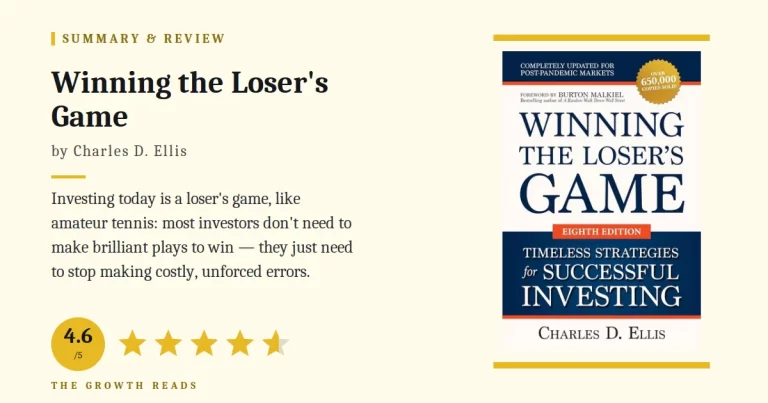
Winning the Loser’s Game Summary and Review
★★★★★ 4.6/5 — A classic, data-backed case that most investors win not by picking brilliant stocks, but by avoiding costly, unforced mistakes.…
Read Summary →"Investment consultant whose tennis analogy reshaped how the world thinks about active management."
Charles D. Ellis is an investment consultant, author, and former managing partner of Greenwich Associates, the institutional investment research firm he founded in 1972. Over a five-decade career he advised many of the world's largest investment institutions and served on the investment committees of Yale University and other major endowments, working alongside legendary investor David Swensen. His 1975 Financial Analysts Journal paper "The Loser's Game" became one of the most influential essays in the history of investment management, laying the intellectual groundwork for the shift toward low-cost index investing. Ellis has written more than 20 books on investing and institutional management, and Winning the Loser's Game, first published in 1985 and now in its eighth edition, remains one of the most widely read books on long-term investing.
Our in-depth summaries and reviews of his work
★★★★★ 4.6/5 — A classic, data-backed case that most investors win not by picking brilliant stocks, but by avoiding costly, unforced mistakes.…
Read Summary →A contest decided by who makes the fewest mistakes, not who makes the most brilliant plays — Ellis's frame for modern investing.
The mix of stocks, bonds, and cash matched to your goals and time horizon — the single biggest driver of long-term portfolio outcomes.
The gap between a fund's stated return and what investors actually earn, caused by poorly timed buying and selling.
"The great secret for success in long-term investing is to avoid serious losses."— Winning the Loser's Game
"Time is Archimedes' lever in investing."— Winning the Loser's Game
★★★★★ 4.6/5 — A classic, data-backed case that most investors win not by picking brilliant stocks, but by avoiding costly, unforced mistakes. Best for: readers who want the intellectual case for low-cost, long-term index investing, made with a memorable analogy…