

★★★★☆ 4.5/5 — A rigorous, humane case that scarcity itself — not character — imposes a real cognitive tax on anyone who experiences it, tested across money, time, and food.
Best for: readers who want a research-backed reframe of why “poor decisions” are often a scarcity effect, not a willpower failure · Reading time: ~7 hrs (this guide: ~12 min) · Difficulty to apply: Moderate — the diagnosis is clear, building genuine slack into a scarce life takes real structural change
Scarcity in one minute
Scarcity captures the mind — and it happens to anyone, regardless of intelligence, the moment they have too little of something they need. Economist Sendhil Mullainathan and psychologist Eldar Shafir show that having too little money, time, or even calories imposes a measurable “bandwidth tax” on cognitive capacity: Indian sugarcane farmers scored significantly worse on IQ tests before harvest, when cash-poor, than after, when the same person with the same intelligence had money in hand. The core mechanism is “tunneling” — an intense focus on the scarce resource that crowds out everything else, including decisions that matter for the future. Published in 2013, the book reframes what looks like poor judgment among people under financial stress as a structural, situational effect of scarcity itself, not a character flaw — with real implications for how programs and policies aimed at poverty should be designed.
Key takeaways
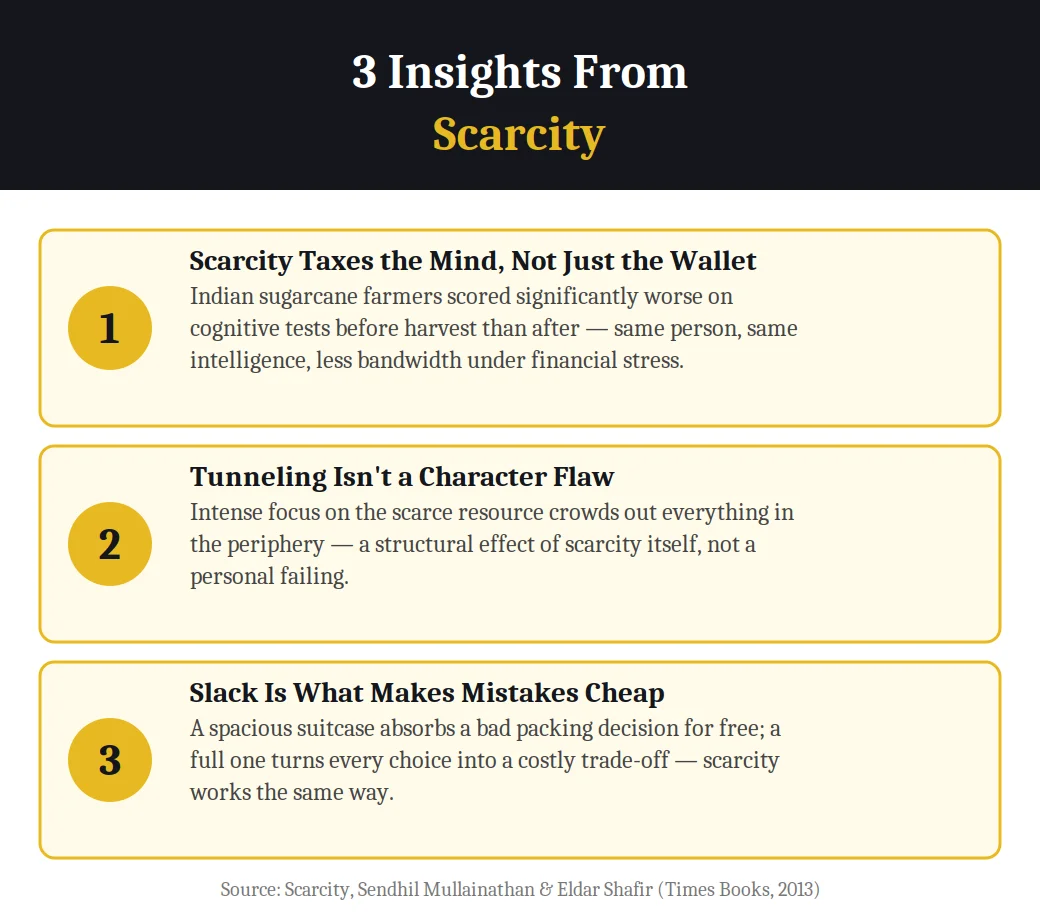
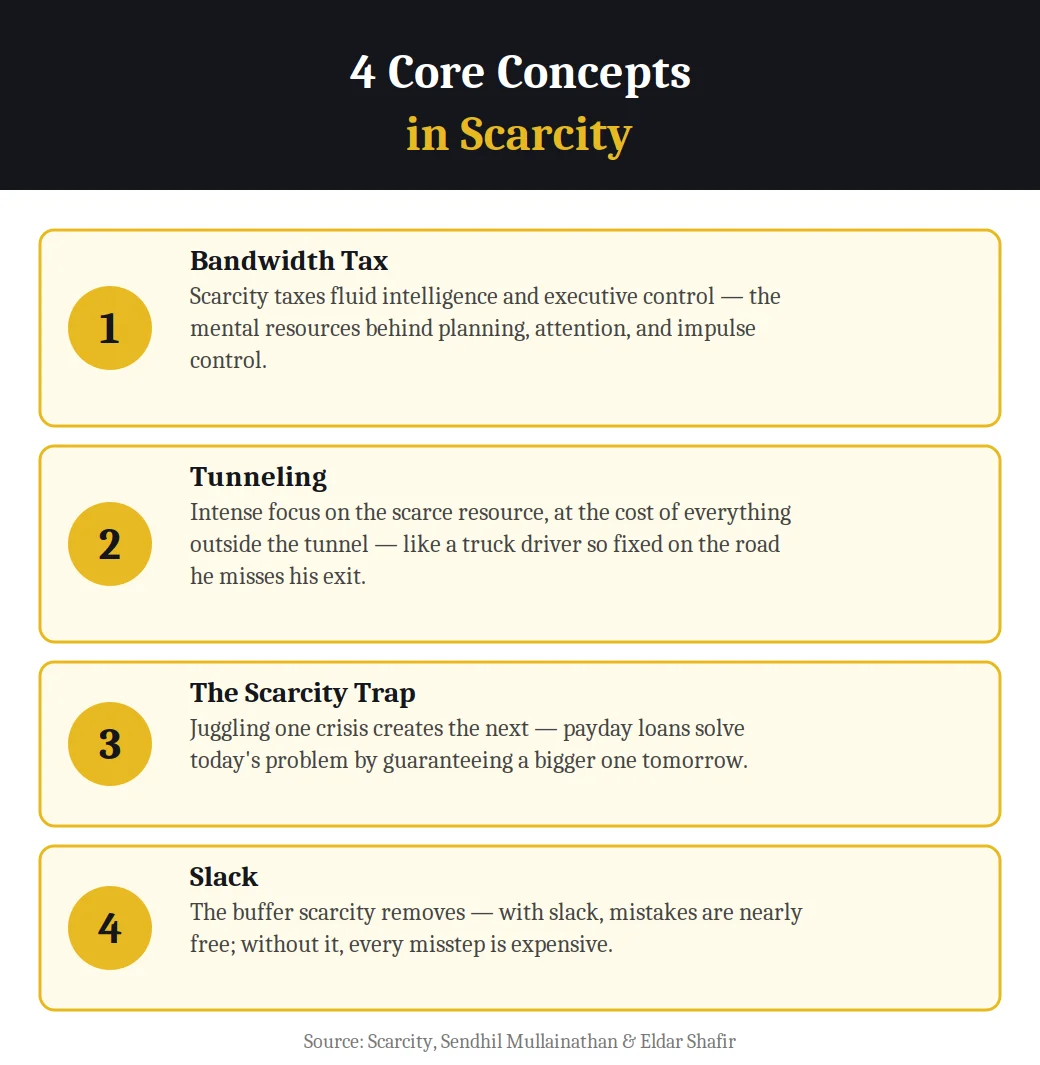
- Scarcity taxes the mind, not just the wallet: having too little of any resource reduces fluid intelligence and executive control — the “bandwidth tax” — independent of a person’s underlying intelligence.
- Tunneling is structural, not a personal failing: intense focus on the scarce resource crowds out the periphery, like a truck driver so fixed on the road ahead that he misses his exit.
- The sugarcane farmer study isolates the effect cleanly: the same farmers, tested before and after harvest, showed a cognitive performance gap comparable to losing a full night’s sleep — proving it’s the situation, not the person.
- Low-income shoppers showed the same effect under a hypothetical stressor: a mall study found cognitive scores dropped sharply for low-income participants imagining an expensive unexpected cost, while wealthier participants showed no such drop.
- Scarcity creates its own trap: juggling one crisis often creates the next — a payday loan solves today’s problem while guaranteeing a bigger one next month, leaving people perpetually one step behind.
- Slack is what makes mistakes cheap: a spacious suitcase absorbs a bad packing choice for free; a full one turns every addition into a costly trade-off — money, time, and attention work the same way.
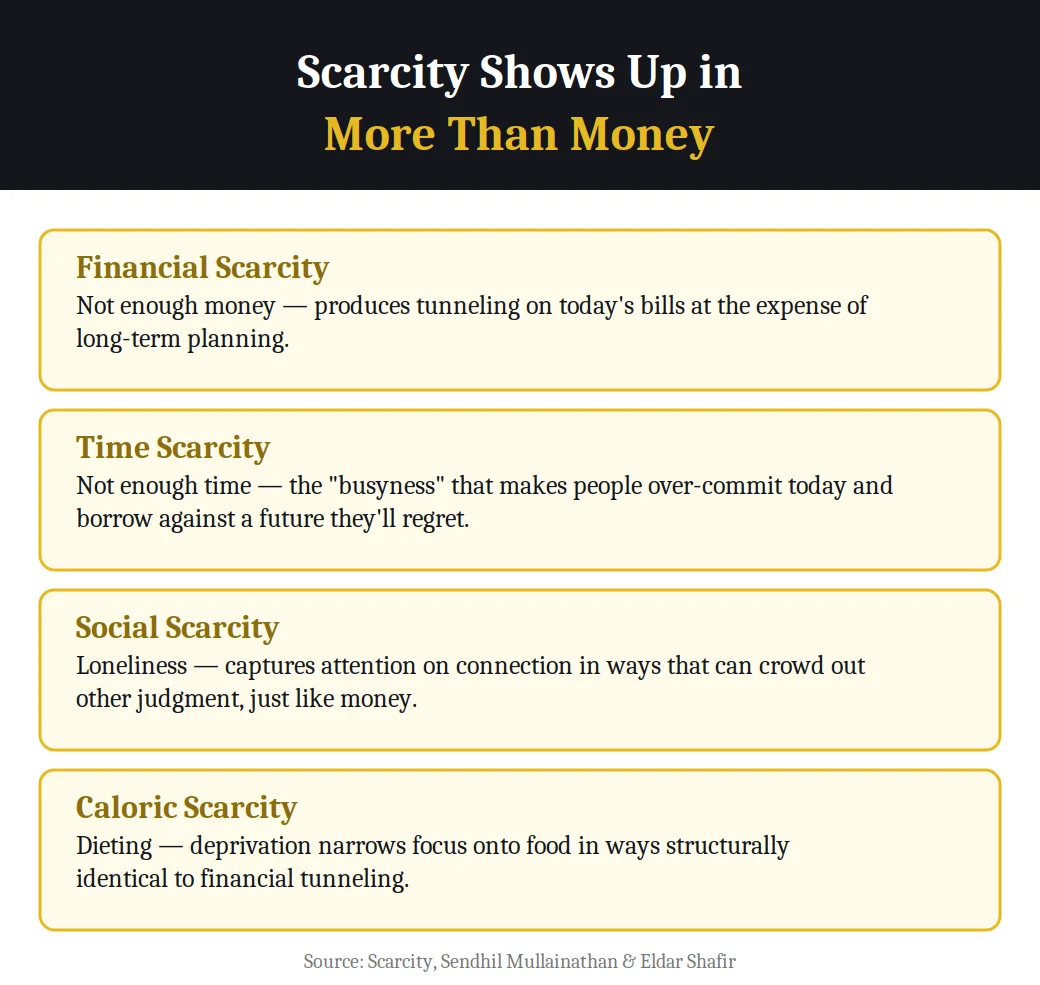
- Scarcity isn’t only about money: the same tunneling and bandwidth-tax dynamics show up in time scarcity (busyness), social scarcity (loneliness), and caloric scarcity (dieting).
- Policy should target the “cockpit,” not the “pilot”: the authors argue poverty programs should assume bandwidth depletion and build in slack, reminders, and forgiving deadlines, rather than assuming failures reflect low ability or poor character.
- Small design changes measurably help: a Cleveland housing nonprofit using reminder postcards and payment incentives achieved a 20% improvement in on-time rent payment — evidence that scarcity-aware design, not moralizing, changes outcomes.
What is Scarcity about?
Scarcity is Sendhil Mullainathan and Eldar Shafir’s argument that having too little of any resource — money, time, or calories — captures the mind and imposes a measurable cognitive cost, regardless of the underlying intelligence of the person experiencing it. Merging economics and psychology, the authors show through field research (Indian sugarcane farmers tested before and after harvest) and lab experiments (shoppers under simulated financial stress) that scarcity produces “tunneling,” an intense focus on the scarce resource that crowds out everything else, including decisions that matter for the future. First published in 2013, the book reframes what looks like poor judgment among people under scarcity as a structural, situational effect rather than a character flaw, with direct implications for how poverty programs and policies should be designed.
About the author
Sendhil Mullainathan is an economist and MacArthur “genius grant” recipient who has held faculty positions at MIT, Harvard, and the University of Chicago Booth School of Business, and co-founded the behavioral-design nonprofit ideas42 and MIT’s Poverty Action Lab (J-PAL). Eldar Shafir is the Class of 1987 Professor in Behavioral Science and Public Policy at Princeton University, where he directs the Kahneman-Treisman Center for Behavioral Science and Public Policy; his research on judgment and decision-making includes work with Amos Tversky. Their collaboration paired economics with psychology to build Scarcity’s unified account of how having too little shapes the mind, drawing on field research with Indian sugarcane farmers and lab studies of shoppers under financial stress. Explore all Sendhil Mullainathan & Eldar Shafir book summaries →
Key concepts at a glance
| Concept | What it means | Use it when |
|---|---|---|
| Bandwidth Tax | Scarcity reduces fluid intelligence and executive control, regardless of underlying intelligence | You’re judging someone’s “poor decisions” without accounting for what they’re managing |
| Tunneling | Intense focus on the scarce resource at the cost of everything in the periphery | You notice yourself or someone else fixated on one urgent problem while important things slip |
| The Scarcity Trap | Solving today’s crisis in a way that guarantees a bigger one tomorrow | A short-term fix (a loan, an all-nighter) keeps creating the next emergency |
| Slack | The buffer that makes mistakes cheap instead of costly | You’re deciding whether to build margin into a budget, schedule, or plan |
| Scarcity-Aware Design | Building systems (reminders, forgiving deadlines, simplified defaults) that assume bandwidth depletion instead of full attention | You’re designing a program, policy, or process for people under real time or money pressure |
Part 1: The bandwidth tax
Mullainathan and Shafir’s central claim rests on a striking piece of field research: the same Indian sugarcane farmers, tested cognitively before harvest (cash-poor) and after harvest (cash-rich), performed significantly worse on the same tests when money was scarce — a gap roughly comparable to the cognitive effect of losing a full night’s sleep. Because it was the same people with the same underlying intelligence, the difference could only be explained by the situation, not the person. A parallel mall-shopper study found the same pattern: low-income participants imagining a $3,000 unexpected expense performed markedly worse on cognitive tests than when imagining a $300 expense, while wealthier participants showed no difference either way. As the authors put it, “scarcity captures the mind” — automatically and powerfully orienting attention toward unfulfilled needs.
TGR Note: This distinction between a situational effect and a fixed trait connects to Freakonomics‘s broader theme that incentives and circumstances, not innate character, are usually the better explanation for surprising behavior.
Part 2: Tunneling and the scarcity trap
The mechanism behind the bandwidth tax is what the authors call “tunneling” — the mind’s automatic, intense focus on the scarce resource, at the cost of everything in the periphery. A truck driver so fixed on the urgent road ahead misses an exit that mattered; someone juggling overdue bills focuses so completely on this month’s crisis that a cheaper, better long-term solution goes unseen. This produces what the book calls the scarcity trap: a short-term fix, like a payday loan, solves today’s problem while guaranteeing a worse one next month, leaving people perpetually “one step behind.” Crucially, the authors argue myopia here “is not a personal failure” and “tunneling is not a personal trait” — it’s what scarcity does to any mind, not a defect in some minds.
Part 3: Slack, other domains, and what to do about it
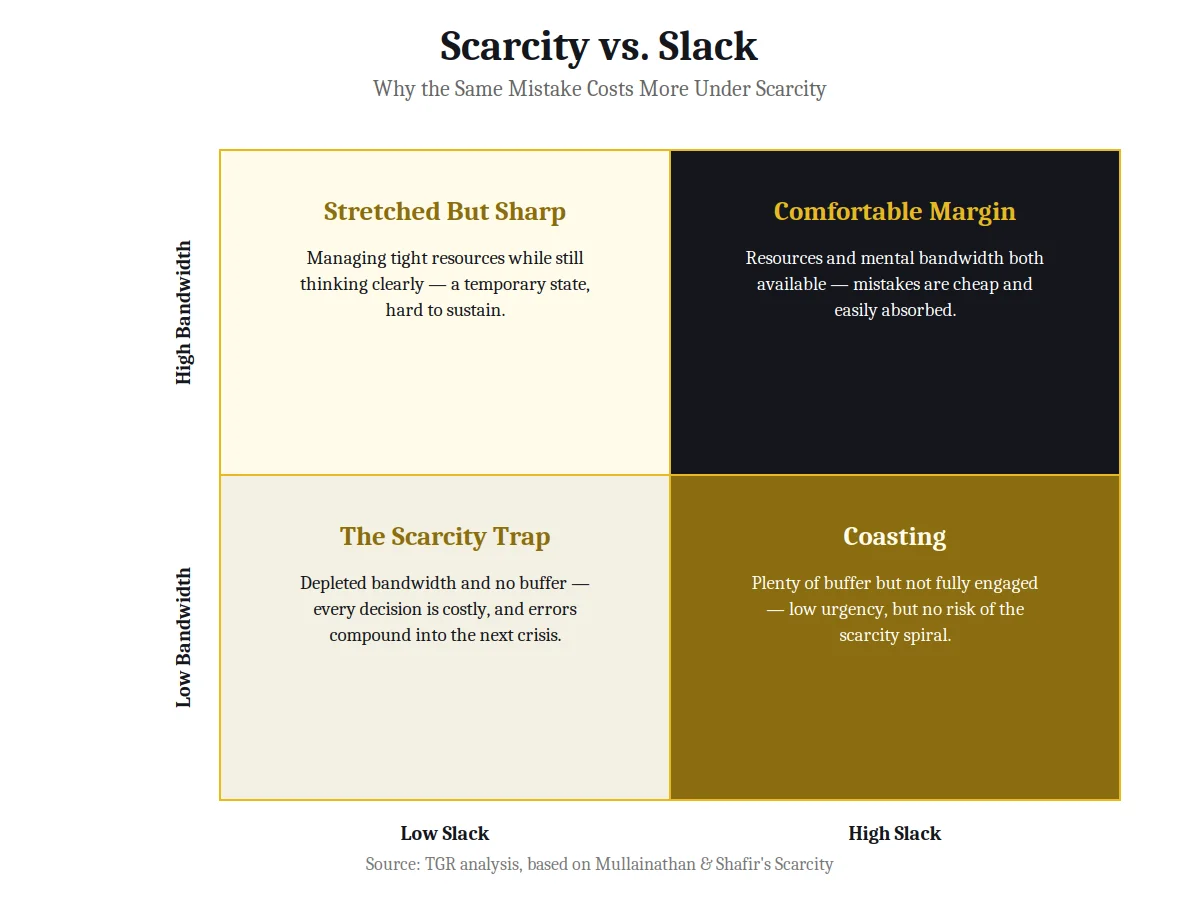
The opposite of scarcity is slack — buffer that makes mistakes cheap. A spacious suitcase lets you add one more item without a second thought; a full one forces a trade-off every time, and only the full one “really feels like a problem.” The authors extend this logic well beyond money: time scarcity (busyness) produces the same tunneling and borrowing-from-the-future dynamics, as does social scarcity (loneliness) and caloric scarcity (dieting) — all structurally similar phenomena, not separate problems.
The book’s policy implications follow directly: rather than blaming the “pilot” for errors, redesign the “cockpit” — build slack, reminders, and forgiving deadlines into programs for people under real resource pressure. A Cleveland housing nonprofit that added reminder postcards and small payment incentives saw a 20% improvement in on-time rent payment, evidence that scarcity-aware design changes outcomes more reliably than moral appeals to try harder.
Who is Scarcity best for — and who should read something else first?
This book is best for readers who want a research-backed reframe of why “poor decisions” under financial or time pressure are often a scarcity effect rather than a character or intelligence problem — managers, policymakers, and anyone who has judged their own or someone else’s behavior under stress too harshly. Its unified psychological framework rewards readers who want one sustained argument rather than a loose anthology of case studies.
If you’d rather see the same “circumstances explain behavior better than character” logic applied across a wider set of unrelated case studies, Freakonomics covers similar intellectual territory in a very different, anthology-style format.
Questions to reflect on
- Where in your own life does a scarce resource — money, time, attention — currently have you tunneling on the urgent at the expense of the important?
- Have you judged someone’s “poor decision” as a character flaw when it might actually reflect a genuine bandwidth tax they’re under?
- Where do you currently have slack, and where are you operating without any buffer at all?
- Is there a “scarcity trap” pattern in your life — a short-term fix that keeps quietly guaranteeing next month’s bigger problem?
- What’s one piece of “cockpit” redesign — a reminder, a default, a forgiving deadline — you could build into your own routine or your team’s process?
🔥 Ready to see scarcity’s real cost — and build slack against it?
This guide covers the core framework — the book gives you Mullainathan and Shafir’s full research, studies, and policy implications.
How to apply Scarcity (7-day plan)
- Day 1: Identify one area — money, time, or attention — where you’re currently tunneling, and name what’s slipping in the periphery.
- Day 2: Find one “scarcity trap” pattern in your life: a short-term fix that’s quietly creating a bigger problem later.
- Day 3: Build one piece of slack into a tight budget, schedule, or plan — a buffer that makes a mistake cheap instead of costly.
- Day 4: Set up one reminder or default that removes reliance on willpower or memory for something important but not urgent.
- Day 5: Reconsider a recent judgment you made about someone’s “poor decision” — could a bandwidth tax explain it better than character?
- Day 6: Notice whether a non-financial scarcity — time, loneliness, or dieting — is producing the same tunneling pattern in your life.
- Day 7: Redesign one small process (at work or home) to assume depleted bandwidth rather than full attention.
Frequently asked questions
What is the main idea of Scarcity?
That having too little of any resource — money, time, or calories — captures the mind and imposes a measurable cognitive cost, regardless of a person’s underlying intelligence.
What is the “bandwidth tax”?
The reduction in fluid intelligence and executive control that scarcity imposes, demonstrated in studies of farmers before and after harvest and shoppers under simulated financial stress.
What is “tunneling” in the book?
An intense, automatic focus on the scarce resource at the cost of everything in the periphery, including decisions that matter for the future.
What was the sugarcane farmer study?
The same Indian farmers were tested cognitively before and after harvest, scoring significantly worse when cash-poor than when cash-rich — isolating scarcity itself as the cause.
Does scarcity only apply to money?
No — the book argues the same dynamics show up in time scarcity, social scarcity (loneliness), and caloric scarcity (dieting).
What is “slack” in the book?
The buffer that scarcity removes — with slack, mistakes are nearly free to absorb; without it, every misstep is costly.
How is this different from Freakonomics?
Freakonomics is a loose anthology of incentive-driven case studies; Scarcity builds one unified psychological mechanism tested across several different domains.
Related summaries
If Scarcity resonated, these dig further into related territory: Freakonomics on incentives and hidden causality, and other titles in our best money and economics books pillar page.
How we analyze books: We work from the full book — reconstructing its core arguments in our own words, adding commentary that connects it to related research and other books in our library, and pressure-testing the advice in a practical 7-day plan. Ratings weigh usefulness, readability, and evidence quality. Read our full methodology.
Related Money Summaries
Die With Zero Summary & Review: How to Spend Your Money Before You Run Out of Time
Poor Charlie’s Almanack Summary & Review: Munger’s Masterclass in Worldly Wisdom
The Millionaire Fastlane Summary & Review: Build Wealth Fast
The Most Important Thing Summary & Review: Uncommon Sense for Thoughtful Investors
The Simple Path to Wealth Summary & Review: One Fund, Zero Complexity, Total Freedom