

★★★★★ 4.7/5 — A Pulitzer-caliber case study in emotional intelligence as leadership strategy, showing Lincoln turning his fiercest political enemies into his most effective cabinet.
Best for: leaders who want a deep, textured historical case rather than a numbered framework · Reading time: ~20 hrs (this guide: ~14 min) · Difficulty to apply: High — the lessons are simple to state, living without grudges under real pressure is genuinely hard
Team of Rivals in one minute
After winning the 1860 Republican nomination as the underdog, Abraham Lincoln filled his cabinet with the three men who had run against him for it. Doris Kearns Goodwin’s Pulitzer Prize-caliber history argues that Lincoln’s real genius wasn’t intellect alone but an extraordinary emotional intelligence — the capacity to understand rivals’ motives, absorb their criticism, and hold no grudges, which let him convert William Seward, Salmon Chase, and Edward Bates from opponents into some of the most effective cabinet members in American history. He later added Edwin Stanton as Secretary of War despite Stanton once calling him a “long-armed ape.” Published in 2005 and later adapted into Steven Spielberg’s film Lincoln, the book reads Lincoln’s presidency as a masterclass in building and holding together a team of genuinely talented people who didn’t start out on his side.
Key takeaways
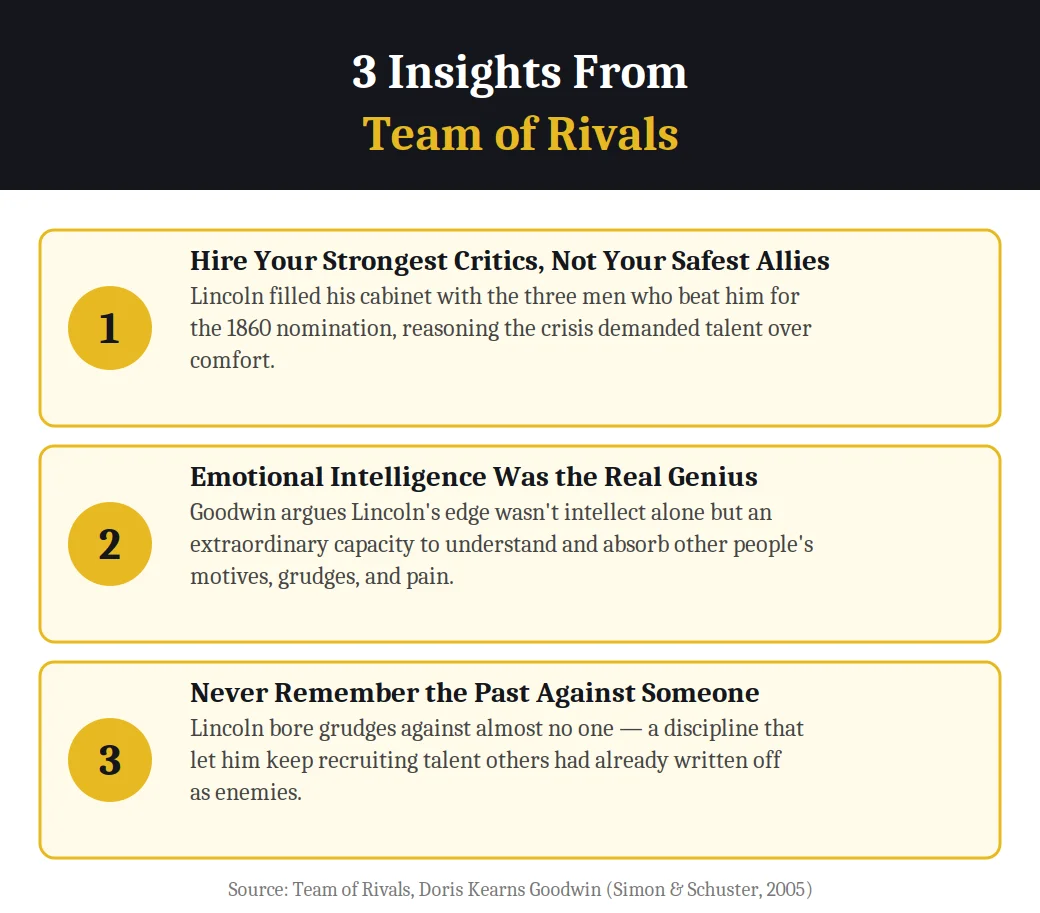
- Hire your strongest rivals, not your safest allies: Lincoln filled his cabinet with the three men who beat him for the 1860 nomination, reasoning the crisis demanded the party’s real talent, not comfortable loyalists.
- Emotional intelligence was the actual edge: Goodwin frames Lincoln’s political genius as, above all, an ability to put himself in other people’s place and understand their motives and desires.
- He almost never held grudges: “If any man ceases to attack me, I never remember the past against him” — a discipline that let him keep recruiting people who had every reason to resent him.
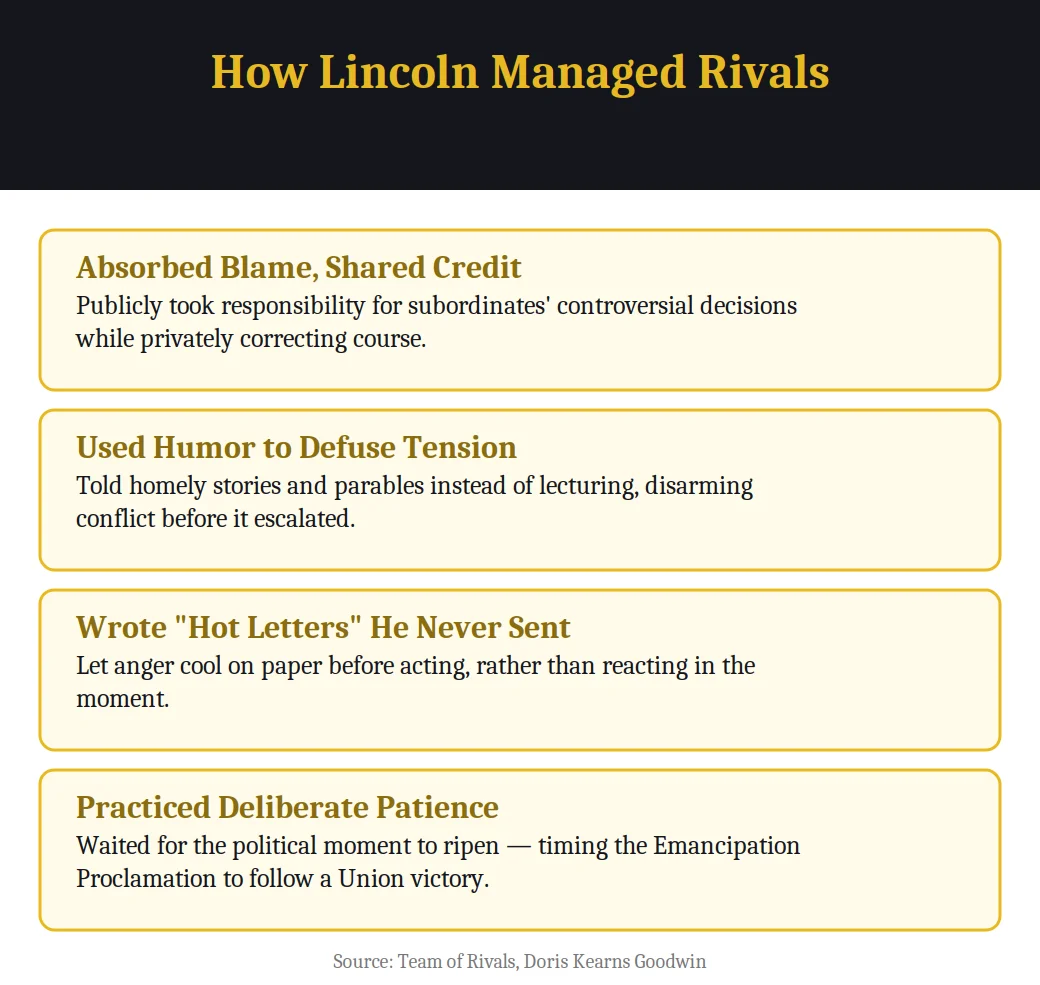
- He absorbed blame and shared credit: Lincoln publicly took responsibility for subordinates’ controversial decisions, including Stanton’s, while privately correcting course.
- Humor defused tension that confrontation would have escalated: he used homely stories and parables rather than lectures or classical rhetoric to make difficult points land softly.
- He wrote “hot letters” he deliberately never sent: a discipline for letting anger cool before acting, rather than reacting to provocation in the moment.
- Timing mattered as much as conviction: Lincoln deliberately timed the Emancipation Proclamation to follow a Union victory at Antietam, waiting, as he put it, “like a man watching his pear-tree… impatient for the ripening.”
- Loyalty was earned, not assumed: Stanton went from open contempt for Lincoln to devoted service; Seward went from condescension to becoming his closest defender — both won over through respect and fair treatment, not authority.
- Not every rival converts, and that’s a leadership problem too: Chase remained ambitious and disloyal even inside the cabinet, running a shadow campaign against Lincoln in 1864 — Lincoln accepted his resignation gracefully, then later appointed him Chief Justice anyway.
What is Team of Rivals about?
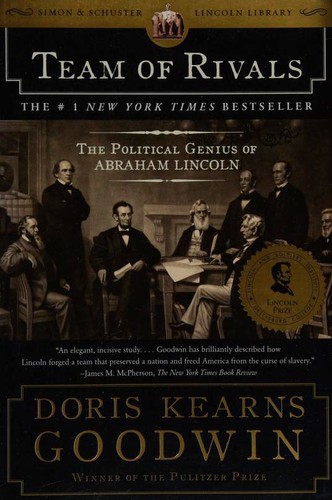
Team of Rivals is Doris Kearns Goodwin’s history of Abraham Lincoln’s presidency, built around a striking leadership choice: after winning the 1860 Republican nomination as the underdog, Lincoln appointed his three main rivals for that nomination — William Seward, Salmon Chase, and Edward Bates — to his cabinet, and later added Edwin Stanton as Secretary of War despite Stanton’s earlier open contempt for him. Goodwin argues this wasn’t naive generosity but calculated strength: Lincoln wanted the strongest people available for a national crisis, and his emotional intelligence — his capacity to understand rivals’ motives, absorb criticism, and hold no grudges — let him turn most of them into devoted, effective allies. Published in 2005, the book won the Lincoln Prize and was later adapted into Steven Spielberg’s 2012 film Lincoln.
About the author
Doris Kearns Goodwin is an American presidential historian who earned her PhD from Harvard and served as a White House Fellow under Lyndon B. Johnson before becoming one of the country’s leading biographers of the presidency. She won the Pulitzer Prize for History in 1995 for No Ordinary Time: Franklin and Eleanor Roosevelt: The Home Front in World War II. Her other major works include Lyndon Johnson and the American Dream, The Bully Pulpit: Theodore Roosevelt, Taft, and the Golden Age of Journalism, and Leadership: In Turbulent Times, which compares the leadership styles of Lincoln, Theodore Roosevelt, FDR, and LBJ. President Obama has cited Team of Rivals as an influence while forming his own cabinet. Explore all Doris Kearns Goodwin book summaries →
Key concepts at a glance
| Concept | What it means | Use it when |
|---|---|---|
| Team of Rivals | Deliberately recruiting your strongest critics and competitors rather than the safest, most agreeable candidates | You’re tempted to hire people who’ll never challenge you |
| No Grudges | Lincoln’s practiced discipline of not remembering past attacks against people once they stop attacking | Old resentment is quietly blocking you from working with a genuinely capable person |
| Absorbing Blame | Publicly taking responsibility for a subordinate’s controversial call while privately correcting course | A direct report made a defensible but unpopular decision |
| Hot Letters Never Sent | Writing out anger in full, then deliberately not sending it, to let the reaction cool before acting | You’re about to respond to a provocation while still angry |
| Waiting for the Pear to Ripen | Deliberately timing a decision for maximum effect rather than acting the moment you’re convinced you’re right | You’re right, but the moment isn’t |
Part 1: The Cabinet of Rivals
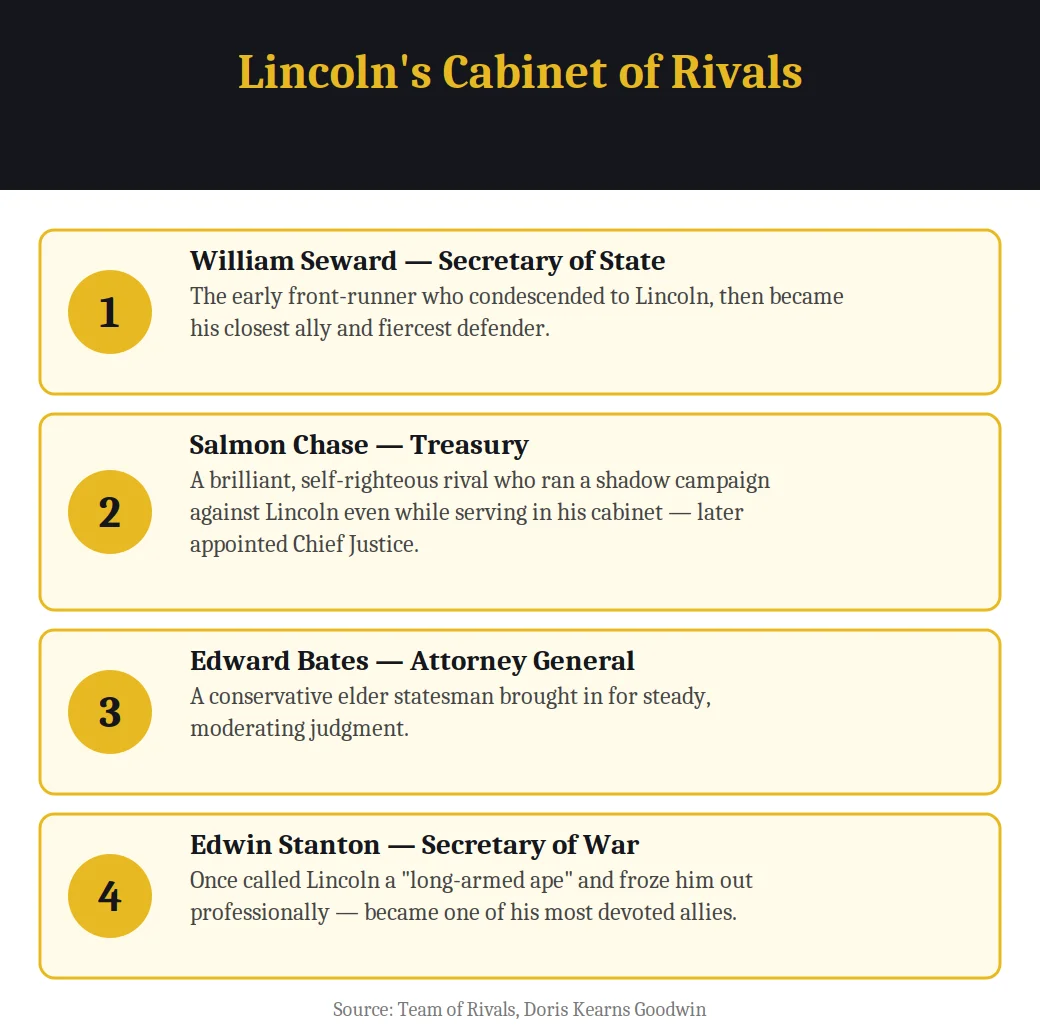
Lincoln entered the presidency as the least experienced and least famous of the major 1860 Republican contenders. Rather than surrounding himself with loyalists, he appointed Seward, the early front-runner, as Secretary of State; Chase, a brilliant and self-righteous abolitionist, as Treasury Secretary; and Bates, a conservative elder statesman, as Attorney General. He later added Stanton — who, at an 1855 patent trial, had sneeringly called Lincoln a “long-armed ape” and frozen him out of meals and legal work — as Secretary of War. Goodwin’s account frames this as calculated strength: the country’s crisis demanded the party’s real talent, not comfortable agreement.
TGR Note: This willingness to hire genuine strength over comfortable agreement echoes Legacy‘s “no dickheads” principle, though Kerr’s version screens for character rather than actively recruiting people who were recently trying to beat you.
Part 2: Emotional Intelligence as Strategy
Goodwin’s central claim is that Lincoln’s real advantage was psychological, not intellectual: “an extraordinary ability to put himself in the place of other men, to experience what they were feeling, to understand their motives and desires.” This showed up in concrete habits — writing “hot letters” he never sent, letting anger cool before acting; using homely stories and parables instead of confrontation to defuse tension; and telling a former political foe, General Benjamin Butler, “When you see me doing anything that… ought not to be done, come and tell me so.” Above all, he almost never held grudges, reasoning that resentment was a resource he couldn’t afford to spend.
TGR Note: Lincoln’s habit of publicly absorbing blame for subordinates’ decisions parallels The Score Takes Care of Itself‘s emphasis on leaders taking pride in effort and process over defending their own reputation in the moment.
Part 3: When It Didn’t Work, and What Held the Team Together
Not every rival converted fully. Chase remained ambitious throughout his tenure, running a barely-concealed shadow campaign for the 1864 nomination even while serving as Treasury Secretary. When his scheme collapsed, Lincoln accepted his resignation without rancor — and later appointed him Chief Justice of the Supreme Court, judging him the best person to secure the rights of newly freed Black citizens despite their history. Seward, by contrast, became Lincoln’s closest ally, credited with helping keep Britain from intervening on the Confederacy’s behalf. Stanton became so devoted that at Lincoln’s deathbed he reportedly said, “Now he belongs to the ages.”
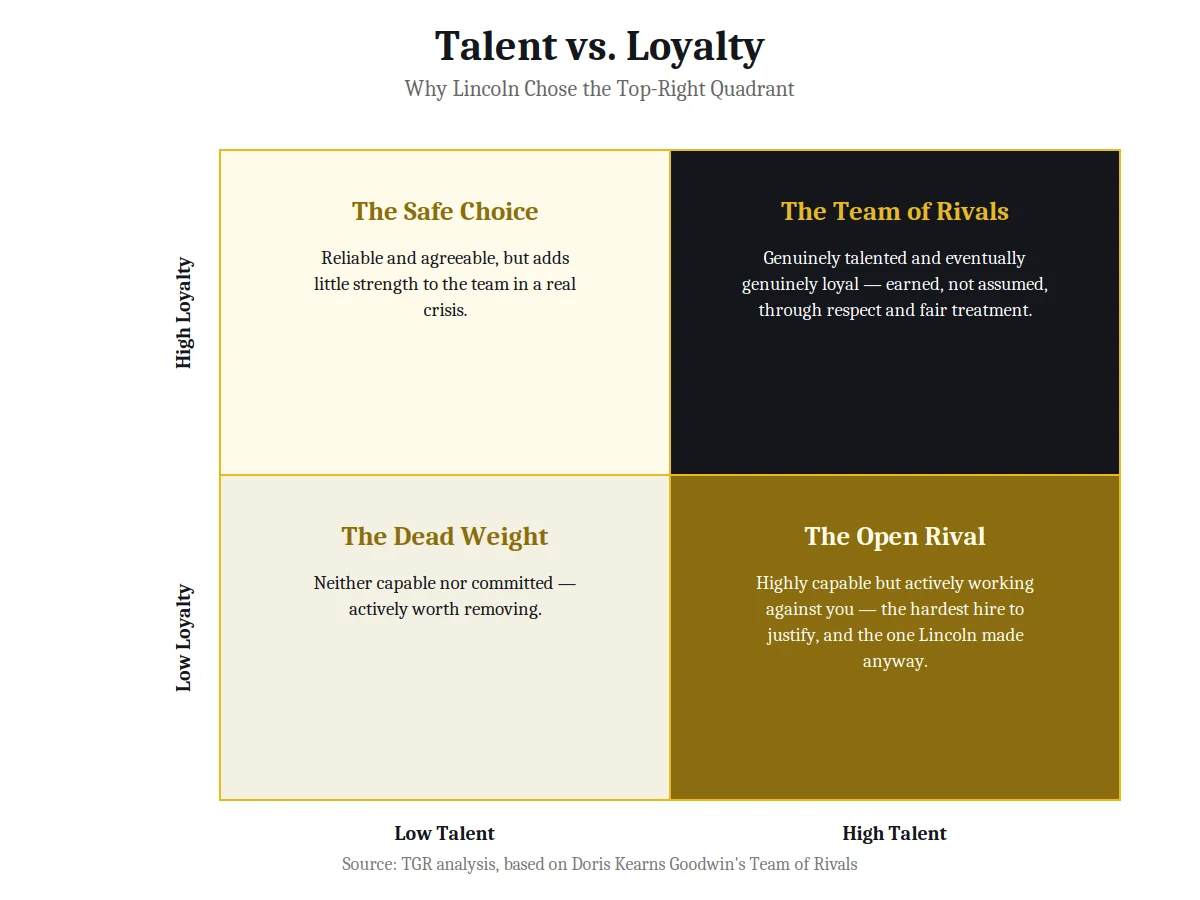
What held the team together through the Civil War, Goodwin argues, wasn’t formal authority — Lincoln governed largely through persuasion rather than command, most visibly in the personal lobbying and patronage he used to secure the Thirteenth Amendment’s passage. It was Lincoln’s own consistency: absorbing criticism, sharing credit, holding no grudges, and treating even open rivals as people worth winning over rather than enemies to defeat.
Who is Team of Rivals best for — and who should read something else first?
This book is best for leaders who want a deep, textured historical case study rather than a numbered framework — executives building a leadership team from genuinely capable but not always agreeable people, and anyone drawn to leadership lessons embedded in real, high-stakes narrative rather than extracted into bullet points. At 900-plus pages, it’s a serious commitment; readers wanting something more concise should expect this guide to cover the throughline, not the full narrative.
If you want the same “assemble genuine talent, not comfortable agreement” instinct applied to sports team culture, Legacy covers related ground in far fewer pages. If organizational health at the company level, not a single leader’s psychology, is your focus, The Advantage applies related thinking with a business lens.
Questions to reflect on
- Is there someone genuinely talented you’ve avoided working with because of an old grudge or rivalry?
- When a direct report makes a defensible but unpopular call, do you publicly back them or let them take the heat alone?
- Do you have your own version of a “hot letter you never send” — a real cooling-off discipline before you respond to provocation?
- Are you waiting for the right moment on a decision you know is correct, or rushing it because you’re impatient to be right?
- Do the people on your team stay because of your authority, or because you’ve genuinely earned their loyalty?
🔥 Ready to build your own team of rivals?
This guide covers the core throughline — the book gives you Goodwin’s full, richly sourced narrative of Lincoln’s presidency and cabinet.
How to apply Team of Rivals (7-day plan)
- Day 1: Identify one genuinely talented person you’ve avoided working with because of past friction, and consider what re-engaging would take.
- Day 2: Next time you feel a flash of anger at criticism, write the “hot letter” — then don’t send it. Reread it a day later.
- Day 3: Publicly back a direct report’s defensible-but-unpopular decision instead of distancing yourself from it.
- Day 4: Practice explaining a difficult point through a story or analogy instead of a lecture or directive.
- Day 5: Identify a decision you’re pushing too early, and deliberately wait for a better moment instead.
- Day 6: Ask someone who has clashed with you in the past what they’d need to genuinely trust you again.
- Day 7: Write down one grudge you’re still holding, and consider what it’s actually costing you to keep it.
Frequently asked questions
What is the main idea of Team of Rivals?
That Lincoln’s political genius was rooted in emotional intelligence — his ability to understand rivals’ motives, absorb criticism, and hold no grudges — which let him turn political opponents into an effective governing cabinet.
Who were the rivals in Lincoln’s cabinet?
William Seward (Secretary of State), Salmon Chase (Treasury), and Edward Bates (Attorney General) — his three main rivals for the 1860 Republican nomination — plus Edwin Stanton (War), who had previously shown him open contempt.
Did all of Lincoln’s rivals become loyal to him?
Most did — Seward became his closest ally and Stanton became fiercely devoted — but Chase remained ambitious and ran a shadow campaign against Lincoln even while serving in his cabinet.
What does “hot letters he never sent” mean?
Lincoln would write out an angry response in full, then deliberately not send it, letting his anger cool before deciding how to actually act.
Was Team of Rivals made into a movie?
Yes, it was loosely adapted, focusing on the Thirteenth Amendment fight, into Steven Spielberg’s 2012 film Lincoln, starring Daniel Day-Lewis.
Who is Doris Kearns Goodwin?
A Pulitzer Prize-winning presidential historian who has written extensively on Lincoln, the Roosevelts, Lyndon Johnson, and Theodore Roosevelt.
How is this different from Legacy?
Legacy distills a sports team’s culture into 15 short, numbered lessons; Team of Rivals is a 900-plus-page historical narrative with no formal framework, requiring the reader to draw out the leadership lessons themselves.
Related summaries
If Team of Rivals resonated, these dig further into related territory: Legacy on the All Blacks’ culture of selecting for character, The Score Takes Care of Itself on Bill Walsh’s Standard of Performance, and The Advantage on building organizational health. For more, see our best leadership books pillar page.
How we analyze books: We work from the full book — reconstructing its core arguments in our own words, adding commentary that connects it to related research and other books in our library, and pressure-testing the advice in a practical 7-day plan. Ratings weigh usefulness, readability, and evidence quality. Read our full methodology.
Related Leadership Summaries
The First 90 Days Summary & Review: Master Every Leadership Transition
The Ideal Team Player Summary & Review: Hire for Humility, Hunger, and People Smarts
The Leadership Challenge Summary and Review
The Ride of a Lifetime Summary & Review: Leadership Lessons from Disney’s Greatest CEO
Who Moved My Cheese? Summary & Review: Navigate Change Before It Breaks You