

★★★★☆ 4.5/5 — 15 tight, quotable lessons in leadership from the most statistically dominant team in professional sports history.
Best for: leaders who want a punchy, culture-first framework rather than a data-heavy business case study · Reading time: ~4 hrs (this guide: ~11 min) · Difficulty to apply: Moderate — the lessons are simple to state, building a genuine “no dickheads” culture takes sustained discipline
Legacy in one minute
The New Zealand All Blacks have the highest winning percentage of any team in the history of professional sport — roughly 86% across international test matches over more than a century. James Kerr, a former advertising creative director, embedded with and studied the team to understand what actually produces that level of sustained excellence, and distilled it into 15 short, quotable lessons: from “Sweep the Sheds” (humility — players clean their own locker room after every match) to “No Dickheads” (selecting for character as ruthlessly as for talent) to “Be a Good Ancestor” (thinking generationally, not just for this season). Published in 2013 and reissued in a 10th Anniversary Edition, the book argues that the All Blacks’ dominance isn’t about individual genius — it’s about a deliberately built, ruthlessly maintained culture.
Key takeaways
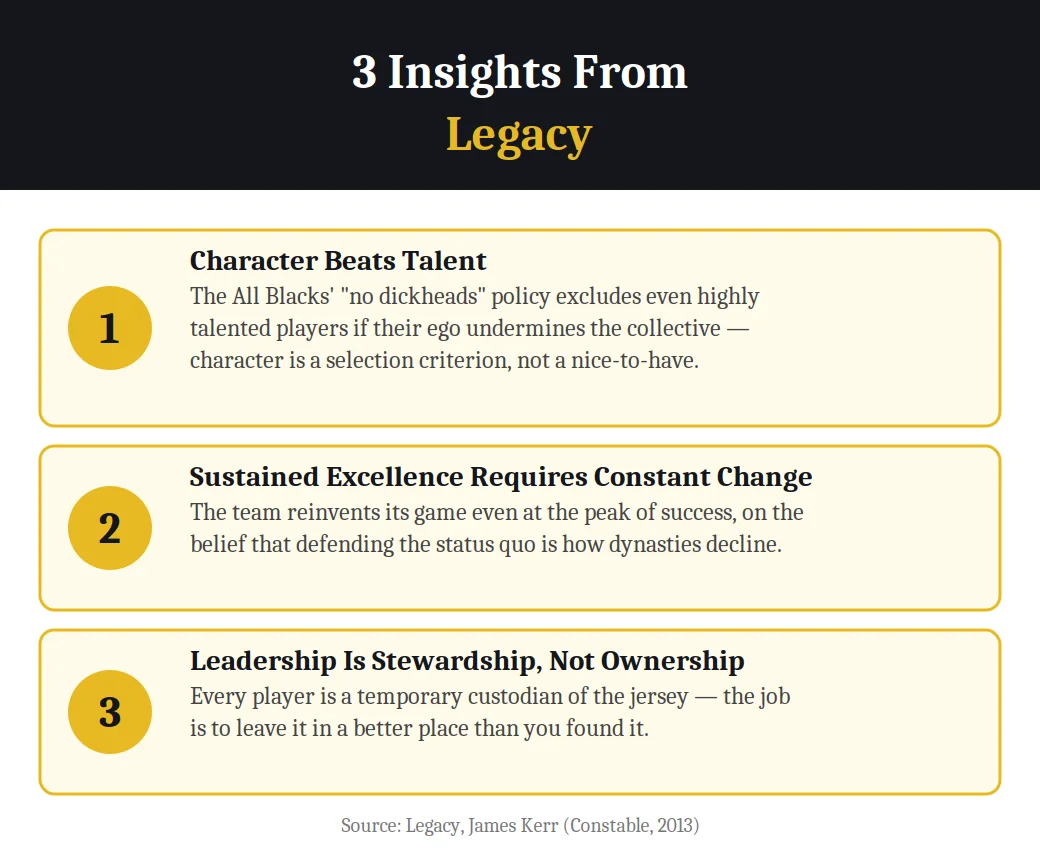
- Character is a selection criterion, not a bonus: the All Blacks’ “no dickheads” policy excludes even highly talented players if their ego undermines the team.
- Humility starts with the small stuff: “Sweep the Sheds” — players clean their own locker room after every match, win or lose — no one is too big for unglamorous tasks.
- Change while you’re winning: “Go for the Gap” argues teams should reinvent their approach at the peak of success, not wait until decline forces their hand.
- Leadership should be distributed, not hoarded: “Pass the Ball” reflects the All Blacks’ practice of shifting real authority from coaches to senior players to the players themselves as game day approaches.
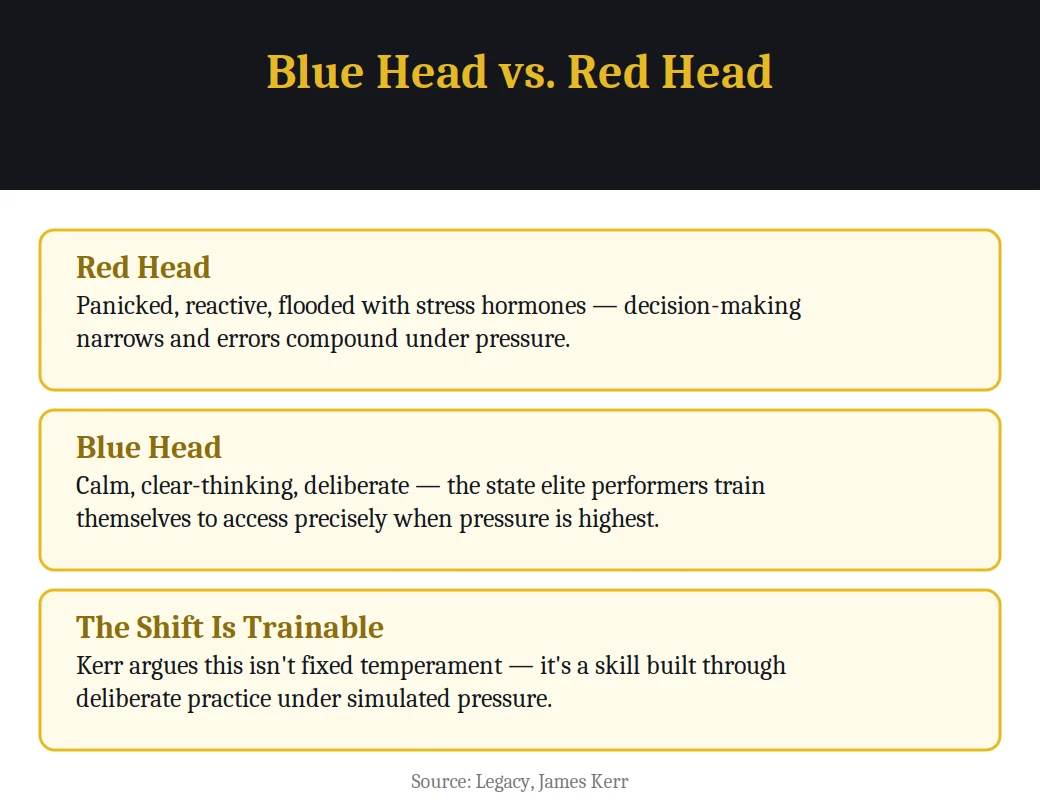
- Pressure performance is trainable: “Keep a Blue Head” describes shifting from a panicked, reactive “red head” state to a calm, clear-thinking “blue head” — a skill built through deliberate practice, not fixed temperament.
- Rituals anchor identity: “Ritualize to Actualize” uses the haka as a case study in how shared ritual connects performance to deeper meaning and belonging.
- Purpose has to outlast any single season: “Be a Good Ancestor” — plant trees you’ll never see grow — reframes leadership as a generational responsibility, not a personal scoreboard.
- The ultimate goal is stewardship: the book’s closing lesson, “Write Your Legacy,” treats every leader as a temporary custodian obligated to leave the jersey in a better place than they found it.
- Better people make better teams: across all 15 lessons, the throughline is that sustained excellence is a culture problem before it’s a talent or strategy problem.
What is Legacy about?
Legacy is James Kerr’s study of the New Zealand All Blacks rugby team — the most statistically dominant team in the history of professional sport — distilled into 15 short lessons in leadership and culture. Drawing on the team’s practices, rituals, and Māori-influenced values (whānau, or family; whakapapa, or generational heritage), Kerr argues that the All Blacks’ sustained excellence comes from a deliberately built culture rather than individual talent alone: selecting for character as much as skill, distributing leadership rather than hoarding it, and treating every player as a temporary custodian obligated to leave the jersey better than they found it. First published in 2013 and reissued in a 10th Anniversary Edition, the book has become a staple leadership text well beyond sports.
About the author
James Kerr is a UK-based author, speaker, and consultant specializing in culture and leadership. Before writing Legacy, he had a career as an award-winning creative director and brand consultant in advertising, and had previously authored one earlier book, The Alphabet of the Human Heart. Following Legacy’s success, Kerr became a full-time author and consultant, working with organizations including Special Forces units, Formula 1 teams, America’s Cup crews, Premier League football clubs, and major corporations such as Google, PayPal, and Unilever. He has since written further books, including Spearhead and Where the Earth Meets the Sky. Explore all James Kerr book summaries →
Key concepts at a glance
| Concept | What it means | Use it when |
|---|---|---|
| No Dickheads | Selecting for character as ruthlessly as for talent — egos that undermine the team are excluded regardless of skill | A talented person’s behavior is quietly corroding team morale |
| Sweep the Sheds | Humility in small, unglamorous tasks — no one is too senior to do them | Star performers start expecting to skip the basics |
| Blue Head vs. Red Head | The trained ability to stay calm and clear-thinking under pressure instead of panicked and reactive | Your team’s performance falls apart specifically when stakes are highest |
| Pass the Ball | Deliberately distributing leadership and authority rather than concentrating it at the top | Your organization has a single point of failure in decision-making |
| Be a Good Ancestor | Thinking and building generationally, beyond your own tenure | Decisions are being made purely for short-term wins at long-term cost |
Part 1: Character as a selection criterion
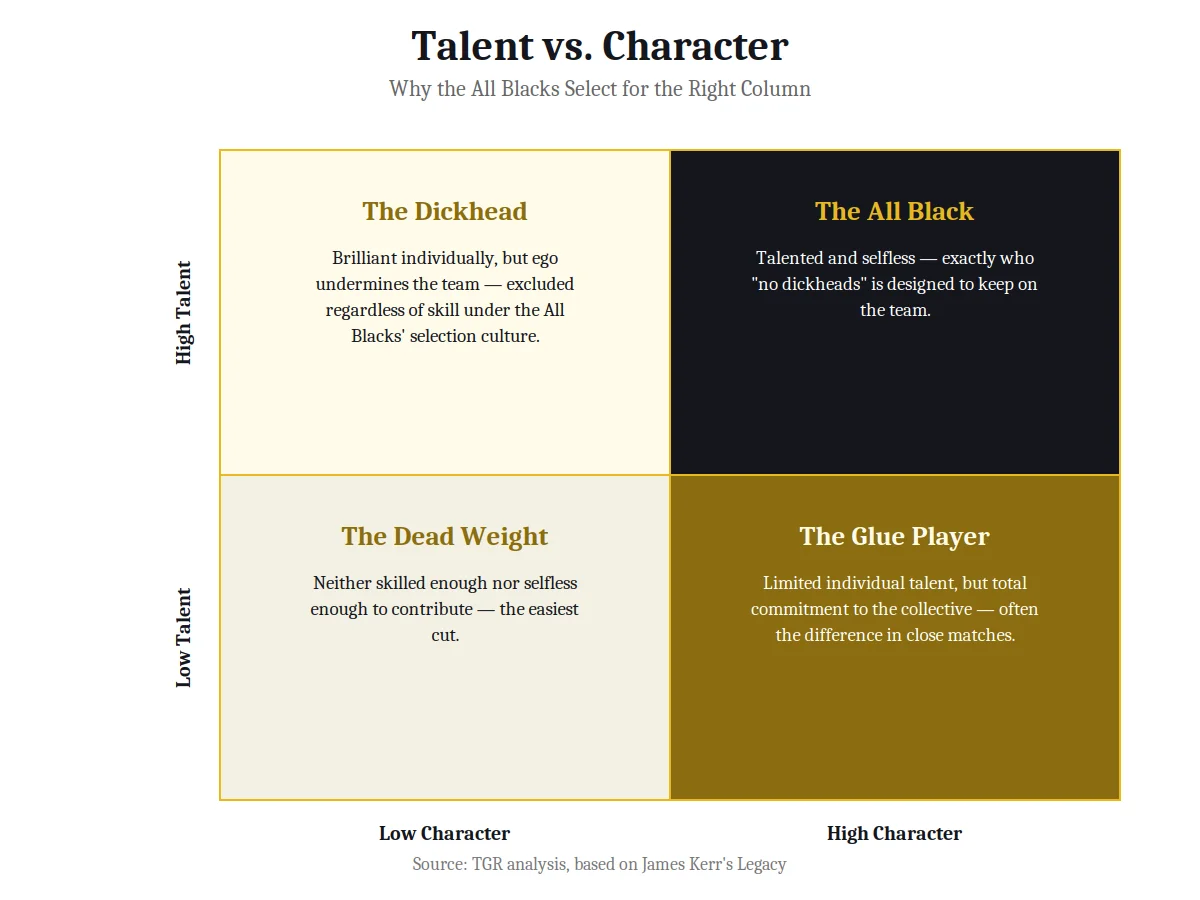
The All Blacks’ most quoted cultural rule is blunt: no dickheads. Talent alone doesn’t earn a place on the team — players whose ego or self-interest threatens the collective are excluded, regardless of ability. This is paired with “Sweep the Sheds,” the practice of players cleaning their own locker room after every match, win or lose, reinforcing that no one — however famous — is above small, unglamorous work. Kerr frames both as expressions of the same underlying principle: “Better people make better All Blacks.”
TGR Note: This character-first selection philosophy closely mirrors The Score Takes Care of Itself, where Bill Walsh’s Standard of Performance codifies behavior and character expectations for the entire 49ers organization, not just its star players.
Part 2: Distributed leadership and performance under pressure
Kerr describes a leadership model that shifts across the training week — coaches setting direction early on, senior players taking more ownership mid-week, and full player autonomy by game day. “Pass the Ball” captures this: leaders create leaders, rather than concentrating authority and decision-making at the top indefinitely. This distributed model is paired with “Keep a Blue Head,” the deliberately trained ability to stay calm and clear-thinking under pressure instead of slipping into a panicked, reactive “red head” state — a skill Kerr argues is built through practicing under match-level intensity, not something players are simply born with.
TGR Note: The idea of leadership distributed across a team rather than concentrated in one person connects to The Advantage‘s argument that a cohesive leadership team, not a single visionary, is what actually produces organizational health.
Part 3: Ritual, generational thinking, and legacy
Kerr treats ritual — most visibly the haka — as more than ceremony: it’s a mechanism for connecting performance to identity and shared meaning, turning belief into repeated, embodied action. This feeds into the book’s final lessons, “Be a Good Ancestor” and “Write Your Legacy,” which reframe leadership as a generational responsibility. Every player is only a temporary custodian of the black jersey; the obligation isn’t ownership but stewardship — leaving it in a better place than you found it, for people you may never personally coach or play alongside.
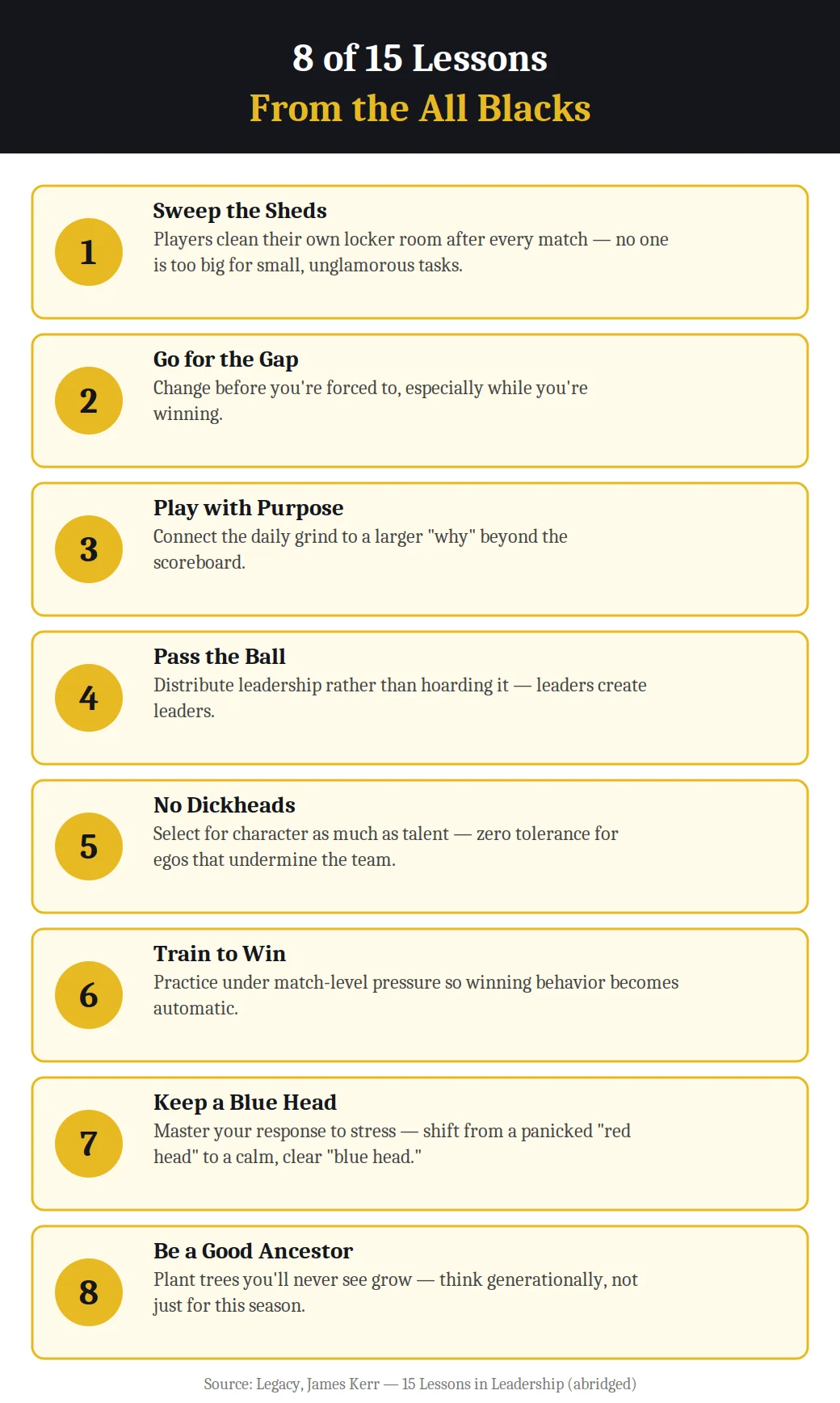
Taken together, the 15 lessons argue that the All Blacks’ record — the best win rate of any team in professional sports history — isn’t the product of any single tactic, but of a culture maintained with unusual discipline across generations of players who never met each other.
Who is Legacy best for — and who should read something else first?
This book is best for leaders who want a punchy, culture-first framework told through vivid sports storytelling rather than a data-heavy business case study — team leads building or resetting culture, sports coaches at any level, and readers who find longer business books slow going. Its short, skimmable chapters make it easy to revisit lesson by lesson.
If you want a single-organization leadership memoir from an actual head coach rather than an outside journalist’s synthesis, The Score Takes Care of Itself offers that first-person depth. If organizational health at the company level is your focus, The Advantage applies related thinking with a business-team lens. And if you want the behavioral-practices angle validated by decades of cross-industry research, The Leadership Challenge offers a research-driven parallel.
Questions to reflect on
- Would your team pass a “no dickheads” test — and if not, whose talent are you tolerating at the expense of everyone else’s morale?
- What’s your organization’s version of “sweeping the sheds” — and do your most senior people actually still do it?
- Are you distributing real authority to the people below you, or does every decision still funnel through you?
- How do you perform specifically when the pressure is highest — do you have a trained “blue head” response, or do you go “red”?
- If you left your role tomorrow, would you be leaving the jersey in a better place than you found it?
🔥 Ready to build a “no dickheads” culture?
This guide covers the core lessons — the book gives you Kerr’s full reporting, the complete 15-lesson framework, and the stories behind them.
How to apply Legacy (7-day plan)
- Day 1: Write down what “no dickheads” would actually mean for your team — be specific about the behaviors you’d no longer tolerate.
- Day 2: Do one unglamorous task yourself today that you’d normally delegate — your own version of sweeping the sheds.
- Day 3: Identify one thing your team is doing well right now, and change it anyway, before you’re forced to.
- Day 4: Hand a real decision to someone more junior than you this week, and don’t take it back.
- Day 5: Notice your own “red head” moments today — where pressure made you reactive — and practice one deliberate pause before responding.
- Day 6: Identify one ritual (a meeting, a kickoff, a debrief) your team could use to reinforce shared identity and values.
- Day 7: Write one sentence describing the state you want to leave your team or role in — your own legacy statement.
Frequently asked questions
What is the main idea of Legacy?
That the All Blacks’ record-breaking win rate comes from a deliberately built culture — distilled into 15 lessons — rather than individual talent alone.
What does “no dickheads” mean in the book?
A selection principle: players whose ego or self-interest undermines the team are excluded regardless of talent — character is a requirement, not a bonus.
What is “Sweep the Sheds”?
The All Blacks’ practice of players cleaning their own locker room after every match, symbolizing that no one is too important for small, unglamorous tasks.
What is “Blue Head vs. Red Head”?
Kerr’s framework for pressure performance: “red head” is panicked and reactive, “blue head” is calm and clear-thinking — a trainable skill, not fixed temperament.
How dominant are the All Blacks, statistically?
They’re commonly cited as having roughly an 86% win rate across international test matches over more than a century — the highest of any team in professional sports history.
Is this book only relevant to sports?
No — while it’s built entirely around one rugby team, its 15 lessons are widely applied in business, and Kerr now consults for corporations and organizations well beyond sports.
How is this different from The Score Takes Care of Itself?
The Score Takes Care of Itself is a first-person memoir by the actual coach who built the culture; Legacy is outside journalism synthesizing observations into a tidy 15-lesson framework.
Related summaries
If Legacy resonated, these dig further into related territory: The Score Takes Care of Itself on Bill Walsh’s Standard of Performance, The Advantage on building organizational health, and The Leadership Challenge on the five practices of exemplary leadership. For more, see our best leadership books pillar page.
How we analyze books: We work from the full book — reconstructing its core arguments in our own words, adding commentary that connects it to related research and other books in our library, and pressure-testing the advice in a practical 7-day plan. Ratings weigh usefulness, readability, and evidence quality. Read our full methodology.
Related Leadership Summaries
Leadership and Self-Deception Summary & Review: Get Out of the Box
Primal Leadership Summary & Review: Lead With Emotional Intelligence
Team of Rivals Summary and Review
The Culture Map Summary & Review: Decode Any Culture Before It Costs You a Deal
Tribal Leadership Summary & Review: Upgrade Your Team from Stage 3 to Stage 4