

★★★★☆ 4.3/5 — one of the simplest, most durable focus systems around: a kitchen timer, 25 minutes of real work, and a genuine 5-minute break.
Best for: anyone who starts tasks with good intentions and loses the thread to notifications, stray thoughts, or vague time estimates · Reading time: ~3 hrs (this guide: ~13 min) · Difficulty to apply: Very easy — a timer is the only tool required
The Pomodoro Technique in one minute
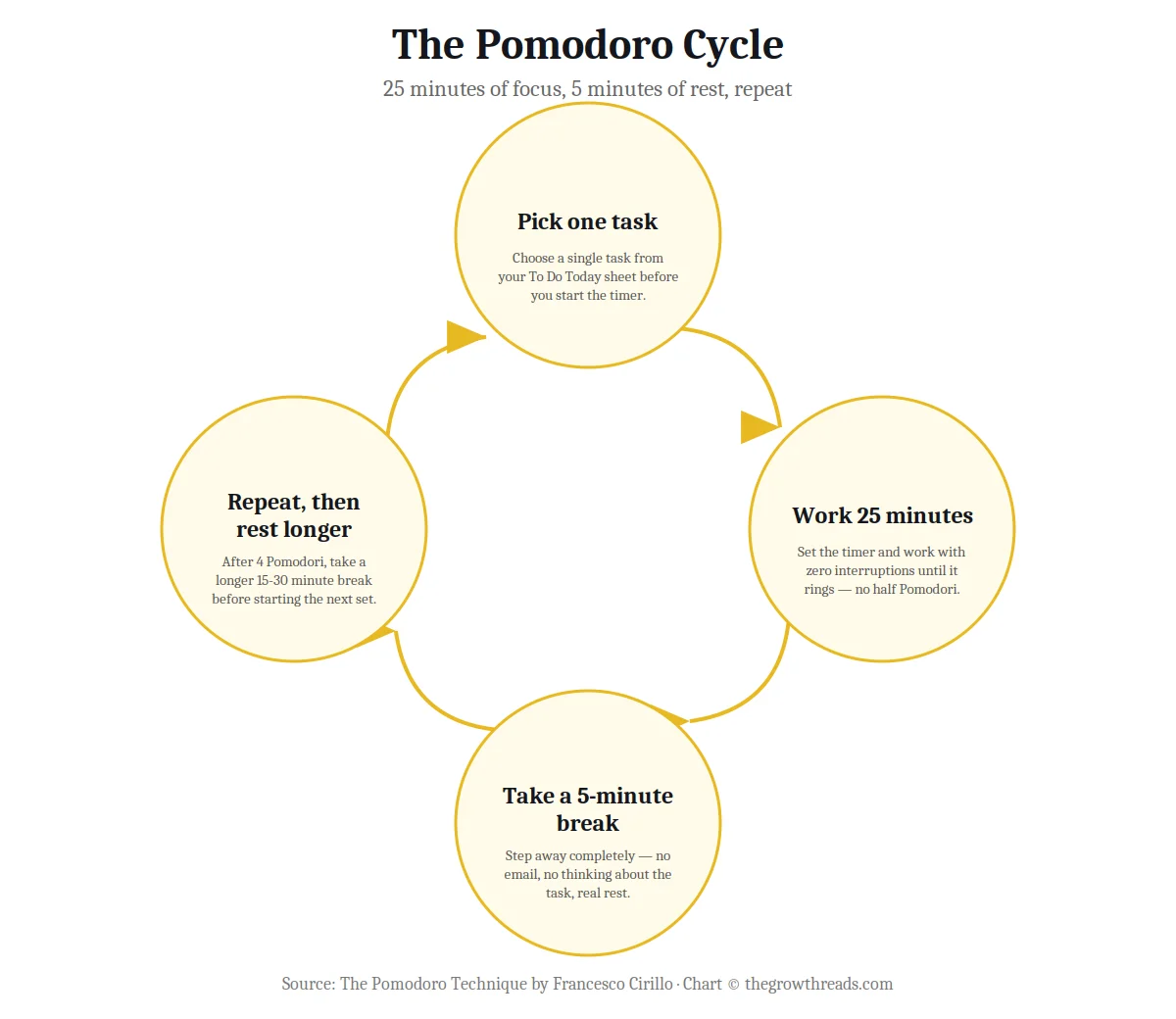
Francesco Cirillo developed the Pomodoro Technique as a university student, using a tomato-shaped kitchen timer to force himself into short, genuinely focused study sessions. The method is deliberately simple: work on one task for 25 uninterrupted minutes — one “Pomodoro” — then take a real 5-minute break, and after four Pomodori, take a longer break of 15 to 30 minutes. The strictness is the point. A Pomodoro that gets interrupted has to restart, not resume, which builds a habit of protecting the 25 minutes rather than treating it as negotiable. Paired with three simple paper sheets for planning and tracking, the technique turns vague intentions to “focus more” into a concrete, repeatable unit of work.
Key takeaways
- The core cycle is 25 minutes of work, 5 minutes of rest: after four Pomodori, take a longer break of 15 to 30 minutes before starting the next set.
- There are only complete Pomodori: no half Pomodori, no 80% ones — if a Pomodoro is interrupted in a way that can’t be logged and continued, it has to restart from zero.
- A physical, ticking timer works better than a phone app: winding it strengthens your commitment to the block, and the ticking becomes a focus cue rather than a distraction.
- Interruptions split into internal and external: a stray thought or urge to check something is internal; a colleague’s question or a phone call is external — each has a specific handling method.
- Internal interruptions get written down, not suppressed: jotting the thought on paper and returning to the task preserves focus better than trying to force the thought away.
- External interruptions get informed, negotiated, and deferred: tell the person you’re in a Pomodoro, agree on a callback time, and get back to the block rather than stopping.
- Three simple sheets run the whole system: an Activity Inventory of everything you need to do, a To Do Today list of daily priorities, and a Records sheet logging completed Pomodori.
- Tracking Pomodori sharpens future estimates: logging how many Pomodori a task actually took turns your planning from guesswork into a measured baseline.
- Workplace interruptions are more costly than they seem: research cited in the book found interruptions occur roughly every 8 minutes on average but take about 23 minutes to fully recover from — which is exactly the gap the technique is built to close.
What is The Pomodoro Technique about?
The Pomodoro Technique is Francesco Cirillo’s account of a time-management system he built for himself as a student and has since spread to millions of individuals and teams. The core cycle — 25 minutes of focused work followed by a 5-minute break, repeated four times before a longer rest — is intentionally simple to describe, but the book spends most of its pages on the discipline around that cycle: how to handle interruptions without losing focus, how to plan a day using three paper sheets, and how to use logged data to get better at estimating how long things actually take.
About the author
Francesco Cirillo is a software designer, author, and consultant who developed the Pomodoro Technique as a university student in the late 1980s, using a tomato-shaped kitchen timer (pomodoro is Italian for tomato) to force himself into short, genuinely focused study sessions instead of vague, unstructured cramming. He began sharing the method informally in the 1990s and self-published it as a short book in 2006, and it has since become one of the most widely used personal productivity systems in the world, adapted for individuals, pairs, and full teams. Cirillo has continued to develop related methods, including Defuse the IF Strategy and Combinant, and runs a company built around books, courses, and consulting on productivity and software design. Explore all Francesco Cirillo book summaries →
Key concepts at a glance
| Concept | What it means | Use it when |
|---|---|---|
| The Pomodoro | 25 minutes of single-task, uninterrupted work, treated as an indivisible unit | You want a concrete, bounded block of real focus instead of open-ended “work time” |
| No half Pomodori | An interrupted Pomodoro has to restart, not pause and resume | You’re tempted to treat the 25 minutes as flexible or negotiable |
| Internal vs. external interruptions | Distinguishing thoughts and urges (internal) from other people (external), each with its own handling method | You keep losing focus mid-task and want a specific fix, not just more willpower |
| The three sheets | Activity Inventory, To Do Today, and Records — the paper system that runs the whole technique | You want a lightweight planning system that doesn’t require an app |
| Estimating in Pomodori | Using logged Pomodoro counts from past tasks to estimate new ones more accurately | Your time estimates for tasks are consistently off |
Part 1: The origin of the tomato timer and why 25 minutes
Cirillo developed the technique almost by accident, as a university student struggling to study effectively. Rather than another willpower-based resolution to “focus more,” he made a concrete bet with himself: could he commit to just ten minutes of genuinely undistracted work, using a kitchen timer shaped like a tomato that happened to be sitting in his kitchen? The small, literal commitment — winding a physical timer and working until it rang — turned out to matter more than any productivity theory; the timer became both a countdown and a promise.
The 25-minute length that eventually stuck isn’t arbitrary trivia so much as a practical sweet spot: long enough to get meaningfully into a task, short enough that full, uninterrupted attention for the whole block feels achievable rather than daunting. Because a Pomodoro can’t be interrupted without restarting, the length also forces a specific kind of planning — you can’t fit a sprawling, ill-defined project into 25 minutes, so tasks have to be broken down into pieces small enough to fit the unit, which is itself a useful discipline.
TGR Note: The insistence on protecting a short, bounded block of attention echoes Deep Work‘s broader case for scheduling distraction-free focus — Cirillo’s version is smaller in scale and easier to start today, at the cost of depth in any single session.
Part 2: Internal and external interruptions
Cirillo splits interruptions into two categories that call for different responses. Internal interruptions — a stray thought, an urge to check email, a sudden idea unrelated to the task — are handled by writing them down immediately rather than either acting on them or trying to suppress them by force. Suppression, he argues, quietly drains mental energy even when it appears to work, while writing the thought down releases it from working memory without requiring you to act on it right away.
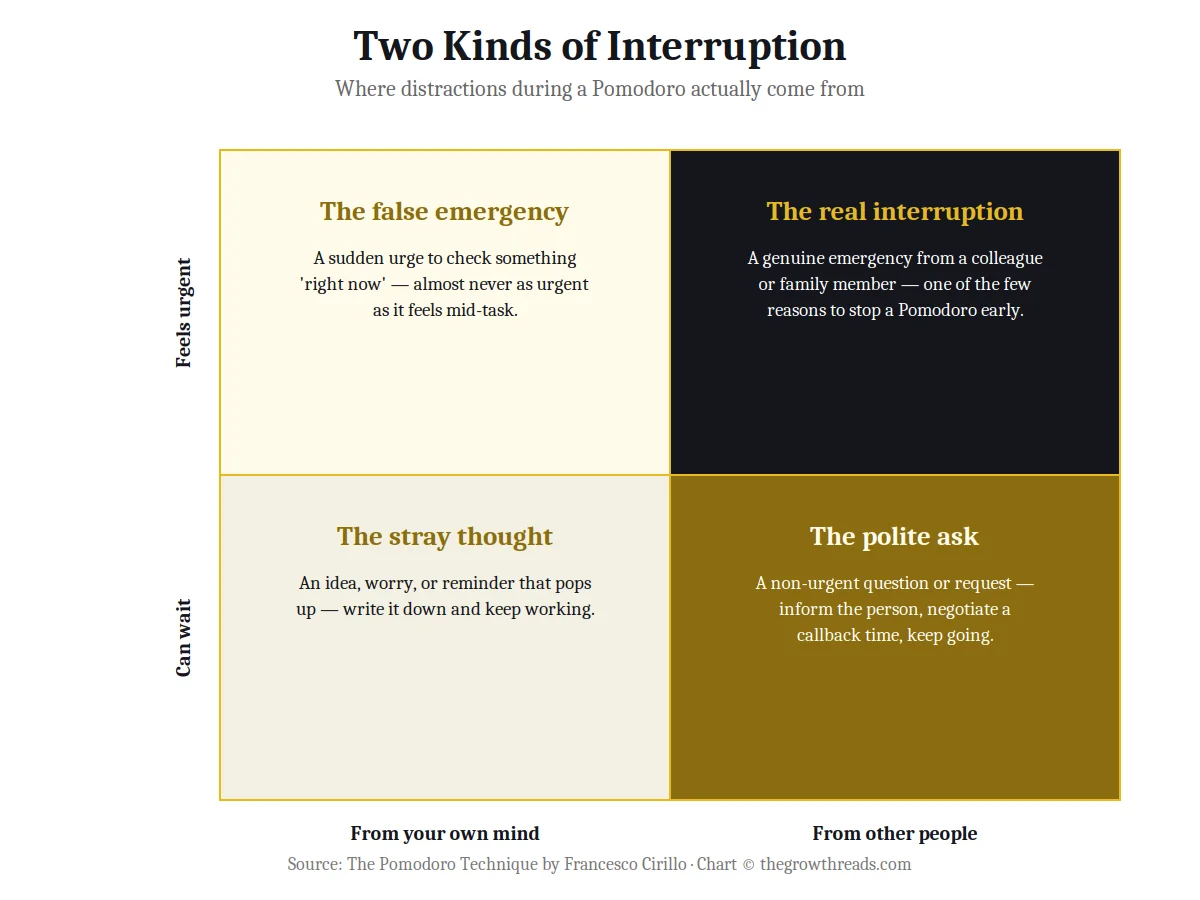
External interruptions — a colleague’s question, a phone call, an unplanned request — get a slightly different protocol: inform the person that you’re in a focused work block, negotiate a specific time to follow up, and then actually return to the Pomodoro rather than letting the negotiation itself become the interruption. Only genuine emergencies justify abandoning a Pomodoro outright, and even then, the discipline is to note it honestly rather than quietly count a broken block as complete.
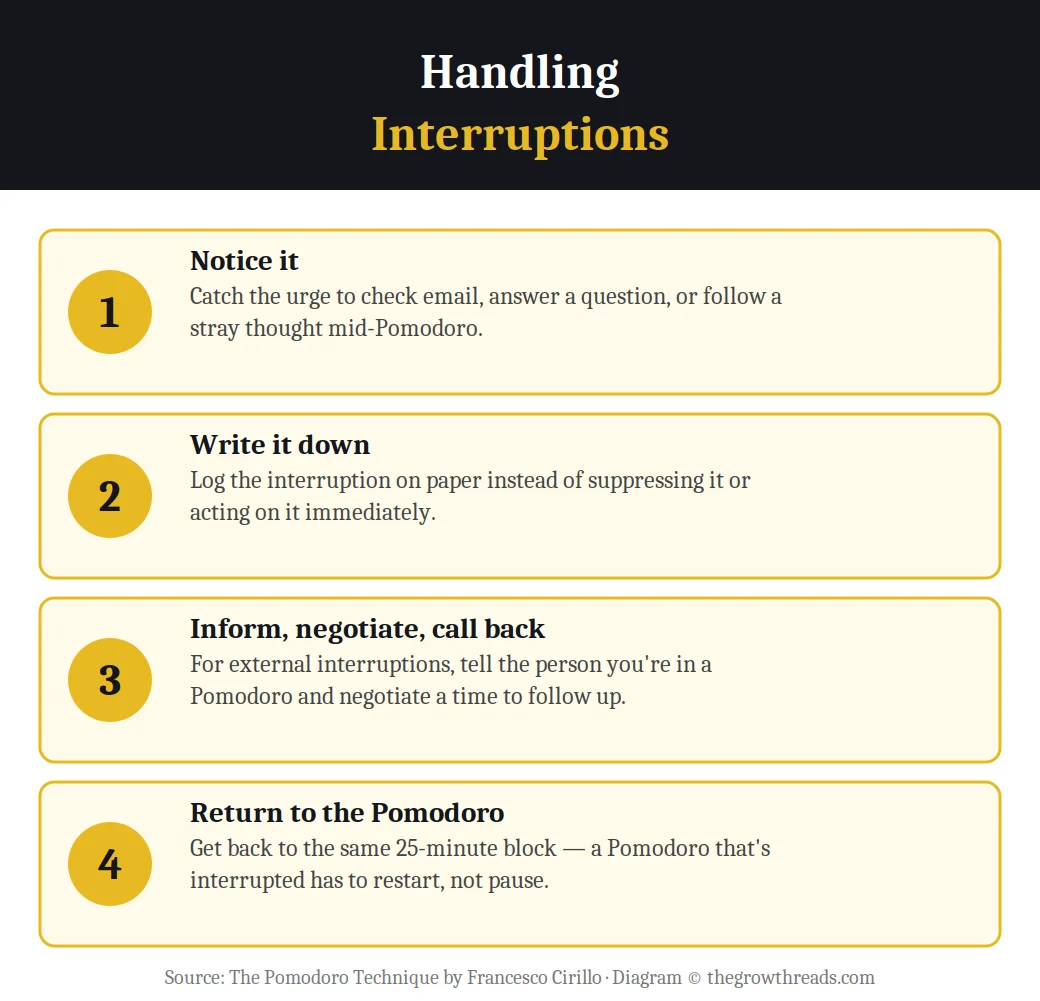
TGR Note: Writing down internal interruptions instead of suppressing them is the same underlying move as capturing open loops in Getting Things Done — both systems treat an unresolved thought as something to externalize onto paper, not something to hold in your head through sheer discipline.
Part 3: The three sheets that run the system
Cirillo’s planning system is deliberately low-tech: an Activity Inventory sheet holds a running master list of everything you need to do, independent of when you’ll do it. Each day, you pull specific items from that inventory onto a To Do Today sheet, which also reserves space for unplanned urgent tasks that inevitably show up. The daily sheet keeps your actual commitments visible and bounded, rather than working reactively from whatever feels most pressing at the moment.
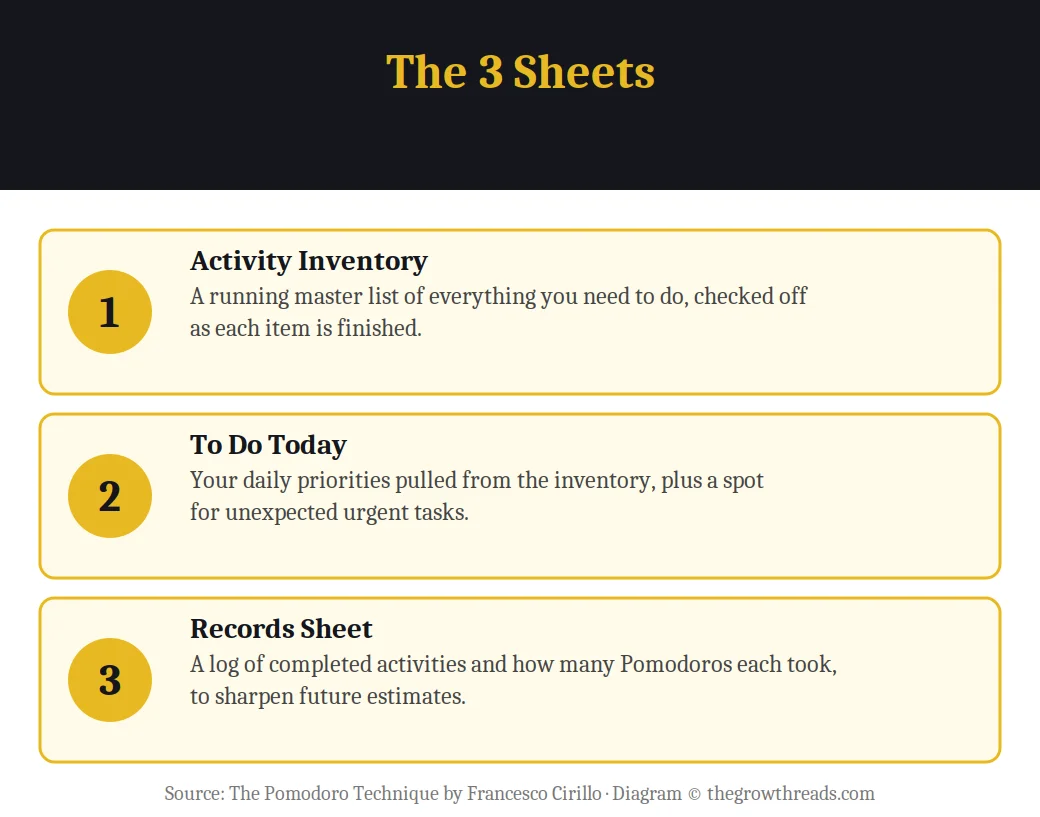
The third sheet, Records, is where the system’s long-term value compounds: logging how many Pomodori each completed activity actually took builds a personal database of realistic time estimates. Over weeks and months, this turns “I think that’ll take about an hour” into a specific, evidence-based number, grounded in how similar tasks have actually gone in the past rather than optimistic guesswork.
Part 4: Scaling the technique to teams
While the core method is built around individual focus, Cirillo dedicates part of the book to adapting it for teams, arguing that shared Pomodori and synchronized breaks can improve collective focus the same way individual ones improve personal focus. Team practices include a shared counter to track collective Pomodori completed, a “Pomodoro hackathon” for focused group problem-solving, and shared rules around interruptions that mirror the individual protocol — informing, negotiating, and deferring rather than breaking focus reflexively whenever a question arises.
The underlying idea scales the same way regardless of team size: protecting a short, well-defined block of uninterrupted attention produces disproportionately better output than treating every hour as equally interruptible, whether that attention belongs to one person or an entire team working in parallel.
Who is The Pomodoro Technique best for — and who should read something else first?
This book is best for people who already know what they need to do but keep losing the thread to notifications, stray thoughts, or vague time estimates — it’s a light, immediately actionable system rather than a philosophy of work. It’s also a good fit for anyone who prefers simple, paper-based tools over apps.
If your challenge is organizing a large, sprawling list of commitments rather than protecting focused blocks of time, Getting Things Done addresses that broader planning problem in more depth. If you want to protect much longer, uninterrupted stretches for genuinely demanding cognitive work rather than a 25-minute unit, Deep Work is a better match. And if your core issue is procrastination rather than fragmented attention, The Now Habit addresses the emotional root more directly.
Questions to reflect on
- What’s the one task you’d choose for your very first Pomodoro today, and is it small enough to genuinely fit in 25 minutes?
- Which internal interruptions — specific thoughts or urges — tend to derail you most often when you try to focus?
- Do you currently have any system for logging how long tasks actually take, or are your estimates still pure guesswork?
- How would you handle a colleague’s non-urgent question if you were genuinely mid-Pomodoro right now?
- Would a physical, ticking timer change your relationship to a focus block compared to a silent phone app?
🔥 Ready to run your first Pomodoro?
This guide covers the core cycle and sheets — the book gives you Cirillo’s full method, team practices, and the reasoning behind each rule.
How to apply The Pomodoro Technique (7-day plan)
- Day 1: Get a timer (physical if possible), pick one small task, and run your first 25-minute Pomodoro followed by a genuine 5-minute break.
- Day 2: Set up your Activity Inventory sheet with everything currently on your plate.
- Day 3: Build your first To Do Today sheet by pulling specific items from the inventory, and run 3-4 Pomodori against it.
- Day 4: Practice writing down internal interruptions the moment they arise instead of acting on them or suppressing them.
- Day 5: Practice the inform-negotiate-defer response the next time someone interrupts you mid-Pomodoro.
- Day 6: Start a Records sheet, logging how many Pomodori each task actually took.
- Day 7: Review your Records sheet and use it to make one task estimate for next week more realistic.
Frequently asked questions
What is the main idea of The Pomodoro Technique?
The Pomodoro Technique is a time-management system built around 25-minute blocks of single-task, uninterrupted work called Pomodori, each followed by a 5-minute break, with a longer break after every four cycles. Francesco Cirillo developed it as a student using a tomato-shaped kitchen timer, and the book covers the full method, including how to handle interruptions and plan using three simple paper sheets.
Why is it called the Pomodoro Technique?
“Pomodoro” is Italian for tomato. Cirillo used a tomato-shaped kitchen timer as a university student to time his focused study sessions, and the name stuck as the technique spread.
What happens if a Pomodoro gets interrupted?
Cirillo’s rule is that there are no half Pomodori — if a block is genuinely interrupted in a way that breaks the 25 minutes of continuous work, it has to restart from zero rather than being paused and resumed. This strictness is meant to build real commitment to protecting the block.
What’s the difference between internal and external interruptions?
Internal interruptions are thoughts, ideas, or urges that arise in your own mind during a Pomodoro; external interruptions come from other people, like a colleague’s question or a phone call. Cirillo recommends writing down internal interruptions immediately, and informing, negotiating, and deferring external ones.
What are the three sheets in the Pomodoro Technique?
The Activity Inventory sheet holds a running list of everything you need to do. The To Do Today sheet holds your daily priorities pulled from that inventory, plus room for unexpected urgent tasks. The Records sheet logs completed activities and how many Pomodori each one took, to improve future estimates.
Can the Pomodoro Technique work for teams, not just individuals?
Yes, Cirillo dedicates part of the book to team applications, including shared Pomodoro counters, a “Pomodoro hackathon” for group problem-solving, and team-wide interruption rules that mirror the individual protocol of informing, negotiating, and deferring.
Do you need a physical timer, or can you use an app?
Cirillo recommends a physical, ticking timer over a silent phone app, arguing that winding it up strengthens commitment to the time block and the ticking sound becomes a focus cue rather than a distraction. An app can still work, but the book treats the physical ritual as part of what makes the technique effective.
Related summaries
If The Pomodoro Technique resonated, these dig further into related territory: Getting Things Done on organizing a full system of commitments, Deep Work on protecting longer stretches of demanding focus, and The Now Habit on the emotional roots of procrastination. For more, see our best productivity books pillar page.
How we analyze books: We work from the full book — reconstructing its core arguments in our own words, adding commentary that connects it to related research and other books in our library, and pressure-testing the advice in a practical 7-day plan. Ratings weigh usefulness, readability, and evidence quality. Read our full methodology.
Related Productivity Summaries
Feel-Good Productivity Summary & Review: Do More by Feeling Better
Great at Work Summary & Review: The Hidden Habits of Top Performers
Make Your Bed Summary & Review: 10 Lessons That Can Change Your Life
Sprint Summary & Review: Solve Big Problems and Test Ideas in Five Days
The One Thing Summary & Review: The Surprisingly Simple Truth Behind Extraordinary Results