

★★★★☆ 4.5/5 — a five-year study of 5,000+ workers that replaces hustle-culture advice with hard evidence about what top performers actually do differently.
Best for: managers and professionals who feel busy but not effective, and who want data instead of platitudes · Reading time: ~7 hrs (this guide: ~15 min) · Difficulty to apply: Moderate — the practices are simple but require saying no
Great at Work in one minute
Top performers don’t work longer hours or grind harder than everyone else — they work fundamentally differently. Morten T. Hansen, a management professor and former Boston Consulting Group consultant, spent five years studying more than 5,000 managers and employees to isolate exactly what separates the best performers from the rest. His finding: seven specific, learnable practices account for 66 percent of the variation in performance he measured — far more than education, tenure, or hours worked. The core move underlying all seven is counterintuitive: instead of doing more, top performers narrow their focus to a small number of priorities and obsess over doing those few things exceptionally well, while working smarter with others rather than just harder alone.
Key takeaways
- Seven practices explain most of the performance gap: Hansen’s study found these seven behaviors accounted for 66% of the variance in performance, dwarfing traditional factors like hours worked or years of experience.
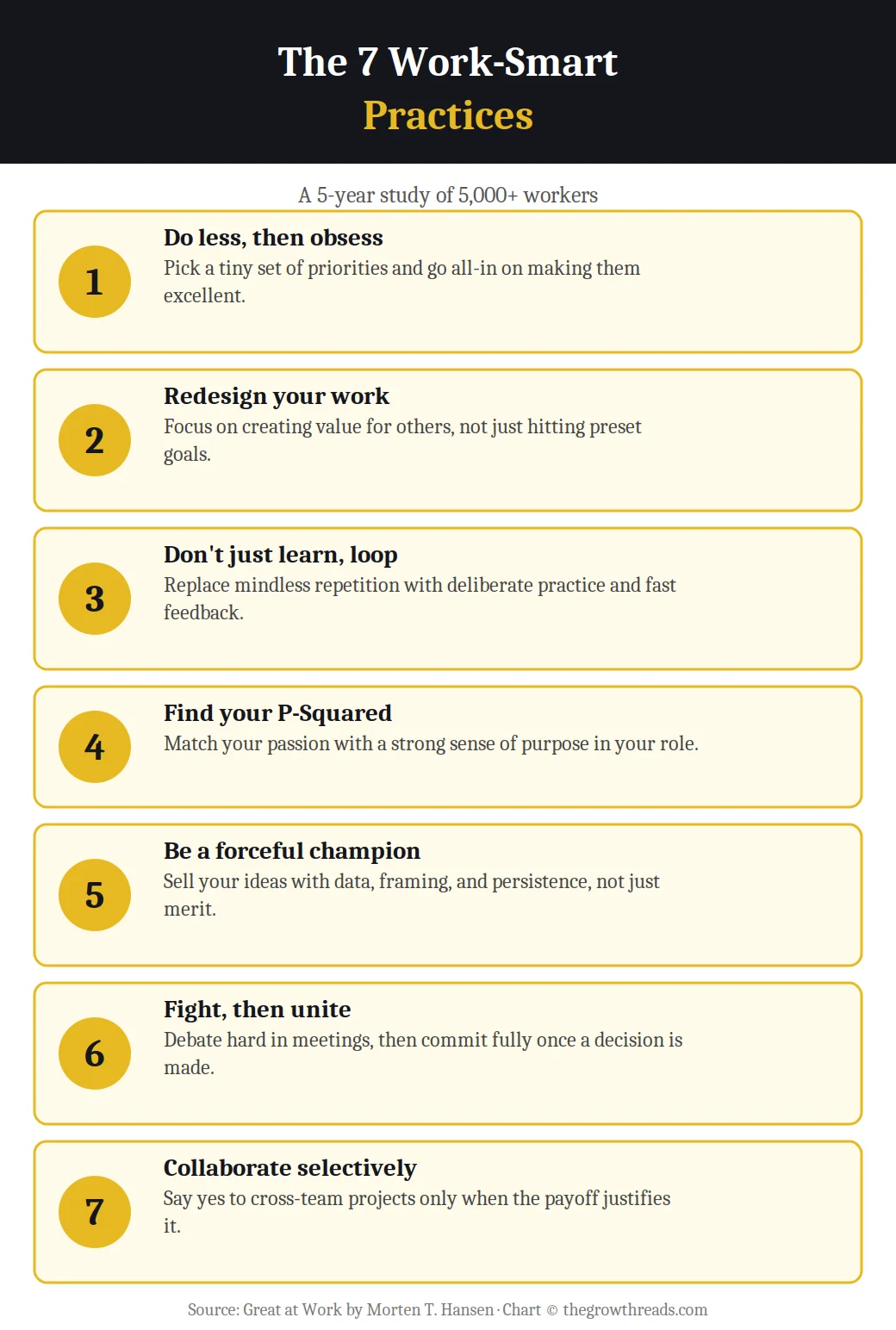
- Do less, then obsess: top performers narrow their priorities to a tiny set and pour disproportionate effort into making just those excellent, rather than spreading themselves across many goals.
- Redesign your work around value, not busyness: the best performers ask whether an activity creates real value for someone else, not just whether it checks a box or meets a preset target.
- Don’t just learn — loop: repeating a task for years doesn’t automatically build skill; deliberate practice with fast feedback does, and most people skip the feedback step.
- Find your P-Squared — passion matched with purpose: loving your work isn’t enough on its own, and neither is a sense of duty alone — the combination is what predicts sustained high performance.
- Be a forceful champion for your ideas: the best performers don’t just have good ideas, they build coalitions, frame proposals around what others need, and push past initial rejection.
- Fight and unite: high-performing teams debate hard and openly before a decision, then commit fully and visibly once it’s made — skipping either half breaks the model.
- Collaborate selectively, not indiscriminately: saying yes to every cross-team request looks collaborative but often destroys performance; the best performers say no to most of it.
- Value creation beats hours logged: across the entire study, the amount of time people worked had almost no relationship to how well they performed.
What is Great at Work about?
Great at Work is Morten Hansen’s data-driven answer to a simple question: why do some people perform so much better at work than others with similar talent, resources, and hours? Rather than relying on anecdote or intuition, Hansen and his research team surveyed and measured more than 5,000 managers and employees over five years, isolating seven specific practices statistically linked to top performance. The book is organized around those seven practices, split into ones that improve individual work (how you choose and execute tasks) and ones that improve how you work with others (how you sell ideas, run meetings, and collaborate across teams).
About the author
Morten T. Hansen is a management professor at the University of California, Berkeley, and has previously taught at INSEAD and Harvard Business School. He holds a Ph.D. from Stanford Business School, where he was a Fulbright Scholar, and began his career as a management consultant at the Boston Consulting Group. Great at Work grew directly out of his five-year research project surveying and measuring more than 5,000 managers and employees to identify which specific work practices actually separate top performers from everyone else. Hansen previously co-authored Great by Choice with Jim Collins and wrote Collaboration: How Leaders Avoid the Traps, Build Common Ground, and Reap Big Results, and has been repeatedly ranked among Thinkers50’s list of the world’s most influential management thinkers. Explore all Morten T. Hansen book summaries →
Key concepts at a glance
| Concept | What it means | Use it when |
|---|---|---|
| Do less, then obsess | Narrow your priorities to a tiny set and pour disproportionate effort into making just those excellent | Your task list is long but nothing on it is getting truly great results |
| Redesign your work | Reshape your role to create more value for others, not just to hit preset goals or stay busy | You’re meeting your targets but not sure anyone actually benefits |
| The learning loop | Deliberate practice paired with fast, specific feedback, instead of passive repetition | Years of experience haven’t translated into a real skill increase |
| P-Squared (passion + purpose) | Work that you both enjoy and can see clearly benefits someone else | You’re evaluating a role change or feeling burned out despite liking the work |
| Forceful champion | Building coalitions and framing your idea around others’ interests, then persisting past the first no | A good idea keeps failing to get traction or funding |
| Fight and unite | Vigorous, open debate before a decision, followed by full public commitment once it’s made | Your team either avoids conflict entirely or can’t move on after a decision |
Part 1: Do less, then obsess — the individual practice that matters most
Hansen’s research kept surfacing the same surprising pattern: the people who tried to do the most, across the broadest range of goals and projects, tended to perform worse — not better — than people who deliberately narrowed their scope. Top performers in his data picked a small number of priorities, sometimes as few as two or three, and then applied intense, focused effort to make those specific things excellent. Everything outside that short list got minimized, delegated, or simply dropped, even when it meant turning down opportunities that looked reasonable on paper.
This isn’t the same as simply working on fewer things and calling it a day — the “obsess” half is what makes the practice work. Hansen found that merely narrowing scope without also driving for excellence in what remained didn’t move the needle; the performance gains came specifically from combining a short list with disproportionate effort on that list. The redesign practice builds directly on this by asking a further question: of the few things you’ve chosen to focus on, are you doing them in a way that actually creates value, or just going through the motions of a task that used to matter?
TGR Note: This is close kin to the central argument of Essentialism — both books treat ruthless prioritization as the foundation of high performance, though Hansen’s version is grounded in a specific, large-sample study rather than a general philosophy of less.
Part 2: The learning loop and finding your P-Squared
One of Hansen’s more counterintuitive findings is that simply doing a job longer doesn’t reliably make you better at it. Experience alone, without a structured feedback loop, tends to plateau — people repeat the same patterns, including the same mistakes, because nothing is forcing a correction. The practice he calls “loop” instead pairs deliberate, targeted practice with fast, specific feedback, so that each cycle of work actually changes the next one, rather than simply repeating it.
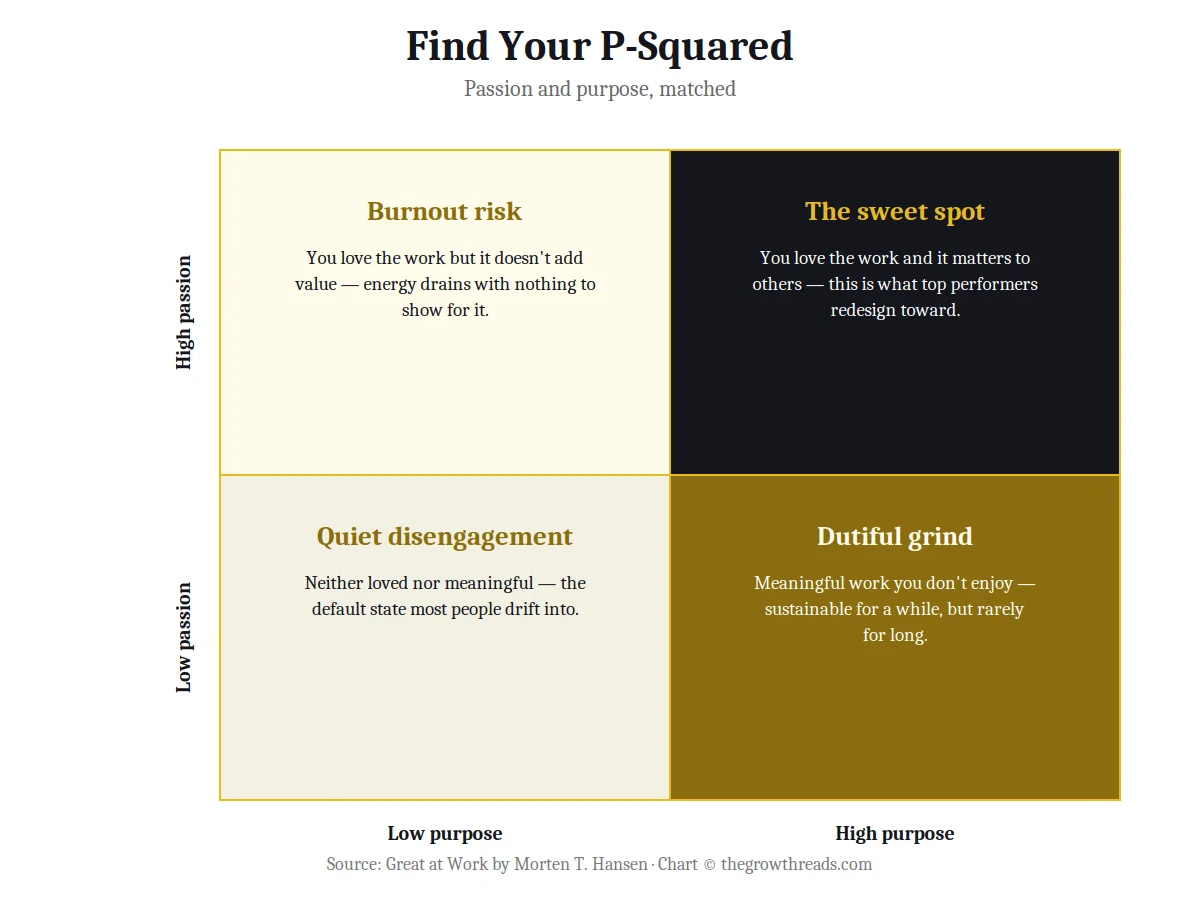
Alongside the learning loop, Hansen introduces “P-Squared” — passion matched with purpose. His data showed that loving your work by itself wasn’t a strong predictor of performance, and neither was a sense of duty or mission on its own. What predicted sustained high performance was the combination: people who felt genuine enthusiasm for their work and could clearly see how it created value for someone else. Top performers in the study had often actively redesigned their own roles, sometimes without asking permission, specifically to increase this overlap.
TGR Note: The learning loop pairs well with the deliberate-practice ideas in The Art of Learning — both argue that raw repetition without feedback caps your skill well below what focused, corrected practice can reach.
Part 3: Becoming a forceful champion for your ideas
Having a good idea, Hansen found, is nowhere near enough to get it adopted inside an organization. Top performers in his study were distinctly more effective at what he calls “forceful championing” — building support for their ideas before formally presenting them, framing proposals around what decision-makers actually need rather than just why the idea is correct, and persisting through an initial rejection instead of treating a first no as final. This wasn’t about aggression or political maneuvering for its own sake; it was a specific, learnable skill set around influence.
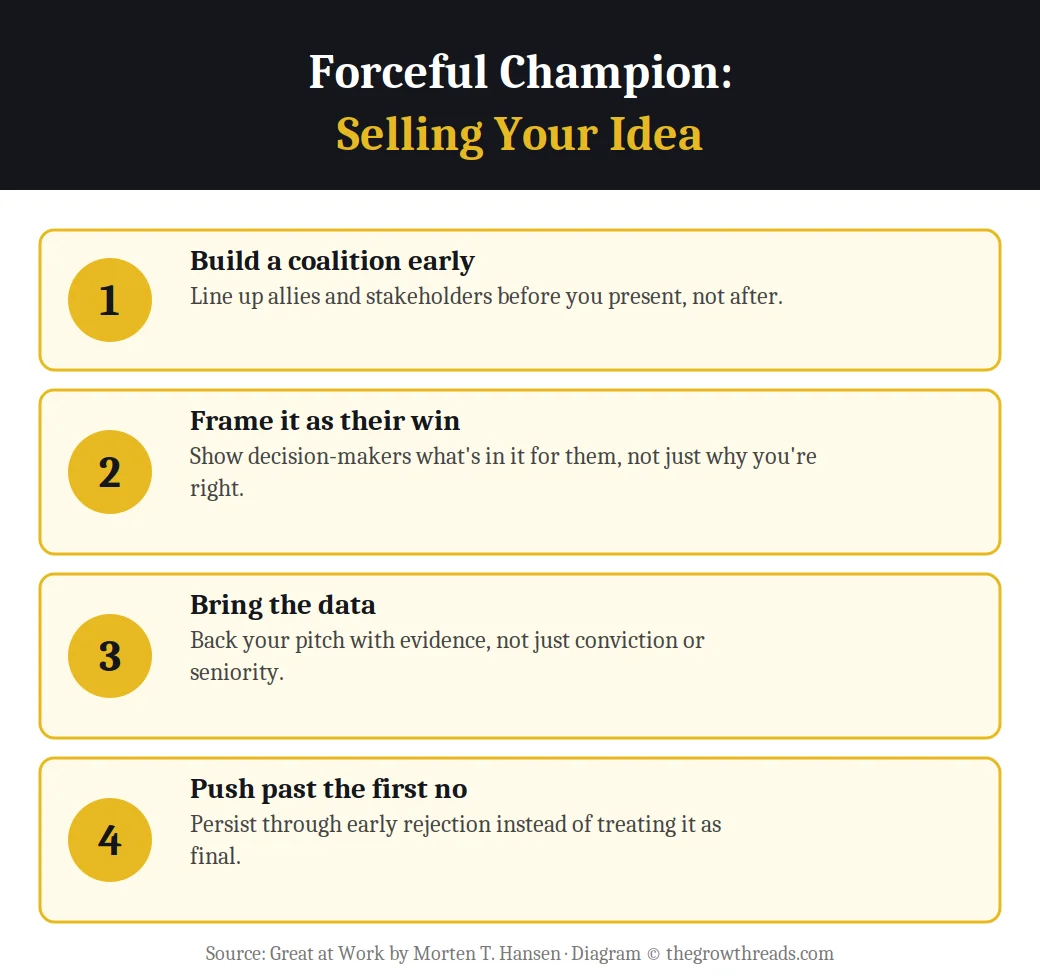
Hansen’s research also found that emotional appeals mattered, but not indiscriminately — when the goal was to convince a skeptical audience, calm, rational framing consistently outperformed passionate appeals, which could read as pushy or unconvincing to people who weren’t already on board. The most effective champions matched their tone to their audience rather than defaulting to one style for every pitch.
TGR Note: Forceful championing is a useful individual-level complement to the WIG-and-scoreboard system in The 4 Disciplines of Execution — Hansen’s practice is about getting a goal chosen and funded in the first place; 4DX is about executing it once it has buy-in.
Part 4: Fight and unite, and collaborating selectively
Hansen’s data on teams surfaced a pattern that looks contradictory at first: the highest-performing teams argued more, not less, before making decisions — but they also united more completely once a decision was made. Teams that avoided conflict entirely often made worse decisions because dissenting information never surfaced. Teams that debated hard but then splintered into factions after the decision performed just as poorly, because the disagreement never actually resolved. The combination — vigorous debate followed by full, visible commitment — is what separated high performers from both extremes.
The final practice, disciplined collaboration, addresses a mistake many organizations actively reward: saying yes to every cross-team project as a sign of being a good team player. Hansen’s research found that indiscriminate collaboration frequently destroyed performance rather than building it, by spreading people’s attention across too many projects and diluting their contribution to each. Top performers said yes far more selectively, reserving collaboration for the specific projects where the payoff clearly outweighed the cost — and said no, clearly and often, to the rest.
TGR Note: Disciplined collaboration is essentially “do less, then obsess” applied to team requests instead of your own to-do list — the same logic that makes Slow Productivity‘s case for doing fewer things well shows up again here at the organizational level.
Who is Great at Work best for — and who should read something else first?
This book is best for managers and individual contributors who already feel busy — even overworked — but suspect that more hours aren’t the answer, and who want a research-backed framework rather than motivational advice. It particularly rewards readers who like data: Hansen shows his methodology and findings throughout, rather than asserting conclusions.
If your main challenge is protecting long, uninterrupted blocks of focus rather than choosing which priorities deserve that focus, Deep Work addresses that more specific problem directly. If you want a broader philosophy of elimination applied to your whole life, not just your job, Essentialism is a good complement. And if your team already knows its priority but struggles to execute against it week to week, The 4 Disciplines of Execution picks up where Hansen’s individual-level practices leave off.
Questions to reflect on
- If you had to cut your current priorities down to two or three, which would survive — and what would that mean saying no to?
- Where in your work are you repeating a task without any real feedback loop that would help you improve it?
- Does your current role sit closer to “burnout risk,” “the sweet spot,” “quiet disengagement,” or “dutiful grind” on the P-Squared matrix?
- Think of an idea you’ve struggled to get adopted — did you build support and frame it around others’ needs, or just argue that you were right?
- Is there a recurring cross-team request you keep saying yes to out of obligation, even though the payoff doesn’t really justify it?
🔥 Ready to work smarter, not harder?
This guide covers the seven practices — the book gives you Hansen’s full research methodology, self-assessment quizzes, and dozens of real-world case studies.
How to apply Great at Work (7-day plan)
- Day 1: List every active priority you’re carrying, then circle only the 2-3 that matter most to your role.
- Day 2: For one task on your short list, ask what would make it not just done, but excellent — then do that instead of the minimum.
- Day 3: Identify one recurring task where you’re repeating without improving, and build in a specific feedback step this week.
- Day 4: Plot your current role on the P-Squared matrix and note one change that would move it toward the sweet spot.
- Day 5: Take one idea you’ve been sitting on and line up at least one ally before you pitch it.
- Day 6: In your next team meeting, deliberately invite one dissenting view before the group commits to a decision.
- Day 7: Say no to one cross-team request this week that doesn’t clearly justify the time it would take.
Frequently asked questions
What is the main idea of Great at Work?
Great at Work argues that top performers don’t succeed by working longer or harder across the board, but by narrowing their focus to a small set of priorities and applying intense effort to those specific things, combined with six other research-backed practices covering learning, motivation, influence, and collaboration. Morten Hansen’s five-year study of over 5,000 workers found these seven practices explained 66% of the performance variation he measured.
What are the 7 work-smart practices in Great at Work?
The seven practices are: do less, then obsess; redesign your work around value; don’t just learn, loop (deliberate practice with feedback); find your P-Squared (match passion with purpose); be a forceful champion for your ideas; fight and unite (debate hard, then commit); and collaborate selectively rather than indiscriminately.
Is Great at Work based on real research or just opinion?
It’s based on a five-year study Hansen led surveying and measuring more than 5,000 managers and employees across a range of industries, designed specifically to isolate which work practices statistically predicted top performance. The book presents this methodology and its findings directly, rather than relying primarily on anecdote.
What is P-Squared in Great at Work?
P-Squared stands for passion matched with purpose. Hansen’s research found that loving your work alone, or feeling a sense of duty alone, didn’t strongly predict performance — but people who felt both genuine enthusiasm and could see clearly how their work created value for others performed significantly better on average.
Does working more hours actually improve performance, according to the book?
No — Hansen’s data found almost no relationship between hours worked and performance quality. What mattered was how those hours were allocated: narrowly focused on a few obsessed-over priorities rather than spread thinly across many tasks.
What does “fight and unite” mean in Great at Work?
It describes how the highest-performing teams in Hansen’s study made decisions: through vigorous, open debate that surfaces disagreement before a decision is made, followed by full and visible commitment to that decision once it’s final. Teams that skip either the debate or the unity tend to perform worse.
Why does the book say collaboration can hurt performance?
Hansen found that saying yes to every cross-team request, often seen as a sign of being a good team player, actually diluted people’s attention and hurt their results. Top performers collaborated selectively, choosing only the projects where the expected payoff clearly justified the time investment, and declined the rest.
Related summaries
If Great at Work resonated, these dig further into related territory: Essentialism on ruthless prioritization as a life philosophy, Deep Work on protecting focus for demanding tasks, and The 4 Disciplines of Execution on executing a chosen goal at the team level. For more, see our best productivity books pillar page.
How we analyze books: We work from the full book — reconstructing its core arguments in our own words, adding commentary that connects it to related research and other books in our library, and pressure-testing the advice in a practical 7-day plan. Ratings weigh usefulness, readability, and evidence quality. Read our full methodology.
Related Productivity Summaries
First Things First Summary & Review: Live by the Compass, Not the Clock
Slow Productivity Summary & Review: The Case for Doing Fewer Things Better
The 4 Disciplines of Execution Summary & Review: Achieving Your Wildly Important Goals
The 80/20 Principle Summary & Review: Find Your Vital Few
The Miracle Morning Summary & Review: Wake Up to Your Full Potential