

★★★★☆ 4.4/5 — a data-driven rebuttal to “I don’t have time,” built on hundreds of real time logs rather than time-management platitudes.
Best for: busy professionals and parents who feel maxed out but suspect the math doesn’t quite add up · Reading time: ~6 hrs (this guide: ~14 min) · Difficulty to apply: Easy — the time log takes one week to run
168 Hours in one minute
Everyone gets the same 168 hours a week — the constraint was never the number, it’s what you’re doing with it. Laura Vanderkam built her case not on theory but on hundreds of real time logs collected from busy professionals, including mothers with demanding careers who insist they have “no time.” What the logs actually show is that most weeks have more discretionary hours than they feel like they do — the problem is usually that time gets spent on autopilot, on low-value tasks mistaken for necessary ones, or on things that simply aren’t real priorities once you’re honest about it. Her fix starts with tracking your actual 168 hours, then reallocating around your core competencies — the few things you do well and enjoy — while minimizing, eliminating, or outsourcing everything else.
Key takeaways
- 168 hours a week is the same for everyone: reframing time in weekly rather than daily terms makes room for priorities that don’t fit into any single day but fit easily across a full week.
- Most people misjudge their own time use: a detailed time log routinely reveals that perceived time crunches don’t match the actual hours spent on work, sleep, or leisure.
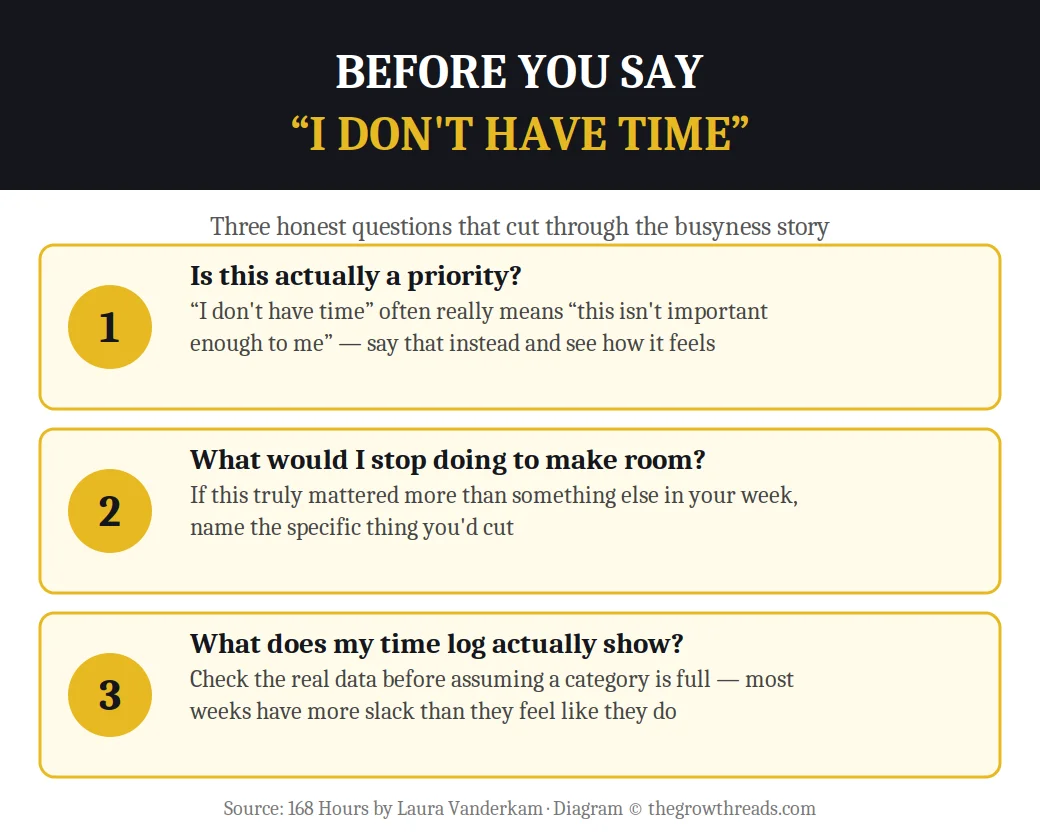
- “I don’t have time” usually means “it’s not a priority”: swapping the phrase is an uncomfortable but clarifying exercise Vanderkam recommends trying literally.
- Core competencies deserve your best hours: figure out what you do both well and enjoy, at work and at home, and build your schedule around protecting time for it.
- Everything outside your core competencies is a candidate to cut: ignore it, minimize it, or outsource it — the goal is fewer things competing for your best hours, not doing everything faster.
- Much of a “busy” day is fake work: checking email repeatedly or attending low-value meetings can feel productive while displacing the few things that actually move your priorities forward.
- Leisure needs deliberate planning too: Vanderkam argues for choosing a short list of activities that genuinely bring you joy and scheduling them, rather than letting free time default to whatever’s easiest.
- Career advancement benefits from the same clarity: picturing your next role, identifying who actually influences that decision, and building a narrative that connects past work to future goals is itself a time-allocation exercise.
- Outsourcing isn’t only for the wealthy: the book reframes outsourcing low-value tasks as an investment in protecting time for your highest-value work, not an indulgence.
What is 168 Hours about?
168 Hours: You Have More Time Than You Think is Laura Vanderkam’s argument that most people have significantly more discretionary time than they perceive, and that the real obstacle to a better-used week is honest tracking and prioritization rather than a genuine shortage of hours. Drawing on time logs from hundreds of busy professionals, Vanderkam replaces “I don’t have time” with a more rigorous question: given the actual 168 hours available, what would you choose to do with them if you were being honest about your real priorities?
About the author
Laura Vanderkam is a time-management writer and speaker whose work rests on a large personal database of real time logs gathered from professionals across industries, including mothers with demanding careers who are often assumed to have the least spare time of anyone. Rather than dispensing generic productivity advice, Vanderkam builds her arguments from that data, and 168 Hours (2010) established the weekly-hours reframe and time-log method that recur throughout her later books, including I Know How She Does It and Off the Clock. She writes a regular time-management column, has delivered a widely viewed TED talk on gaining control of free time, and continues to publish new time-use research. Explore all Laura Vanderkam book summaries →
Key concepts at a glance
| Concept | What it means | Use it when |
|---|---|---|
| 168 hours | Reframing your week’s total time budget instead of thinking day by day | A priority doesn’t fit into any single day but could fit across a full week |
| The time log | A detailed 30-minute-increment record of an entire week’s actual activity | You want to know where your time really goes, not where you assume it goes |
| Core competency | An activity you both do well and genuinely enjoy, worth building your schedule around | You’re deciding what deserves your best, most protected hours |
| Fake work | Low-value activity that feels productive but displaces real priorities | A day feels packed but nothing important actually moved forward |
| Outsourcing | Paying or delegating to remove a low-value, low-enjoyment task from your week | A recurring task drains time you could spend on a core competency |
| The priority test | Replacing “I don’t have time” with “it’s not a priority” to test whether that’s actually true | You want to check whether a stated constraint is really about time at all |
Part 1: Why “I don’t have time” is usually the wrong diagnosis
Vanderkam opens by challenging the near-universal complaint that there isn’t enough time, using her own collected time logs as evidence. When people track their actual hours rather than relying on memory or impression, the categories that felt maxed out — work, chores, screen time — are often smaller than assumed, while genuinely free or flexible hours turn out to be larger than expected. The problem isn’t usually the total supply of time; it’s that time gets spent by default rather than by decision, and defaults rarely align with what someone would choose if they stopped to think about it.
The reframe from 24 hours a day to 168 hours a week matters because daily thinking makes tradeoffs feel more binary than they are. A priority that seems impossible to fit into today’s schedule often fits easily somewhere across a full week — the constraint was the daily framing, not the actual time available.
TGR Note: This pairs well with the lead-versus-lag distinction in The 4 Disciplines of Execution — both books argue that vague complaints (“too busy,” “falling behind”) need to be replaced with a specific, trackable measure before you can actually act on the problem.
Part 2: Running the time log and finding your core competencies
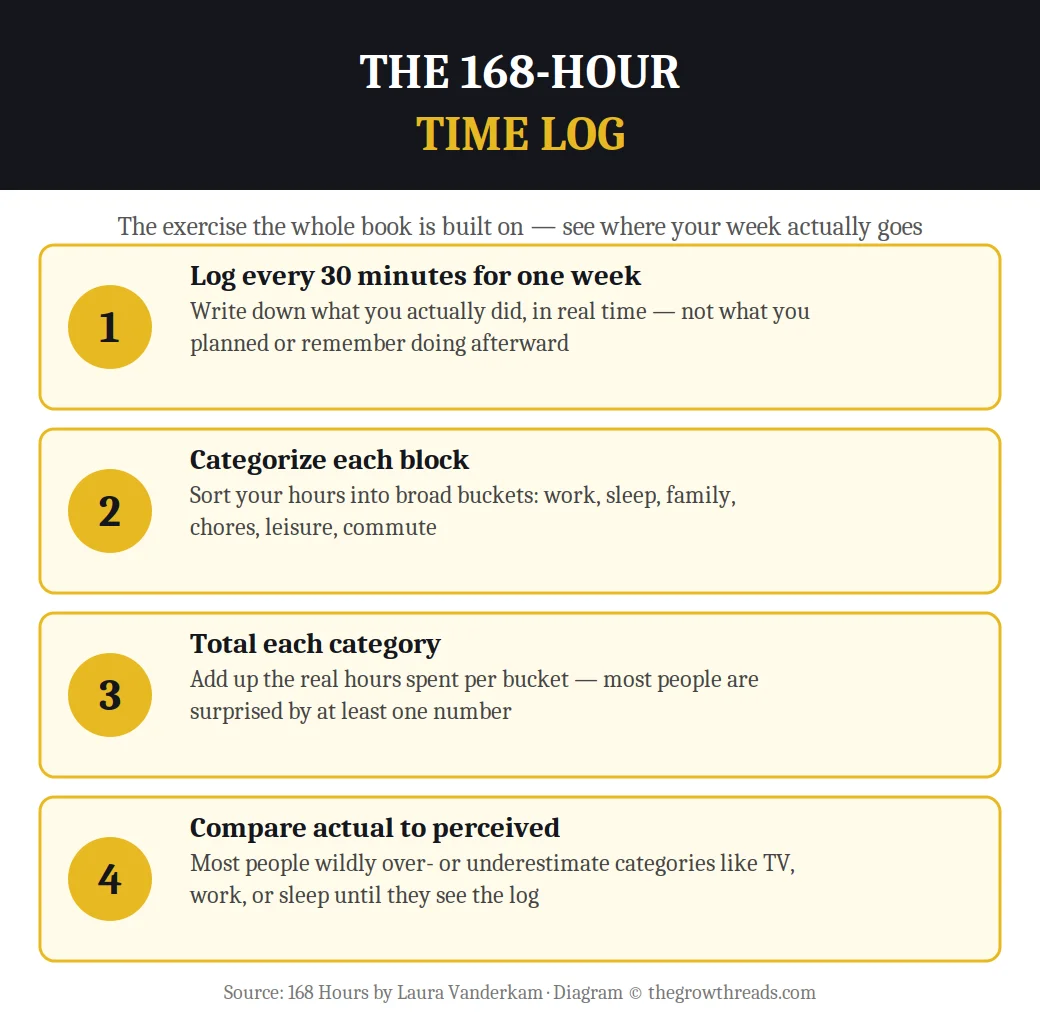
The book’s foundational exercise is deceptively simple: log every 30-minute block of an entire week in real time, categorize each block, total the categories, and compare the actual numbers against what you assumed before starting. Vanderkam is emphatic that this has to be done in the moment, not reconstructed from memory afterward, because memory is exactly what produces the distorted picture the exercise is meant to correct.
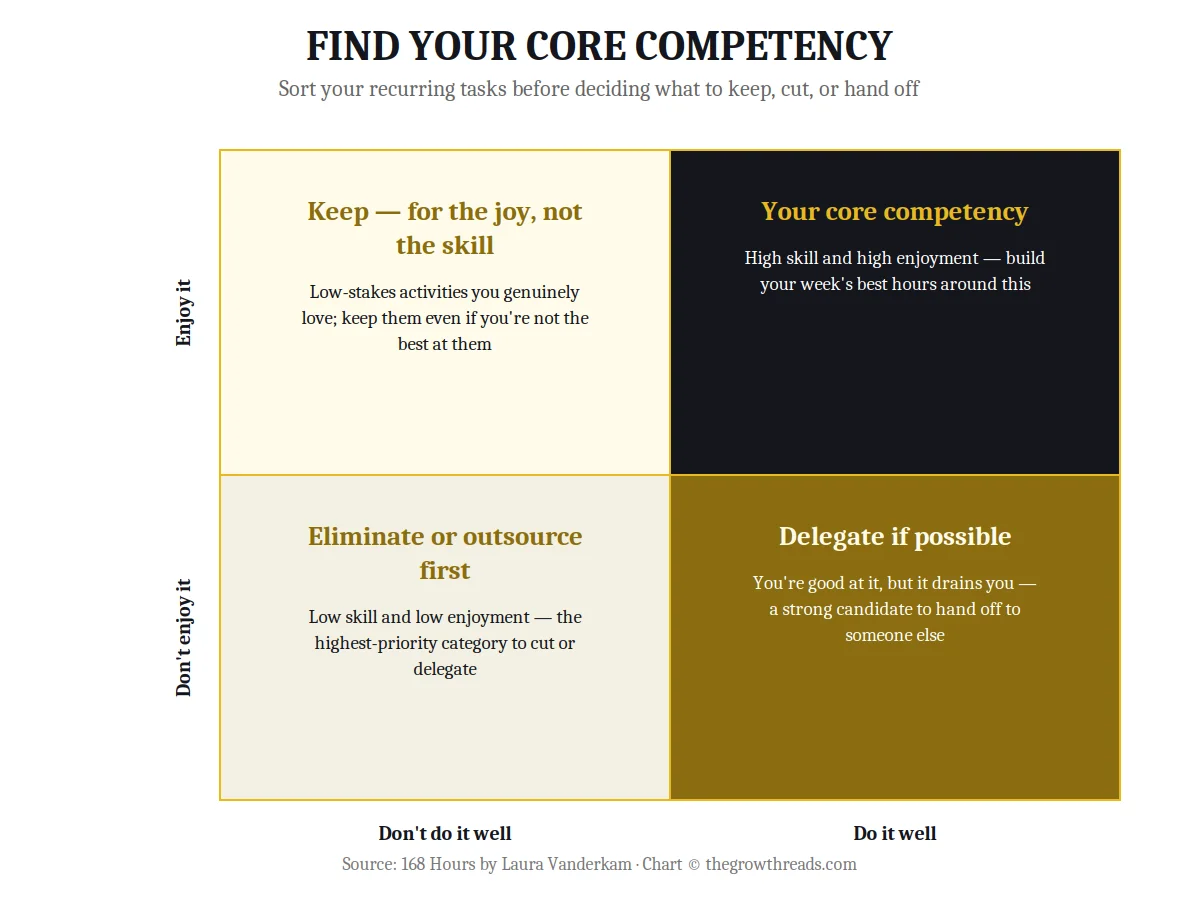
With real data in hand, the next step is sorting recurring activities by two questions: do you do this well, and do you enjoy doing it? Activities that score high on both are your core competencies — the things worth building your best hours around, whether at work or at home. Activities that score low on both are the clearest candidates to eliminate or outsource first; the harder calls are the activities you’re good at but don’t enjoy (worth delegating if possible) and the ones you enjoy but aren’t particularly skilled at (worth keeping anyway, for the joy rather than the output).
TGR Note: The core-competency sort is a personal-life version of the “focus on the wildly important” discipline from The 4 Disciplines of Execution — both frameworks insist that narrowing what you protect is what makes protecting it possible, rather than trying to protect everything a little.
Part 3: Taking back your calendar and planning leisure deliberately
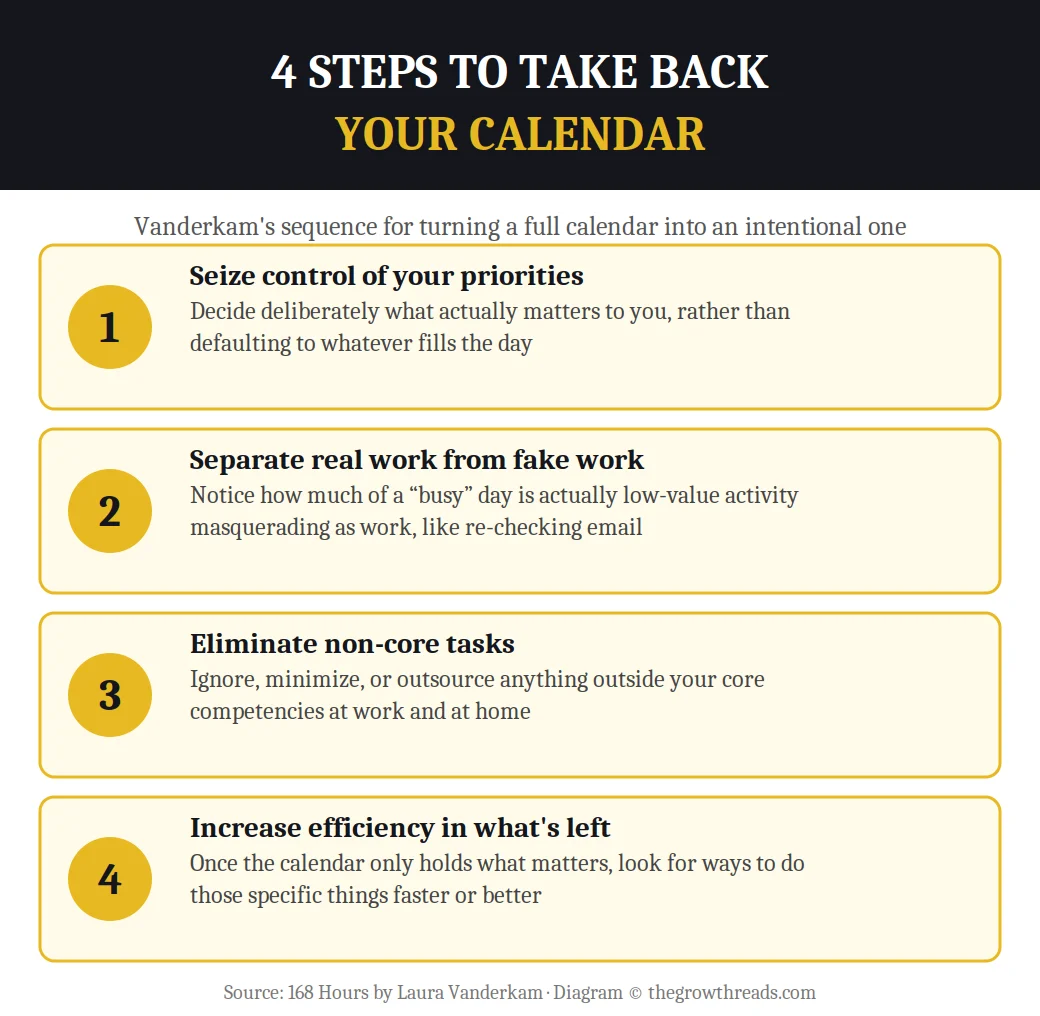
Vanderkam lays out a four-step sequence for turning a full calendar into an intentional one: seize control by deciding your real priorities rather than accepting whatever fills the day by default, separate real work from fake work that only feels productive, eliminate or outsource anything outside your core competencies, and only then look for ways to do the remaining work more efficiently. The order matters — efficiency applied to the wrong tasks just makes you faster at things that shouldn’t be on your calendar at all.
Leisure gets the same deliberate treatment as work in Vanderkam’s framework: rather than letting free time default to whatever’s easiest — usually a screen — she recommends choosing a small number of activities that genuinely bring meaningful happiness and actually scheduling dedicated time for them, the same way you’d schedule a work commitment. Treating rest as something to plan rather than something left over is, in her account, what keeps leisure time from quietly evaporating into low-value defaults.
TGR Note: Scheduling guilt-free leisure before work echoes the Unschedule from The Now Habit — both authors independently landed on the same fix: protect rest deliberately, rather than treating it as whatever’s left after work is done.
Part 4: Testing your real priorities and planning your career
Vanderkam’s most uncomfortable exercise is also her simplest: the next time you catch yourself saying “I don’t have time” for something, replace it mentally with “it’s not a priority” and notice how that feels. For genuinely low-priority items, the substitution is a relief — it’s honest and doesn’t require guilt. For the things that still sting when reframed that way, the discomfort is useful information: it usually means the activity matters more than your calendar currently reflects, and something else needs to move to make room for it.
The book extends the same clear-eyed approach to career planning: picture your next professional level concretely, identify the specific people who actually influence that advancement, and build a narrative connecting your past work to that future goal rather than hoping visibility happens on its own. It’s the same core-competency logic applied forward in time — deciding deliberately what to build toward, instead of letting a career happen by default the way an overbooked week does.
TGR Note: The “it’s not a priority” reframe is a close cousin of the self-talk shifts in The Now Habit — both books use a small, specific change in internal language to surface a truth that vaguer complaints (“I’m so busy,” “I have to”) were quietly hiding.
Who is 168 Hours best for — and who should read something else first?
This book is best for busy professionals and parents who feel maxed out but suspect, at some level, that the math doesn’t fully add up — it rewards readers willing to actually run the time log rather than just reading about the idea of it. It’s also a good fit for anyone skeptical of generic time-management advice who wants a case built on real data instead of platitudes.
If your problem is specifically procrastination and fear around starting tasks rather than overall time allocation, The Now Habit addresses that more directly. If you’re trying to solve execution at the team level rather than your personal calendar, The 4 Disciplines of Execution is a better fit. And if what you actually need is permission to do less rather than a system for allocating more, a book focused on simplification will serve you better than this one.
Questions to reflect on
- If you tracked every 30 minutes of your week starting today, which category do you predict would surprise you the most?
- What’s one recurring task you do well but don’t enjoy — and could you actually hand it off to someone else?
- The next time you say “I don’t have time,” try substituting “it’s not a priority” — does that feel true, or does it sting?
- What’s one genuinely enjoyable leisure activity you haven’t actually scheduled time for this week?
- If you pictured your next career milestone clearly, who are the specific people who’d actually need to see that progress?
🔥 Ready to see where your week actually goes?
This guide covers the framework — the book gives you Vanderkam’s full time-log templates and dozens of real case studies from her research.
How to apply 168 Hours (7-day plan)
- Day 1: Start logging every 30-minute block of your day in real time — don’t reconstruct it from memory at the end of the day.
- Day 2-6: Keep logging daily, in the moment, without judging or adjusting your behavior to look better on paper.
- Day 7: Total each category (work, sleep, chores, leisure, family, commute) and compare the real numbers to what you assumed before you started.
- Ongoing: Sort your five most time-consuming recurring tasks by whether you do them well and whether you enjoy them, using the core-competency matrix.
- Ongoing: Pick one low-skill, low-enjoyment task to eliminate or outsource this month.
- Ongoing: Schedule one genuinely enjoyable leisure activity onto your calendar this week, the same way you’d schedule a meeting.
- Ongoing: The next time you say “I don’t have time,” swap in “it’s not a priority” and notice whether that’s actually true.
Frequently asked questions
What is the main idea of 168 Hours?
168 Hours argues that most people have significantly more discretionary time than they perceive, and that the real obstacle to a better-used week is honest tracking and clear priorities rather than an actual shortage of hours. Laura Vanderkam builds this case on time logs collected from hundreds of busy professionals, showing that perceived time crunches routinely don’t match the real numbers once tracked in detail. The core method is a weekly time log paired with a core-competency framework for deciding what deserves your best hours.
How do you do the 168-hour time log?
You record what you’re actually doing in real time, in 30-minute increments, for a full week, then sort those entries into broad categories like work, sleep, chores, and leisure. The key is logging in the moment rather than reconstructing your day from memory afterward, since memory is exactly what produces the distorted sense of time that the exercise is designed to correct. Most people find at least one category is meaningfully different from what they assumed before tracking.
What does Vanderkam mean by “core competencies”?
Core competencies are the activities you both do well and genuinely enjoy, whether at work or at home, and Vanderkam argues your schedule should be built around protecting time for them. Everything outside that zone becomes a candidate to minimize, eliminate, or outsource — with the hardest decisions falling on tasks you’re skilled at but don’t enjoy, or enjoy but aren’t especially skilled at.
Is 168 Hours only for people who can afford to outsource tasks?
Vanderkam frames outsourcing as a spectrum, not an all-or-nothing luxury — trading tasks with a partner, batching errands, or paying for a small amount of help with the lowest-value, lowest-enjoyment tasks all count. The underlying principle, protecting time for your core competencies by reducing time spent on everything else, applies regardless of budget, even if the specific tactics available differ.
Does 168 Hours apply to people without demanding careers?
Yes — while many of Vanderkam’s case studies are busy professionals and parents, the core method (track your real time, identify core competencies, cut or delegate the rest) is independent of how demanding your job is. Anyone who feels like their week disappears without producing what they actually value can use the time log and priority test regardless of their specific schedule.
How is 168 Hours different from typical time-management books?
Most time-management books lead with techniques — to-do lists, calendar systems, productivity hacks. Vanderkam leads with data, using real time logs to challenge the premise that people are actually as time-starved as they feel, before introducing any technique. The book’s persuasive power comes less from a novel system and more from the gap it reveals between perceived and actual time use.
What’s the difference between 168 Hours and Vanderkam’s other books?
168 Hours (2010) establishes the core weekly-hours reframe and time-log method. I Know How She Does It applies the same research specifically to how successful working mothers structure their weeks, and Off the Clock focuses more on the subjective experience of time and how to feel like you have enough of it. All three share the same evidence-based, time-log-driven approach.
Related summaries
If 168 Hours resonated, these dig further into related territory: The Now Habit on overcoming the fear that drives procrastination, The 4 Disciplines of Execution on protecting a priority at the team level, and Atomic Habits on the small daily behaviors that compound over time. For more, see our best productivity books pillar page.
How we analyze books: We work from the full book — reconstructing its core arguments in our own words, adding commentary that connects it to related research and other books in our library, and pressure-testing the advice in a practical 7-day plan. Ratings weigh usefulness, readability, and evidence quality. Read our full methodology.
Related Productivity Summaries
Digital Minimalism Summary & Review: How to Reclaim Your Attention
Eat That Frog! Summary & Review: How to Stop Procrastinating and Do Your Most Important Work First
Range Summary & Review: Why Generalists Triumph in a Specialized World
Smarter Faster Better Summary & Review: The 8 Drivers of Real Productivity
When Summary & Review: Master the Science of Perfect Timing