

⭐⭐⭐⭐⭐ 4.6/5 — Leadership isn’t a title someone hands you on day one; it’s influence you earn one level at a time, and Maxwell hands you the map for earning it on purpose instead of by accident.
Best for: New managers and rising leaders who want to move from “people follow because they have to” to “people follow because of who I am.”
Reading time: ~3.5 hrs to read the book · 16 min to read this guide
Difficulty to apply: Moderate — the framework is simple to understand but takes sustained relational investment to actually climb
The 5 Levels of Leadership in one minute
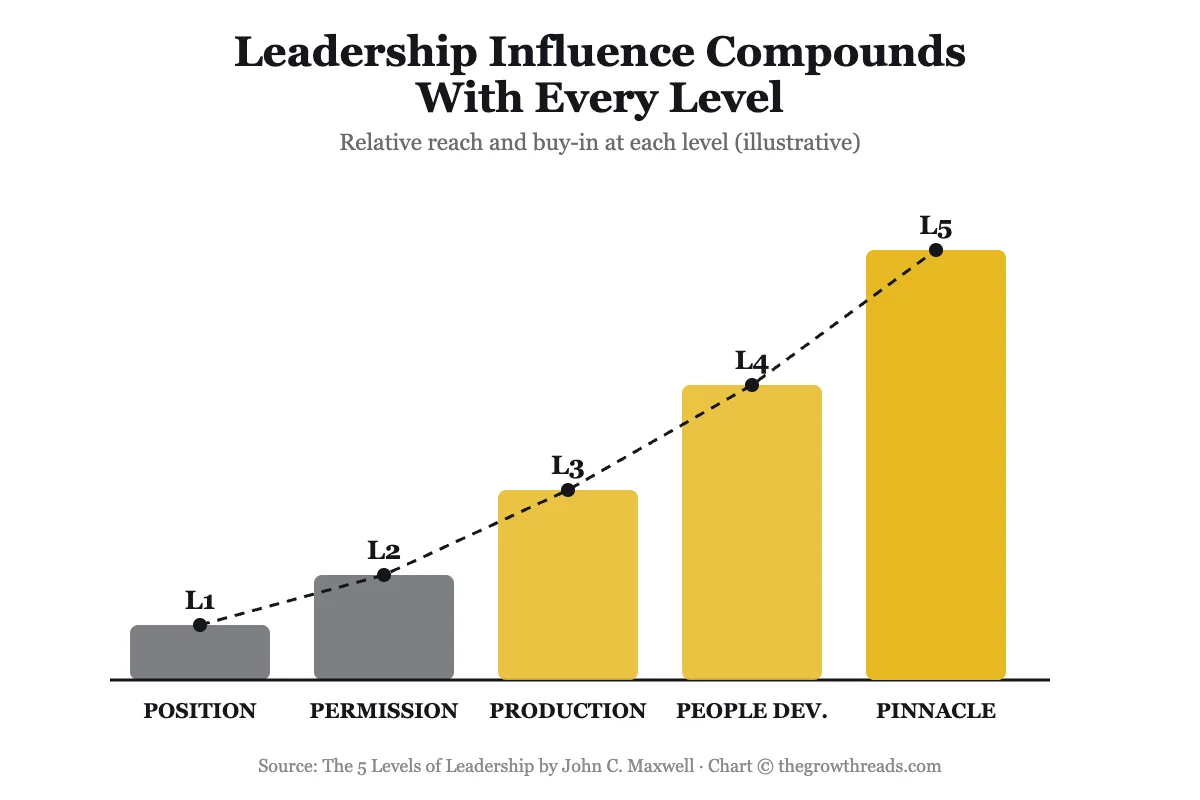
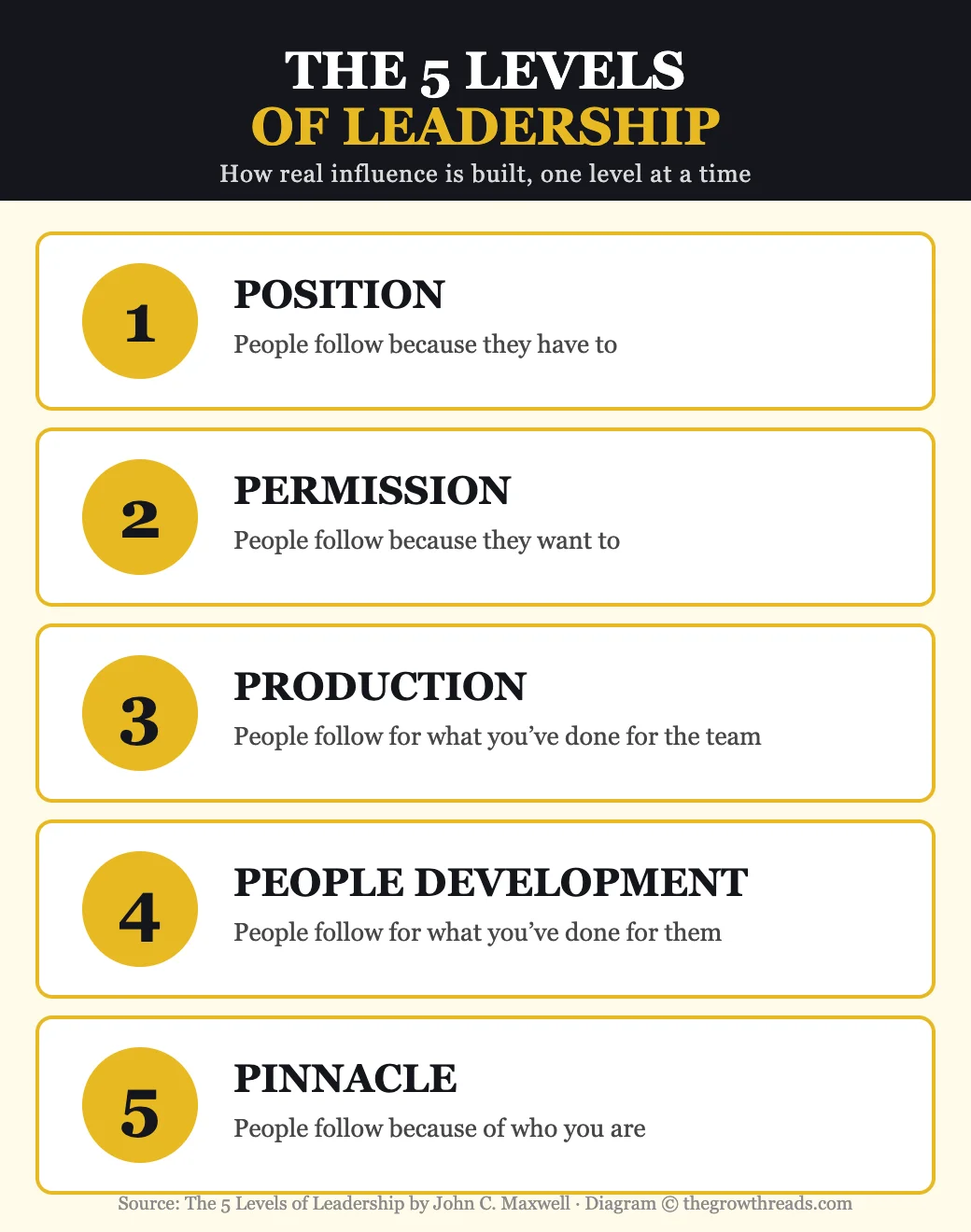
You don’t get real leadership from a title — you earn it, one level at a time. John C. Maxwell’s The 5 Levels of Leadership argues that “leader” is not a fixed identity but a moving target: at Level 1 (Position), people follow you because your badge says they have to. At Level 2 (Permission), they follow because they’ve come to like and trust you. At Level 3 (Production), they follow because you consistently get real results. At Level 4 (People Development), they follow because you’ve invested in making them better leaders themselves. And at Level 5 (Pinnacle), the rarest level of all, they follow because of who you’ve become and what you represent — often years after you’ve stopped directly leading them. Maxwell’s core claim is uncomfortable but freeing: your title tells you almost nothing about your actual leadership. Your level does. This guide walks through all five levels, the upside and downside of each, and the specific behaviors that move you from one to the next.
Key takeaways
- Leadership is influence, not authority: your job title only grants Level 1 — everything above it has to be earned through your own actions.
- Position is a starting line, not a finish line: new leaders who lean on their title instead of building relationships get compliance, not commitment.
- Permission is built through the Golden Rule: treating people the way you’d want to be treated is what turns “my boss” into “my leader.”
- Production is the level that separates real leaders from popular ones: results — not likability — are what earn you lasting credibility with a team.
- Momentum is a leader’s best friend: once a team starts winning together at Level 3, problems that used to feel impossible start feeling solvable.
- People Development multiplies your leadership instead of just adding to it: one leader who develops five other leaders accomplishes more than five leaders working alone.
- You can’t give away what you don’t have: you can only develop other leaders as far as you’ve grown yourself — Maxwell calls this the Law of the Lid.
- Pinnacle leadership is rare on purpose: it’s earned over decades and is less a level you arrive at than a byproduct of getting the other four right, repeatedly.
- You lead at a different level with every person: you might be Level 4 with a longtime deputy and only Level 1 with someone who joined your team yesterday — and that’s normal.
- Every level has an upside and a downside: Maxwell is explicit that no level is “bad” on its own — the danger is getting comfortable and never climbing further.
What is The 5 Levels of Leadership about?
The 5 Levels of Leadership is John C. Maxwell’s framework for understanding leadership as five stages of earned influence — Position, Permission, Production, People Development, and Pinnacle — each with distinct beliefs, behaviors, and pitfalls that determine whether you’re truly leading people or merely managing their compliance.
About the author
John C. Maxwell is an American author, speaker, and pastor widely regarded as one of the most influential voices on leadership of the past several decades. He spent the first half of his career leading churches and growing them from small congregations into some of the largest in their denominations, then moved into full-time leadership training and writing in the 1990s. He has since written more than 70 books, including The 21 Irrefutable Laws of Leadership and Developing the Leader Within You, and founded organizations such as EQUIP and the John Maxwell Team to train leaders in businesses, nonprofits, and governments worldwide. What distinguishes his teaching is that it comes from decades of hands-on organization-building rather than purely academic research — The 5 Levels of Leadership distills his most frequently cited model into a single, practical guide. Explore all John C. Maxwell book summaries →
Key concepts at a glance
| Concept | What it means | Use it when |
|---|---|---|
| Level 1: Position | Authority granted by your title or rights, not earned | Starting a brand-new role or team |
| Level 2: Permission | Influence built on relationship, trust, and being liked | Building buy-in with a new team |
| Level 3: Production | Influence earned through consistent, visible results | Proving your leadership is real, not just likable |
| Level 4: People Development | Influence multiplied by growing other leaders around you | Scaling your impact beyond what you alone can do |
| Level 5: Pinnacle | Influence that outlives your role or title entirely | Building a legacy other leaders remember and repeat |
| The Law of the Lid | Your leadership ability caps your team’s effectiveness | Diagnosing why results have stalled despite effort |
| The Elevator Principle | You operate at a different level with each individual person | Managing a mixed team of longtime staff and new hires |
Part 1: Position and Permission — the foundation of leadership
Every leader starts at Level 1: Position. It’s the level you get the moment your title changes — you’re the manager, the captain, the founder — and with it comes a certain baseline authority. People on your team will do what you ask because your role gives you the right to ask it. Maxwell’s warning here is blunt: Position is a legitimate starting point, but leaders who never move past it end up managing paperwork and enforcing rules instead of leading people. The tell-tale sign of a Level 1 leader who’s stuck is a team that follows the letter of every instruction but volunteers nothing extra — no initiative, no ideas, no discretionary effort. Compliance is not the same thing as commitment.
The way out of Level 1 is Level 2: Permission. This is where leadership actually starts, because it’s the first level built entirely on relationship rather than rights. Maxwell roots Level 2 in a version of the Golden Rule — leading others the way you’d want to be led — which sounds simple but is rarely practiced consistently. Concretely, it means learning people’s names and stories, listening more than you talk in one-on-ones, and remembering that every person on your team has a life, a history, and priorities that don’t disappear when they clock in. Leaders who invest here start to notice something: the same instructions that used to feel like orders start to feel like requests from someone they trust. The team’s energy shifts from obligation to willingness.
Maxwell is careful to note that Permission leadership has its own downside if it’s the only level you ever reach: teams led purely on likability can become too comfortable, avoiding hard conversations or difficult decisions because the leader doesn’t want to jeopardize the relationship. Permission earns you the right to lead — it doesn’t yet prove you’re good at it. That proof comes at Level 3.
TGR Note: If Permission leadership resonates with you, pair this with Simon Sinek’s Start With Why — where Maxwell shows you how to earn trust person by person, Sinek explains why a clear purpose makes that trust spread across an entire organization instead of staying one relationship at a time.
Part 2: Production — where leadership becomes real
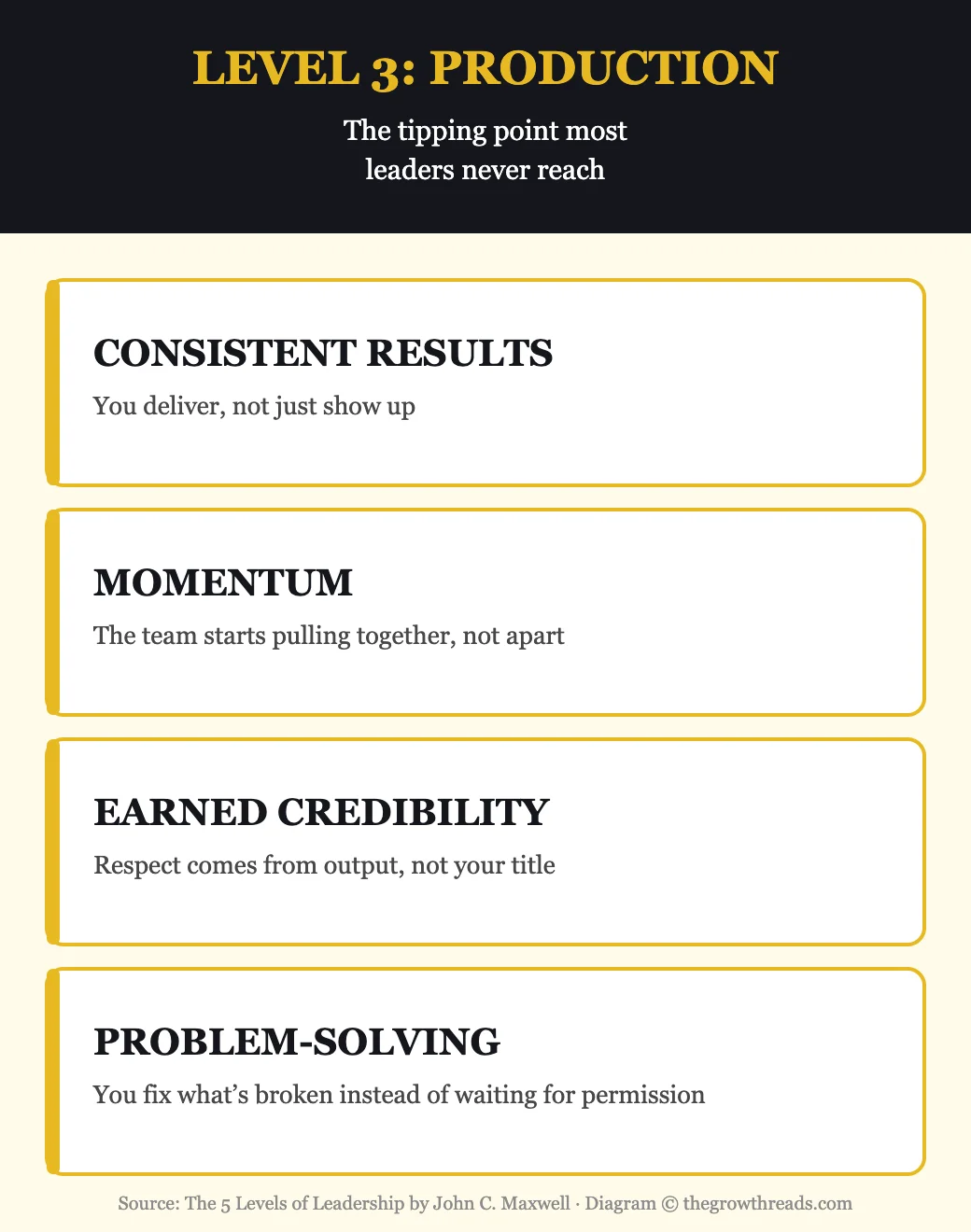
Level 3 is the tipping point Maxwell spends the most energy on, because it’s where most self-identified “nice” leaders quietly plateau. Production means your team consistently gets results because of how you lead them — not despite it. This is the level where credibility stops being about how much people like you and starts being about what you’ve actually delivered together. A Level 3 leader can point to a track record: a project turned around, a target hit quarter after quarter, a process that used to break and now doesn’t.
What makes Production different from the levels below it is momentum. Maxwell describes momentum as a leader’s best friend — once a team has tasted a real win together, problems that used to feel paralyzing start to feel solvable, because the team has evidence they can solve hard things. Momentum also compounds: each result makes the next one a little more believable, which makes the team a little more willing to stretch. This is also where a leader’s own credibility becomes durable. People who worked alongside you during a hard, successful stretch will trust your judgment in ways that no amount of charm at Level 2 could buy.
The risk at Level 3 is burnout — both the leader’s and the team’s — if results become the only currency that matters. Maxwell is explicit that Production should be a launching pad into Level 4, not a permanent home, because a team that only ever produces under one leader’s direct supervision hasn’t actually grown; it’s just been managed well.
TGR Note: For a deeper, more tactical playbook on the accountability that underpins Production-level results, see our Extreme Ownership summary — Jocko Willink and Leif Babin’s Navy SEAL framework for owning outcomes maps almost directly onto what Maxwell calls Level 3.
Part 3: People Development — multiplying your influence
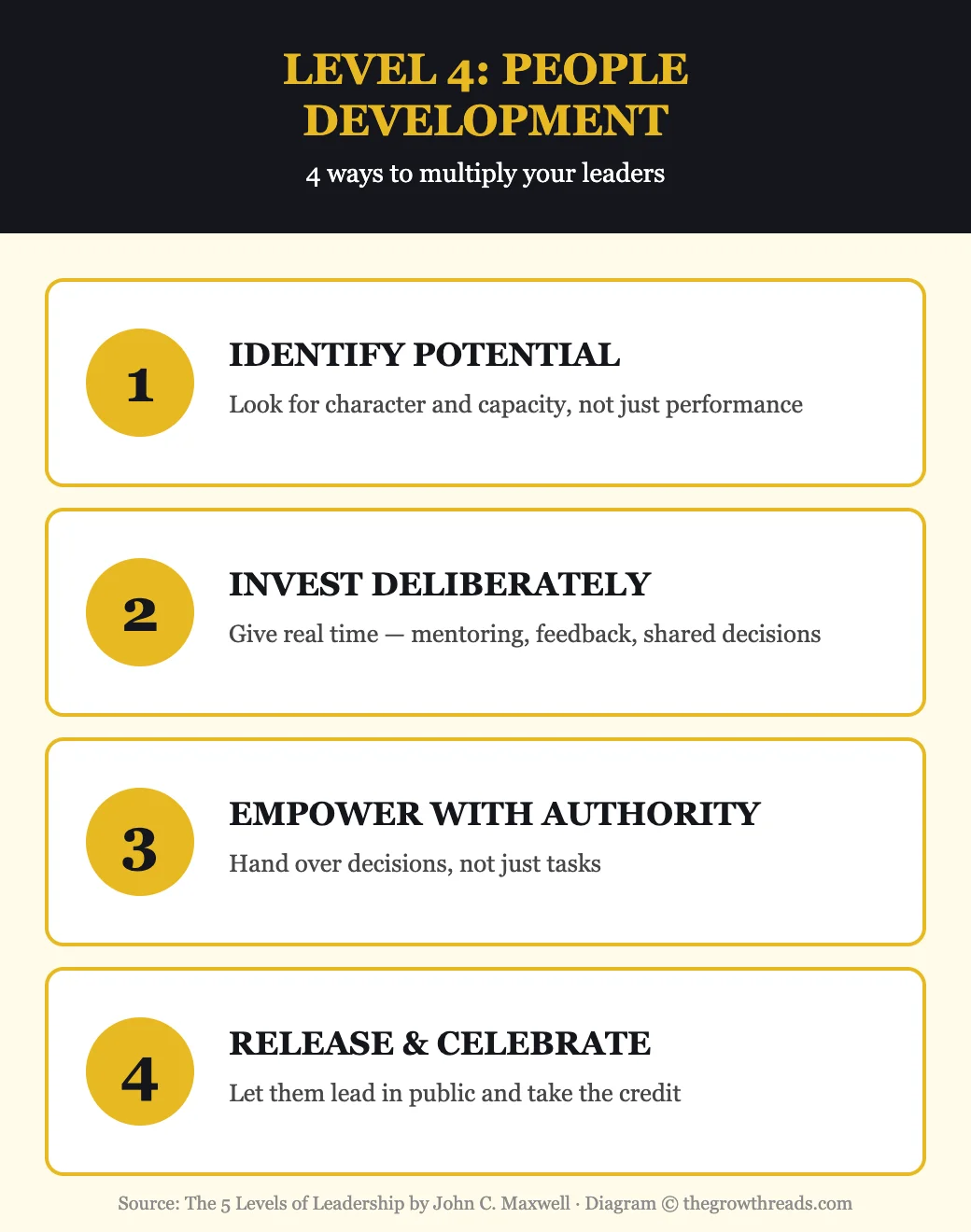
Level 4 is where Maxwell’s framework shifts from addition to multiplication. A Level 3 leader who personally produces great results is still limited by their own hours in the day. A Level 4 leader develops other people into leaders, and each of those leaders can go on to produce results — and develop still more leaders — without the original leader in the room. This is the level at which an organization’s capacity stops being capped by any one person’s calendar.
Maxwell breaks People Development into a few deliberate practices. First, identify potential — look for character and capacity, not just current performance, because today’s quiet contributor might be tomorrow’s best leader if given the chance. Second, invest real time — mentoring and honest feedback that costs you something, not a single motivational speech. Third, empower with actual authority, not just delegated tasks; people grow fastest when they’re handed real decisions with real consequences. Fourth, release and celebrate — let the leaders you’ve developed take visible credit, even publicly, rather than quietly running things from behind the scenes.
This is also where Maxwell introduces the Law of the Lid: you can only develop other people as far as you’ve developed yourself. A leader who has never learned to handle conflict well cannot teach a protégé to do it. Which is why Level 4 leaders tend to be lifelong learners themselves — the ceiling they’re building for their team is a direct reflection of the one they’ve built for themselves.
TGR Note: This is the exact territory Liz Wiseman covers in Multipliers — her research on leaders who make everyone around them smarter is essentially a field guide to what People Development looks like in practice, complete with the specific “Diminisher” habits that quietly cap a team instead.
Part 4: Pinnacle — leadership as legacy
Level 5 is the level Maxwell is most cautious about, because so few leaders ever reach it — and he doesn’t want readers chasing it as a goal in itself. Pinnacle leadership isn’t something you can strategize your way into directly; it’s what tends to happen, over decades, to leaders who’ve genuinely mastered the other four levels and kept developing other leaders long enough that their influence starts to outlive their formal role. People at this level are followed not because of what they’re currently doing for anyone, but because of who they’ve become and what they represent — their reputation walks into the room before they do.
Maxwell describes Pinnacle leaders as having an influence that extends beyond their own organization: other leaders seek them out for advice, their name becomes shorthand for a standard of excellence, and the leaders they’ve developed go on to develop leaders of their own, creating a multi-generational ripple effect. The honest takeaway for most readers is that Pinnacle is less a destination to plan for than a byproduct of getting comfortable staying uncomfortable — continuing to climb levels with new people and new challenges long after you could coast on your reputation alone.
TGR Note: If you want the fuller 21-principle version of Maxwell’s philosophy that underlies this 5-level model, our 21 Irrefutable Laws of Leadership summary is the natural next read — many of the laws map directly onto specific levels here.
Who is The 5 Levels of Leadership best for — and who should read something else first?
This book is best for new and mid-level managers who have a title but can feel the gap between “people report to me” and “people actually want to follow me.” It’s also useful for experienced leaders who’ve plateaued at Production and want a language for why their team’s growth has stalled despite good results. If you’re specifically wrestling with accountability and ownership on a team, start with Extreme Ownership instead. If your challenge is more about organizational culture and psychological safety than personal influence, Dare to Lead is the better starting point. And if you’re already comfortable with the 5-levels framework and want the exhaustive, principle-by-principle version, go to The 21 Irrefutable Laws of Leadership.
Questions to reflect on
- Which level are most of the people on your team actually following you at — Position, Permission, or something higher — and how do you know?
- Where in your week are you relying on your title to get things done instead of relationship or results?
- Who on your team has untapped leadership potential you haven’t deliberately invested in yet?
- What’s one piece of real authority — not just a task — you could hand off this month?
- If your influence disappeared tomorrow, what would remain of what you’ve built in other people?
🔥 Ready to lead beyond your title?
Get the full book and start climbing the 5 levels with your own team this week.
How to apply The 5 Levels of Leadership (7-day plan)
- Day 1 — Map your levels: list your five to ten key working relationships and honestly write down which level you’re at with each one.
- Day 2 — Learn one new thing about someone: in every one-on-one today, ask a non-work question and actually listen to the answer.
- Day 3 — Audit your Position habits: notice every time today you lead with “because I said so” energy instead of relationship or reasoning.
- Day 4 — Deliver one visible win: pick a stalled task and push it to completion with your team, publicly crediting their part in it.
- Day 5 — Identify your next leader: choose one person with untapped potential and schedule a real development conversation with them.
- Day 6 — Hand over real authority: delegate one decision — not just a task — and commit to living with the outcome.
- Day 7 — Reflect and recommit: revisit your Day 1 map and choose the one relationship you’ll deliberately move up a level this month.
Frequently asked questions
What are the 5 levels of leadership in order?
In order, they are: Level 1 Position (people follow because they have to), Level 2 Permission (people follow because they want to), Level 3 Production (people follow because of what you’ve done for the team), Level 4 People Development (people follow because of what you’ve done for them personally), and Level 5 Pinnacle (people follow because of who you are and what you represent). Each level builds on the one before it — Maxwell doesn’t recommend skipping any of them.
Is The 5 Levels of Leadership based on real research?
The book is grounded primarily in Maxwell’s decades of firsthand experience leading and consulting for organizations, plus interviews and case studies he gathered from executives who applied the model. It’s more of a practitioner’s framework than an academic study, and some readers note that the anecdotes lean heavily on business and ministry contexts. The practical advice on building trust, delivering results, and developing others is broadly uncontroversial and echoed across the leadership literature.
How long does it take to read The 5 Levels of Leadership?
At roughly 200 pages, most readers finish it in about 3 to 4 hours, or a bit less on audiobook. It’s written in short, digestible sections with frequent summaries, so it also works well as a book you dip into level by level rather than reading cover to cover in one sitting.
Can you skip levels or jump straight to Level 5?
No — this is one of Maxwell’s firmest points. Each level is built on trust and credibility earned at the level below it, so trying to claim Pinnacle-style influence without first proving yourself at Production and People Development tends to come across as hollow or presumptuous. The framework is explicitly sequential, even though the time spent at each level varies enormously by person and situation.
Does the 5 Levels framework apply outside of a traditional workplace?
Yes. Maxwell explicitly frames it as a model for any relationship where influence matters — parenting, coaching a sports team, volunteering in a community organization, or leading within a family business. The mechanics of earning trust, delivering results, and developing others in someone else translate well beyond a formal org chart.
How is this different from The 21 Irrefutable Laws of Leadership?
The 21 Laws is Maxwell’s broader, more exhaustive body of leadership principles, covering everything from timing to sacrifice to connection. The 5 Levels is a narrower, more structural framework specifically about how influence is earned and escalates over time. Many readers use the 5 Levels as an organizing map and the 21 Laws as the deeper toolkit for executing at each level.
What’s the biggest mistake leaders make with this model?
Getting comfortable at Level 2 or Level 3 and assuming that’s the finish line. Maxwell repeatedly warns against leaders who coast on being well-liked or on past results instead of continuing to invest in developing other leaders. The other common mistake is treating the levels as universal — you may be at Level 4 with a longtime colleague and Level 1 with someone who joined last week, and both are normal.
Related summaries
- The 21 Irrefutable Laws of Leadership Summary & Review
- Multipliers Summary & Review
- Extreme Ownership Summary & Review
- Dare to Lead Summary & Review
- See all 48 Best Leadership Books
How we analyze books: We read the full text, cross-check key claims and frameworks against the author’s other published work and interviews, and build original diagrams and application plans rather than reproducing the book’s content. Read our full methodology.
Related Leadership Summaries
Leaders Eat Last Summary & Review: Build a Team That Has Your Back
Shoe Dog Summary & Review: The Raw Truth Behind Building Nike
Team of Teams Summary & Review: Leading in Complexity
The Advantage Summary and Review
The Innovator’s Dilemma Summary & Review: Why Great Companies Fail When They Do Everything Right