

★★★★☆ (4.4/5) — A Navy captain took over the worst-performing ship in the fleet and turned it into the best, using nothing but ownership, trust, and listening.
Best for: Managers and team leads who want a practical, story-driven playbook for building ownership rather than mere compliance.
Reading time: ~13 min summary (book: ~5–6 hrs)
Difficulty to apply: Moderate — the principles are simple, but they require genuinely giving up control
It’s Your Ship in one minute
When Captain D. Michael Abrashoff took command of the USS Benfold, he inherited one of the lowest-performing, lowest-morale ships in the U.S. Navy — and within months, through a handful of deceptively simple leadership changes, turned it into a model of performance the Navy studied for years afterward. It’s Your Ship distills what he actually did: listen aggressively, explain the purpose behind every order, tolerate honest mistakes, and treat every crew member as if they owned the outcome, not just their narrow task. The result wasn’t softer discipline — it was a crew that took more initiative, made fewer costly errors, and stayed in the Navy at rates the fleet had never seen. The book is short, concrete, and built almost entirely from real incidents aboard one ship.
Key takeaways
- Ownership beats compliance: people who feel it’s “their ship” perform far better than people who are just following orders.
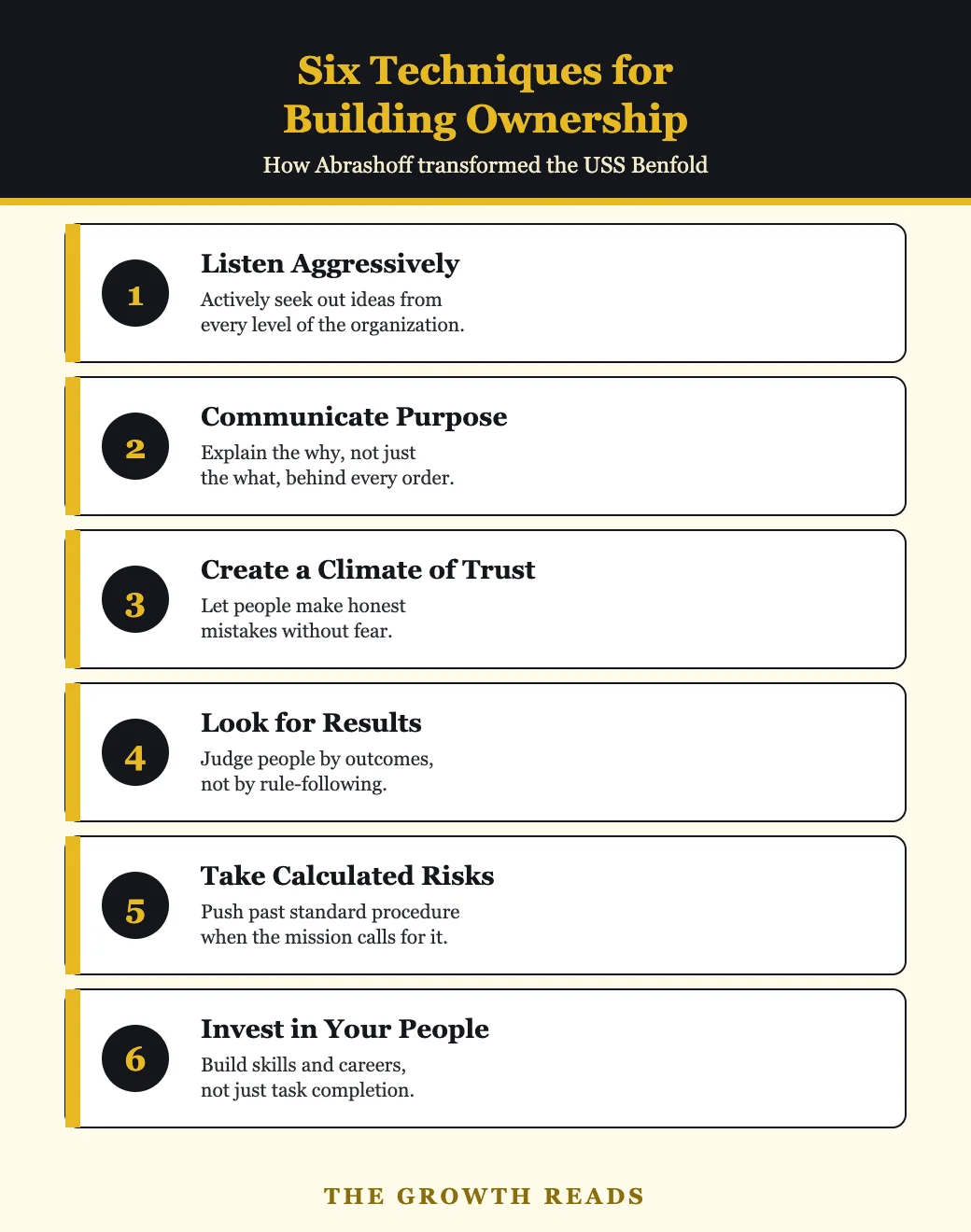
- Listen aggressively: actively seek out ideas and concerns from every level, not just the ones who report directly to you.
- Communicate purpose, not just orders: explaining why a task matters produces better judgment than simply issuing instructions.
- Create a climate of trust: people need room to make honest mistakes without fear of punishment, or they stop taking initiative entirely.
- Judge by results, not by rule-following: rigid adherence to procedure for its own sake often produces worse outcomes than flexible, results-focused judgment.
- Take calculated risks: good leaders sometimes go around standard procedure when it clearly serves the mission better.
- Invest in your people’s growth: training and career development pay for themselves many times over in performance and retention.
- Generate unity around a shared purpose: a team that understands its larger mission works together more naturally than one that doesn’t.
- Improve people’s quality of life: small, practical improvements to how people work and live translate directly into performance.
- Leadership is mostly about removing obstacles: the leader’s job is less about giving orders and more about clearing the way for people to do their best work.
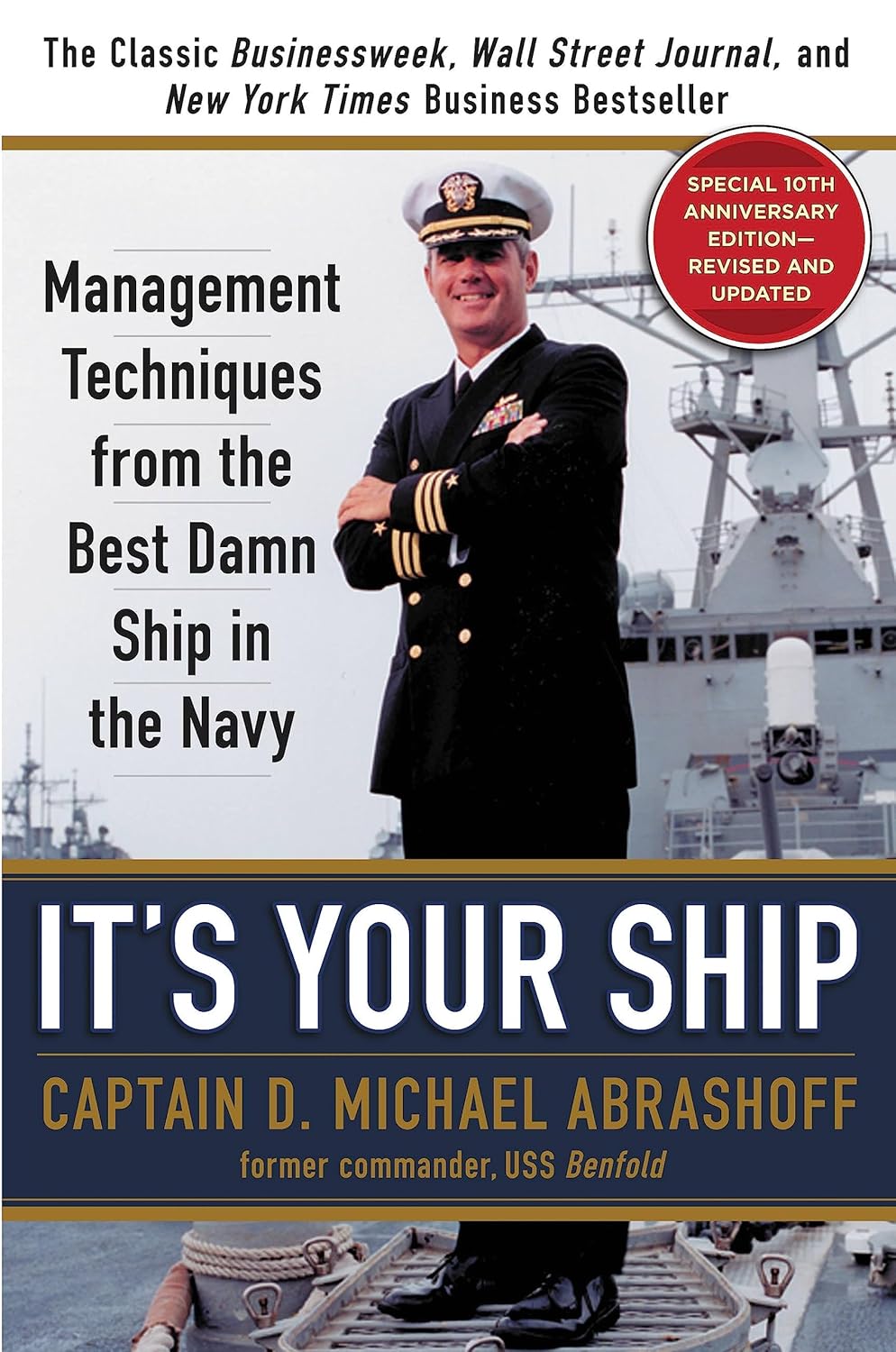
What is It’s Your Ship about?
It’s Your Ship is Captain D. Michael Abrashoff’s account of transforming the USS Benfold from one of the Navy’s worst-performing ships into one of its best, using ownership, trust, and purpose instead of rigid command-and-control.
About the author
Captain D. Michael Abrashoff served in the U.S. Navy for over 16 years, including as military assistant to the Secretary of Defense, before taking command of the USS Benfold, a guided-missile destroyer, in 1997. Under his leadership, the Benfold went from a ship plagued by low morale and poor performance to one that won the Spokane Trophy for having the best crew readiness in the entire Pacific Fleet — achieved with the same crew and equipment he inherited, not a wholesale replacement of personnel. After leaving the Navy, Abrashoff became a sought-after speaker and consultant, applying the leadership principles from his command to corporate and organizational settings well beyond the military. What distinguishes his account from many leadership books is that it isn’t built from research or case studies of other people’s organizations — it’s a direct, first-person record of specific decisions made aboard one ship, with specific, verifiable outcomes attached to them, which gives the book an unusually concrete, falsifiable quality compared to more abstract leadership theory.
Key concepts at a glance
| Concept | What it means | Use it when |
|---|---|---|
| Ownership culture | Treating every team member as if they personally own the outcome, not just their task | Building a team that takes initiative instead of waiting for instructions |
| Listening aggressively | Actively seeking out ideas and concerns from every level of the organization | Surfacing problems and improvements before they become crises |
| Communicating purpose | Explaining why a task matters, not just issuing the instruction | Improving judgment in situations you haven’t explicitly covered |
| Climate of trust | Allowing honest mistakes without punishment so people keep taking initiative | Encouraging a team that has become risk-averse or passive |
| Results over ritual | Judging performance by outcomes rather than strict adherence to procedure | Cutting through bureaucracy that no longer serves the mission |
| Calculated risk | Going around standard procedure deliberately when it clearly serves a better outcome | Situations where rigid rule-following would produce a worse result |
Part 1: Inheriting the Worst Ship in the Fleet
When Abrashoff took command of the USS Benfold, he inherited a ship with poor morale, high turnover, and a culture where sailors did the bare minimum to avoid punishment. His first instinct wasn’t to tighten discipline further — it was to talk to as many crew members as possible, one-on-one, and simply listen to what wasn’t working. He calls this “listening aggressively”: not waiting for problems to be reported through the chain of command, but actively seeking out the person on deck who actually knows why a process is broken.
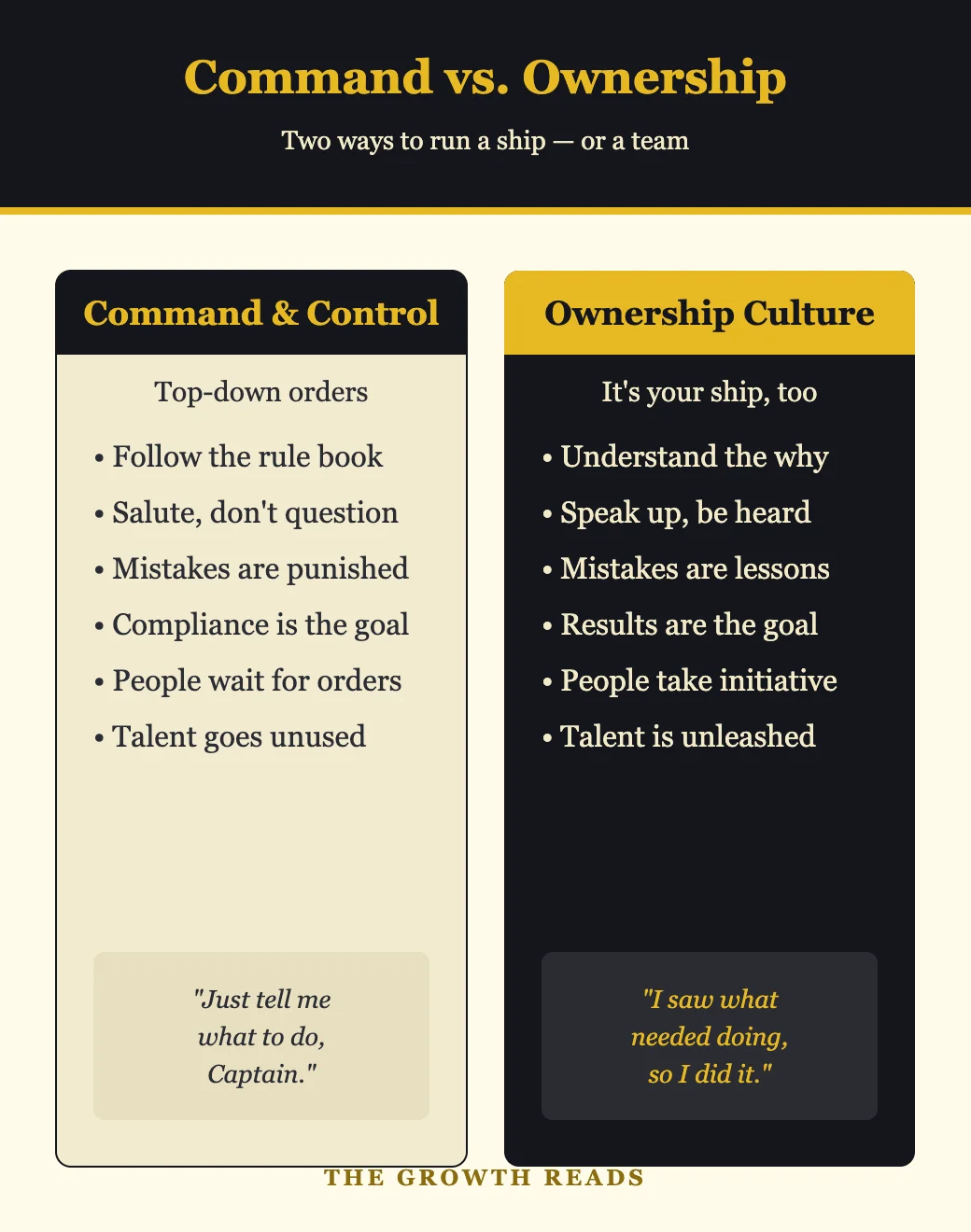
What he found was that many of the ship’s problems weren’t caused by lazy or incapable sailors — they were caused by procedures nobody had questioned in years, procedures that made sense on paper but wasted enormous time and effort in practice. Rather than assume the crew needed more supervision, Abrashoff started assuming the crew probably had better ideas than the standard procedures they were following, and his job was to create space for those ideas to surface and get implemented.
This reframing — from “my crew needs tighter control” to “my crew has answers I haven’t asked for yet” — is the foundation the rest of the book builds on. It’s a direct rejection of the assumption that discipline problems are solved by more command and less autonomy; Abrashoff’s experience was closer to the opposite.
He also describes a deliberate practice of walking the ship without an agenda, simply making himself available to whoever wanted to talk, rather than only holding formal meetings where junior sailors would rarely speak candidly in front of senior officers. Informal conversations in the mess hall or on deck surfaced problems and ideas that never would have reached him through official channels, where information tends to get filtered, softened, or withheld entirely as it moves up a hierarchy. He treated this filtering effect as a structural problem every leader faces, not a personal failing of any particular sailor, and built habits specifically designed to route around it.
TGR Note: This mirrors the submarine command story in Turn the Ship Around, which documents an almost identical transformation using a different Navy vessel and command structure.
Part 2: Communicating Purpose, Not Just Orders
One of Abrashoff’s most consistent practices was explaining the reasoning behind orders, not just issuing them. Standard military culture often treats explanation as unnecessary or even inappropriate — orders are meant to be followed, not debated. Abrashoff found the opposite was true in practice: sailors who understood why a task mattered made better judgment calls in situations the original order hadn’t anticipated, because they understood the underlying goal, not just the literal instruction.
This became especially important in ambiguous or fast-changing situations, where following the letter of an order without understanding its purpose could actually produce a worse outcome than adapting sensibly to new information. A sailor who only knows “do X” will do X even when circumstances make X counterproductive; a sailor who understands “we’re trying to achieve Y, and X is normally how we do it” can adapt when circumstances change.
Abrashoff extended this principle to the ship’s broader mission as well, regularly explaining to the crew how their work connected to the Navy’s larger strategic goals, not just the day’s task list. He found that understanding the larger purpose measurably increased both morale and initiative — people who saw themselves as part of something meaningful worked differently than people who saw themselves as executing a checklist.
One recurring example involves routine maintenance tasks that sailors had historically treated as tedious busywork. Once Abrashoff connected specific maintenance routines to concrete consequences — a corroded part failing during an actual combat scenario, a delayed repair putting the ship or a crew member at real risk — the same tasks were performed with noticeably more care and attention, without any change to the formal instructions themselves. The task hadn’t changed; the sailors’ understanding of why it mattered had, and that alone changed how carefully it got done.
TGR Note: The idea that purpose changes behavior more than instructions do is the central argument of Start With Why, which builds an entire leadership framework around this single insight.
Part 3: Building a Climate of Trust and Judging by Results
Abrashoff deliberately built a culture where honest mistakes were treated as learning opportunities rather than offenses to be punished. This wasn’t laxity — negligence and dishonesty were still taken seriously — but genuine, good-faith errors made while trying to improve something were explicitly protected from punitive consequences. He argued that punishing honest mistakes teaches people exactly one lesson: stop taking initiative, because the safest path is always to do the minimum and avoid scrutiny.
Paired with this was a shift toward judging sailors by results rather than strict procedural compliance. Where standard Navy culture often prized adherence to established process above all else, Abrashoff pushed his crew to ask whether a given procedure was actually serving its intended purpose, and to propose changes when it wasn’t. This produced numerous small efficiency improvements that added up to substantial savings in time, money, and frustration — improvements that would never have surfaced under a culture where questioning procedure was itself discouraged.
The combination of trust and a results orientation also meant Abrashoff was willing to take calculated risks — bending or bypassing standard procedure when it clearly served the mission better, provided the underlying reasoning was sound. This required a level of confidence in his crew’s judgment that a purely command-and-control culture would never have permitted, and it’s precisely the confidence that built up as sailors proved, repeatedly, that they could be trusted with real autonomy.
Abrashoff is careful to distinguish this from recklessness. Every calculated risk he describes came with a clear rationale that could be explained and defended afterward, and none of them involved compromising safety or the ship’s core mission. The willingness to bend procedure applied specifically to situations where the procedure itself had drifted away from serving its original purpose — not to safety-critical protocols where the cost of being wrong was catastrophic. This distinction between “flexible where flexibility helps” and “rigid where rigidity protects people” is what allowed the ownership culture to coexist with, rather than undermine, real operational discipline.
TGR Note: This tension between rules and judgment shows up throughout Extreme Ownership, which comes from a different military background but reaches many of the same conclusions about decentralized decision-making under pressure.
Part 4: Investing in People and Generating Unity
Abrashoff treated training and career development as one of his highest priorities, not a distraction from operational readiness. He connected sailors with education opportunities, mentored them on career paths beyond the Navy, and made an explicit point of helping people grow even when that growth eventually meant they left his ship for a promotion elsewhere. This ran counter to a common managerial instinct to hoard talent, but Abrashoff found that visibly investing in people’s growth, even at the cost of eventually losing them, dramatically increased loyalty, effort, and retention while they were under his command.
He also worked deliberately to generate a sense of unity and shared purpose across the crew, treating the ship’s mission as something everyone owned together rather than a set of separate, siloed jobs. Small, practical improvements to quality of life — better food, more reasonable schedules, clearer communication about what to expect — compounded with the larger cultural changes to produce a crew that, by most conventional measures, shouldn’t have performed as well as it did given its starting point.
Abrashoff describes these quality-of-life changes as low-cost, high-return decisions that most command structures overlooked simply because they weren’t officially prioritized. Improving the food service, for instance, cost relatively little but had an outsized effect on morale, because it signaled to the crew that their day-to-day experience genuinely mattered to leadership, not just their output. He treats this as a broader lesson about organizational blind spots: the improvements with the highest return on effort are often the ones that fall outside whatever gets measured and reported up the chain, which means they only get addressed if a leader deliberately goes looking for them.
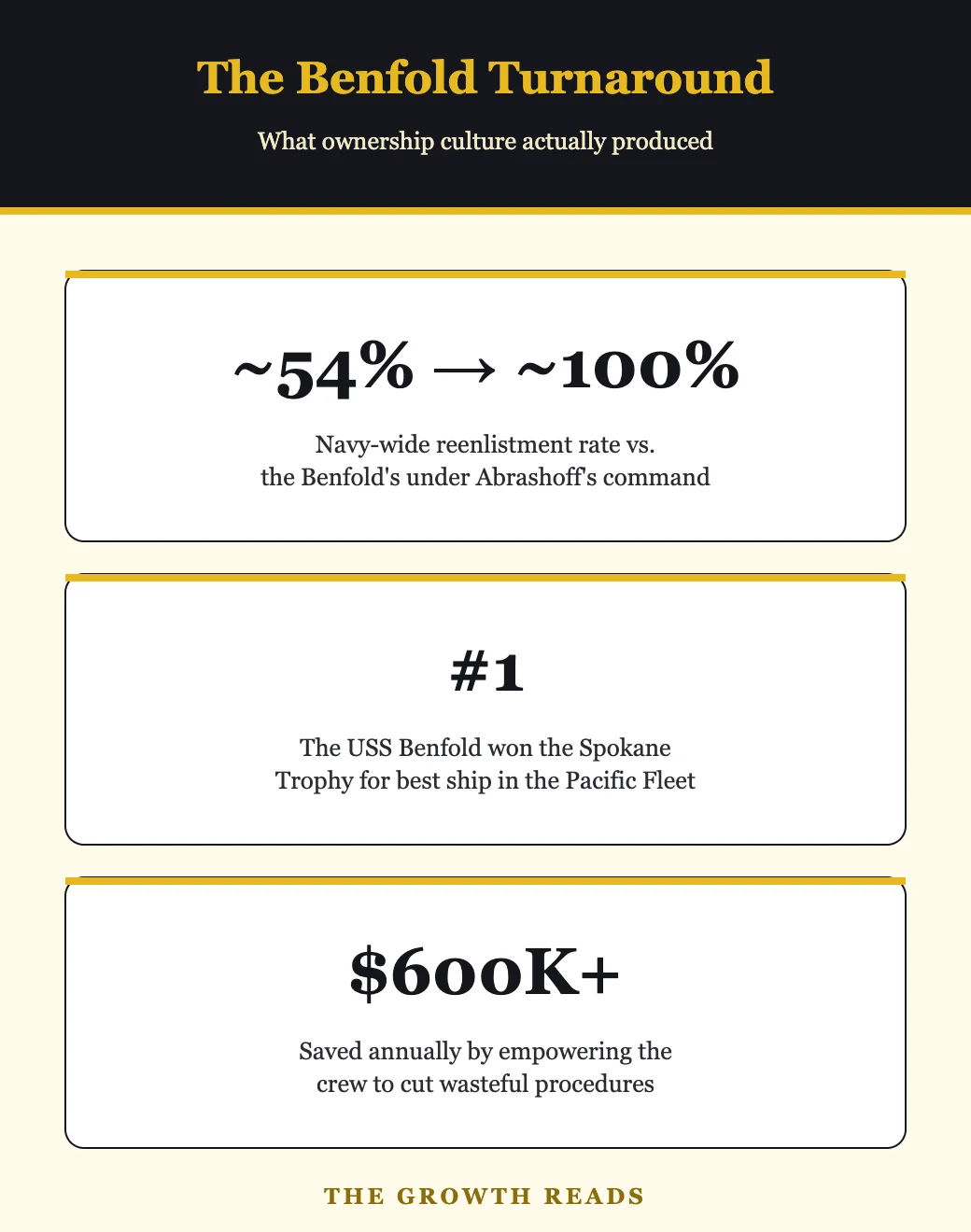
The results were concrete and measurable: reenlistment rates far above the Navy average, dramatically improved efficiency, and top marks in Pacific Fleet readiness evaluations — all achieved with the same crew and the same ship Abrashoff inherited, not through replacing personnel or equipment.
What makes these results notable is the counterfactual: the Navy, like most large hierarchical organizations, has a strong institutional bias toward assuming that underperformance reflects a personnel problem — the wrong people, in the wrong roles, needing more supervision or replacement. Abrashoff’s experience directly challenges that assumption. The same sailors who had been considered mediocre performers under the previous command structure became, by external measures, some of the best performers in the fleet under a different leadership approach, without any change in who was actually on the ship. That single fact is arguably the book’s strongest piece of evidence for its central argument: performance problems that look like people problems are frequently leadership and system problems in disguise.
TGR Note: The idea that leaders should prioritize their people’s growth and wellbeing above their own convenience is the core argument of Leaders Eat Last, which grounds the same principle in a broader look at trust and biology.
Who is It’s Your Ship best for — and who should read something else first?
This book is best for managers and team leads who want a short, concrete, story-driven introduction to building ownership rather than compliance, especially those managing frontline or operational teams. Its brevity and clarity make it an easy re-read before a leadership transition or team reset.
If you want a similar story from a different branch of the military with more tactical depth, Turn the Ship Around is the closest companion. If you’re more interested in the purpose-driven side of the argument, start with Start With Why. And if you want the decentralized-command version of these ideas from a combat leadership perspective, Extreme Ownership extends the thread further.
Questions to reflect on
- Do the people on your team feel like it’s “their ship,” or like they’re just following your orders?
- When was the last time you actively sought out an idea from someone several levels below you?
- Do you explain the purpose behind your instructions, or just the instructions themselves?
- How do you currently respond to an honest, good-faith mistake on your team?
- Where are you enforcing a procedure that no longer actually serves its original purpose?
🔥 Ready to build a crew that owns the outcome?
Grab a copy of It’s Your Ship and start applying Abrashoff’s principles of ownership, trust, and purpose-driven leadership.
How to apply It’s Your Ship (7-day plan)
- Day 1 — Listen aggressively: Have one-on-one conversations with three people on your team, at different levels, and just listen.
- Day 2 — Explain one “why”: Pick one standing instruction and explain the purpose behind it to your team, not just the instruction.
- Day 3 — Protect one honest mistake: Respond to a good-faith error this week with curiosity rather than punishment.
- Day 4 — Question one procedure: Identify a rule or process that may no longer serve its original purpose and ask your team about it.
- Day 5 — Take one calculated risk: Deliberately bend a low-stakes standard procedure when a better outcome is clearly available.
- Day 6 — Invest in one person: Have a career-development conversation with someone on your team, even if it might eventually mean they move on.
- Day 7 — Reconnect to purpose: Explain to your team how this week’s work connects to the larger mission, not just the task list.
Frequently asked questions
Do I need a military or Navy background to apply this book?
No. While the story is set aboard a Navy destroyer, Abrashoff explicitly wrote the book for a general management audience, and its principles — listening, purpose, trust, and ownership — apply directly to corporate teams, small businesses, and any organization with a hierarchy. The military setting mainly provides a dramatic, high-stakes backdrop for ideas that generalize well beyond it.
Is this the same story as Turn the Ship Around?
No, though the two are often paired. It’s Your Ship covers Captain D. Michael Abrashoff’s command of the USS Benfold, a guided-missile destroyer. Turn the Ship Around covers Captain L. David Marquet’s command of the USS Santa Fe, a submarine. Both describe strikingly similar transformations achieved through decentralizing authority and building ownership, but they are separate commands, separate authors, and separate books.
Does “ownership culture” mean less discipline or accountability?
No — Abrashoff is explicit that negligence and dishonesty were still treated seriously aboard the Benfold. The distinction is between honest, good-faith mistakes made while trying to improve something, which were protected from punitive consequences, and genuine negligence or dishonesty, which was not. Ownership culture increased accountability in practice, because people who feel ownership tend to hold themselves to a higher standard than people who are simply complying with orders.
What specific results did the USS Benfold achieve?
Under Abrashoff’s command, the Benfold saw reenlistment rates far above the Navy-wide average, meaningful efficiency and cost savings from crew-driven procedural improvements, and top marks in Pacific Fleet readiness evaluations, including the Spokane Trophy for best ship performance. These results were achieved with the same crew and equipment Abrashoff inherited, not through replacing personnel.
Is the book more memoir or management framework?
It leans toward memoir with extracted principles woven throughout, rather than a formal, numbered framework. Each chapter typically centers on a real incident aboard the Benfold, followed by the leadership lesson Abrashoff drew from it. Readers looking for a rigorous academic framework may prefer a more research-driven leadership book, but the concrete, story-based format is a major reason the book has remained widely read.
How long does it take to read?
The book is relatively short at around 200 pages, and most readers finish it in five to six hours. Its brevity and story-driven format make it a common choice for a quick re-read before a leadership transition, a new management role, or a team reset.
What’s one practical takeaway from the book?
If you take just one idea from the book, make it this: the next time you’re about to give an instruction, explain the purpose behind it as well as the instruction itself. People who understand why a task matters make better judgment calls than people who are only told what to do, and that single habit compounds into real ownership over time.
Related summaries
- Turn the Ship Around — the submarine-command version of the same leadership transformation
- Start With Why — why purpose changes behavior more than instructions do
- Extreme Ownership — decentralized command and accountability from a combat leadership perspective
- Leaders Eat Last — why prioritizing people’s wellbeing builds lasting trust
See all our best leadership books →
How we analyze books: Every TGR summary is built from a full read of the book, cross-checked against the author’s interviews and published research, then structured into a practical, apply-it-this-week format. Read our full methodology.
Related Leadership Summaries
The Advantage Summary and Review
The Making of a Manager Summary & Review: Your First Leadership Playbook
The Motive Summary & Review: Why You Lead Matters Most
Turn the Ship Around Summary & Review: How to Build Teams That Think for Themselves
Who Moved My Cheese? Summary & Review: Navigate Change Before It Breaks You