

★★★★★ (4.5/5) — A chess prodigy turned martial arts champion distills two decades of competing at the highest level into a genuinely transferable theory of mastery.
Best for: Anyone pursuing deep skill in a competitive or high-pressure domain — sport, chess, business, or the arts.
Reading time: ~14 min summary (book: ~7–8 hrs)
Difficulty to apply: Moderate — the ideas are simple to state but demand real, sustained practice to internalize
The Art of Learning in one minute
Josh Waitzkin became a national chess champion as a child, then walked away from the game to become a world champion in Tai Chi Chuan push hands — and along the way discovered that the deep principles of mastering one skill transfer almost entirely to mastering another. The Art of Learning is his account of what that transfer actually requires: a growth-oriented theory of ability, a method of learning fundamentals so deeply they become intuitive, and a set of psychological tools for staying resilient and present under real competitive pressure. It is part memoir, part instruction manual, built from two very different arenas that turn out to run on the same underlying principles.
Key takeaways
- How you think about ability shapes how far you go: an incremental, growth-oriented theory of skill outperforms a fixed, talent-based one over the long run.
- Master the fundamentals until they’re intuitive: deep, felt understanding of basics beats broad, shallow knowledge of advanced material.
- The smaller-circles method builds real depth: shrink a skill down to its smallest unit, feel the principle inside it, then reconnect that principle to the whole.
- Invest in loss: short-term setbacks, sought out deliberately, are often the fastest route to long-term improvement.
- Stay in the soft zone: resilience under pressure comes from fluid presence, not rigid resistance to distraction.
- Make sandals, don’t try to cover the world in leather: adapt your internal state to conditions, rather than demanding the conditions change for you.
- You can train yourself to slow down time: deep presence and pattern recognition make split seconds feel expansive under pressure.
- Catch the downward spiral early: one mistake becomes catastrophic only when it triggers a cascade of panic-driven follow-up errors.
- Cross-training compounds: principles learned in one intense discipline (chess) carried directly into mastering an entirely different one (martial arts).
- Numbers to leave behind: as skill deepens, explicit calculation gives way to intuitive feel — the goal is to internalize principles so completely you stop consciously counting.
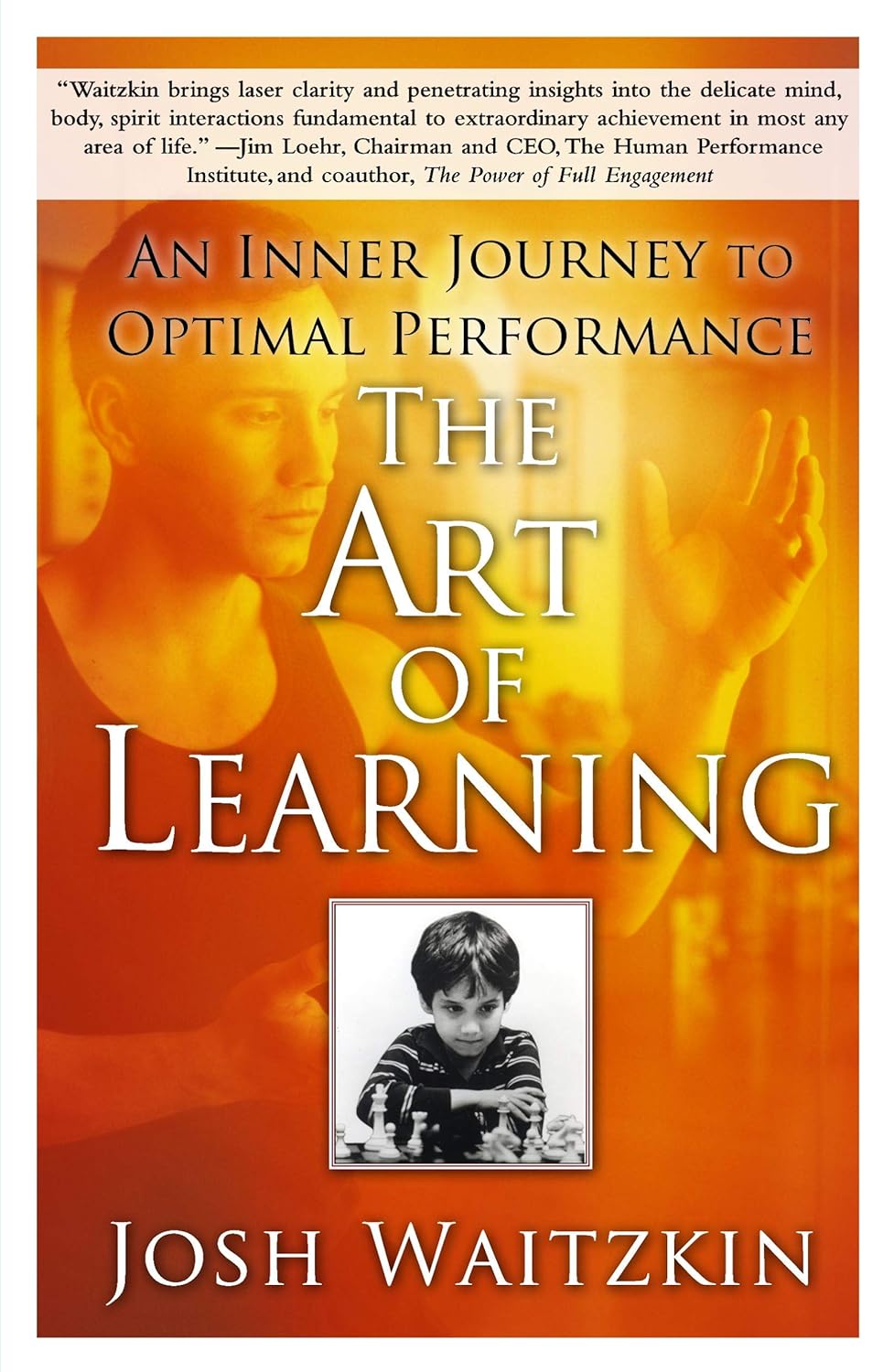
What is The Art of Learning about?
The Art of Learning is Josh Waitzkin’s account of becoming a champion in two unrelated disciplines — chess and Tai Chi push hands — and the transferable principles of mastery, resilience, and presence that made both possible.
About the author
Josh Waitzkin became a national chess champion by age nine, an experience later dramatized in the film Searching for Bobby Fischer, and went on to earn the title of International Master. In his twenties, he largely left competitive chess behind and turned to the martial art of Tai Chi Chuan, eventually becoming a Push Hands World Champion — a rare case of someone reaching the top of two entirely different competitive disciplines. Waitzkin has since worked as a performance coach, applying the principles from both chess and martial arts to athletes, investors, and executives. His central claim, developed across years of firsthand competitive experience rather than academic research, is that the deep structure of learning and performing under pressure is largely the same no matter the domain.
Key concepts at a glance
| Concept | What it means | Use it when |
|---|---|---|
| Entity vs. incremental theory | Believing ability is fixed and innate versus believing it is built through effort | Diagnosing why you avoid challenges or crumble after setbacks |
| Smaller circles | Shrinking a skill to its smallest unit to feel its underlying principle deeply | Moving from surface knowledge to intuitive mastery of fundamentals |
| Investment in loss | Deliberately accepting short-term setbacks in exchange for long-term growth | Choosing whether to play it safe or take on a harder challenge |
| The soft zone | Staying fluid and present amid distraction, rather than rigidly resisting it | Performing under noisy, unpredictable, or high-pressure conditions |
| Making sandals | Adapting your inner state to conditions instead of demanding conditions change | Facing circumstances you cannot control (weather, opponents, external noise) |
| Slowing down time | Using deep presence and pattern recognition to expand perceived time | Operating under intense time pressure or split-second decisions |
| The downward spiral | One mistake triggering a cascade of panic-driven follow-up errors | Recovering composure immediately after an initial setback |
Part 1: Two Theories of Ability
Waitzkin opens with a distinction he borrows from psychological research on achievement, though he arrived at it through lived competitive experience rather than academic study: some people hold an “entity” theory of ability, believing talent is fixed and innate, while others hold an “incremental” theory, believing ability is built through effort and process. The distinction sounds abstract until you watch how the two groups respond to failure.
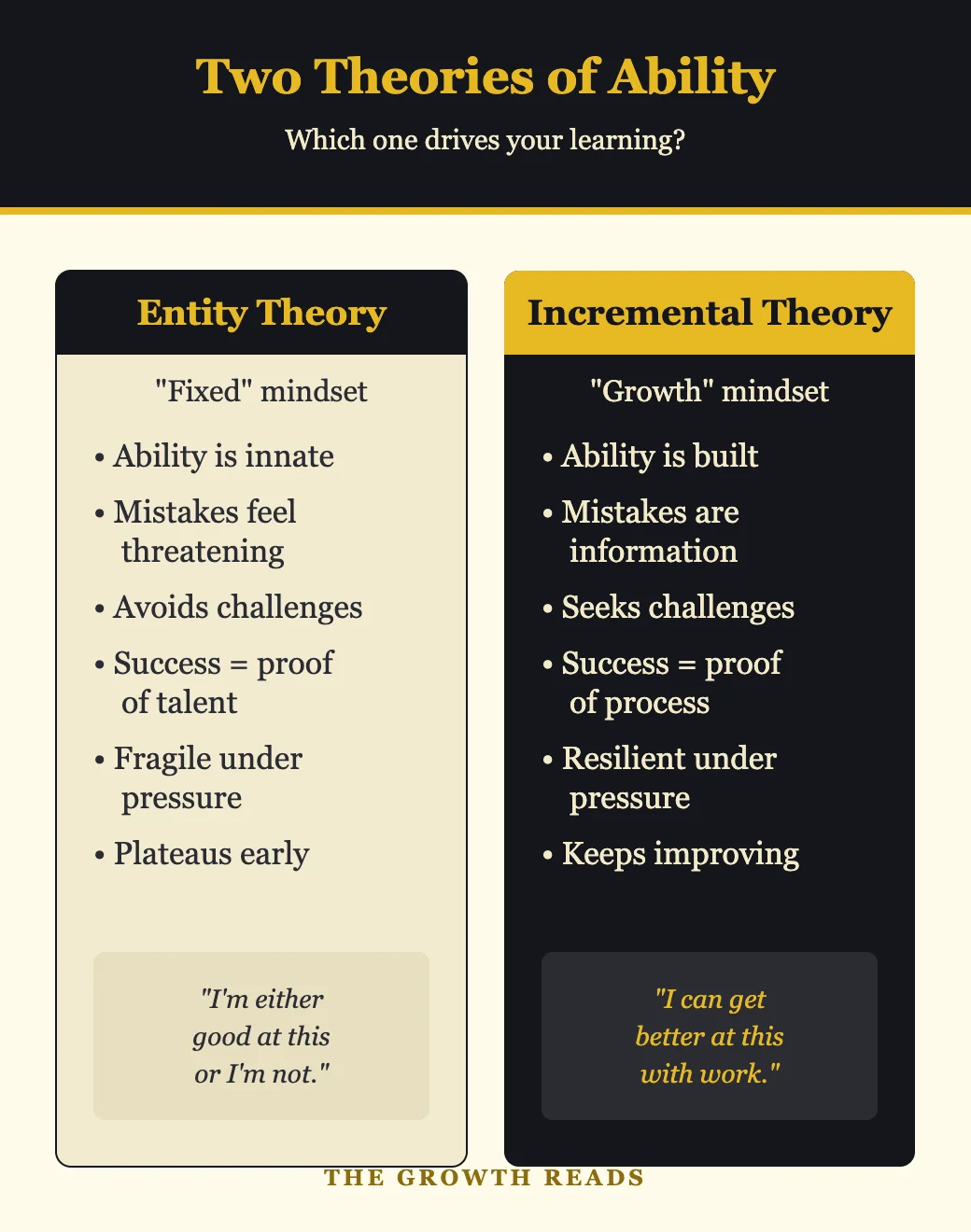
Entity theorists tend to interpret a loss as proof that they lack talent, which makes every subsequent challenge feel existentially threatening — better to avoid a risky position altogether than to confirm you’re “not good enough.” Incremental theorists interpret the same loss as information about where the gaps in their game are, which makes them actively seek out harder positions rather than avoid them. Waitzkin traces his own early success as a child chess prodigy directly to being praised, almost by accident, for his love of the game and his process rather than for being naturally gifted — a subtle framing difference that shaped how he responded to adversity for the rest of his career.
The practical stakes are high because the two mindsets create a compounding gap over time. An incremental learner who loses ten games and treats each as data will improve faster than an entity-theory learner who avoids difficult opponents to protect a self-image of talent. Waitzkin argues that the mindset itself, more than any single technique, determined how far he and the people he later coached were able to progress in their respective fields.
Waitzkin is careful to note that this isn’t simply a matter of positive thinking or repeating affirmations about growth. The theory of ability someone holds shapes concrete behavior long before any conscious reflection happens: which opponents they agree to play, how long they persist on a difficult problem before giving up, and whether a loss produces curiosity or shame in the moment it happens. He describes watching young chess students who had been praised primarily for being “smart” or “talented” become visibly more fragile after a loss than students praised for effort and persistence, even when the two groups started with comparable raw ability. The framing adults use with learners, in other words, actively shapes which theory of ability takes root.
TGR Note: This is essentially Carol Dweck’s growth-mindset research, arrived at independently through competitive experience — Mindset is the definitive deep dive into the psychology behind it.
Part 2: Making Smaller Circles
Waitzkin’s core method for building real mastery is what he calls “making smaller circles”: instead of accumulating a wide but shallow range of techniques, he isolates one small piece of a skill and repeats it until the underlying principle is felt intuitively, not just known intellectually. Only after that principle is internalized does he reconnect it to the larger, fluid whole.
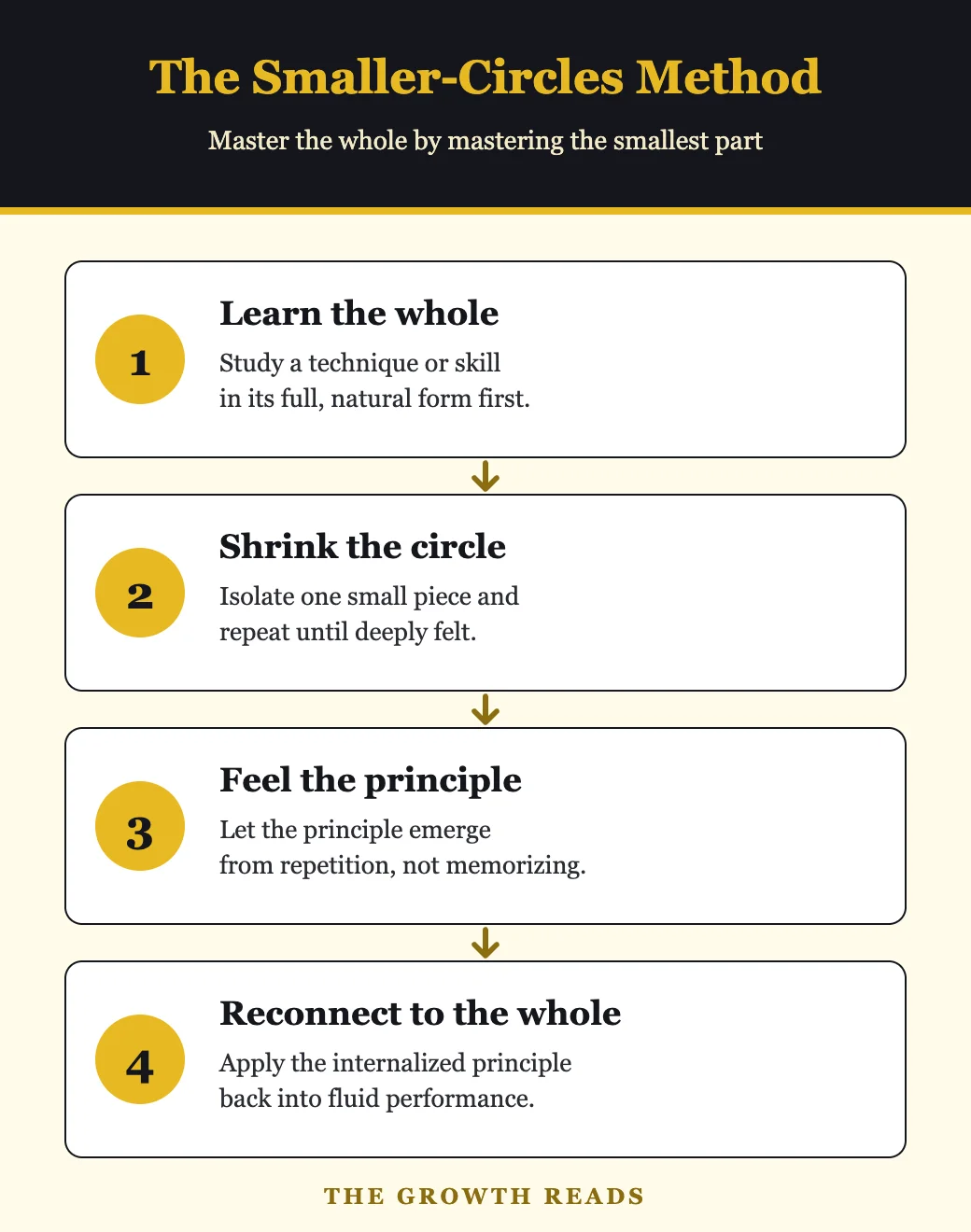
In chess, this meant studying stripped-down endgame positions — a king and a pawn against a king, for instance — for months, long after most students had moved on to more “advanced” material. That patience paid off: the principles Waitzkin internalized from the simplest possible positions turned out to be the same principles governing far more complex middlegames, and because he’d felt them deeply rather than merely memorized them, he could apply them intuitively under pressure. In Tai Chi, the same method applied to a single, small movement — practiced thousands of times until its underlying mechanical principle became automatic — before that movement was combined with others into full technique.
This is where Waitzkin’s idea of “numbers to leave out” becomes important: early in learning any skill, you consciously track details, count moves, or calculate explicitly. As mastery deepens, that explicit counting should fall away, replaced by direct, intuitive feel. Waitzkin argues that many learners get stuck at an intermediate plateau precisely because they keep relying on conscious calculation long after they should have let it dissolve into unconscious competence — a transition that only happens if the fundamentals were learned deeply enough in the first place.
Waitzkin draws a useful distinction here between what he calls entity and process-oriented learners at the intermediate stage specifically: those who rush to accumulate advanced-sounding techniques often plateau earlier, because their foundation was never solid enough to support real improvisation under pressure. The learners who instead spent what felt like an excessive amount of time on the smallest, most “boring” fundamentals ended up with a much higher ceiling, because everything more advanced they later built was resting on principles they had actually internalized rather than merely memorized. He argues this pattern holds regardless of domain — the temptation to skip ahead to impressive-looking material is nearly universal, and nearly always costly.
TGR Note: The smaller-circles method maps closely onto Anders Ericsson’s research on deliberate practice — Peak goes deep on why isolated, feedback-rich repetition builds expertise faster than broad, unfocused practice.
Part 3: Investment in Loss
One of the book’s most counterintuitive ideas is “investment in loss”: deliberately accepting a short-term setback because it’s the fastest route to long-term growth. Waitzkin describes routinely putting himself into losing chess positions on purpose during training, specifically to learn what real trouble felt like and how to fight his way out of it, rather than only ever practicing from comfortable, winning positions.
The instinct to protect your ego, avoid a loss, or play it safe is exactly what keeps most learners stuck at an intermediate level. A player who only ever practices from strong positions never builds the skill of recovering from a bad one — and in real competition, bad positions happen constantly. Waitzkin’s willingness to lose on purpose in low-stakes training situations meant that when a real, high-stakes loss threatened during competition, he’d already built the psychological and technical tools to respond to it productively instead of collapsing.
This principle extends directly into how Waitzkin thinks about setbacks generally: an injury, a bad tournament, a public failure are not simply obstacles to be endured, but genuine opportunities to build capacities — patience, resilience, technical range — that success alone never forces you to develop. The willingness to invest in loss is, in effect, the practical, action-oriented version of the incremental mindset from Part 1.
He also distinguishes investment in loss from simply losing carelessly or without structure. The setbacks that build skill are the ones sought out deliberately, in a controlled setting, with enough safety that the lesson can actually be absorbed rather than simply endured. Losing a tournament game because you never studied is not investment in loss — it’s just a loss. Deliberately playing from a disadvantaged position against a stronger opponent, specifically to learn what real pressure feels like and how you personally respond to it, is investment in loss in the sense Waitzkin means. The distinction between structured, deliberate setbacks and random, uncontrolled ones is what separates productive struggle from mere hardship.
TGR Note: Investment in loss is close cousin to Angela Duckworth’s research on grit — Grit explores why sustained passion through repeated setbacks predicts achievement better than raw talent.
Part 4: The Soft Zone, Making Sandals, and Slowing Down Time
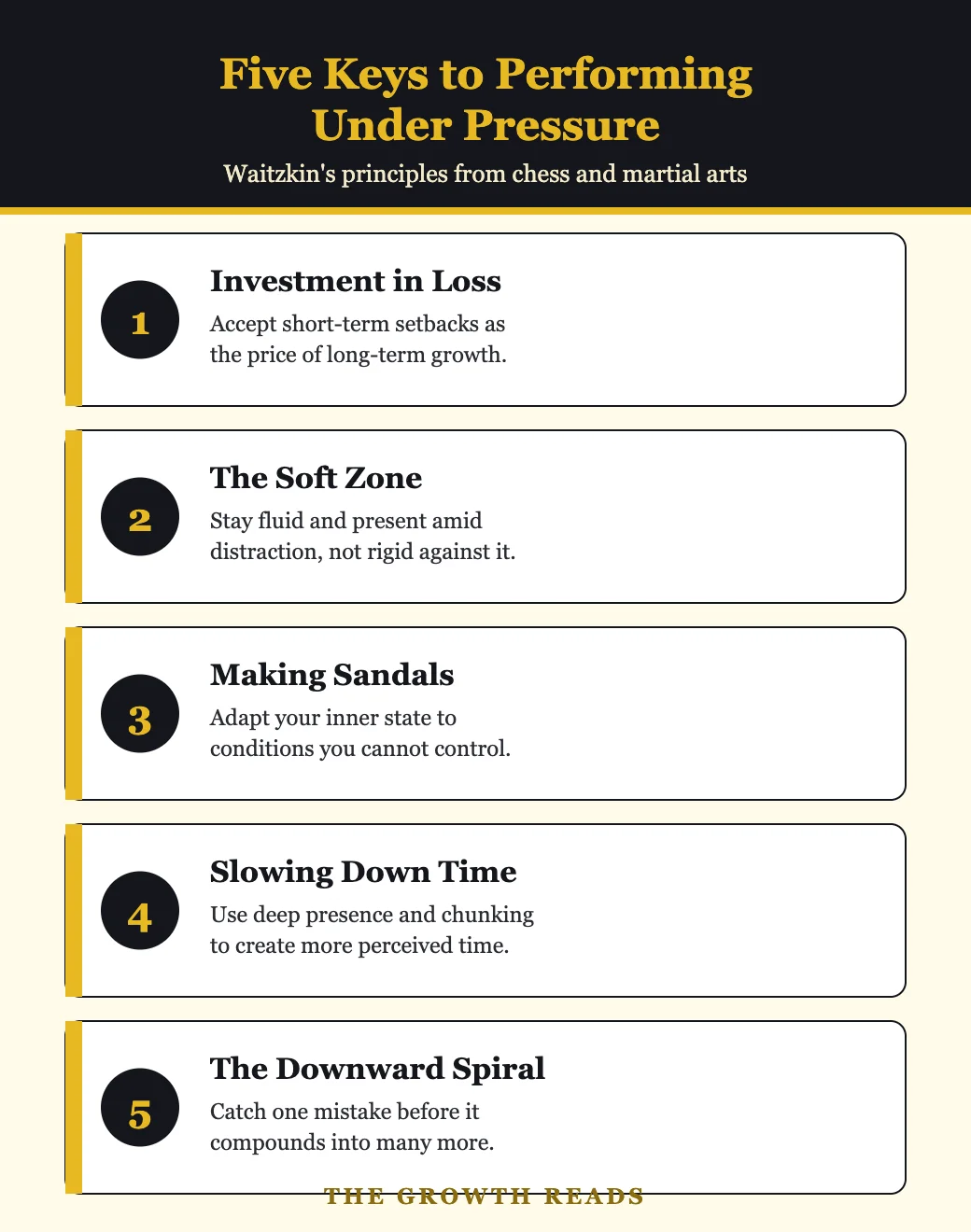
The book’s later sections turn to performing under real pressure, starting with what Waitzkin calls the “soft zone”: staying fluid and present when distractions arise, rather than rigidly resisting them. He describes tournament games disrupted by loud noises, hostile opponents, or physical discomfort, and argues that trying to force those distractions away through sheer willpower usually backfires — the effort of resistance becomes its own distraction. The soft zone instead absorbs the disruption and continues functioning, the way a flexible reed bends in wind that would snap a rigid branch.
Closely related is the principle of “making sandals” — a reference to the idea that instead of trying to cover the entire world in leather to protect your feet, you make sandals to protect your feet from the world. Applied to performance, this means adapting your internal state to whatever conditions you actually face, rather than insisting the conditions change to suit you. A tournament held in an uncomfortably hot room, an opponent playing an unfamiliar style, or a schedule disrupted at the last minute are treated as fixed facts to adapt to, not injustices to resist.
The final piece is Waitzkin’s account of “slowing down time” — the sensation, familiar to elite performers across many domains, that split-second decisions feel expansive and clear rather than rushed. He argues this isn’t a mystical gift but a trainable byproduct of deep pattern recognition: once fundamentals are internalized deeply enough (per Part 2), the mind needs less conscious processing to recognize a situation, which frees up attention and creates the subjective experience of more available time.
Waitzkin ties this back to his experience of the “downward spiral” that can follow a single mistake in competition. The danger of an initial error is rarely the error itself — it’s the cascade of panic, self-recrimination, and rushed follow-up decisions it triggers, each one compounding the last. He describes training himself to treat the moment right after a mistake as the single most important moment in a match: instead of letting attention spiral into what just went wrong, the goal is to immediately narrow focus back onto the present position, using the soft zone and slowed-down perception to prevent one error from becoming several. This recovery skill, he argues, distinguishes strong competitors from great ones far more reliably than raw talent does.
TGR Note: The soft zone is essentially applied flow psychology — Flow unpacks the conditions that produce this state of fluid, absorbed attention in far more scientific detail.
Who is The Art of Learning best for — and who should read something else first?
This book is best for anyone pursuing genuine depth in a skill under real competitive or high-pressure conditions — athletes, chess and strategy-game players, performers, and professionals in high-stakes fields. Its strength is that the principles come from lived, repeated experience at the highest competitive level in two unrelated disciplines, not from a single case study or secondhand research summary.
If you want the psychological research underneath Waitzkin’s mindset distinction, start with Mindset. If you’re more interested in the deliberate-practice mechanics behind the smaller-circles method, Peak is the natural companion. And if sustained resilience through setbacks is your main interest, Grit extends that thread with a much larger research base.
Questions to reflect on
- Do you treat setbacks in your field as proof you lack talent, or as information about where to improve?
- Which fundamental in your craft have you truly mastered at the level of feel, rather than just knowing intellectually?
- Where could you deliberately invest in a small loss now to build a capacity you’ll need later?
- What’s your version of the “soft zone” — how do you stay fluid when a real distraction hits mid-performance?
- Are you trying to change your conditions, or trying to change your response to them?
🔥 Ready to build real mastery in your own craft?
Grab a copy of The Art of Learning and start applying Waitzkin’s principles of deep practice and pressure performance.
How to apply The Art of Learning (7-day plan)
- Day 1 — Audit your theory of ability: Notice one moment this week where you treated a setback as proof of fixed talent rather than as information.
- Day 2 — Pick one fundamental: Choose the single most basic element of your craft and practice it in isolation, slower than feels necessary.
- Day 3 — Make a smaller circle: Shrink that fundamental down further — the smallest possible unit — and repeat it until it feels automatic.
- Day 4 — Invest in a small loss: Deliberately attempt something slightly beyond your current level, expecting to struggle, and study exactly where you struggle.
- Day 5 — Practice the soft zone: Introduce a mild distraction during focused practice and notice whether you resist it or absorb it.
- Day 6 — Make a sandal: Identify one condition you cannot control and adjust your internal response to it instead of fighting it.
- Day 7 — Review your downward spirals: Recall a recent mistake that snowballed, and plan one specific way to interrupt that cascade next time.
Frequently asked questions
Do I need to know chess or martial arts to get value from this book?
No. While the examples are drawn from competitive chess and Tai Chi push hands, Waitzkin explicitly frames the book around principles that transfer across domains — learning theory, deliberate practice, resilience, and performing under pressure. Readers with no interest in either discipline regularly apply the ideas directly to business, sport, music, and other skill-intensive pursuits.
Is this the same Josh Waitzkin from Searching for Bobby Fischer?
Yes. Waitzkin’s childhood chess career was the basis for the 1993 film Searching for Bobby Fischer. The Art of Learning picks up his story well beyond that period, covering his transition away from competitive chess and into becoming a Push Hands World Champion in Tai Chi Chuan, along with the lessons he drew from both careers.
What is the “smaller circles” method in simple terms?
It means shrinking a skill down to its smallest possible unit and practicing that unit until its underlying principle is felt intuitively, rather than trying to learn a wide range of techniques shallowly. Once the small piece is deeply internalized, it’s reconnected to the larger, fluid skill — which now performs better because its foundation is genuinely solid rather than merely memorized.
What does “investment in loss” actually mean in practice?
It means deliberately accepting a short-term setback — playing from a losing position in practice, attempting something beyond your current level, taking on a hard challenge you might fail — because the experience of struggling and recovering builds capacities that only ever succeeding never forces you to develop. It is the practical application of treating ability as something built through effort rather than something fixed.
How is this different from other books on deliberate practice, like Peak?
Peak, by Anders Ericsson, is a research-driven synthesis of decades of expertise studies across many domains. The Art of Learning is a first-person account from a single individual who reached the top of two very different competitive fields, with more emphasis on the psychological and emotional dimensions of pressure, resilience, and identity than on the underlying research base. The two books complement each other well: Peak explains the mechanics, The Art of Learning shows what living them actually feels like.
Is the book more about chess, martial arts, or general learning?
It’s structured as roughly half memoir — covering Waitzkin’s chess career and his transition into Tai Chi push hands — and half extracted principles that generalize well beyond either discipline. Readers looking for chess strategy or martial arts technique specifically will find some of that detail, but the book’s lasting value and its popularity outside both communities comes from the transferable framework around learning, mindset, and performance.
What’s one practical takeaway from the book?
If you take just one idea from the book, make it this: pick the single most fundamental element of whatever skill you’re building, and practice it in isolation — slower and longer than feels necessary — until it becomes intuitive rather than something you consciously think through. That depth at the foundation is what makes everything built on top of it actually hold up under pressure.
Related summaries
- Mindset — the psychological research behind the growth-versus-fixed distinction
- Peak — the deliberate-practice science behind the smaller-circles method
- Grit — sustained passion and perseverance through repeated setbacks
- Flow — the psychology of fluid, absorbed attention under pressure
See all our best productivity books →
How we analyze books: Every TGR summary is built from a full read of the book, cross-checked against the author’s interviews and published research, then structured into a practical, apply-it-this-week format. Read our full methodology.
Related Productivity Summaries
Limitless Summary & Review: Unlock Your Brain’s Full Potential
Make Your Bed Summary & Review: 10 Lessons That Can Change Your Life
Mastery Summary & Review: The Path to Extraordinary Skill
The 5 Second Rule Summary & Review: Stop Overthinking, Start Moving
The 80/20 Principle Summary & Review: Find Your Vital Few