

★★★★☆ 4.1/5
One-liner: The definitive eight-step framework for leading organizational change — from creating urgency to anchoring new behaviors in culture.
Best for: Executives, managers, and change leaders who need a proven, step-by-step process for driving transformation in organizations resistant to change.
Reading time: ~4 hours (208 pages)
Difficulty to apply: Moderate to high — the steps are clear but require organizational authority and sustained commitment.
Leading Change in One Minute
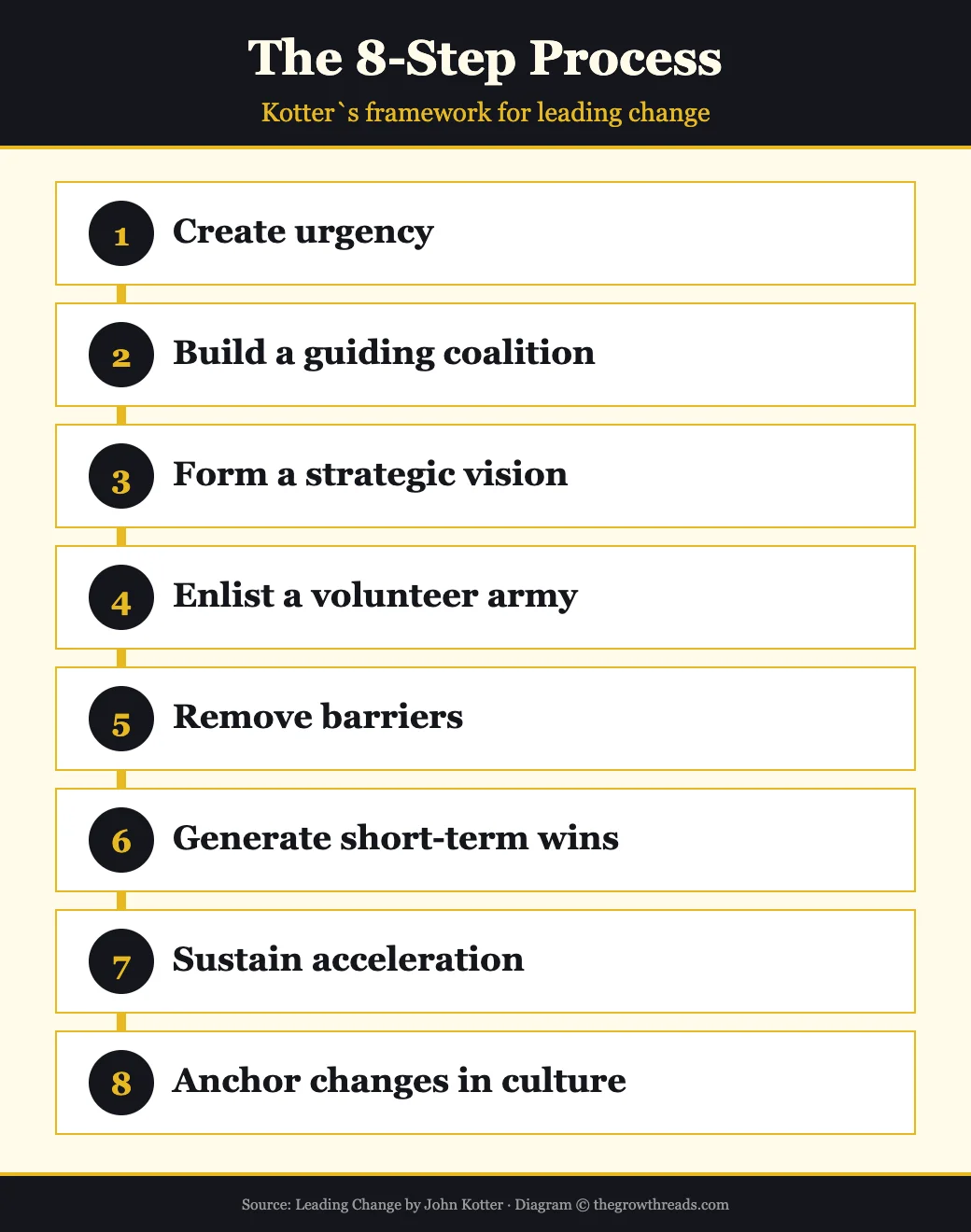
Seventy percent of organizational change efforts fail — and the reason is almost always the same sequence of leadership mistakes. John Kotter studied dozens of transformation efforts at major corporations and distilled his findings into an eight-step process that separates successful change from failed initiatives. The sequence begins with establishing genuine urgency, building a powerful guiding coalition, and creating a compelling vision. It then moves through communicating that vision relentlessly, empowering action by removing barriers, generating visible short-term wins, sustaining momentum without declaring victory prematurely, and finally anchoring the new approaches in organizational culture. Each step must be completed thoroughly before the next begins — skipping or rushing any step is the most common cause of failure.
Key Takeaways
- Most change fails from complacency: The single biggest error is not establishing a high enough sense of urgency at the start, allowing complacency to undermine the effort before it begins.
- A guiding coalition is essential: No single leader can drive major change alone. You need a team with enough power, expertise, credibility, and leadership to guide the process.
- Vision drives change, not plans: Detailed plans without a compelling vision produce compliance at best. A clear, memorable vision motivates people to change their behavior voluntarily.
- Communication must be massive: Leaders consistently under-communicate the change vision by a factor of ten or more. Every channel, every meeting, and every interaction should reinforce the message.
- Barriers must be actively removed: Structures, systems, and supervisors that block the new vision must be confronted directly, or they will quietly sabotage the effort.
- Short-term wins build credibility: Visible, unambiguous improvements within six to eighteen months prove that the change is working and give the coalition ammunition against skeptics.
- Declaring victory too soon is fatal: After the first wins, it is tempting to relax. But change efforts that lose momentum before the new approaches are embedded in culture will regress to the old ways.
- Culture changes last, not first: New behaviors must produce visible results before they can become cultural norms. You cannot change culture by decree — you change it by demonstrating that new approaches work.
What Is Leading Change About?
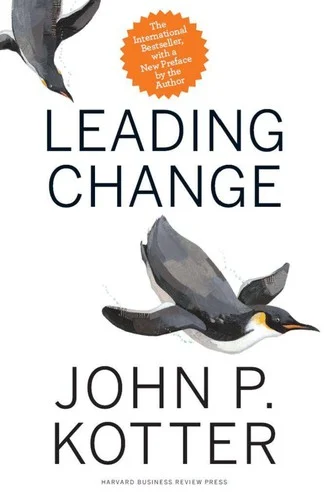
Leading Change presents an eight-step framework for successfully transforming organizations — from creating urgency and building coalitions through generating wins and anchoring new behaviors in culture. Based on research into why most change efforts fail, it provides a sequential process that leaders can follow to drive lasting transformation.
About the Author
John P. Kotter is the Konosuke Matsushita Professor of Leadership, Emeritus, at Harvard Business School and is widely regarded as the foremost authority on organizational change and leadership. His research over four decades has focused on what distinguishes successful organizational transformations from failed ones. Originally published in 1996, Leading Change grew out of a landmark 1995 Harvard Business Review article that became one of the most reprinted in the publication’s history. Kotter has authored over twenty books and his frameworks are used by organizations worldwide. Explore all John P. Kotter book summaries →
Key Concepts at a Glance
| Concept | What It Means | Use It When |
|---|---|---|
| Sense of Urgency | Making the status quo feel more dangerous than the unknown | Your organization is complacent despite real competitive threats |
| Guiding Coalition | A powerful team of leaders aligned behind the change | You need organizational authority and credibility to drive transformation |
| Change Vision | A clear, compelling picture of the future that motivates action | People are confused about where the organization is headed |
| Short-Term Wins | Visible improvements within months that prove change is working | Skeptics are growing and the coalition needs ammunition |
| Anchoring in Culture | Embedding new approaches into norms, values, and shared practices | You have achieved results but worry about regression |
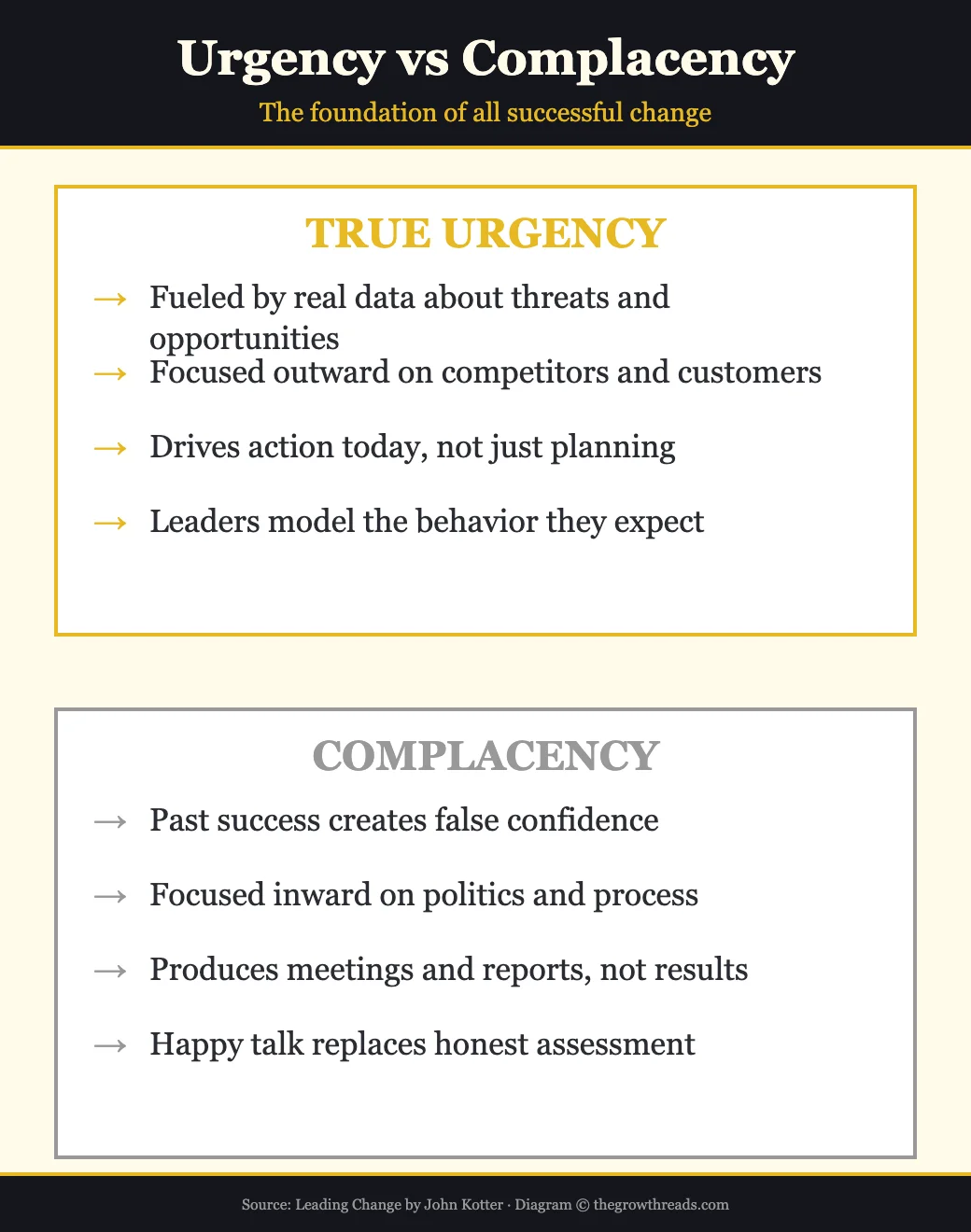
| Complacency | False confidence from past success that blocks urgency | Your organization believes it is already doing well enough |
Part 1: Establishing Urgency and Building the Coalition
Kotter’s first step is creating a sense of urgency — and he argues this is where most change efforts already fail. Complacency is the default state of successful organizations. Past victories, comfortable routines, and the absence of a visible crisis all conspire to make people feel that the current approach is working fine. Leaders must break through this complacency by presenting compelling evidence of external threats, competitive pressures, or missed opportunities that make the status quo genuinely dangerous.
The second step is assembling a guiding coalition. Kotter is emphatic that one person — even a CEO — cannot drive major change alone. The coalition needs four qualities: position power (enough key players that those left out cannot block progress), expertise (relevant skills and perspectives), credibility (good reputations so the group is taken seriously), and leadership (proven ability to drive change, not just manage it). This coalition must operate outside the normal hierarchy, meeting frequently and building trust quickly.
The third step is developing a clear vision and strategy. Kotter distinguishes between a vision (a picture of the future that is desirable, feasible, focused, and communicable in under five minutes) and a plan (a detailed set of steps). Vision motivates; plans coordinate. Without a compelling vision, a transformation effort can dissolve into a list of confusing, incompatible projects that take the organization in the wrong direction or nowhere at all.
Part 2: Communicating and Empowering
The fourth step — communicating the change vision — is where Kotter delivers one of his most memorable findings: leaders under-communicate by a factor of ten or more. They announce the vision once in a town hall meeting and assume people understand and are on board. In reality, the vision must be communicated through every available channel, repeated in every meeting, embedded in every decision, and modeled in every action the leadership team takes. Simple, vivid language beats corporate jargon. Stories and analogies beat bullet points. And the leaders’ behavior must be visibly consistent with the vision — any gap between words and actions destroys credibility instantly.
The fifth step is empowering broad-based action by removing barriers. Even when people are motivated by the vision, structural obstacles can block their path. Organizational structures that fragment responsibility, performance systems that reward old behaviors, and supervisors who resist the change must all be addressed directly. Kotter argues that confronting blockers is essential — ignoring them signals to the organization that the change is not serious.
Part 3: Sustaining and Anchoring
Step six is generating short-term wins — visible, unambiguous improvements within six to eighteen months. These wins serve multiple functions: they prove the change is worth the effort, reward people who are making sacrifices, undermine critics and cynics, build momentum, and provide data for fine-tuning the vision and strategy. Kotter stresses that short-term wins must be planned and engineered, not left to chance. Leaders must actively look for opportunities to create visible proof of progress.
Step seven — consolidating gains and producing more change — addresses the most common point of failure. After the first successes, there is enormous temptation to declare victory and relax. Kotter warns that premature celebration gives resistors an opening to reassert the old ways. Instead, the credibility earned from early wins should be used to tackle bigger problems, change systems and structures that do not fit the vision, and promote people who embody the new approach.
The eighth and final step is anchoring new approaches in the culture. Kotter argues that culture cannot be changed by decree or training programs. Culture changes only when people see that new behaviors produce better results and when those behaviors are reinforced through promotion decisions, stories, and daily practices. This step happens last because cultural change requires sustained evidence that the new way works — it is the output of a successful transformation, not the input.
Who Is Leading Change Best For — and Who Should Read Something Else First?
Leading Change is essential for executives and senior managers who are responsible for driving organizational transformation. It is the standard reference for change management and is required reading in most MBA programs. The framework scales from department-level changes to company-wide transformations.
If you are a front-line manager leading a small team rather than an organization-wide effort, Switch by Chip and Dan Heath offers a more accessible and immediately applicable framework. If your challenge is more about team dynamics than organizational change, start with The Five Dysfunctions of a Team.
Questions to Reflect On
- Is your organization genuinely urgent about change, or is complacency masquerading as confidence?
- Do you have a guiding coalition with enough power, expertise, and credibility to drive your change?
- Can you communicate your change vision in under five minutes in a way that motivates action?
- What structural barriers exist that would quietly block the change even if people wanted to support it?
- What visible short-term win could you engineer within the next ninety days?
🔥 Ready to Lead Change That Actually Sticks?
Learn the eight-step process that separates successful transformations from the seventy percent that fail.
How to Apply Leading Change (7-Day Plan)
- Day 1 — Assess urgency: Rate your team’s current sense of urgency on a 1-10 scale. Identify three facts about competitive threats or missed opportunities that most people do not know.
- Day 2 — Map your coalition: List the five to eight people you would need on a guiding coalition. Rate each on position power, expertise, credibility, and willingness to lead. Identify gaps.
- Day 3 — Draft your vision: Write a change vision in under fifty words. Test it: can you explain it in five minutes in a way that motivates action? Refine until it passes.
- Day 4 — Plan your communication: Identify every channel and touchpoint where the vision should appear. Schedule at least five communication moments for the next two weeks.
- Day 5 — Identify barriers: List the structures, systems, and people that could block the change. Rank them by impact and decide which to address first.
- Day 6 — Plan a short-term win: Identify one visible, achievable improvement you can deliver within ninety days. Assign a specific owner and deadline.
- Day 7 — Set the anchor: Define what success looks like at the culture level — what behaviors should be normal in two years? Write it down as your north star for the entire change process.
Frequently Asked Questions
What is the 8-step change model?
Kotter’s 8-step model is a sequential framework for leading organizational change: create urgency, build a guiding coalition, form a vision, communicate the vision, empower action by removing barriers, generate short-term wins, sustain acceleration, and anchor changes in culture. Each step builds on the previous one, and skipping or rushing any step is the primary reason change efforts fail. The model is based on research into dozens of corporate transformations.
Why do most change efforts fail?
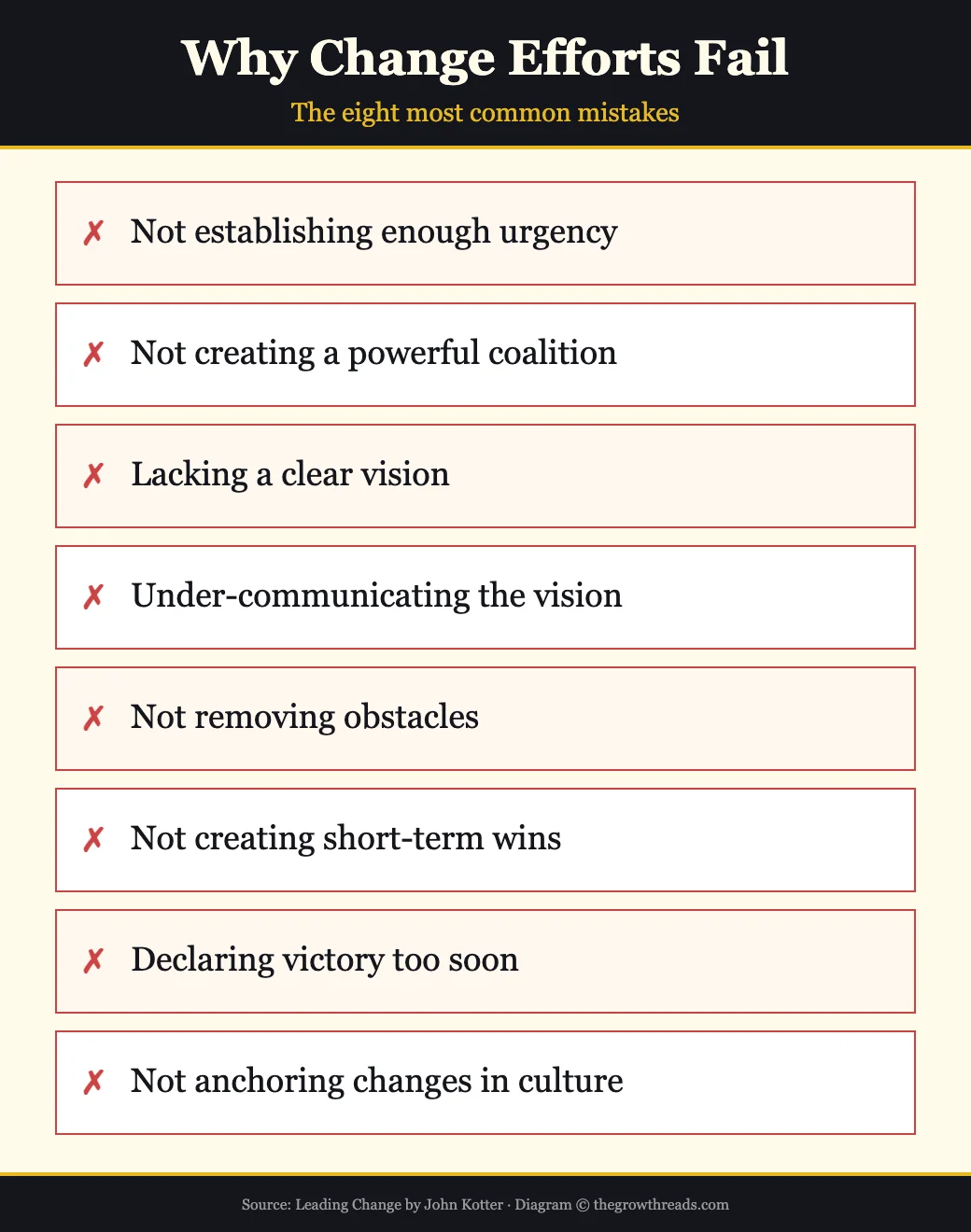
Kotter identifies eight common errors, each corresponding to a step that was skipped or poorly executed. The most frequent is not establishing sufficient urgency — complacency from past success makes people unwilling to invest in change. Other common failures include having a weak guiding coalition, lacking a clear vision, under-communicating by a factor of ten, not removing structural barriers, failing to create short-term wins, declaring victory too early, and not anchoring changes in culture.
What is a guiding coalition?
A guiding coalition is a group of people with enough power, expertise, credibility, and leadership to guide a major change effort. It operates outside the normal hierarchy and must include people senior enough that those not in the group cannot easily block progress. The coalition must develop trust quickly and operate with a shared commitment to the change vision. Kotter argues that no single leader, no matter how powerful, can drive major change alone.
How important are short-term wins?
Short-term wins are critical for sustaining momentum. They must be visible, unambiguous, and clearly related to the change effort. Wins serve six functions: providing evidence the sacrifices are worth it, rewarding change agents, helping fine-tune the vision, undermining cynics, keeping bosses on board, and building momentum. Kotter emphasizes that these wins must be planned and engineered rather than left to chance — hoping for early results is not a strategy.
Can the steps be done in parallel or out of order?
Kotter strongly recommends following the steps sequentially, especially the first four. You cannot communicate a vision you have not developed, and you cannot develop a vision without a coalition. However, once the foundation is laid, some overlap is natural — you can generate short-term wins while still working on barrier removal, and communication is continuous throughout. The key is not to skip steps entirely, as each provides the foundation for the next.
Is Leading Change still relevant today?
Yes. While originally published in 1996, the fundamental dynamics of organizational change have not changed. People still resist change, complacency still undermines urgency, and culture still outlasts strategy. The book has been updated with new prefaces and case studies, and its framework is used by major consulting firms, business schools, and Fortune 500 companies worldwide. The principles apply equally to digital transformations, restructurings, and cultural shifts.
How does Leading Change compare to Switch?
Leading Change provides a top-down, organization-level framework designed for executives driving large-scale transformation. Switch by Chip and Dan Heath offers a more psychologically focused approach that works at any scale — from personal habits to team changes. Switch is more accessible and immediately actionable for individual contributors. Leading Change is more comprehensive for senior leaders who need to coordinate complex, multi-year efforts. The two books complement each other well.
Related Summaries
- Start with Why by Simon Sinek — the power of purpose-driven leadership.
- Switch by Chip and Dan Heath — a psychological framework for driving change at any level.
- The Five Dysfunctions of a Team by Patrick Lencioni — building the team dynamics that change requires.
- Best Leadership Books — our complete guide to the top books on leading effectively.
Related Leadership Summaries
The 5 Levels of Leadership Summary & Review: Build Real Influence, Not Just Authority
The Infinite Game Summary & Review: Lead Beyond the Finish Line
The New One Minute Manager Summary & Review: Three Simple Secrets to Effective Leadership
The No Asshole Rule Summary and Review
Tribes Summary & Review: How to Lead a Movement Without Permission