

★★★★☆ 4.0/5
One-liner: A research-backed case that deliberate rest is not the opposite of work — it is work’s essential partner.
Best for: Ambitious professionals, creatives, and entrepreneurs who feel guilty about resting and want science-backed permission to do less in order to achieve more.
Reading time: ~5 hours (288 pages)
Difficulty to apply: Moderate — requires restructuring daily habits and resisting hustle culture pressure.
Rest in One Minute
The world’s most productive people don’t grind — they rest strategically. Alex Soojung-Kim Pang draws on history, neuroscience, and the routines of Nobel laureates, famous writers, and groundbreaking scientists to argue that deliberate rest is a skill, not laziness. Working four focused hours per day, taking long walks, napping, pursuing absorbing hobbies, and detaching completely from work in the evenings are not signs of slacking — they’re the practices that allow sustained, high-level creative output for decades. Rest turns the conventional productivity narrative upside down: you accomplish more by doing less, but only when your rest is intentional.
Key Takeaways
- Rest is a skill, not an absence: Deliberate rest requires as much intention and practice as deliberate work. It is not what happens when you stop working — it is what powers your best work.
- Four hours is the daily creative limit: History’s most prolific scientists, composers, and writers consistently worked in focused bursts totaling about four hours per day, then rested intentionally.
- Walking stimulates creative thinking: Regular walking, especially in nature, increases creative output measurably and was a non-negotiable habit for Darwin, Beethoven, Tchaikovsky, and many others.
- Naps sharpen performance: Short afternoon naps of 10 to 30 minutes restore alertness and improve memory consolidation, a practice used by Churchill, Edison, and modern high performers.
- Deep play is essential: Hobbies that are mentally absorbing — climbing, painting, chess, sailing — provide cognitive restoration that passive entertainment cannot.
- Morning routines protect peak hours: Starting the day with rituals and exercise primes the brain for focused work and ensures you use your best energy on your most important tasks.
- Sabbaticals multiply output: Extended periods away from work do not reduce lifetime output — they dramatically increase it by preventing burnout and sparking breakthrough ideas.
- Sleep is non-negotiable: Sleep deprivation degrades cognitive performance more than most people realize, and high performers prioritize sleep above almost everything else.
- Detachment accelerates recovery: Completely disconnecting from work in the evening — psychologically, not just physically — is essential for next-day creative capacity.
- Overwork is counterproductive: Beyond a certain threshold, additional hours produce negative returns — more errors, worse decisions, and accelerated burnout.
What Is Rest About?
Rest argues that deliberate rest — including walking, napping, deep play, and sabbaticals — is not the opposite of productive work but its essential complement. Drawing on neuroscience research and the daily routines of history’s most creative minds, Alex Soojung-Kim Pang shows that strategic downtime is the secret behind sustained high-level performance.
About the Author
Alex Soojung-Kim Pang is a Silicon Valley consultant and visiting scholar at Stanford University who studies the relationship between technology, rest, and creativity. A former Microsoft Research fellow and contributor to publications including Scientific American and the Wall Street Journal, Pang became fascinated by how elite performers structure their days after noticing that the most accomplished people he studied worked far fewer hours than conventional wisdom would suggest. His research spans four continents and draws on history, psychology, and neuroscience. He is also the author of The Distraction Addiction and Shorter. Explore all Alex Soojung-Kim Pang book summaries →
Key Concepts at a Glance
| Concept | What It Means | Use It When |
|---|---|---|
| Deliberate Rest | Intentionally structured downtime that restores cognitive capacity | You feel guilty about not working and need a framework for guilt-free recovery |
| 4-Hour Creative Window | Peak creative output happens in roughly 4 focused hours per day | You want to restructure your workday around high-value deep work |
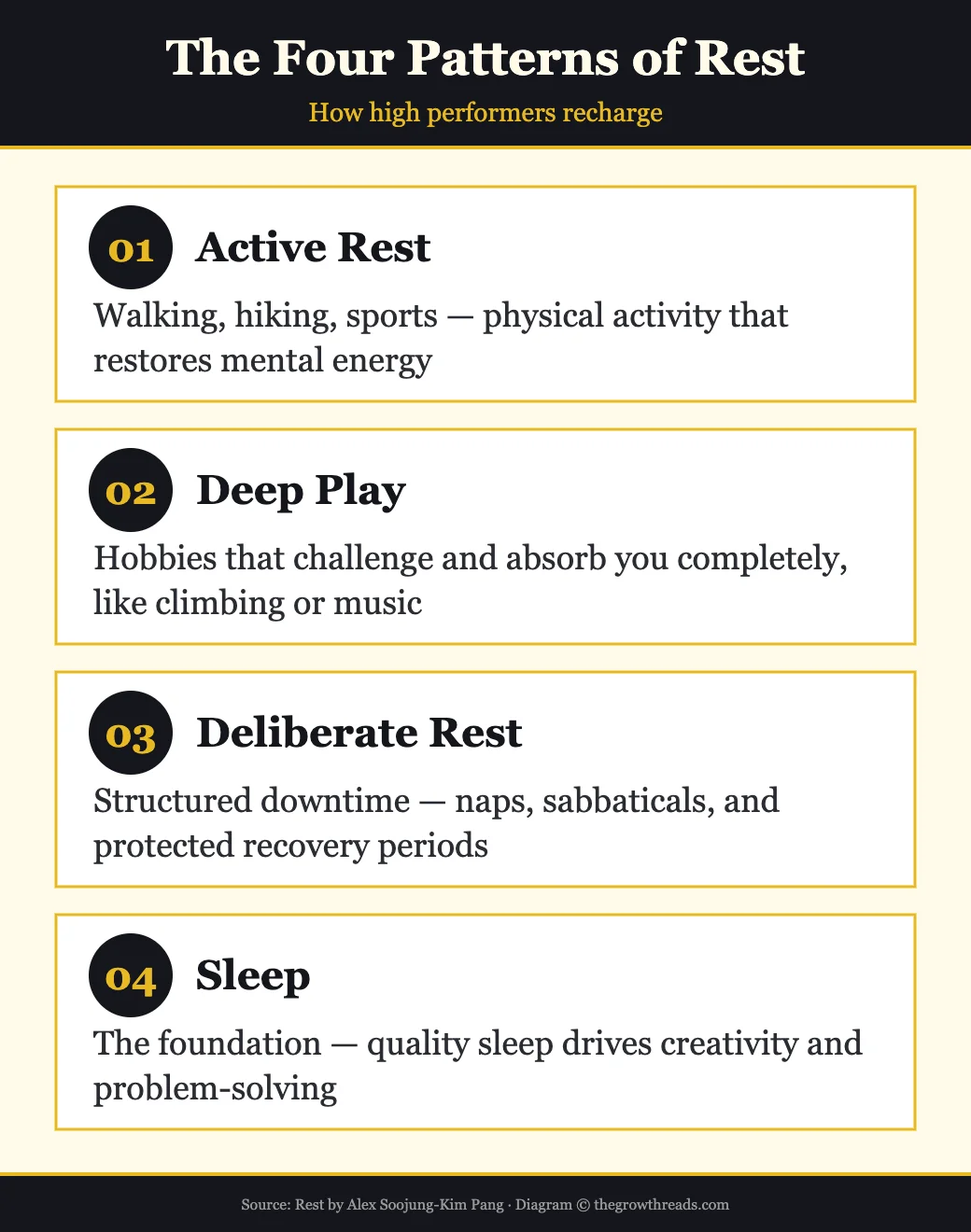
| Active Rest | Physical activities like walking and exercise that restore mental energy | You need a break but passive rest leaves you feeling flat |
| Deep Play | Absorbing hobbies that challenge you and provide cognitive restoration | You want a hobby that actually recharges your brain, not just kills time |
| Incubation Effect | The subconscious continues problem-solving during rest periods | You are stuck on a creative problem and brute force is not working |
| Sleep Architecture | Quality sleep consolidates memories and primes creative insight | You suspect poor sleep is undermining your performance |
| Sabbatical Thinking | Extended rest periods that prevent burnout and spark breakthroughs | You are planning long-term career sustainability |
Part 1: The Science of Rest
Pang opens with a provocative claim: the most productive people in history were not workaholics. Charles Darwin worked about four hours a day and spent the rest walking, napping, and corresponding with friends. Novelist Anthony Trollope wrote for exactly three hours each morning and produced forty-seven novels. Mathematician Henri Poincaré worked from ten to noon and five to seven, yet made discoveries that shaped modern physics.
The science behind this pattern lies in how the brain’s default mode network operates. When you stop concentrating, your brain does not shut off — it shifts into a different mode of processing that is essential for creativity. This network activates during mind-wandering, daydreaming, and rest, and it is responsible for connecting disparate ideas, consolidating memories, and generating the flashes of insight that feel like they come from nowhere.
Pang draws on neuroscience research showing that the brain uses about twenty percent of the body’s energy at rest — the same as during focused work. Rest is not idleness. It is a different kind of cognitive work, and it is indispensable for creative output.
Part 2: Structuring the Creative Day
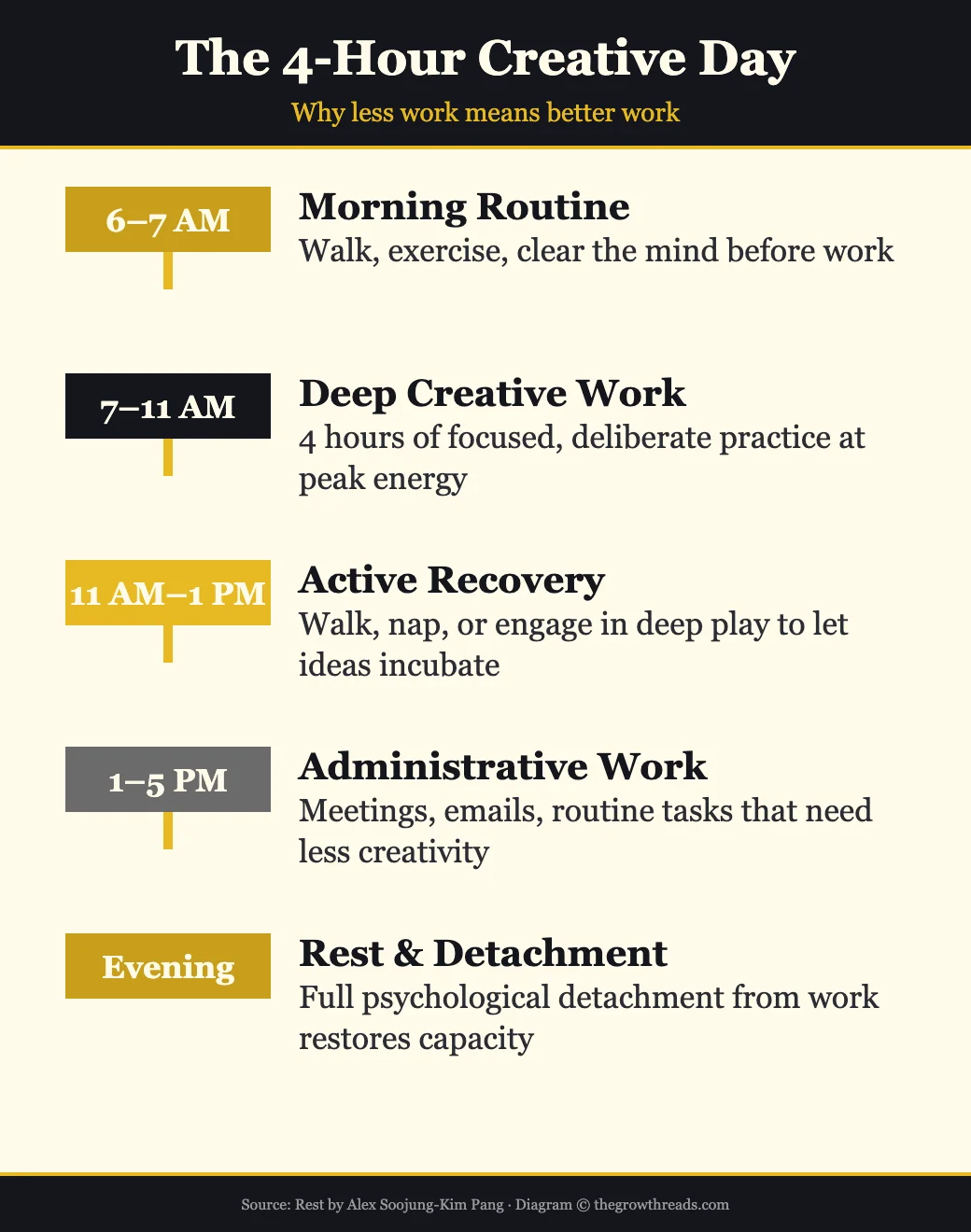
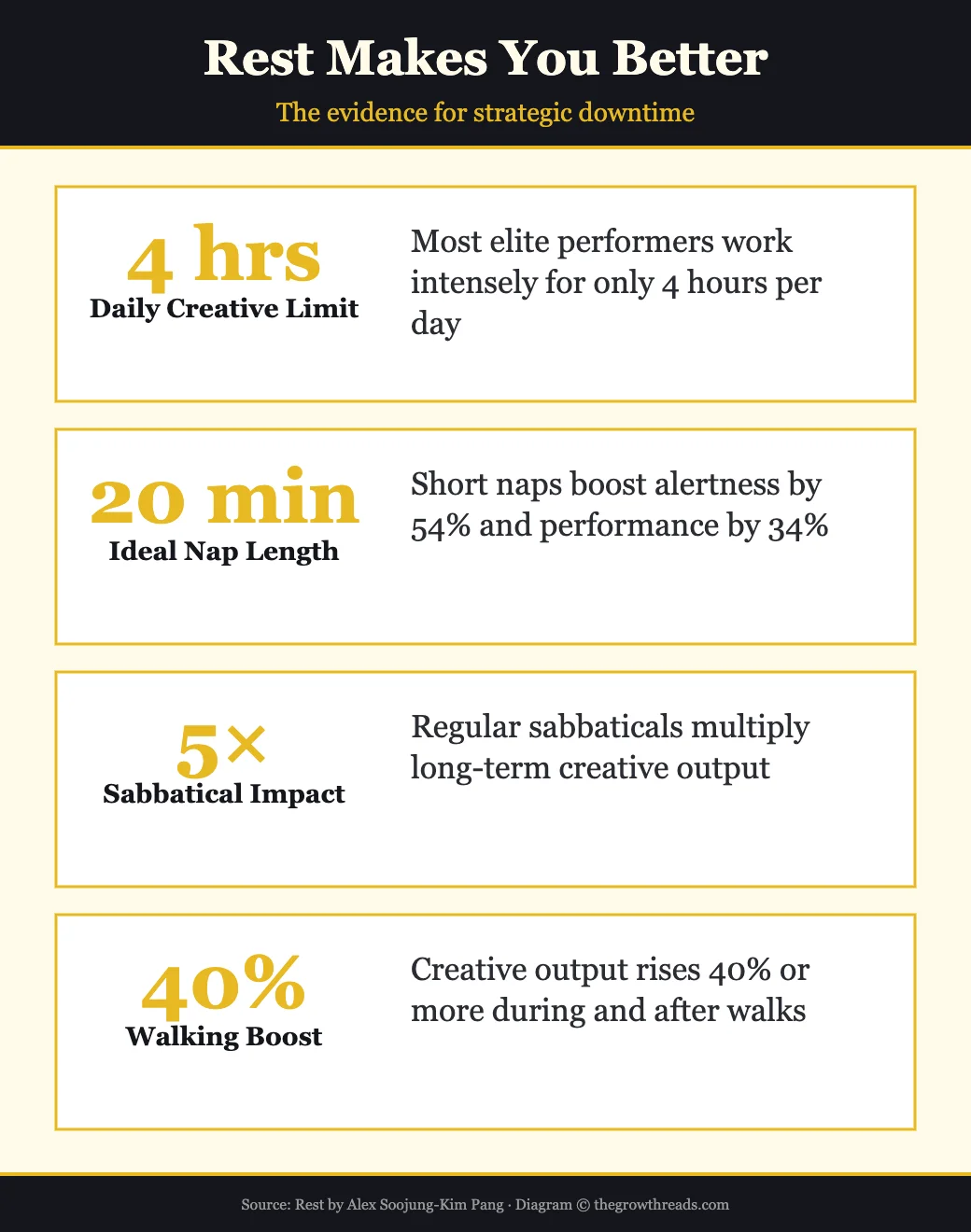
The centerpiece of Rest is the four-hour workday. Pang documents how prolific creators across centuries — from Darwin to Stephen King to contemporary tech executives — cluster their most important work into a single morning block and treat the rest of the day as recovery time. This is not laziness. The research shows that most people are capable of only about four hours of truly concentrated cognitive work per day. Pushing beyond that threshold produces diminishing and eventually negative returns.
Morning routines play a critical role. Pang describes how many high performers begin the day with exercise, a walk, or a brief meditation — not to check off a wellness box, but because these activities prime the prefrontal cortex for the deep work session that follows. The ritual creates a psychological on-ramp that reduces the friction of getting started.
He also explores the science of napping. A nap of ten to thirty minutes in the early afternoon — what NASA calls a “power nap” — can boost alertness by fifty-four percent and performance by thirty-four percent. Winston Churchill swore by his afternoon nap during World War II, calling it the key to his ability to work long into the evening when necessary.
Part 3: Walking, Deep Play, and Recovery
Pang devotes significant attention to walking as the quintessential form of active rest. Darwin walked three times a day on a prescribed route he called the Sandwalk. Beethoven took long afternoon walks through Vienna with a sketchbook. Tchaikovsky walked for exactly two hours every day, believing his creativity depended on it. Modern research confirms their intuition: a Stanford study found that walking increases creative output by an average of sixty percent, with effects lasting even after the walk ends.
Deep play — hobbies that are absorbing, challenging, and mentally demanding — provides a different form of recovery. Pang profiles scientists who are serious mountaineers, executives who paint, and surgeons who play competitive chess. These activities work because they engage the brain in ways that are structurally similar to work but different enough to allow recovery of the specific neural circuits used during professional tasks. The key is that deep play must be genuinely challenging. Watching television does not count.
Psychological detachment — the ability to completely disconnect from work during evenings and weekends — rounds out the recovery toolkit. Research from organizational psychology shows that workers who achieve full psychological detachment from work report higher well-being, better sleep, and stronger performance the following day. Partial detachment — checking email once, thinking about a project — undermines the entire benefit.
Part 4: Sabbaticals and Long Rest
The final section of Rest addresses longer periods of recovery: sabbaticals, vacations, and seasonal rhythms. Pang argues that sabbaticals are not luxuries but investments. Academics who take regular sabbaticals produce significantly more publications over their careers than those who do not. Companies like 3M and Google that have experimented with structured time off have produced many of their most successful products during those periods.
Pang documents how the concept of retirement as permanent rest is a modern invention. Throughout most of history, productive people transitioned into advisory roles, writing, or teaching — forms of work that were lighter but still meaningful. The research suggests that complete cessation of productive activity is harmful to both cognitive and physical health, while a pattern of intense work alternating with genuine rest sustains performance and satisfaction across a lifetime.
He closes with a practical framework: design your days around four hours of deep creative work, build in active rest through walking and exercise, cultivate at least one deep play hobby, protect your evenings for psychological detachment, prioritize sleep, and plan regular extended breaks. This is not about doing less. It is about structuring your time so that the work you do and the rest you take both contribute to your long-term creative output.
Who Is Rest Best For — and Who Should Read Something Else First?
Rest is ideal for ambitious professionals, founders, and creatives who intellectually know they should rest more but feel guilty doing it. The historical examples and neuroscience research provide genuine permission to step back. It also works well for managers who want to redesign team culture around sustainable output rather than visible busyness.
If you are looking for a tactical daily planner or time-management system, start with Make Time or Deep Work instead — Rest provides the philosophy but fewer step-by-step tools. If your challenge is not overwork but underwork or procrastination, Eat That Frog addresses that problem more directly.
Questions to Reflect On
- When was the last time you took genuine, guilt-free rest — and how did it affect your work the following day?
- If you limited your deep creative work to four hours per day, which tasks would survive the cut?
- Do you have a deep play hobby that genuinely absorbs you, or do your leisure activities tend toward passive consumption?
- How well do you achieve psychological detachment from work in the evenings — or do you check email “just once”?
- What would a personal sabbatical look like for you, even if it were just one week?
🔥 Ready to Work Less and Achieve More?
Discover the science-backed strategies that history’s greatest minds used to fuel their creativity through deliberate rest.
How to Apply Rest (7-Day Plan)
- Day 1 — Audit your current rest: Track how you spend every non-working hour today. Note which activities feel genuinely restorative versus merely distracting.
- Day 2 — Identify your 4-hour window: Review when you do your best creative work. Block that window on your calendar and move all meetings outside it.
- Day 3 — Add a morning walk: Walk for twenty minutes before your deep work session begins. Leave your phone behind or keep it in your pocket.
- Day 4 — Try a power nap: Set an alarm for twenty minutes after lunch and lie down. Even if you do not fall asleep, the rest itself is valuable.
- Day 5 — Choose a deep play hobby: Identify one activity that challenges you mentally or physically — not scrolling, not streaming. Commit to thirty minutes of it today.
- Day 6 — Practice evening detachment: Set a hard stop for work at a specific time. Close your laptop, put your phone in another room, and do something completely unrelated until bedtime.
- Day 7 — Plan your first micro-sabbatical: Schedule one full day off within the next month — not for errands, but for rest, exploration, or deep play. Protect it as firmly as your most important meeting.
Frequently Asked Questions
Is Rest just about working less?
No. The core argument is not that you should do less work, but that you should structure your work and rest more intentionally. Pang shows that four focused hours of creative work combined with deliberate rest produces more high-quality output over a career than ten scattered hours of partially attentive work. The book redefines rest as an active, skill-based practice rather than passive idleness. Rest is a complement to deep work, not a replacement for it.
Does the 4-hour workday really work for people with regular jobs?
Pang acknowledges that most people cannot restructure their entire workday. His practical advice is to protect your best four hours for your most important creative tasks and use the remaining hours for routine work, meetings, and administrative tasks. Even if you cannot reduce your total hours, rearranging them to front-load creative work during peak energy produces meaningful improvements in output quality and job satisfaction.
What makes “deep play” different from regular hobbies?
Deep play activities share specific characteristics: they are mentally or physically challenging, they produce a state of absorption similar to flow, and they engage different cognitive circuits than your professional work. A surgeon who rock climbs is practicing deep play. A surgeon who watches reality television is not. The key distinction is that deep play demands your full attention and provides genuine cognitive restoration, while passive entertainment merely passes time without restoring capacity.
How long should naps be according to Rest?
Pang recommends naps of ten to thirty minutes, taken in the early afternoon when the body’s circadian rhythm naturally dips. NASA research shows that a twenty-six-minute nap improves alertness by fifty-four percent and performance by thirty-four percent. Longer naps risk sleep inertia — the groggy feeling of waking from deep sleep — so shorter is generally better. The key is consistency: a regular nap habit is more effective than occasional long naps.
Is Rest based on scientific research?
Yes. Pang draws on neuroscience research about the default mode network, sleep studies from institutions including NASA, psychological research on cognitive restoration and recovery, and historical analysis of the daily routines of highly productive individuals. The book combines peer-reviewed science with biographical research to build its case. Some of the historical anecdotes are necessarily interpretive, but the core scientific claims about rest and cognitive performance are well-supported by the research literature.
How does Rest compare to Deep Work by Cal Newport?
The two books are complementary. Deep Work focuses on how to protect and optimize your focused work sessions — eliminating distractions, building rituals, and training concentration. Rest focuses on what to do outside those sessions to maximize recovery and sustain long-term creative output. Newport tells you how to work; Pang tells you how to rest. Reading both gives you a complete system for structuring your days around peak performance and genuine recovery.
Can Rest help with burnout?
Rest is an excellent resource for understanding the mechanics of burnout and designing a recovery plan. Pang explains that burnout results not just from overwork but from the absence of genuine recovery — most burned-out professionals rest poorly, not insufficiently. The book’s framework of active rest, deep play, and psychological detachment provides specific, actionable strategies for rebuilding capacity. For severe burnout, professional support may also be needed, but the practices in Rest form a solid foundation for prevention and recovery.
Related Summaries
- Deep Work by Cal Newport — the complementary guide to protecting your focused work hours.
- Make Time by Jake Knapp and John Zeratsky — practical daily tactics for creating space for what matters.
- Flow by Mihaly Csikszentmihalyi — the science of optimal experience that underlies deep play.
- Best Productivity Books — our complete guide to the top books on getting more from your time.
Related Productivity Summaries
High Performance Habits Summary & Review: The Six Habits That Separate Extraordinary From Average
Peak Summary & Review: The Science of Building Genuine Expertise
The Productivity Project Summary & Review: Manage Your Time, Attention, and Energy
The War of Art Summary & Review: How to Defeat Resistance and Do Your Work
Ultralearning Summary & Review: Master Any Skill Faster