

★★★★✬ 4.6/5 — The most comprehensive explanation of human behaviour ever assembled in one book — from neurons firing milliseconds before an action to the evolutionary pressures shaped millions of years ago.
Best for: Anyone who wants to genuinely understand why humans are capable of breathtaking cruelty and extraordinary compassion — and why the answer is never simple.
Reading time: ~20 hours (790 pages)
Difficulty to apply: High — this is a dense, scholarly work. The reward is a fundamentally different understanding of human nature that reshapes how you judge behaviour.
Behave in one minute
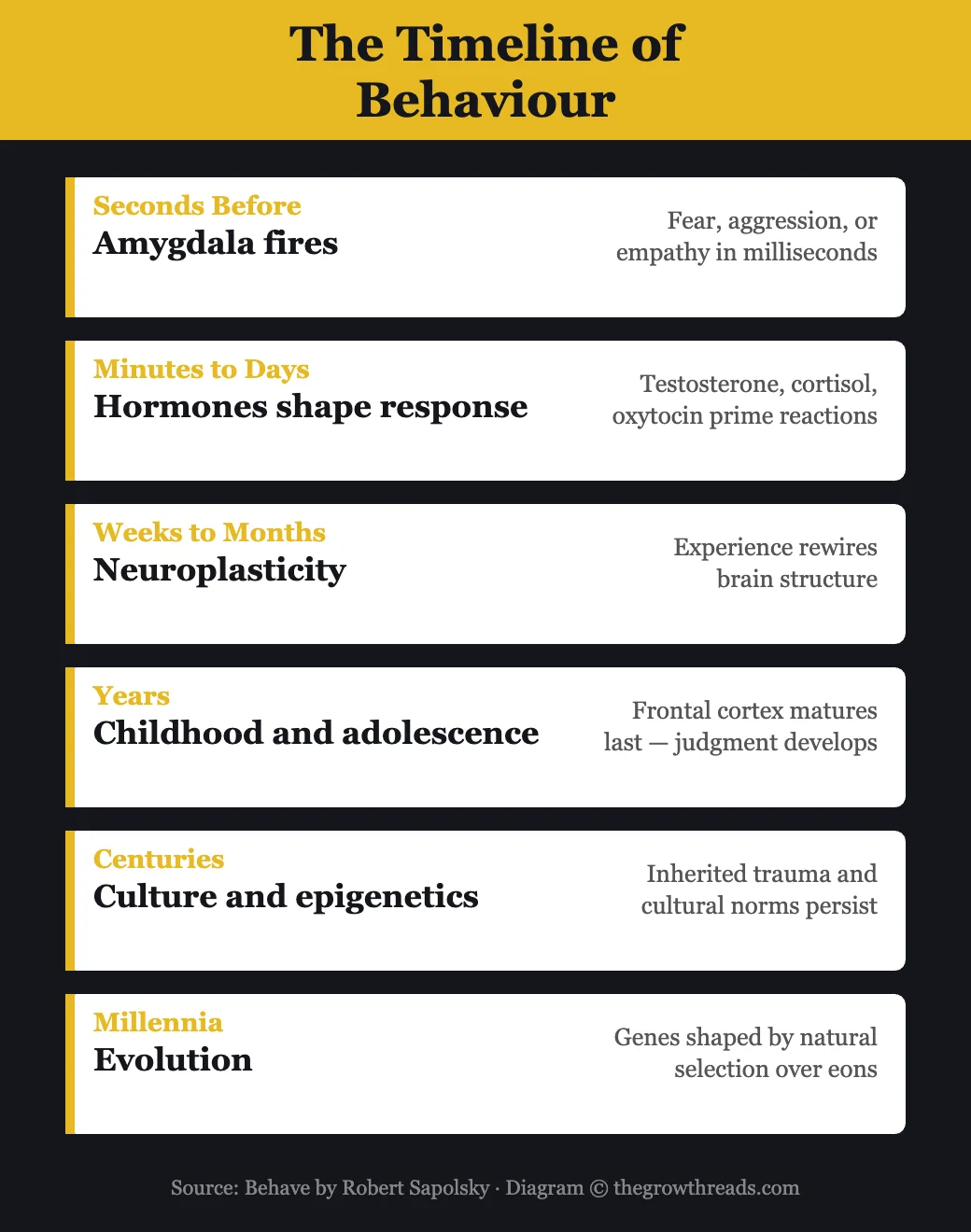
Every human behaviour — from a fist thrown in anger to a hand extended in compassion — is the product of biology acting across multiple timescales simultaneously, and no single explanation is ever sufficient. Robert Sapolsky, a neuroendocrinologist at Stanford, structures his magnum opus around a single question: when a human does something — beautiful or terrible — why did they do it? He answers by working backward through time: what happened in their brain one second before (neuroscience), then seconds to minutes before (hormones and sensory triggers), then hours to days (neuroplasticity and learning), then through adolescence and childhood (developmental biology), then through their ancestors (genetics and epigenetics), and finally through the species (evolution). The result is a unified, multi-layered account of behaviour that makes single-cause explanations — “it was their genes,” “it was how they were raised,” “they are just evil” — impossible to sustain.
Key takeaways
- No single explanation is ever enough: Every behaviour emerges from the interaction of neurobiology, hormones, development, genes, epigenetics, culture, and evolution. Claiming any one factor “causes” a behaviour is always wrong.
- The amygdala acts before you think: Your brain’s fear and aggression centre fires in milliseconds — faster than conscious awareness — meaning your first reaction to a threat is never a choice.
- The frontal cortex is the last to mature: The brain region responsible for impulse control, long-term planning, and moral reasoning does not fully develop until approximately age 25, which has profound implications for juvenile justice.
- Hormones do not cause behaviour: Testosterone does not create aggression — it amplifies whatever social behaviour is already dominant. In a status-seeking context, it increases aggression; in a nurturing context, it increases caretaking.
- Stress reshapes the brain: Chronic stress shrinks the hippocampus and prefrontal cortex while enlarging the amygdala, literally rewiring the brain toward anxiety, impulsivity, and poor decision-making.
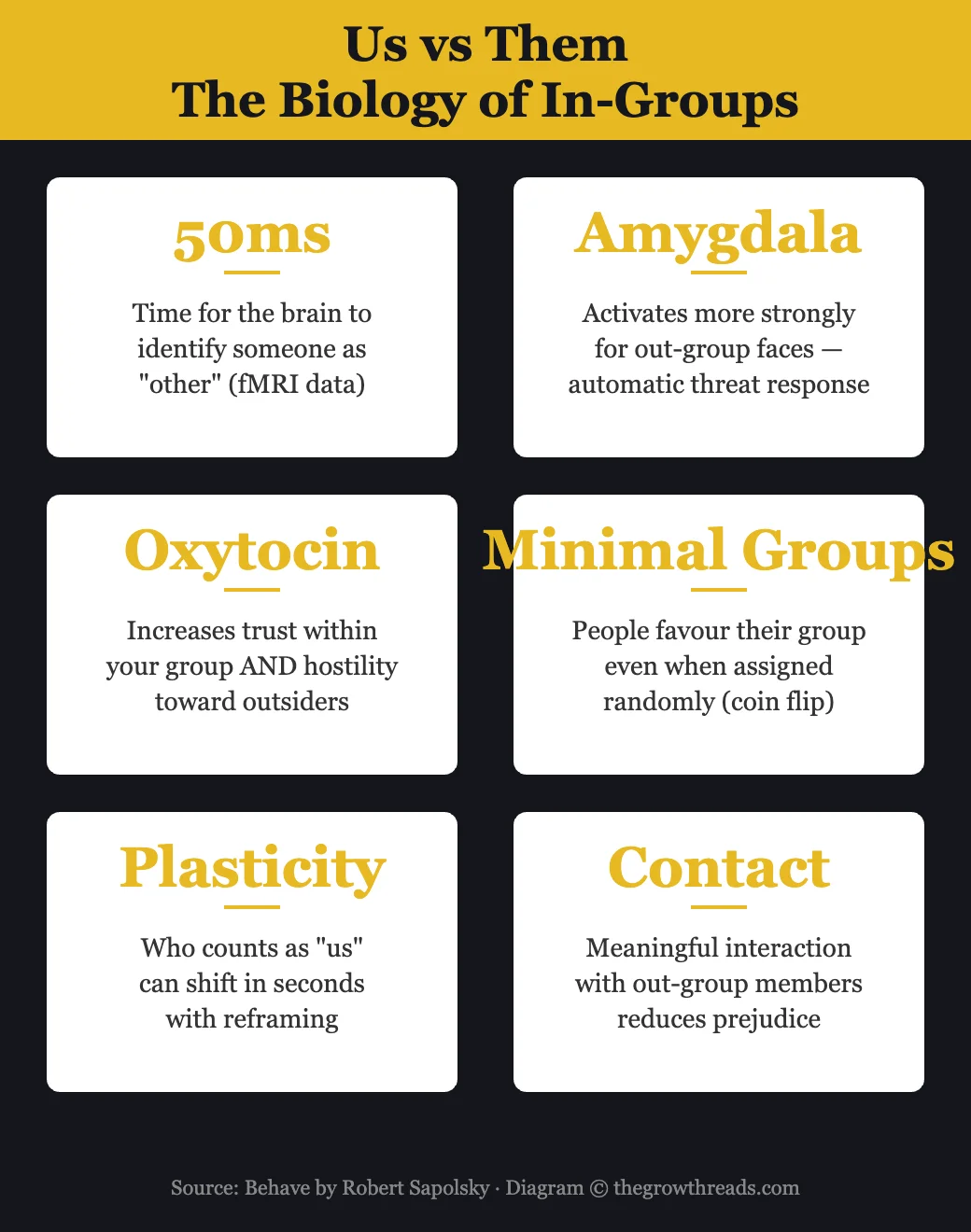
- Us-vs-Them is automatic but malleable: The brain categorises people as in-group or out-group within 50 milliseconds, but who counts as “us” can be shifted almost instantly through reframing.
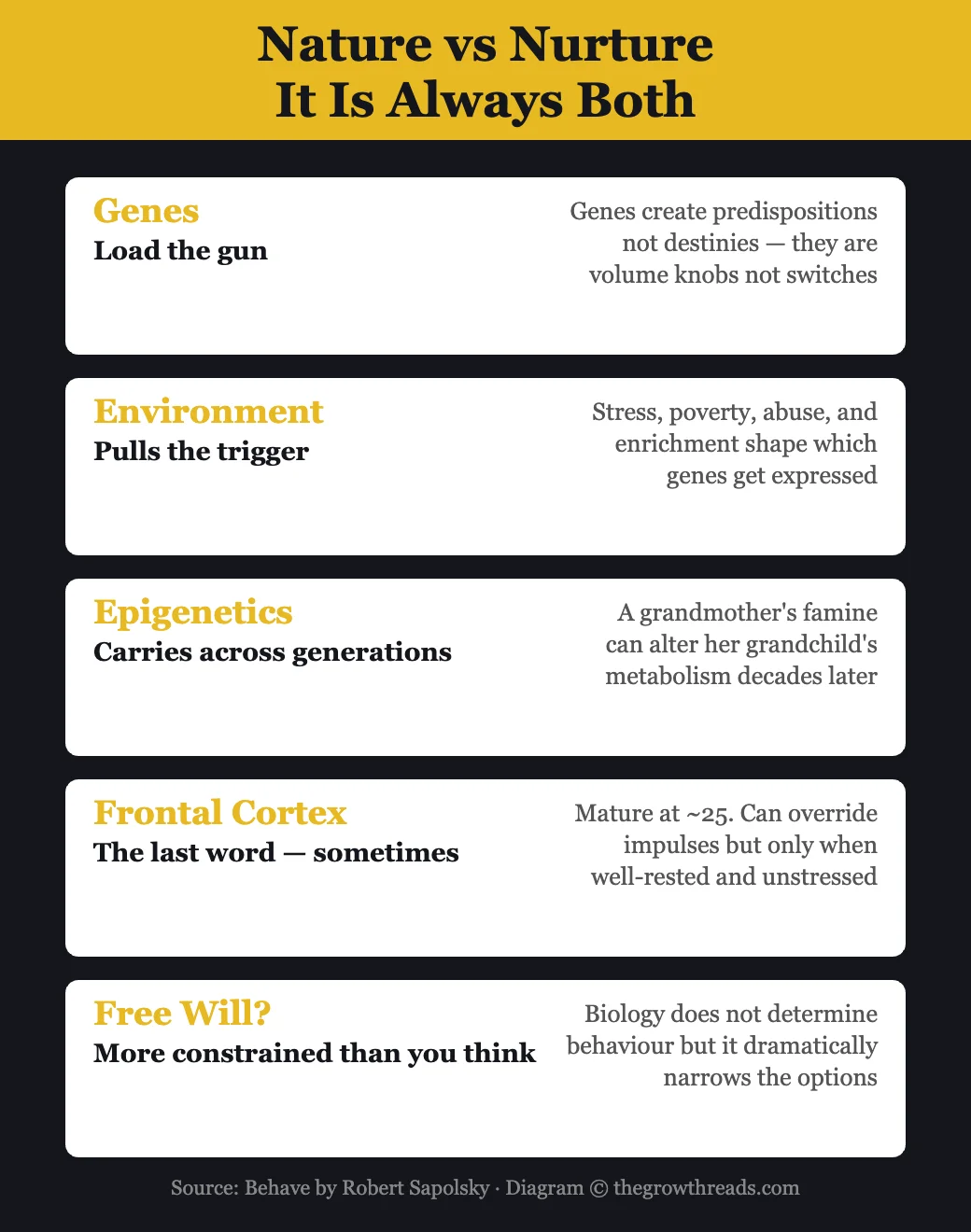
- Genes are not destiny: Genes are like volume knobs, not on-off switches. The same gene variant produces different outcomes depending on the environment — the “warrior gene” (MAOA) only increases aggression in people who were also abused as children.
- Epigenetics transmits experience across generations: A grandmother’s stress or famine can alter gene expression in her grandchildren through epigenetic markers, without changing the DNA sequence itself.
- Empathy has limits: Humans are better at empathising with individuals than groups, with similar people than different ones, and with identifiable victims than statistics — which creates systematic moral blind spots.
- Change is possible but hard: Neuroplasticity means the brain can rewire throughout life, but the older and more stressed you are, the harder it becomes. Early intervention is orders of magnitude more effective than late remediation.
What is Behave about?
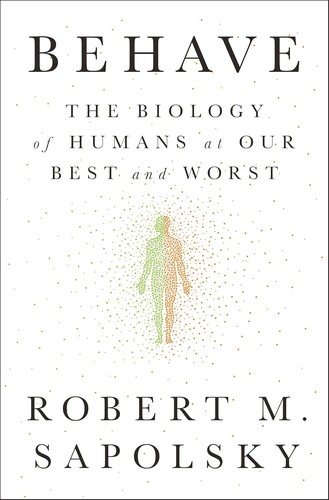
Behave is a comprehensive exploration of why humans behave the way they do, working backward through every timescale of causation — from the neuron firing one second before an action to the evolutionary pressures shaped over millions of years. Sapolsky synthesises neuroscience, endocrinology, genetics, epigenetics, developmental biology, and anthropology into a unified account that makes simple explanations of behaviour impossible.
About the author
Robert Sapolsky is the John A. and Cynthia Fry Gunn Professor of Biological Sciences, Neurology, and Neurological Sciences at Stanford University. He has spent over 30 years studying stress, neuronal degeneration, and behaviour in both primates and humans, dividing his time between his Stanford laboratory and a baboon troop in Kenya’s Masai Mara. He is the author of several acclaimed books including A Primate’s Memoir, Why Zebras Don’t Get Ulcers, and Determined. His Stanford lecture series on human behavioural biology, freely available on YouTube, has been viewed millions of times and is widely considered one of the greatest university lecture series ever recorded. Explore all Robert Sapolsky book summaries →
Key concepts at a glance
| Concept | What it means | Use it when |
|---|---|---|
| Multi-layered causation | Every behaviour has causes operating at multiple timescales simultaneously | You are tempted to explain behaviour with a single factor |
| Amygdala | The brain’s rapid threat-detection centre that fires before conscious awareness | You react with fear or anger before you can think |
| Frontal cortex | The seat of impulse control, planning, and moral reasoning — last to mature | You wonder why adolescents make risky decisions |
| Gene-environment interaction | Genes create predispositions; environments determine whether they are expressed | Someone claims a behaviour is “genetic” or “purely environmental” |
| Epigenetics | Environmental experiences alter gene expression without changing DNA | You want to understand intergenerational trauma |
| Us vs Them | Automatic in-group/out-group categorisation that is powerful but malleable | You observe prejudice, tribalism, or dehumanisation |
| Neuroplasticity | The brain rewires throughout life based on experience | You want to change habitual patterns of thought or behaviour |
| Testosterone amplification | Testosterone does not cause aggression — it amplifies existing social tendencies | Someone claims testosterone makes men aggressive |
Part 1: The neuroscience of seconds to minutes
Sapolsky begins where behaviour begins: in the brain, seconds before an action. The amygdala — a small almond-shaped structure deep in the temporal lobe — processes fear, aggression, and emotional memory faster than any other brain region. It can trigger a fight-or-flight response in under 50 milliseconds, well before the conscious mind has any idea what is happening. This is why you flinch before you know why you flinched, why you feel afraid before you can name the threat, and why your first reaction to a provocation is never truly voluntary.
The frontal cortex, by contrast, is the seat of everything we consider uniquely human: impulse control, long-term planning, empathy, moral reasoning, and the ability to do the harder thing when it is the right thing. It is the last brain region to fully develop — not completing myelination until approximately age 25 — which is why adolescents can understand risks intellectually but still make catastrophically poor decisions under peer pressure or emotional arousal. Sapolsky uses this finding to mount a powerful argument against trying juveniles as adults: their brains are literally not finished building the hardware required for adult-level judgment.
The interplay between the amygdala and frontal cortex is central to Sapolsky’s framework. In a well-rested, unstressed, secure person, the frontal cortex can override amygdala impulses — this is self-control. But chronic stress, sleep deprivation, trauma, and poverty all weaken frontal cortex function while strengthening amygdala reactivity. The result is a brain that is biologically biased toward impulsive, fearful, aggressive responses — not because the person is morally weak, but because their neurobiology has been shaped by their circumstances.
Part 2: Hormones, genes, and development
Sapolsky devotes several chapters to dismantling popular myths about hormones and genes. Testosterone, he demonstrates, does not cause aggression. In a series of elegant studies, researchers showed that testosterone amplifies whatever social behaviour is already dominant in a given context. In competitive environments, it increases aggression. In nurturing environments, it increases caretaking. In status-seeking environments, it increases whatever behaviour earns status — which might be generosity, not violence. The popular narrative that testosterone equals aggression is, Sapolsky argues, one of the most persistent and damaging oversimplifications in biology.
His treatment of genetics is equally nuanced. Sapolsky uses the metaphor of genes as volume knobs rather than on-off switches. The same gene variant can produce wildly different outcomes depending on the environment. The most famous example is the MAOA gene variant, sometimes misleadingly called the “warrior gene”: men with the low-activity variant are more likely to be violent — but only if they were also abused as children. Without childhood abuse, the gene variant produces no measurable increase in aggression. This gene-environment interaction is the rule, not the exception, and it means that claims about genetic determinism are always scientifically incomplete.
The chapters on epigenetics are among the most profound in the book. Sapolsky explains how environmental experiences — stress, nutrition, nurturing, trauma — alter gene expression without changing the DNA sequence, through chemical modifications that can be passed across generations. A rat mother’s licking and grooming behaviour in the first week of a pup’s life permanently alters the expression of stress-response genes in the pup’s brain. And in humans, studies of famine survivors have shown that the grandchildren of people who experienced starvation have altered metabolic gene expression — the grandmother’s hunger is written into the grandchild’s biology.
Part 3: Us versus Them, empathy, and the possibility of change
Sapolsky’s chapters on in-group/out-group dynamics are among the most important in the book. Using fMRI data, he shows that the brain categorises faces as in-group or out-group within 50 milliseconds — faster than conscious processing. The amygdala activates more strongly for out-group faces, triggering an automatic threat response. Oxytocin, often called the “love hormone,” increases trust and generosity toward in-group members while simultaneously increasing suspicion and hostility toward out-group members. It is not a universal love drug — it is a tribal bonding chemical.
But the most important finding is that these categorisations are extraordinarily plastic. In the minimal group paradigm, researchers assign people to arbitrary groups (by coin flip or T-shirt colour) and within minutes, participants favour their own group. The boundary between “us” and “them” is not fixed by race, religion, or nationality — it is a neurological category that can be redrawn almost instantly. A sports fan who hates a rival team will embrace a player the moment he is traded to their side. Sapolsky argues that this malleability is the basis for hope: if the brain constructs in-group and out-group categories flexibly, they can be expanded.
The book closes with Sapolsky’s reflections on free will, moral responsibility, and the possibility of change. He does not conclude that biology excuses all behaviour — but he argues forcefully that understanding the biological forces shaping behaviour must change how we think about punishment, justice, and moral judgment. When someone grows up in poverty, with chronic stress, an abusive home, and epigenetically inherited trauma, their brain has been shaped by forces they did not choose. This does not eliminate responsibility, but it demands that we are humble about assigning blame.
Who is Behave best for — and who should read something else first?
Behave is essential reading for anyone who wants the deepest available understanding of why humans do what they do. It is particularly valuable for educators, policymakers, justice professionals, and anyone who finds themselves making quick moral judgments about other people’s behaviour. Be warned: it is dense and long (790 pages). If you want a shorter, more accessible introduction to behavioural science, start with Thinking, Fast and Slow. If you want to focus specifically on the psychology of moral judgment, try The Righteous Mind. If you want practical tools for managing your own stress response, read The Happiness Trap.
Questions to reflect on
- When you judge someone’s behaviour, how often do you consider the biological, developmental, and environmental forces that shaped their brain?
- Can you recall a time when your amygdala reacted before your frontal cortex could intervene — and what might have changed if you had paused?
- Who do you unconsciously categorise as “them,” and what would it take to expand that boundary?
- How has chronic stress in your own life affected your capacity for patience, empathy, and impulse control?
- If behaviour is shaped by forces largely outside our control, how should that change our approach to punishment and justice?
🔥 Ready to understand human nature at its deepest level?
Behave is the most complete account of why we do what we do ever written.
How to apply Behave (7-day plan)
- Day 1 — Notice your amygdala: Throughout the day, catch moments when you react with fear, anger, or disgust before your conscious mind engages. Simply labelling these — “that was my amygdala” — begins to strengthen frontal cortex override.
- Day 2 — Question a snap judgment: When you judge someone’s behaviour today, pause and ask: what happened in the seconds, hours, years, and generations before this moment that might explain it? Build the multi-layered picture.
- Day 3 — Protect your frontal cortex: Prioritise sleep, reduce one source of chronic stress, and avoid making important decisions when tired or emotionally aroused. Your self-control is a biological resource that depletes.
- Day 4 — Expand your in-group: Seek out a meaningful interaction with someone you would normally categorise as “other” — a different generation, background, or viewpoint. Notice how the Us-vs-Them boundary shifts.
- Day 5 — Examine your hormonal context: Notice how your behaviour changes with fatigue, hunger, stress, or social pressure. These are not moral failings — they are biological states shaping your frontal cortex capacity.
- Day 6 — Investigate your developmental history: Reflect on how your childhood environment shaped your default reactions. Which of your automatic responses were adaptive then but may be maladaptive now?
- Day 7 — Practice empathic complexity: When you encounter behaviour you find repugnant, resist the single-cause explanation. Instead, build the full causal chain: neurons, hormones, development, genes, culture, evolution. Notice how this changes your emotional response.
Frequently asked questions
Is Behave too long and dense for a general reader?
At 790 pages, Behave is undeniably demanding. But Sapolsky is one of the best science communicators alive — he uses humour, vivid stories, and clear analogies to make complex neuroscience accessible. If you are intimidated by the length, start with his free Stanford lecture series on YouTube (Human Behavioral Biology), which covers much of the same material in an engaging lecture format. The book rewards persistence with a fundamentally different way of understanding every person you encounter.
Does Sapolsky believe in free will?
Sapolsky is deeply sceptical of free will — a position he developed fully in his subsequent book, Determined. In Behave, he argues that every behaviour is the product of biological causes the individual did not choose: their genes, their developmental environment, their hormonal state, their neural wiring. He does not conclude that this eliminates moral responsibility entirely, but he argues it should fundamentally change how we think about blame, punishment, and the criminal justice system.
Does the book excuse bad behaviour because of biology?
No. Sapolsky explicitly rejects the idea that understanding the biology of behaviour means excusing it. Understanding that chronic stress impairs frontal cortex function does not mean violent behaviour is acceptable — it means our interventions should address the biological conditions that increase violence rather than only punishing individuals after the fact. He advocates for a justice system informed by neuroscience rather than one that pretends biology does not exist.
What does Behave say about testosterone and aggression?
Sapolsky demolishes the popular myth that testosterone causes aggression. Multiple studies show that testosterone amplifies whatever social behaviour is already dominant: in competitive contexts it increases aggression, but in caregiving contexts it increases nurturing. Castrating males does not eliminate aggression — only aggression’s intensity. And in humans, the relationship between testosterone and violence is mediated by culture, context, and individual history. The “testosterone makes men aggressive” narrative is, Sapolsky argues, dangerously oversimplified.
How does epigenetics work in Behave?
Epigenetics refers to modifications that change how genes are expressed without altering the DNA sequence itself. Chemical groups (like methyl groups) attach to DNA and either silence or activate specific genes based on environmental signals. A rat pup that receives abundant licking and grooming from its mother develops permanently different stress-response gene expression than an identical pup that does not. In humans, studies of famine survivors show altered metabolic gene expression in grandchildren. The implication is that your ancestors’ experiences are literally written into your biology.
How does Behave compare to Thinking, Fast and Slow?
Kahneman’s book describes the cognitive architecture of human decision-making (System 1 and System 2) from a psychological perspective. Sapolsky goes deeper — he reveals the biological machinery underneath those systems: the amygdala (which generates many System 1 responses), the frontal cortex (which performs System 2 functions), and the hormonal, genetic, and developmental factors that determine how effectively each system operates. Read Kahneman for the cognitive patterns; read Sapolsky for why those patterns exist.
What are the practical implications of this book?
Behave is primarily about understanding rather than applying, but several practical implications emerge: protect your frontal cortex by prioritising sleep and managing stress; recognise that snap judgments about others are neurologically automatic but not necessarily accurate; expand your in-group boundaries through deliberate contact with different people; understand that early childhood intervention is orders of magnitude more effective than adult remediation; and approach others’ behaviour with curiosity about causes rather than certainty about blame.
Related summaries
- Thinking, Fast and Slow by Daniel Kahneman — The cognitive architecture that Sapolsky grounds in neurobiology.
- The Righteous Mind by Jonathan Haidt — The moral psychology of tribalism and political division.
- The Body Keeps the Score by Bessel van der Kolk — How trauma physically reshapes the brain and body.
- Incognito by David Eagleman — A neuroscience exploration of the unconscious forces driving human behaviour.
📚 Explore more in our Best Psychology Books guide.
Related Psychology Summaries
Flow Summary & Review: The Science of Losing Yourself in What You Do
Influence Summary & Review: The Psychology of Persuasion
Stumbling on Happiness Summary & Review: Why Your Brain Lies About the Future
Switch Summary & Review: The Rider-Elephant-Path Framework for Real Change
Talking to Strangers Summary & Review: Why We Misread Everyone