

⭐⭐⭐⭐✦ 4.3 / 5
One-liner: The definitive guide to managing your energy — not your time — for sustained high performance and personal renewal.
Best for: Professionals, athletes, and anyone feeling chronically drained who wants a science-backed system for sustainable performance.
Reading time: ~6 hours (336 pages)
Difficulty to apply: Moderate — requires honest self-assessment and consistent ritual-building over 30–60 days.
The Power of Full Engagement in one minute
Energy, not time, is the fundamental currency of high performance. Jim Loehr and Tony Schwartz argue that most people try to manage their schedules when they should be managing their energy across four dimensions: physical, emotional, mental, and spiritual. Drawing on 25 years of work with elite athletes and Fortune 500 executives at their Human Performance Institute, the authors show that the key to sustained excellence is treating life like a series of sprints — oscillating rhythmically between energy expenditure and strategic recovery. The book provides a practical training system for building energy capacity through positive rituals, confronting the gap between your values and your behavior, and creating an action plan you can sustain for life.
Key takeaways
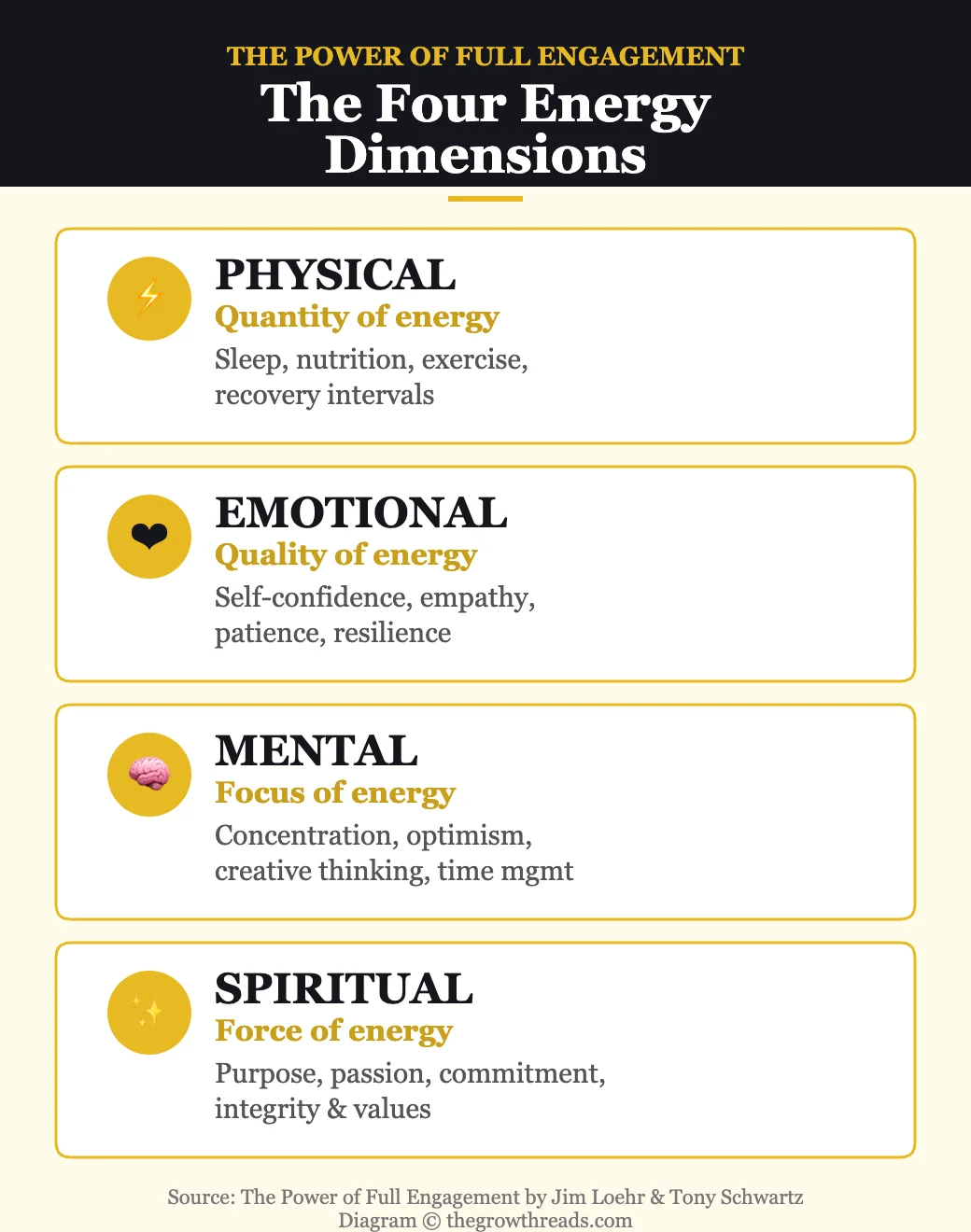
- Energy has four dimensions: Physical energy provides the foundation, emotional energy drives quality, mental energy sharpens focus, and spiritual energy supplies purpose and motivation.
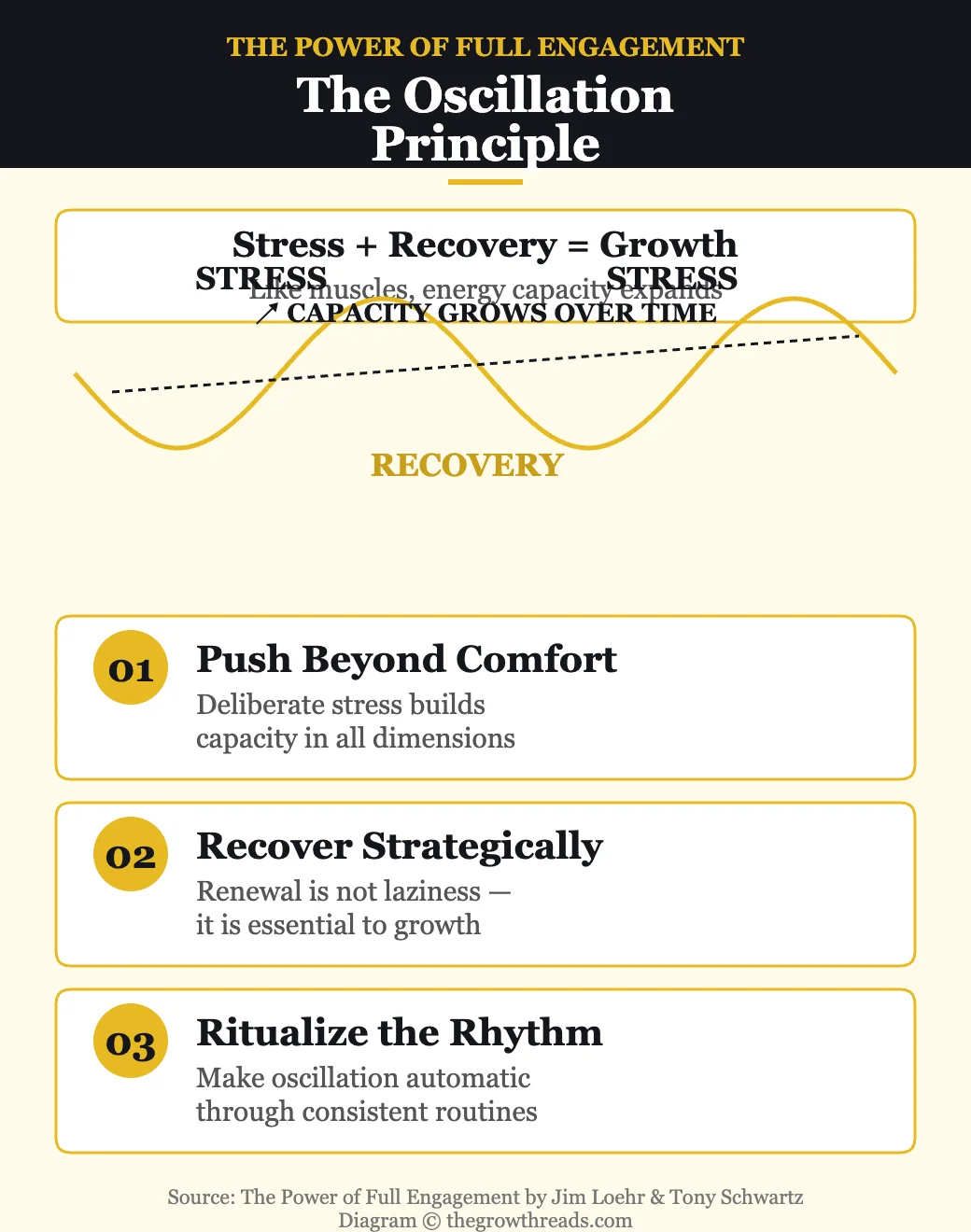
- Oscillation is the key to sustainability: Like muscles that must alternate between stress and recovery, peak performers rhythmically pulse between intense effort and deliberate renewal.
- Rituals trump willpower: Positive energy rituals — precise, scheduled behaviors — remove the need for conscious decision-making and create autopilot pathways to performance.
- Spiritual energy is not religious: It refers to connection to a deeply held purpose beyond self-interest, which is the single most powerful source of motivation and resilience.
- The performance pyramid has a base: Physical energy sits at the bottom of the pyramid; neglecting sleep, exercise, or nutrition undermines every other capacity.
- Stress is not the enemy — linear stress is: Chronic, unrelieved stress without recovery intervals leads to burnout; intermittent stress with recovery leads to growth.
- Face the truth first: The full engagement process begins with an honest audit of how you currently spend your energy, including the uncomfortable gaps between your values and your actions.
- Define your purpose clearly: A compelling personal mission acts as the north star that organizes all your energy investment decisions and sustains commitment through difficulty.
- Small rituals compound: Starting with just one or two targeted rituals and maintaining them for 30–60 days creates a stable foundation before adding complexity.
- Recovery is productive, not lazy: Strategic disengagement — naps, walks, play, vacations — is as important to performance as the work itself.
What is The Power of Full Engagement about?
The Power of Full Engagement is a performance guide by sports psychologist Jim Loehr and journalist Tony Schwartz that reframes productivity around energy management rather than time management. The book introduces a four-part training system — built on physical, emotional, mental, and spiritual energy — showing readers how to build capacity through oscillation between stress and recovery, anchor their efforts in a clear personal purpose, and create positive rituals that sustain high performance without burnout.
About the author
Jim Loehr is a world-renowned performance psychologist who spent over 30 years working with elite athletes including tennis champions Monica Seles, Jim Courier, and Dan Jansen. He co-founded the Human Performance Institute (now part of Johnson & Johnson) and pioneered the concept of “mental toughness” in sports. Tony Schwartz is a journalist and author who previously co-authored The Art of the Deal and later founded The Energy Project, a consulting firm that helps organizations fuel sustainable performance. Together, their athlete-to-boardroom methodology has been adopted by thousands of executives worldwide. Explore all Barry Schwartz book summaries →
Key concepts at a glance
| Concept | What it means | Use it when |
|---|---|---|
| Energy management | Managing your four energy sources rather than hours on a clock | You feel time-rich but energy-poor |
| Oscillation | Rhythmic alternation between stress and recovery | You are burning out from linear, unrelieved effort |
| Performance pyramid | Physical → Emotional → Mental → Spiritual energy hierarchy | You want to identify which dimension to strengthen first |
| Positive rituals | Precisely defined, scheduled behaviors that become automatic | You rely on willpower and keep failing |
| Full engagement | Recruiting all four energy dimensions simultaneously | You perform below your potential despite effort |
| Purpose (spiritual energy) | Connection to values and mission beyond self-interest | You lack motivation or feel your work is meaningless |
| The truth gap | Distance between your stated values and actual behavior | You want an honest audit of how you spend energy |
| Recovery rituals | Strategic disengagement: naps, walks, breaks, vacations | You view rest as laziness instead of investment |
Part 1: The energy management system
Loehr and Schwartz open with a provocative reframe: the problem is not that we have too little time, but that we mismanage our energy. They introduce the cases of several executives — one who fell asleep in meetings despite sleeping seven hours, another who snapped at her children every evening despite loving them deeply. The common thread was not poor scheduling but depleted energy reserves.
The authors draw on their decades at the Human Performance Institute to explain that fully engaged people bring full, focused energy to whatever they do. They perform in their own “Ideal Performance State” — physically energized, emotionally connected, mentally focused, and spiritually aligned. The four energy dimensions are hierarchical: physical energy is the base, without which everything else collapses. But each dimension also influences the others; chronic anxiety (emotional) fragments concentration (mental), and a lack of purpose (spiritual) drains motivation across all levels.
The research foundation draws from exercise physiology, cognitive psychology, and sports science. The authors cite a study showing that tennis players who used recovery rituals between points had heart rates 20 beats per minute lower than those who did not — and won significantly more often. This principle scales to every domain of life.
Part 2: The pulse of high performance
The core insight of the book: life is not a marathon but a series of sprints. Loehr and Schwartz argue that the central dynamic for sustained performance is oscillation — the rhythmic movement between energy expenditure (stress) and energy renewal (recovery). Linear energy expenditure without recovery leads to burnout and breakdown. Linear recovery without stress leads to atrophy and weakness.
The authors trace this principle through biology. Muscles grow through a process called supercompensation: stress them beyond their current capacity, then allow adequate recovery, and they rebuild stronger. The same mechanism operates in every energy dimension. Emotional resilience grows when we face difficult emotions and then process them. Mental acuity sharpens when we focus intensely and then fully disengage. Even spiritual energy deepens through cycles of purposeful engagement and reflective solitude.
They present compelling case studies from their executive training programs. Roger, a hard-charging CEO, worked 14-hour days without breaks and was deteriorating physically and emotionally. After implementing 90-minute work sprints with 15-minute recovery intervals, his productivity increased, his relationships improved, and his resting heart rate dropped 15 beats per minute within two months.
The practical implication is that recovery is not a reward for hard work — it is a prerequisite for it. Strategic recovery practices include taking breaks every 90–120 minutes, getting adequate sleep, scheduling vacations, exercising regularly, and building in periods of complete disengagement from work.
Part 3: Building your energy capacity
Loehr and Schwartz devote substantial chapters to expanding capacity in each energy dimension, offering specific exercises and benchmarks for each.
Physical energy starts with the basics: sleep seven to eight hours, eat five to six small meals daily for stable blood sugar, drink 64 ounces of water, and do cardiovascular exercise three to four times per week plus strength training twice. They cite research showing that regular exercisers outperform sedentary peers by 15-20 percent on cognitive tests and report 40 percent less fatigue. Recovery rituals at this level include power naps (15–20 minutes), stretching, and breathing exercises.
Emotional energy is about cultivating positive emotions — confidence, empathy, patience, and enjoyment — while managing negative ones. The authors distinguish between “survival emotions” (fear, anger, frustration) that are appropriate in genuine emergencies and “performance emotions” (challenge, joy, gratitude) that fuel sustained engagement. They teach clients to use physical movement to shift emotional states: walking, deep breathing, or even smiling can trigger neurochemical shifts from cortisol to endorphins within minutes.
Mental energy requires realistic optimism, focus, and creativity. The authors prescribe mental preparation rituals (visualizing the day’s key challenges), concentration training (gradually extending periods of unbroken focus), and creativity breaks (switching between left-brain analytical work and right-brain creative tasks). They note that multitasking reduces efficiency by up to 25 percent and recommend single-tasking in focused intervals.
Spiritual energy — the most powerful and often most neglected — comes from connection to a purpose larger than oneself. Loehr and Schwartz ask clients to write their own obituary as a values-clarification exercise and to identify the gap between their stated values and their daily behavior. When spiritual energy is high, people tolerate more physical and emotional stress because they have a compelling reason to push through.
Part 4: The full engagement training system
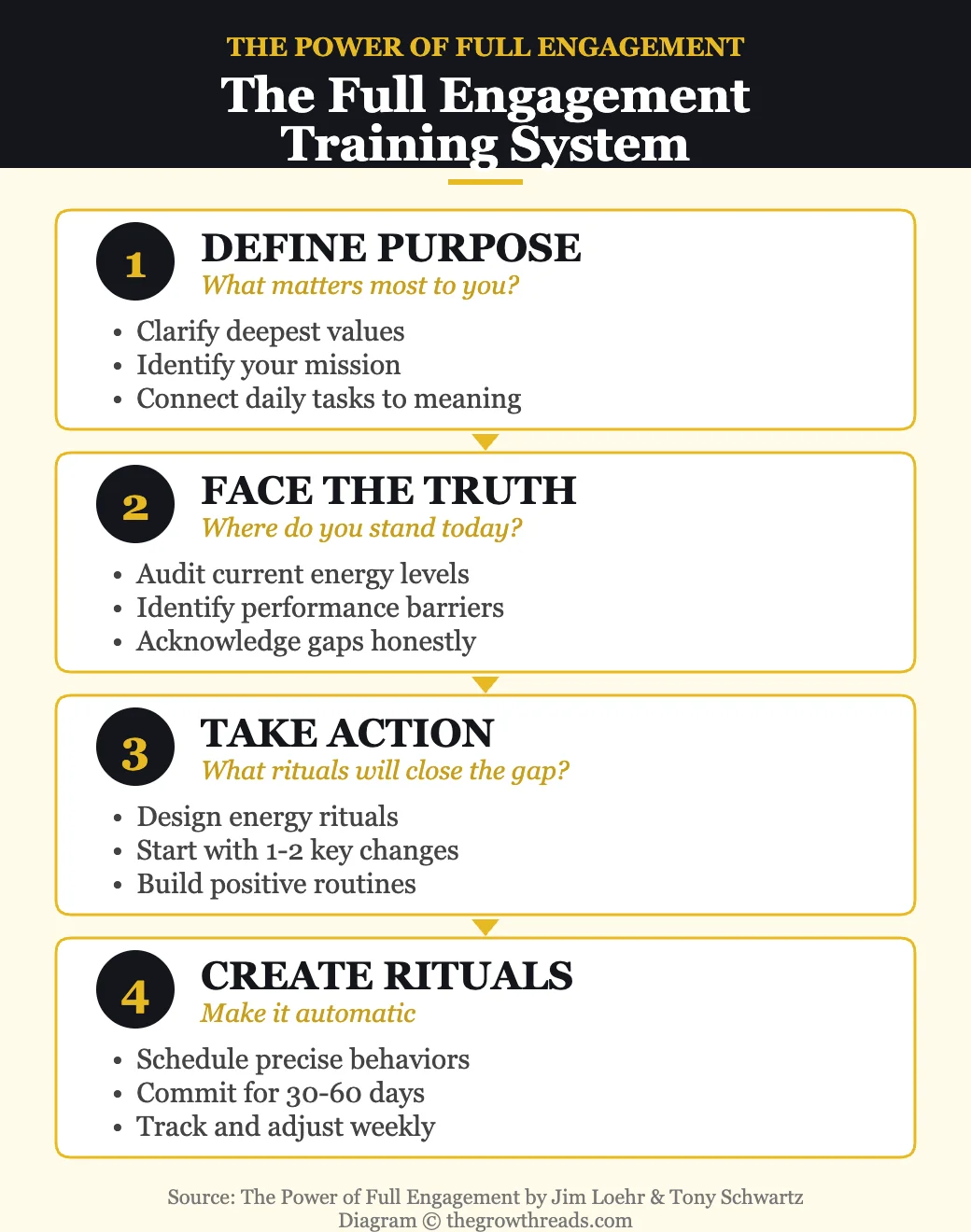
The final section is the practical playbook: a three-step process for creating lasting change.
Step 1 — Define purpose: Participants articulate their deepest values and create a personal mission statement. The authors note that many executives can recite their company’s mission statement but have never written their own. Without a personal mission, energy investment decisions default to urgency rather than importance. The obituary exercise and “best self” visualization help participants reconnect with what truly matters.
Step 2 — Face the truth: Using tools like the Full Engagement Inventory (a self-assessment questionnaire), participants audit their current energy management across all four dimensions. This often reveals painful discrepancies — the executive who says family is his top priority but spends 80 hours per week at the office, or the manager who values health but has not exercised in two years. Facing these gaps without judgment is the prerequisite for change.
Step 3 — Take action through rituals: Rather than relying on willpower (which Loehr and Schwartz view as a finite, depletable resource), participants design positive energy rituals — highly specific behaviors performed at precise times until they become automatic. Examples include going to the gym at 6:00 AM on Monday, Wednesday, and Friday (never “I’ll try to exercise more”), eating a protein-rich breakfast within 30 minutes of waking, or taking three deep breaths before every meeting.
The authors recommend starting with just one or two rituals and maintaining them for 30 to 60 days before adding more. Research from the Human Performance Institute showed that 70 percent of participants who committed to a single well-defined ritual maintained it a year later, compared to fewer than 10 percent who attempted multiple vague behavior changes simultaneously.
Who is The Power of Full Engagement best for — and who should read something else first?
This book is ideal for knowledge workers, executives, entrepreneurs, and high-performers who feel chronically depleted despite being productive. It is especially valuable for anyone who has optimized their schedule but still feels exhausted — the reframe from time to energy management is the breakthrough. Athletes and coaches will also recognize the training periodization principles translated to everyday life.
If you are looking for a more tactical, habit-focused approach, start with Atomic Habits for the mechanics of behavior change. If you want a deeper dive on focused work specifically, Deep Work by Cal Newport is the sharper tool. And if you are struggling with burnout at the organizational level rather than the individual level, The 4-Hour Workweek offers a complementary perspective on redesigning work itself.
Questions to reflect on
- Which of the four energy dimensions — physical, emotional, mental, or spiritual — is your weakest right now, and how does that weakness cascade into the others?
- When was the last time you felt fully engaged in what you were doing — and what conditions made that possible?
- What is one recovery ritual you could add to your day tomorrow that would feel restorative rather than indulgent?
- If you wrote your obituary today, would it reflect the values you actually live by or the values you aspire to?
- What single positive ritual, performed at a specific time and place, would have the biggest impact on your energy over the next 30 days?
🔥 Ready to manage your energy for peak performance?
Get the science-backed system that has transformed thousands of executives and athletes.
How to apply The Power of Full Engagement (7-day plan)
- Day 1 — Energy audit: Track your energy levels every two hours today using a 1–10 scale. Note what activities drain you and which ones fuel you. Identify your weakest energy dimension.
- Day 2 — Define your purpose: Write a one-paragraph personal mission statement. Ask: “What do I want to be remembered for?” Keep it visible on your desk or phone.
- Day 3 — Fix the physical base: Set a bedtime that gives you 7–8 hours of sleep. Prepare three healthy snacks in advance. Drink water every hour.
- Day 4 — Add oscillation: Work in 90-minute focused sprints, then take a 15-minute recovery break (walk, breathe, stretch). Do at least three cycles today.
- Day 5 — Create one ritual: Choose one positive ritual targeting your weakest dimension. Define the exact behavior, time, and trigger. Write it down as a commitment.
- Day 6 — Emotional reset practice: Before each meeting or transition today, take three deep breaths and consciously choose the emotional state you want to bring into the next activity.
- Day 7 — Review and commit: Compare your energy levels today versus Day 1. Decide which one or two rituals you will commit to for the next 30 days. Tell someone about your commitment for accountability.
Frequently asked questions
What is the main idea of The Power of Full Engagement?
The central argument is that energy, not time, is the fundamental currency of high performance. Most people try to squeeze more hours from their day when they should be managing their energy across four dimensions: physical, emotional, mental, and spiritual. By oscillating between periods of intense effort and strategic recovery — and anchoring behavior change in positive rituals rather than willpower — anyone can achieve sustained performance without burning out.
How does energy management differ from time management?
Time management focuses on scheduling tasks efficiently within available hours. Energy management focuses on ensuring you bring the right quality and quantity of energy to those tasks. You can have a perfectly organized calendar and still perform poorly because you are physically exhausted, emotionally disengaged, mentally scattered, or spiritually disconnected. The authors argue that managing energy first makes time management far more effective.
What are the four types of energy in the book?
Physical energy is the quantity of energy available — your endurance and vitality. Emotional energy is the quality — confidence, empathy, patience, and enjoyment. Mental energy is the focus — concentration, realistic optimism, and creativity. Spiritual energy is the force — your connection to purpose, values, and a mission beyond self-interest. All four are interdependent, and full engagement requires recruiting all of them simultaneously.
What is the oscillation principle?
Oscillation is the rhythmic alternation between energy expenditure and energy recovery. Just as muscles grow through cycles of stress and rest (supercompensation), all forms of human energy expand through the same pattern. The authors argue that chronic, linear stress without recovery causes breakdown, while chronic rest without stress causes atrophy. Peak performance comes from balancing both — working in focused sprints and recovering deliberately between them.
How long does it take to build a positive energy ritual?
The authors recommend committing to a single well-defined ritual for 30 to 60 days before it becomes automatic. Research from the Human Performance Institute showed that participants who focused on one precise ritual maintained it at a 70 percent rate after one year, while those who attempted vague or multiple changes simultaneously succeeded less than 10 percent of the time. Start small, be precise, and add complexity only after the foundation is solid.
Is The Power of Full Engagement still relevant today?
The core principles are arguably more relevant now than when the book was published in 2003. The always-on digital work culture has made energy depletion more common and recovery more difficult. The four-dimensional energy model and the oscillation framework have been validated by subsequent research in neuroscience, chronobiology, and behavioral psychology. While some specific examples feel dated, the underlying science and practical system remain robust and widely cited.
How does this book compare to Atomic Habits?
Atomic Habits by James Clear focuses on the mechanics of building habits — cue, craving, response, reward. The Power of Full Engagement provides the broader energy framework that determines whether you have the capacity to sustain those habits. Clear tells you how to build a gym habit; Loehr and Schwartz explain why you keep abandoning it (depleted energy, no recovery, no spiritual motivation). Reading both gives you the complete picture: the energy system plus the tactical habit playbook.
Related summaries
- Atomic Habits by James Clear — The tactical habit system that complements this book’s energy framework.
- Deep Work by Cal Newport — A focused dive into mental energy and concentration as a competitive advantage.
- Essentialism by Greg McKeown — The disciplined pursuit of less, which naturally reduces energy waste on non-essentials.
- The ONE Thing by Gary Keller — Concentrating your energy on the single most important task.
Explore more: 📚 Best Productivity Books