

⭐⭐⭐⭐ 4.4 / 5
One-liner: A psychiatrist’s unflinching argument that personal growth requires embracing difficulty — and that genuine love is an act of will, not a feeling.
Best for: Anyone seeking a deeper, more honest framework for understanding love, discipline, and spiritual growth — readers willing to be challenged.
Reading time: ~7 hours (315 pages)
Difficulty to apply: Moderate to high — the concepts are simple but demand genuine self-examination and sustained effort.
The Road Less Traveled in one minute
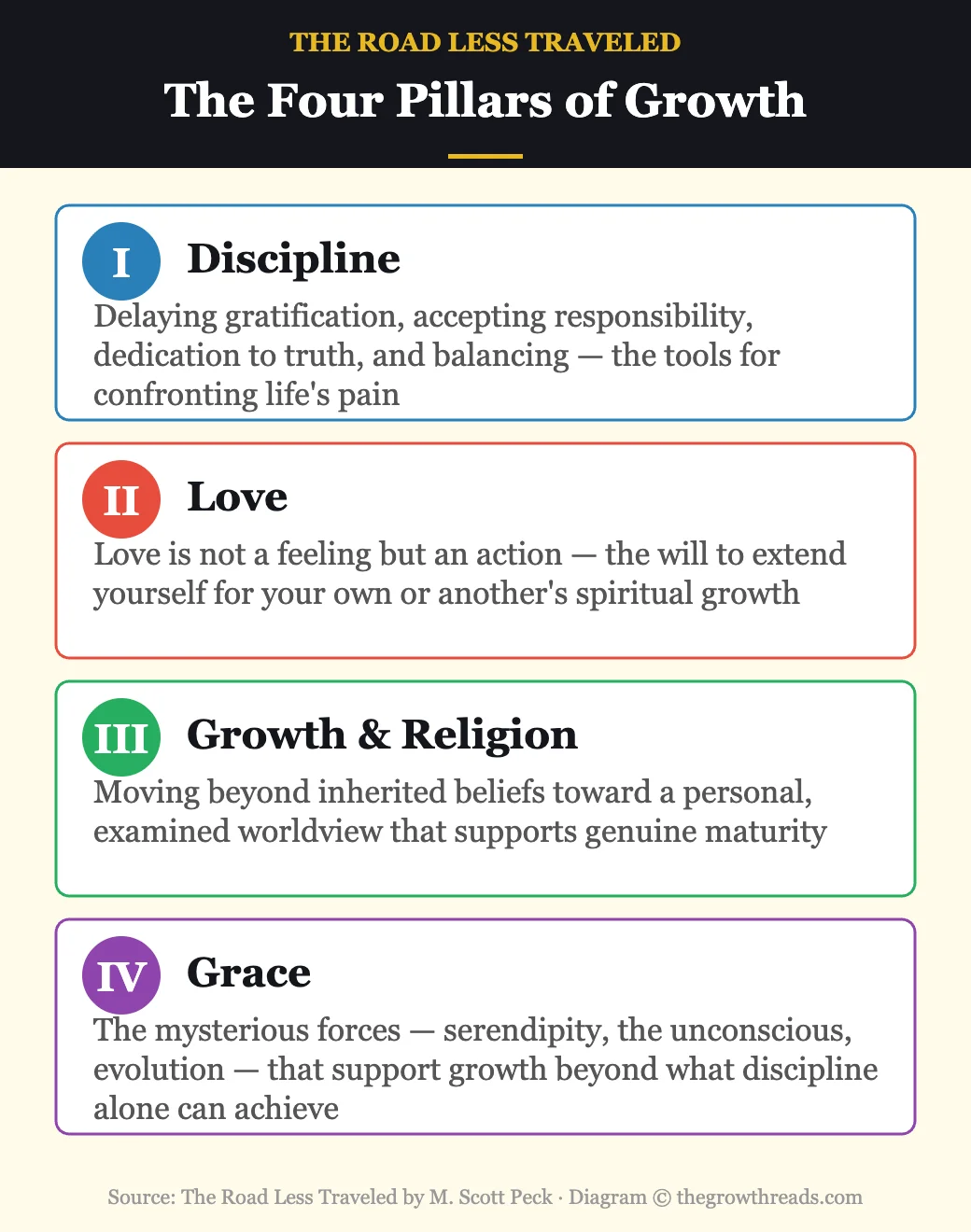
“Life is difficult.” Those three words open the book, and everything follows from them. M. Scott Peck, a practicing psychiatrist, argues that most human suffering comes not from life’s inherent difficulty but from our attempts to avoid that difficulty. The book moves through four interconnected sections: discipline (the tools for confronting pain productively), love (redefined as an action rather than a feeling), growth and religion (the evolution of personal worldview), and grace (the mysterious forces that support growth beyond willpower). Peck draws on decades of clinical practice to show that the path to emotional maturity and meaningful relationships runs directly through the discomfort most people spend their lives trying to sidestep. It has sold over ten million copies since 1978 and remains one of the most influential self-help books ever written.
Key takeaways
- Life is difficult: Accepting this truth — rather than resenting it — is the first step toward emotional maturity. Most neurosis stems from avoiding legitimate suffering.
- Discipline has four tools: Delaying gratification, accepting responsibility, dedication to truth, and balancing. These are the mechanics of confronting pain productively.
- Love is not a feeling: Peck defines love as the will to extend yourself for the purpose of your own or another’s spiritual growth. Feelings of love are a biological starting point, not the destination.
- Falling in love is not love: Romantic infatuation is a temporary ego-boundary collapse that nature designed for mating. Real love begins after the infatuation fades.
- Dependency is not love: Needing someone is not the same as loving them. Genuine love enhances both people’s growth; dependency stunts it.
- Mental health requires constant map revision: Your internal map of reality must be updated continuously. Clinging to outdated beliefs — about yourself, your partner, or the world — is a form of mental illness.
- Responsibility problems come in two forms: Neurotic people assume too much responsibility for others’ problems. Character-disordered people assume too little. Both are failures of discipline.
- Growth requires giving things up: Every stage of development demands surrendering something — comfort, certainty, old identity, even cherished beliefs.
- Grace operates beyond effort: Peck observes patterns of growth and healing that cannot be explained by discipline alone — serendipity, the unconscious mind, and forces that seem to support human evolution.
- Laziness is the original sin: Peck argues that the fundamental human obstacle to growth is not evil or trauma but our deep reluctance to do the work that growth demands.
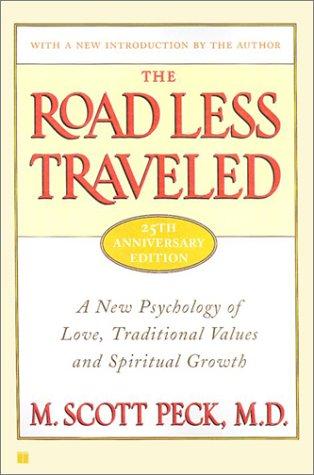
What is The Road Less Traveled about?
The Road Less Traveled is a psychiatrist’s guide to emotional maturity, arguing that genuine growth requires embracing difficulty rather than avoiding it. Through four sections — discipline, love, growth, and grace — M. Scott Peck redefines love as an act of will, presents four practical tools for building discipline, and makes the case that spiritual development is inseparable from psychological health.
About the author
M. Scott Peck (1936–2005) was an American psychiatrist who spent decades in private practice and served as a psychiatrist in the United States Army. He wrote The Road Less Traveled in 1978, and it spent over a decade on The New York Times bestseller list — one of the longest runs in the list’s history. Peck combined clinical psychology with philosophical and spiritual inquiry in a way that was unusual for the time, drawing equally on Freudian psychoanalysis, Christian theology, and Buddhist thought. His insistence that mental health and spiritual growth are inseparable made the book controversial in clinical circles but deeply resonant with general readers. He went on to write several follow-up books, including People of the Lie and Further Along the Road Less Traveled. Explore all M. Scott Peck book summaries →
Key concepts at a glance
| Concept | What it means | Use it when |
|---|---|---|
| Delaying Gratification | Scheduling pain before pleasure to enhance the experience of both | Facing any task you would rather postpone |
| Accepting Responsibility | Owning your problems rather than projecting them onto others | Recognizing patterns of blame in relationships |
| Dedication to Truth | Continuously updating your internal map of reality | A belief you hold is challenged by new evidence |
| Balancing | The discipline of giving up parts of yourself to make room for growth | An old identity or belief no longer serves you |
| Love as Will | Extending yourself for spiritual growth — yours or another’s | Choosing to love when feelings are absent |
| Cathexis vs Love | Investment of energy (cathexis) is not the same as genuine love | Distinguishing attachment from care |
| Neurosis vs Character Disorder | Too much responsibility assumed vs too little | Diagnosing relationship conflict patterns |
| Grace | Growth-supporting forces beyond conscious effort | Recognizing progress that exceeds what willpower explains |
Part 1 — Discipline: the tools for confronting life’s pain
Peck opens with three words that became one of the most famous opening lines in self-help history: “Life is difficult.” He argues that once you truly accept this — not as a complaint but as a fact — difficulty ceases to be an outrage and becomes simply the texture of existence. Most psychological suffering, he claims, comes not from life’s inherent challenges but from the energy people spend trying to avoid them.
The first tool of discipline is delaying gratification: the practice of scheduling pain and pleasure so that pain comes first, enhancing the pleasure that follows. Peck uses the example of a financially impulsive client who could not save money because every paycheck was spent immediately on whatever felt good in the moment. The inability to endure present discomfort for future reward, Peck argues, is the root cause of most financial, relational, and professional dysfunction.
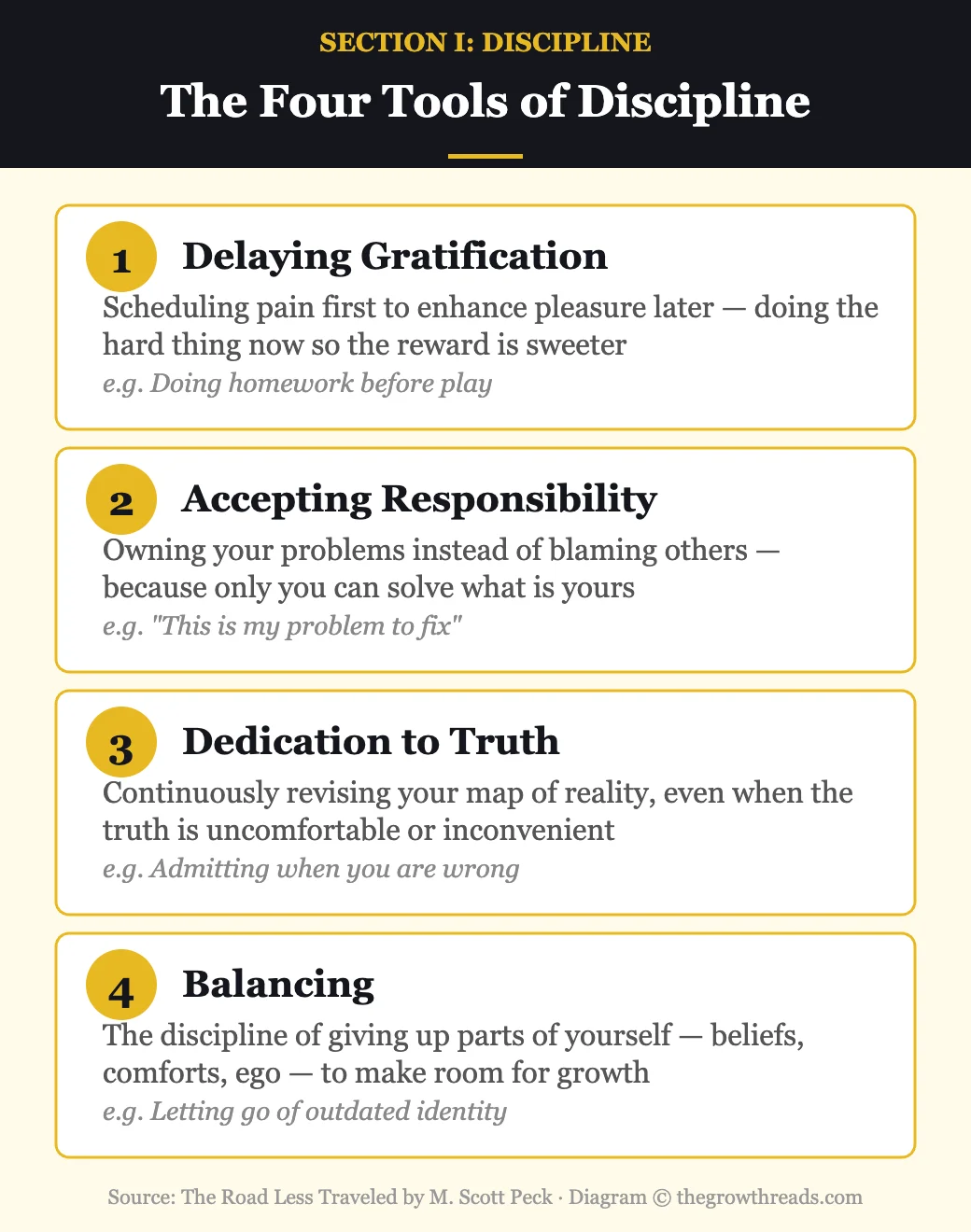
The second tool, accepting responsibility, addresses the two ways people mishandle their problems. Neurotic individuals assume too much responsibility — they believe everything is their fault, including things they cannot control. Character-disordered individuals assume too little — they blame the world, their parents, their partners, or bad luck for everything that goes wrong. Peck observed that most people oscillate between these extremes depending on the situation, and that emotional maturity requires learning to distinguish which problems are genuinely yours.
Dedication to truth, the third tool, requires continuously revising your internal map of reality. Peck compares each person’s worldview to a map: it was drawn in childhood based on limited experience, and it requires constant updating as new territory is explored. The problem is that map revision is painful — it means admitting you were wrong, letting go of comforting illusions, and accepting uncomfortable realities about yourself and your relationships. Most people stop updating their maps in early adulthood, which is why they keep making the same mistakes.
The fourth tool, balancing, is the discipline of giving things up. Growth always requires surrendering something: comfort, certainty, a cherished belief, even an old identity. Peck describes clients who could not progress in therapy because they refused to let go of anger, or victimhood, or the fantasy of a perfect parent. Balancing is the willingness to lose parts of yourself so that new, more mature parts can emerge.
Part 2 — Love: an act of will, not a feeling
Peck’s definition of love is one of the book’s most influential contributions: “The will to extend one’s self for the purpose of nurturing one’s own or another’s spiritual growth.” Every word is deliberate. Love is will — a decision and an action, not a feeling. It involves extending yourself — moving beyond your comfort zone, expending effort, taking risks. And its purpose is spiritual growth — not pleasure, not security, not the avoidance of loneliness.
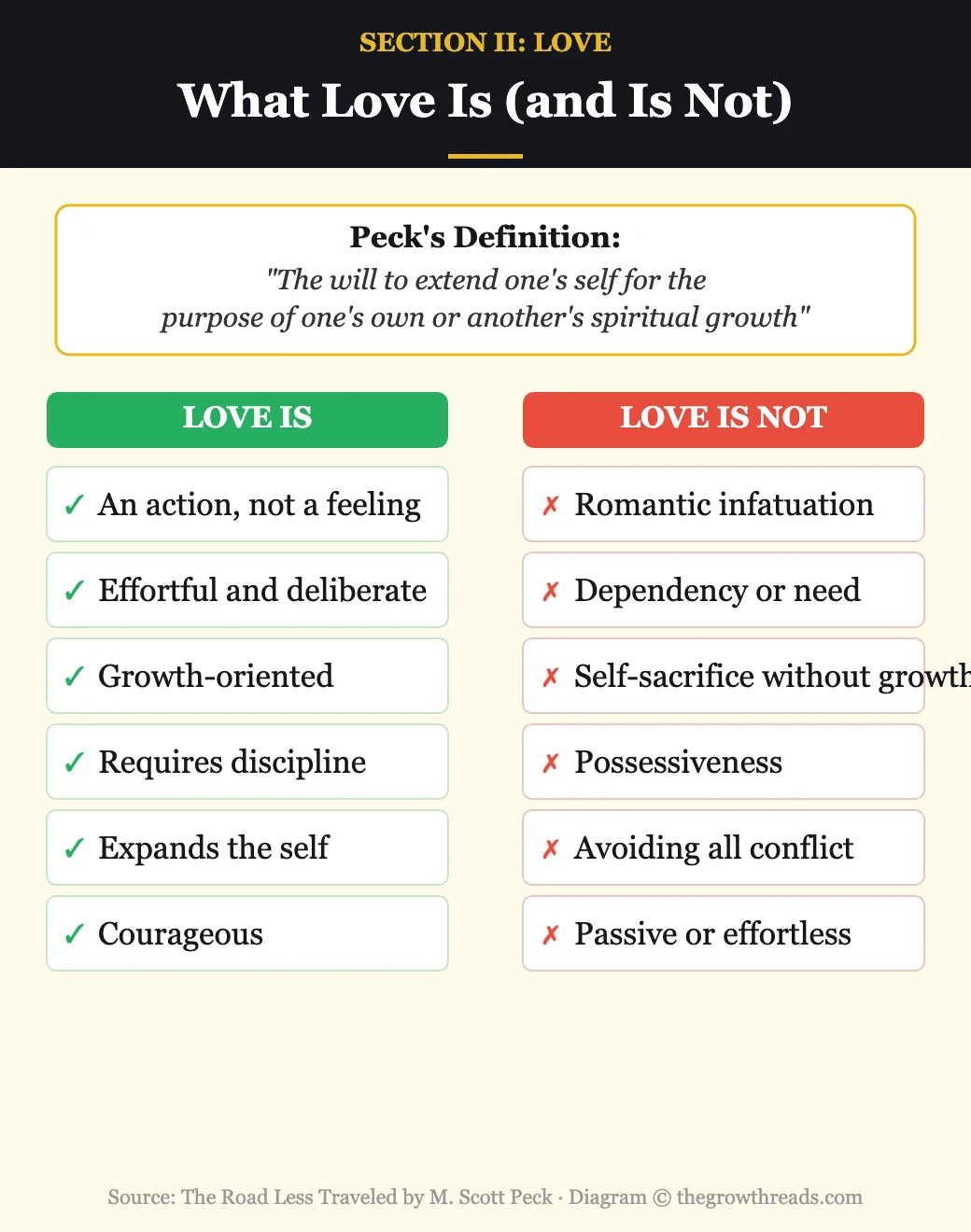
Peck systematically dismantles popular misconceptions. Falling in love, he argues, is not love — it is a temporary collapse of ego boundaries that nature designed to initiate mating. The experience feels transcendent, but it is biologically programmed and inevitably temporary. When the boundaries re-form (as they always do), couples face a choice: either begin the real work of loving — which is effortful, deliberate, and often unglamorous — or abandon the relationship in search of the next infatuation high.
Dependency gets equally harsh treatment. Peck describes patients who insisted they loved their partners but whose behavior revealed pure need — they could not function independently and confused their terror of being alone with devotion. Genuine love, he insists, requires two whole people choosing to extend themselves for each other’s growth. A relationship built on dependency is not a love relationship; it is a mutual hostage situation.
The section’s most practical insight is that love requires attention. Peck defines attention as “an act of will, an act of work against the inertia of our own minds.” Listening to your partner when you would rather check your phone, noticing their emotional state when you are preoccupied with your own — these small acts of attention are the daily practice of love. Without them, even the most passionate relationship degrades into parallel living.
Part 3 — Growth and religion: evolving your worldview
The third section argues that spiritual development is inseparable from psychological growth. Peck is not advocating for any specific religion; he is arguing that everyone has a worldview — a set of beliefs about how reality works — and that examining and evolving that worldview is essential to maturity. People who cling to the religious frameworks they inherited in childhood without questioning them are as psychologically stuck as people who reject all spiritual inquiry.
Peck presents a developmental model of spiritual growth moving from chaos and antisocial behavior (Stage I), through rigid institutional belief (Stage II), to skeptical individualism (Stage III), and finally to a mystical, communal spirituality that integrates doubt and faith (Stage IV). He emphasizes that each stage is necessary and that people at different stages tend to misunderstand and judge each other — the institutional believer sees the skeptic as lost, while the skeptic sees the believer as naive. Maturity means recognizing the legitimacy of each stage while continuing to grow beyond your current one.
Part 4 — Grace: the forces beyond discipline
The final section is the book’s most controversial and most personal. Peck describes clinical observations that he cannot explain through psychology alone: patients who healed faster than their effort warranted, coincidences that aligned too perfectly to be random, moments of insight that seemed to come from outside the conscious mind. He groups these phenomena under the heading of “grace” — forces that support human growth beyond what discipline and effort can achieve.
He frames the unconscious mind not as a reservoir of repressed darkness (the Freudian view) but as a source of wisdom that operates ahead of conscious awareness. Dreams, intuitions, and sudden moments of clarity are evidence that a part of the mind is working on problems the conscious self has not yet confronted. Peck argues that resisting this unconscious guidance — through rigidity, denial, or distraction — is another form of laziness: the refusal to do the work of integrating what your deeper self already knows.
He closes with an evolutionary argument: the very existence of love, discipline, and grace suggests that the universe is oriented toward growth. Entropy — the tendency toward disorder — is the default in physics, yet human beings consistently create order, meaning, and connection. Peck sees this as evidence (not proof, he is careful to say) that something in the structure of reality supports the difficult, painful, rewarding work of becoming more fully human.
Who is The Road Less Traveled best for — and who should read something else first?
This book is best for readers who want a challenging, intellectually honest framework for understanding love, maturity, and personal growth. It is particularly powerful for people in their late twenties through forties who are navigating the gap between who they were raised to be and who they want to become. It is also useful for anyone struggling to understand why their relationships keep following the same patterns.
If you want more contemporary, research-backed relationship guidance, start with The Seven Principles for Making Marriage Work by Gottman. If you want a more accessible entry point into personal growth, Daring Greatly by Brené Brown offers similar themes with a warmer, less confrontational tone.
Questions to reflect on
- Which of Peck’s four tools of discipline is weakest in your life right now — and what would change if you strengthened it?
- In your closest relationship, are you practicing love as Peck defines it (extending yourself for growth), or are you primarily seeking comfort and security?
- When was the last time you revised your internal map of reality — let go of a belief, admitted you were wrong, or accepted an uncomfortable truth about yourself?
- Do you lean toward neurotic responsibility (taking on too much) or character-disordered responsibility (taking on too little) — and how does that pattern show up in your relationships?
- What are you refusing to give up that might be blocking your growth — a comfort, a grudge, an outdated identity?
🔥 Ready to take the road less traveled?
Start the journey toward genuine love, discipline, and growth.
How to apply The Road Less Traveled (7-day plan)
- Day 1 — Identify your avoidance pattern: Write down three things you have been putting off because they feel uncomfortable. Choose the smallest one and do it today. Notice how the relief afterward exceeds the discomfort you feared.
- Day 2 — Practice delaying gratification: In one area today — food, phone, spending — choose to experience the difficult part first and the pleasant part second. Eat the vegetables before dessert, literally or metaphorically.
- Day 3 — Audit your responsibility: List three current problems in your life. For each, ask: Am I taking too much responsibility (blaming myself for what I cannot control) or too little (blaming others for what is mine)?
- Day 4 — Update one belief: Identify one belief you hold about yourself, your partner, or your work that may be outdated. Write down the evidence for and against it. If the evidence has shifted, let the old belief go.
- Day 5 — Practice love as attention: In one conversation today, give your full, undivided attention. Put away your phone, make eye contact, and listen without planning your response. Notice what you learn.
- Day 6 — Distinguish love from dependency: Think about your closest relationship. Ask honestly: Am I extending myself for this person’s growth, or am I primarily seeking comfort and security? Write your answer without judgment.
- Day 7 — Give something up: Identify one comfort, habit, or belief that is no longer serving your growth. Take one concrete step toward releasing it — cancel the subscription, have the conversation, change the routine.
Frequently asked questions
Is The Road Less Traveled a religious book?
Not in a denominational sense. Peck draws on Christian, Buddhist, and psychoanalytic traditions without advocating for any specific religion. His argument is that spiritual growth — the development of a personal, examined worldview — is inseparable from psychological health. Readers of any faith background or none can engage with the ideas, though the final section on grace may feel more speculative to strictly secular readers.
Is this book still relevant today, or is it outdated?
The core insights about discipline, love, and responsibility are timeless and have been validated by subsequent research in psychology and neuroscience. Some cultural references and case studies reflect 1970s norms, and Peck’s views on gender roles feel dated in places. However, the psychological framework is as applicable today as it was in 1978 — which is why it continues to sell millions of copies nearly fifty years after publication.
What does Peck mean by “life is difficult”?
It is not a pessimistic statement but a liberating one. Peck argues that once you accept difficulty as the baseline condition of existence — rather than treating it as a personal injustice — you stop wasting energy on resentment and start directing it toward productive problem-solving. The suffering comes not from difficulty itself but from the expectation that life should be easy.
How is Peck’s definition of love different from other books?
Most love books focus on feelings, compatibility, or communication techniques. Peck strips love down to its functional essence: the will to extend yourself for growth. This means love is a choice and an action, not an emotion you either feel or do not feel. It also means self-love and other-love are the same process — you cannot genuinely love another if you are not committed to your own growth. This definition influenced an entire generation of therapists and relationship writers.
What is the difference between neurosis and character disorder?
In Peck’s framework, neurotic people take on too much responsibility — they assume everything is their fault, leading to guilt, anxiety, and self-blame. Character-disordered people take on too little — they blame everyone else, the system, or bad luck. Most people have elements of both, depending on context. Recognizing which pattern you default to in relationships is one of the book’s most practically useful exercises.
Is this book good for couples to read together?
It can be powerful for couples, particularly the section on love. Peck’s distinction between infatuation and genuine love, and his insistence that love requires effort and attention, gives couples a shared vocabulary for discussing their relationship honestly. However, it is not a couples therapy manual — for that, The Seven Principles for Making Marriage Work by Gottman or Hold Me Tight by Sue Johnson are more directly applicable.
What does Peck mean by grace?
Grace refers to the forces that support human growth beyond what discipline and effort alone can explain. Peck points to clinical observations: patients who healed faster than expected, serendipitous coincidences, insights that arrived seemingly from nowhere. He does not claim to prove a supernatural force but argues that the consistency of these observations suggests something in the structure of reality supports growth. It is the book’s most philosophical and debatable section.
Related summaries
- Daring Greatly — Brené Brown on vulnerability as the foundation of meaningful connection
- Attached — the science of how attachment styles shape romantic relationships
- The Seven Principles for Making Marriage Work — Gottman’s research-based guide to lasting partnerships
- The Courage to Be Disliked — Adlerian psychology on living with freedom and responsibility
Best Relationship Books — The Full TGR List