

★★★★½ (4.6/5) — A rigorously reported, myth-busting journey into the neuroscience and renewed medical promise of psychedelics.
Best for: Readers curious about consciousness, mental health science, and the therapies emerging from the psychedelic renaissance.
Reading time: ~7.5 hours to read the book · ~35 minutes for this guide
Difficulty to apply: Moderate — the value here is conceptual and perspective-shifting, not a step-by-step habit system.
This summary is educational, not medical advice. Psychedelics remain restricted substances outside licensed research, therapy, or care.
How to Change Your Mind in one minute
Psychedelics are having a second act — and this time, science is taking notes. In How to Change Your Mind, journalist Michael Pollan traces how LSD and psilocybin went from 1950s psychiatric research tools to countercultural symbols to Schedule I contraband — and how a new generation of researchers at Johns Hopkins, NYU, and Imperial College London quietly rebuilt the case for their therapeutic use. Pollan combines science journalism with first-person memoir: he interviews the researchers, the guides, and the patients, then — carefully, legally, under supervision — takes the journeys himself. The result is a rare kind of book: rigorous about the neuroscience of the Default Mode Network and “ego dissolution,” honest about what altered states of consciousness can and can’t do, and clear-eyed about why a single guided session is producing results that years of standard treatment sometimes can’t. This isn’t a permission slip to self-medicate. It’s a reported account of a medical and cultural shift already underway, and a genuinely fascinating tour of what your mind is doing when the volume gets turned down on your sense of self.
Key takeaways
- A research renaissance: Psychedelic science is picking back up after a roughly 40-year near-total research freeze triggered by 1960s backlash and the War on Drugs.
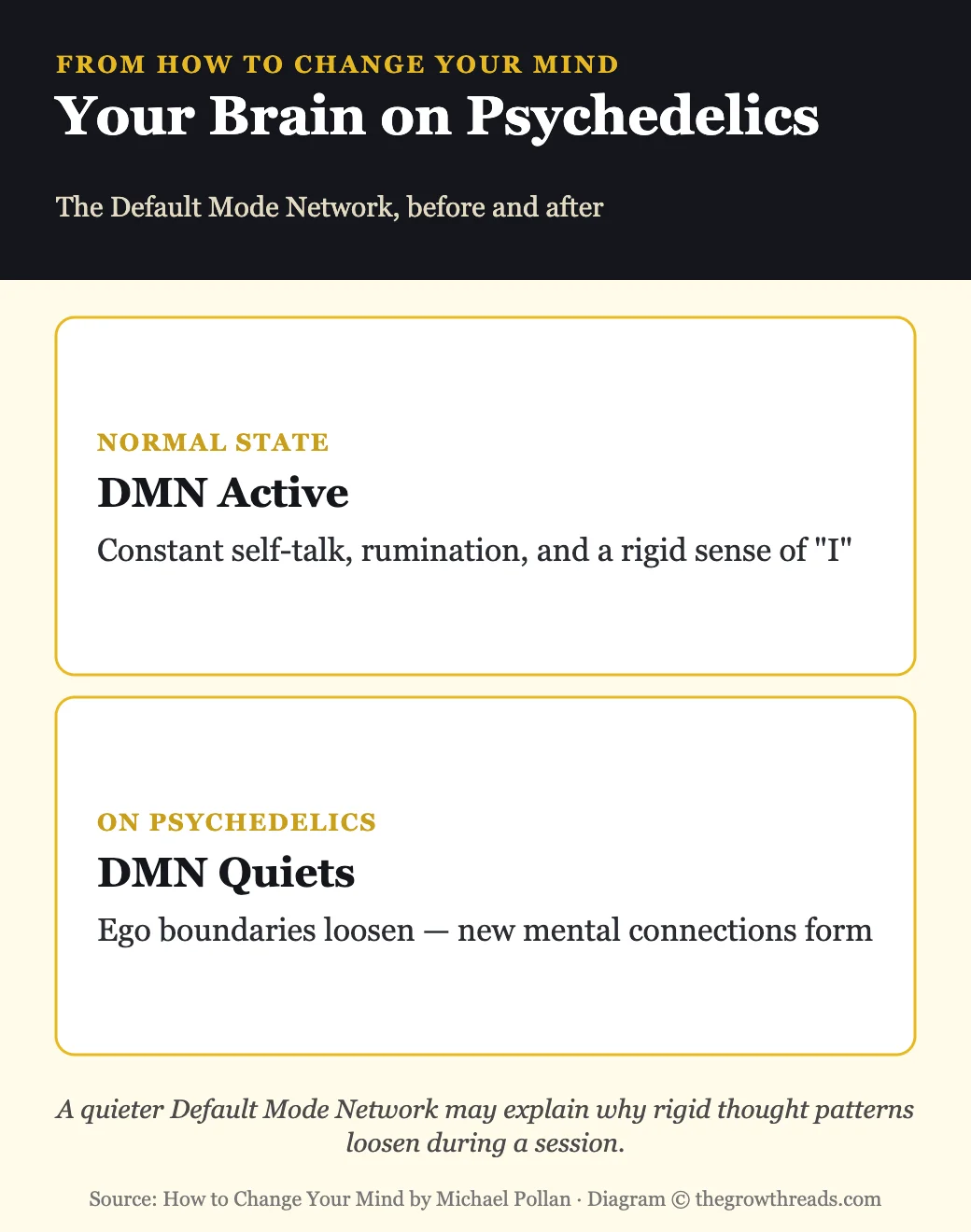
- The Default Mode Network (DMN): Psilocybin and LSD quiet this brain network, which is tied to rumination, self-criticism, and the sense of “I.”
- Ego dissolution predicts outcomes: The more a person’s sense of self loosens during a session, the better their reported results tend to be.
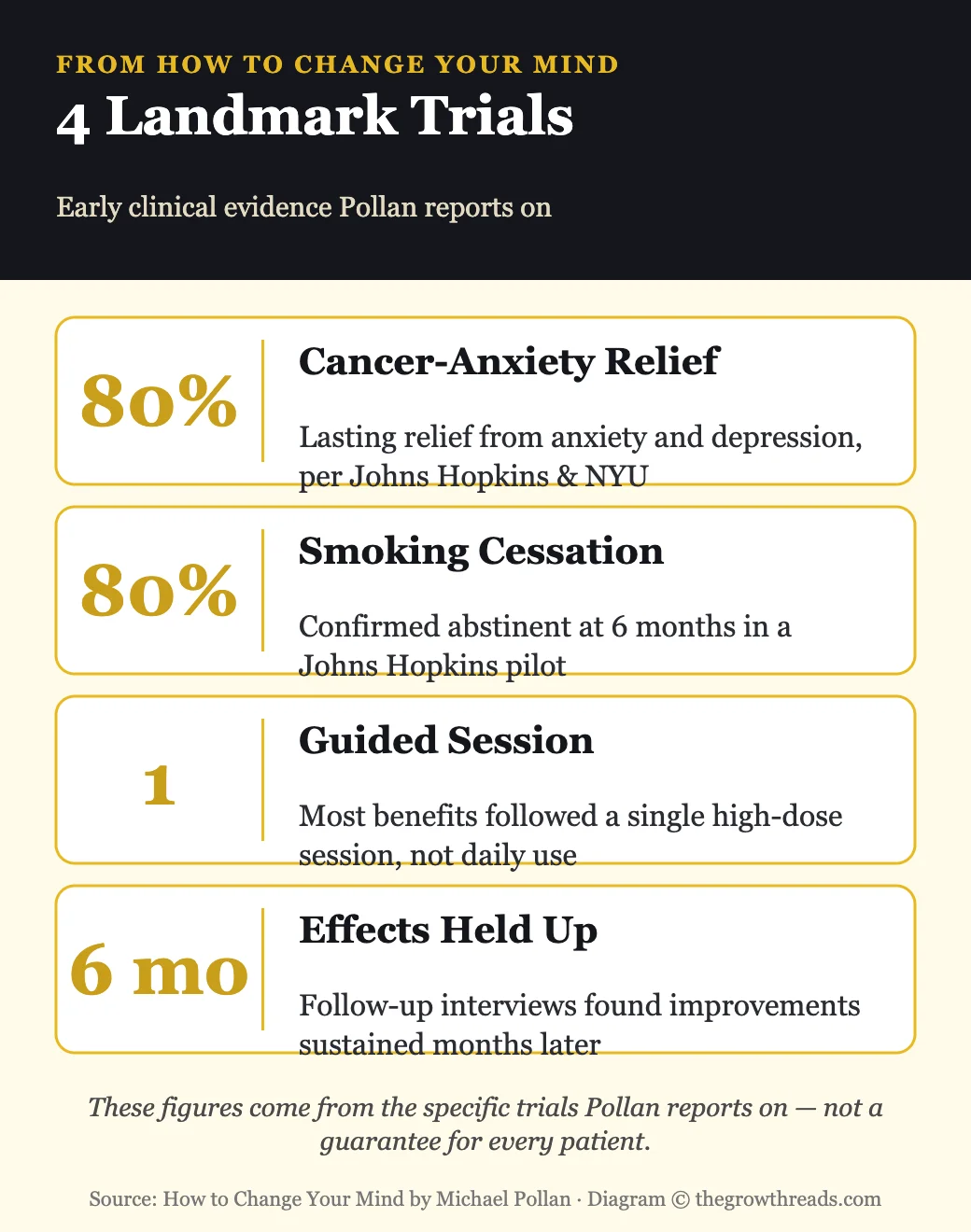
- Relief from end-of-life anxiety: In Johns Hopkins and NYU trials, most terminally ill participants reported lasting relief from anxiety and depression after a single dose.
- A path off addiction: A small Johns Hopkins pilot found most longtime smokers were biologically confirmed abstinent six months after psilocybin-assisted sessions.
- Set and setting matter as much as the molecule: Mindset going in and the physical, emotional environment shape the experience as much as the drug’s chemistry.
- Guides drive safety, not solo trips: Every clinical protocol pairs the substance with careful screening, a trained sitter, and follow-up integration sessions.
- Meditators and trippers overlap: Experienced meditators show brain patterns during deep practice that resemble those on psilocybin — a possibly shared mechanism.
- The 1960s crackdown was partly political: Pollan argues the backlash was driven as much by countercultural panic and showmanship as by evidence of harm.
- A new model for mental illness: The book frames depression and addiction partly as “stuck” thought patterns — and psychedelics as a way to loosen that rigidity so new patterns can form.
What is How to Change Your Mind about?
How to Change Your Mind (2018) is Michael Pollan’s reported deep dive into the science and history of psychedelics — LSD, psilocybin, and 5-MeO-DMT. It traces their 1950s medical promise, 1960s collapse, and 21st-century revival as treatments for depression, addiction, and end-of-life anxiety, combining clinical research with Pollan’s own supervised experiences.
About the author
Michael Pollan is an American journalist and the Knight Professor of Science and Environmental Journalism at UC Berkeley. He built his reputation writing about food systems — The Omnivore’s Dilemma, In Defense of Food, and The Botany of Desire all examine how what we eat shapes health, culture, and the planet. How to Change Your Mind marked a turn toward a subject he’d circled for years: consciousness itself. Pollan spent several years reporting the book, interviewing neuroscientists, guides, and patients, and — in his sixties, with no prior drug history — undergoing supervised psychedelic sessions himself so he could write about the experience firsthand. The book became a #1 New York Times bestseller and was adapted into a Netflix documentary series in 2022. Pollan followed it with This Is Your Mind on Plants (2021), a closer look at opium, caffeine, and mescaline. Explore all Michael Pollan book summaries →
Key concepts at a glance
| Concept | What it means | Use it when |
|---|---|---|
| Default Mode Network (DMN) | The brain network tied to self-referential thought, rumination, and the sense of “I” | Explaining why psychedelics can quiet depressive rumination |
| Ego dissolution | A temporary loosening of the boundary between self and world during a psychedelic experience | Understanding why users report mystical or unity experiences |
| Set and setting | Mindset (“set”) and physical/social environment (“setting”) that shape any altered-state experience | Preparing for any guided or high-stakes emotional experience |
| Entropic brain hypothesis | Robin Carhart-Harris’s theory that psychedelics increase neural “entropy,” breaking rigid thought patterns | Explaining post-session mental flexibility |
| Mystical-type experience | A measurable psychological state — unity, sacredness, ineffability — linked to the best outcomes | Predicting who is likely to benefit most from a session |
| Trip treatment | Structured psychedelic-assisted psychotherapy: preparation, dosing, and integration sessions with a guide | Considering clinical or legal psychedelic therapy |
| Neuroplasticity | The brain’s capacity to form new neural connections, potentially boosted after a session | Discussing lasting change after a single dose |
| Integration | The process of making sense of — and applying — insights from an altered-state experience | After any significant psychological breakthrough, chemical or not |
Part 1: A History Half-Told — From Miracle Drug to Contraband
Pollan opens not with a trip but with a timeline. Albert Hofmann synthesized LSD in a Swiss lab in 1943 and discovered its effects by accident; within a decade, psychiatrists on multiple continents were running legitimate trials on it and on psilocybin, the compound in “magic” mushrooms first documented for Western readers by banker-turned-mycologist R. Gordon Wasson after a 1955 mushroom ceremony with the Mazatec curandera Maria Sabina. Between the early 1950s and the mid-1960s, researchers published more than a thousand papers on psychedelics, treating alcoholism, end-of-life anxiety, and treatment-resistant depression with results that, by Pollan’s account, were often better than anything psychiatry had produced before or since.
Then it collapsed. Timothy Leary’s Harvard-based advocacy turned careful clinical work into a countercultural movement — “turn on, tune in, drop out” — and the establishment recoiled. Richard Nixon’s Controlled Substances Act of 1970 classified psilocybin and LSD as Schedule I, the most restrictive category, alongside a formal judgment that they had no accepted medical use. Nearly all legitimate research stopped overnight. Pollan interviews researchers who had papers in progress when the door shut, some of whom waited three decades to pick the work back up. His argument isn’t that the backlash had no basis — the drugs were being used recklessly outside clinical settings — but that the scientific verdict got tangled up with a moral panic, and the two got treated as the same thing for a generation.
TGR Note: The pattern of “promising science stalled by public panic” shows up again in our summary of The Body Keeps the Score, where trauma treatment spent decades sidelined by skepticism about the mind-body connection. Six years after this book published, the FDA declined to approve MDMA-assisted therapy for PTSD (August 2024), citing trial-design and safety concerns and asking for further study — a reminder that regulatory approval, even with strong early data, is its own slow process.
Part 2: A Journalist Goes Under — Pollan’s Own Journeys
About a third of the book is memoir, and it’s the part that keeps the science from feeling abstract. Unable to access a clinical trial as a healthy journalist, Pollan works with a network of underground guides — experienced, unlicensed practitioners who’ve quietly kept the “trip treatment” model alive since the 1970s — and undergoes several sessions: LSD in a private home, psilocybin mushrooms in a wooded retreat, and 5-MeO-DMT, a compound drawn from the venom of the Sonoran Desert toad, whose effects are extraordinarily intense and unusually brief.
He’s a skeptical narrator by design. Pollan repeatedly flags his discomfort with words like “mystical” and “sacred,” then describes experiences that push him toward using them anyway: a dissolving sense of boundary between himself and his surroundings, a loss of the usual narrating voice in his head, and afterward, a persistent shift in how ordinary moments — a walk, a piece of music — register emotionally. Every session is preceded by hours of preparation with his guide and followed by a debrief. That structure, he stresses, is not incidental. It is what separates a “trip” from a controlled therapeutic experience, and it’s the same structure researchers build into every clinical protocol.
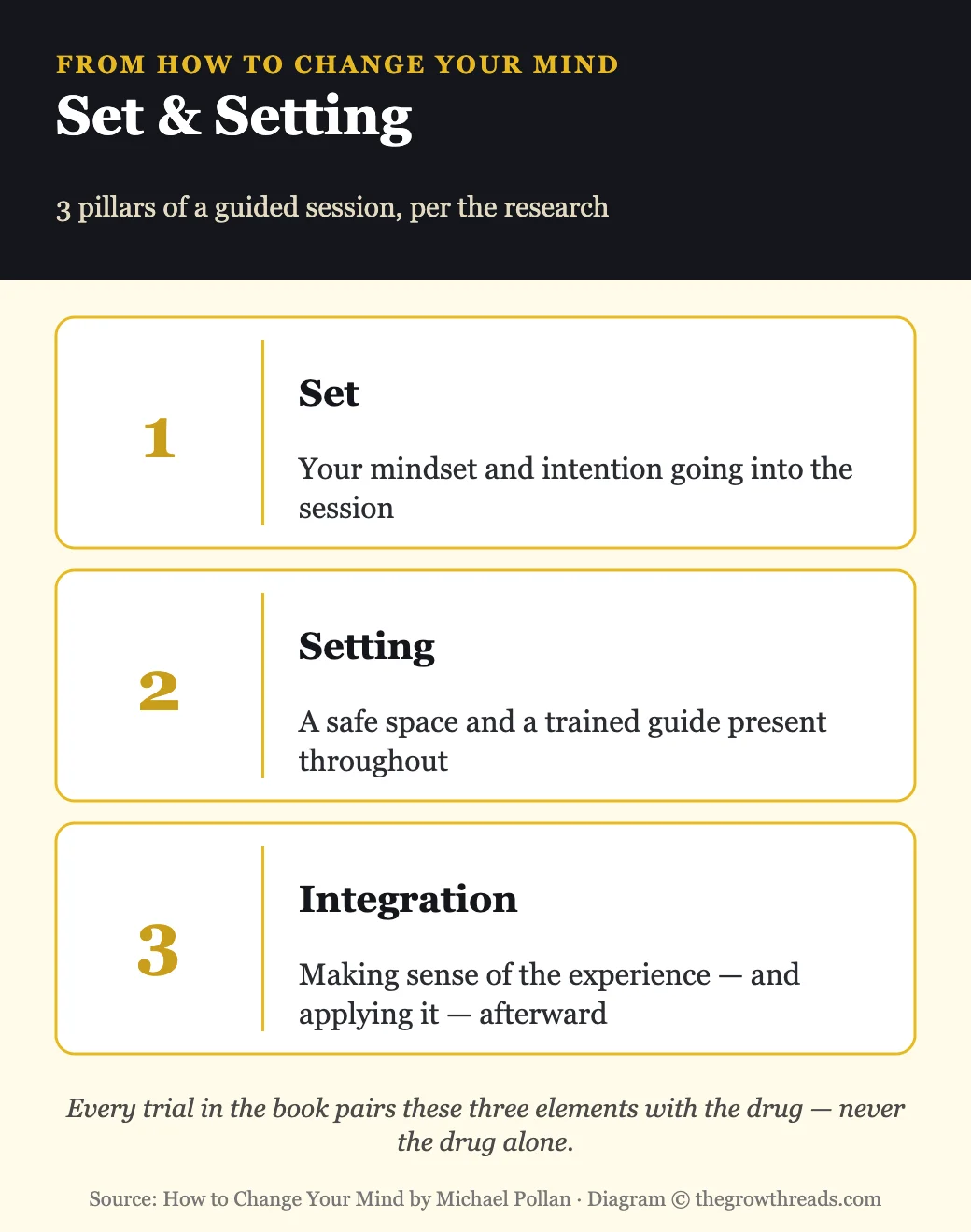
TGR Note: Pollan’s insistence that preparation and environment shape the experience as much as the substance echoes a theme we cover in Why We Sleep: consciousness researchers keep finding that altered mental states — sleep, dreaming, or a guided session — are studied best not as isolated brain events, but as states shaped heavily by the conditions surrounding them.
Part 3: The Neuroscience — Quieting the Self
This is the book’s scientific core. Neuroscientist Robin Carhart-Harris, using fMRI at Imperial College London, found that psilocybin and LSD markedly reduce activity in the Default Mode Network — a set of connected brain regions most active during mind-wandering, self-reflection, and rumination, and closely tied to what neuroscientists call the sense of a stable, narrating “self.” At the same time, the drugs increase communication between brain regions that don’t normally talk to each other, temporarily flattening the brain’s usual hierarchical organization.
Carhart-Harris calls this the “entropic brain hypothesis”: a healthy mind needs a balance between order and flexibility, and conditions like depression and addiction often involve an overactive, overly rigid DMN — thought loops that have worn deep grooves. Psychedelics appear to temporarily raise the brain’s entropy, disrupting those grooves and opening a window in which new patterns of thought can form. Pollan draws a striking parallel to experienced Buddhist meditators, whose brains — studied separately — show reduced DMN activity during deep practice that resembles what researchers see on psilocybin. Two very different paths, he suggests, may converge on a similar underlying mechanism: loosening the grip of the self.
TGR Note: If the idea that “you are not the voice in your head” resonates, it’s worth reading The Untethered Soul, which argues for the same basic insight — a self that is not identical to its inner narrator — from a meditative rather than neuroscientific angle. Reading the two together makes the overlap between contemplative and chemical approaches to ego dissolution much clearer.
Part 4: The Trip Treatment — Clinical Promise and What Comes Next
The final section moves from theory to outcomes. At Johns Hopkins and NYU, researchers gave single high doses of psilocybin, under close supervision, to cancer patients struggling with anxiety and depression about their diagnoses. The results — sizable majorities reporting substantial, lasting relief, still measurable at six-month follow-up — were unusual enough that Pollan spends real time on the trial design itself: small samples, difficulty blinding a study when participants clearly know they’ve taken a psychedelic, and the field’s own awareness that early results need replication at scale.
A smaller Johns Hopkins pilot applied the same model to smoking cessation, pairing psilocybin sessions with standard cognitive-behavioral support; most longtime smokers in the trial were biologically confirmed abstinent six months later, a result that outperforms most approved smoking-cessation treatments. Every protocol Pollan describes follows the same shape: careful medical and psychological screening (people with a personal or family history of psychosis, or certain heart conditions, are excluded), a preparation session, one or two guided high-dose sessions with a trained sitter present throughout, and structured integration afterward to help the person make sense of what happened. Pollan is careful to note what this model is not: casual, unsupervised, or a substitute for medical care.
TGR Note: The regulatory picture keeps shifting since 2018. Oregon began licensing supervised psilocybin services in 2023 under Measure 109, and Colorado followed with its own program under Proposition 122 — the first state-level moves of their kind. It’s a useful reminder, alongside our note in Part 1 about the FDA’s 2024 MDMA decision, that scientific promise and regulatory approval move on very different timelines.
Who is How to Change Your Mind best for — and who should read something else first?
Best for: readers curious about consciousness and the neuroscience of the mind; anyone who wants a rigorously reported, non-hyped account of the psychedelic-therapy renaissance; people processing anxiety about mortality, meaning, or a mental health condition that hasn’t responded to standard treatment; and readers of narrative science journalism who enjoy a writer thinking honestly on the page.
Read something else first if you want a practical, step-by-step behavior-change system — try Atomic Habits instead. If your interest is the neuroscience of the everyday “self” without the psychedelics angle, The Untethered Soul covers similar ego-dissolution territory through meditation rather than medicine. And if trauma, not consciousness, is your focus, The Body Keeps the Score is the more direct read.
Questions to reflect on
- What rigid patterns of thought or behavior in your life might benefit from being “shaken loose” — even without any substance involved?
- How much do your surroundings and mindset (your own version of “set and setting”) shape your emotional state on an ordinary day?
- Where do you over-identify with the voice in your head — the one that never stops narrating, judging, and comparing?
- If you could sit with a hard truth about mortality or meaning for one afternoon, what would you actually want to understand?
- What insight have you already had but not yet integrated — and what would acting on it look like this week?
🔥 Ready to understand the science behind the psychedelic renaissance?
Get the full reported story — the history, the neuroscience, and Pollan’s own journeys — in How to Change Your Mind.
How to apply How to Change Your Mind (7-day plan)
- Day 1 — Set your baseline. Read the introduction and skim the chapter list. Write one sentence about what “quieting your inner narrator” might mean for you personally.
- Day 2 — Watch your DMN in action. Sit for 10 minutes of silent meditation and simply notice every time a self-referential thought (“I feel,” “I should,” “I always”) arises.
- Day 3 — Rewrite one rigid story. Identify a repetitive narrative you tell yourself about who you are or what you can’t do, and write a single alternative version of it.
- Day 4 — Change your setting on purpose. Deliberately alter one environment — your workspace, your walk route, your evening routine — and notice how it shifts your mood.
- Day 5 — Have the hard conversation. Talk with someone you trust about mortality or meaning. Pollan’s reporting suggests these conversations help more than we expect.
- Day 6 — Seek novelty. Try one new sensory experience — unfamiliar music, a new route, an unusual meal — and pay attention to how novelty affects your focus and mood.
- Day 7 — Integrate. Write a short journal entry: one real insight from the week, and one concrete action that carries it forward.
Frequently asked questions
Is How to Change Your Mind recommending that readers try psychedelics themselves?
No. Pollan is explicit that this is a work of reporting and memoir, not a how-to guide. His own experiences happened under the guidance of experienced guides after months of research and interviews — not as casual recreation. Psilocybin, LSD, and 5-MeO-DMT remain Schedule I controlled substances in the United States outside approved clinical trials and, as of 2023, licensed psilocybin services in Oregon and Colorado. The book’s argument is that these substances show real therapeutic promise under careful medical supervision, not that unsupervised use is safe, legal, or advisable. Readers curious about the science should treat this as education, not instruction.
What is the Default Mode Network and why does it matter in the book?
The Default Mode Network (DMN) is a set of connected brain regions most active when you’re not focused on a task — during mind-wandering, self-reflection, and rumination. Neuroscientist Robin Carhart-Harris found that psilocybin and LSD substantially quiet DMN activity, temporarily loosening the brain’s usual sense of a fixed, narrating “self.” Pollan treats this finding as the book’s scientific anchor: it offers a physical explanation for why users report ego dissolution, why the experience can interrupt depressive rumination, and why researchers believe a single session might open a window for lasting psychological change.
Are psychedelics legal for therapeutic use?
It’s a patchwork. In the U.S., psilocybin and LSD remain federally classified as Schedule I substances, meaning they’re illegal outside approved research settings. Since the book published in 2018, Oregon (2023) and Colorado began licensing supervised psilocybin services at the state level, and several cities have deprioritized enforcement. The FDA has granted “breakthrough therapy” status to psilocybin research for depression, which speeds clinical trials, but no classic psychedelic is FDA-approved as a prescription treatment yet — in 2024 the agency declined to approve MDMA-assisted therapy for PTSD, asking for further study. The legal and medical picture is still evolving.
What conditions do psychedelic-assisted therapy trials target?
The trials Pollan reports on focus mainly on end-of-life anxiety and depression in cancer patients (Johns Hopkins and NYU), nicotine addiction (a Johns Hopkins smoking-cessation pilot), and alcohol dependence. Since the book’s publication, the same basic model — a small number of guided, high-dose sessions paired with therapy — has been studied for treatment-resistant depression, OCD, and PTSD (via MDMA, a related but chemically distinct compound). The common thread across trials is treating conditions where standard medications and talk therapy have had limited success.
What’s the difference between LSD and psilocybin as discussed in the book?
Both are classic psychedelics that act on the brain’s serotonin receptors and produce broadly similar effects — altered perception, emotional intensity, and loosened ego boundaries — but they differ in origin and duration. LSD is synthesized in a lab and its effects can last 8 to 12 hours; psilocybin occurs naturally in certain mushrooms and typically lasts 4 to 6 hours. Pollan notes that psilocybin’s shorter, gentler arc has made it the preferred compound for most modern clinical trials, while LSD’s history is more tightly bound up with 1960s counterculture.
Did Michael Pollan try psychedelics himself while researching the book?
Yes. After months of interviews, Pollan — in his sixties, with almost no prior experience with illegal drugs — underwent several guided sessions with LSD, psilocybin mushrooms, and 5-MeO-DMT, working with experienced underground guides rather than clinical researchers. He describes these firsthand accounts in detail, including his own resistance to language like “mystical” and “sacred,” and uses the experiences to illustrate concepts like ego dissolution and set and setting from the inside rather than only secondhand.
Is this book based on solid science, or is it speculative?
Both, and Pollan is careful to distinguish them. The neuroscience — DMN activity, the entropic brain hypothesis, small but rigorous randomized trials at Johns Hopkins and NYU — is peer-reviewed and reported with appropriate caveats about sample size and the difficulty of blinding psychedelic studies. The more speculative material — mystical experience, consciousness, what ego dissolution “means” — is presented as reported testimony and Pollan’s own reflection, clearly framed as interpretation rather than established fact. Readers get both threads, kept distinct.
Related summaries
- The Body Keeps the Score — how trauma reshapes the brain and body
- Why We Sleep — the new science of sleep and dreams
- Breath — the lost art that changes everything
- The Untethered Soul — the voice in your head is not you
See the full list of the best health books.
How we analyze books: We read the full book, cross-reference the author’s research and public interviews, and structure each summary around the book’s actual argument rather than a generic template — then think through the practical implications ourselves before publishing. Read our full methodology.
Related Health Summaries
Spark Summary & Review: The Science of Exercise and the Brain
The China Study Summary & Review: The Case for Plant-Based Eating
The Diabetes Code Summary and Review
The Energy Paradox Summary & Review: Why Your Gut Is Stealing Your Energy
The Obesity Code Summary & Review: Why Insulin Controls Your Weight, Not Willpower