

★★★★☆ 4.4 / 5 — A brilliantly practical framework for understanding why change is hard and exactly how to make it happen, at any scale.
Best for: Managers, leaders, parents, and anyone trying to change behaviour — their own or someone else’s — who wants a clear model instead of vague motivation.
Reading time: ~6 hours (305 pages)
Difficulty to apply: Easy — the Rider-Elephant-Path framework is immediately usable and the book provides a checklist for every change situation.
Switch in one minute
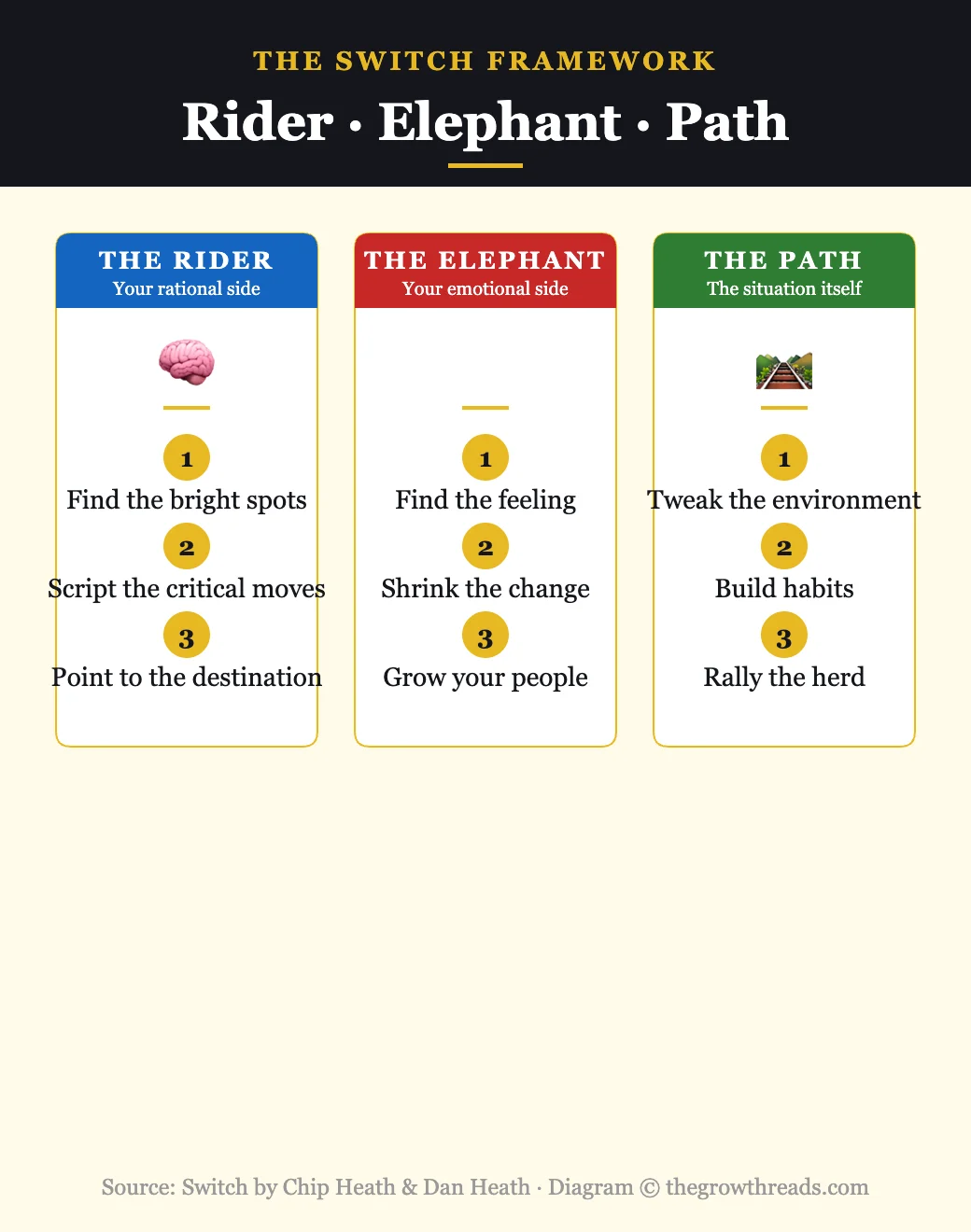
Change fails not because people are lazy, but because they are exhausted. Chip and Dan Heath argue that every change situation involves a tension between two systems: the Rider (your rational, analytical mind) and the Elephant (your emotional, instinctive side). When the Rider and Elephant disagree, the Elephant wins — it is simply bigger. The solution is a three-part framework: direct the Rider by providing crystal-clear direction, motivate the Elephant by connecting to emotion and making progress feel achievable, and shape the Path by redesigning the environment so the desired behaviour becomes the path of least resistance. The genius of Switch is showing that what looks like a people problem is almost always a situation problem.
Key takeaways
- What looks like resistance is often lack of clarity: When people do not change, the Rider is usually spinning — overanalysing options. Provide specific behavioural instructions, not abstract goals.
- What looks like laziness is often exhaustion: Self-control is an exhaustible resource. If the environment demands constant willpower, people will eventually give in — change the environment instead.
- Find the bright spots: Instead of analysing what is broken, study what is already working and clone it. This is the single most powerful move for directing the Rider.
- Script the critical moves: Ambiguity is the enemy of change. Tell people exactly what to do in the key moments, not “be more innovative” but “spend 15 minutes each Friday prototyping one new idea.”
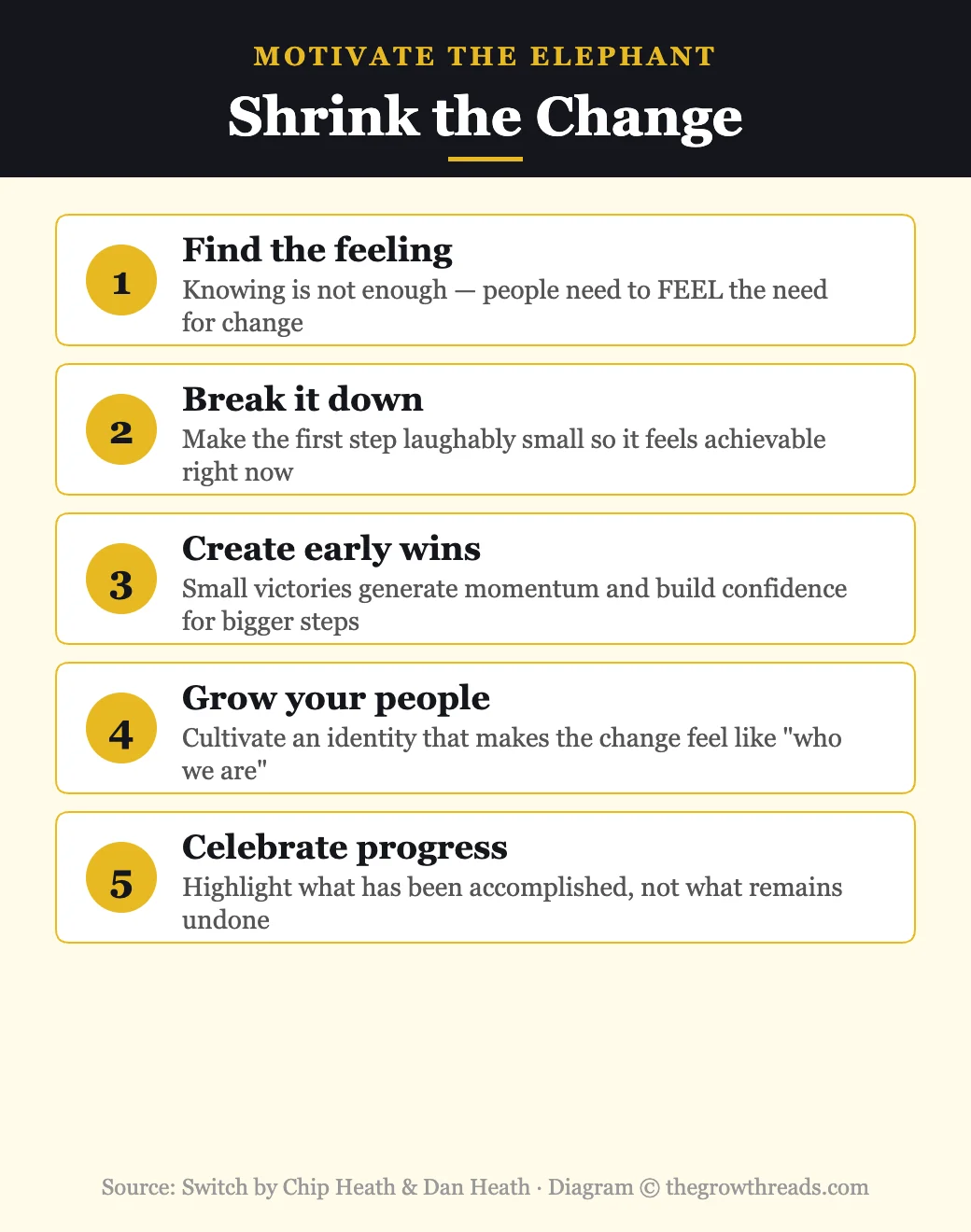
- Find the feeling: Knowledge rarely drives change — emotion does. Help people feel the problem, not just understand it analytically.
- Shrink the change: Make the first step so small it feels almost trivial. This gets the Elephant moving, and movement creates momentum.
- Grow your people: Cultivate a new identity. People act in ways consistent with who they believe they are — frame the change as an expression of identity, not a burden.
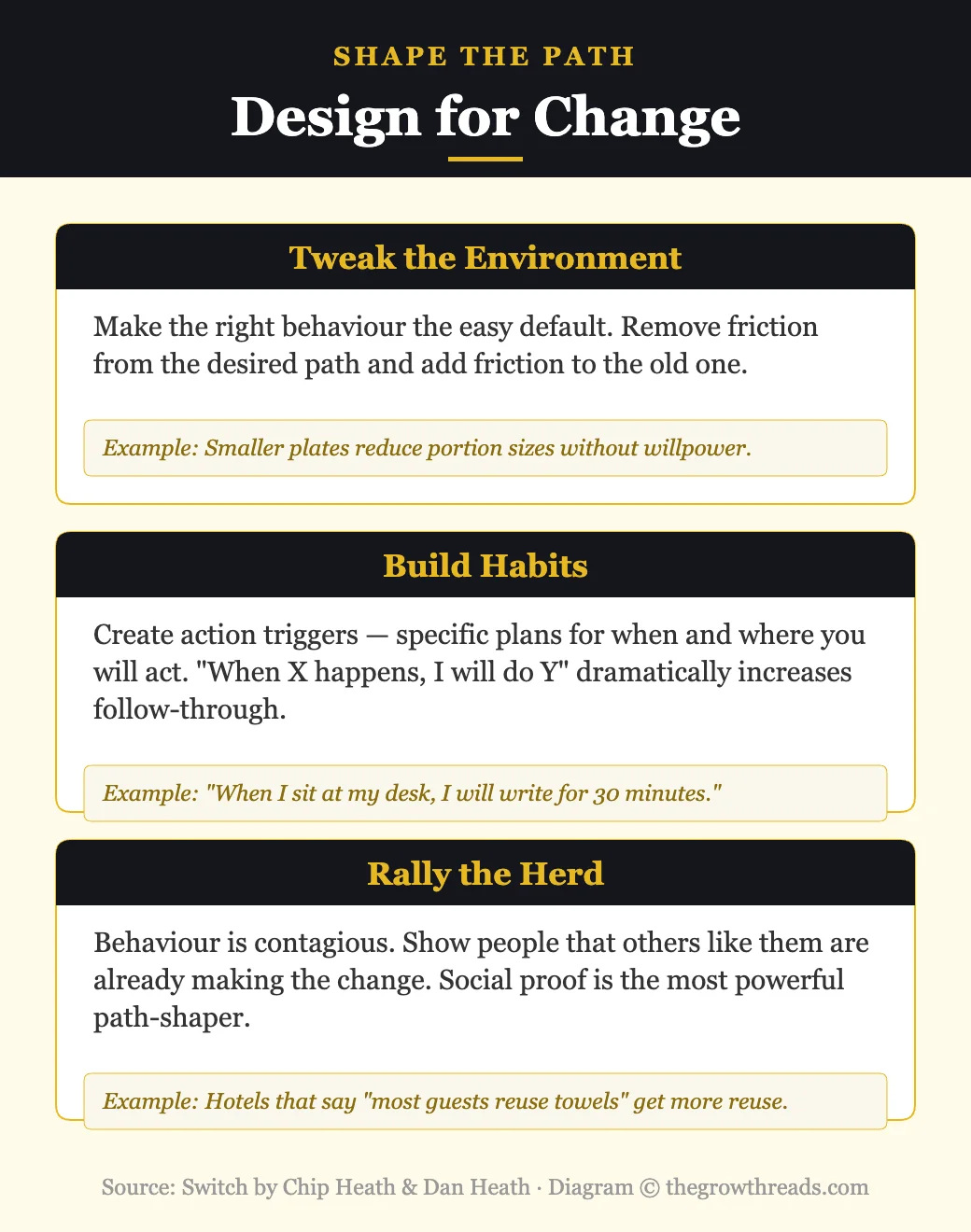
- Tweak the environment: Make the right behaviour the default. The most effective interventions redesign the situation rather than trying to change the person.
- Build habits with action triggers: “When situation X arises, I will do Y” — this simple if-then planning dramatically increases follow-through by reducing the need for deliberation.
- Rally the herd: Behaviour is contagious. Show people that others like them are already making the change, and social momentum will carry the rest.
What is Switch about?
Switch is a practical guide to making change happen — in your life, your organisation, or your community. Chip and Dan Heath present a three-part framework (direct the Rider, motivate the Elephant, shape the Path) drawn from psychology, behavioural economics, and case studies ranging from corporate turnarounds to public health campaigns to individual habit change.
About the author
Chip Heath is a professor at Stanford Graduate School of Business, where he studies why certain ideas survive and others die. Dan Heath is a senior fellow at Duke University’s CASE centre and a former researcher at Harvard Business School. Together they have written four New York Times bestsellers: Made to Stick, Switch, Decisive, and The Power of Moments. Their work blends rigorous academic research with vivid storytelling, and their books have been translated into 33 languages and sold millions of copies worldwide. They are widely regarded as two of the most gifted translators of behavioural science into practical application. Explore all Chip Heath & Dan Heath book summaries →
Key concepts at a glance
| Concept | What it means | Use it when |
|---|---|---|
| The Rider | The rational, analytical mind that plans and deliberates | People are overanalysing or paralysed by options |
| The Elephant | The emotional, instinctive side that provides energy for change | People understand the need for change but cannot get started |
| The Path | The situational environment that makes behaviour easy or hard | People keep failing despite good intentions |
| Bright Spots | Existing successes that can be studied and replicated | Looking for solutions instead of problems to diagnose |
| Shrink the Change | Making the first step trivially small to overcome inertia | The Elephant is overwhelmed by the size of the task |
| Action Triggers | Pre-decided if-then plans that automate behaviour | People intend to act but consistently forget or hesitate |
| Identity-Based Change | Framing change as who you are, not what you do | Building lasting motivation beyond initial enthusiasm |
| The Fundamental Attribution Error | Blaming people when the situation is the real cause | Diagnosing why change is not working |
Part 1: Direct the Rider
The Heaths open with a case study that encapsulates their entire philosophy. Jerry Sternin, working for Save the Children in Vietnam, was tasked with solving child malnutrition in rural villages — with no budget, no staff, and six months. Rather than analysing the causes of malnutrition (poverty, dirty water, ignorance — all true but all intractable), Sternin asked a different question: are there any children in this village who are well-nourished despite having the exact same resources as everyone else? There were. These “bright spot” families were doing three things differently: they fed their children four smaller meals instead of two large ones, they mixed sweet potato greens into the rice, and they actively hand-fed their children rather than letting them serve themselves. Sternin did not write a report. He organized cooking classes where mothers practiced these specific behaviours. Within six months, 65% of the children were better nourished. Within two years, the program had reached 2.2 million Vietnamese people.
The bright spots principle is the first and most powerful tool for directing the Rider. Instead of drowning in problem analysis (which gives the Rider an excuse to spin indefinitely), you study what is already working and systematically replicate it. The Heaths show how this principle applies everywhere: a company studying its best salespeople rather than its worst, a therapist asking “when is the problem less severe?” rather than digging into childhood roots, a school district finding classrooms where test scores are rising and asking what those teachers are doing differently.
The second tool is scripting the critical moves. The Rider is easily paralysed by ambiguity — the more options available, the more analysis required, and the more likely the Rider is to default to the status quo. The Heaths cite research showing that people asked to donate to a vague “hunger in Africa” cause gave far less than those asked to donate to feed a specific seven-year-old girl named Rokia. Specificity cuts through paralysis. In change situations, this means translating abstract goals into concrete behaviours: not “eat healthier” but “switch from whole milk to 1% milk.”
Part 2: Motivate the Elephant
The emotional dimension of change is where most rational plans die. The Heaths cite a study by Jonathan Haidt (whose elephant-and-rider metaphor they borrowed) showing that people are far more motivated by loss aversion and emotional connection than by logical arguments. Knowing that smoking causes cancer does not make people quit; seeing a diseased lung does. The Rider can see the destination, but only the Elephant has the energy to get there.
Finding the feeling is the first imperative. The Heaths describe a manufacturing company where a purchasing manager wanted to convince leadership that their procurement process was wasteful. He could have presented a spreadsheet of cost data. Instead, he collected one of every type of glove the company purchased — 424 different kinds, at wildly different prices — and piled them on the boardroom table. The visual, visceral impact of that pile of gloves achieved in thirty seconds what months of memos had failed to do. Change was approved immediately.
Shrinking the change addresses a different emotional obstacle: the Elephant’s tendency to be overwhelmed. When a task feels too large, the Elephant balks. The Heaths present the car wash loyalty card study: customers given a card requiring 8 stamps to earn a free wash were far less likely to complete it than customers given a card requiring 10 stamps but with 2 already filled in. Both groups needed 8 more washes — but the second group felt they had already started. The lesson: frame progress to show the Elephant it has already begun.
Growing your people — the identity dimension — is the deepest form of motivational change. The Heaths contrast a “consequences model” (what will I gain or lose?) with an “identity model” (who am I, and what would someone like me do?). They cite the St. Lucia parrot conservation campaign, where the endangered bird was reframed from a nuisance crop-raider into a symbol of national identity — appearing on passports, currency, and the national flag. Poaching dropped dramatically, not because penalties increased, but because killing a St. Lucia parrot became something “a St. Lucian would never do.”
Part 3: Shape the Path
The Heaths’ most counterintuitive insight is that what looks like a people problem is almost always a situation problem. They invoke the Fundamental Attribution Error — our tendency to attribute behaviour to character (“she is lazy”) rather than circumstance (“her environment makes the desired behaviour hard”). The antidote is environmental design: instead of trying to change the person, change the path they walk.
Tweaking the environment means making the right behaviour the default and the wrong behaviour require effort. The Heaths describe how Amazon redesigned its website so that one-click ordering became the default — removing every friction point between impulse and purchase. They describe how one company eliminated unnecessary meetings not by lecturing about time management but by reducing the default meeting length in the calendar system from 60 minutes to 30. In both cases, the environment did the work that willpower could not sustain.
Building habits through action triggers — pre-committed if-then plans — is presented with compelling research. Peter Gollwitzer’s studies show that people who make specific plans (“When I finish breakfast, I will walk for 20 minutes”) are dramatically more likely to follow through than those who merely set goals. The action trigger pre-loads the decision, eliminating the moment of deliberation where the Elephant can talk the Rider out of acting.
Rallying the herd leverages the social dimension of behaviour. The Heaths cite the famous hotel towel reuse study: a sign saying “75% of guests in this room reuse their towels” was far more effective than signs appealing to environmental responsibility. People follow what people like them do. In organisations, this means making early adopters visible, publicising success stories, and creating peer pressure that flows in the direction of the desired change.
Who is Switch best for — and who should read something else first?
Switch is ideal for managers leading organisational change, parents trying to shift family habits, educators designing behaviour interventions, and anyone who has ever been frustrated that knowing the right thing to do was not enough to actually do it. It is one of the most practical psychology books ever written — every chapter ends with actionable steps.
If you want a deeper dive into individual habit change specifically, start with Atomic Habits. If you want the academic research behind nudging and choice architecture, try Nudge first. Switch is the best bridge between personal behaviour change and organisational change management.
Questions to reflect on
- Think of a change you are struggling with — is the problem with your Rider (unclear direction), your Elephant (insufficient motivation), or your Path (an environment that works against you)?
- Where are the bright spots in your current situation — things that are already working that you could do more of?
- What is one way you could shrink a change you have been putting off to make the first step feel trivially easy?
- Is there a situation where you are blaming a “people problem” that might actually be an environment problem?
- What identity would make your desired change feel natural rather than forced?
🔥 Ready to make change happen — for real this time?
The Rider-Elephant-Path framework will change how you approach every change challenge, at home and at work.
How to apply Switch (7-day plan)
- Day 1 — Diagnose the system. Pick one change you want to make. Write down: What does the Rider need (clarity)? What does the Elephant need (motivation)? What does the Path need (environmental redesign)?
- Day 2 — Find the bright spots. Identify a time when the change was already happening, even partially. What was different about that situation? How can you replicate those conditions?
- Day 3 — Script the critical moves. Write down the specific behaviours required — not abstract goals but concrete actions. “At 9 AM I will [specific action] for [specific duration].”
- Day 4 — Find the feeling. Make the case for change emotional, not just logical. Show yourself (or your team) the gap between where you are and where you want to be in a way that creates urgency.
- Day 5 — Shrink the change. Take your scripted moves from Day 3 and cut them in half. Make the first step laughably small. Do it today — the only goal is to start.
- Day 6 — Shape the path. Identify one environmental tweak that would make the right behaviour easier. Remove a temptation, add a visual reminder, set a default, or change a physical layout.
- Day 7 — Rally the herd. Tell someone about your change. Find one other person who is making a similar change and connect with them. Social accountability and social proof multiply your momentum.
Frequently asked questions
What is the main idea of Switch?
The main idea is that successful change requires three things working together: a clear direction for the rational mind (the Rider), emotional motivation (the Elephant), and an environment designed to make the right behaviour easy (the Path). When change fails, it is almost always because one of these three elements is missing — not because people are lazy or resistant. The framework works for personal habits, team dynamics, and large-scale organisational transformation.
What is the Rider-Elephant-Path framework?
The Rider represents your rational, analytical side — it plans, analyses, and deliberates. The Elephant represents your emotional, instinctive side — it provides the energy and motivation for action. The Path is the situation or environment you operate in. The metaphor comes from Jonathan Haidt: a rider atop an elephant walking down a path. If the Rider and Elephant disagree, the Elephant wins because it is simply larger. Effective change must address all three: give the Rider clear direction, give the Elephant emotional motivation, and make the Path easier to follow.
What does “find the bright spots” mean?
Finding the bright spots means looking for existing successes rather than analysing failures. Instead of asking “what is wrong and how do we fix it?” you ask “what is already working and how do we do more of it?” The Heaths drew this concept from the positive deviance approach used by Jerry Sternin in Vietnam, where he identified well-nourished children in malnourished villages and studied what their families were doing differently. This approach avoids analysis paralysis and provides the Rider with a concrete, proven playbook.
How is Switch different from Atomic Habits?
Atomic Habits by James Clear focuses specifically on building and breaking individual habits through a four-step loop (cue, craving, response, reward). Switch addresses a broader challenge: how to make any kind of change happen, from personal to organisational. Switch provides a diagnostic framework (Rider, Elephant, Path) for understanding why change is stuck, while Atomic Habits provides a detailed system for the habit-building component. They complement each other well — Switch tells you which lever to pull, and Atomic Habits gives you the tools for one specific lever.
Can Switch be applied in organisations, not just personal life?
Absolutely — organisational change is one of the book’s primary applications. The Heaths draw extensively on corporate case studies: a hospital that reduced infections, a software company that transformed its culture, a government agency that improved citizen services. The framework is especially powerful for leaders because it reframes change resistance. Instead of blaming employees for not changing, it asks leaders to provide clearer direction (Rider), create emotional buy-in (Elephant), and redesign processes and environments (Path). Many management consultants consider it essential reading.
How long does it take to read Switch?
Switch is 305 pages and takes approximately 6 hours to read at an average pace. The book is structured in three main sections (Rider, Elephant, Path) with three chapters each, plus opening and closing chapters. It reads quickly because the Heaths are exceptional storytellers — each principle is illustrated with vivid case studies rather than abstract theory. The audiobook runs about 7 hours and 43 minutes. Most readers report finishing in 2–3 sittings.
What is the most important takeaway from Switch?
The single most important takeaway is that what looks like a people problem is almost always a situation problem. The Fundamental Attribution Error — our tendency to blame character rather than circumstance — is the biggest obstacle to effective change. When someone is not changing, the instinct is to push harder, motivate more, or explain better. Switch argues that the higher-leverage move is almost always to redesign the environment: make the right behaviour easier, make the wrong behaviour harder, and let the situation do the work that willpower cannot sustain.
Related summaries
- Atomic Habits by James Clear — The definitive system for building good habits and breaking bad ones.
- Nudge by Richard Thaler & Cass Sunstein — The academic foundation for choice architecture and behavioural design.
- Influence by Robert Cialdini — The six psychological principles that drive human behaviour.
- Mindset by Carol Dweck — How beliefs about ability shape growth and change.
📚 See all psychology book summaries
Related Psychology Summaries
Grit Summary & Review: The Power of Passion and Perseverance
The Confidence Gap Summary and Review
The Defining Decade Summary & Review: Why Your Twenties Matter
The Elephant in the Brain Summary and Review
The Paradox of Choice Summary & Review: Why Less Is More for Happiness