

⭐⭐⭐⭐ 4.0/5 — The definitive guide to why non-conformists succeed and how to become one.
Best for: Leaders, entrepreneurs, and anyone who wants to champion new ideas without being reckless.
Reading time: ~7 hrs
Difficulty to apply: Moderate — the concepts are clear but require courage to implement in group settings.
Originals in one minute
The people who drive change are not fearless risk-takers — they are careful, strategic, and prolific. Adam Grant, Wharton’s top-rated professor, dismantles the myth that originals are fundamentally different from the rest of us. Drawing on research from psychology, business, politics, and sports, he shows that originality is not a fixed trait but a choice and a skill. The book’s central insight is counterintuitive: the most successful originals hedge their bets, generate far more bad ideas than good ones, and often procrastinate strategically. Grant provides a practical playbook for recognizing, voicing, and championing new ideas — whether you are pitching to your boss, raising children to think independently, or building an organization that rewards dissent over groupthink.
Key takeaways
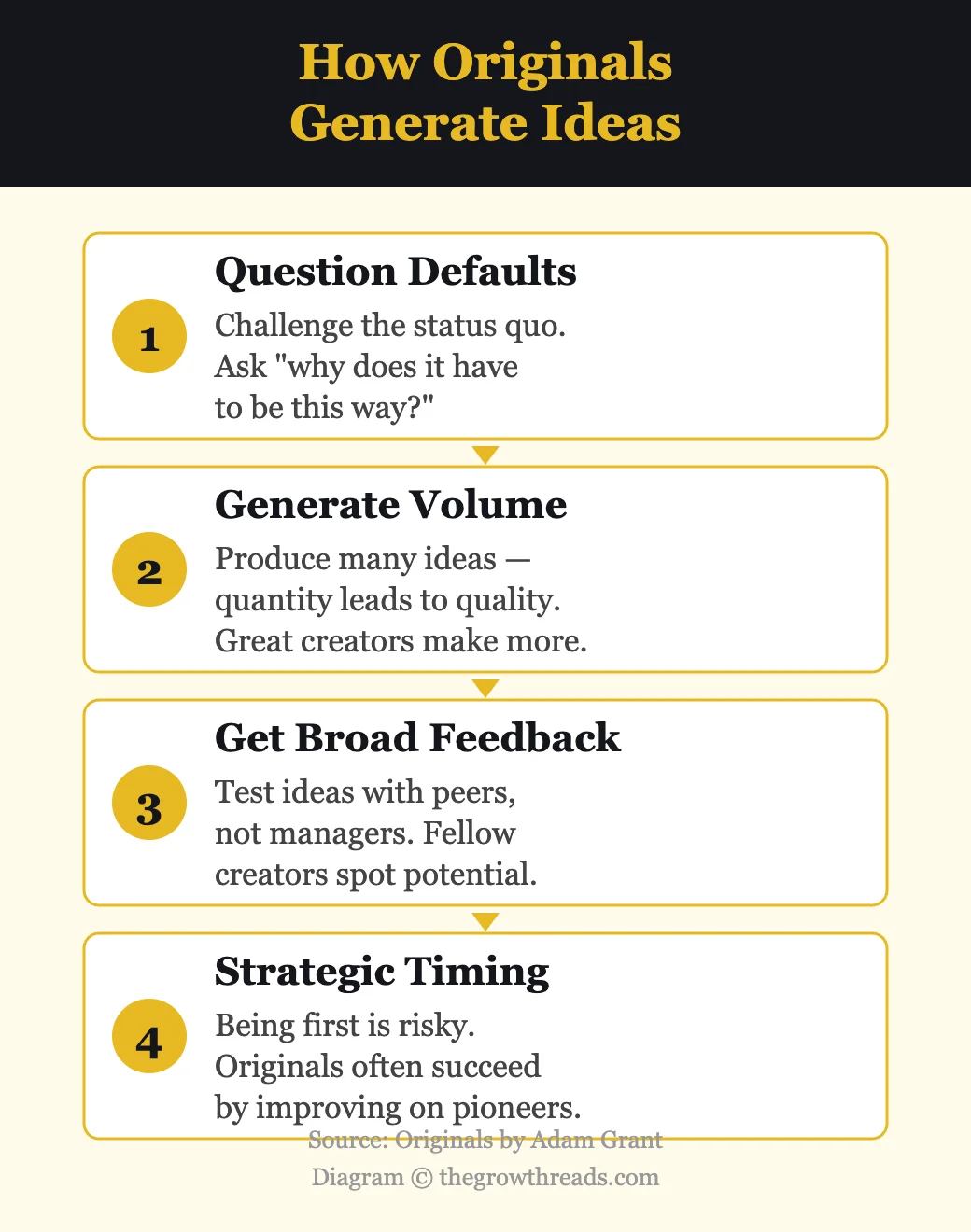
- Originals are not born — they choose to act: Creativity is a decision to question defaults rather than accept them. The first step to originality is simply asking “why does it have to be this way?”
- Quantity produces quality: The most original creators in history — Shakespeare, Picasso, Edison, Mozart — produced the highest volume of work. More attempts mean more chances for a breakthrough.
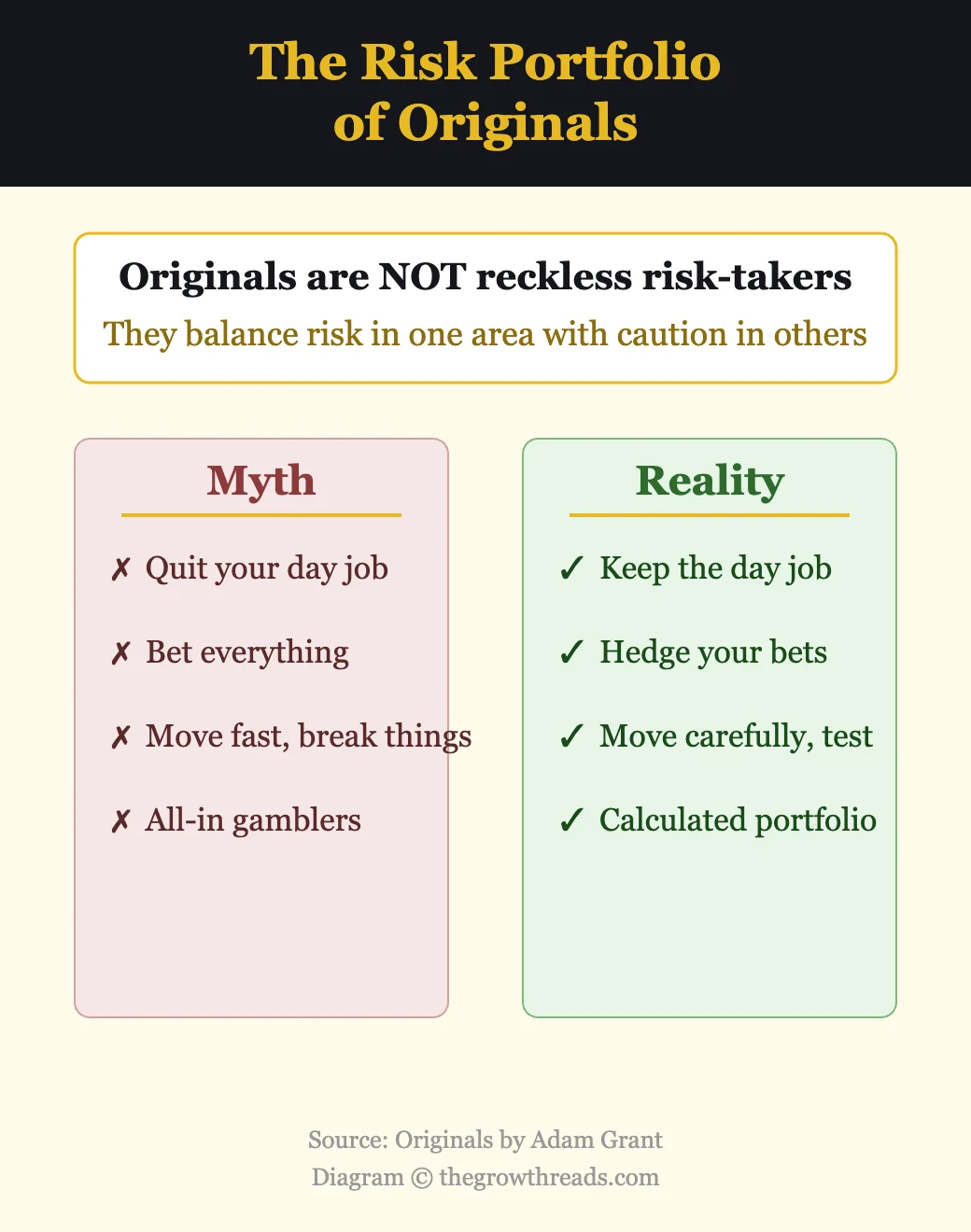
- Successful originals hedge their risk: Contrary to the “burn the boats” myth, the most impactful innovators kept their day jobs, maintained backup plans, and balanced bold bets with stability elsewhere in their lives.
- First-movers are overrated: Research shows that settlers — those who enter after pioneers — succeed more often because they learn from the pioneers’ mistakes and time the market better.
- Speak up with evidence, not passion: People who frame new ideas with data and acknowledge weaknesses upfront are more persuasive than those who rely on enthusiasm alone.
- Procrastination can fuel creativity: Moderate procrastination — delaying a task while actively thinking about it — allows ideas to incubate. Rushing to finish kills the divergent thinking that produces breakthroughs.
- Build coalitions with unlikely allies: Radical ideas gain traction faster when championed by people who seem moderate. Reframing extreme positions in familiar terms makes them palatable to skeptics.
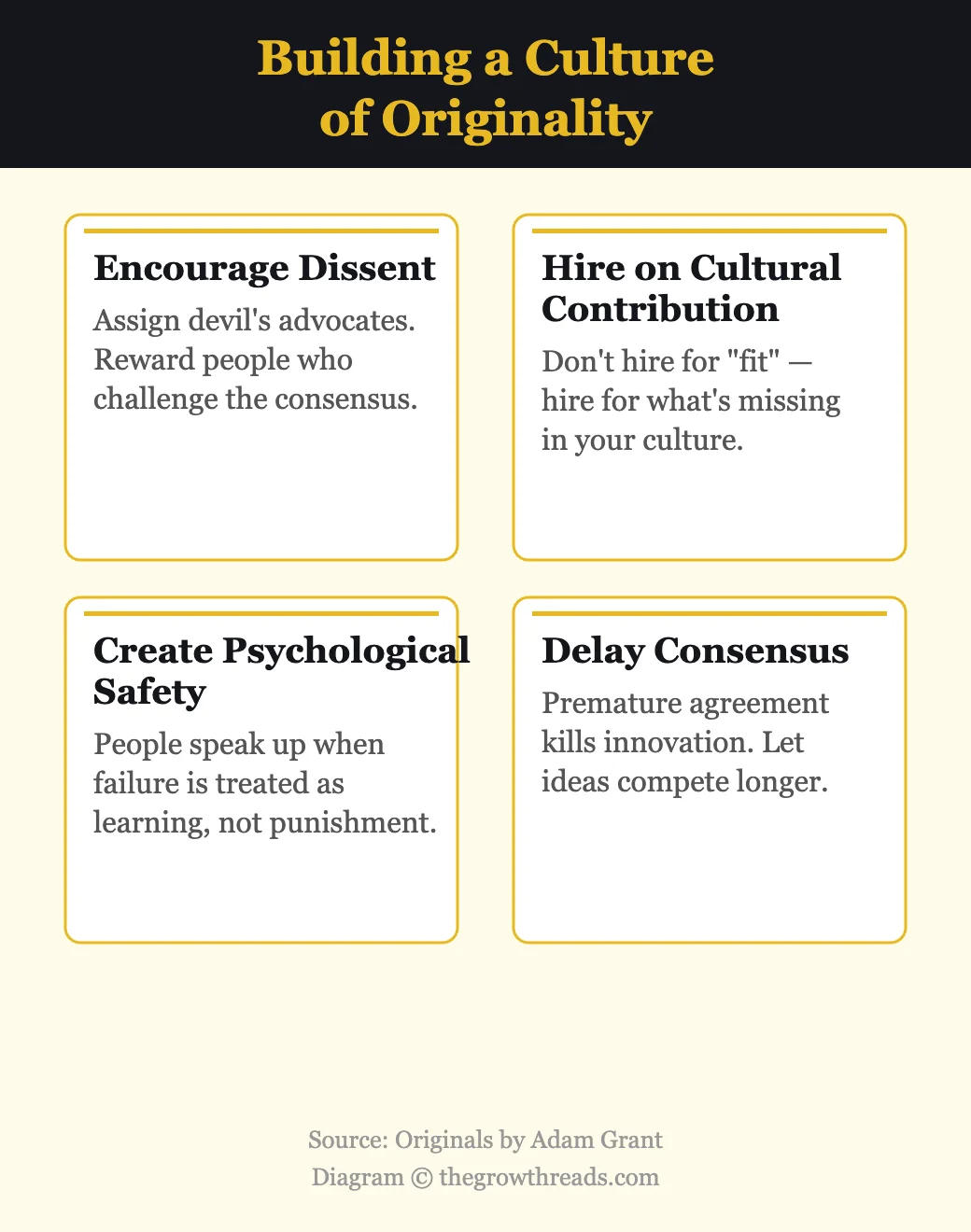
- Groupthink is the enemy of originality: The best teams assign devil’s advocates, encourage dissent, and delay consensus. Premature agreement produces mediocre outcomes.
- Birth order shapes originality: Later-born children tend to be more original because they must find unconventional niches to stand out. But birth order is a tendency, not a destiny — any child can be raised to question defaults.
- Culture is a verb, not a noun: Organizations that sustain originality hire for cultural contribution (not cultural fit), reward candor, and treat failure as data rather than disgrace.
What is Originals about?
Originals examines how people champion new ideas and fight conformity — in business, politics, and everyday life. Adam Grant combines original research with stories of entrepreneurs, activists, and artists to show that creativity is a learnable skill, not an inborn gift, and that the path to impact runs through strategic risk-taking, prolific output, and building cultures that welcome dissent.
About the author
Adam Grant is an organizational psychologist at the Wharton School of the University of Pennsylvania, where he has been the top-rated professor for seven consecutive years. His research on motivation, generosity, and original thinking has been published in top academic journals and featured in outlets from the New York Times to TED (his talks have been viewed over 30 million times). His previous book Give and Take was a New York Times bestseller and was named one of the best books of the year by Amazon, the Financial Times, and the Wall Street Journal. Grant also hosts the podcast WorkLife and serves as an advisor to organizations including Google, Goldman Sachs, and the Gates Foundation. Explore all Adam Grant book summaries →
Key concepts at a glance
| Concept | What it means | Use it when |
|---|---|---|
| Vuja dé | Seeing familiar things with fresh eyes — the opposite of déjà vu | You feel stuck in a routine and need to spot hidden opportunities |
| The risk portfolio | Originals offset bold bets by being conservative elsewhere in life | You want to pursue a creative venture without financial ruin |
| The first-mover disadvantage | Pioneers often fail; settlers who enter later win more often | You are debating whether to rush to market or wait and refine |
| Strategic procrastination | Delaying work while thinking about it allows incubation | You are tackling a creative problem and feel pressured to ship fast |
| Tempered radicals | Moderate allies are more effective champions for extreme ideas | You need organizational buy-in for a disruptive proposal |
| Devil’s advocacy | Assigning someone to argue against the consensus | Your team is converging too quickly on a single option |
| Cultural contribution | Hiring for what the culture is missing, not what it already has | Your organization values conformity over diverse perspectives |
| Kill-the-company exercise | Asking teams to brainstorm how competitors could destroy them | You want to surface threats and uncover innovative defensive strategies |
Part 1: Seeing differently — the psychology of originals
Grant opens with a study that most readers will not expect: internet browser choice predicts job performance. Employees who switched from the default browser (Internet Explorer or Safari) to Chrome or Firefox showed 15% higher sales, lower absenteeism, and longer tenure. The reason is not technical — it is psychological. Switching browsers signals a willingness to question defaults, and that disposition cascades into how people approach their work.
This “vuja dé” mindset — seeing familiar things as if for the first time — is the common thread Grant finds across originals in every domain. He profiles entrepreneurs like Warby Parker’s founders, who noticed that a single company (Luxottica) controlled 80% of the eyeglass market and asked why glasses should cost as much as a smartphone. Grant walks through the research on creativity, showing that the most original people are not those with the highest IQ or the most expertise. They are the ones who consume the broadest range of experiences: Nobel Prize-winning scientists are 22 times more likely than their peers to be actors, dancers, or magicians.
The section culminates in a direct challenge to the myth of the fearless entrepreneur. Grant reveals that the Warby Parker founders kept their day jobs, applied to backup grad schools, and hedged every major bet. Sara Blakely developed Spanx while keeping her full-time job selling fax machines. Phil Knight sold shoes out of his car trunk while working as an accountant. The data is clear: the most successful originals are not reckless — they are strategic risk managers who balance audacity in one domain with security in another.
Part 2: Voicing and timing ideas
Having an original idea is only the beginning. The harder problem, Grant argues, is getting anyone to listen. This section examines the psychology of persuasion and timing — why some ideas gain traction while equally good ones die in silence.
Grant introduces the “Sarick Effect,” named after a study where entrepreneurs who highlighted the weaknesses of their own pitch were more successful at securing funding. The logic is simple: when you lead with a limitation, the audience shifts from a critical mindset (“what’s wrong with this?”) to a problem-solving mindset (“how could that be fixed?”). This reversal of the typical sales pitch is one of the book’s most actionable tactics.
On timing, Grant demolishes the first-mover advantage. Analyzing 48 product categories, researchers found that first movers had a 47% failure rate compared to just 8% for settlers who entered later. Grant uses case studies including Friendster versus Facebook, Netscape versus Google, and Segway versus modern e-scooters to show that being first is often a liability. The ideal timing is to enter after the pioneers have educated the market and revealed the pitfalls, but before the market has consolidated around a dominant player.
The section’s most provocative argument concerns procrastination. Grant cites his own research showing that moderate procrastinators produce more creative work than either chronic procrastinators or people who finish immediately. The incubation period — when the task sits in the back of your mind while you do other things — allows the brain to make unexpected connections. Martin Luther King Jr. improvised the most famous portion of his “I Have a Dream” speech; Leonardo da Vinci took 16 years to finish the Mona Lisa. Strategic delay is not laziness — it is creative fuel.
Part 3: Building movements and managing emotions
The final section scales from individual originality to collective action. Grant examines how movements form, how alliances are built between unlikely partners, and how originals manage the fear and doubt that inevitably accompany going against the grain.
Grant introduces the concept of “tempered radicals” — people who hold radical views but express them in ways that feel moderate. The civil rights movement succeeded in part because leaders framed their demands in the language of the Constitution and the Declaration of Independence, making radical equality sound like a return to founding principles rather than a departure from them. Grant applies this to business: the most effective change agents in organizations are not the loudest protesters but the people who package disruptive ideas in familiar language.
On building coalitions, Grant makes a counterintuitive argument: the most effective allies for a radical idea are not fellow radicals but moderates who lend credibility. He walks through research on political movements, startup fundraising, and organizational change to show that broad coalitions beat ideological purity every time.
The section on managing emotions is especially practical. Grant distinguishes between “defensive pessimism” — imagining everything that could go wrong and preparing for it — and “strategic optimism” — choosing to focus on the upside. He shows that the right strategy depends on your personality: anxious people perform better with defensive pessimism (because it channels their worry into preparation), while naturally calm people perform better with optimism. The key is knowing which type you are and using the approach that matches your wiring.
Who is Originals best for — and who should read something else first?
Best for: Managers and leaders who want to build teams that innovate rather than conform. Entrepreneurs evaluating when and how to launch. Anyone who has ideas they want to champion but struggles with the fear of speaking up. Parents who want to raise children who think independently.
Read something else first if: You want a tighter focus on personal habit change — start with Atomic Habits. If you are looking for a deep dive into persuasion mechanics, Influence by Cialdini is more specialized. And if you want organizational psychology focused on collaboration rather than originality, Grant’s own Give and Take is the better starting point.
Questions to reflect on
- What default in my work or personal life have I accepted without questioning — and what would happen if I challenged it this week?
- Am I generating enough ideas, or am I self-editing too early and killing potential breakthroughs before they can develop?
- Where am I taking too much risk by going all-in? What would a balanced risk portfolio look like for my current situation?
- When was the last time someone on my team disagreed with me openly — and did I reward or discourage that behavior?
- Am I naturally a defensive pessimist or a strategic optimist, and am I using the emotional strategy that actually works for my personality?
🔥 Ready to champion your original ideas?
Learn why non-conformists succeed — and how to become one without burning the boats.
How to apply Originals (7-day plan)
- Day 1 — Question one default: Pick one routine, process, or assumption at work that everyone takes for granted. Write down why it exists and whether the original reason still applies. Share your observation with a colleague.
- Day 2 — Generate ten ideas: Set a timer for 20 minutes and brainstorm ten possible improvements to anything in your life — no filtering, no judgment. The goal is volume, not quality. Circle the two most surprising ideas.
- Day 3 — Lead with weakness: In your next pitch or proposal, open by naming the biggest objection yourself. Notice how the conversation shifts from critique to problem-solving.
- Day 4 — Audit your risk portfolio: List the bold bets you are currently making. For each one, identify a hedge — a safety net that lets you take the creative risk without catastrophic downside.
- Day 5 — Assign a devil’s advocate: In your next team meeting, explicitly ask one person to argue against the emerging consensus. Reward them for the quality of their dissent, not for agreeing.
- Day 6 — Procrastinate on purpose: Take a creative challenge you are working on and deliberately step away from it for 24 hours. Do something unrelated. Return to it tomorrow and notice what new ideas emerged during the break.
- Day 7 — Find an unlikely ally: Identify one person who would not obviously support your idea but whose endorsement would carry weight. Figure out how to frame your proposal in terms they already care about, and have the conversation.
Frequently asked questions
Is Originals worth reading?
Yes — particularly if you work in an organization where new ideas struggle to get traction. Grant’s combination of rigorous research and compelling storytelling makes abstract psychology concepts immediately actionable. The book is especially valuable for managers, because it provides concrete tactics for building teams that innovate rather than conform. If you enjoyed Think Again or Give and Take, this is Grant at his best.
What is the main argument of Originals?
Grant argues that originality is not an inborn trait reserved for a lucky few — it is a set of habits and strategies that anyone can learn. The book’s central thesis is that successful non-conformists are not reckless risk-takers; they are strategic thinkers who generate many ideas, hedge their bets, time their moves carefully, and build coalitions to champion change. The path to originality runs through volume, prudence, and persistence — not genius or bravery alone.
How is Originals different from other creativity books?
Most creativity books focus on individual techniques — how to brainstorm better, think laterally, or overcome blocks. Grant takes a broader view, covering the psychology of persuasion, timing, coalition-building, and organizational culture. The book is less about having creative ideas and more about getting those ideas adopted in the real world, making it uniquely practical for leaders and change agents.
Is procrastination really good for creativity?
Grant’s argument is nuanced. He distinguishes between chronic procrastination (which hurts performance), moderate strategic procrastination (which helps creativity), and immediate task completion (which produces conventional results). The sweet spot is starting a creative project, then deliberately stepping away to let ideas incubate, before returning with fresh perspective. This works for creative tasks where the solution is unknown — not for routine execution tasks.
Does birth order really affect originality?
Grant presents research showing that later-born children tend to be more willing to challenge the status quo, partly because they need to differentiate themselves from older siblings. However, he emphasizes that birth order is a statistical tendency, not a deterministic force. Parenting style, exposure to diverse experiences, and individual choices matter far more. Any person — firstborn or last — can develop an original mindset through deliberate practice.
What should I read after Originals?
For more on challenging assumptions, try Think Again by Adam Grant (his follow-up on intellectual humility). For the psychology of persuasion, read Influence by Robert Cialdini. For building innovative organizations, Creativity, Inc. by Ed Catmull shows how Pixar institutionalized the principles Grant describes. And for the individual mindset beneath originality, Mindset by Carol Dweck provides the growth mindset foundation that enables non-conformity.
Can Originals help me be more creative at work?
Absolutely — and the book’s value extends beyond personal creativity to organizational impact. Grant provides specific tactics for pitching ideas, managing timing, building support, and creating psychological safety. The “kill the company” exercise alone — where teams brainstorm how competitors could destroy them — has been adopted by companies from Bridgewater to Google as a tool for surfacing innovation. If you want both personal and organizational creativity, this is the book.
Related summaries
If Originals resonated with you, explore these related summaries:
- Mindset — Carol Dweck’s growth mindset is the psychological foundation beneath originality
- Influence — The science of persuasion that complements Grant’s ideas on championing change
- Creativity, Inc. — How Pixar built a culture of candor and creative excellence
- Thinking, Fast and Slow — The cognitive biases that originals must overcome to see clearly