

★★★★☆ 4.4 / 5
One-liner: The definitive guide to recognizing toxic parenting patterns, understanding how they shaped you, and reclaiming your emotional freedom through confrontation and boundary-setting.
Best for: Adults who grew up in dysfunctional families and are ready to understand the impact and begin healing — especially those still enmeshed with controlling or abusive parents.
Reading time: ~6 hours (326 pages)
Difficulty to apply: High — the confrontation exercises are emotionally demanding and often benefit from professional therapeutic support.
Toxic Parents in one minute
You are not responsible for what was done to you as a child — but you are responsible for taking action to heal. That is the core message of Susan Forward’s Toxic Parents, a book that gave millions of adult children the language to name what happened to them and the framework to stop the cycle. Forward identifies six types of toxic parents — from the inadequate to the physically and sexually abusive — and shows how each type creates a “family system” where the child absorbs blame, suppresses emotions, and carries the damage into adult relationships. The second half of the book is pure therapy: step-by-step exercises for confronting your parents (even if only on paper), setting non-negotiable boundaries, and releasing the guilt that keeps you trapped in the role of family caretaker.
Key takeaways
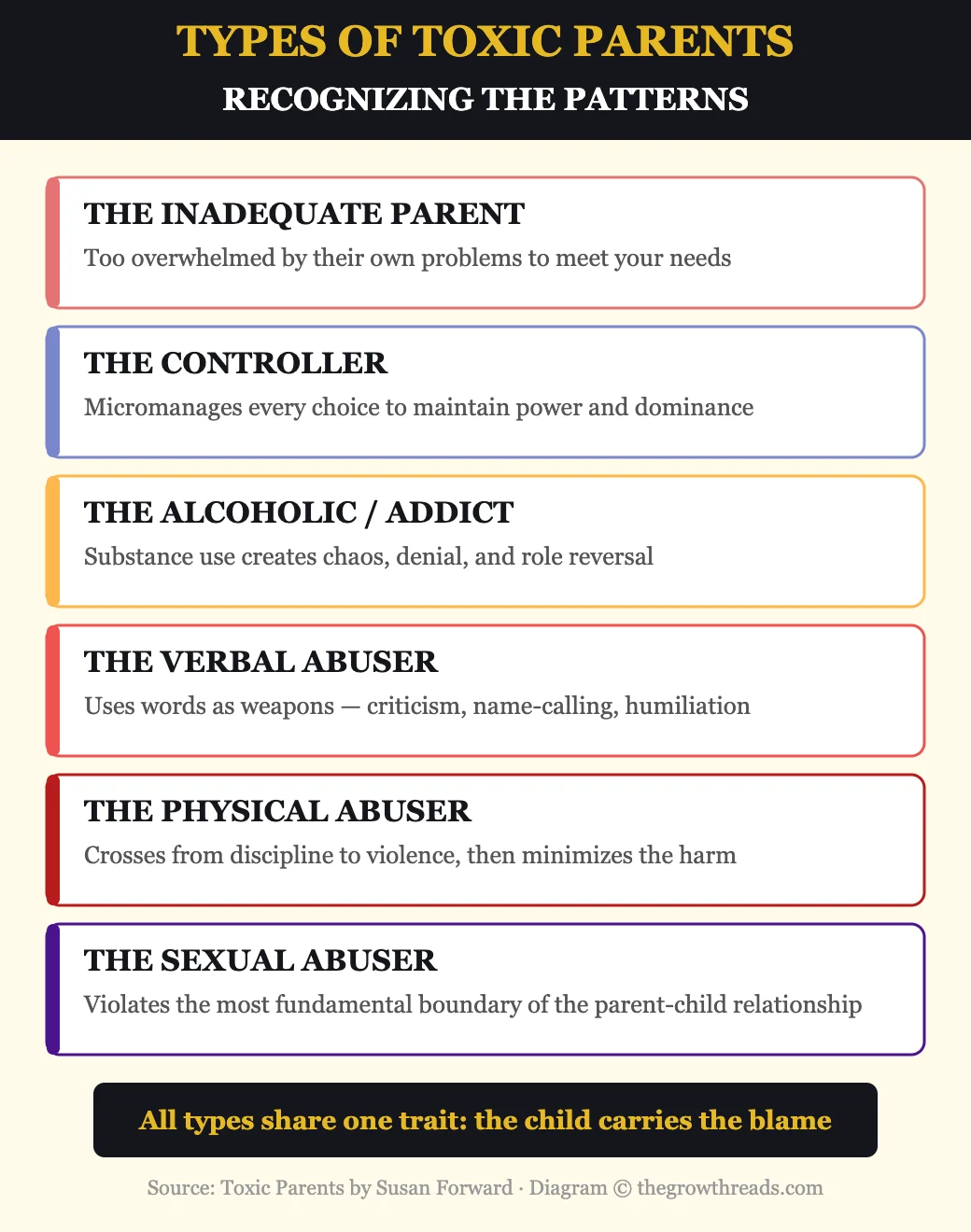
- Toxic parents come in six patterns: The inadequate parent, the controller, the alcoholic/addict, the verbal abuser, the physical abuser, and the sexual abuser — each leaves a distinct emotional imprint.
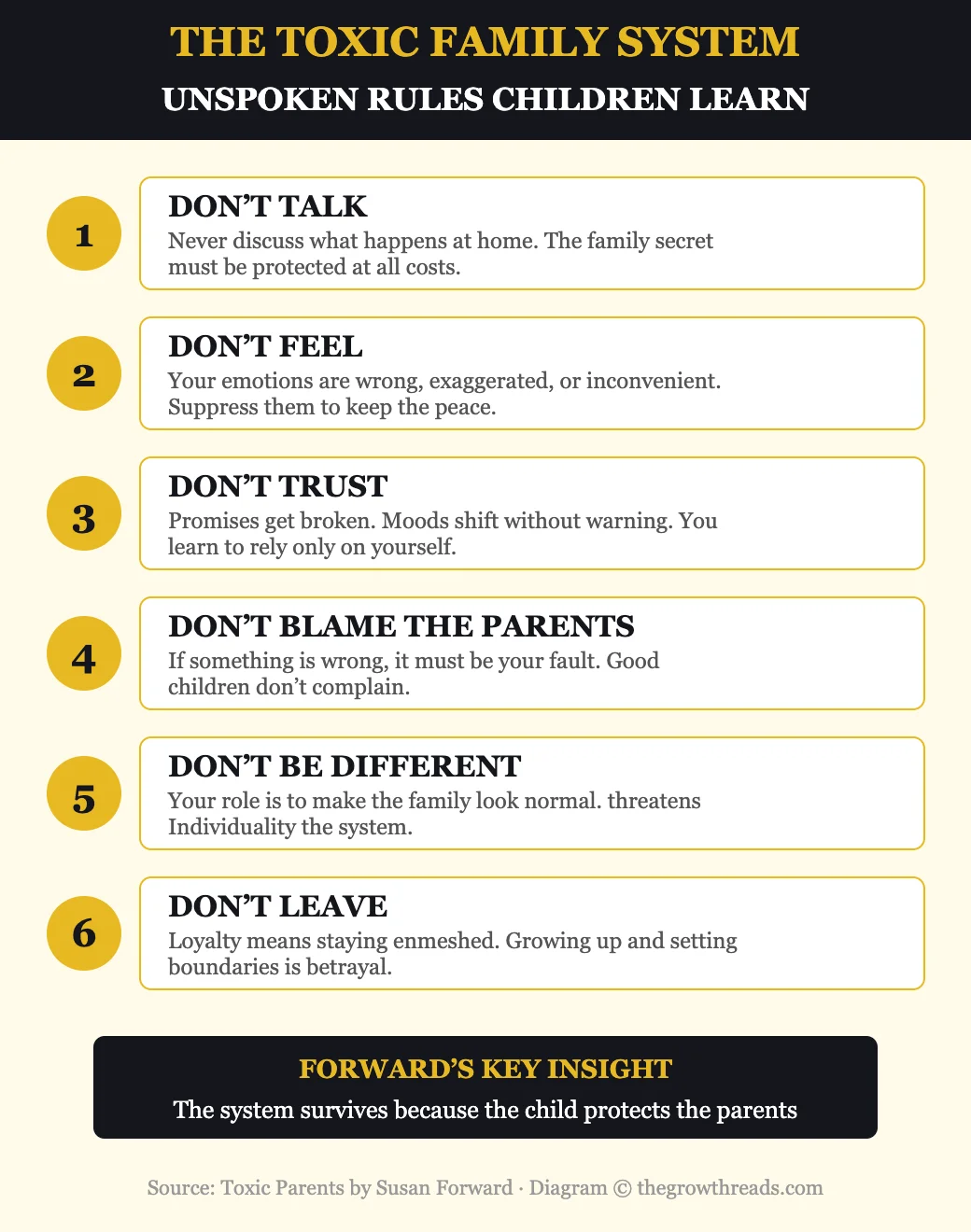
- The family system protects the parents, not the child: Unspoken rules — don’t talk, don’t feel, don’t trust, don’t blame the parents — keep the dysfunction invisible from the outside.
- Children always blame themselves: Because depending on your parents is a survival need, it feels safer to believe “I’m bad” than “my parents are unsafe.” This self-blame follows you into adulthood.
- Toxic patterns repeat across generations: Without intervention, adults who were parented toxically tend to replicate the same dynamics in their own relationships and with their own children.
- Confrontation is therapeutic, not punitive: Forward’s confrontation process is designed to free you — not to change your parents. Whether they respond well or badly, you have reclaimed your voice.
- Boundaries are not betrayal: Setting limits with toxic parents feels like disloyalty because the family system was designed to prevent exactly this. Boundaries are the foundation of healing.
- Forgiveness is optional and cannot be rushed: Forward pushes back against the pressure to “forgive and forget,” arguing that premature forgiveness often serves the abuser, not the survivor.
- Emotional independence requires grief: You have to mourn the parents you deserved but never had before you can fully separate from the parents you got.
- You don’t need your parents’ permission to heal: The confrontation can happen in a letter you never send, a conversation with an empty chair, or a therapy session — their participation is not required.
- The goal is not to cut off — it is to choose: Some people maintain contact with new boundaries; others reduce or end it. The point is that the relationship becomes your choice, not your obligation.
What is Toxic Parents about?
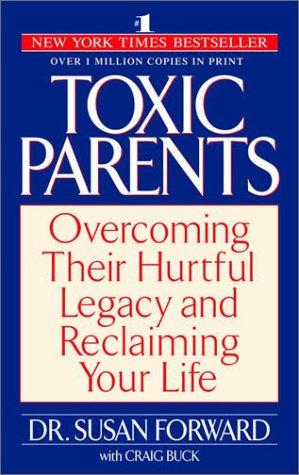
Toxic Parents is a psychology and self-help classic by therapist Susan Forward that identifies six types of dysfunctional parenting, explains how each pattern damages children into adulthood, and provides a step-by-step healing process including confrontation techniques and boundary-setting exercises. First published in 1989, it remains the foundational text on recognizing and recovering from toxic family dynamics.
About the author
Susan Forward is a therapist, lecturer, and author who has specialized in toxic relationships, emotional abuse, and dysfunctional family dynamics for over four decades. She has been a group therapist, instructor, and consultant for the California Department of Social Services. Her private practice in Los Angeles has treated thousands of patients dealing with the aftermath of toxic parenting. Forward has written several bestselling books including Emotional Blackmail and Men Who Hate Women and the Women Who Love Them. She is known for her direct, no-nonsense therapeutic style that prioritizes the client’s wellbeing over family loyalty or social convention. Toxic Parents, co-written with Craig Buck, has sold millions of copies worldwide and has been translated into fifteen languages. Explore all Susan Forward book summaries →
Key concepts at a glance
| Concept | What it means | Use it when |
|---|---|---|
| The Toxic Family System | Unspoken rules that protect the parents and silence the children | Recognizing why you still feel guilty for having needs |
| Internalized Blame | Children absorb fault for parental dysfunction as a survival mechanism | Understanding why you default to self-criticism in relationships |
| Confrontation | A structured process of telling your truth to (or about) your parents | When you are ready to reclaim your voice with professional support |
| Non-Negotiable Boundaries | Limits you set and enforce regardless of parental reaction | Every interaction with a toxic parent going forward |
| Emotional Independence | Separating your self-worth from parental approval or disapproval | The ongoing practice of adult self-definition |
| Generational Transmission | Toxic patterns pass from parent to child unless consciously interrupted | Deciding how you want to parent or relate to partners |
| Role Reversal | Children becoming emotional caretakers for their own parents | Recognizing when you are parenting your parent |
| Premature Forgiveness | Forgiving before processing — it suppresses rather than heals | When others pressure you to “just forgive” and move on |
Part 1: Identifying the patterns — the six types of toxic parents
Forward opens by establishing a crucial distinction: all parents make mistakes, but toxic parents create a consistent pattern of behavior that dominates a child’s life and causes lasting damage. The difference is not the occasional bad day — it is the relentless, systemic nature of the dysfunction. She then walks through six distinct types.
The inadequate parent is the one most people struggle to name as toxic because the harm comes from absence rather than aggression. These parents are so consumed by their own emotional needs — depression, anxiety, illness, or simply immaturity — that they reverse roles with their children. The child becomes the caretaker, the emotional support, the miniature adult. The damage is subtle but deep: the child learns that their own needs do not matter and that love is earned by serving others.
The controller uses manipulation, guilt, and sometimes rage to maintain dominance over every aspect of the child’s life — from friendships to career choices to whom they marry. Forward distinguishes between overt controllers (who use direct commands and threats) and covert controllers (who use helplessness, illness, or emotional withdrawal to get compliance). Both types produce adults who either cannot make decisions without permission or who rebel so completely that they define themselves entirely in opposition to their parents.
The alcoholic or addicted parent creates a household defined by unpredictability, denial, and shame. The child never knows which parent will walk through the door — the sober, loving one or the intoxicated, volatile one. Forward explains how this chaos produces hypervigilant adults who are constantly scanning for danger, people-pleasing to prevent explosions, and struggling with trust in every relationship.
Part 2: How the system works — the unspoken rules
Forward devotes several chapters to explaining why toxic family dynamics are so hard to see from the inside. The answer is the family system — a set of unspoken rules that every member absorbs without anyone explicitly stating them. The core rules are: don’t talk about what happens at home, don’t feel (or at least don’t show your feelings), don’t trust (because promises are unreliable), don’t blame the parents, don’t be different, and don’t leave.
These rules serve a single purpose: protecting the parents from accountability. If the child talks, the family’s public image cracks. If the child feels, they might express anger or pain that forces the parents to confront their behavior. If the child trusts anyone outside the family, they might tell the truth. The system is self-reinforcing because the child who breaks any of these rules is punished — with withdrawal of love, guilt-tripping, rage, or being labeled the “problem child.”
The most insidious rule is the last one: don’t leave. Forward explains that many toxic families use emotional enmeshment to prevent children from developing autonomy. Growing up, having your own opinions, choosing your own partner, or setting boundaries are all framed as betrayal. The adult child who tries to individuate is hit with guilt (“After everything we’ve done for you”), martyrdom (“You’re killing your mother”), or outright hostility (“You think you’re better than us”). The result is adults who remain emotionally hostage to their parents well into their 30s, 40s, and beyond.
Part 3: The confrontation and healing process
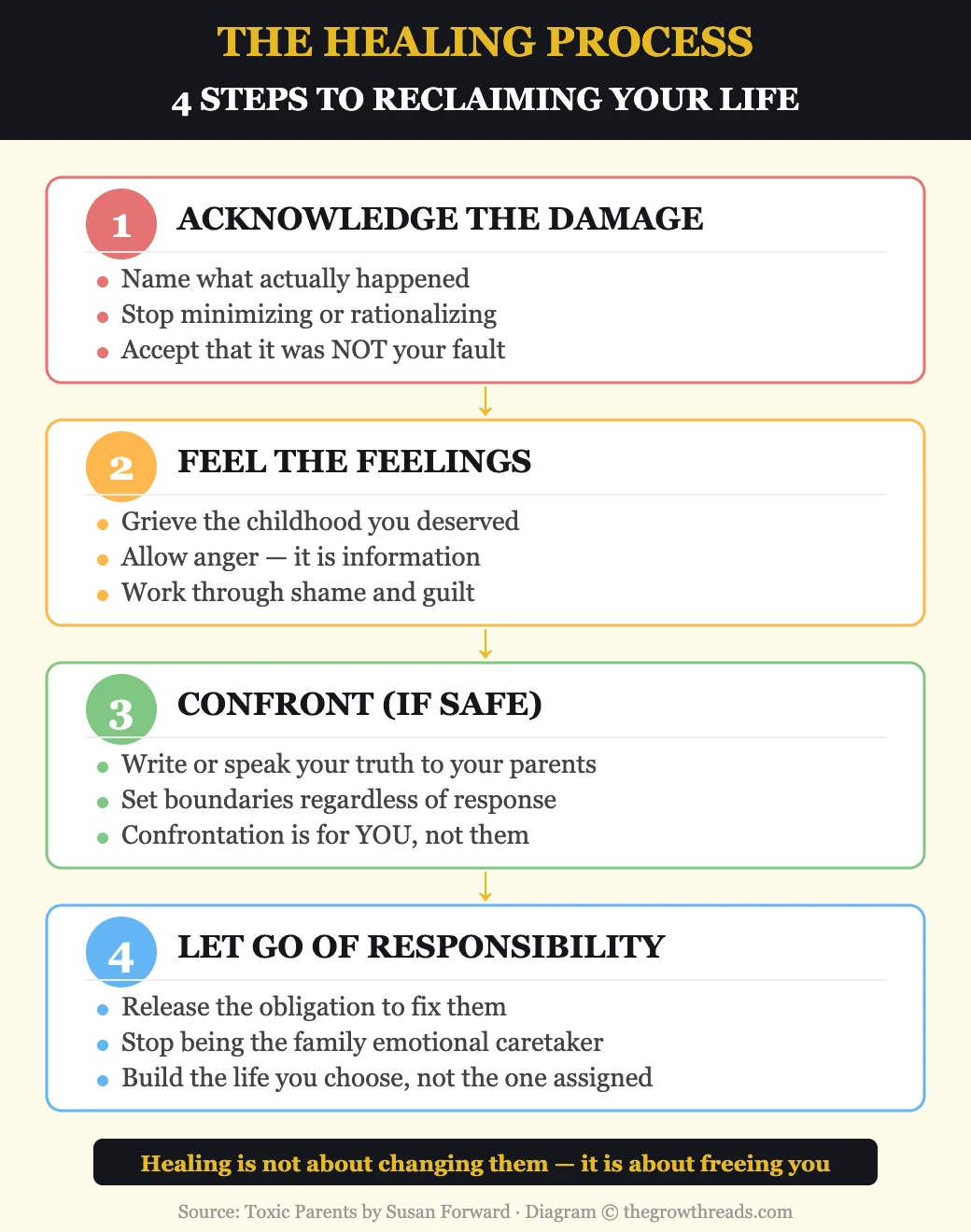
The second half of Toxic Parents shifts from diagnosis to treatment. Forward presents a four-step healing process: acknowledge the damage, feel the feelings, confront the parents (if safe), and let go of responsibility for their behavior.
Acknowledgment means calling what happened by its real name. Not “my parents were strict” but “my parents were controlling.” Not “things were tough at home” but “my father was an alcoholic and my mother enabled him.” Forward argues that euphemism is the enemy of healing — as long as you soften the language, you soften the reality, and you continue to carry blame that does not belong to you.
Feeling the feelings means allowing yourself to grieve the childhood you deserved but did not get. Many adult children of toxic parents have spent decades suppressing sadness, anger, and pain. Forward encourages clients to let these emotions surface — ideally in a therapeutic setting — because emotions that are not processed do not disappear; they drive behavior from underground. The anger you cannot express toward your parents becomes depression, anxiety, or rage directed at partners, children, or yourself.
Confrontation is the most controversial and most powerful step. Forward provides detailed scripts and guidelines for confronting toxic parents — either face-to-face, by letter, or symbolically (an empty chair, a letter you do not send). She is clear: the confrontation is for you, not for them. Whether they apologize, deny, rage, or go silent, you have said your truth. That act itself is transformative. For situations where confrontation would be physically or emotionally unsafe, Forward provides alternative exercises that achieve the same internal liberation.
The final step — letting go of responsibility — means accepting that you cannot fix your parents, that their emotional wellbeing is not your job, and that maintaining a relationship with them is a choice, not an obligation. Some clients maintain contact with strong boundaries. Others reduce contact. Some end it entirely. Forward supports all three options, provided the decision comes from clarity rather than guilt.
Who is Toxic Parents best for — and who should read something else first?
This book is essential for any adult who suspects their childhood was more damaging than they have allowed themselves to acknowledge — especially those who are still in contact with controlling, critical, or manipulative parents. It is also invaluable for therapists and counselors working with clients from dysfunctional families.
If you are dealing specifically with emotionally distant or immature (but not overtly abusive) parents, start with Adult Children of Emotionally Immature Parents, which covers the subtler end of the spectrum. If your primary struggle is codependency in relationships rather than the parent-child dynamic, Codependent No More is the better starting point. And if you are ready for trauma processing at a somatic level, The Body Keeps the Score goes deeper into how the body holds childhood wounds.
Questions to reflect on
- Which of Forward’s six toxic parent types — if any — most closely resembles the dynamics I experienced growing up?
- Which of the “unspoken rules” (don’t talk, don’t feel, don’t trust, don’t blame, don’t be different, don’t leave) am I still following in my adult life?
- When I think about setting a boundary with a family member, what is the first emotion that arises — and whose voice is behind it?
- Have I ever been pressured to “just forgive” before I felt ready — and how did that affect my healing?
- If I could say one thing to my parents with zero consequences, what would it be?
🔥 Ready to break free from toxic family patterns?
Get Susan Forward’s groundbreaking guide to recognizing toxic parenting, setting boundaries, and reclaiming your life.
How to apply Toxic Parents (7-day plan)
- Day 1 — Take Forward’s self-assessment: Write down three specific incidents from childhood that still carry an emotional charge. For each, note who was responsible and who got blamed. Notice if you instinctively protect your parents in the retelling.
- Day 2 — Identify your family’s unspoken rules: Review the six rules (don’t talk, don’t feel, don’t trust, don’t blame, don’t be different, don’t leave). Write down which ones you are still following today and how they show up in your adult relationships.
- Day 3 — Map the pattern in your current life: Identify one relationship or behavior pattern that mirrors your childhood dynamic — people-pleasing, difficulty saying no, choosing partners who control or criticize, or suppressing your own needs.
- Day 4 — Write the unsent letter: Write a letter to your parent(s) saying everything you have never said. Be specific, be honest, and do not soften the language. You will not send this letter — it is for you.
- Day 5 — Set one boundary: Choose one small boundary to set with a family member this week. It can be as simple as ending a phone call when the conversation becomes critical, or declining an invitation without offering an explanation.
- Day 6 — Process the guilt: After setting your boundary, notice the guilt response. Write down the internal messages: “You’re being selfish,” “You’re hurting them,” “Good children don’t do this.” Ask yourself: whose voice is this?
- Day 7 — Research therapeutic support: If this week’s exercises surfaced significant pain, find a therapist who specializes in family-of-origin work or childhood trauma. Forward is clear that this work is most powerful with professional support.
Frequently asked questions
Do I have to confront my parents to heal?
No. Forward provides multiple confrontation methods, including writing letters you never send, speaking to an empty chair in therapy, or simply setting boundaries without explanation. Direct confrontation can be powerful, but it is not required — and it is not recommended if your physical or emotional safety would be at risk. The goal is to say your truth and release the burden of silence, not to get a specific response from your parents.
Is it okay to cut off contact with my parents?
Forward supports the full range of outcomes — from maintaining contact with strong boundaries to significantly reducing contact to ending the relationship entirely. What matters is that the decision comes from clarity and self-respect rather than guilt or obligation. She is careful not to prescribe one answer, because every family situation is different. The key question is whether the relationship, even with boundaries, adds enough positive value to justify the emotional cost.
Do I have to forgive my parents?
Forward takes a controversial but well-reasoned position: forgiveness is not a prerequisite for healing, and premature forgiveness — forgiving before you have fully processed the pain — can actually impede recovery. She argues that the cultural pressure to “forgive and forget” often serves the abuser by shutting down the victim’s legitimate anger. If forgiveness comes naturally after healing work, that is fine. If it doesn’t, that is also fine. Your healing does not depend on it.
My parents weren’t physically abusive — can this book still help me?
Absolutely. Forward devotes significant attention to emotional toxicity — the inadequate parent who was never “there,” the controller who micromanaged your life, the verbal abuser who used criticism and humiliation. These forms of toxicity can be just as damaging as physical abuse, precisely because they are harder to name and easier to minimize. If you grew up feeling that your needs did not matter or that you were responsible for your parents’ emotional state, this book is for you.
Can I use this book without a therapist?
You can read it and gain significant insight independently. However, Forward strongly recommends professional support for the confrontation exercises and for processing intense emotions that surface during the healing work. A therapist who specializes in family-of-origin dynamics or childhood trauma can provide safety, pacing, and accountability that self-guided work cannot. If therapy is not accessible, a trusted support group (like Adult Children of Alcoholics or Codependents Anonymous) can serve a similar function.
Is Toxic Parents still relevant today?
Yes. While the book was first published in 1989, the family dynamics Forward describes are universal and timeless. Controlling parents, addicted parents, and emotionally absent parents exist in every generation. The therapeutic framework — acknowledge, feel, confront, release — is consistent with modern trauma-informed approaches. Some readers note the case studies reflect the cultural context of the late 1980s, but the core insights and exercises remain as applicable now as they were three decades ago.
What should I read after Toxic Parents?
For emotional immaturity specifically, read Adult Children of Emotionally Immature Parents. For practical boundary-setting scripts, try Set Boundaries, Find Peace. For understanding how childhood trauma lives in the body, see The Body Keeps the Score. And for codependency patterns that often accompany toxic parenting, Codependent No More is the essential companion.
Related summaries
- Adult Children of Emotionally Immature Parents — Lindsay Gibson’s framework for understanding and recovering from emotionally unavailable parents.
- Set Boundaries, Find Peace — Nedra Glennon Tawwab’s practical guide to identifying, communicating, and enforcing healthy boundaries.
- The Body Keeps the Score — Bessel van der Kolk’s landmark work on how trauma lives in the body and how to heal it.
- Codependent No More — Melody Beattie’s classic on breaking free from codependent patterns that often originate in toxic families.
📚 See all Relationship book summaries →
How we analyze books: We read every book cover to cover (no AI-generated summaries of summaries), cross-reference key claims with primary sources and later research, and test the practical advice against real-world application. Our 5-point rating weighs evidence quality, practical utility, writing clarity, originality, and lasting impact. Read our full methodology.