

⭐⭐⭐⭐ 4.0/5
One-liner: The definitive science of self-control — and why it runs out when you need it most.
Best for: Anyone who wants to understand why they make bad decisions late in the day and how to structure life to conserve willpower.
Reading time: ~7 hours (291 pages)
Difficulty to apply: Moderate — the strategies are simple, but the book is research-dense and requires synthesis.
Willpower in one minute
Self-control is not a character trait — it is a biological resource that depletes with use and recharges with rest and glucose. Roy Baumeister, the psychologist who discovered the ego depletion effect, teams up with journalist John Tierney to explain decades of research showing that willpower works like a muscle. Every decision you make, every emotion you suppress, every temptation you resist draws from the same limited pool. When that pool runs low — typically by evening — your judgment, discipline, and patience all suffer. The book then offers a practical toolkit: self-monitoring, precommitment devices, bright-line rules, and small daily exercises that strengthen your willpower capacity over time.
Key takeaways
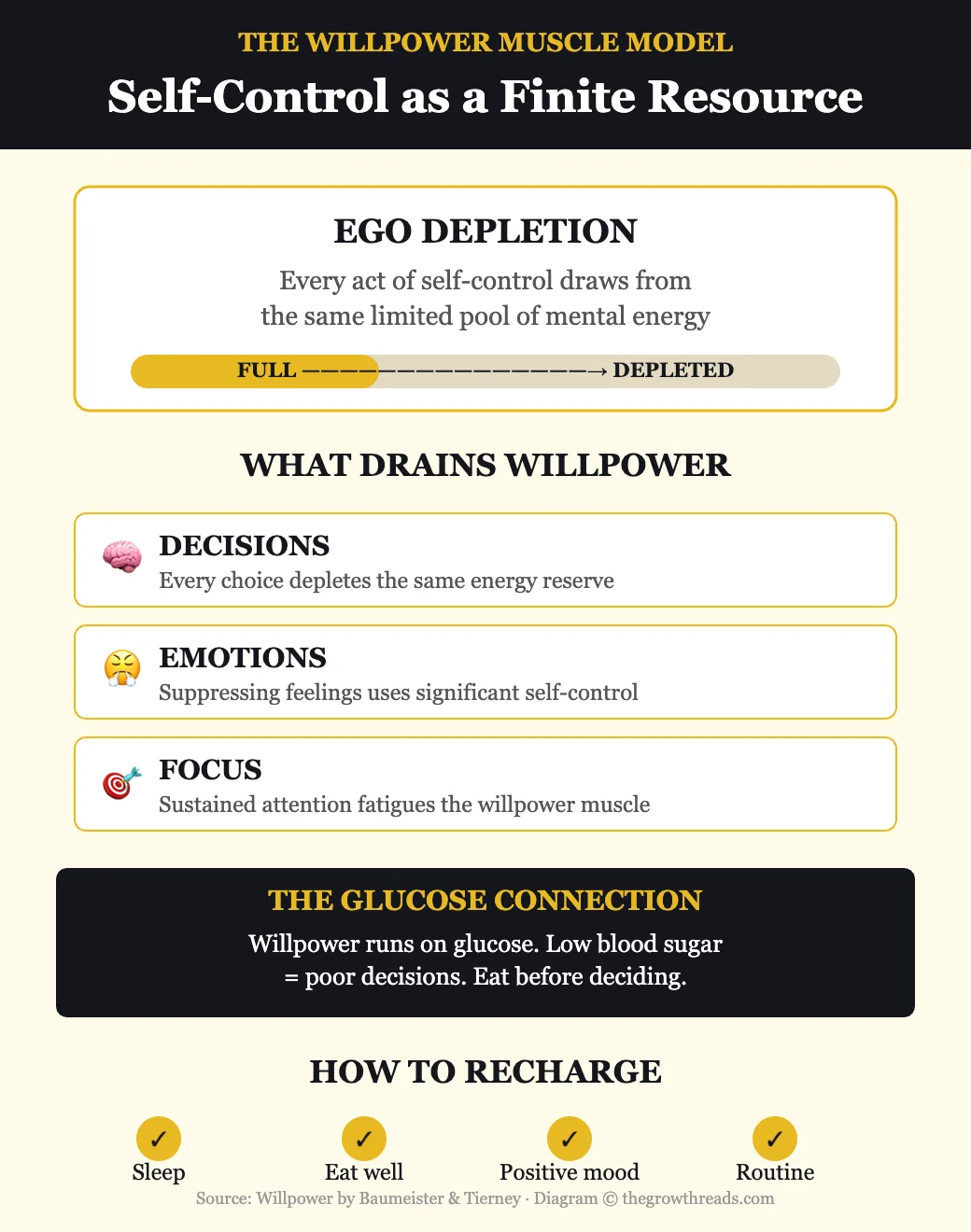
- Willpower is a finite resource: Laboratory experiments consistently show that exerting self-control on one task makes you worse at a subsequent, unrelated task. All self-control draws from one pool.
- Glucose fuels self-control: Brain scans and blood-glucose studies reveal that willpower literally runs on fuel. Low blood sugar produces poor decisions, increased aggression, and reduced persistence.
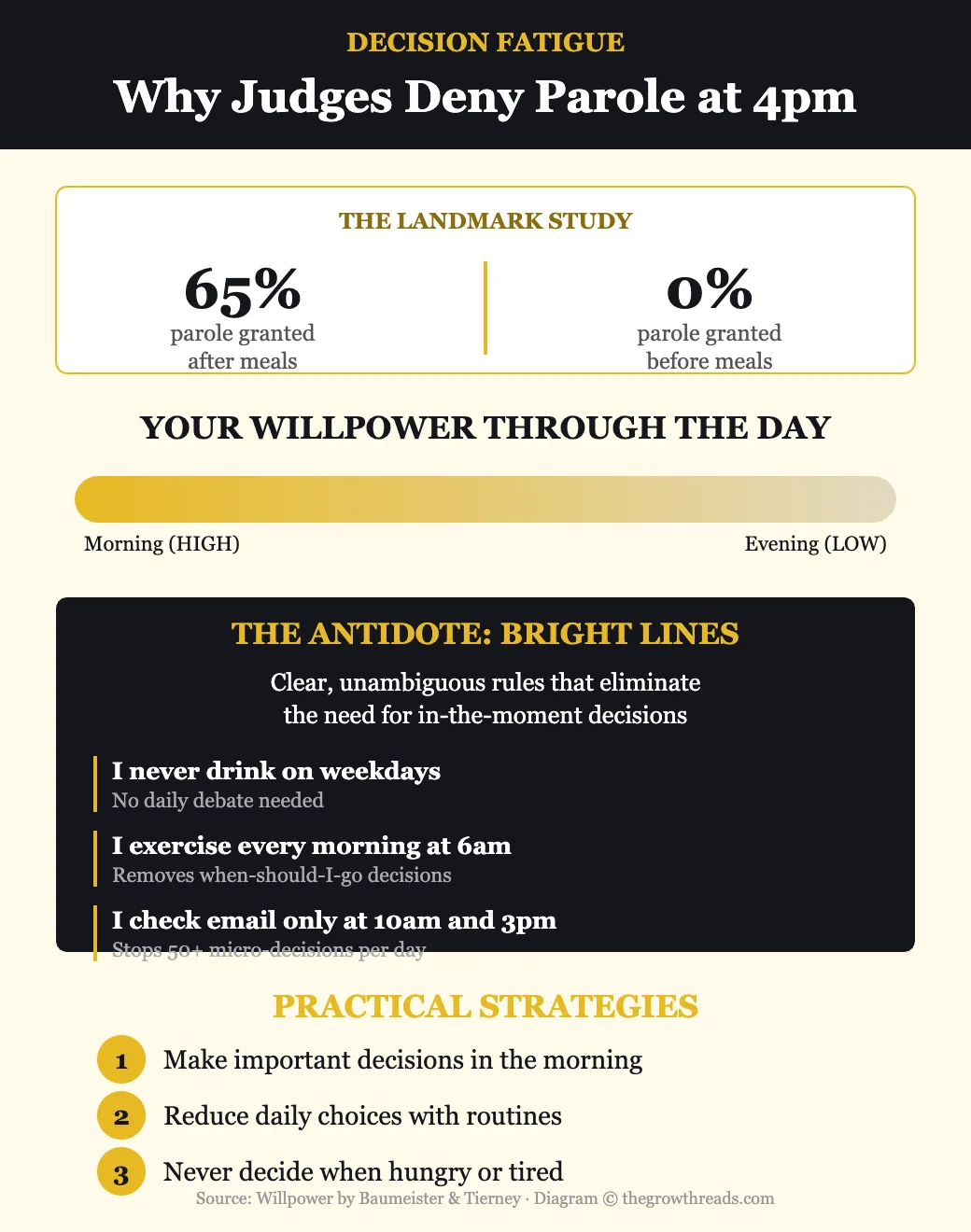
- Decision fatigue is real: Judges grant parole 65% of the time after meals and nearly 0% before them. Every decision — even trivial ones — depletes the same resource used for important choices.
- Self-monitoring is the most effective strategy: People who track their behavior — food diaries, expense logs, time tracking — consistently outperform those who rely on willpower alone.
- Precommitment beats willpower: The best strategy is to eliminate the need for self-control altogether. Automatic savings, public pledges, and removing temptations from your environment all work.
- Bright-line rules eliminate decision fatigue: Unambiguous rules like “I never drink on weekdays” require zero in-the-moment deliberation, saving willpower for decisions that actually matter.
- Small exercises build willpower capacity: Practicing self-control in minor areas — maintaining good posture, using your non-dominant hand, monitoring your speech — strengthens the muscle for bigger challenges.
- Orderly environments support self-control: Research shows that people in clean, organized spaces exhibit more self-control than those in messy ones. External order promotes internal order.
- Sleep is a willpower multiplier: Sleep deprivation devastates self-control. A well-rested brain has dramatically more willpower capacity than a tired one.
- Procrastination is a willpower failure with compounding costs: Putting off tasks does not save energy — it creates a persistent cognitive load (the Zeigarnik effect) that drains willpower continuously.
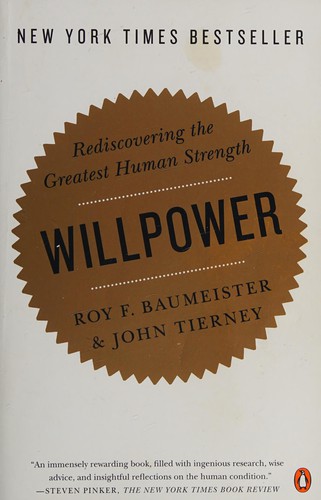
What is Willpower about?
Willpower synthesizes decades of experimental psychology to explain why self-control depletes like a muscle, how glucose and sleep fuel it, and what practical strategies — self-monitoring, precommitment, bright-line rules, and small daily exercises — can help you conserve and strengthen it for the decisions that matter most.
About the author
Roy F. Baumeister is a social psychologist and one of the most cited researchers in his field, with over 700 publications and an h-index that places him among the most influential living psychologists. He spent decades at Case Western Reserve University and Florida State University before moving to the University of Queensland. His research on ego depletion, self-regulation, and belongingness has shaped modern psychology. John Tierney is a longtime science columnist for The New York Times, known for translating complex research into accessible prose. Together, they bring both scientific rigor and narrative clarity to a subject that affects every decision people make. Explore all Roy F. Baumeister book summaries →
Key concepts at a glance
| Concept | What it means | Use it when |
|---|---|---|
| Ego Depletion | Self-control draws from a single, limited resource that diminishes with each use | You need to understand why you collapse on the couch after a hard day of decisions |
| Decision Fatigue | The deterioration of decision quality after a long session of making choices | You face important decisions late in the day and want to protect judgment quality |
| Bright-Line Rules | Unambiguous, non-negotiable rules that eliminate the need for in-the-moment willpower | You repeatedly fail at moderation and need a clear boundary instead |
| Precommitment | Locking in a choice before temptation arrives, like Ulysses tying himself to the mast | You know future-you will be tempted and want to remove the option now |
| Self-Monitoring | Systematically tracking your own behavior to improve it | You want the single highest-leverage willpower strategy |
| The Glucose Connection | Willpower runs on blood glucose; depletion leads to worse decisions | You need to time meals around important decisions |
| The Zeigarnik Effect | Unfinished tasks occupy mental bandwidth until completed or planned | You feel mentally drained despite not having done much — open loops are the culprit |
| Willpower Exercises | Small daily self-control tasks that build overall willpower capacity | You want to grow your self-control over weeks and months |
Part 1: The science of ego depletion
Baumeister opens with the experiment that launched the field. Participants were placed in a room with freshly baked cookies and radishes. Half were told to eat only the radishes while resisting the cookies. Both groups then attempted an unsolvable puzzle. The radish group gave up after eight minutes. The cookie group persisted for nineteen. The radish eaters had used up their self-control resisting the cookies, leaving nothing for the puzzle. This was the first demonstration of ego depletion.
Dozens of subsequent experiments confirmed the finding across domains. People who suppressed emotions performed worse on physical endurance tasks. People who resisted impulse purchases made poorer dietary choices afterward. People who maintained a cheerful facade during a frustrating task were more aggressive in the next one. The implication was startling: all forms of self-control — resisting temptation, managing emotions, forcing attention, making decisions — draw from the same limited reserve.
The biological basis turns out to be glucose. Baumeister’s team measured blood-glucose levels before and after self-control tasks and found consistent drops. When they gave depleted participants a glucose drink (not an artificially sweetened one), their self-control recovered. This is not metaphorical — willpower literally runs on fuel. The brain, which represents about 2% of body weight, consumes roughly 20% of the body’s energy, and self-control tasks increase its glucose consumption measurably.
Part 2: Decision fatigue and the planning trap
The most striking application of ego depletion research is decision fatigue. Baumeister and Tierney present the Israeli parole board study: judges granted parole about 65% of the time right after eating but close to 0% just before meals. The pattern was consistent across judges, case types, and ethnicities of prisoners. The explanation was not bias — it was depletion. After hours of making difficult decisions, judges defaulted to the safest option: deny parole.
This has profound implications. Every decision you make — what to wear, what to eat for breakfast, whether to reply to an email, which route to drive — draws from the same pool you need for important choices about your career, relationships, and health. This is why successful decision-makers from Barack Obama to Steve Jobs famously limited their daily wardrobe choices. It is not pretentiousness — it is willpower management.
The Zeigarnik effect compounds the problem. Unfinished tasks sit in working memory, consuming cognitive resources continuously. Simply having an unfinished to-do list drains willpower even when you are not actively working on it. Baumeister found that making a specific plan for when and how you will complete a task releases it from working memory — the brain treats a plan as a kind of completion. This is why David Allen’s Getting Things Done methodology works: capturing every open loop frees cognitive resources.
Part 3: Strategies that actually work
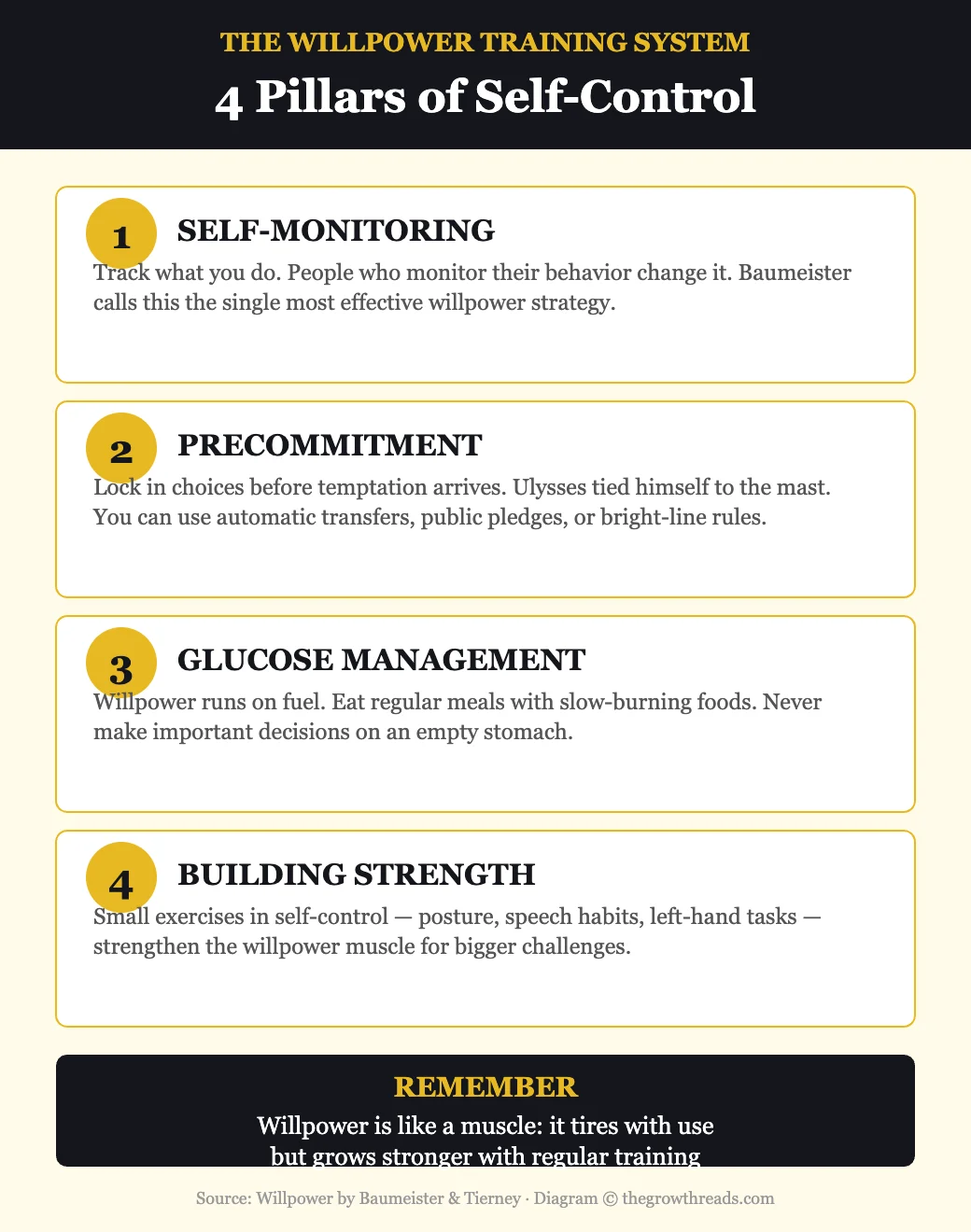
The practical heart of the book introduces four strategies backed by Baumeister’s research. The first and most powerful is self-monitoring. Study after study shows that simply tracking a behavior improves it. Food diaries help people lose weight — not because the diary offers advice, but because the act of recording creates awareness. Financial tracking reduces spending. Time logs improve productivity. Baumeister calls this the closest thing to a free lunch in self-improvement.
The second strategy is precommitment — what the authors call the Ulysses approach. Before facing temptation, you remove the option. Automatic savings transfers prevent spending decisions. Website blockers prevent social media binges. Telling friends about a goal creates social accountability that costs more to break than the temptation is worth. The key is that precommitment happens when willpower is high (planning phase) and protects you when willpower is low (execution phase).
Third are bright-line rules. Unlike flexible guidelines (“I’ll try to eat less sugar”), bright-line rules are binary and non-negotiable (“I never eat dessert on weekdays”). The power is that they eliminate deliberation entirely. You do not spend willpower debating whether this particular brownie is an acceptable exception. The rule is clear. Research on dieters, alcoholics, and productivity habits consistently shows that bright-line rules outperform flexible moderation.
Fourth, Baumeister presents evidence that willpower can be trained through small exercises. Participants who practiced using their non-dominant hand for routine tasks, or who committed to speaking in complete sentences without slang, showed improved self-control on entirely unrelated tasks weeks later. The willpower muscle had grown stronger through targeted exercise.
Part 4: Willpower in real life
The final section applies the science to common challenges: dieting, parenting, work productivity, addiction, and financial management. On dieting, Baumeister is blunt — restrictive diets fail because they create a double drain on willpower. You use self-control to resist food while simultaneously depleting the glucose that fuels self-control. This biological catch-22 explains why dieters are statistically likely to regain lost weight. His recommendation: eat regular, planned meals with slow-burning carbohydrates that maintain stable glucose levels, and never attempt a restrictive diet during a period of high stress or high decision load.
On parenting, the authors discuss the Quantified Self approach to child-rearing, showing that children develop stronger self-regulation when given clear rules (bright lines), consistent monitoring, and warm encouragement for self-control successes. They cite longitudinal studies tracking children’s self-control at age four and finding it predictive of academic success, financial stability, and health outcomes decades later.
The most actionable chapter covers orderliness. Baumeister presents research showing that people in clean, organized environments consistently demonstrate more self-control, generosity, and persistence than those in messy ones. The external environment either supports or undermines the internal environment. This is why decluttering feels productive — it literally increases your willpower capacity by reducing the cognitive friction of disorder.
Who is Willpower best for — and who should read something else first?
This book is ideal for people who want to understand the science behind why self-control fails and what to do about it structurally. It is particularly valuable for professionals who make many decisions daily, anyone struggling with procrastination or evening snacking, and parents who want to help children build self-regulation. The research density gives it credibility that lighter habit books lack.
If you want a more action-oriented habit system with less research narration, start with Atomic Habits. If your primary challenge is focus and distraction rather than willpower, Deep Work is more targeted. And if you want the simplest possible entry point to behavior change, Tiny Habits by BJ Fogg requires no willpower at all — by design.
Questions to reflect on
- At what time of day do you consistently make your worst decisions — and are you scheduling important choices for your best hours?
- Which areas of your life drain the most willpower through repeated small decisions that could be automated or eliminated?
- Do you have bright-line rules in any area of your life, or do you rely on flexible moderation that requires constant deliberation?
- What unfinished tasks are sitting in your mental working memory right now, draining cognitive resources in the background?
- Could you design a small daily willpower exercise — like maintaining posture or tracking one metric — to build your self-control capacity?
🔥 Ready to understand and strengthen your self-control?
Learn the science of willpower and the practical strategies to make it work for you — not against you.
How to apply Willpower (7-day plan)
- Day 1 — Audit your decision load: Write down every decision you make today, from trivial (what to wear) to significant (work priorities). Count them. Identify the five most draining ones that could be automated or pre-decided.
- Day 2 — Create three bright-line rules: Pick three areas where you repeatedly struggle with moderation. Replace each with a non-negotiable binary rule. Write them down and commit for one week.
- Day 3 — Schedule decisions by energy: Move your most important decisions and creative work to your peak willpower hours (usually morning). Relegate routine tasks and email to afternoon. Protect your morning slot fiercely.
- Day 4 — Start self-monitoring: Choose one behavior to track — spending, food, screen time, or exercise. Use a simple notebook or app. Record without judgment. The act of tracking is the intervention.
- Day 5 — Close your open loops: Write down every unfinished task sitting in your mental workspace. For each one, make a specific plan: what, when, and where you will complete it. Notice the mental relief that comes from planning, even before doing.
- Day 6 — Set up precommitments: Identify your biggest willpower challenge. Design a precommitment: remove temptation from your environment, set up an automatic system, or make a public commitment to someone who will hold you accountable.
- Day 7 — Begin willpower training: Choose one small daily exercise in self-control — maintaining good posture, using your non-dominant hand for a routine task, or speaking in complete sentences. Practice it for two weeks and observe whether your overall self-control improves.
Frequently asked questions
Is willpower really like a muscle?
Baumeister’s research strongly supports the muscle analogy in two ways. First, willpower fatigues with use — exerting self-control on one task measurably reduces performance on subsequent tasks, a phenomenon called ego depletion confirmed in hundreds of experiments. Second, willpower can be strengthened through exercise — participants who practiced small self-control tasks for two weeks showed improved performance on unrelated willpower tests. The analogy is not perfect, but it captures the core dynamics of depletion and growth.
Has the ego depletion theory been debunked?
Some replication studies in the mid-2010s produced mixed results, sparking a scientific debate. A large multi-lab replication in 2016 found a smaller effect than originally reported. Baumeister and others have responded with additional research and methodological critiques of the replication attempts. The current scientific consensus is nuanced: ego depletion appears to be a real phenomenon, but its magnitude may be smaller and more context-dependent than early studies suggested. The practical advice in the book remains useful regardless of the exact effect size.
Does willpower really run on glucose?
Baumeister presents multiple studies showing that self-control tasks deplete blood glucose and that replenishing glucose restores performance. The relationship appears genuine but may be more complex than a simple fuel model. Later research suggests that the brain’s glucose needs during self-control tasks are small in absolute terms, and that the psychological perception of depletion may matter as much as the biological reality. The practical takeaway remains sound: eating regular meals with stable blood sugar supports better decision-making.
What is the best way to build willpower?
According to Baumeister, the most effective approach combines four strategies: self-monitoring (tracking your behavior creates awareness and accountability), precommitment (removing temptation before it arrives), bright-line rules (eliminating the need for in-the-moment decisions), and small exercises (practicing minor acts of self-control to build the muscle). Of these, self-monitoring is consistently the highest-leverage single strategy across research studies.
How is Willpower different from Atomic Habits?
Willpower is a science book that explains the psychology and biology of self-control, focusing on why we fail and what depletes us. Atomic Habits is a practical system for building habits through environment design, identity change, and the four laws of behavior change. Baumeister provides the theoretical foundation; Clear provides the tactical playbook. Reading both gives you a complete picture — the why and the how of lasting behavior change.
What is decision fatigue?
Decision fatigue is the decline in decision quality that occurs after a long session of making choices. Baumeister’s research shows that the mental energy used to make decisions comes from the same pool as willpower. After many decisions, people either make impulsive choices (acting without thinking) or default to the status quo (avoiding any decision at all). The Israeli parole board study — where judges granted parole 65% of the time after meals and nearly 0% before — is the most dramatic demonstration of this effect.
Can you increase your willpower permanently?
Baumeister’s research suggests that willpower capacity can be increased through training, much like physical strength. Participants who practiced small self-control exercises — using their non-dominant hand, maintaining posture, monitoring speech patterns — showed improved self-control on completely unrelated tasks after two weeks. However, the trained muscle still depletes with use. You can increase the size of your willpower tank, but you cannot make it infinite. The practical strategy is both to build capacity and to reduce unnecessary drains.
Related summaries
If you found Willpower valuable, explore these related summaries:
- Atomic Habits by James Clear — the practical system for building habits that Willpower’s science explains.
- Deep Work by Cal Newport — how to protect your focus and do cognitively demanding work in a distracted world.
- The Power of Habit by Charles Duhigg — the neuroscience of the cue-routine-reward loop that drives automatic behavior.
- 📚 Browse all productivity book summaries
Related Productivity Summaries
Great at Work Summary & Review: The Hidden Habits of Top Performers
Slow Productivity Summary & Review: The Case for Doing Fewer Things Better
The 7 Habits of Highly Effective People Summary & Review: The Principles That Still Define Effectiveness
The Now Habit Summary & Review: A Strategic Program for Overcoming Procrastination
The Power of Full Engagement Summary & Review: Manage Energy, Not Time