

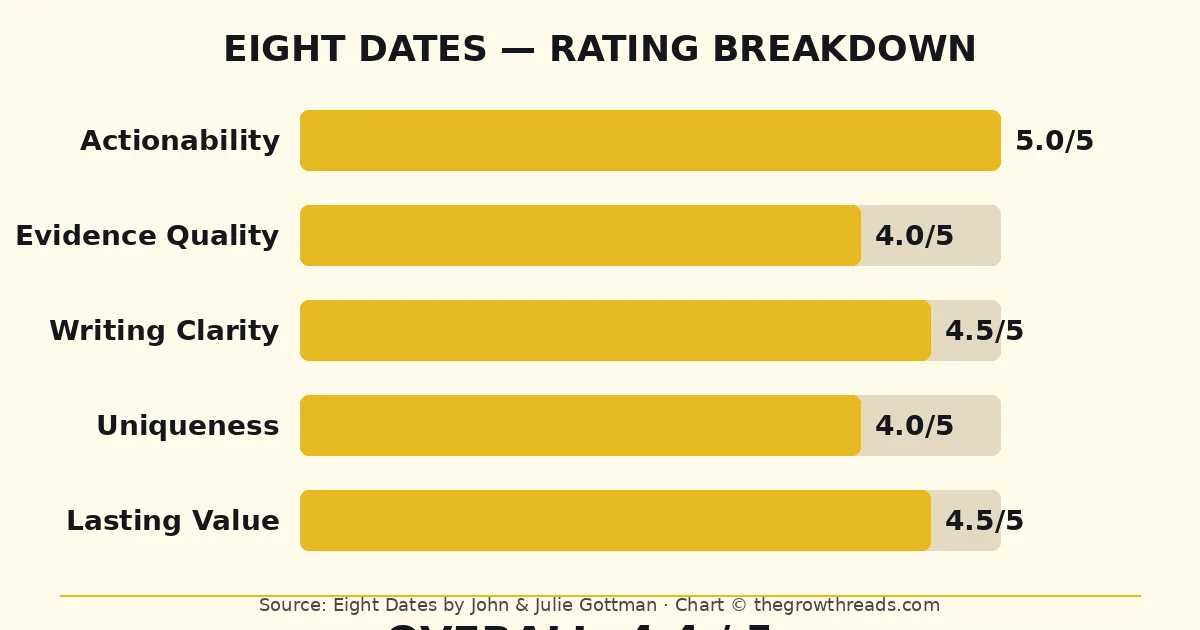
⭐⭐⭐⭐✬ 4.4 / 5
A structured, research-backed guide to the eight conversations every couple needs to have — with exact questions, practical frameworks, and 40+ years of relationship science behind them.
Best for: Couples at any stage who want to deepen connection and tackle difficult topics with a proven framework instead of avoiding them.
Reading time: ~5 hours (256 pages)
Difficulty to apply: Low — the book is designed to be done together, one date at a time, with all the questions provided.
Eight Dates in one minute
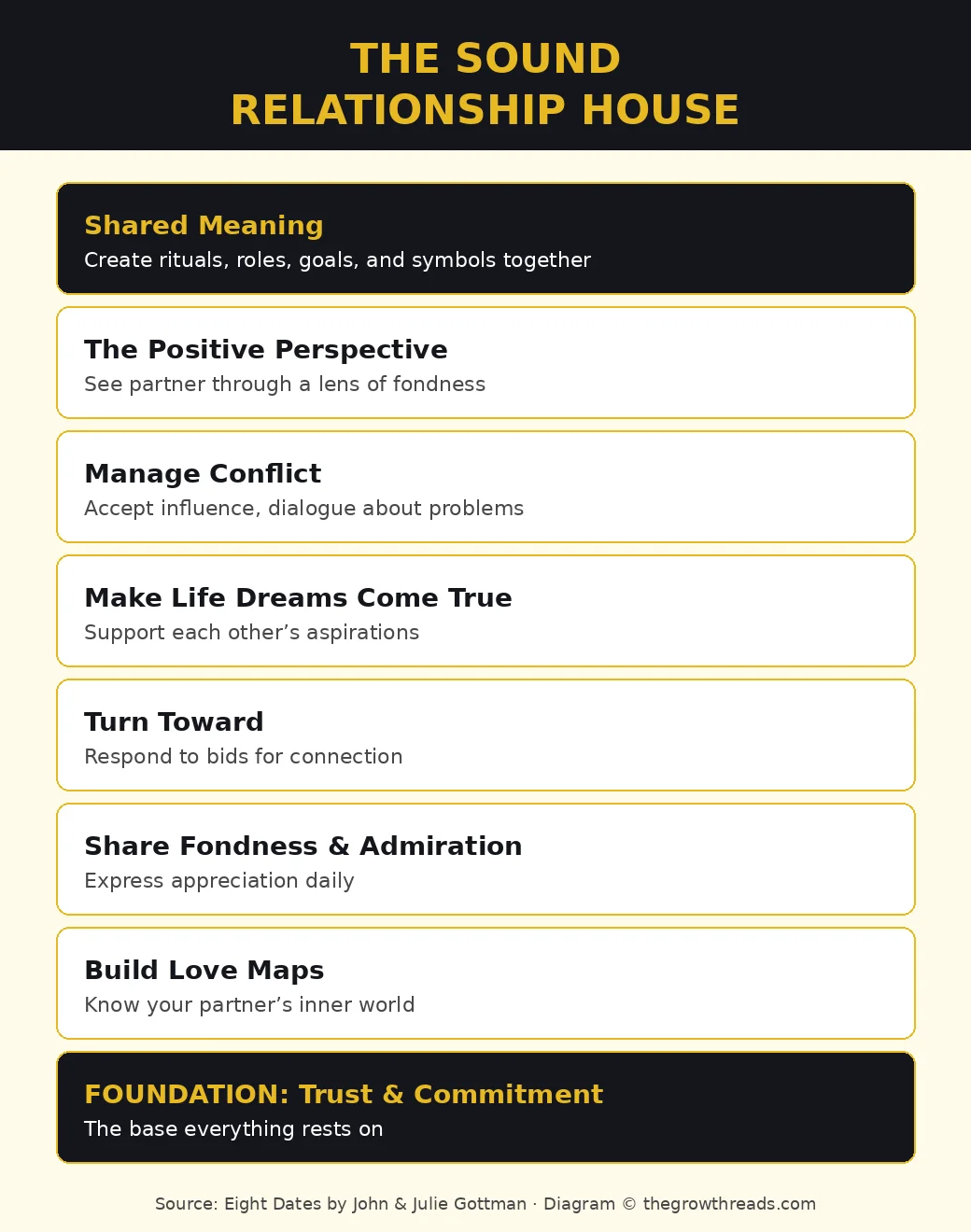
Most couples never have the conversations that actually matter — until a crisis forces them to. John and Julie Gottman, the world’s leading relationship researchers, distilled four decades of studying thousands of couples into eight essential conversations that separate thriving partnerships from struggling ones. Each chapter focuses on one topic — trust, conflict, sex, money, family, fun, growth, and dreams — and provides specific open-ended questions designed to deepen understanding rather than spark arguments. The book is not a passive read; it is an interactive experience designed to be done together over eight dedicated date nights. The Gottmans’ research shows that couples who regularly engage in structured, vulnerable conversations build what they call a “Sound Relationship House” — a foundation of trust, admiration, and shared meaning that can weather any storm.
Key takeaways
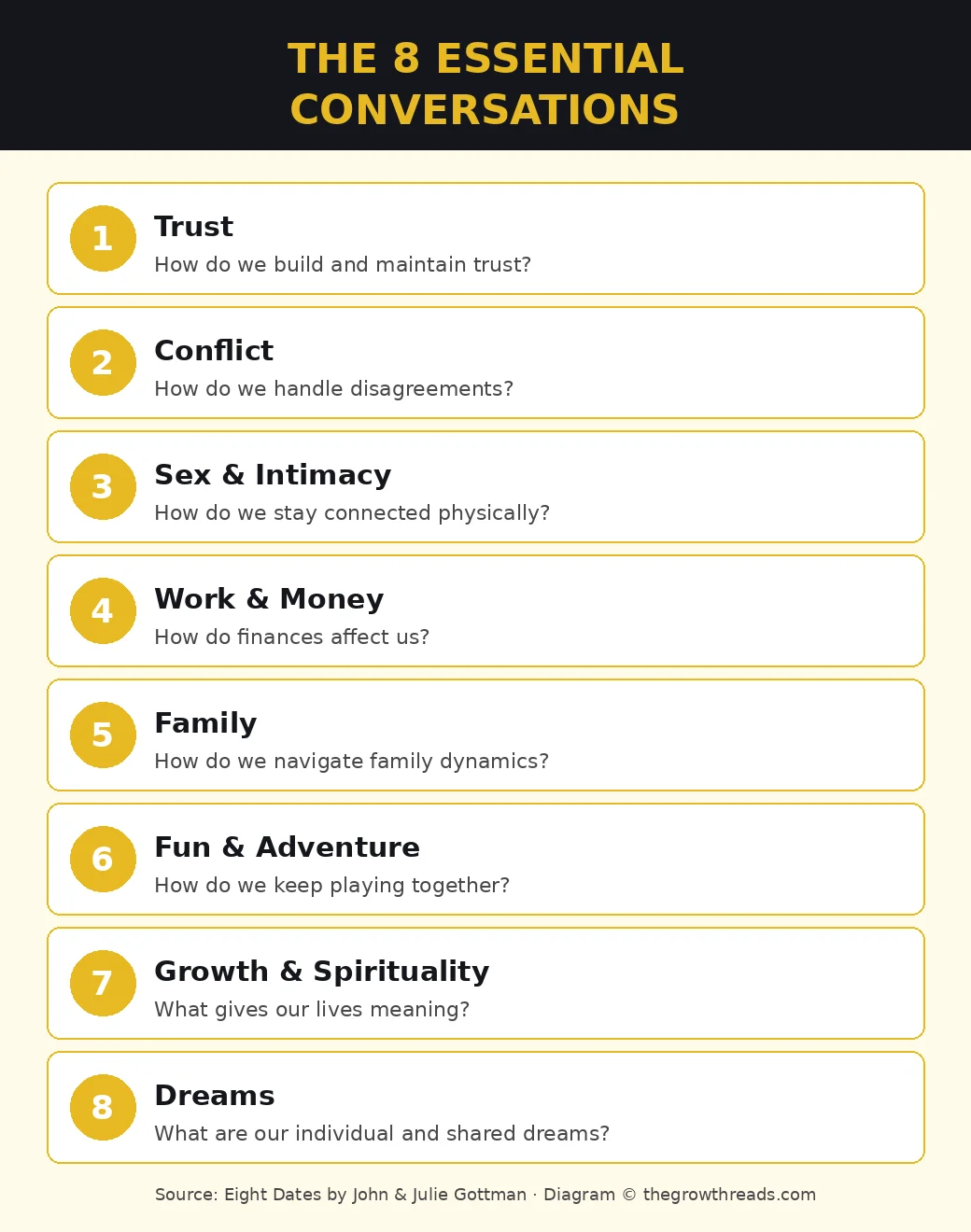
- Eight conversations cover everything: Trust, conflict, sex and intimacy, work and money, family, fun and adventure, growth and spirituality, and dreams. These eight topics encompass the areas where couples most commonly disconnect.
- Questions are more powerful than answers: The Gottmans provide open-ended questions for each date specifically designed to create understanding, not debate. The goal is curiosity, not problem-solving.
- Love maps are the foundation: Knowing your partner’s inner world — their fears, dreams, stresses, and joys — is the single best predictor of relationship longevity.
- Bids for connection define everything: In Gottman’s research, couples who stay together respond positively to each other’s bids for attention 86% of the time. Couples who divorce respond only 33% of the time.
- Conflict is not the problem; avoidance is: Every couple has perpetual problems that never fully resolve. The difference between happy and unhappy couples is whether they can dialogue about those problems with humor and affection.
- Rituals of connection matter: Small daily practices — a six-second kiss, a stress-reducing conversation at the end of the day — build more lasting connection than grand romantic gestures.
- Sex requires ongoing conversation: Physical intimacy is not a static need — it changes over a lifetime. Couples who talk about sex have better sex.
- Shared meaning gives relationships purpose: The strongest couples create a shared narrative — rituals, inside jokes, values, and goals — that gives their partnership meaning beyond logistics.
- Dreams within conflict: Behind every entrenched position in a recurring argument is an unfulfilled dream. Understanding the dream behind your partner’s position transforms gridlock into dialogue.
- Date nights are not optional: Regular, intentional time together is not a luxury — it is preventive maintenance for the relationship.
What is Eight Dates about?
Eight Dates is a practical relationship guide that provides eight structured date-night conversations — each backed by the Gottmans’ research on thousands of couples — covering trust, conflict, intimacy, money, family, fun, spirituality, and dreams, with specific questions designed to deepen understanding and connection.
About the authors
John Gottman and Julie Schwartz Gottman are the co-founders of The Gottman Institute and the most widely cited relationship researchers in the world. John, a professor emeritus at the University of Washington, spent over 40 years studying couples in his “Love Lab” — a research apartment where he observed and measured couples’ interactions, physiological responses, and communication patterns. His research can predict with over 90% accuracy whether a couple will stay together or divorce based on a 15-minute conversation. Julie is a clinical psychologist who co-developed the Gottman Method of couples therapy, now practiced by therapists in over 50 countries. Together they have written numerous books, including The Seven Principles for Making Marriage Work, and have trained tens of thousands of therapists worldwide.
Key concepts at a glance
| Concept | What it means | Use it when |
|---|---|---|
| Love maps | A detailed mental model of your partner’s inner world | You realize you cannot name your partner’s current biggest worry |
| Bids for connection | Any attempt to get your partner’s attention, affection, or engagement | You notice yourself or your partner turning away from small moments |
| Turning toward | Responding positively to a bid for connection instead of ignoring or dismissing it | Your partner says something and you are tempted to keep scrolling |
| Perpetual problems | The ~69% of relationship conflicts that never fully resolve | You keep having the same argument about the same thing |
| Dreams within conflict | The unfulfilled hopes or values behind a partner’s rigid position | You are stuck in gridlock and cannot understand why your partner will not budge |
| Four Horsemen | Criticism, contempt, defensiveness, and stonewalling — the four destructive communication patterns | Arguments escalate quickly and leave both people feeling worse |
| Sound Relationship House | A model of the seven components of a healthy relationship, from love maps to shared meaning | You want a framework for understanding which areas of your relationship need attention |
| Rituals of connection | Small, repeated practices that maintain the emotional bond | You feel disconnected but cannot point to a single big problem |
Part 1 — Trust and conflict: the foundation dates
The first two dates tackle the topics most couples instinctively avoid: trust and conflict. The trust conversation is not about suspicion or jealousy — it is about understanding what trust means to each partner at a fundamental level. The Gottmans define trust not as the absence of betrayal but as the ongoing choice to prioritize your partner’s needs alongside your own. They call this “sliding door moments” — the hundreds of small decisions each day where you choose to turn toward or away from your partner. Over time, these micro-decisions determine whether trust is built or eroded.
The questions for the trust date are designed to surface unspoken assumptions: “What makes you feel I’ve got your back?” “When in your life did you feel most betrayed, and what did that teach you about trust?” “What does commitment mean to you?” The power of these questions is that they replace the abstract concept of trust with specific, concrete behaviors each partner can understand and act on.
The conflict date is built on the Gottmans’ most counterintuitive finding: 69% of relationship conflicts are perpetual — they never fully resolve. Couples fight about the same issues for decades because these disagreements are rooted in fundamental personality differences and values. The difference between happy and unhappy couples is not whether they have these conflicts but how they handle them. Happy couples can talk about their perpetual problems with humor, affection, and acceptance. Unhappy couples let perpetual problems become gridlocked — each partner digs in, and the issue becomes a source of emotional flooding rather than dialogue.
Part 2 — Sex, money, and family: the uncomfortable dates
The middle dates address the topics couples report as the most difficult to discuss: sex, money, and family. The Gottmans note that the discomfort itself is the point — avoiding these conversations does not make the underlying issues disappear; it just pushes them underground where they cause resentment and disconnection.
The sex and intimacy date is handled with unusual directness for a relationship book. The Gottmans acknowledge that physical intimacy changes over a relationship’s lifetime — desire fluctuates, bodies change, and the scripts that worked early in a relationship often stop working. The questions are designed to create a safe space for honesty: “What did you learn about sex growing up?” “What do you enjoy most about our physical relationship?” “Is there something you have been curious about but hesitant to bring up?” They emphasize that the conversation itself — the willingness to be vulnerable — often improves intimacy more than any specific technique.
The money conversation is not about budgeting. It is about understanding each partner’s emotional relationship with money — which, like the “money narrative” concept in other financial books, is shaped by childhood experiences and rarely examined. Some people grew up in households where money meant security; others grew up where it meant control or conflict. These invisible scripts drive spending and saving behaviors that partners often misinterpret as character flaws rather than learned patterns. The Gottmans provide questions that surface these narratives without triggering defensiveness.
The family date addresses one of the most common sources of relationship stress: navigating in-laws, parenting disagreements, and the tension between the family you came from and the family you are building. The Gottmans’ research shows that couples who establish clear boundaries with their families of origin while maintaining respect and connection have significantly higher relationship satisfaction.
Part 3 — Fun, growth, and dreams: the aspirational dates
The final three dates shift from problem areas to possibility. The fun and adventure date is based on a finding that surprises many couples: novelty and play are not luxuries but necessities for relationship health. The Gottmans’ research shows that couples who regularly try new experiences together maintain higher levels of attraction and satisfaction than those who fall into comfortable routines. The questions here are designed to rediscover what drew you together — and what might reignite that spark: “When was the last time we laughed together until we cried?” “What adventure have you always wanted to try?” “How can we make more room for play?”
The growth and spirituality date is not about religion — it is about meaning. The Gottmans define spirituality broadly as anything that connects you to something larger than yourself: nature, art, community, purpose, or faith. This conversation explores what gives each partner’s life meaning and how the relationship supports or hinders that sense of purpose. For many couples, this is the first time they have explicitly discussed what their lives are for, beyond the daily logistics of work, bills, and children.
The dreams date is the culmination. The Gottmans argue that behind every recurring conflict is an unfulfilled dream — a hope, value, or aspiration that feels threatened. When couples understand the dream behind their partner’s position, gridlocked arguments transform into conversations about what each person most deeply needs. The questions in this chapter help partners articulate dreams they may have never voiced: “What did you dream about becoming when you were a child?” “Is there a dream you have given up on that still matters to you?” “What is one dream we could pursue together?”
Part 4 — Making it work: the ritual of connection
The final section addresses the practical reality of implementing eight intentional conversations into a busy life. The Gottmans recommend one date every two weeks, completing the full cycle in about four months — but they emphasize that the sequence and pacing should adapt to each couple’s needs. Some couples will want to start with the easier conversations (fun, dreams) to build momentum. Others will want to tackle the hardest topics (conflict, sex) first because the avoidance is causing active damage.
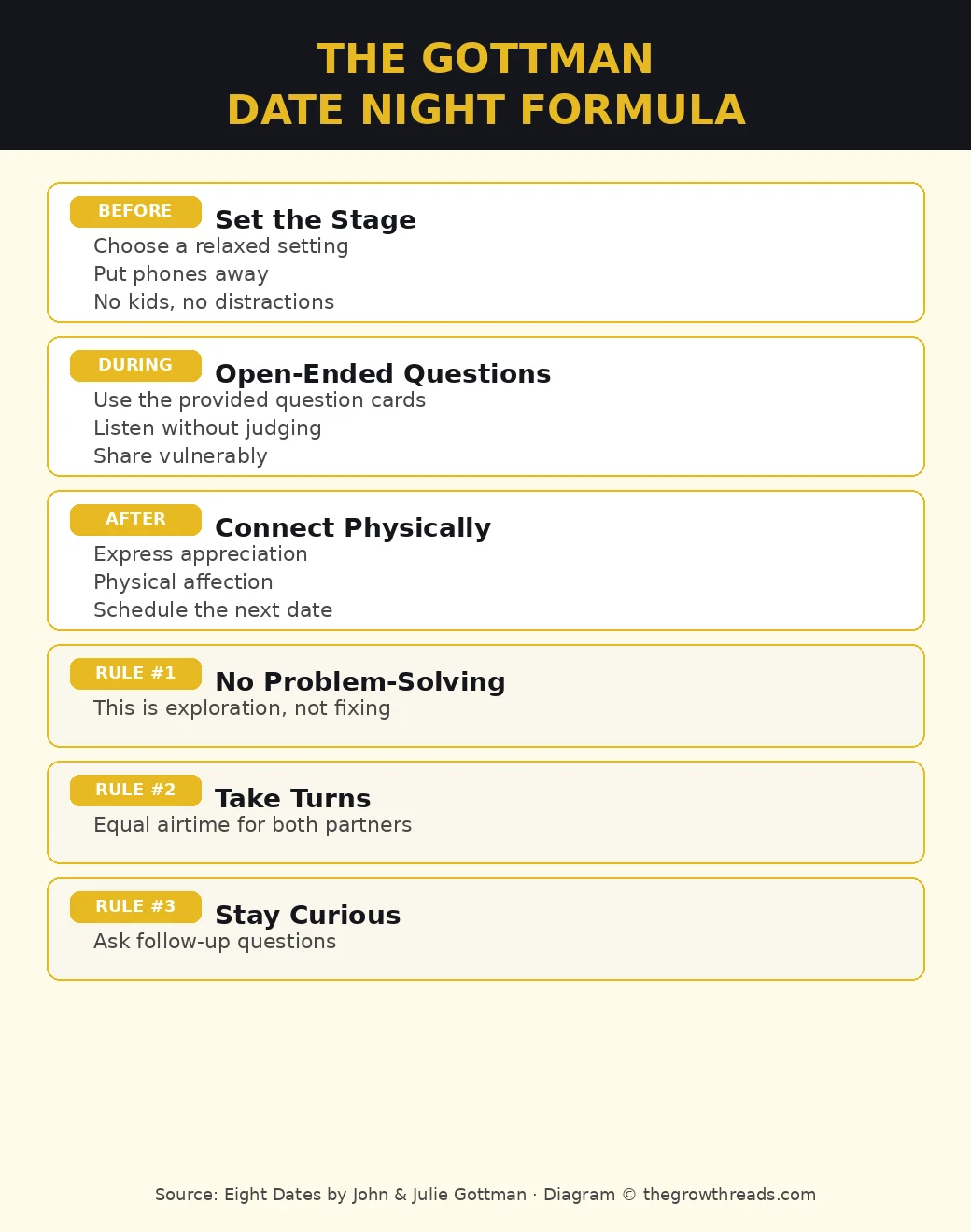
Each date follows a simple structure: choose a relaxed setting outside the home, put phones away, use the provided questions as conversation starters, take turns sharing and listening, and end with physical affection and a commitment to schedule the next date. The Gottmans are specific about the rules: no problem-solving during the date (this is exploration, not fixing), equal airtime for both partners, and genuine curiosity about your partner’s answers even if you think you already know what they will say. The research behind these rules is clear — couples who approach conversations with curiosity rather than certainty maintain higher levels of connection and lower levels of defensiveness.
Who is Eight Dates best for — and who should read something else first?
Eight Dates is perfect for couples who want a structured way to have meaningful conversations without it feeling like therapy. It works for new couples building a foundation, established couples looking to reconnect, and engaged couples preparing for marriage. The book’s greatest strength is its accessibility — you do not need to be in crisis to benefit, and the date-night format makes it feel like an experience rather than homework.
If your relationship is in serious distress — constant contempt, emotional abuse, or one partner has already checked out — this book alone may not be enough. Start with Hold Me Tight by Sue Johnson for deeper attachment repair, or seek a Gottman-trained therapist. If you want the full theoretical foundation behind the research, The Seven Principles for Making Marriage Work provides the comprehensive framework that Eight Dates distills into practice.
Questions to reflect on
- When was the last time you and your partner had an intentional, phone-free conversation about something other than logistics?
- Of the eight topics — trust, conflict, sex, money, family, fun, growth, dreams — which one do you most actively avoid? What would happen if you explored it together?
- Can you name your partner’s three biggest current worries and their most important unfulfilled dream?
- When your partner reaches out for connection — a question, a touch, a look — what percentage of the time do you genuinely turn toward them versus turning away?
- Is there a recurring argument in your relationship where understanding the dream behind your partner’s position might change everything?
🔥 Ready to have the conversations that will transform your relationship?
Eight Dates gives you the exact questions, the research-backed framework, and a practical plan to build deeper connection — one date at a time.
How to apply Eight Dates (7-day plan)
- Day 1 — Update your love map: Write down your partner’s three biggest current stresses, their favorite way to unwind, and one dream they have mentioned recently. Then ask them how accurate you were.
- Day 2 — Notice bids for connection: For one full day, pay attention to every time your partner makes a bid — a comment, a question, a touch — and consciously turn toward each one.
- Day 3 — Schedule your first date: Pick a day and location for Date 1 (Trust). Block the time, arrange childcare if needed, and commit to leaving phones in the car.
- Day 4 — Review the Four Horsemen: Read the descriptions of criticism, contempt, defensiveness, and stonewalling. Identify which one you are most likely to use and which antidote you can practice.
- Day 5 — Start a daily ritual: Introduce one small ritual of connection — a six-second kiss when reuniting, a 20-minute stress-reducing conversation at the end of the day, or a weekly appreciation check-in.
- Day 6 — Identify your perpetual problems: Write down the arguments you keep having. Consider: what dream might be behind your partner’s position?
- Day 7 — Go on Date 1: Have the Trust conversation using the book’s provided questions. Follow the rules: no problem-solving, take turns, stay curious.
Frequently asked questions
Do we need to do the dates in order?
The Gottmans recommend starting with the order in the book because it builds from foundational topics (trust, conflict) to more aspirational ones (dreams, growth). However, they acknowledge that some couples will benefit from starting with easier conversations to build momentum. If trust and conflict feel too heavy to begin with, start with fun and adventure or dreams, then circle back to the harder topics once you have established the practice of intentional conversation.
What if my partner will not do it?
The Gottmans address this directly: you cannot force engagement, but you can model it. Start by improving your own side of the relationship — turn toward bids more consistently, express fondness and admiration more often, and bring up one of the book’s questions casually rather than as a formal exercise. Many resistant partners become curious when they see the other person changing. If your partner is firmly opposed to any form of relationship work, a couples therapist can help navigate the resistance.
How is Eight Dates different from The Seven Principles?
The Seven Principles for Making Marriage Work is the Gottmans’ comprehensive research-based framework — it explains the science, provides the theory, and includes exercises. Eight Dates is the practical distillation — it takes the most important insights from decades of research and structures them into eight specific conversations you can have over dinner. Think of Seven Principles as the textbook and Eight Dates as the workbook. Both are valuable; Eight Dates is easier to start with because it gives you an immediate action plan.
Can unmarried or new couples use this book?
Absolutely. The Gottmans designed it for couples at any stage — from new relationships to decades-long marriages. For newer couples, the dates serve as a foundation-building exercise that surfaces important values and expectations early. Many premarital counselors recommend it as preparation for engagement. The only adjustment is that newer couples may not have enough history for some of the questions about recurring patterns — in that case, the forward-looking questions (dreams, values, boundaries) become the primary focus.
Is the sex conversation awkward?
The Gottmans acknowledge the awkwardness and designed the questions to ease into the topic gradually. They start with general questions about what each partner learned about intimacy growing up, then move to what each person currently enjoys, and finally to what they might want to explore. The format — a dedicated date with ground rules — makes it easier than bringing up sex randomly. Many couples report that simply having permission to discuss the topic openly is the most valuable part of the conversation.
What if we do all eight dates and still have problems?
Eight Dates is preventive and connective — it strengthens the foundation. If deeper issues persist — communication breakdowns, unresolved trauma, addiction, or betrayal — the book alone may not be sufficient. The Gottmans recommend seeking a Gottman-trained therapist for more intensive work. The Gottman Institute’s website has a directory of certified clinicians. The eight dates can complement therapy, but they are not a substitute for professional support when the situation requires it.
Is Eight Dates still relevant in 2026?
The Gottmans’ research is among the most replicated in psychology — their predictions of divorce have been validated across cultures and decades. The core topics (trust, conflict, intimacy, money, family, fun, meaning, dreams) are timeless relationship concerns that do not change with technology or culture. If anything, the book has become more relevant as digital distraction makes intentional, phone-free conversation increasingly rare. The eight topics will be relevant as long as people form partnerships.
Related summaries
- The Seven Principles for Making Marriage Work Summary — The Gottmans’ comprehensive research framework for building lasting relationships.
- Hold Me Tight Summary — Sue Johnson on attachment theory and emotionally focused therapy for couples.
- The 5 Love Languages Summary — Gary Chapman on understanding how your partner gives and receives love.
- Crucial Conversations Summary — Patterson et al. on handling high-stakes dialogue without damaging relationships.
📚 Explore the full Relationships collection
This summary is part of our best relationship books series — 39 in-depth reviews to help you communicate better, love deeper, and build lasting connections.
Related Relationships Summaries
How to Know a Person Summary & Review: The Art of Truly Seeing Others
I Hear You Summary & Review: The Validation Skill That Transforms Every Relationship
No More Mr Nice Guy Summary & Review: Why People-Pleasing Backfires
The Mastery of Love Summary & Review: Build Relationships Without Fear
Untamed Summary & Review: Stop Pleasing and Start Living as Your Truest Self